Editor’s Note:We are delighted to republish a column by Linda Ahnert, of Old Lyme, which celebrates this day of thankfulness.
If you say the name “Wilbur Cross” to Connecticut residents, they will most likely think of the parkway that bears his name.But older readers will recall that he was governor of our state for eight years—from 1931 to 1939, to be exact.
On Nov. 12, 1936, Wilbur Cross issued an eloquent Thanksgiving Proclamation, which has gone down in the annals of Connecticut history. Many generations of school children either were read the Proclamation in class or required to memorize it … or both!
For the benefit of those not familiar with his memorable words, we reprint them here:
Time out of mind at this turn of the seasons when the hardy oak leaves rustle in the wind and the frost gives a tang to the air and the dusk falls early and the friendly evenings lengthen under the heel of Orion, it has seemed good to our people to join together in praising the Creator and Preserver, who has brought us by a way that we did not know to the end of another year.In observance of this custom, I appoint Thursday, the twenty-sixth of November, as a day of Public Thanksgiving for the blessings that have been our common lot and have placed our beloved State with the favored regions of earth—for all the creature comforts: the yield of the soil that has fed us and the richer yield from labor of every kind that has sustained our lives—and for all those things, as dear as breath to the body, that quicken man’s faith in his manhood, that nourish and strengthen his spirit to do the great work still before him: for the brotherly word and act; for honor held above price; for steadfast courage and zeal in the long, long search after truth; for liberty and for justice freely granted by each to his fellow and so as freely enjoyed; and for the crowning glory and mercy of peace upon our land;—that we may humbly take heart of these blessings as we gather once again with solemn and festive rites to keep our Harvest Home.
It’s no wonder that Wilbur Cross knew how to use words.In 1889, he earned a Ph.D. in English literature from Yale.Before he became governor, he taught English at Yale, was a well-known literary critic, and wrote several books.
By 1941, just five years after Cross wrote about the “mercy of peace upon our land,” the United Sates would be fighting in World War II.
In 1976, another Connecticut governor—Ella Grasso—reissued the proclamation from 40 years earlier and called it a “masterpiece of eloquence.”
Today, Wilbur Cross’s words still stir our spirits.We are thankful that we live in this “favored region of earth” and for the freedoms that we enjoy.And, yes, we are grateful for the glory of the English language.
Editor’s Note: Seventeen years ago, our friend and former colleague at ‘Main Street News,’ Linda Ahnert of Old Lyme wrote a wonderful column for us about the first Thanksgiving and how it evolved into a national holiday. As Thanksgiving is almost upon us, we are delighted to republish it here.
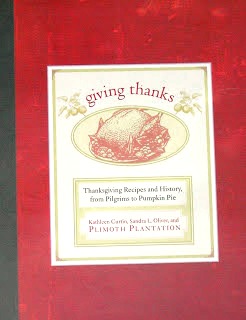
On this Thursday, Nov. 28, Americans from sea to shining sea will be sitting down to a turkey dinner. During these politically polarized times, this is something we can agree on—we all love Thanksgiving! Which is why I am grateful to re-read “Giving Thanks: Thanksgiving Recipes and History, from Pilgrims to Pumpkin Pie.” This book by Kathleen Curtin, Sandra L. Oliver, and Plimoth Plantation is a fascinating look at how an autumnal feast evolved into a “quintessential American holiday.”
And since this article was first published, The Plimoth Plantation has changed its name to Plimoth Patuxet Museums. Its mission is to tell the story of the English colonists in Plymouth, Mass. and the native peoples who lived there. So in 2020 the new name was adopted because it better reflects the multicultural history that is the essence of the museum’s mission.
After all, wasn’t this what we first learned about Thanksgiving in grade school? It was the story of the Pilgrims and Indians breaking bread together. And what is better than people sharing a good meal?
Read on to find out what was really on the menu that first Thanksgiving in 1621 and learn how this fall feast evolved into a national holiday.
Who Doesn’t Love Thanksgiving?
In 2005 a book entitled “Giving Thanks: Thanksgiving Recipes and History, from Pilgrims to Pumpkin Pie” was published. The co-authors are Kathleen Curtin, food historian at The Plimoth Plantation, Mass., and Sandra L. Oliver, food historian and publisher of the newsletter “Food History News.”
The book is a fascinating look at how an autumnal feast evolved into a “quintessential American holiday.”
Most Americans, introduced to the story of the Pilgrims and Indians during childhood, assume there is a direct link between the traditional holiday menu and the first Thanksgiving. But we learn from the book that many of those food items—such as mashed potatoes and apple pie—were simply impossible in Plymouth, Mass., in 1621. Potatoes were not introduced to New England until much later and those first settlers did not yet have ovens to bake pies.
What we do know about the bill of fare at the first celebration in 1621 comes from a letter written by colonist Edward Winslow to a friend in England: “Our harvest being gotten in, our governor sent four men on fowling, that so we might after a special manner rejoice together after we had gathered the fruit of our labors.”
Later 90 Indians joined the party with “their great king Massasoit whom for three days we entertained and feasted.” Then the Indians “went out and killed five deer which they brought to the plantation.”
So venison was a principal food on the menu. It also seems safe to assume that mussels, clams, and lobsters (all in plentiful supply) were served as well. According to other journals of the colonists, the “fowl” that Winslow described were probably ducks and geese. But wild turkeys were also bountiful in 1621, and so it is very likely that they were on the Pilgrims’ table. Thank goodness for that.
Throughout the New England colonies, it became common to proclaim a day of thanksgiving sometime in the autumn. In period diaries, there are many descriptions of food preparation—such as butchering and pie baking—followed by the notation that “today was the general thanksgiving.”
By the 19th century, Americans were taking the idea of a “thanksgiving” to a whole new level. The religious connotations were dropping away in favor of a holiday celebrating family and food. Roast turkey had become the centerpiece of these fall celebrations.
Turkeys, of course, were native to North America. (Benjamin Franklin, in a letter, had even proposed the turkey as the official U.S. bird!)
And turkey was considered to be a fashionable food back in the Mother Country. Just think of the significance of turkey in Charles’ Dickens’ “A Christmas Carol.” When Scrooge wakes up in a joyful mood on Christmas morning, he calls to a boy in the street to deliver the prize turkey in the poulterer’s shop to the Cratchit family. (Earlier in the story, the poor Cratchits were dining on goose.)
It is thanks to a New England woman that Thanksgiving became an American holiday. Sarah Hale was a native of New Hampshire and the editor of “Godey’s Lady’s Book,” a popular women’s magazine. She lobbied for years for a national observance of Thanksgiving. She wrote editorials and sent letters to the president, all state governors, and members of Congress.
Finally, in 1863, she convinced Abraham Lincoln that a national Thanksgiving Day might help to unite the Civil War-stricken country. The fourth Thursday in November was now officially on the American calendar.
Connecticut’s own Harriet Beecher Stowe wrote this description of a New England Thanksgiving in one of her novels—“But who shall … describe the turkey, and chickens, and chicken pies, with all that endless variety of vegetables which the American soil and climate have contributed to the table … After the meat came the plum-puddings, and then the endless array of pies. . .”
The autumnal feast became a national holiday, but each region of the country put its own spin on the menu. Not to mention that immigrants have also added diversity. The result is a true “melting pot” of America. The second half of “Giving Thanks” contains recipes that reflect what Americans eat for Thanksgiving in the 21st century.
In the South, for instance, the turkey might be stuffed with cornbread and there would be pecan and sweet potato pies on the table. In New Mexico, chiles and Southwestern flavors may be added to the stuffing.
There’s the “time-honored traditional bread stuffing” recipe. There’s also one for a Chinese American rice dressing and directions for a Cuban turkey stuffed with black beans and rice. Desserts run the gamut from an (authentic) Indian pudding to an (exotic) coconut rice pudding. Old-fashioned pumpkin pie is included as well as the newfangled pumpkin cheesecake.
But no matter what food items grace our Thanksgiving tables, it seems that we all end up stuffing ourselves silly.
Perhaps overeating started at that very first harvest celebration in 1621. In Edward Winslow’s letter describing the feast with the Indians, he noted that food was not always this plentiful. But he wrote his friend in England “ … yet by the goodness of God, we are so far from want that we often wish you partakers of our plenty.”
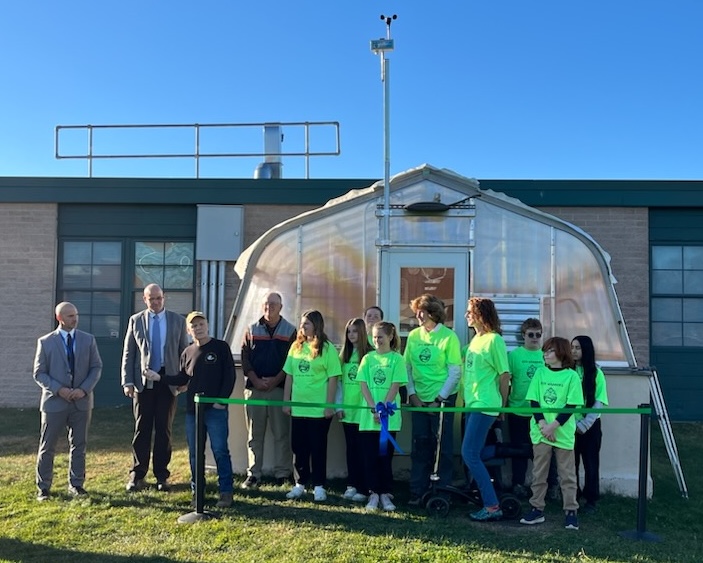
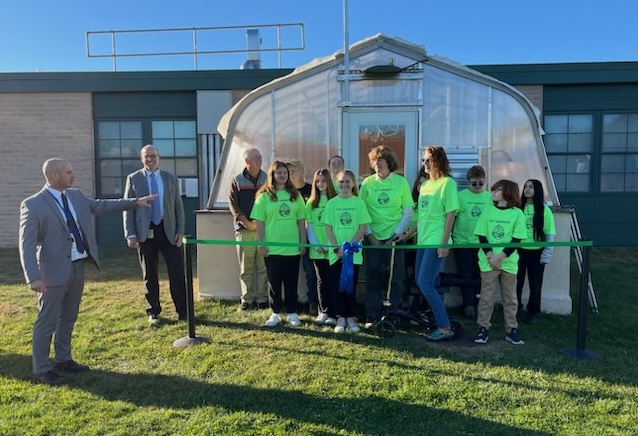
Lyme Food Share Garden President Jim Ward (third from left) thanks Sustainable CT, Lyme-Old Lyme Schools, and the numerous donors to the greenhouse renovation project in a short speech made immediately prior to the ribbon-cutting.
OLD LYME — Lyme-Old Lyme Middle School welcomed more than a dozen community members to view the renovated school greenhouse at a ribbon-cutting ceremony held Tuesday, Nov. 19. The greenhouse has been renovated as a partnership between Lyme-Old Lyme Schools, the Lyme-Old Lyme Food Share Garden (LOLFSG), and the community.
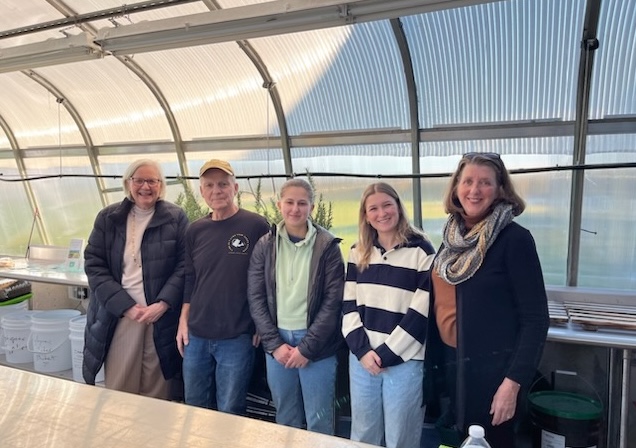
From left to right, Old Lyme First Selectwoman Martha Shoemaker (left) joins Lyme-Old Lyme Food Share Garden President Jim Ward, Sustainable CT Fellow Summer Mitchell, Sustainable CT Program Coordinator Dorothy Piszczek and Old Lyme Economic Development Chairwoman Cheryl Poirier (right) in the renovated Lyme-Old Lyme Middle School greenhouse, which was officially reopened Tuesday with a ribbon-cutting.
At the ribbon-cutting, Lyme Food Share Garden President Jim Ward spoke warmly of the relationship LOLFSG had established with Lyme-Old Lyme Schools, saying, “We are excited to collaborate with the school district to revitalize and utilize the greenhouse. This effort fosters a great connection between the school and the community.”
He added, “We look forward to working with students and teachers in enhancing the curriculum and hands-on learning. Garden volunteers will maintain educational exhibits, such as a vermicomposting (worm) bin and a hydroponic display.”
Ward noted, “Access to a greenhouse will enable the Food Share garden to increase production by starting and maintaining plants for early and late-season crops.”
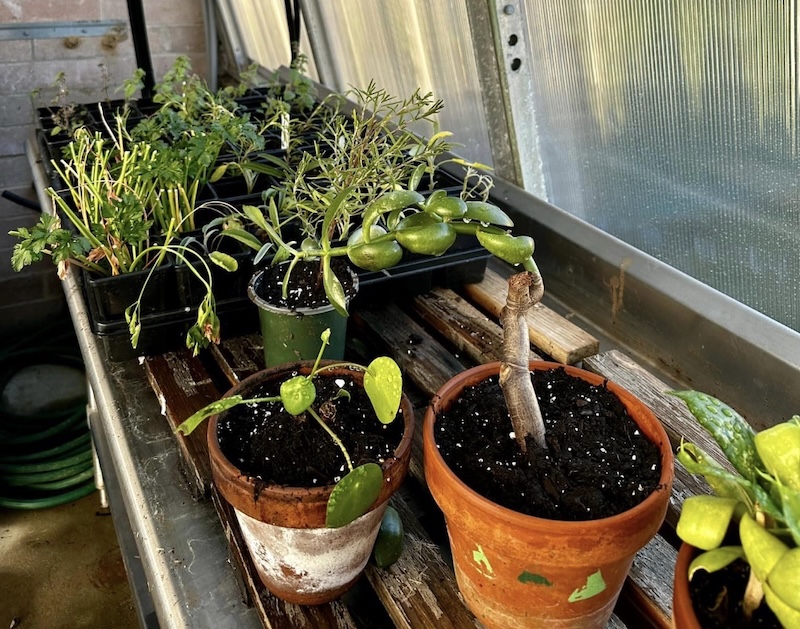
The greenhouse is already yielding valuable results.
Expressing thanks to all the donors, who had made the greenhouse renovation possible, Ward gave examples of the impact the project had made on certain former students.
He explained, “During the fundraising campaign, I spoke to a former student who is a farmer; he told me that his experience in this greenhouse helped inspire his desire to grow vegetables and raise cattle. I also spoke with a local landscaper who shared his positive senior-year experience with the greenhouse. Hopefully, the greenhouse experience will have an impact on future students.”
Ward also acknowledged the support from the Sustainable CT Community Match Fund, noting, “Three years ago, we utilized this program to establish the garden and turned to them to assist us in funding this greenhouse project.” This program supports sustainability improvements across Connecticut.
Lyme-Old Lyme Middle School (LOLMS) Principal Mark Ambruso welcomes the LOLMS ‘EcoWarriors’ to the greenhouse where they will be undertaking a number of projects under the guidance of LOLMS science teacher Shannon Glorioso.
While searching for a greenhouse in which the LOLFSG could start and maintain plants for late season crops, Jim Ward, president of LOLFSG, noticed the rarely-used greenhouse at the middle school. In his mind, he began to think about the possibilities …
After extensive discussions between LOLFSG and Lyme-Old Lyme Schools, it was agreed that renovating the greenhouse would be beneficial to all.
The LOLFSG raised approximately $8,000 for the project via the Community Match Fund offered by Sustainable CT.
With these funds, the polycarbonate on the roof, sides and gable end of the greenhouse have been replaced. New exhaust fans, shutters, and vents have been added, along with an irrigation system and a hydroponic tower.
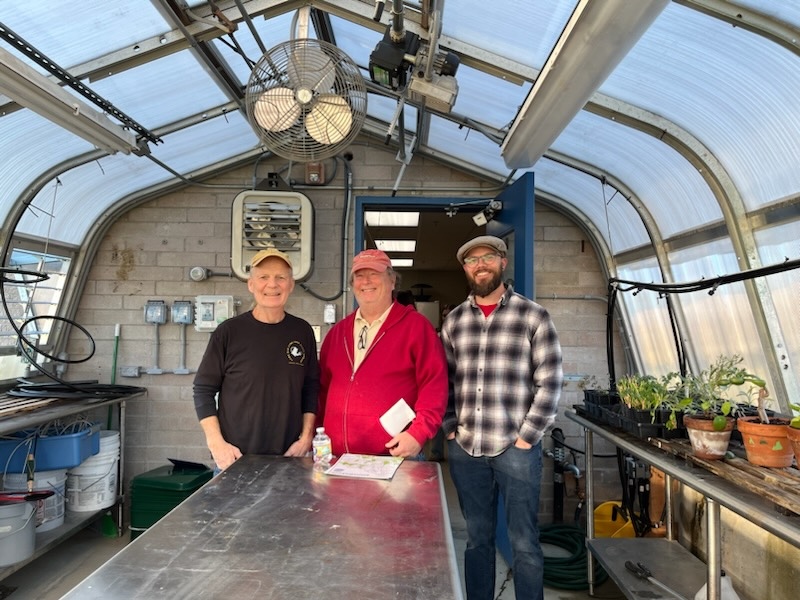
From left to right, Lyme-Old Lyme Food Share Garden LOLFSG) President Jim Ward is joined by fellow LOLFSG Board Members Steven Moore and Michael Hansen for this celebratory photo.
Ward commented, “The Lyme-Old Lyme Food Share Garden is excited to collaborate with the school district to revitalize and utilize the greenhouse. This effort fosters a great connection between the school and the community.” He added, “ We look forward to working with students and teachers in enhancing the curriculum and hands-on learning.”
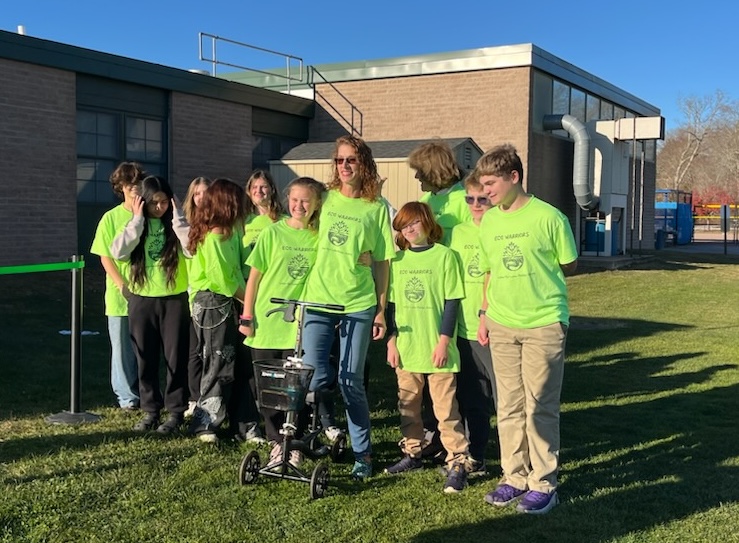
Lyme-Old Lyme Middle School science teacher Shannon Glorioso (center) stands with her team of ‘EcoWarriors’ prior to the ribbon-cutting.
Lyme-Old Lyme Middle School science teacher Shannon Glorioso aims to incorporate use of the greenhouse in her teaching this year, including implementing worm-composting. She plans to Introduce and maintain a worm-composting system within the greenhouse to recycle organic waste, thus promoting nutrient-rich soil for plant growth and reducing waste sent to landfills.
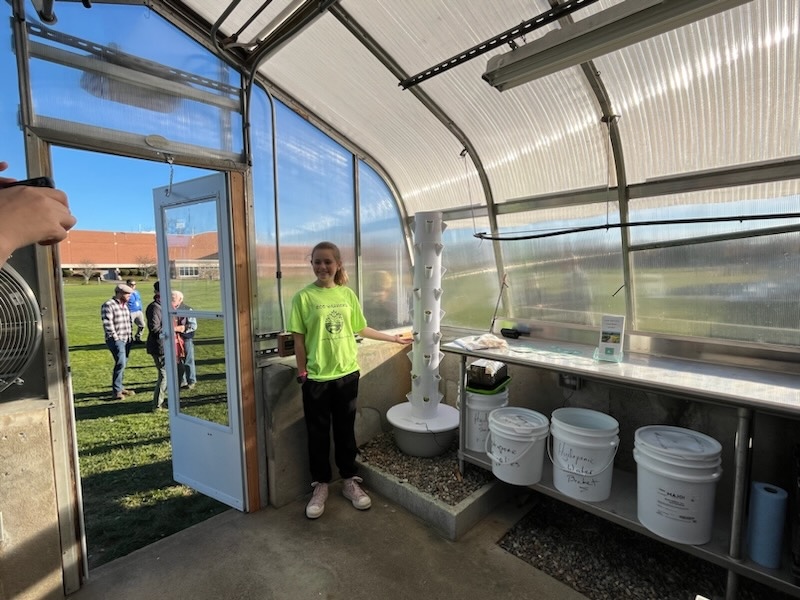
Another topic Glorioso intends to explore in the greenhouse with her students is hydroponics. She hopes to establish a hydroponic system in the greenhouse to teach students about alternative methods of cultivation, water conservation, and the importance of nutrient management in plant growth.
This ‘Eco-Warrior’ was delighted to have the opportunity to explain the details of hydroponic gardening to the assembled onlookers.
Raised-bed farming will also be introduced by the energetic Glorioso. She intends to teach students how to cultivate raised-bed gardens within the greenhouse to demonstrate sustainable farming techniques, including soil management, crop rotation, and pest control methods.
Finally, Glorioso plans to engage students in the entire process of growing lettuce from seed to harvest. But she will not stop there—she hopes to organize regular deliveries of the lettuce to the Shoreline Soup Kitchen and Pantries at the First Congregational Church of Old Lyme. This in turn will not only address local food insecurity but also instill values of community service and empathy in the students.
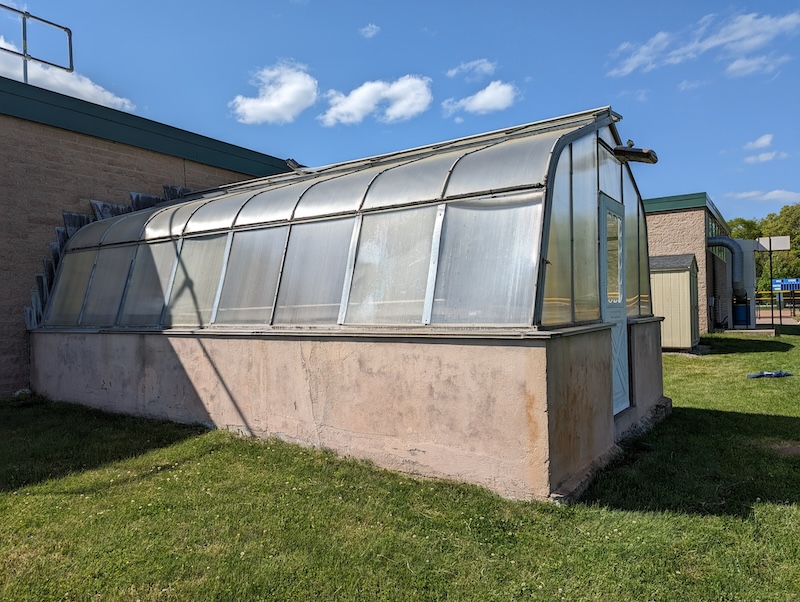
A view of the exterior of the greenhouse. The facility has been ‘in situ ‘at the LOL Middle School for decades but had fallen into disrepair. This project has rejuvenated both the greenhouse and its role as a learning environment for students.
“Partnerships such as this one between our students, staff and the community are an integral part of what makes our schools outstanding,” said Superintendent of Schools Ian Neviaser.
He continued, “We thank LOLFSG for bringing new learning experiences to our students and raising the funds necessary for the work.”
Editor’s Note: The greenhouse renovation project used Sustainable CT’s Community Match Fund grant program to crowdfund the project and access a matching grant. For further information on the Community Match Fund grant program page, visit this link.
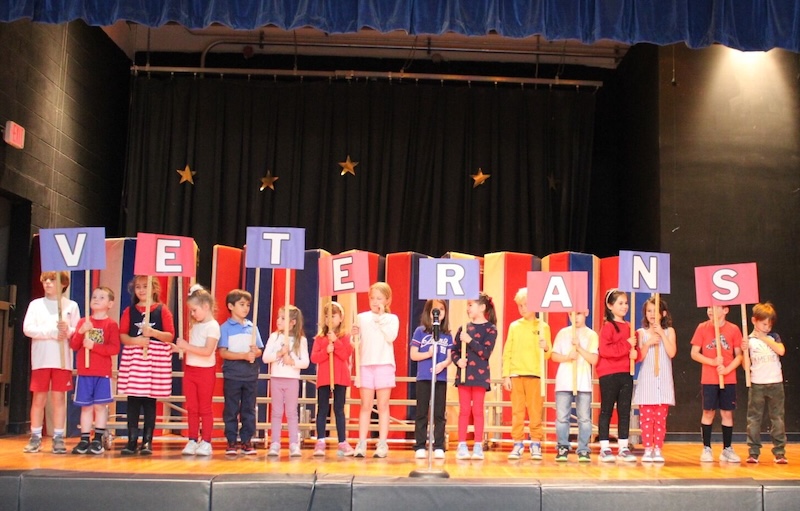
Lyme School students welcomed visiting veterans with a colorful message. All photos courtesy of Lyme-Old Lyme Schools.
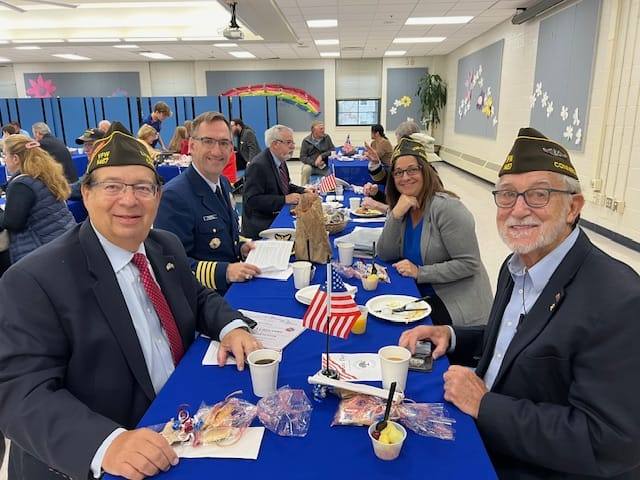
LYME/OLD LYME—On Monday, Lyme-Old Lyme Schools commemorated Veterans Day with a breakfast for local veterans followed by ceremonies in each school incorporating speeches, music and singing to honor all veterans.
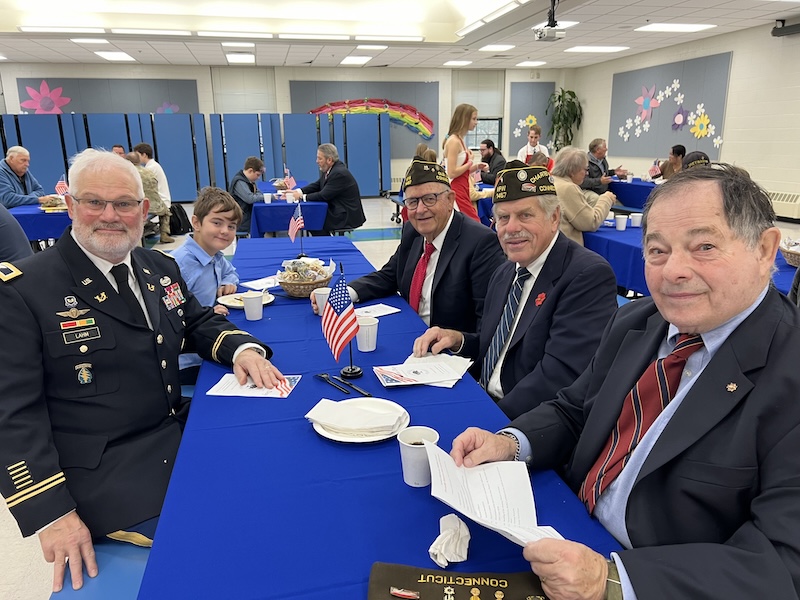
Veterans including Joe LaCasse (right) and former Old Lyme First Selectman Tim Griswold (second from right) enjoyed a hearty breakfast at Lyme-Old Lyme Middles School to kick off the festivities.
Students of all ages were involved in the day’s events.
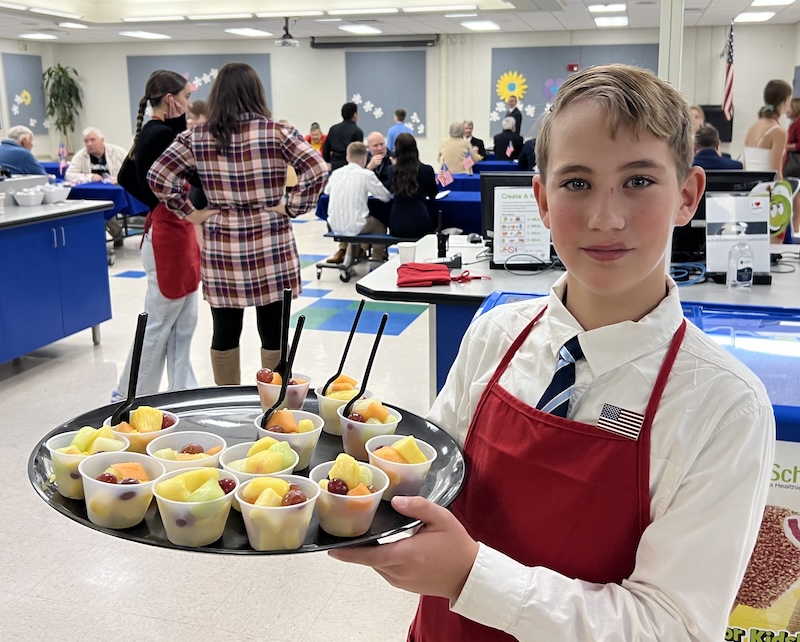
This young man performed an important role serving fresh fruit to the Middle School’s honored guests.
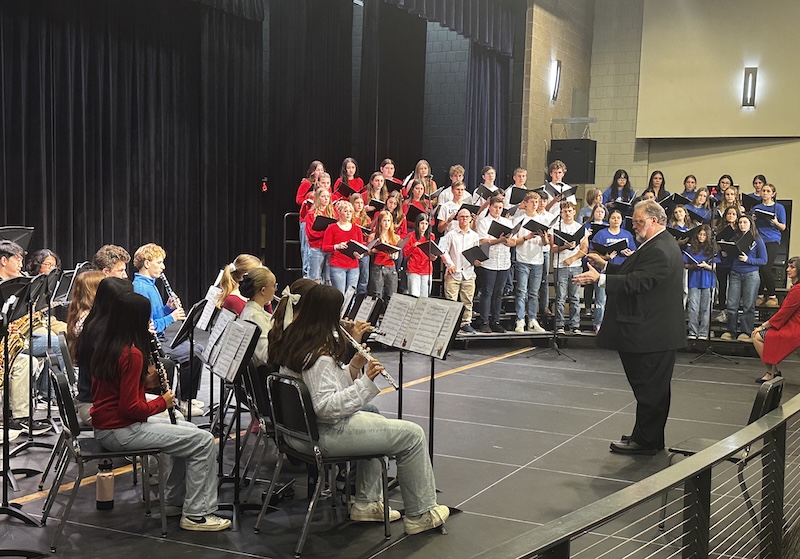
After breakfast at the middle school, the veterans attended a program in their honor in the auditorium.
VFW Post 1467 Commander Richard Mason (left) commented on the success of the day’s events, saying, “We bonded with middle school and high school students and staff as well as community friends.”
This was a very nice, inspirational day enjoying Veterans Day side-by-side with our students and community members. The students celebrated the day with heart and passion with our vets.Later they moved to Lyme-Old Lyme High School for another event, also commemorating veterans.
Longtime music teacher Jacob Wilson conducts the high school band.
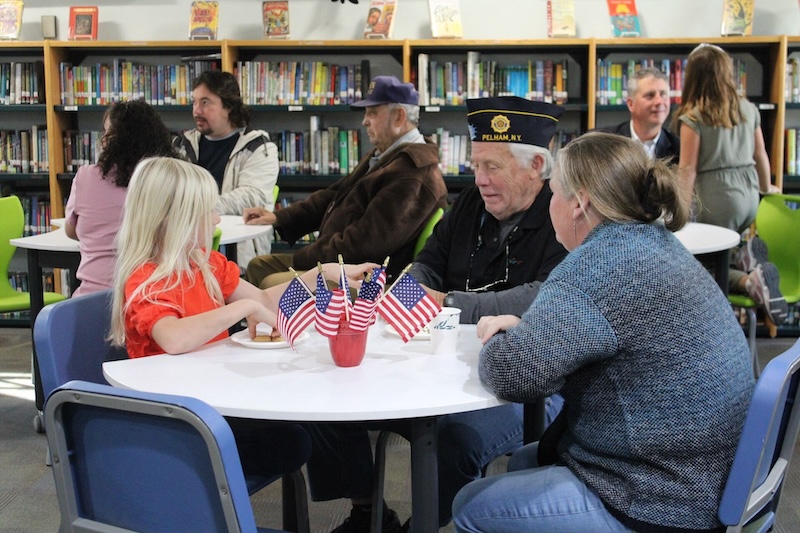
At Lyme School, a tea was held for the veterans
The generations mixed seamlessly during a tea held for the veterans held at Lyme School.
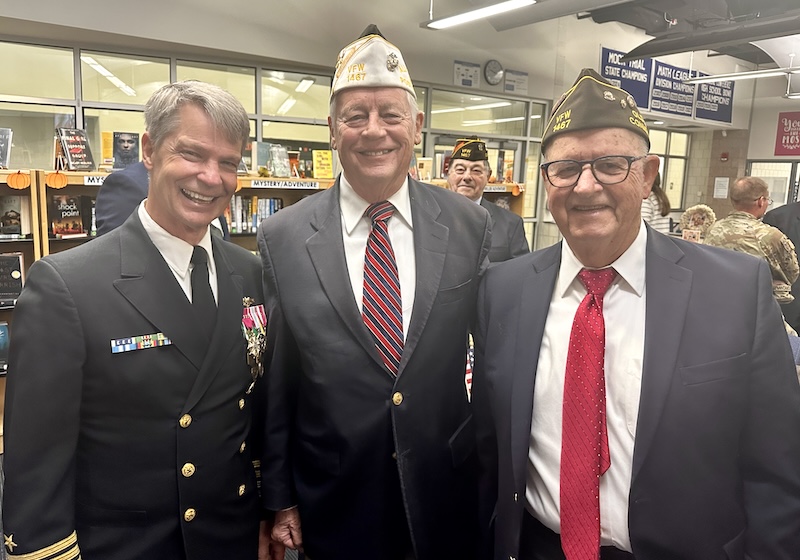
A reception was held at the high school after the program there allowing the veterans to mingle with the students.
Veteran David Griswold (center) stands with two fellow veterans at the reception following the high school program.
VFW Post 1467 Commander Mason summed up the day, saying, “This was a very nice, inspirational day enjoying Veterans Day side-by-side with our students and community members. The students celebrated the day with heart and passion with our vets.”
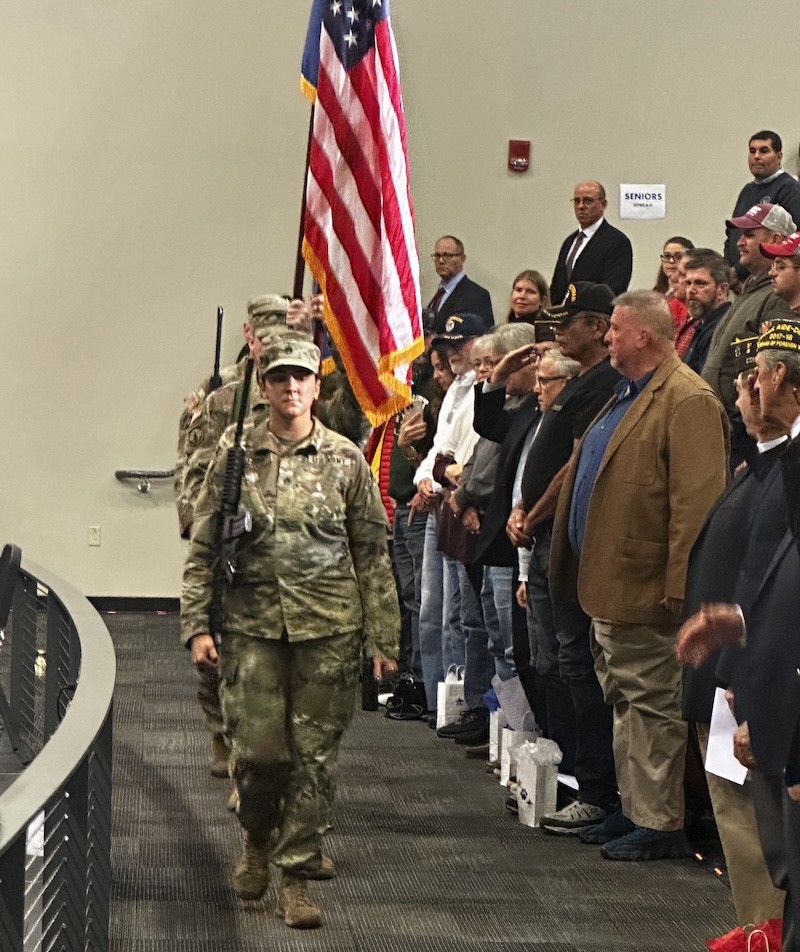
The color guard delivered the flags to the fonr of the high school auditorium.
It was a truly memorable day for all involved.
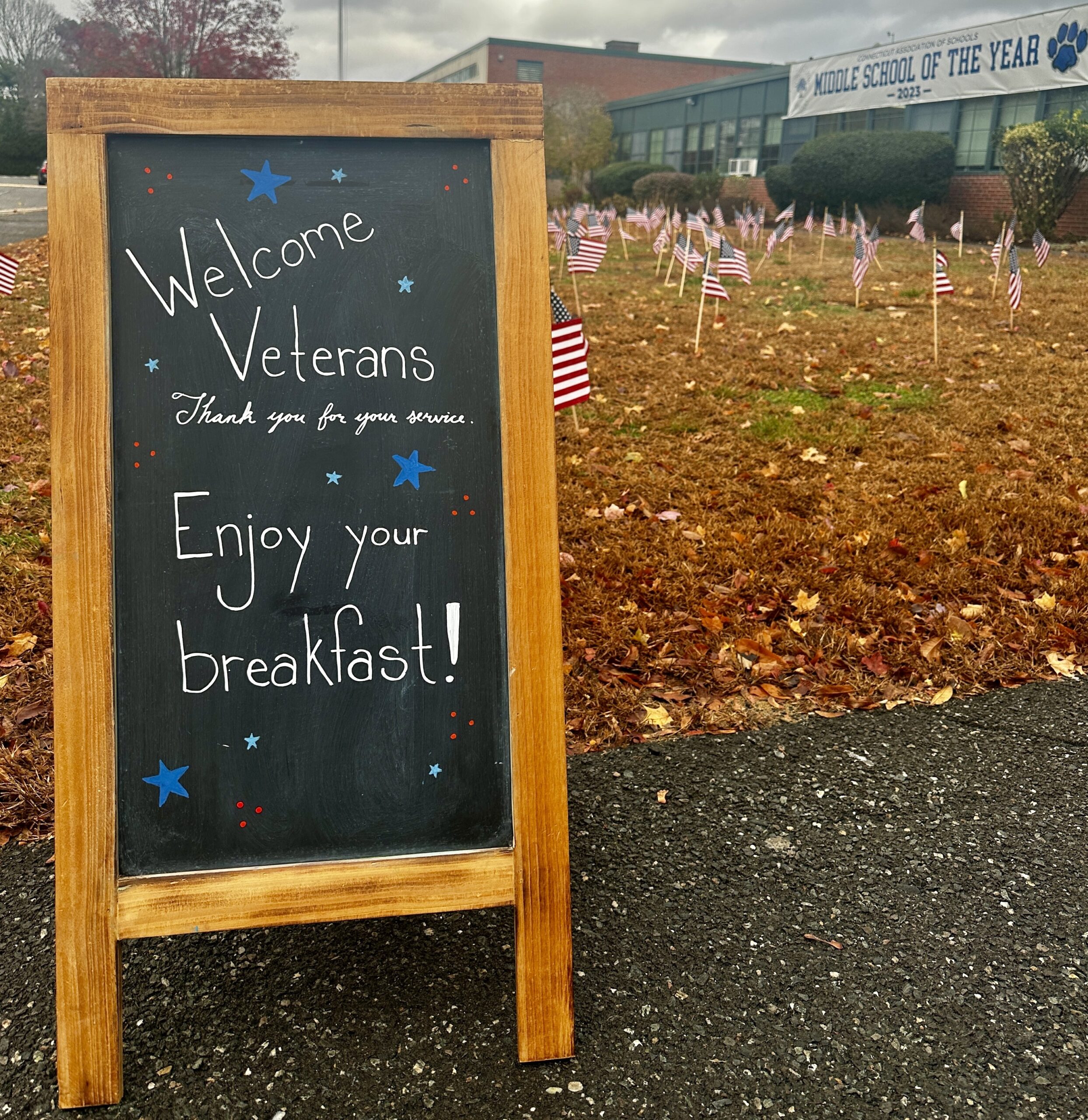
The welcoming sign at the Middle School that greeted the arriving veterans.
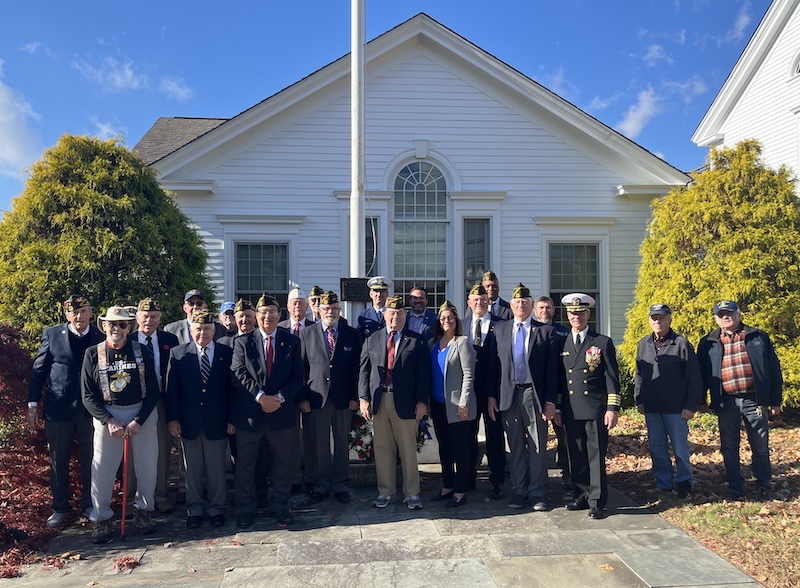
Local Heroes: the veterans gathered outside Old Lyme’s Memorial Town Hall for a commemorative photo. All photos by Martha Shoemaker.
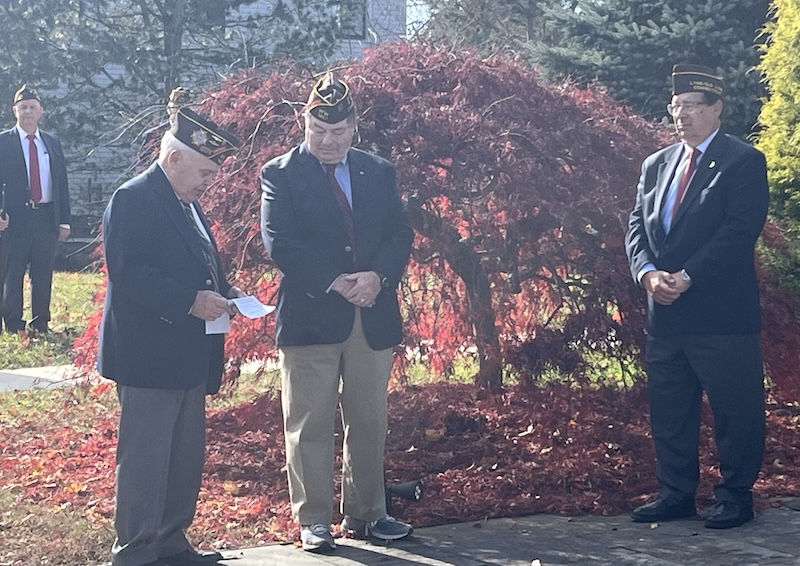
OLD LYME — A brief ceremony honoring Veterans Day was held Monday at the flagpole in front of Old Lyme’s Memorial Town Hall.
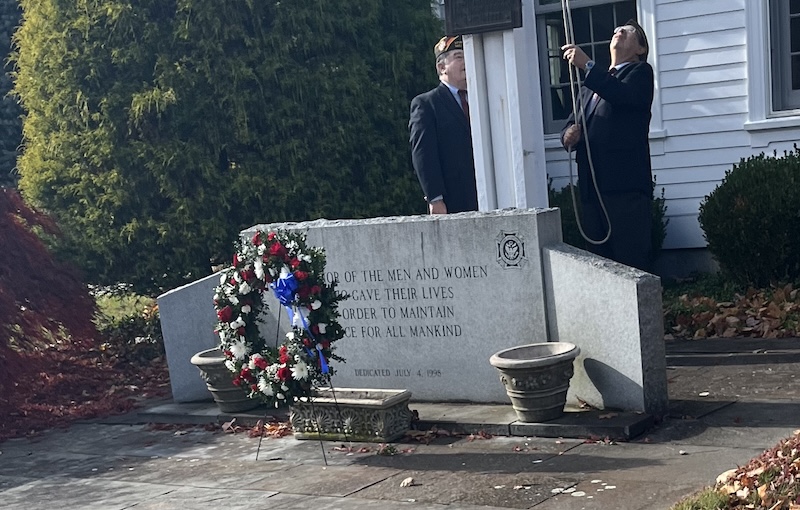
A wreath was laid Monday at the flagpole in front of Old Lyme’s Memorial Town Hall and then the flag was raised.
Current and former members of the military from Old Lyme gathered at the flagpole to honor those, who have given their lives to preserve the freedom of their country, and those who have served in the past or continue to serve today.
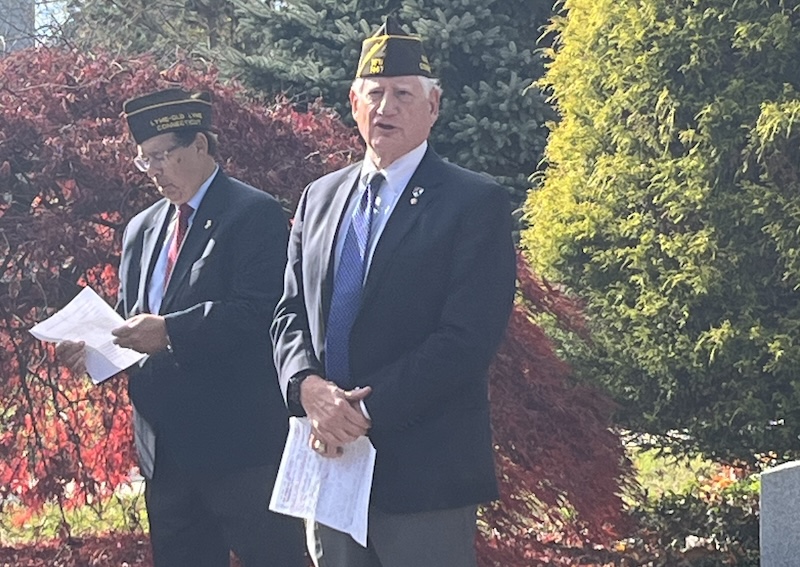
Richard Mason, Commander of VFW Post 1467, stands at right with Joe Lacasse in the center while Larry Ghirardi speaks.
The simple service was relatively short, but still poignant.
Retired Colonel Bill Bachman addresses the veterans gathered around the flagpole while Richard Mason, Commander of VFW Post 1467, stands at left.
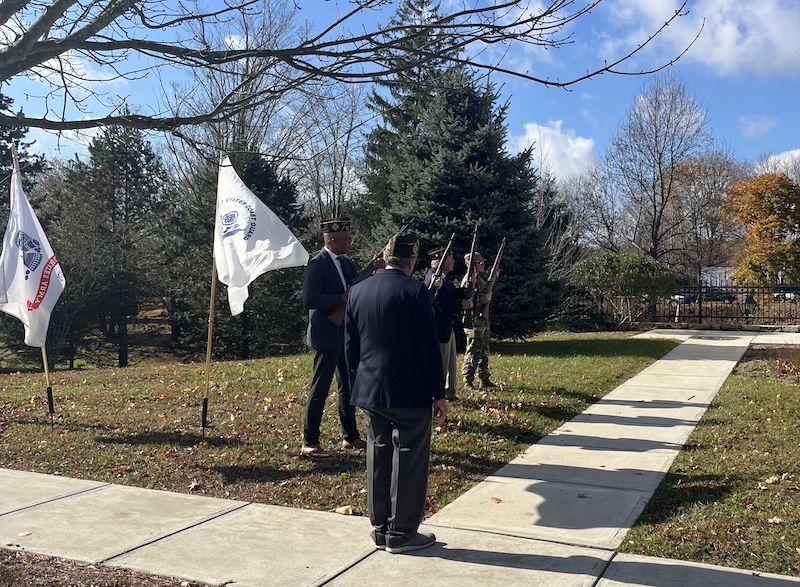
A three-gun-salute was fired to commemorate all veterans everywhere.
Preparing to fire …
Here at LymeLine, we thank all veterans for your past or present service and commemorate all those who have made the ultimate sacrifice.