Organization Confronting Racial Injustice with Public Art Announces Partnership to Install Murals in Four Towns, Including Old Lyme

NEW LONDON, CT —Public Art for Racial Justice Education (PARJE) and CT Murals have today announced a partnership to enable the installation of four murals in each of four towns:- New London, Old Lyme, Norwich, and East Lyme.

This will be part of the Sister Murals Project whereby skilled and unskilled artists from different communities, races, ethnicities, and generations will work together under master Black, Indigenous and People of Color (BIPOC) artists. The murals they create will bring lesser told stories to life while remembering cherished values in their respective communities.

Since its official launch in March of this year, PARJE has gained support from all around southeastern Connecticut. This includes colleges and museums, municipalities, art galleries, civic organizations, churches, and various businesses throughout the region.

Public Art for Racial Justice Education is a broad-based, interracial, non-partisan, non-sectarian group consisting of volunteers from various communities around the shoreline region. These communities include Old Lyme, Lyme, Old Saybrook, East Lyme, Essex, Deep River, Norwich and New  London. Building partnerships with surrounding communities is an additional focus of the group’s stated mission.

CT Murals has been dedicated to creating inclusive public art since 2015. The group utilizes grants as well as community support and donations to create all of its public art. Currently, CT Murals is working to install its 39 MLK Murals across the state, one for every year of Martin Luther King Jr.’s life.

The Sister Murals will be the second official public art project of PARJE. Their first public art project is a diptych that travels between schools, museums, libraries, and faith communities to teach about the history of the Edmund Pettis Bridge in Selma, Alabama.

The diptych, a two-panel painting, was created by artists Nancy Gladwell and Jasmine Oyola. The first host of the diptych was Norwich Free Academy in early July. Since then, it has been to Old Lyme, Old Saybrook, Waterford, New London and Hartford.

Public Art for Racial Justice Education has also been working with one of its earliest partners, Sustainable CT, on a series of videos to document their conversations with everyone from students to elected officials regarding the role public art can play in society.

In addition to these videos PARJE has partnered with the Florence Griswold Museum of Old Lyme and the Lyman Allyn Museum of New London to produce lectures discussing race, society, and art. Jason Deeble, project manager for the East Lyme Sister Mural, hopes to keep the spirit of those lectures going and sees public art as the best chance to do it.

When discussing the Sister Murals Project, Deeble commented “Art and learning, and civic responsibility, are all kinds of major fixtures in my life and a mural project like this makes a beautiful little Venn diagram with me right in the center.”

Public Art for Racial Justice Education, along with their financial sponsor, The Community Foundation of Eastern Connecticut, will work with CT Murals to involve the community in a variety of ways.

Public Art for Racial Justice Education believes there is an opportunity to involve the community in all aspects of mural installation. Whether it be discussing the mural themes in person or on a virtual call, or students assisting the artist with installation, there are several ways to involve the community.

More important than the installation of the murals themselves, however, are the plans PARJE has made for the time after these four pieces have been completed. The group is planning to host both presentations and performances at the site of the Sister Murals.

Fulton Park, the site of the New London Sister Mural wall, is configured in such a way that the area directly in front of the wall creates a natural stage. PARJE is committed to using the broad appeal of art and education to facilitate easy opportunities for conversation in the community about the difficult subject of racial injustice.

With three full basketball courts and a skate park, Eddie Long, PARJE Co-chair and member of the New London Arts Council, believes Fulton Park could easily accommodate a large crowd or audience. In discussing the need for neglected spaces to be utilized, Long stated, “We don’t like blank spaces in New London. We like spaces to be filled with people, with art, and ideas.”

CT Murals will have a chance to help install an indoor piece as well with Lyme-Old Lyme Middle School agreeing to become the future home of the Old Lyme Sister Mural. Located beside the school’s auditorium there is potential for educational programs or events that tie into the mural’s theme of “Welcoming All.”

There will be a Call for Artists coming from PARJE in the beginning of September.

For the Sister Murals Project, an official fundraising campaign has begun this month with a page on the crowdfunding site, Patronicity. If you would like to learn more about PARJE, or donate to one of the four Sister Murals, visit racialjusticeart.org

To become involved with PARJE, email racialjusticeart@gmail.com

Follow Public Art for Racial Justice Education on social media at these links:

Editor’s Note: This article is based on a press release from PARJE.

‘Having Our Say: The Delany Sisters’ First 100 Years’ Opens at Ivoryton Playhouse

‘Having Our Say: The Delany Sisters’ First 100 Years’ is currently being performed at The Ivoryton Playhouse.

IVORYTON – The extraordinary and life-affirming play Having Our Say: The Delany Sisters’ First 100 Years by Emily Mann (adapted from the book by Sarah L. Delany and A. Elizabeth Delany with Amy Hill Hearth) opened Aug. 12, at The Ivoryton Playhouse.

Based on the New York Times bestselling novel, Having Our Say takes us into the trail-blazing worlds of Sadie and Bessie Delany, two real-life, civil rights pioneers. Their warm, funny, and intelligent tale is a remarkable and moving portrait of two groundbreaking women, who continue to laugh, love, and embrace life after over 100 years living side-by-side.

This Tony-nominated play begins as sisters, Sadie and Bessie (103- and 101-years-old, respectively), welcome us into their Mount Vernon home while they prepare a celebratory dinner in remembrance of their father’s birthday. Along the way they take us on a remarkable journey through the last 100 years of our nation’s history.

From post-Civil War Reconstruction through the Harlem Renaissance and beyond, their sharp memories recapture the worlds of Booker T. Washington, Langston Hughes, W.E.B. Du Bois, and Paul Robeson.

A scene from ‘Having Our Say: The Delany Sisters’ First 100 Years.’

Throughout their respective life journeys, Sadie and Bessie broke barriers of color and race becoming a respected dentist and a New York City schoolteacher at a time when America held high the potential for change and growth. Their extraordinary and inspiring lives are examples in courage and love that stand as monumental contributions to our nation’s heritage.

This poignant and touching family drama stars Catherine Williams* as Sadie and Hope Harley* as Bessie. And the Delany Sisters’ influence is not lost on them, evidenced by Harley commenting, “Much like their contemporary, Anna James, of the James Pharmacy here in Connecticut, they serve as role models even today.” Or as Williams states simply, “I am very humbled to play the role.”

The play is directed by Ivoryton Playhouse’s Associate Artistic Director Todd Underwood with set design by Martin Marchitto; costumes by Elizabeth Saylor; lighting by Marcus Abbott; and sound by Tate R. Burmeister.

Having Our Say: The Delany Sisters’ First 100 Years runs through Sunday, Sept. 5, 2021. Performance times are Wednesday and Sunday matinees at 2 p.m.; evening performances are Wednesday and Thursday at 7:30 p.m., Friday and Saturday at 8 p.m.

The safety of its audience is the theater’s primary concern. Its capacity has been socially-distanced so that there are now only 140 seats in the theatre for the audience’s comfort and protection.

Tickets are $55 for adults, $50 for seniors, $25 for students and avalable by calling the Playhouse box office at 860.767.7318. Tickets are not available online.

Visit the Playhouse’s website for more information. (Group rates are available by calling the box office for information.)

The Playhouse is located at 103 Main St. in Ivoryton.

*Denotes member of Actors Equity

Lyme Art Association Celebrates its Centennial in True ‘Twenties’ Style

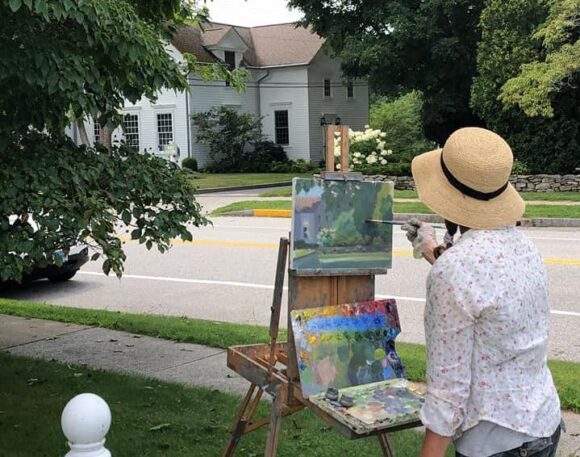
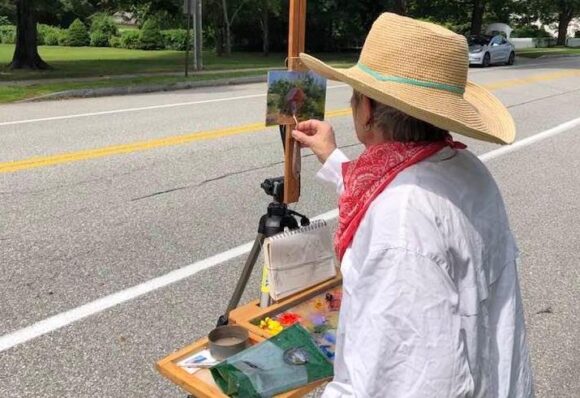
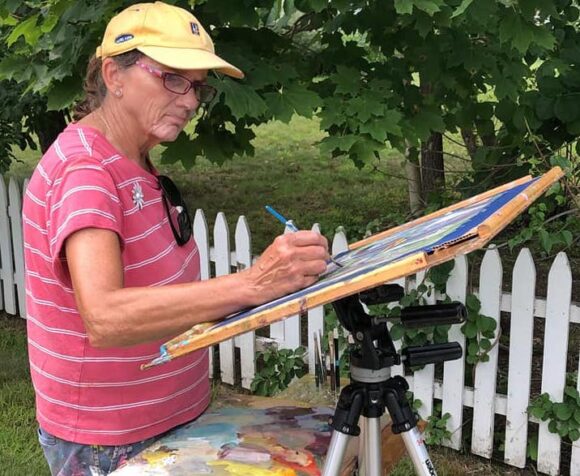
Replicating the traditions of the early part of the last century, artists associated with the Lyme Art Association set up their easels at different points along Lyme St. on Saturday, and painted local scenes. Photo by Anne Smith Brandenburg.

OLD LYME — On Saturday, the Lyme Art Association (LAA) celebrated 100 years (and one day!) since their gallery opened with art and awards, teas and ‘The Twenties,’ and much mirth and merriment all around.

Photo by Anne Smith Brandenburg.

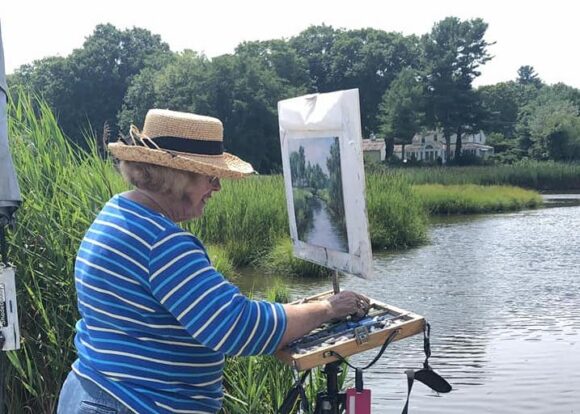
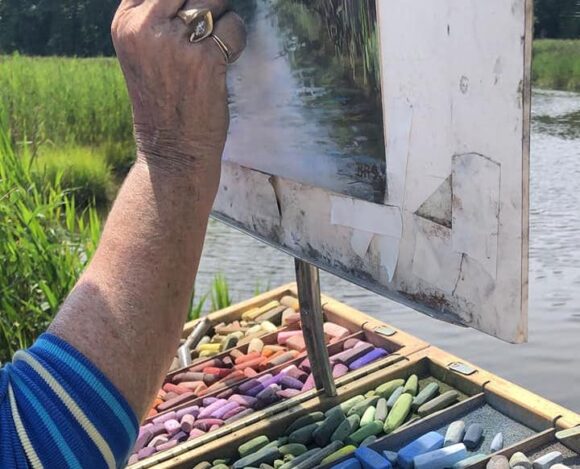
Some artists took their palettes to the river.

Photo by Anne Smith Brandenburg.

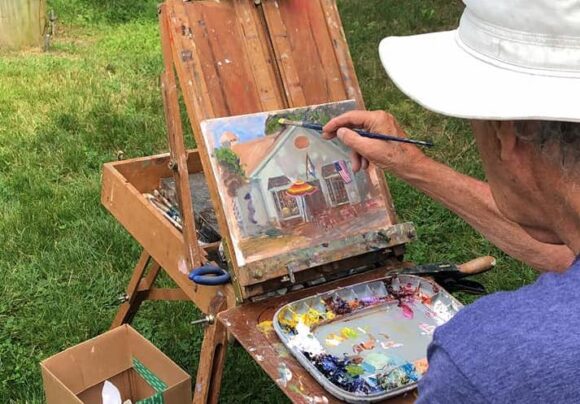
Artwork was created in all sizes …

Photo by Anne Smith Brandenburg.

… and colors.

Photo by Anne Smith Brandenburg.

Some was small …

Photo by Anne Smith Brandenburg.

… while others were large.

Photo by Anne Smith Brandenburg.

But concentration was high wherever the artists were working and the results were truly remarkable.

Photo by Suzanne Thompson.

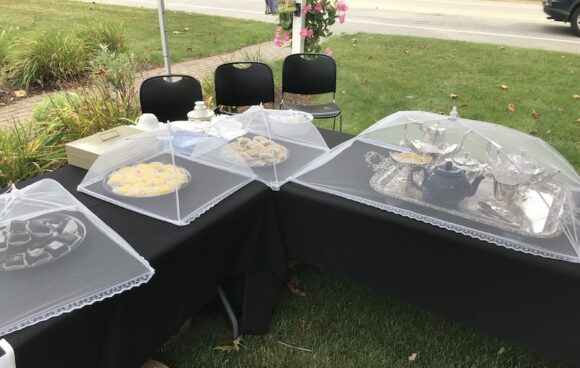
Tea was served ‘Twenties’ style at the LAA during the afternoon, celebrating the period when the Association first opened its doors …

Photo by Suzanne Thompson

… with delicious goodies for all.

Photo by Linda Ahnert.

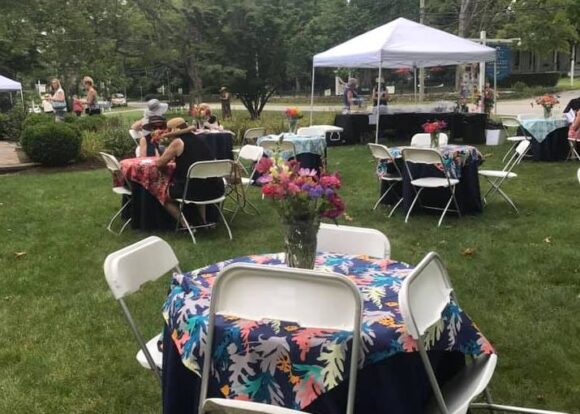
There were tables with flowery cloths and flowers in vases everywhere …

Photo by Linda Ahnert.

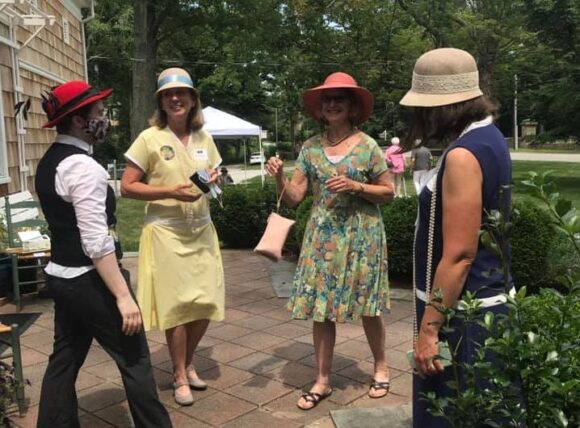
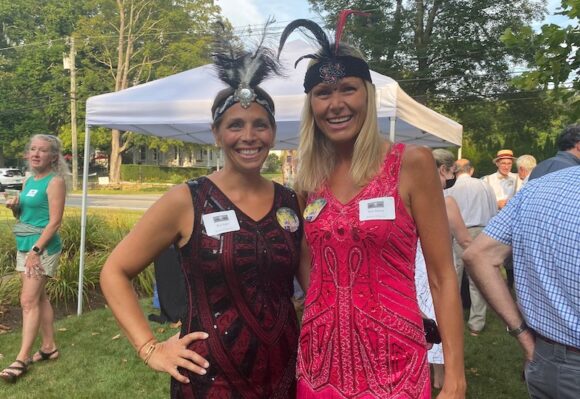
The weather was perfect, faces were smiling, and these ladies in their ‘Twenties’ tea-dresses were clearly having a lovely time.

Photo by Linda Ahnert.

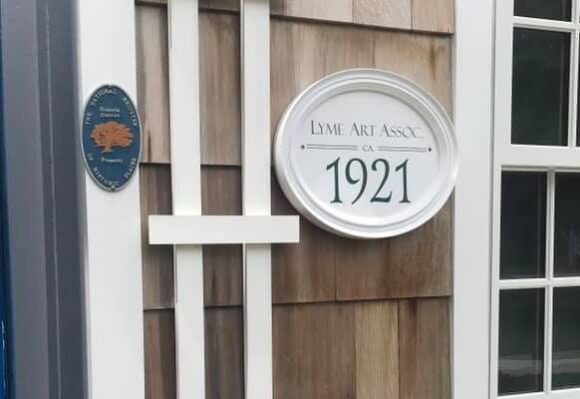
This plaque reminded guests of the joyful date they were all celebrating …

Photo by Linda Ahnert.

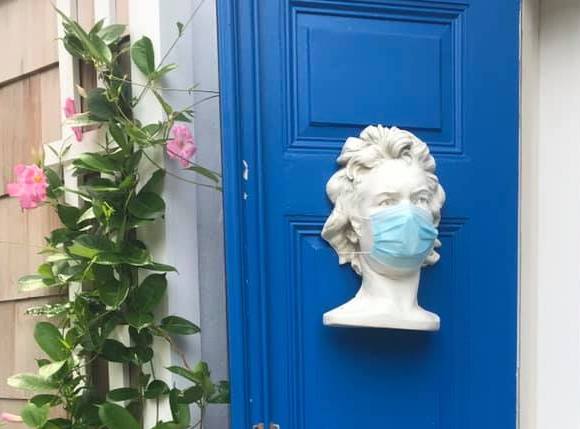
… while this mask reminded guests of the unwelcome newcomer in our midst.

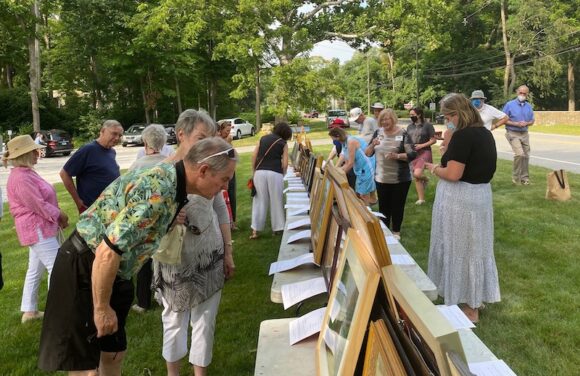
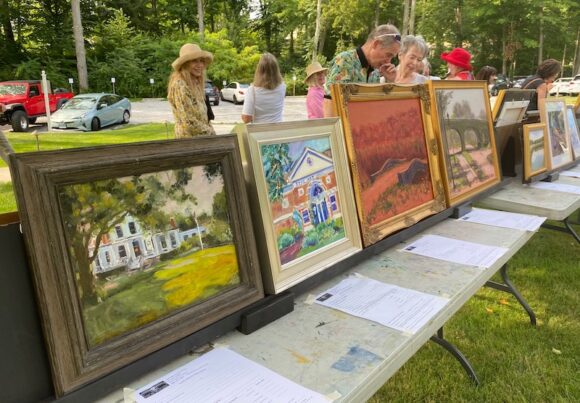
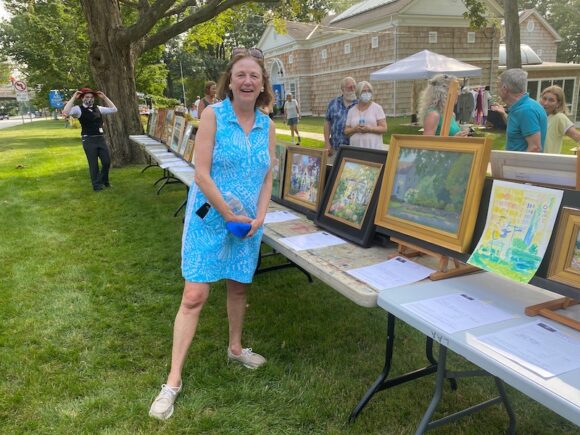
All the freshly-painted artwork was gathered on the LAA’s lawn where guests studied it intently to decide  whether to make a purchase.

There was so much wonderful work from which to choose …

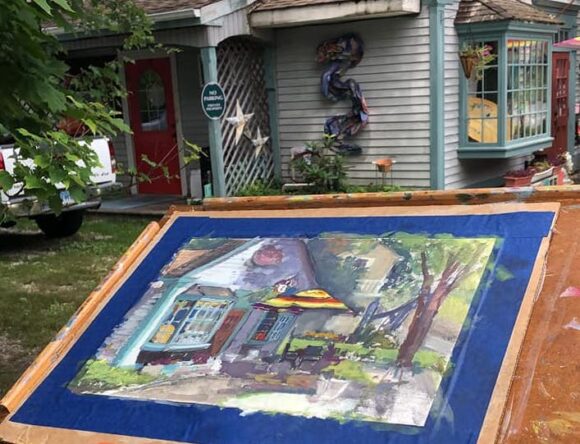
… but Lyme Street resident Lynn Fairfield-Sonn knew precisely which piece she wanted to buy. It was the beautiful painting of her house depicting herself and husband Jim on the porch!

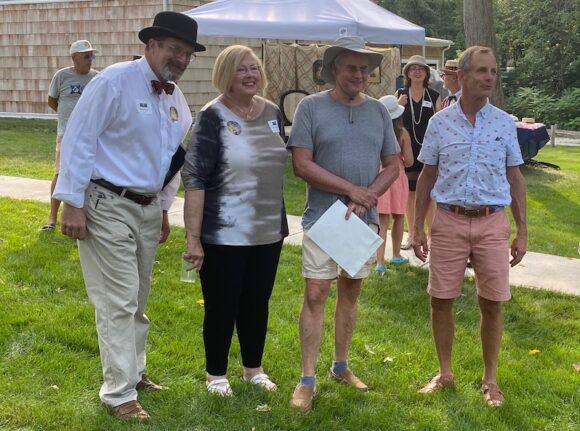
Cooley Gallery owner Jeff Cooley (right) announced the winners of the ‘Wet-Paint Contest,’ who gathered for a photo with LAA Board Chairman Harley Bartlett (left) after the presentation of awards.

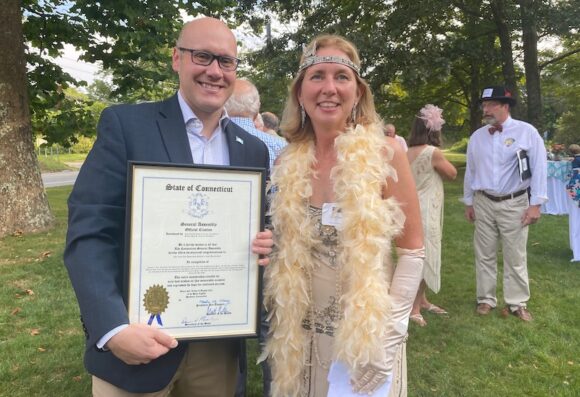
State Representative Devin Carney (R-23rd) was on hand to present LAA Executive Director Laurie Pavlos with a Proclamation from the State House and Senate honoring the event.

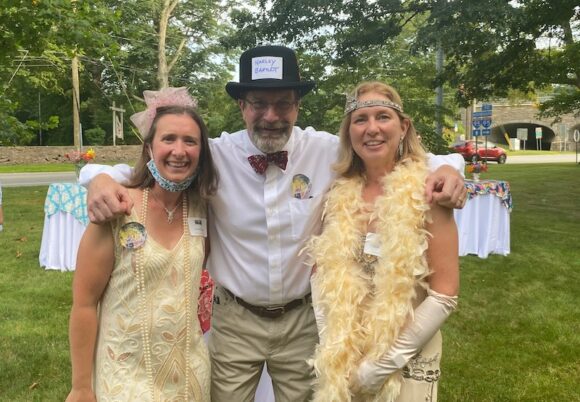
The LAA Board Chair, Harley Bartlett (center), cheerfully shared a smile with the LAA Executive Director Laurie Pavlos (right) and Development Director Elsbeth Dowd (left.)

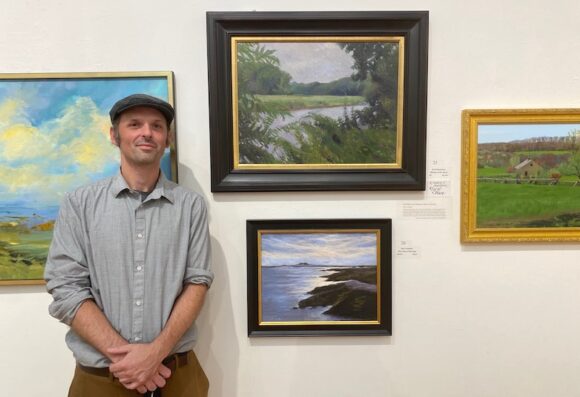
Local artist Jack Montmeat was awarded first prize in the Lyme Art Association’s summer exhibition A Century of Inspiration.

The early evening morphed into the Centennial Frolic with a 1920s-themed fundraiser for the Second Century Skylight Project. This delightful event celebrated the next 100 years of the LAA’s historic gallery in the spirit of their founders with fabulous ‘Twenties’ attire being the fashion theme.

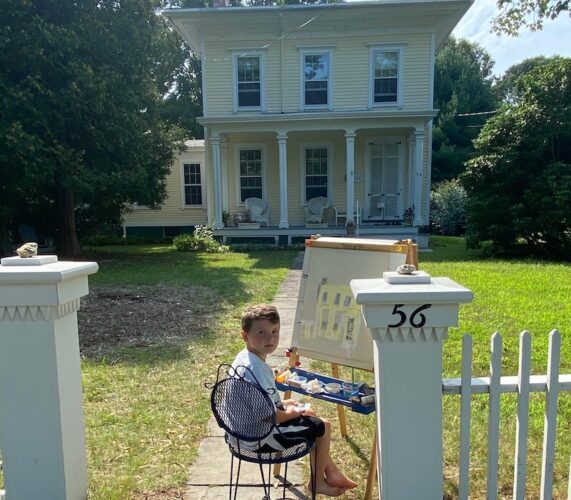
And so this memorable day came to an end, but let us not forget the artists of the future, who will see the LAA through their next 100 years … and here is one of them, Gideon Halferty — the seven-year-old son of Esther and Paul — hard at work in front of his house on Lyme Street!

Lyme Art Association Celebrates 100th Anniversary TODAY with Lyme Street ‘Paint-Out’, Tea Day, ‘Centennial Frolic’

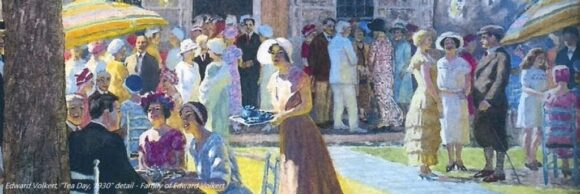
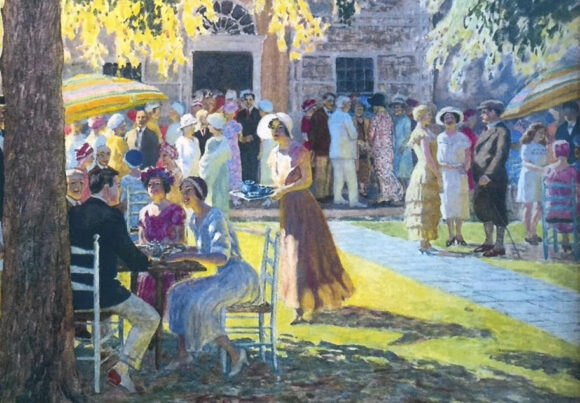
‘Tea Day’ by Edward Volkert, 1930, and printed courtesy of the family of Edward Volkert, hints at the festivities to be held on the Lyme Art Association’s ‘Centennial Day,’ Aug. 7.

OLD LYME — In 1921, after years of discussion, planning, and fundraising, the early members of the Lyme Art Association (LAA) achieved their goal: a purpose-built gallery to display their art. This year, the LAA will be marking that milestone with special exhibitions, events, and activities.

Centennial Day, Aug. 7, 2021 is 100 years (plus one day) from the opening day of the first exhibit in the Lyme Art Association Gallery. The impetus for the incorporation of Lyme Art Association back in 1914 was to plan and build a gallery perfect for the display of the works of the Lyme Impressionists, who formed the Lyme Art Colony.

The Lyme Art Association on Lyme Street is celebrating the centennial of its founding with three related events being held throughout the day on Saturday, Aug. 7, culminating in a 1920s-themed fundraising “Frolic’ from 5 to 7 p.m.

The opening of the gallery seven years later on Aug. 6, 1921, represented the culmination of years of planning, fundraising, delays, more fundraising, and construction.

The gallery’s opening was celebrated enthusiastically by the community, praised by national journals, and of course, was the pride and joy of the artists themselves and Miss Florence Griswold, who served as the first gallery manager.

On Saturday, Aug. 7, the Lyme Art Association is celebrating the 100th anniversary of the construction of the LAA gallery and the start of a continuous connection with the Old Lyme and Lyme communities with three related events:

  • Wet Paint on Lyme Street will place member artists throughout the Old Lyme village at their easels painting en plein air, thus evoking the early artists with whose presence the community was quite familiar. The artists will work at varying times during the day and then sell their paintings on the LAA lawn at 4:30 p.m. This will be an opportunity to see many LAA artists painting in their own styles.

Tea Day is a family-friendly event being held from 1 to 4 p.m., which will harken back to the LAA’s early fundraisers of tea parties held on the front lawn for the townspeople and artists. Beverages and baked goods will be sold while crafts, games, and other fun activities will be offered. Costumed historical interpreters will be on hand to share stories of the artists, who founded the LAA along with planning and building the gallery. Join today’s LAA for a contemporary take on an event from years gone by.

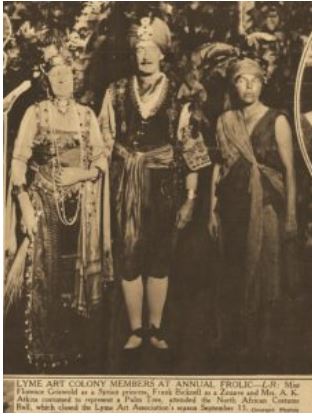
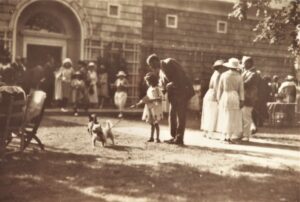
Lyme Art Colony Annual Frolic, 1928

  • The Centennial Frolic will take place from 5 to 7 p.m. with a 1920s-themed fundraiser (1920s attire encouraged!) for the  Second Century Skylight Project. This event will celebrate the next 100 years of the LAA’s historic gallery in the spirit of their founders.The artists of the Lyme Art Colony marked the end of every summer with a “Frolic,” which often included elaborate costuming (see photo above.)This event is open to donors to the Skylight Project (visit this page on the LAA website or call 860- 434-7802 to donate) and will include beverages and appetizers. Help save the skylights and “frolic” like the LAA founders!

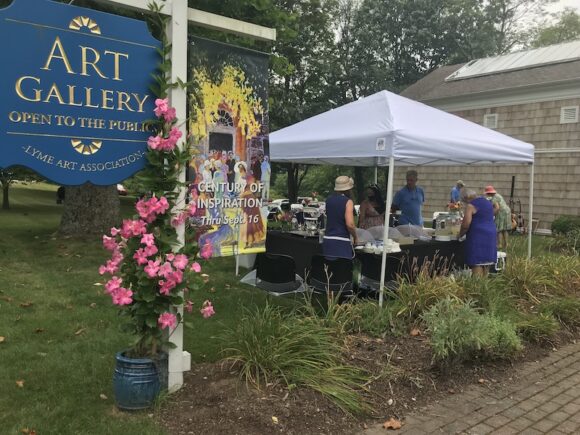
A Century of Inspiration, the Lyme Art Association’s summer exhibition will explore the connections between the current Association’s artists and the original Lyme Art Colony artists.

The best work of LAA members, inspired by some of the same landscapes and subject matter that early Lyme artists painted, will be hung along with pieces by the founding artists. Displays exploring the founding, growth, and changes in the LAA will be presented, taking visitors all the way through the century that saw so much change in both the Association and the world at large.

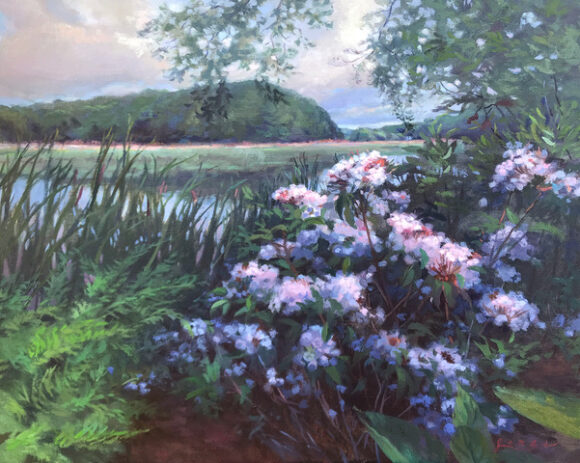
This work titled, ‘Return of the Laurel,’ (oil) is one of the featured paintings in the new exhibit at the LAA.

Lyme Art Association Executive Director Laurie Pavlos explained, “Artists who visited Old Lyme in the early 1900s found its beauty and rural atmosphere an antidote to some of the more unpleasant changes that industrialization and urbanization were causing. They also found a wonderful camaraderie and encouragement in each other as well as their patron and landlady, Florence Griswold.”

Pavlos continued, “In many respects, as much as things have changed, they have stayed the same. Miss Florence is gone, but many Lyme Art Association artists are still inspired by the same combination of local beauty, camaraderie and encouragement, which are important aspects of our mission, along with the extensive educational opportunities we offer.”

For more information about the Skylight Campaign and/or the Frolic, visit lymeartassociation.org.

The Century of Inspiration exhibit runs from July 30 through Sept. 16. The LAA gallery is open Wednesday through Sunday, 10 a.m. through 5 p.m. and also by appointment.

Saturday’s Centennial Celebrations at Lyme Art Association Include Traditional ‘Tea Day’ … But What’s Its History?

‘Tea Day 1930’ by Edward Volkerts paints a beautiful picture of the teas held on the lawn in front of the Lyme Art Association in yesteryear. A ‘Tea Day’ forms part of the LAA’s Centennial celebrations this Saturday. Image published courtesy of the Volkerts family.

OLD LYME — On Saturday, Aug. 7, the Lyme Art Association (LAA) is celebrating the 100th anniversary of the opening of its gallery.  Several special events are planned, one of which is a tea party on the LAA lawn.  

Though the gallery itself opened in August of 1921, the history of the LAA goes even further back and is interwoven with our town library and the Florence Griswold Museum. 

To start at the very beginning—in 1899, Henry Ward Ranger, already an established painter, arrived in Old Lyme and bunked down at the boardinghouse of Florence Griswold. So smitten was Ranger with the beauty of the area and the quality of the light that he began to envision the village as an American art colony.

He wrote to his agent in New York that Lyme was a landscape waiting to be painted and told Miss Florence he would be back the next summer and bring more painters with him.  And so the artists came. 

The Phoebe Griffin Noyes Library was the original home of the Lyme Art Colony’s summer exhibition from 1902 through 1920 before the Lyme Art Association had a building of its own.

And in 1902, the artists began a summertime tradition when they held an exhibition in the Phoebe Griffin Noyes Library.  An article in the Hartford Courant explained that “the library and the artists have formed a sort of close corporation.” The library (which opened in 1898, the year before Ranger arrived) needed funds to buy books; the artists needed an exhibition space.

“One scheme after another was tried until it occurred to someone to ask the artists who spend their summers in town to exhibit some of their paintings” the Courant reporter wrote. Admission to the show was 50 cents and proceeds were for the benefit of the library.  Additionally, the library received a percentage of all paintings sold.  

It was the beginning of a beautiful friendship and the shows were a success from the start.  As the fame of the Lyme Art Colony grew, the artists started making plans to build their own gallery. Many of them settled permanently in town and, in 1914, incorporated as the Lyme Art Association. But the shows continued at the library until 1920.

It took years both to raise money and decide on the best location for the new building.  One of the options was a parcel of Miss Florence’s property which fronted on Lyme Street.  World War I also intervened — not to mention what American Art News described as a “merry war” among the artists about the design of the gallery.  

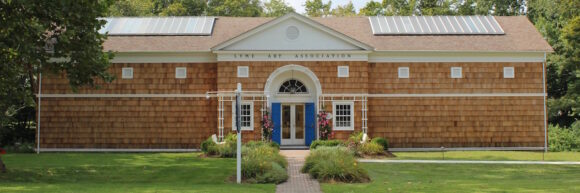
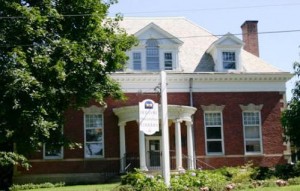
Finally, on Aug. 6, 1921, the LAA gallery was ready for its close-up and opened its doors at 90 Lyme Street next door to Miss Florence’s boardinghouse.  In its review of the opening, the New York Times praised the gallery “as an embodiment of art in harmony with its natural surroundings.” 

Miss Florence became the first gallery manager and remained so until her death in 1937.

Tea on the lawn of the LAA.

During the years of the early exhibitions at the library, the Ladies’ Library Association served tea on the lawn.  And the artists continued this tea time tradition at the new gallery.  Tea was served en plein air at the LAA on Wednesday and Saturday afternoons.  The Edward Volkert painting above, which is on the poster for the centennial show, depicts one such “Tea Day.” 

A 1928 article in American Motorist also gives a vivid description—“For every July when Lyme Art Association opens the doors to its annual exhibition, the whole village and surrounding countryside awakes to a regular orgy of art and delightful social festivities.  The yellow pennants streaming from tall flagpoles at either end of the terrace, dainty tea tables gay with attractive china and lovely flowers, to say nothing of the pretty girls who serve tea and punch to visitors on Wednesday and Saturday afternoons . . . ” 

Several women, who as teenagers helped serve tea at LAA, were interviewed for an article published in The Pictorial Gazette in 1988.  They remembered the lace tablecloths and that the ladies wore “long, filmy dresses that were every pastel color imaginable.” They also recalled big, floppy hats; white gloves; and ginger and cream cheese sandwiches.

All was not perfect in this pastel paradise, however.  One of the women noted that as a 12-year-old, she was shocked at her first sight of a lady smoking which was “unheard of in this town.” 

And this coming Saturday afternoon, on the 100th anniversary of the gallery opening, the LAA will once again host a tea party.  There will be refreshments and family-friendly activities on the front lawn from 1 to 4 p.m.

Inside the gallery, the current exhibition is “A Century of Inspiration,” for which today’s artists have created works painted at many of the sites that the Old Lyme “old masters” immortalized a century ago.  And throughout the day, you can observe LAA artists up close and personal as they paint in various locations along Lyme Street.  

So much has changed in the world in the last century and we no longer live in a genteel era of outdoor tea parties. Right now, we are even living in the midst of a global pandemic. 

But some things have not changed. 

Old Lyme is still the beautiful village that Ranger first saw in 1899.  Each May and June, the mountain laurel still blooms. And 100 years after the LAA first opened, painters continue to find inspiration in the natural beauty of our town and to exhibit fine art in the gallery.

Editor’s Note: Visit this link for full details of all the events planned for the LAA’s Centennial Day.