
Talking Transportation: Saving Money on Metro North

MTA logoWith the holidays upon us, let’s review some money-saving tips for riding Metro-North into the city for commuters and day-trippers alike:

TRANSITCHEK: See if your employer subscribes to this great service, which allows workers to buy up to $130 per month in transit using pre-tax dollars.  If you’re in the upper tax brackets, that’s a huge savings on commutation.  A recent survey shows that 45 percent of all New York City companies offer TransitChek, which can be used on trains, subways and even ferries. 

GO OFF-PEAK: If you can arrive at Grand Central weekdays after 10 a.m. and can avoid the 4 to 8 p.m. peak return hours, you can save 25 percent.  Off-peak’s also in effect on weekends and holidays.  These tickets are good for 60 days after purchase.

BUY TICKETS IN ADVANCE: If you buy your ticket on the train you’ll pay the conductor a $5.75 – $6.50 “service charge”… a mistake you’ll make only once !  (Seniors: don’t worry, you’re exempt and can buy on-board anytime without penalty.) There are ticket machines at most stations, but the cheapest tickets are those bought online.  And go for the ten-trip tickets (Peak or Off-Peak) to save an additional 15 percent.  They can be shared among passengers and are good for six months.

KIDS, FAMILY & SENIOR FARES:   Buy tickets for your kids (ages 5 – 11) in advance and save 50 percent over adult fares.  Or pay $1 per kid on board (up to four kids traveling with an adult, but not in morning peak hours).  Seniors, the disabled and those on Medicare get 50 percent off the one-way peak fare.  But you must have proper ID and you can’t go in the morning rush hours.

FREE STATION PARKING: Even stations that require weekday parking permits usually offer free parking after 5 pm, on nights and weekends.  Check with your local town. 

METROCARDS: Forget about the old subway tokens.  These nifty cards can be bought at most stations (even combined with your Metro-North ticket) and offer some good deals:  put $5.50 on a card (bought with cash, credit or debit card) and you get a 5% bonus.  Swipe your card to ride the subway and you’ll get a free transfer to a connecting bus, or vice versa.  You can buy unlimited ride MetroCards for a week ($31) or a month ($116.50). 

BUT IS IT CHEAPER TO DRIVE?: Despite being a mass transit advocate, I’m the first to admit that there may be times when it’s truly cheaper to drive to Manhattan than to take the train, especially with three or more passengers.  You can avoid bridge tolls by taking the Major Deegan to the Willis / Third Ave. bridge, but I can’t help you with the traffic you’ll have to endure.  Check out www.bestparking.com to find a great list of parking lots and their rates close to your destination.   Or drive to Shea Stadium and take the # 7 subway from there.

The bottom line is that it isn’t cheap going into “the city”.  But with a little planning and some insider tips, you can still save money.  Happy Holidays!

Jim Cameron

Jim Cameron

Jim Cameron is founder of The Commuter Action Group, and a member of the Darien RTM.  The opinions expressed in this column are only his own.  You can reach him at CommuterActionGroup@gmail.com   For a full collection of “Talking Transportation” columns, see www.talkingtransportation.blogspot.com
Talking Transportation: Traveling by Tube

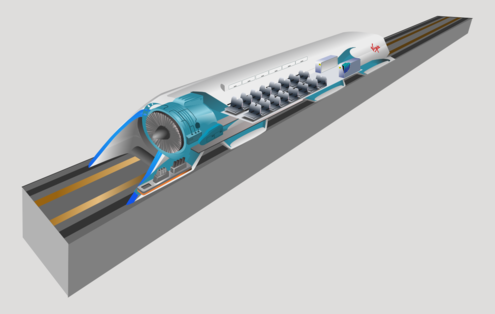
Cutaway graphic of "The Loop."

Cutaway graphic of “The Loop.”

Will the train of the future be a high-speed tube, not a railroad?  That’s inventor and entrepreneur Elon Musk’s and others’ vision.  And Musk, the man who brought us the Tesla (all-electric car) and SpaceX (for-profit space rocket company) is putting his own money behind a proof-of-concept project for what he calls Hyperloop.

The concept sound simple:  move passengers in a sealed tube through a series of giant pipes propelled by air pressure at speeds up to 700+ mph.  That would mean a trip from New York to DC would take 20 minutes.

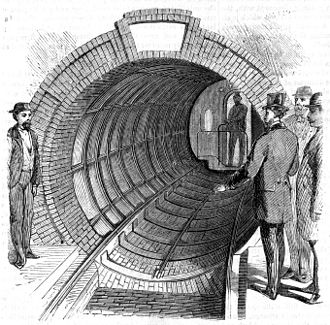
Diagram of the "Beach" pneumatic transit system.

Alfred Beach’s “Pneumatic Transit” system.

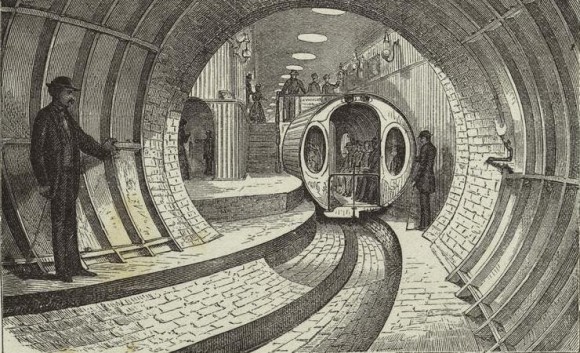
But this is not a new concept.  In fact, the first experimental “subway” in New York City, Alfred Beach’s “Pneumatic Transit” proved back in 1870 that it would work.  Despite political opposition, Beach secretly built a 300-foot-long subway under Broadway near City Hall, offering daring passengers a round-trip ride in the system’s only railcar, pushed and pulled by air.  The system ran for almost three years and carried over 400,000 riders, 11,000 alone in the first two weeks.  The fare was 25 cents (equivalent to $18 today). Competing elevated railroad owners eventually won the City’s franchise and Beach’s system was abandoned.

Even Beach’s idea wasn’t new, as vast underground pneumatic tube systems in Paris and London were already delivering telegrams and mail by the 1850’s.  As recently as the 1960s, office buildings in major cities were designed with pneumatic tube systems for inter-office mail.  Some older department stores still use the tubes to record sales and make change from a centralized money room.

Hurtling through a tube may be fine for mail, but what about humans?  As a recent article in Smithsonian Magazine points out, the psychological factor of being enclosed in a sealed tube, traveling 700+ mph, is not that much different than flying in a jet … maybe just a bit more claustrophobic.

Whether by train or plane, I always like to look out the window.  Seeing where we’re going is half the fun, even on a familiar route.  But wrapped in a metal tube inside a giant pipe affords no views at all.  Riding 31 miles in the Chunnel under the English Channel takes 20 minutes at today’s speeds, and that’s more than enough time for me, thank you very much.

Of greater concern are the propulsion methods and the sheer physics of accelerating and braking from near-supersonic speeds.  But the biggest challenge of all would be where to locate the “pipes” and how to acquire necessary land.

A station inside the"Pneumatic Transit" system.

A station inside the “Pneumatic Transit” system.

Like high-speed rail, it would make no sense to follow the median on Interstate 95 or the Metro-North / Amtrak rights of way with all their twists and turns.  And anyone crazy enough to invest in any project along the coastline with the inevitability of rising sea levels should probably think pontoons, not pipes.

It will be interesting to see if Musk’s and others’ Hyperloop concepts get off the ground (pun intended) … but I don’t expect to ride such a system any distance in my lifetime.

Jim Cameron

Jim Cameron

Jim Cameron is founder of The Commuter Action Group, and a member of the Darien RTM.  The opinions expressed in this column are only his own.  You can reach him at CommuterActionGroup@gmail.com  

For a full collection of “Talking Transportation” columns, see www.talkingtransportation.blogspot.com
Talking Transportation: Good News — and Bad — for Metro-North

It’s been a rough few years for Metro-North what with derailments, crashes and commuter deaths.  But it finally seems like service and safety are coming back.

The best metric of that is the recent surge in ridership, up 1.7 percent compared to last year.  That works out to more than 3,000 additional riders every day.

Certainly this ridership gain is a sign of more people finding jobs. But with gasoline prices near a record low, there’s a reason these folks are training instead of driving:  they like what they see.

  • The trains are on time.  Yes, running slower than in years past, but what’s a few minutes if it means better safety?  What matters most is that the 7:37 shows up at 7:37, plus a minute or so, and arrives in NY pretty close to on-time.  It’s much more dependable now than last winter.
  • There have been no fare increases (at least in Connecticut), even though our fares are still the highest in the nation.
  • There’s more service too:  at least two trains per hour, even in off-peak.  That means more options.
  • And we have the spiffy new M8 railcars, at last.  Riders seem to like the clean, modern interiors and amenities, such a power plugs at each seat.

So for all of these reasons, a lot more people are taking the train.  Good news, right?  Yeah, but in the long run, not so good news because “supply” is not keeping up with “demand”.

More riders without additional capacity means crowding, and we’re already hearing more reports about that, especially at rush hour when some trains are SRO.  And that’s only going to get worse.

The problem is, we didn’t order enough new M8 cars back in 2005 when we placed our order:  just 300 cars for $762 million.  That worked out to $2.54 million per car.

By the time those cars finally went into service in 2011, CDOT and Metro-North realized they should order more. This time, just single un-powered cars, so trains could run with 7 or 9 cars, not just 6, 8 or 10 using the “married pairs” in the original order.

But by then, Kawasaki whacked us $3.3 million per car … and those newest single cars don’t even have motors.   Were we to try ordering more M8 cars today, who knows the price … or delivery time?

From the legislature’s approval of the M8s in 2005 through design, testing and construction, the first M8s took six years to get into service.  The latest single-car order took 4 years.  So even if we were to call Kawasaki today, we couldn’t get new cars until probably 2020 even if we could find the money.

Meanwhile, the Malloy administration is pushing an almost $10 billion, multi-year plan to widen I-95 and I-84.  By the time it’s done, crowding could be so bad on our trains that getting on a four-lane wide interstate might just be better alternative.  Ironic, no?

Jim Cameron

Jim Cameron

Jim Cameron is founder of The Commuter Action Group, and a member of the Darien RTM.  The opinions expressed in this column are only his own.  You can reach him at CommuterActionGroup@gmail.com   For a full collection of “Talking Transportation” columns, see www.talkingtransportation.blogspot.com

Talking Transportation: Happy 75th Birthday to The Merritt: Queen of the Parkways

A century ago the only way to drive between New York and Boston was on Rte. 1, The Post Rd. If you think traffic is bad today, imagine that journey! So in 1936, 2,000 men began work on the state’s largest public works project, the $21 million four-lane- parkway starting in Greenwich and running to the Housatonic River in Stratford. The adjoining Wilbur Cross Parkway didn’t open until years later when the Sikorsky Bridge across the Housatonic was completed.

The Merritt, named after Stamford resident, Congressman Schuyler Merritt, is best known for its natural beauty, though most of it was planted: 22,000 trees and 40,000 shrubs. And then there are the bridges, since 1991 protected on the National Register of Historic Places.

Architect George Dunkleberger designed 69 bridges in a variety of architectural styles, from Art Moderne to Deco to Rustic. No two bridges are exactly alike. In short order the Merritt was being hailed as “The Queen of Parkways”.

The parkway at first had tolls, a dime (later 35 cents) at each of three barriers, not to pay for the parkway’s upkeep but to finance its extension to Hartford via the Wilbur Cross Parkway, named after Wilbur Lucius Cross who was Governor in the 1930’s. Tolls were dropped in 1988.

The old toll booths themselves were as unique as the Parkway, constructed of wooden beams and covered in shingles. One of the original booths is now preserved in Stratford at the Boothe Memorial Park.

At recent celebrations of the parkway’s 75th birthday, one old timer told of a friend from Yale who resented paying the dime toll in the 1940’s. So he went to the medical school and procured a cadaver arm, glued a dime on its finger and hid the arm up his sleeve. When the prankster slowed to pay his toll, the collector got the dime and the arm as the student sped off.

The Merritt’s right of way is a half-mile wide, the vistas more obvious now since massive tree clearing after the two storms in 2011 and 2012 where downed trees pretty much closed the highway.

Since its design and opening in 1938 the Merritt Parkway has been off-limits to commercial vehicles and trucks. But as traffic worsens on I-95, debates rage from time to time about allowing trucks on the Merritt and possibly widening the road. Either move would probably mean demolition of the Parkway’s historic bridges, so don’t expect such expansion anytime soon.

The best watchdog of the Parkway is the Merritt Parkway Conservancy which has fought to preserve the road’s unique character. Their latest battle is against plans for a multi-use trail along the south side of the roadway. Costing an estimated $6.6 million per mile, the Conservancy worries that the trees and foliage that would be clear-cut to allow bike and pedestrian users would despoil the eco-system.

Jim Cameron

Jim Cameron

Jim Cameron is founder of The Commuter Action Group, and a member of the Darien RTM. The opinions expressed in this column are only his own. You can reach him at CommuterActionGroup@gmail.com For a full collection of “Talking Transportation” columns, see www.talkingtransportation.blogspot.com

Talking Transportation: Sound Barriers: A Waste of Money?

One and a half million dollars a mile.  The cost of building a new lane on I-95?  Hardly! That’s more like $20 million.  No, “$1.5 million dollars a mile” would be the cost of building new sound barriers on that crowded highway, according to testimony by the Connecticut Department of Transportation’s Commissioner.

This won’t win me many friends among my neighbors in Darien, but I just don’t see that they should be asking the government to subsidize their peace and quiet.  After all, most of them bought houses near the highway benefiting from speedy access to the roadway and should have known full-well that being that close would subject them to noise.

Do you have sympathy for those who buy homes near airport runways, then complain about the jets?  Neither do I.

The first sections of what became I-95 were built in Darien in 1954, long before most current residents came to town.  Sure, traffic has increased on I-95 over the years.  We are well over the planned capacity of this interstate highway.  But thinking the solution to highway noise is to create a walled concrete canyon through our coastal communities paid for by others, is just selfish and short-sighted.

I live about 1500 feet from I-95.  On a quiet summer’s night I can hear the trucks as they whiz by at 70 mph, especially when they’re “Jake braking” (illegal in many states).  And yes, there is a wooden sound barrier between me and the road which helps a bit.  I try to think of the noise as like surf at the beach.  But when shopping for my current home, I knew that highway noise was the price I would pay for being so near an on-ramp.

Some neighbors in my, and many other towns, want the state or Uncle Sam to build miles and miles of new sound barriers to cushion their karmic calm.  But why should the few benefit at the expense of so many?

Can we really argue that someone in Tolland or Torrington should pay for sound barriers in Westport or Greenwich?

Sound-barriers seem to me to be wasted money.  They don’t reduce accidents, improve safety or solve congestion.  Two miles of sound-barriers would buy another new M8 rail car for Metro-North, taking 100 passengers off the road.  And sound-barriers are often just sound-reflectors, not absorbers, only bouncing the sound off to bother others.

Consider these alternatives:

  • Soundproof the homes. This has worked well for neighbors of big airports and is probably cheaper than sound-proofing entire neighborhoods.  And insulation against noise also insulates against heat loss, saving energy.
  • Explore rubberized asphalt. Reduce the road noise at its source, literally where the “rubber meets the road”.  Using this new road surface, some highways have seen a 12 decibel reduction in noise.  Rubberized asphalt also reuses 12 million junked tires each year.
  • Pay for it yourself. Let neighborhood associations affected by road noise create special taxing zones to collect funds to build sound barriers they’ll benefit from, both with reduced noise and resulting increased home valuations.

I can think of any number of better places to spend federal tax dollars to improve mass transit than erecting sound barriers.  Can’t you?

Jim Cameron

Jim Cameron

About the Author: Jim Cameron is founder of The Commuter Action Group, and a member of the Darien RTM.  The opinions expressed in this column are his alone.  You can reach him at CommuterActionGroup@gmail.com   For the full collection of “Talking Transportation” columns, see www.talkingtransportation.blogspot.com