Talking Transportation: Big Brother Comes Along for the Ride

Big_BrotherHere in my car, I feel safest of all.  I can lock all my doors.  It’s the only way to live, in cars.*
* Quote from Gary Numan, “Cars”, 1979

You may feel that your car is your last private refuge in this busy world.  But there’s someone along for the ride:  Big Brother.  And you’d be surprised what he knows about you, thanks to modern technology.

Cell Phones:
Your cell phone is constantly transmitting its location, and services like Google Dashboard’s location history can show exactly where you were at any date in time.  Don’t want to be tracked?  Turn off your cellphone.

E-Z Pass:
Even when you are nowhere near a toll booth, E-ZPass detectors can monitor your location.   Want to stay anonymous? Keep your E-ZPass wrapped in aluminum foil in your glove box.

Highway Cameras: 
The extensive network of traffic cameras on our interstates and parkways is used mostly to monitor accidents.  But State Police can also watch individual vehicles. The cameras are even available to the public online.  But state law specifically forbids using these cameras to write speeding tickets.

License Plate Readers (LPRs): 
This is the newest and most powerful tracking tech, as I saw in a ride-along a few years ago with my local PD.  These cameras mounted on police cars can scan up to 1,800 license plates a minute as cars drive by at speed.

As the plate number is recognized, it is transmitted to a national crime computer and compared against a list of wanted vehicles and scofflaws.  If it gets a “hit,” a dashboard screen in the cop car flashes a red signal and beeps, detailing the plate number and infraction.  In just one hour driving through my town, we made stops for outstanding warrants, lack of insurance and stolen plates.  (Some towns also use LPR’s for parking enforcement in train station parking lots, forgoing the need for hang-tags or stickers.)

While this may lead to very efficient law enforcement, LPRs also have a potentially darker side: the data about plate number, location and time can be stored forever.

Faced with a string of unsolved burglaries, Darien police used their LPR to track every car entering the targeted neighborhood and looked for patterns of out-of-town cars driving through at the time of the burglaries and made an arrest.

But the American Civil Liberties Union (ACLU) is concerned about how long cops can store this data and how it should be used.  They laud the Connecticut State Police policy of only storing data for 90 days.

In the early days of LPRs in 2012, an ACLU staffer filed an FOI request for his car’s plate number and found it had been tracked four times by 10 police departments in a database that had 3 million scan records.

So enjoy your car.  But realize that none of us have any privacy.

Jim Cameron

Jim Cameron

About the author: Jim Cameron is founder of The Commuter Action Group, and a member of the Darien RTM.  The opinions expressed in this column are only his own.  You can reach him at CommuterActionGroup@gmail.com  

For a full collection of “Talking Transportation” columns, see www.talkingtransportation.blogspot.com

Talking Transportation: Infrastructure – Dangling by a Thread

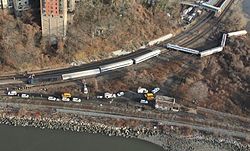
The Spuyten Duyvil derailment in 2012 caused massive disruption.

The Spuyten Duyvil derailment in 2013 caused massive disruption on Metro North..

The recent fire under the Park Avenue viaduct in Harlem, which disrupted commutes of a quarter million Metro-North riders got me thinking:  our aging, crumbling and vulnerable transportation infrastructure is close to collapse, and the effects of such failure could be catastrophic.  Consider this track-record:

June 1983:  Inadequate inspections and repairs cause the collapse of the Mianus River Bridge on I-95 in Greenwich. Three people were killed and three others injured.  For almost five months, 80,000 daily vehicles had to detour through city streets.

March 2004:  An oil tanker crashes on I-95 in Bridgeport and the ensuing fire is hot enough to melt steel supports on the Howard Avenue overpass.  Traffic was disrupted for a week.

September 2013:  Con-Ed plans to replace a crucial electric feeder cable for Metro-North in the Bronx.  The railroad decides to forgo the $1 million cost of a temporary back-up cable and the main cable fails, disrupting train service for weeks, both on Metro-North and Amtrak.

June 2014:  Twice in one week the Walk Bridge in South Norwalk (built in 1896) won’t close, cutting all rail service between New York and Boston.  Cost of replacement will be more than $450 million.

May 2016:  Illegally stored chemicals and propane tanks at a gardening center under the Park Ave. viaduct catch fire.  The flames’ heat melts steel girders, cutting all train service out of Grand Central Terminal and stranding thousands.  Limited train service in the following days leads to subway-like crowding and lengthy delays.

Mind you, this list does not include fatal accidents and disruptions caused by human error, like the Metro-North crash at Spuyten Duyvil that killed four.

Our lives, our jobs and our economy rely on safe, dependable transportation.  But when the roads we drive and the rails we ride are museum pieces or go uninspected and unrepaired, we are dangling by a thread.

A single fire, whether caused by accident or act of terrorism, can bring down our infrastructure in an instant, cutting us off from work for days and costing our economy billions.

What can be done?  Safety inspections by engineers and fire departments looking to prevent disaster are obvious.  Better enforcement of speed limits and safety are as well.  But prevention of accidents cannot make up for decades of neglect in reinvestment in our roads, rails and bridges.

The American Society of Civil Engineers’ annual infrastructure report card gives the US a D+.  They estimate we will need to spend $3.6 trillion to get things back into good shape … less than the cost of the last 15 years of US fighting in the Middle East and Afghanistan.

As the old auto-repair ad used to say, “You can pay me now or you can pay me later”.  But sooner or later, we will have to pay.

Jim Cameron

About the author: Jim Cameron is founder of The Commuter Action Group, and a member of the Darien RTM. The opinions expressed in this column are only his own. You can reach him at CommuterActionGroup@gmail.com

For a full collection of “Talking Transportation” columns, visit www.talkingtransportation.blogspot.com

Talking Transportation: The ‘Lock Box’ is Log-Jammed in Hartford

locked_chestI hope you’ve been following CT-N to watch our dysfunctional legislature in recent weeks as they struggle to fill a $900 million budget gap. Not only could they not get a new budget together before adjourning (only to be summoned back mid-May for a special session), but the legislative logjam left several important measures in limbo. Among them, the long debated “lock box” for special transportation funding.

As I wrote weeks ago, none of Governor Malloy’s plans to spend $100 billion to rebuild and expand our transportation systems over the next 30 years can go anywhere without an agreement to safeguard those funds from misappropriation by putting them in an untouchable “lock box”.

Because the legislature couldn’t pass such a bill or even put it on the ballot as a potential constitutional amendment referendum, that puts the entire Malloy plan on hold. Without a lock box, nobody trusts Hartford with money raised by tolling or taxes, nor should they.

The lock box idea is not new. In fact, it was Republicans who suggested it years ago. But when Malloy appropriated the idea as his own, GOP lawmakers saw the Governor’s version as more sieve than safe, and they held up a vote.

Folks, if lawmakers can’t agree on an annual budget, let alone a way to keep transportation funding secure, how can we trust them with $100 billion in new money?

The Connecticut Department of Transportation’s (CDOT) track-record on private-public partnerships for transit-oriented development also gives one pause. For example, consider the Fairfield Metro train station where a private developer went belly-up, leaving CDOT to finish the job, sort of: the beautiful new station they built still has no waiting room.

Or consider the ongoing saga of the Stamford rail station garage. It’s been almost three years since CDOT tapped a private developer to demolish the old garage, replace it with a high-rise office / condo / hotel and build new commuter parking lots within a quarter mile from the station. In three years, nothing has been done because there is still no signed contract.

Yet, that project is wrapped in such secrecy that nobody understands the delay. Or why the CDOT is even still negotiating with this laggard “developer of choice.” It couldn’t be because the developer contributed $165,000 to the Malloy campaign that he’s being given so much time, could it? Nah, that would never happen.

So here we are, fellow Nutmeggers. Lawmakers deadlocked. A $900 million budget deficit to fill this year and another $2 billion hole in years ahead. State workers are being laid-off. State funding to towns for education is being cut (meaning local taxes rise). Billionaires are bailing (a third of our taxes are paid by the top 1 percent). And no prospects for a lock box … let alone more funding for transportation. Yup, just the same old stuff as ever.

No wonder they call us “the land of steady habits.”

Jim Cameron

About the author: Jim Cameron is founder of The Commuter Action Group, and a member of the Darien RTM. The opinions expressed in this column are only his own. You can reach him at CommuterActionGroup@gmail.com

For a full collection of “Talking Transportation” columns, visit www.talkingtransportation.blogspot.com

Talking Transportation: Why There’s No Wi-Fi On Metro-North

wifi-train-600x397

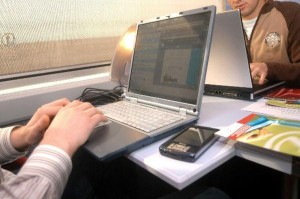
A few weeks ago a friend was showing me his new Chevy Volt. Not only does the hybrid-electric car get 42 mpg, it has its own Wi-Fi hotspot. That’s right. The car is a Wi-Fi device, so kids in the backseat can watch YouTube.

Days later we were on a road-trip from the Maryland shore when we caught the Lewes – Cape May ferry. Onboard the vessel they offered passengers free Wi-Fi.

Airlines have offered flyers Wi-Fi for years now. Discount bus lines like Megabus have free Wi-Fi. Even Connecticut’s new CTfastrak commuter bus system to Hartford gives its passengers free Wi-Fi.

But there is no Wi-Fi on Metro-North. And the railroad says none is planned, even though the new M8 railcars are ready for the needed gear. And therein lies a story.

Offering Wi-Fi on a moving vehicle usually involves cellular technology. That’s how the first airline Wi-Fi was offered by companies like Go-Go, though JetBlue and Southwest now rely on proprietary satellite systems, which are much faster (up to 30 mb per second.)

When Amtrak first offered Wi-Fi on its Acela trains between Washington and Boston, they immediately had bandwidth issues. So many passengers were using their cell phones and tablets, speeds dropped to 0.6 mb per second and the complaints came pouring in.

That’s part of the reason that Metro-North is reluctant to offer Wi-Fi: if an Acela train carrying 300 passengers can’t handle the online load, how could a 10-car train carrying a thousand commuters? The railroad has enough complaints as it is.

Metro-North’s experience with on-board communications has left them feeling burned. Remember years ago when the railroad installed pay-phones on the trains? Great idea, until a year later when costs came down and everyone had their own cell phone. Those pay cell phone booths went unused and were eventually removed.

Back in 2006 then-President of MNRR Peter Cannito said Wi-Fi would be built into the new M8 cars, both for passengers and to allow the railcars to “talk” to HQ by beaming diagnostic reports. The railroad issued an RFP for ideas and got a number of responses, including from Cablevision, with whom they negotiated for many months. They even initiated on-train testing of Wi-Fi gear on one railcar.

But Metro-North insisted any Wi-Fi would have to cost it nothing, that all the expense and tech risk would be borne by Cablevision or its customers. And that’s where the negotiations deadlocked.

Today the railroad sees Wi-Fi as just a convenience. Smart phones and cell-card configured laptops can access the internet just fine, they say, using cellular technology. But to their credit the railroad is trying to get cell providers to fill in the coverage gaps, for example, in the tunnels and at GCT.

So don’t look for Wi-Fi anytime soon on America’s biggest and busiest commuter railroad. It’s not seen as a necessity … except perhaps by its passengers who really have no other transportation option.

Jim CameronAbout the author: Jim Cameron is founder of The Commuter Action Group, and a member of the Darien RTM. The opinions expressed in this column are only his own. You can reach him at CommuterActionGroup@gmail.com For a full collection of “Talking Transportation” columns, visit www.talkingtransportation.blogspot.com

Talking Transportation: Is Uber Really a Bargain?

In the almost two years since Uber rolled into Connecticut, the state’s car/taxi service business has been rocked to its core. But is Uber competing on the same level as taxis and car service companies? Of course not, which is why it’s so successful.

I spoke with Uber’s Connecticut Manager Matt Powers and Drivers Unlimited (a Darien car & limo company) owner Randy Klein to try to get an objective comparison of the services. (Full disclosure: I have been a customer of both firms.)

While Uber does offer a “black car” (premium) service, my comparisons are with their more popular Uber X service … private cars driven by non-chauffeurs, 7,000 of whom have signed up as drivers in CT, according to Powers.

VEHICLES: Car services opt for Lincoln Town Cars and SUV’s. Uber X just requires drivers have a 4-door car, less than 10 years old with a trunk big enough to carry a wheelchair.

MAINTENANCE: Klein owns and maintains his own fleet, inspecting all cars weekly. Uber relies on its X drivers to do upkeep.

DRIVER SCREENING: Klein does his own background checks on top of the DMV screening required for a CDL (commercial drivers license). Uber says it does “rigorous” screening of drivers, including terrorist watch lists, but requires only a regular driver’s license. Klein’s firm also does random drug testing of his drivers.

INSURANCE: Klein has coverage of up to $1.5 million for every driver. Uber relies on the individual driver’s personal insurance but layers a $1 million policy on top when they are driving Uber customers.

RATINGS: Uber asks drivers and passengers to rate each other after every trip. Klein asks passengers to rate drivers but says it’s unfair to allow drivers to rate customers. “We’re in a service business,” he says.

BOOKING: Klein says most of his reservations are made two to three weeks in advance. Uber doesn’t do advance bookings, though, in personal experience, I’ve never had to wait more than 10 minutes for a car.

FARES: Though not an apples-to-apples comparison, an average car service ride from Darien to LaGuardia Airport is anywhere from $130 – $180, one-way. Uber’s quote for an X car is about $75.

SURGE PRICING: When demand is highest, Uber adds a surcharge to fare quotes, sometimes doubling the fare. Klein says his rates are the same 24 x 7.

IF YOU HAVE PROBLEMS: Klein says his office can be reached anytime by phone, toll-free. Uber’s website offers a template to file complaints online.

So, is Uber really a bargain? Let me answer with a hotel analogy. Sometimes I love staying at the Ritz Carlton with its plush rooms and fabulous service. Other times, a Motel 6 or LaQuinta is fine, though there’s always the risk of a “surprise”.

I see car services the same way. With a plush Lincoln SUV and chauffeur you get what you pay for. But sometimes all you want is to get from home to the airport and an Uber X is just fine … and a lot cheaper!

Jim Cameron

Jim Cameron

Editor’s Note: Jim Cameron is founder of The Commuter Action Group, and a member of the Darien RTM. The opinions expressed in this column are only his own.

You can reach him at CommuterActionGroup@gmail.com

For a full collection of “Talking Transportation” columns, see www.talkingtransportation.blogspot.com