Talking Transportation: What Does ‘On Time’ Really Mean?


Last spring, Japanese railroad officials apologized for a huge mistake: one of their trains left a station 25 seconds early!  This was the second time such an egregious error had been made and I imagine that the offenders were severely disciplined.

Meanwhile back on Metro-North’s New Haven line, the railroad’s latest OTP (On Time Performance) statistics stand at about 82 percent ... a new low.

To make matters worse, what the Japanese railroads and Metro North Rail Road (MNRR) consider “on time” are two different things.  “On time” in Japan means the 7:12 a.m. train departs at 7:12, not 7:11 (as in this horrendous incident which prompted the apology) nor at 7:13.  “On time” means on time.

Metro-North, however, defines a train is being on time if it arrives or departs within five minutes and 59 seconds of the scheduled time.  So the train due in Grand Central at 8:45 a.m. is still “on time” in its record keeping if it pulls in just before 8:51 a.m.

On a train run averaging an hour from Connecticut to Grand Central Station, that’s about a 10 percent margin of error, so their 82 percent “on time” record could really be much, much lower.  What the exact “on time” stats are, they will not say.

But Metro-North is not alone in such squishy record keeping.  Most commuter railroads in the US also observe this 5:59 standard.  And on Amtrak, it’s even worse.  On a short run (less than 250 miles), a train is on time if its 10 minutes late.  Long distance trains (over 550 miles) are given a 31-minute leeway.

When trains are late, there is usually a good reason.  For Metro-North it could be switch problems, overhead power lines (catenaries), track conditions and, of course, weather.  And when one train is late, delays can cascade, just like a fender-bender on I-95 can create a huge back-up.

But all of this is OK with me.  I’d rather be safe than on-time.

We used to be able to always count on MNRR to be on time and would schedule our travel accordingly, assuming no delays.  And yes, the trains were on time something like 98 percent of all runs.  But they were also unsafe and we didn’t know it.

So if my train now is five or 10 minutes late, that’s OK.  Because I took an earlier train just to be safe, I can handle the delay and still keep to my personal schedule.

Over the years I’ve found that when service on MNRR is messed up, there’s usually a valid explanation.  While commuters’ Tweets are quick to assume it’s stupidity or incompetence on the part of the railroad, it usually isn’t.  It’s aging equipment or things beyond their control.

The men and women who work at Metro-North may not be rocket scientists, but I honestly believe most of them are trying their best.

While OTP on the railroad has been slipping, there is one area where we have seen a huge improvement: communications.

A small army of railroad people now work 24/7 to Tweet and e-mail every problem on every line.  And they update the information, keeping us posted on delays.  That’s valuable information riders can use to make decisions, find alternatives and alert colleagues they may be late.

Let’s give the railroad credit for doing this much right.

 

Jim Cameron

About the author: 

Jim Cameron is founder of The Commuter Action Group, and a member of the Darien RTM.  The opinions expressed in this column are only his own.  You can reach him at CommuterActionGroup@gmail.com

For a full collection of “Talking Transportation” columns, visit www.talkingtransportation.blogspot.com

Posted with permission of Hearst CT Media.

Talking Transportation: Secret “Hacks” of Grand Central 

Grand Central Terminal stands resplendent in the center of New York City. Photo by Rob Bye on Unsplash.com.

There is possibly no more beautiful railroad station in the world than New York City’s Grand Central Terminal (GCT).  As the destination of over 55,000 daily rail commuters from Connecticut, it’s a place where many of us spend a fair amount of time.

I’ve been riding in and out of Grand Central for over 50 years.  So to help you maneuver the station’s labyrinth of tunnels, ramps and stairs, here are some of the “secrets” of Grand Central that I find most useful.

Underground Access:

Sure, you can enter Grand Central from street level, but in bad weather you can find your way there underground from blocks away.  The north-end access entrances at Madison and 47th St., Park Ave. and 48th St. and the Helmsley Building walk-ways are dandy, though not all open on weekends.  But did you know you can also access from 43rd or 45th St., west of Vanderbilt, from inside the Chrysler Building, the Hyatt Hotel on 42nd St. or via the subway’s shuttle station, on the south side of 42nd St., just west of Park?

Fastest Way from / to the Lower Level:

If your train dumps you on the lower level, forget about the ramps or stairs for the long climb to street level, especially with luggage.  Walk to the forward end of the train and look for the elevator near Track 112.  It’ll take you to the upper level or, better yet, to within steps of Vanderbilt Avenue (see below).  Getting to the lower level platforms from street level is just as easy.  On the upper level, look for the elevators and take them down to “P” (Platform) level avoid two flights of stairs.

Washrooms with No Wait:

The new washrooms at the west end of the lower level have helped a lot, but still there’s often a line.  Take the nearby escalators up one level, turn around, and on your left is the Stationmaster’s Office complete with a small waiting room and lav’s … but for women only!  Or, go right and just before the ramp up to 42nd St. and Vanderbilt, look on your left for the sign for the Oyster Bar.  Go down the steps into the bar and you’ll find ornate bathrooms known only to a few.

Best Place To Get A Cab:          

Forget about the long line at the taxi stand on 42nd St. east of Vanderbilt.  Instead, go out the west end of the Main Concourse, up the stairs and out onto Vanderbilt Ave.  Cross the street and wait at the corner of 43rd.  Taxis flow through here, dropping off passengers every few seconds. If you’re heading west you’ll avoid the traffic on 42nd Street too.

Where to Have a Smoke:

Want to enjoy a cigar before your train?  Forget about lighting up anywhere inside the station. Instead, go to the Hyatt Hotel just east on 42nd St. From street level, go up two levels by escalator to their taxi stand and you’ll find yourself on the raised Park Avenue as it wraps around GCT.

These are a few of my favorite “hacks” of Grand Central.  Drop me an e-mail with yours and I’ll include them in a future column.

Posted with permission of Hearst CT Media 

Talking Transportation: Trucks as Traffic Scapegoats

“Why don’t we just ban all trucks from our interstate highways in rush hour?”

The question was asked of me by a small town mayor in Fairfield County who’d obviously given a lot of thought to solutions to our traffic woes. He’s a smart guy and thought he’d come up with “the answer” to our transportation crisis.

He said he wasn’t in favor of tolls, but liked them as a traffic mitigation tool.  By charging trucks more to drive our highways in rush hour, they’d be incentivized to instead go off-peak.  He was just taking the idea a step further:  ban them completely at certain hours.

Well, I explained, that’s probably illegal.  This is an interstate, federal highway built to carry trucks.  Wouldn’t it be a better idea to tell the merchants where they are going to only accept deliveries at, say, 3 a.m. instead of 9 to 5, which is more convenient for the stores?

But the truck-haters are not satisfied.  Any number of candidates are calling for truck-only tolls, pointing to Rhode Island’s recent launch of such as system.  It’s been a huge success, raking in $625,000 in its first month of operation.

But it’s also attracted lawsuits, because it is illegal, just like the Mayor’s idea.  Tolling only big-rigs is a violation of the US Constitution’s “Commerce Clause”.  The truckers and big-box stores say it’s not fair to toll them and not charge drivers of cars and small trucks.  I’m no lawyer, but I think they’re right.

Trucks are not the problem.  Cars are.

But it’s so easy to blame the trucks for delays on our roads, isn’t it?  Blame them, instead of ourselves.  Toll them, not me. I’m not creating the traffic, they are.

Trucks are not allowed on the Merritt and Wilbur Cross Parkways, so why are those roads so congested?  Look at I-95 in rush hour and count the number of trucks vs. single-occupancy-vehicles.  Again, it’s the volume of the traffic, not the kind of vehicles that are causing the delays. It’s the geometry of the highway … too many exits and entrances … and too few alternatives (aside from rail).

Truckers don’t want to be on the interstates in bumper-to-bumper traffic any more than you do.  They are not out there, driving on I-95 and I-84, just to annoy you.  Compared to you, driving solo in your automobile, they are high-occupancy vehicles carrying your Amazon orders and making deliveries to the big box stores.  You put those trucks on the road, and now you want to ban them at certain hours?  Then you’ll be moaning about late deliveries.

You don’t want to pay tolls?  Trucks already do, even in Connecticut.  They pay higher state gas taxes (44 cents for diesel vs. 25 cents for gasoline), even if they don’t buy that gas in Connecticut.  And they must pay to register their trucks in CT, even if they are from out of state, thanks to the International Fuel Tax Agreement, or IFTA.

Add a layer of tolls on top of those costs and guess who’s going to pay?  You!

There’s no free lunch, folks.  And the solution to our traffic is not to blame others … but to look in the mirror.


Jim Cameron

About the author: 

Jim Cameron is founder of The Commuter Action Group, and a member of the Darien RTM.  The opinions expressed in this column are only his own.  You can reach him at CommuterActionGroup@gmail.com

For a full collection of “Talking Transportation” columns, visit www.talkingtransportation.blogspot.com

Posted with permission of Hearst CT Media.

Talking Transportation: ‘Train Time is Your Own Time’ … True or False?


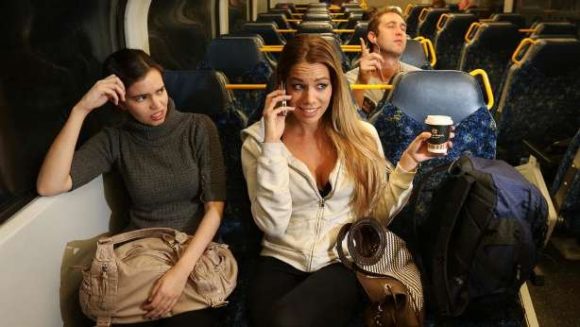
Train time is your own time” was the old marketing slogan of Metro-North, encouraging commuters to kick back and enjoy the ride while reading, working or taking a snooze.

But in reality, train time is shared time.  They don’t call it “mass transit” for nothing as passengers much share their space with a hundred other commuters on each railcar.

Assuming you get a seat, this means you’re squeezed in next to one or two fellow riders.

Usually commuters are respectful of each other and don’t blare their radios or carry on loud conversations, with each other or on cell-phones.  Or so we’d hope.

It was almost 20 years ago that Amtrak first introduced the concept of The Quiet Car, following suggestions of daily commuters riding to DC.  It was such a success that quiet cars were soon added to other Northeast Corridor trains and Acela.

The concept was simple, as conductors reminded passengers on every trip:  maintain a “library like atmosphere”.  That meant no cell phone calls and only quiet, subdued conversation.  You want to yuck it up over a beer, go to the Café Car.  Got an important phone call … sit in any other coach.

Other commuter railroads picked up Amtrak’s cue … but not Metro-North. While serving on the CT Metro-North Commuter Council, I regularly beseeched the railroad to give us a break and dedicate just one car to peace and quiet, convinced it would attract riders.  Finally in 2011, the railroad took the hint and launched such a car, branded as a “Quiet CALMmute”.

Victory for the sonically overloaded?  Not by a long shot.  This is Metro-North and if anyone can screw up a good idea, they can.

First, they offered the worst car location on the train to their CALMmute:  the last car in-bound and the first car out-bound from GCT.  And there were no signs indicating which car was “quiet”.  Worst of all, conductors all but refused to enforce the quiet rules, leading to altercations between passengers.

Conductors have no trouble enforcing other rules:  luggage on the overhead racks, no feet on the seats, no smoking etc.  But asking people to keep down the chatter was apparently too much.  All they would do, at first, was hand “Shhh cards” to offenders.

In 2016 the quiet car program was expanded to two cars per train, peak and off-peak.  But, still no signage (until just recently) and no enforcement.

Now, a major change.  The railroad announced that effective immediately there would be only one quiet car per off-peak train.  And the PR team at MNRR spun the story so well that some local media made it sound like the program was being expanded, not cut in half.  Brilliant.

There was no explanation for the cut in quiet cars though one official told me, “We have had no reports of quiet car demand exceeding availability in the off-peak.”  In other words, people who ride off-peak just prefer to yap.

That’s an amazing PR “spin” on what is really an admission of failure.  Metro-North never wanted quiet cars and clearly didn’t want to enforce the rules.  The people have literally “spoken” and the Quiet CALMmute won’t be as accessible anymore.

This is what happens when you have a monopoly, answerable to nobody, especially its customers.  I’d raise my voice in protest but … I’m in the quiet car.

Posted with permission of Hearst CT Media

Jim Cameron

About the author: 

Jim Cameron is founder of The Commuter Action Group, and a member of the Darien RTM.  The opinions expressed in this column are only his own.  You can reach him at CommuterActionGroup@gmail.com

For a full collection of “Talking Transportation” columns, visit www.talkingtransportation.blogspot.com

Posted with permission of Hearst CT Media.

Talking Transportation: “The Automotive-Construction Complex”

How did Americans develop their love affair with driving?

Visit the Smithsonian’s National Museum of American History in Washington and the transportation exhibit, “America on the Move,” will sell you on the commonly-held theory that when Henry Ford made cars affordable, Americans loved them and demanded more and more highways.

Of course, that exhibit is sponsored by General Motors, which donated millions to put its name on the collection.

But University of Virginia history Professor Peter Norton, author of “Fighting Traffic: The Dawn of the Motor Age in American Cities,” says that’s a myth.  Just as outgoing President Eisenhower warned us of the military industrial complex, Norton says an automotive-construction complex took over our country, paving from coast to coast.

Sure, Americans like their cars.  But it was a conspiracy of economic interests that turned us into a car culture.  Where cities once enjoyed a network of cheap, fast streetcars, GM, Firestone and the oil companies bought and wiped them out, replacing them with buses and cars.

“This country destroyed and rebuilt its cities in the 20th century to serve automobiles,” says Norton.  And those same interest groups are alive and well today in Connecticut.

Groups like “Move CT Forward” aren’t pro-transportation as much as they are pro jobs … their jobs, in construction.  And they’ve spent a lot of money lobbying in Hartford to keep their members, the unions and contractors, busy.   While I’m happy they’re promoting transportation, their motives are hardly altruistic.

This is nothing new, says Norton.  The original interstate highways built in the 1950s used Portland Cement because that company lobbied so hard for its product over cheaper asphalt.  And now that rusting rebar and crumbling cement is costing us a fortune.

Another myth from that era was that President Eisenhower built the interstates to move troops quickly for national defense.  That may have been the pitch to Congress, but the real reason for the highways was to evacuate civilians from the big cities in the event of nuclear war.  Lucky we never had to test that idea.

Last August when Hurricane Harvey hit Houston … the most urbanized highway city in the country … authorities didn’t even try to evacuate people because they knew more would die on congested roads than in the storm.

Who pays for all this road building?  You do, in the form of income taxes and, yes, gasoline taxes.  But Norton says gas taxes are hardly a fair way to pay for all this.

Why does the motorist driving on a dirt road pay the same gas tax as one driving I-95?  The costs they place on road maintenance, the environment and our stress levels are grossly different, so why isn’t the cost?

“It would be like having Best Buy selling everything by the pound.  People would flock to the electronics (our crowded interstates) instead of the towels,” he notes (though I’m not sure Best Buy even sells towels, but I take his point.)

He reminds us that before the interstates, the nation’s first “super highways” like the Pennsylvania Turnpike and the New Jersey Turnpike were built – not as freeways – but toll roads, and they still are today.

Driving may seem to be free, but it isn’t.  And until we ask drivers to pay for its real cost, there is no incentive to do anything but drive (and pave) more.

Jim Cameron

About the author: 

Jim Cameron is founder of The Commuter Action Group, and a member of the Darien RTM.  The opinions expressed in this column are only his own.  You can reach him at CommuterActionGroup@gmail.com

For a full collection of “Talking Transportation” columns, visit www.talkingtransportation.blogspot.com

Posted with permission of Hearst CT Media.