
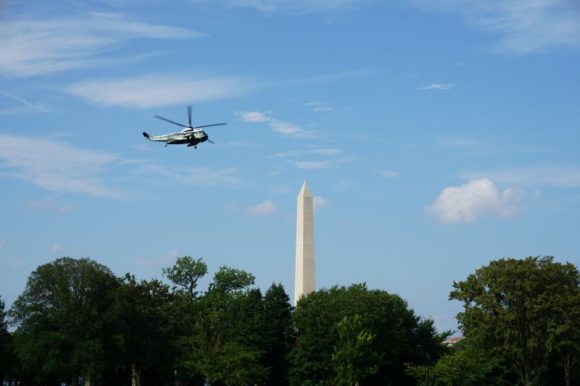
Talking Transportation: Connecticut’s Own … Igor Sikorsky

Photo by Adam Bignell on Unsplash.

Jim Cameron

Have you ever flown in a helicopter?

They seem such a glamorous (if expensive) way to travel, by-passing the traffic en route to the airport or sightseeing over rugged terrain.

But do you know that the helicopter had its first flight ever right here in Connecticut, the creation of Russian immigrant and inventor Igor Sikorsky, 80 years ago.

Sure, Leonardo da Vinci made early drawings of a vertical flying machine, but that was in the 1480s.  And kids had been playing with hand-turned, propeller-driven toys for centuries before that.

Sikorsky drew his earliest concept drawings of a helicopter years before the Wright brothers ever flew at Kitty Hawk.  But when he fled Russia with his family, it was fixed-wing aircraft that gave Sikorsky his start in aviation.

At the age of 21 he designed his first airplane, the S-1, a single-engine pusher biplane. Twenty-three designs later he built the S-42 flying boat, made famous by Pan American as “The Flying Clipper”.  The four-engined craft had a range of 1200 miles carrying 37 passengers by day or 14 by night in berths, cruising at 170 mph.

Even as Pan Am was opening literally over-seas markets, Sikorsky was still working on his dreams of a helicopter.  At his plant in Stratford his VS-300 made its first flight, albeit tied to the ground, in September of 1939.

A 1942 version, the Sikorsky R-4, became the first mass-produced helicopter, quickly adopted by the armed forces of the US and UK. It had only one crew member, could carry just 500 pounds, but had a range of 130 miles flying 65 mph at up to 8000 feet.

Flash forward to the present and Sikorsky’s old company, now part of Lockheed Martin, still produces helicopters. Sikorsky’s successor companies, then part of United Aircraft Corp, even designed the short-lived (1968 -1976) Turbotrain, powered by a Pratt & Whitney turbine “jet engine.”  The train could make the 230-mile New York to Boston run in three hours and 39 minutes.  Today’s Acela can do the same run in no less than 3 hours 55 minutes.

In a competition with the electric-powered Metroliner in 1967, the Turbotrain hit 170 mph, a land-speed record for a gas turbine-powered rail vehicle. Acela does no better than 145 mph.

Today’s modern helicopters come in all sizes and speeds … from the beefy Seahawk SH-3 “Sea King” which can carry five tons over 600 miles at 166 mph … to “personal” helicopters for one person flying 60 miles at 80 mph.

For helicopter fans, New York’s east-side heliports at Wall Street and 34th Street offer the chance to see luxury craft in action, some privately owned, others offering passenger service.  BLADE Helicopters will get you to the Hamptons from midtown in 33 minutes starting at $695 one-way.

In the 1960s, NY Helicopter flew from the NY airports to the top of the Pan Am building. I took that flight once, transferred to an elevator and walked onto a train in Grand Central.  For a while they even choppered to Stamford’s heliport on Canal Street in the South End.

Much has changed in aviation in the last 80 years since Sikorsky’s first helicopter took to the air.  And to think that it all started here in Connecticut.

Posted with permission of Hearst CT Media

About the author: Jim Cameron is founder of The Commuter Action Group, and a member of the Darien RTM.  The opinions expressed in this column are only his own. You can reach him at CommuterActionGroup@gmail.com  For a full collection of  “Talking Transportation” columns, visit www.talkingtransportation.blogspot.com

Talking Transportation: Commuting Can Make You Sick

Jim Cameron

It shouldn’t come as much surprise to learn that commuting, especially by car, is hazardous to your health.

Research now shows that the longer your drive, the greater the risk of obesity, heart attacks and even low birth-weight babies for moms-to-be.  At fault are a number of factors:

STRESS: 
Being stuck in bumper-to-bumper traffic increases your cortisol and adrenaline levels, increasing your risk of a heart attack during your drive and for an hour after. Getting angry when someone cuts you off only makes things worse.  Increased blood pressure also leads to lack of sleep, leaving you tired even as you leave the house each morning.

OBESITY:  
The longer your commute, by car or mass transit, the more sedentary your life and the less exercise you get.  Couple that commute with fast food (and its sugar, salt and fat) and you’re at even greater risk.

BACK & NECK PAIN:   
A 2010 Gallup poll shows that a third of all people who commute more than 90 minutes a day complain of pain due to poor posture and uncomfortable seating.

POLLUTION: 
The longer you’re stuck in traffic the more bad air you breathe. A 2007 study of Los Angeles residents showed that half of their exposure to harmful air happened during their drive time.

LOW BIRTH-WEIGHT:    
Researchers at Lehigh University, studied New Jersey birth records. They found that for pregnant women commuting 50 miles each day, there was a 1 percent increase in the chance of having a low birth-weight baby for every 10 miles they traveled. Not only was “chronic maternal stress” a factor, but so too were missed doctor visits due to lack of free time.

The average commute time for Connecticut residents is 26 minutes each way, and climbing.  For Fairfield County residents going to jobs in New York City, it’s more than an hour.  And as traffic worsens and trains run slower, those commute times are climbing.

For those who bike or walk to work, the risks are lessened, but not eliminated.  The physical exertion is better for your heart, but bikers and pedestrians are still prone to collisions and accidents en route.

Just 20 years ago up to 70 percent of kids walked to school.  Now it’s only about 20 percent as the others take the school bus or are driven by Mom.  We’re turning our kids into local commuters at a very young age.

What can you do if you must commute long distances?  Plenty:

Try not to get stressed out while driving.  Leave a bit earlier than usual so you’re not grinding your teeth fearing you’ll be late.  Listen to books on tape, podcasts or something fun … not the news, which will only contribute to anxiety.  Try varying your route.  A change of scenery will keep you engaged.

On mass transit, don’t isolate yourself.  Socialize by talking to your fellow commuters (but not in The Quiet Car!)

In your automobile, keep the windows up and the air recirculating to avoid auto exhausts.  Make up for the sedentary (though stressful) drive by taking a walk at lunch.

Acknowledge the lack of control in your commute when traffic or train delays happen.  Just know that you’re doing the best you can with the things you can control … that you’re going to get there eventually and most of all that you’re trying to get their safely.

Posted with permission of Hearst CT Media

About the author: Jim Cameron is founder of The Commuter Action Group, and a member of the Darien RTM.  The opinions expressed in this column are only his own. You can reach him at CommuterActionGroup@gmail.com  For a full collection of  “Talking Transportation” columns, visit www.talkingtransportation.blogspot.com

Talking Transportation: The Train Ride From Hell 

Jim Cameron

It was the railroad trip from hell:  the hottest day of the year, stuck for five hours on a sold-out Amtrak train where only half the cars had air conditioning.

The ride to Washington days earlier had been uneventful, almost on time and pleasantly cool, even though I’d made the mistake of taking a Northeast Corridor train, not Acela.  Its older Amfleet cars, though recently refurbished on the inside, are still 50-years-old.

But coming back from Washington on a torrid Sunday, by cheaping out for the slower, less expensive train I got what I’d paid for.  Put another way, I didn’t get what I’d paid for.

Already a half-hour late arriving in Washington from Newport News Va., train #88 arrived on one of DC’s low-level platforms, meaning boarding passengers had to cue up for about 30 minutes before even being allowed on the platform to board.

One of the station agents said that “extra cars” had been added in Washington, so I immediately headed to the front of the train where I assumed the new cars would be empty.  It was already 98 degrees in DC, heading for a “feels like” high that day of 110, so I was looking forward to the super-AC Amtrak is known for.

No such luck, as even the newly added cars were only slightly cooler than outside.  That’ll improve when we get going, I thought.

Wrong!

By Baltimore it was getting hot and the fan system was intermittent.  Pleas for help to the conductors brought nothing more than promises that “they’ll try to reset the system in Philly,” another hour away.

In desperation I turned to social media, Tweeting sarcastically about Amtrak’s new “Sauna Cars”.  Direct messaging to @Amtrak brought no response.

The train was getting later and later on its schedule, partly because of the heat’s adverse effect on the power lines and potential warping of the rails. Knowing there’d be a lot of passengers getting off and on in Philly, I plotted my move to one of the few cars with breathable air.  Success … a cooler, though not cold, car with seats.

At Philadelphia, nothing changed, though we did learn that five of the 10 cars on this train bound for Boston carrying 700+ passengers were without air conditioning.

The DC conductor crew never apologized, though they did offer small, free bottles of water, which quickly ran out. But when a new set of conductors boarded in New York, the tone changed significantly.

“We apologize folks.  This is not the kind of service we want to provide or you deserve.  Please call 1-800-USA-RAIL and register a complaint.  If the cars don’t reset after New York, we’ll try again at New Haven,” said one conductor on the PA system.

We got off in Stamford, arriving 90 minutes late, so I don’t know if the cars ever did get cooler during the next four hours run to Boston.

The next day I called Amtrak Customer Service.  A 20+ year veteran agent commiserated, empathized and got me a refund voucher.

“Those old Amfleet cars shouldn’t be refurbished, they should be retired,” she said.  “Their air conditioning is either on or off.  There’s no moderating the temperature.  Next time you should take Acela,” she added.

Never mind that Acela costs twice as much.  Its AC works and it’s mostly on time! I’ve learned from my mistakes.

Posted with permission of Hearst CT Media

About the author: Jim Cameron is founder of The Commuter Action Group, and a member of the Darien RTM.  The opinions expressed in this column are only his own. You can reach him at CommuterActionGroup@gmail.com  For a full collection of  “Talking Transportation” columns, visit www.talkingtransportation.blogspot.com

Talking Transportation: Airlines That Are No More

Which airline company will disappear next into the clouds? Photo by Leio McLaren (@leiomclaren) on Unsplash.

Rail fans call them “fallen flags”… railroads that are no more, like the original New Haven and New York Central Railroads.  But before I start getting all misty-eyed, let’s also pay homage to airlines that have flown away into history.

Like PEOPLExpress, the domestic discount airline ,which flew out of Newark’s grungy old North Terminal starting in 1981.  Fares were dirt cheap, collected on-board during the flight and checked bags cost you $3.  You even had to pay for sodas and snacks.  The airline expanded too fast, even adding a 747 to its fleet for $99 flights to Brussels, and was eventually merged with Continental under its rapacious Chairman Frank Lorenzo, later banished from the industry by the Department of Transportation.

There were any number of smaller, regional airlines that merged or just folded their wings, including MidwayL’ExpressIndependence AirAir CaliforniaPSA and a personal favorite, Midwest Express, started by the Kimberly-Clark paper company to shuttle employees between its mills and headquarters in Milwaukee.

Midwest flew DC-9’s, usually fitted with coach seats in a two-and-three-configuration, but equipped instead with business-class two-and-two-leather seats.  Meals were free and included fresh baked chocolate chip cookies.

We all probably remember the fallen giants like TWA (acquired by American Airlines), Eastern Airlines (also gobbled up by Lorenzo), Braniff (which even flew a chartered Concorde at one point between Washington DC and Dallas TX) and Pan American (which was the US’s semi-official overseas airline for decades.)

And let’s not forget more recent carriers like Continental, merged with United Airlines in 2012 or US Airways (previously known as Allegheny Airlines), which was taken over by American Airlines in 2015.  Or how about the old Northwest Orient, which Delta took over in 2008?  I especially remember flying AmericaWest before its 2005 merger with USAir.

And then there were the name-change carriers, like ValueJet which rebranded as AirTran after a deadly crash in the Florida Everglades in 1996 following a series of maintenance and safety issues.  A 1982 crash of an Air Florida jet taking off in a Washington DC snowstorm quickly grounded that airline for financial reasons.

Anyone remember the Trump Shuttle, successor to Eastern Airlines’ Boston – LaGuardia – DC hourly service?  It only flew for three years but innovated such in-flight technology as GTE’s Airphone.  You could even rent laptops for use in-flight.

But did you know that the cruise ship line Carnival once had its own airline of the same name?  Its fleet of 25 jets funneled passengers to their ships in Fort Lauderdale until 1997 when Pan Am took it over, only to itself go belly-up months later.

Another quirky little airline was MGM Grand Air which flew JFK to LA in an all first-class, luxury configuration. There were swiveling lounge seats, private cabins, an onboard chef and even in-flight fax machines. Their 727 carried only 33 passengers and operated out of a private terminal at LAX, making it very popular with camera-shy celebrities. One way fares were $1400.

But did you know that there was also a Hooters Air, modeled after the restaurant chain of the same name? From 2003 to 2006 the seven plane fleet featured business class seating at low fares and in-flight meals served by, you guessed it, tight t-shirt clad Hooters Girls. The restaurant chain is still going, but the airline folded after $40 million in losses.

Jim Cameron

Posted with permission of Hearst CT Media

About the author: Jim Cameron is founder of The Commuter Action Group, and a member of the Darien RTM.  The opinions expressed in this column are only his own. 

You can reach him at CommuterActionGroup@gmail.com  For a full collection of  “Talking Transportation” columns, visit www.talkingtransportation.blogspot.com

Talking Transportation: Summer Vacation … Fly or Drive?

Photo by Sai Kiran Anagani on Unsplash

Going on vacation this summer?  If so, the question is … how to travel: drive, take the train or fly? (I’m eliminating the bus option because, well, life is too short to endure that kind of misery.  I have no problems with commuting by bus, but a 10-hour ride is not going to happen!)

In most cases, the choice depends on how far you’re traveling and what your budget allows. For trips of 300 miles or less, the train is my first choice … assuming it goes where I want.  In the Northeast, Amtrak service is frequent, convenient and affordable.  But to other destinations, not so much.

But it also depends on how many are in your ‘party’ (and traveling with your family is always a party, right?) because traveling as a family of four can add up, especially when each member needs a ticket.  Even going into New York City can be cheaper by car (including tolls and parking) than on Metro-North when you have three or more people.

Flying is faster, but maybe not if you include all of the door-to-door time: driving to the airport, arriving two or three hours before departure, checking your bags, going through security, then after arrival at your destination grabbing your bags, finding your rental car, driving to your destination.  In most cases by train, you go from city-center to city-center.  And by car, well, you get to determine where you’re going.

By train you get to see the country.  But so too with driving.  Train travel is pretty stress-free.  Not so with driving, and certainly not in flying.

In about eight hours you can drive 400+ miles, even with pit-stops.  If two drivers can share the behind-the-wheel duties, a full 12-hour day’s worth of driving can easily get you 700 miles.  That’s almost the distance to Chicago or maybe Atlanta.  But staying alert can really take its strain, so be sure to take frequent breaks and caffeinate.

Of course, having kids on board can complicate things … more stops, more whining.  “No, we’re not there yet!  Play with your Gameboy.”

If you’re confused about the fly-drive value calculations, there’s a great website that can help:  the Be Frugal Fly or Drive Calculator.  Plug in the information … origin, destination, make and model of car, driving hours … and voila!  The app will figure the cost for both alternatives, even including highway tolls and your car’s mpg.  Mind you, gas prices are heading up this summer, so factor that in too.

The final issue is safety.  You do want to arrive alive, right?

It used to be on airlines that after you landed the flight attendant would say something like “The safest part of your journey has just ended, so drive safely”.  Statistically, that’s true.

Federal safety stats say that one person dies for every 100 million vehicle miles traveled.  (Interestingly, Connecticut’s statistics are lower than the national average). Still, there are a lot more highway crashes than air disasters. In 2018 there were no fatalities on US commercial flights and worldwide, only one fatal accident for every 300 million flights.

The National Safety Council says you have one chance in 114 of dying in an automobile crash, but only one chance in 9,821 of dying on a flight.  You’re eight times likelier to die by drowning on vacation.

Thanks to the stronger US economy, a lot more people will be taking a vacation this summer.  A little planning and you should be able to save time and money.  So, bon voyage!

Posted with permission of Hearst CT Media.

Jim Cameron

About the author: Jim Cameron is founder of The Commuter Action Group, and a member of the Darien RTM.  The opinions expressed in this column are only his own. 

You can reach him at CommuterActionGroup@gmail.com  For a full collection of  “Talking Transportation” columns, visit www.talkingtransportation.blogspot.com