Reading Uncertainly? ‘The Wild Places’ by Robert Macfarlane

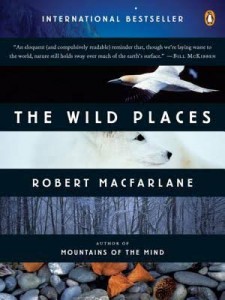
The_Wild_Places_by_Robert_MacFarlaneLast year, at our son’s suggestion, I read and reviewed with enthusiasm Robert Macfarlane’s The Old Ways (2012), his recounting of extensive walks in Great Britain, Spain, Palestine, and Tibet (see LymeLine.com review of Oct. 12, 2014.) That led me to his Landmarks (2015) and now to an earlier work, The Wild Places.

What begins as a eulogy for our disappearing wilderness becomes an elegy, even a celebration of remoteness, privacy and “the wild.” But the reply of the wild, wherever he finds it, at the remote corners of the British Isles or in his own Cambridge backyard, is “reports of my demise are premature!”

Macfarlane, a don at Emmanuel College, Cambridge, mixes remarkable research, reading and language, to explore both geographic and intellectual wildness. On his perambulations, he is always picking up small rocks, leaves, stems, feeling them, admiring them, and saving them for his library. He links every trek with apt, far-ranging quotations from a global entourage of writers. And his words, what words …

Consider:

  • “ideas like waves have fetches.”
  • The sky a “slurless blue”
  • The “grain of the mind”
  • “a row of hawthorns quaffed eastwards by the onshore winds”
  •  the “krekking of a raven”
  • “small waders – knots, plovers, turnstones – form their palping jellyfish-like shoals”
  • “a gang of rooks chakked over the corn stubble”
  • “I had a heptic memory, too.”
  • A rock that was “knapped out.”

Do you recognize any of the places he visited: Ynys Enlli (Scotland), Coruisk (Isle of Skye), Rannoch Moor (near Glencoe), Black Wood (east of Rannoch Moor), Cape Wrath (Scotland north coast), the Holloways (Dorset), Orford Ness (Suffolk), and Burren (north of County Clare, Ireland)? Macfarlane comes to acknowledge that wildness is often found close to home. How many of us know Hog Pond (the old name), Cedar Pond, Brown Hill, Joshua Rocks, Whalebone Creek, Nickerson Hill, Moulson’s Pond, Oliver’s Hole or Rat Island?

Wildness, to this professor, is “a quality to be vanquished and to be cherished.” It has “implications of disorder and irregularity” but it is also “an expression of independence from human direction … containing an energy both exemplary and exquisite.” Wild places remind us “of the narrow limits of human perception, of the provisionality of (our) assumptions about the world.”  Our response: “a brief blazing perception of the world’s disinterest” in what we humans have created — they give us “this sense of the human presence as being something temporary.”

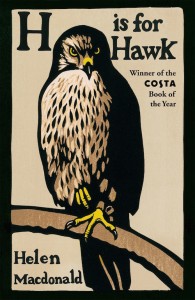
Fellow wanderers appear.  Macfarlane asks a “Helen” to join a walk seeking birds: falcons, tiercels, ospreys, goshawks, and peregrines. None other than Helen Macdonald, also a professor at Cambridge, whose H Is For Hawk I enjoyed earlier this year.

The Wild Places reminded me of my own traipsing along the public footpaths of West Sussex and the South Downs, in the fall of 1978, and along the wanderwegs of St. Gallen and the Appenzell in Switzerland in the 1980s and 1990s. Plus the trails of Nehantic State Forest in the 1990s …

Macfarlane suggests wildness is an attribute to be carefully enjoyed, with both sight and sound: “rooks haggled in the air above the trees … the noise of the wood in the wind; a soft marine road. It was the immense compound noise of friction – of leaf fretting on leaf, and branch rubbing on branch.”

His admonitions: listen and look. Wildness may be close at hand.

Editor’s Note: The Wild Places by Robert Macfarlane was published by Penguin, New York, 2007.

Felix Kloman_headshot_2005_284x331-150x150About the Author: Felix Kloman is a sailor, rower, husband, father, grandfather, retired management consultant and, above all, a curious reader and writer. He’s explored how we as human beings and organizations respond to ever-present uncertainty in two books, ‘Mumpsimus Revisited’ (2005) and ‘The Fantods of Risk’ (2008). A 20-year resident of Lyme, he now writes book reviews, mostly of non-fiction that explores our minds, our behavior, our politics and our history. But he does throw in a novel here and there. For more than 50 years, he’s put together the 17 syllables that comprise haiku, the traditional Japanese poetry, and now serves as the self-appointed “poet laureate” of Ashlawn Farms Coffee, where he may be seen on Friday mornings. His wife, Ann, is also a writer, but of mystery novels, all of which begin in a bubbling village in midcoast Maine, strangely reminiscent of the town she and her husband visit every summer.
Reading Uncertainly? ‘Worrying: A Literary and Cultural History’ by Francis O’Gorman

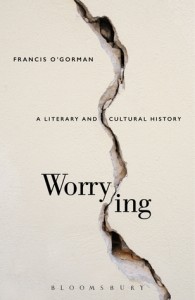
Worrying_“What if … ?” This is the key question that confronts all worriers, their dominant question about an ever-uncertain future. Professor O’Gorman, who teaches at the University of Leeds (U.K.) readily admits he is a worrier, and, in this slim volume (163 pages) he deftly probes, with humility plus good humor, the various definitions, strategies, relevant observations, advantages, and consolations, concluding with some fatalism that there may be little he can do about his condition. He actually begins with his end, “If we can’t ‘cure’ worry, we can venture to understand it – for better or worse.”

Here is his definition: “Worry is a form of fretfulness, of mental uncertainty and persistently tremulous bother,” the “fretful evaluations of the options in our life.” English has many synonyms: fretting, anxiety, bother, concern, fidgeting, doubt, nervousness, apprehension, and perplexity. Rodgers and Hart expressed them well in their hit song from Pal Joey (1940), “Bewitched, Bothered, and Bewildered.”

The dictionary’s verb is defined as “to feel uneasy or concerned about something,” but it also has an alternative “to pull or tear at something, as with the teeth.” It is when normal worry disintegrates into the dog’s work that we become concerned.

So is worry abnormal? For many of us it is a compulsive habit, “part of the fabric of life,” as O’Gorman argues, but too often seen as anti-social. He suggests: “Life is overflowing with opportunities to fret!”

For some of us who are trying to manage organizations facing numerous “risks,” “worry’s primary concern is about an uncertain future or, more exactly, about a future that has some element of the uncertain in it.” Our problem is that one “worry leads to another, and consequential worries.”  And that is unhealthy as too many of us have a “fixed belief that there is, today, something risky about tomorrow.” We end up fearing, not relishing, the future.

Indeed, “daring to be happy is a risk” in itself to a worrier.

Dr. O’Gorman suggests that “worry” also breeds ritual: routines, religions, compulsive habits, not all pleasant.  “The fundamental tenets of the major world religions will look delusional to the skeptic atheist, while seeming the brightest of reality to the believer.” So who is right? What is sanity? The author suggests a re-statement of Descartes’ mantra: “I worry; therefore I am.”

His arguments are ripe with the pertinent and often amusing citations of an enormous range of writers: Bronte, T.S. Eliot, George Eliot, the Bible, Shakespeare, Trollope, Kipling, Auden, Woolf, Joyce, Hardy, Darwin, Gladstone, Descartes, Homer, Mill, Sebald, Boswell, Frost, and, above all, Bach. Plus, of course, numerous academics.

Is reason an antidote for worry? “Reason can gather information. It can enumerate the issues. It can search out matters pertinent to the problem in hand. But the worrier’s reason is notoriously bad at suggesting a way forward.” “Worry’s a kind of mental risk assessment that regularly fails to result in an action plan …”

O’Gorman elaborates, “Our reasoning mind has come, in the contemporary world, to be bogged down in debilitating conditions of fretful decision-making and persistent blame, the grim and politicizing consequences of the apparently innocent and cheering pleasures of choosing.” And, “We run through options, assimilating and listening for the give-away signs of ideas we haven’t listened to. We’re always alert to the snuffling in the undergrowth of bristly problems we’ve not already imagined. We’re analysts who are genuinely good at analyzing even if we take little pleasure in our gifts and frequently fail to adjudicate on the most likely outcomes.”

What is the alternative? Should we all become Doctor Panglosses who exist in this, the most perfect, world? O’Gorman does offer the idea that the “arts” (painting, poetry, and especially music) can divert the worrier, but not permanently. They are, to him, a temporary distraction.

His book was a temporary but thoroughly engaging distraction for me, a non-worrier. I think like Alfred E. Neuman, the cover cartoon character for MAD Magazine, who persistently stated, “What? Me worry?”

I’m also reminded of the classic folk song of the Carter Family, first sung in 1930, “It takes a worried man to sing a worried song.” The last line is the best: “I’m worried now but I won’t be worried long!”

Editor’s Note: Francis O’Gorman, Worrying: A Literary and Cultural History, Bloomsbury, London 2015.

Felix Kloman_headshot_2005_284x331-150x150About the Author: Felix Kloman is a sailor, rower, husband, father, grandfather, retired management consultant and, above all, a curious reader and writer. He’s explored how we as human beings and organizations respond to ever-present uncertainty in two books, ‘Mumpsimus Revisited’ (2005) and ‘The Fantods of Risk’ (2008). A 20-year resident of Lyme, he now writes book reviews, mostly of non-fiction that explores our minds, our behavior, our politics and our history. But he does throw in a novel here and there. For more than 50 years, he’s put together the 17 syllables that comprise haiku, the traditional Japanese poetry, and now serves as the self-appointed “poet laureate” of Ashlawn Farms Coffee, where he may be seen on Friday mornings. His wife, Ann, is also a writer, but of mystery novels, all of which begin in a bubbling village in midcoast Maine, strangely reminiscent of the town she and her husband visit every summer.

Reading Uncertainly? Ruminations on Henry David Thoreau’s Walden, 1854

With the advent of a new year, this seemed the perfect time to publish this wonderful review by our resident book reviewer and aspiring poet Felix Kloman. Felix looks back at a book published 161 years ago and yet finds contemporary wisdom among its pages, some of which is especially pertinent as we enter 2016.

Walden_by_Henry_David_ThoreauAs my stack of reading dwindled recently to nothingness, by chance I was drawn to my ancient copy of Thoreau’s story of his two-year-long self-proclaimed “exile” to the shores of Massachusetts’ Walden Pond. My re-read was well worth the time.
Some stimulating thoughts from the Massachusetts monk, who sought solitude but could not refrain from talking and writing about it:

  • On a Lyme summer evening’s solitude: “This is a delicious evening, when the whole body is one sense, and imbibes delight through every pore.” I considered this observation as I, too, sat quietly on our Lyme porch, overlooking meadows, our Ely’s Ferry Road, and, closer to hand, our orange-embossed cyphea (pronounced like “goofier,” I am advised by my resident horticulturist), whose juices were being avidly sucked away by several hummingbirds. They actually seemed to squeak after each tongue-licking. As Thoreau concluded “… my serenity is rippled but not ruffled.”
  • On the delights of quiet conversation with a few intelligent friends, reminding me of my regular Friday morning “communions” at Ashlawn Farm Coffee: “Having each some shingles of thought well dried, we sat and whittled them, trying our knives, and admiring the clear yellowish grain of the pumpkin pine. We waded so gently and reverently, or we pulled together so smoothly, that the fishes of thought were not scared from the stream, nor feared by any angler on the bank, but came and went grandly, like the clouds which float through the western sky, and the mother-o’-pearl flocks which sometimes form and dissolve there. There we worked, revising mythology, rounding a fable here and there, and building castles in the air for which earth offered no worthy foundation … To converse with whom was a New England Night’s Entertainment. Ah! Such discourse we had …”
  • On spending too much time worrying: “A man sits as many risks as he runs.” Thoreau went on to explain: “The old and the infirm and the timid, of whatever age or sex, thought most of sickness, and sudden accident and death; to them life seemed full of danger – what danger is there if you don’t think of any? – and they thought that a prudent man would carefully select the safest position.” Has anything changed in the past 161 years? Doesn’t seem like it …
  • As I am an aspiring yet amateur poet, contributing occasional haiku to the Ashlawn Farm cognoscenti, I found reassurance in this from Henry David: “… but nothing can deter a poet  … Who can predict his comings and going?”
  • And, finally, Thoreau’s concluding advice: “ … explore your own higher latitudes … Open new channels, not of trade, but of thought … There are continents and seas in the moral world, to which every man is an isthmus or an inlet, yet unexplored by him …“

Surprises can be enthralling and energizing, if only we anticipate them with pleasure. This is just how I found my re-reading of Walden.

Do try your own re-read.

Felix Kloman_headshot_2005_284x331-150x150About the Author: Felix Kloman is a sailor, rower, husband, father, grandfather, retired management consultant and, above all, a curious reader and writer. He’s explored how we as human beings and organizations respond to ever-present uncertainty in two books, ‘Mumpsimus Revisited’ (2005) and ‘The Fantods of Risk’ (2008). A 20-year resident of Lyme, he now writes book reviews, mostly of non-fiction that explores our minds, our behavior, our politics and our history. But he does throw in a novel here and there. For more than 50 years, he’s put together the 17 syllables that comprise haiku, the traditional Japanese poetry, and now serves as the self-appointed “poet laureate” of Ashlawn Farms Coffee, where he may be seen on Friday mornings. His wife, Ann, is also a writer, but of mystery novels, all of which begin in a bubbling village in midcoast Maine, strangely reminiscent of the town she and her husband visit every summer.

Reading Uncertainly? ‘The Social Conquest of Earth’ by Edward O. Wilson

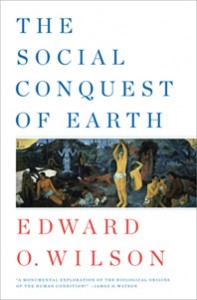
SocialConquest_Mech.inddWho are we?

This has been the eternal question of our curious and self-reflective species. Paul Gauguin, in Tahiti in 1897 in his final painting, expanded this question into three: D’ou Venons Nous? Que Sommes Nous? Ou Allons Nous? (Where do we come from? What are we? And where are we going?) As the weather finally begins to cool, it is time for some serious reading …

Edward O. Wilson, the noted Harvard chronicler of ants, has embarked on a trilogy to try and answer all three. The first, The Social Conquest of Earth, addresses the Gauguin threesome in short, pithy chapters, easy for today’s creatures accustomed to electronic social networks. No Proustian rambling for him!

“We have created a Star Wars civilization,” he begins, “with Stone Age emotions, medieval institutions, and god-like technology. We thrash about. We are terribly confused by the mere fact of our existence, and a danger to ourselves and to the rest of life.” His argument, which represents the story of the evolution of social life and its driving forces, is controversial.

It goes like this: “The social conquerors of Earth” dominate today, but they include not only homo sapiens but also ants, bees, wasps, and termites, species that are possibly more than 100 million years older than us (we emerged several 100,000 years ago, only spreading across this globe over the past 60,000 years). It is altogether probable that these other “eusocial species” — less than two percent of the one million known species — will remain long after we disappear.

Our human condition is both selfish and selfless: “the two impulses are conflated … the worst of our nature coexists with the best, and so it will ever be.” Our “hereditary curse” is “our innate pugnacity … our bloody nature (in which) individuals prefer the company of others of the same race, nation, clan, and religion.”

Wilson continues, “The biological human mind is our province. With all its quirks, irrationality, and risky productions, and all its conflict and inefficiency, the biological mind is the essence and the very meaning of the human condition.”

In answering the question, “What are we?” Wilson explores the origins of culture, language, cultural variation, morality, honor, religions and creative art, suggesting “human beings are enmeshed in social networks.” And in these networks, we express our “relentless ambivalence and ambiguity … the fruits of the strange primate inheritance that rules the human mind.”

Wilson submits that religions are logical hallucinations in response to the ever-unanswered question, determining that, “ … religious faith is better interpreted as an unseen trap unavoidable during the biological history of our species. Humankind deserves better … than surrender and enslavement.”

The final chapter of this engrossing and illuminating exploration asks, “Where are we going?” Do we have free will? Wilson answers his question thus: “We are free as independent beings, but our decisions are not free of all the organic processes that created our personal brains and minds. Free will therefore appears to be ultimately biological.” Are we social creatures? Wilson suggests, ” … group selection (is) the driving force of where we have been and where we are going.”

We, a convoluted and introspective species, live in an “extremely complex biosphere” in which we must respect the “equilibrium created by all the other species, plants, animals, and microorganisms around us.” Failure to do so may mean our collapse or even that of the entire system.

But Wilson concludes on an optimistic note, saying, “Earth, by the twenty-second century, can be turned, if we so wish, into a permanent paradise for human beings, or at least the strong beginnings of one.”

This first philosophical exploration of human existence has been followed by the second, The Meaning of Human Existence, published in early 2015, and the third, The End of the Anthropocene will follow shortly.

Together they require serious reflection.

Editor’s Note: The Social Conquest of Earth, by Edward O.Wilson was published by W. W. Norton & Co., New York 2012.

Felix Kloman_headshot_2005_284x331-150x150About the Author: Felix Kloman is a sailor, rower, husband, father, grandfather, retired management consultant and, above all, a curious reader and writer. He’s explored how we as human beings and organizations respond to ever-present uncertainty in two books, ‘Mumpsimus Revisited’ (2005) and ‘The Fantods of Risk’ (2008). A 20-year resident of Lyme, he now writes book reviews, mostly of non-fiction that explores our minds, our behavior, our politics and our history. But he does throw in a novel here and there. For more than 50 years, he’s put together the 17 syllables that comprise haiku, the traditional Japanese poetry, and now serves as the self-appointed “poet laureate” of Ashlawn Farms Coffee, where he may be seen on Friday mornings. His wife, Ann, is also a writer, but of mystery novels, all of which begin in a bubbling village in midcoast Maine, strangely reminiscent of the town she and her husband visit every summer.

Reading Uncertainly? ‘H Is For Hawk’ by Helen Macdonald

H_is_for_HawkThe New Yorker ads trumpet admiring words: “Riveting;” “Breathtaking;” Dazzling;” “Captivating.” May I offer a modest dissenting view?

Helen Macdonald’s new novel about her response to the death of her father in England and her adoption of a goshawk to help her overcome her misery is, in fact, an orgy of compulsive introspection. She draws heavily on the earlier history of T. H. White, the author of the Arthurian novels, including The Once and Future King, and, more importantly, his own story of self-awareness, The Goshawk. 

White also tried to tame a bird, much less successfully than Macdonald.  This self-assessment actually becomes a triple biography: of Helen Macdonald, of T. H. White, and of Mabel, the hawk she trains.

Macdonald begins by arguing that “I was a different animal. . . . . Like White, I wanted to cut loose from the world.” She quotes Marianne Moore: “the cure for loneliness is solitude,” just Helen and Mabel. She sees England as “an imaginary place.”

The essence of this book is found is her words: “Sometimes when light dawns it simply illuminates how dismal circumstances have become.” But some 300 pages of gloom?

But Helen Macdonald does write lyrically. Her observant eye notes and her mind translates what she sees into phrases often reminiscent of James Joyce in Ulysses and Finnegan’s Wake (the more coherent ones!). The English countryside comes alive with her descriptions: clouds, flowers, grasses, and, above all, birds..

And so does Mabel, her adopted goshawk, come alive, so much so that at the end we are rooting for her future, not Helen’s. She is in fact the one intensely interested in her outside world. The goshawks, ospreys and eagles wheeling in the skies above Lyme make me think of Mabel.

Editor’s Note: ‘H is for Hawk’ is by Helen Macdonald and was published by Grove Press, New York in 2014

Felix Kloman_headshot_2005_284x331-150x150About the author: Felix Kloman is a sailor, rower, husband, father, grandfather, retired management consultant and, above all, a curious reader and writer. He’s explored how we as human beings and organizations respond to ever-present uncertainty in two books, ‘Mumpsimus Revisited’ (2005) and ‘The Fantods of Risk’ (2008). A 20-year resident of Lyme, he now writes book reviews, mostly of non-fiction that explores our minds, our behavior, our politics and our history. But he does throw in a novel here and there. For more than 50 years, he’s put together the 17 syllables that comprise haiku, the traditional Japanese poetry, and now serves as the self-appointed “poet laureate” of Ashlawn Farms Coffee, where he may be seen on Friday mornings. His wife, Ann, is also a writer, but of mystery novels, all of which begin in a bubbling village in midcoast Maine, strangely reminiscent of the town she and her husband visit every summer.