You might not realize it, but Connecticut is home to the world headquarters of a $5 billion international railroad company on whose trains you’ll never be able to ride.
In a small office building across from the Darien railroad station sits the offices of Genesee and Wyoming Inc, a “short line” railroad conglomerate. The original railroad, founded in 1899, hauled salt on a 14-mile track in upstate NY. Today, G&W owns 122 different railroads on three continents, serving 3000 customers with over 16,000 miles of track.
A “short line” railroad, as its name implies, only operates over short distances, sometimes thought of as rail freight’s first and last mile. They pick up boxcars and tankers at factories and plants and carry them to junction points where they hand them off to the major railroads which carry them to their ultimate destination, a journey often completed by another short line railroad.
In the US G&W’s railroads are as short as a single mile in length and as long as 739 miles. They operate 1300 locomotives and 30,000 railcars. But they only carry freight, not passengers.
And because they only travel short distances, they’re not looking for speed as much as customer service. Moving along at 15 mph saves a lot on track maintenance.
How does G&W’s sales team sell companies on shipping by rail instead of truck? Fuel costs. Trains are four times more energy efficient, a crucial consideration when you’re hauling tons of stone, coal, or wheat instead of Amazon boxes filled with packing peanuts.
The G&W’s most local affiliate, The Providence & Worcester, runs a train on Metro-North tracks each night, hauling crushed rock from Connecticut quarries to Queens NY. I can hear the train from my home, usually just before midnight, as its locomotives strain under the load and rumble through town.
That’s about the only freight train left on the New Haven line. But that’s another story for another time.
Overseas the G&W owns some much larger railroads, but still dedicated only to freight. They run trains, container terminals and freight yards in the UK, Germany, Poland, Belgium and the Netherlands.
Down under in Australia the G&W runs a huge freight operation running north-south through the heart of the continent serving the iron ore and manganese mines hauling intermodal containers through the desert-like interior.
How does a tiny, 20-person office in Darien oversee such a massive railroad network around the planet? It doesn’t. Each of G&W’s nine operating regions is locally managed with capital allocated from headquarters. Keeping the decision-making close to the customers, not being second-guessed from thousands of miles away, has been the key to G&W’s success.
But one thing that all of G&W’s railroads do share in common is the color scheme of their logos, originally designed by Milton Glaser (famous for the I Love NY logo). Every G&W railroad’s logo is orange and black. Not just any orange, but Princeton orange, harkening back to its former chairman’s alma mater.
Posted with permission of Hearst CT Media
Jim Cameron
About the author: Jim Cameron is founder of The Commuter Action Group, and a member of the Darien RTM. The opinions expressed in this column are only his own. You can reach him at CommuterActionGroup@gmail.com
Our son, a teacher of English and a sailor, recommended this new study of the Homeric poems, the Iliad and the Odyssey. I had read them in the Robert Fagles translations, the first in 1996, the second a year later. Nicolson’s learned and lyrical commentary brings these 4,000-year-old stories into a fresh perspective of how memory, epic and history are important to us.
He argues that Homer “makes the distant past as immediate to us as our own lives.” In addition, the author is an accomplished sailor, adding to his understanding of Odysseus’s peregrinations throughout the Mediterranean.
These poems present a “plunging perspective into the ancient,” seeking “a form of reassurance that in the end there is some kind of understanding in the world … a braided stream of possibilities pouring into the present out of the past.” Nicolson adds, “no place for Homer is more filled with tragedy than the beach, ”a point of transition for the Greeks transforming themselves from a land-based horde to sea-faring seekers.”
But who was Homer?
Nicolson suggests, “there was no human being called Homer; his words are the descendants of memory and power, the offspring of the muse who had a beautiful voice.” Stories were created, then passed along from generation to generation through memory and song, always modified to fit more current conditions.
“Homer was an ancient inheritance in the eighth century BC … already a thousand years old … The Homeric poems, or at least versions of them, were written down … perhaps about 725 BC, or maybe as much as a century later.” And even then successive scribes often altered the written versions. “Homer is haunted by the threat of transience, by the way memory fails and meanings drift in the face of time.”
To Nicolson the Iliad is “ … a tapestry of sorrow, in which the noncity is set against the city, where the marginal and contingent confront the settled and the secure … the loved against the abused, the creative against the destructive forces of life.” And, yes, even today!
The Greeks attacking Troy were northerners, Indo-Europeans, “their roots in the steppelands of Eurasia … semi-nomadic pastoralists” exhibiting “the hero complex: maleness, heroic individuality and dominance.” Their theme: “… we are all vagabonds on earth, nothing belongs to us, our lives have no consequence and our possessions are dross. We are wanderers, place shifters, the cosmic homeless.” The settled, affluent, and wealthy Trojans didn’t have a chance.
Much of this recurs in the Odyssey: “the heart of the poem is this contingency, the absence of any over-riding permanence,” the continuous search for meaning..
Nicolson’s frequent allusions to sailing are almost elegiac. Here is one about the Odyssey: “They won’t be wrecked on the illusions of nostalgia, the longing for that heroized, antique world, because . . . to live well in the world, nostalgia must be resisted; you must stay with your ship, stay tied to the present, remain mobile, keep adjusting the rig, work with the swells, watch for the wind-shift, watch as the boom swings over, engage, in other words, with the muddle and duplicity and difficulty of life. Don’t be tempted into the lovely simplicities that the heroic past seems to offer.”
Solid counsel for some of our politicians today!
While the Homeric poems illustrate the horrific mores of some 4000 years ago, “ . . . the usefulness of violence, the lack of regret at killing, the subjection and selling of women, the extinction of all men in a surrendering city or the sense that justice resides in personal revenge,” “what is valuable and essential in these poems is the opposite of that: the ability to regard all aspects of life with clarity, equanimity and sympathy, with a loving heart and an unclouded eye.”
Homer “provides no answers, ”… but simply illustrates, “the complexity of life, the bubbling vitality of a boat at sea, the resurgent energy, as he repeatedly says, of the bright wake starting to gleam behind you.”
To conclude: “So now, each time the wind fills in, and you roll your headsails out and get the main up, and you feel the boat starting to gather way, to pick up its skirts, unable to resist the pull of the wind, you will know something essential of the Homeric world. Here under the bow you can listen, like the Phaeacians carrying Odysseus home, to the water surge and fall, that repeated hoosssh-hoosssh of a hull at speed.
And here, as you make your way between the blue islands, the boat heeled far over and the curves of the headsails bellied out to leeward, you can begin to know and sense the power of possibility in the well-balanced, well-benched ship, equipped with all it needs, acquiring the world, stretching the idea of what it means to be alive, leading men to adventure, home or war.”
Isn’t it time to read Nicolson and rereadthe Iliad and the Odyssey?
Editor’s Note: ‘Why Homer Matters’ by Adam Nicolson was published by Henry Holt & Co., New York 2014.
Felix Kloman
About the Author: Felix Kloman is a sailor, rower, husband, father, grandfather, retired management consultant and, above all, a curious reader and writer. He’s explored how we as human beings and organizations respond to ever-present uncertainty in two books, ‘Mumpsimus Revisited’ (2005) and ‘The Fantods of Risk’ (2008). A 20-year resident of Lyme, he now writes book reviews, mostly of non-fiction, which explores our minds, our behavior, our politics and our history. But he does throw in a novel here and there. For more than 50 years, he’s put together the 17 syllables that comprise haiku, the traditional Japanese poetry, and now serves as the self-appointed “poet laureate” of Ashlawn Farm Coffee, where he may be seen on Friday mornings. His late wife, Ann, was also a writer, but of mystery novels, all of which begin in a village in midcoast Maine, strangely reminiscent of the town she and her husband visited every summer.
The European Union (EU) is under attack from all sides.
Will the EU strike back?
The most serious threat against Europe is the dislocation of the world system of security and defense, which Europe relies on as a protection. During the past two years, an avalanche of steps taken by the US is unraveling the Atlantic-dominated frameworkwith a possible US pull-back from NATO;a hasty and sloppy departure of US troops from Syria in December 2018 putting the European allies in front of the fait accompli; breaking away from the Intermediate-Range Nuclear Forces Treaty (INF) in February 2019 (immediately followed by Russia doing the same thing the next day.)
The noxious transatlantic relations came to light during the Munich Security Conference (MSC), February 15-17, an annual event, since 1963, attended by the decision-makers of the world.Angela Merkel was the voice of many worried Europeans. The contrast between her speech and US vice president Mike Pence’s was striking.
Without a script, the German chancellor made a passionate plea for multilateralism, clearly pointing at the US, Russia and China to save the world order which she sees in danger of decline and destruction.
She received a standing ovation.
After her spirited performance, the US Vice President’s words sounded leaden.“He admonished Europeans the way Brejhnev did the Iron Curtain countries back in the USSR days,” commented a French analyst. Pence’s speech was met with an icy reception.There was an incredible moment when he brought Donald Trump’s greetings.
An interminable and deafening silence followed. He clearly was expecting applause from the audience.
Russian Foreign Minister Sergei Lavrov proposed to prolong the New START (Strategic Arms Reduction) Treaty after 2021. This treaty – limiting the number of long-range nuclear missiles- is one of the last remaining from the cold war era.
Sylvie Kauffman, editorial writer for Le Monde, commented, “The Europeans feel left out in the cold, tetanized by the major powers working out a system above their heads.”Sigmar Gabriel, former German minister of foreign affairs, wrote, “In a world of carnivorous geopolitics, the Europeans are the last vegetarians.After the departure of the UK, we will become vegans, then prey.”
One way to attack and therefore weaken Europe is to capitalize on the fact that it is divided. Some foreign powers have become quite adept at using the “Trojan horse” strategy.
On Feb. 13-14, the US and Israel chose Poland as the location of a conference on the Middle East. In Warsaw they were able to meet with the other members of the Visegrad group (V4) —Hungary, Slovakia and Czech Republic. These four countries are run by populist and authoritarian governments and clear in their intention to unravel the EU as it exists today.There was little media coverage here about the conference, which was by-passing Brussels. Federica Mogherini, High Representative of the EU for Foreign Affairs, was not even present.
Steve Bannon, former advisor of Donald Trump is busy traveling all over Europe, giving his support to populist countries like Italy and Hungary.He proclaims that Brexit is a great thing and advocates the creation of a possible axis through Rome/Budapest/Warsaw to counter the Franco-German “couple”.He has purchased a monastery near Rome and turned it into a training center for “sovereignists.”
Europe represents a juicy market of over 700 millions inhabitants. It is particularly vulnerable because it continues to respect some rules, which are disregarded elsewhere.The most striking illustration of unfair competition is the recent failure of the fusion of the two European railroadmagnates Alstom and Siemens. The EU Commissioner for competition, Margrethe Vestager, stopped the process lest it violates the antitrust rule, a rather outdated notion when one considers the size of the giant telecommunications companies in the US.The danger for Europe is that this decision in Brussels leaves the way wide open for China.
China is by far the main predator trying to wedge its way into Europe, hiding under a charming euphemism of “silk road” (the Chinese call it also the “Belt and Road Initiative.”)The investments of Xi Jinping’s government have increased in leaps and bonds to reach a peak in 2016, particularly in the infrastructure of smaller and poorer Eastern European countries, where they are financing bridges, tunnels, or taking over commercial harbors, airports.Even in Western Europe, they are rescuing failing companies or acquiring new ones — China has already taken over the electricity grids of Greece, Italy and Portugal.
How can the EU strike back?
Nathalie Loiseau, French Minister of European Affairs, 55, an extremely intelligent woman and a candidate to watch for in the May 26 European elections, wants to be positive and stresses what has been accomplished, “We have gained more in 18 months than in decade on the subject of defense … Germany has joined us on the idea of a common budget for the Euro zone … Poland agrees with France on the PAC(Common Agricultural Policy) … There is no cohesion among the nationalist governments … Austria and Hungary disagree on many topics.”
Business leaders of the MEDEF (Movement of French enterprises) met in February to reassert their economic sovereignty against malicious cyber attacks and industrial espionage, “Being liberal, they say, does not mean being naive.”
On March 4, the French president Emmanuel Macron published a “Letter to the Citizens of the 28 EU countries.” His vision for the “renaissance of the construction of Europe” is consistent with the seminal speech on foreign policy that he gave at the Sorbonne on Sept. 26, 2017, and also with the Aix-la-Chapelle Treaty of Jan. 22, 2019, between France and Germany. Macron advocates a protective Europe with externalborders guaranteeing free “Schengen Space,” a strong defense and security treaty, the harmonization of salaries, and protection against cyber attacks during elections.
The reactions of the 28 EU members were favorable, although several of them said that trust is more important than the creation of new institutions.
The attitude of all the member countries of the EU to Brexit has proved that those 27 countries do not, in fact, want to leave Europe.Chief Brexit negotiator Michel Barnier has so far accomplished the almost impossible in keeping his troops together.
Editor’s Note: This is the opinion of Nicole Prévost Logan.
Nicole Prévost Logan
About the author: Nicole Prévost Logan divides her time between Essex and Paris, spending summers in the former and winters in the latter. She writes a regular column for us from her Paris home where her topics will include politics, economy, social unrest — mostly in France — but also in other European countries. She also covers a variety of art exhibits and the performing arts in Europe. Logan is the author of ‘Forever on the Road: A Franco-American Family’s Thirty Years in the Foreign Service,’ an autobiography of her life as the wife of an overseas diplomat, who lived in 10 foreign countries on three continents. Her experiences during her foreign service life included being in Lebanon when civil war erupted, excavating a medieval city in Moscow and spending a week under house arrest in Guinea.
The perennially popular mac & cheese. Photo by Hermes Rivera on Unsplash.
I don’t remember tasting mac and cheese until I was 14- or 18-years-old. i.e., high school or college cafeterias. Nobody made it in my house. I remember asking for it when I was fairly little, but at my house it was made with cottage cheese, sour cream, maybe butter, cinnamon and egg noodles. Basically, it was unconstructed noodle kugel.
When I was married the first time, I cooked the boxed Kraft Macaroni and Cheese. When it was done, I put it into a Corning glass pot, sliced a tomato down the middle and ran some breadcrumbs around the tomatoes. For me, that was cooking and garnishing. Then my-then mother-in-law showed me how to make a white sauce and I made mac and cheese from scratch. (She also showed me how to make pork roast on top of sauerkraut, take it out of the oven, take them apart and add applesauce to the sauerkraut. I still make it the same way. It is delicious.)
Of course, almost everyone loves mac and cheese. As I get older, I take a lactase pill before I eat mac and cheese, as many do these days. And I will make sure I have the ingredients to make all the recipes in this month’s Food Network Magazine, of which the one below is the yummiest.
Glam Mac and Cheese
From Food Network Magazine, March 2019, page 48
Yield: serves 4
12 ounces fusilli Kosher salt One-third cup diced pancetta 1 small handful of fresh thyme 3 scallions, thinly sliced 3 tablespoon unsalted butter 3 tablespoon all-purpose flour Pinch of ground nutmeg 1 teaspoon mustard powder\ Three-quarters whole milk (2 percent is fine) 1 and one-quarter cups heavy cream 7 ounces dulcelatte or gorgonzola cheese, crumbled (about 1 cup) 4 ounces parmesan cheese, grated (about 1 and one-half cups) Freshly ground black pepper One-quarter cup breadcrumbs 1 handful chopped fresh parsley, for garnish
Preheat oven to 400 degrees. Cook pasta in a large pot of boiling salted water. Cook just less than al dente, as the pasta will be cooked again in the oven. Reserve 1 cup cooking water, then drain pasta, return it to the pot and set aside.
Fry the pancetta in a medium skillet over medium heat until it just starts to brown and crisp up, then add thyme and scallions and cook for an additional 3 minutes. Add the skillet’s contents to the pasta.
For the sauce, put butter, flour, nutmeg and mustard powder in a small saucepan set over medium heat and cook, stirring, until butter has melted. Mix milk and cream together in a pitcher and add a little to the flour and butter in the saucepan, stirring well. Keep adding milk mixture bit by bit, stirring well each time (be sure to get into the “corners”ofthe pan, as flour often lurks there). Once the sauce has fully come together, turn up the heat and boil for a minute or two. The sauce will thicken. Remove pan from the heat.
Add two-thirds of both the cheeses to the sauce while it is still hot and combine well. (It may be a bit lumpy, that is fine.) Season to taste with salt and pepper and add to the pasta mix. If the cheese sauce thickens too much, add some of the pasta water. Stir everything together and spoon into 4 large ramekins in a shallow 3-quart casserole.
Sprinkle the top with the rest of the cheese and the breadcrumbs and bake in the oven for about 20 minutes, or until the cheese starts to bubble and the topping goes brown. Sprinkle with chopped parsley and serve.
About the author: Lee White (left), a former resident of Old Lyme, has been writing about restaurants and cooking since 1976. She has been extensively published in the Worcester (Mass.) Magazine, The Day, Norwich Bulletin, and Hartford Courant. She currently writes Nibbles and a cooking column called A La Carte for the Shore Publishing newspapers, and Elan, a quarterly magazine, all of which are now owned by The Day.
A diplomatic crisis is going on between France and Italy. Salvoes of insults proffered by deputy prime ministers Matteo Salvini (extreme right) and Luigi Di Maio (anti-establishment) are flyingacross the Alps.A red line was crossed when Di Maio went to France and met with the most radical gilets jaunes who openly demand the resignation of the French president and the overturn of all political institutions.
This constituted a provocation and a never-seen before interference by one member of the European Union (EU)into another’s internal affairs.While on an official visit to Cairo, French President Emmanuel Macron disregarded these heinous remarks with total indifference. Paris recalled its ambassador to Italy – the first time since June 10, 1940 when André François Poncet left Rome following the declaration of war by Mussolini to defeat France. (The French ambassador is already back in Rome)
Tension is high. It is part of the long history of a difficult relationship between the two countries. During the unification of Risorgimento (1848 -1861), France often came to the rescue. At the famous battle of Solferino (1859), a Franco-Sardinian army led by Napoleon III and Victor Emmanuel IIdefeated the Austrians under Emperor Franz Joseph I. In contrast, the annexation of the county of Nice and the Savoie region to France, decided by the Treaty of Turin, was deeply resented by Italy, as was the loss of 550 sq. kms. including the mountain passes of Tende and La Briguein February 1947.
The second cause of friction between the two countries stems from remnants of a colonial past.Italy often challenged France’s intrusion into what it considered its zone of influence. It never really accepted the Bardo Treaty of 1881, which createdFrance’s protectorate over Tunisia. In 1911, Italy had colonized Cyrenaica and Tripolitania, which were to become Libya.So, when the French and British conducted air strikes over Libya with UN supportin 2011, Italy complained of having been kept out of the loop.
Economic and commercial dissensions between the two countries are not unusual. Some might recall that Italy refused to participate in the World Fair of 1889 in Paris.Today the STX shipyard of St Nazaire may pass under the control of the Italian company Fincantieri in spite of France’e efforts to retain a majority vote. At stake in this confrontation is construction of the largest cruise ships in the world, such as “Harmony of the Seas,” which has become the latest vessel to join the Royal Caribbean fleet.
While Italy and France often behave like quarrelsome siblings, they are more than close culturally: they are complementary. Take art for instance.At the turn of the 20th century, France may have been the center of the art world with Monet, Manet, Degas, Cezanne, Gauguin and others, but at the same time, a new school of painting called “Futurism” was growing in Italy with artists like Marinetti, Boccioni, Cora, Bala, and Severini.The lattet were champions of the fast pace of the city, depicting cars, planes and all forms of modernity as well as being pioneers in the expression of movement and speed.
On a lighter side, a Franco-Italian film currently showing on French screens, is the perfect illustration of the closeness of those two “cousins.”The plot of the Estivants (the vacationers), directed by Valeria Bruni Tedeschi – sister of Carla Bruni, former French president Nicolas Sarkozy’s wife – isset in a beautiful residence on the Cöte d’Azur. A well-off and rather dysfunctional Franco-Italian family spends long hours on the terrace overlookingthe Mediterraneanframed by cypress trees. Mixing the two languages, the guests discuss every subject under the sun, including societal conflicts evoked by the servants. Well-known actor Pierre Arditi is perfectly odious in the way he makes disparaging remarks about the lower classes while he older mother is at the grand piano playing the background score created by a talented Italian composer.
The present crisis between France and Italy is linked to the flow of migrants since 2015. Due to the “Dublin rule” making the European country of entry responsible for the refugee status and because only 200 kilometers separate Italy from the African shores, Italy has been on the front line in facing the surge. Salvini accused other EU members, particularly France, of not sharing the burden of welcoming refugee seekers.
The Italian government worked with the Libyan authorities to block the departure of migrants from Africa and prevented humanitarian ships from entering Italian ports. The “Aquarius” had to remain on the high seas for two weeks with dozen of migrants on board. it is worth noting that both France and Italy have about the same percentage(10 percent) of immigrants.Also, more than two-thirds of the sub-Saharan migrants come from former Italian colonies.
Di Maio is erroneously accusing France of investing the “Franc CFA ” (African Financial Community currency) in its own economy. The fact is that eight African countries asked Paris to put the money in the Banque de France‘svaults for safe-keeping.
For Salvini and Di Maio, Macron is the prime target. For them, the French president crystallizes the policies rejected by their populist government:a progressive, multilateralist program with an integrated Europe. Their plan is to create an axis through Italy, Poland and Hungary of authoritarian and non-liberal states capable of countering the actions of the Franco-Germanic “couple” – an ominous trend for Europe.
The Italian economy is sitting on a time bomb. Its public debt is 133 percent of the GDP, only second to Greece’s. It ranks at the bottom in Europe for GDP growth. The populist program of increasing minimum wages, lowering retirement age and other social measures, is bound to increase the deficit.Scolded by Brussels. the Italian government had to revise its budget. Of course, the fact that Pierre Moscovici, the Commissioner for Financial Economic Affairs in Brussels, is French, contributesto the sour relations.
What does this crisis hold for the future?Seen from here, the histrionics of the Italians are not always taken seriously. Paolo Levi, Paris correspondent of La Stompa recently commented that Salvini was able to intercept a malaise and his political movement might not last.
How sad that both France and Italy were founding members of the EU that was created by the Treaty of Rome in 1957 …
Editor’s Note: This is the opinion of Nicole Prévost Logan.
Nicole Prévost Logan
About the author: Nicole Prévost Logan divides her time between Essex and Paris, spending summers in the former and winters in the latter. She writes a regular column for us from her Paris home where her topics will include politics, economy, social unrest — mostly in France — but also in other European countries. She also covers a variety of art exhibits and the performing arts in Europe. Logan is the author of ‘Forever on the Road: A Franco-American Family’s Thirty Years in the Foreign Service,’ an autobiography of her life as the wife of an overseas diplomat, who lived in 10 foreign countries on three continents. Her experiences during her foreign service life included being in Lebanon when civil war erupted, excavating a medieval city in Moscow and spending a week under house arrest in Guinea.



 Our son, a teacher of English and a sailor, recommended this new study of the Homeric poems, the Iliad and the Odyssey. I had read them in the Robert Fagles translations, the first in 1996, the second a year later. Nicolson’s learned and lyrical commentary brings these 4,000-year-old stories into a fresh perspective of how memory, epic and history are important to us.
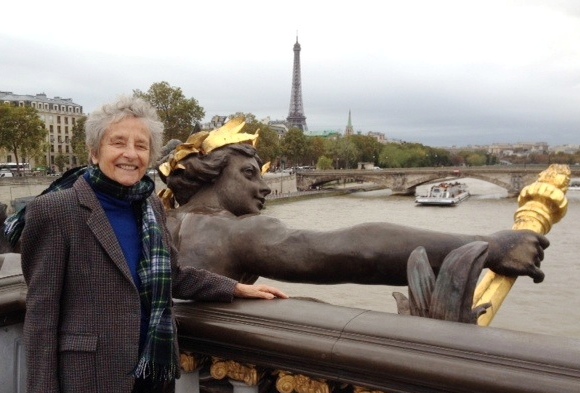


 About the author: Lee White (left), a former resident of Old Lyme, has been writing about restaurants and cooking since 1976. She has been extensively published in the Worcester (Mass.) Magazine, The Day, Norwich Bulletin, and Hartford Courant. She currently writes Nibbles and a cooking column called A La Carte for the Shore Publishing newspapers, and Elan, a quarterly magazine, all of which are now owned by The Day.