Archive

Site Snapshot 11 September 2025

Archive

Legal News You Can Use: Injured at Work? Should I Make a Worker’s Comp. Claim?

Looks safe enough, but injuries can happen anywhere in a work environment.

Sponsored Post from Suisman Shapiro Attorneys-at-Law 

Imagine that you’re working at your desk. There are no significant hazards around you. You reach up and pick up a heavy box above you, and you suddenly feel a snap along your shoulder. You’ve been working in the same position for many hours, and combined with the strain of the weight of the box, you’re now struggling with a painful injury.

Situations like yours aren’t uncommon. It’s actually relatively common for accidents to happen on the job with little that can be done to prevent them. Whether it’s because of repetitive motions, picking up something too heavy or other causes, injuries can happen in an instant.

When they do, you need to know what to do next. No matter what kind of injury you suffer, your employer should help you file a claim with the workers’ compensation insurance carrier. If your injury is extremely painful, a coworker can take you to the hospital, or your employer can call for an ambulance.

It’s important that you receive care right away so that you can prevent the injury from worsening.

What information should you keep from the hospital visit?

Keep every piece of paperwork you receive. You should also inform the medical provider that this is a work-related injury so that they can give you copies of the correct documents for your employer.

If you are hurt on the job in any way, workers’ compensation should be there to protect you and pay for your medical care. Don’t delay in telling someone if you get hurt so you can get care quickly.

The Suisman Shapiro website has more information on the compensation and benefits you may receive after a work injury.

Letter From Paris: Seeing “Red” at the Grand Palais

Nicole Prévost Logan

The year 1917 in Russia marked a unique moment of history when art and  revolution fused together into a mutual source of inspiration. The creativity and energy fed on each other for a short few years, to eventually vanish under the brutal repression and purges of Stalin to become an official and bland art form called “Socialist Realism.”

The exhibit “Red – Art and Utopia in the Soviet Country” at the Grand Palais, Paris, in the spring of 2019 is breaking new ground in describing that unique moment.

All forms of arts were impacted by the October Revolution, from the visual arts to architecture, theater, cinema, music and, of course, literature.  In addition to major artists, already well known before World War I, such as Malevich, the Bolchevik government did welcome all talented artists eager to experiment with new art forms.

Mayakovsky (1893-1930) was the voice of the Revolution – a giant with a booming voice, who galvanized the crowds when he read his poetry.  His emblematic play, the “Bedbug,” is a satire of the NEP (New Economic Policy.)  A young man of that period is frozen and found himself  in a perfect communist world 50 years later where there was no drunkenness nor swearing. 

He decided he was not made for the future.  As a journalist, Mayakovsky used  simple street  language.  A gifted artist, he drew satirical cartoons, making fun of the “petty bourgeoisie.” One of the main metro stations in central Moscow was named after him. He shot himself in 1930 at the age of 37.

Malevich (1878-1935), a major artist of the 20th century, was inspired until 1914, by Gauguin, Matisse and Cezanne, and then moved to abstraction and geometric forms until he reached his extreme “White on White” in 1918.  He was the theoretician of art par excellence. 

His book “From Cubism to Suprematism in Art …” is considered one of the most important reference works of the 20th century. Toward the end of his life he was  forced to reintroduce figurative characters into his paintings.  He never left the Soviet Union where he died of cancer in 1935.

Tatlin (1885-1953) was associated with the concept of “constructivism,” based on the use of materials, the exploitation of movement and tension in matter.  He aimed at the harmonization of artistic form with utilitarian goals.

Artists’ association multiplied at that time.  AKhRR  (Association of Russian Artists of Revolutionary Russia) was founded in 1922.  Vkhutemas (higher Institutes of art and technique) were created as early as 1920 all over the country.  Both Malevich and Tatlin occupied important positions in those institutions .

Vsevolod Mayerhold, (1874-1940) following in the footsteps of Stanislavsky (master of the stage in the 19th century – particularly Chekhov plays), revolutionized theatrical techniques, suppressed settings and replaced them by “constructivist” space, trained the actors according to a new system of “bio-mechanic” and how to form human pyramids. His stage production of Mayakovsky’s  “Bed Bug” is emblematic of the Soviet era.

Rodchenko  (1891-1956) was the leading innovator of the 1917 revolution-inspired  art.  He wanted to bring art down from its pedestal.  He stood against estheticism and “art for art” and made art the champion of productivity. He created a new artistic language by experimenting with photography, using photo-montage, double exposures, and unexpected angles. He gloried the machine in a factory or objects of daily life rather than still life motives in traditional art.

Among this group of brilliant artists were two women – Lioubov Popova, (1889-1924), who died of scarlet fever, and  Varvara Stepanova (1894-1958i), Rodchenko’s wife.
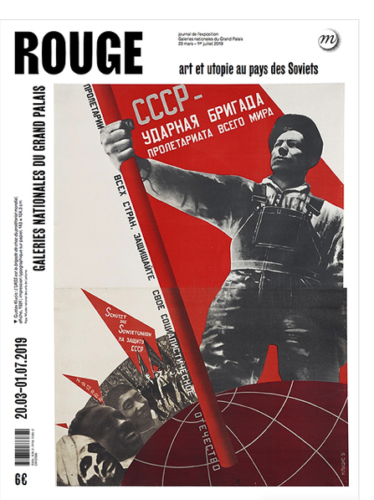
A poster by Gustav Klutsis.

Posters became a new art form used as the most important tool of propaganda. They were intended to make a strong and immediate impact on the viewer.  Using a graphic art medium with calligraphy and geometric designs, they carried a simple message.  The color red was used extensively  (it is interesting to note that, in Russian, “red” and “beautiful” are the same word.)

Oversize paintings like “Bolchevik” by Kustodiev are easy to understand.  A giant man walks through dwarfed  city landscape with churches, holding a huge red banner.  The messages of the October revolution were spread throughout the country in the “agit-prop trains”  to educate the masses.  Some figures are impressive: in 1917 the literacy of the population  was 25 percent whereas by 1939, it had risen to 81 percent.

Gustav Klutsis (1895-1935), born in Latvia, was also one of the best at using photo-montage and posters . He wrote: “Put color, slogan at the service of class war.”  Klutsis was arrested and shot in 1938.

Sergei Eisenstein  (1898-1948) – a pioneer of the cinema – created his own style characterized by melodramatic acting, close-up shots and theatrical editing.  A sequence of “Battlefield Potemkin” has become an absolute classic: during an attack by the Cossacks against Odessa civilians, a baby carriage falls all the way down the long steps.

Eisenstein ‘s mob scenes are so realistic (such as the storming of the Winter Palace in St Petersburg) that they are often mistaken for newsreels in documentaries.

Architecture played a crucial role in bringing about utopia of the proletariat.  Plans for grand buildings, squares and majestic avenues are intended to impress the masses, who are more important than the individuals.  Still standing today is the workers’ club Roussatov designed by Melnikov.
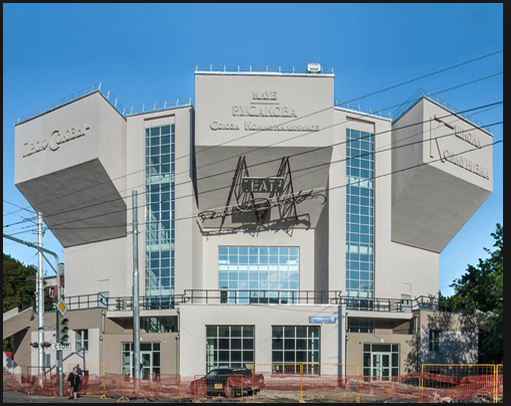
Roussakov Workers’ Club designed by Melnikov, 1927-28.

After the death of Lenin in 1924, power became concentrated in the hands of Stalin, who tightened his control over artists.  In 1932  all artistic associations were suppressed — artists were forced to join the official Union.

The creative, innovative productions had to bend and conform to rules of the new doctrine of Socialist Realism formulated by Andrei Zhdanov in a speech to the Writer’s Union in 1934.  In art,  it can be defined as representation of the bright future of communism through the representation of idealized  workers in healthy bodies.

Therefore, at the 1937 Universal Fair held in Paris, a double statue of a vigorous factory worker and a strong woman kolkhoz farmer stood on top of the Soviet building.

Most representative of this period was Alexander Deïneka, who painted naked, young factory workers taking a break on the beach in the Donbass or Lenin riding in an open sports car through bucolic countryside with several blonde children.

Somehow out of place in 1937 is a delightful painting by Yuri Pimenov called, “The New Moscow.”  A young woman is driving a convertible car on one of the main thoroughfares of central Moscow.  The style is very much in the Impressionist style.

Already in the 1990s, the Tretiakov Gallery of Moscow held exhibits on the 1920s and 1930s Soviet art.  At that time, the Soviet posters were readily available in the book stores of the Arbat pedestrian street.  

Although a large part of the exhibited works included in the “Red” exhibit come from the permanent collection of the Centre Pompidou, Paris, it is interesting to note that in the 1979 Paris-Moscow exhibit organized by that same museum, Soviet art was barely mentioned.

Editor’s Note: This is the opinion of Nicole Prévost Logan.

Nicole Prévost Logan

About the author: Nicole Prévost Logan divides her time between Essex and Paris, spending summers in the former and winters in the latter. She writes a regular column for us from her Paris home where her topics will include politics, economy, social unrest — mostly in France — but also in other European countries. She also covers a variety of art exhibits and the performing arts in Europe. Logan is the author of ‘Forever on the Road: A Franco-American Family’s Thirty Years in the Foreign Service,’ an autobiography of her life as the wife of an overseas diplomat, who lived in 10 foreign countries on three continents. Her experiences during her foreign service life included being in Lebanon when civil war erupted, excavating a medieval city in Moscow and spending a week under house arrest in Guinea.


The Movie Man: ‘Game of Thrones’ Has Ended — What Did YOU Think of the Finale? And Will You Sign the Petition??

Kevin Ganey

“What is dead may never die.”

In spring of 2011 I saw advertisements for an upcoming fantasy show on IMDb, Game of Thrones. I did not pay much attention to it, but it did not take long for me to see its effect on everybody else. It became a phenomenon.

Two years later, South Park aired an episode parodying the affairs of Westeros with the imminent Black Friday as retail’s version of “winter is coming.” I was intrigued and asked around if this show was all that it was hyped up to be. My Christmas list that year included the DVD for the available seasons.

But I did not catch on.

I made it to the third episode and got distracted. This paralleled my fitness life, “I should get back to it, but I’ll need some motivation.”

So, the next several years passed by, and I was always out of the loop when it came to references such as “You know nothing, Jon Snow” and “Hold the door.” I even accompanied a friend to a tattoo parlor as he had the phrase “Valar Morghulis” (All men must die) permanently inked into his body. My other attempts of getting into the series proved to be fruitless, as well. But I was aware that nobody was safe, as George R. R. Martin killed off his characters like it was a bodily function.

Then in 2017, I happened to meet the actor Pedro Pascal through my job, and I had to confess I did not know who he was, and he proceeded to fill me in on his role as Oberyn Martell, but I informed him I had only made it three episodes in. Pascal consoled me saying that I would need to get into the second or third season to get that “hook” that everybody experienced. The next year, I tried watching again, and I made it past the first season, but was distracted (again).

Finally, after taking a position in the night shift, I decided to give it my full attention, and by the end of March 2019, I got “the hook.” After finishing one episode, I would instinctively start the next one, without thinking.

I finally understood what everyone was talking about when they repeated those iconic phrases, and the memes that would perfectly allude to real life events. I would spend hours watching interviews with the cast, particularly Emilia Clarke (her interviews prove that she is a phenomenal actress, nothing like the steadfastly ambitious Daenerys, but someone so silly and adorable that you feel the need to hug her.)

And above all, I was finally ready for the end of the series. HBO opted not to air the eighth and final season in 2018, but rather delayed it another year. Perhaps I can be naïve and think it was cosmically arranged for me to get caught up? But whatever. I had my computer ready to screen each episode after my work was done.

I enjoyed the first three episodes, tearing up when Jamie knighted Brienne, and clenching my grip on the chair as the North battled the armies of the Night King. I was already speculating on how the series would end. It was revealed in the previous season that the supposed bastard Jon Snow was the true heir to the Iron Throne, not Daenerys, the girl we were rooting for the entire time, so how would things turn out?

Would he abdicate in favor of the Mother of Dragons?

Would there be a conflict between the two of them?

And what would become of the malevolent and self-centered Cersei?

Nearly a third of my text messages in the last six weeks dealt with me trading theories with friends and commenting on whether they would work or not. It had to be good, since the show had so many satisfying moments in their conflicts, particularly when Sansa imprisoned the poster boy of sadism, Ramsay Bolton, who tormented her and several others, and had him fed to his own hounds (I was grinning ear to ear and pumping my fists when I watched this transpire.)

But when the last three episodes aired, I did not get the fulfillment I anticipated. To be frank, it was the weakest conclusion to the most intense series I had ever watched. It was almost as if one of Daenerys’ dragons gathered in as much air as he could, cocking his head back, and then thrusting forward to reveal, not a firestorm, but rather a mouth full of sparklers that had replaced his teeth.

Really?

I put so much priority over the course of five years to get myself hooked on the show that had taken the world by storm, and I finally caught on for the lamest conclusion ever. They had us on the hook for over eight years, and they could not provide a fitting conclusion. I sat before my computer, often wondering to myself out loud “How much longer is this?” It’s almost as if their creativity ran dry, and they thought to themselves, “How else are we going to get paid?”

Without giving away any spoilers, I can say, even if it seems arrogant, that this is not the ending we fans deserve. In fact, this is not the ending that the show, in itself, deserves (particularly the actors who have been there since the beginning!)

Yes, this is probably what was bound to happen when George R. R. Martin neglected to publish his final books as the series took the world by storm, having nothing to work with at the end of season five … but David Benioff and D. B. Weiss did manage to make the two following seasons without the use of Martin’s base material.

There is already a petition circulating the internet of fans demanding that the eighth season be tossed away, and a replacement season made in its place. A piece of retroactive continuity (similar to how Halloween’s sequels were done away with, and the 2018 installment is now a direct sequel.) Here is a link to the petition, and should a reader reach a similar conclusion as this review, I would urge them to sign it.

“And now our watch has ended.”

About the Author: Kevin Ganey has lived in the Lyme/Old Lyme area since he was three-years-old, attended Xavier High School in Middletown and recently graduated from Quinnipiac University with a degree in Media Studies. Prior to his involvement here at LymeLine.com, he worked for Hall Radio in Norwich, as well as interned under the Director of Communications at High Hopes Therapeutic Riding Center. Kevin has a passion for movies, literature, baseball, and all things New England-based … especially chowder.

Reading Uncertainly? ‘Elastic’ by Leonard Mlodinow

This author writes, “ Today we consume, on average, a staggering 100,000 words of new information each day from various media, . . . a tidal wave of data . . . an unprecedented torrent of chaos . . . . “ It is his exploration of how human minds work when confronted with incessant and confusing change.


He challenges us to consider new ways of thinking, ways to use our brains, in light of this flood:

·      “the capacity to let go comfortable ideas and become accustomed to ambiguity and contradictions.”

·      Then “willingness to experiment and become tolerant of failure.”

·      Leading to “elastic thinking, a nonlinear mode of processing in which multiple treads of thought may be pursued in parallel”.

Mlodinow challenges, indeed encourages, our genetic ability to “make great adjustments”, contradicting centuries of fixed dogma handed down by soothsayers, priests, popes, imams, philosophers, and the millions who accept fixed ideas in return for a modicum of mental certainty. He suggests we become “neophiliac”, “attracted to both novelty and change.” For many of us that is a tall order, but Mlodinow makes a convincing argument. As he says, “The good news, as we face increasing novelty and accelerating change inn human society, is that although the changes are disruptive,. . . . Most of us have a good dose of neophilia in our genetic inheritance”.

Here’s how he explains it, “We tend to make quick initial assessments of issues based on the assumptions of the paradigms we follow. When people challenge our assessment, we tend to push back. Whatever our politics, the more we argue with others, the further we can dig I, and sometimes vilify those who disagree. Then we reinforce our ideas by preaching to the choir—our friends. But the mental flexibility to consider theories that contradict our beliefs and don’t fit our existing paradigms not only can make you a genius in science; it is also beneficial in everyday life.”

Mlodinow encourages “the symphonies in idle minds”, noting that our “unconscious minds” are at work all the time: “the brain is active even when a person is not engaged in conscious thought.” He goes on to encourage, therefore, “mindfulness,” those moments when we avoid deliberate though, when we can pause, reflect, and let the mind roam. Don’t even look at your cell phone for 24 hours! “Take a few minutes in the morning after you wake up to simply lie in bed” and “stare at the ceiling” – relax the mind. He also makes several references to the techniques of Buddhism, especially its Zen approach. For those so interested,, do try Robert Wright’s  Why Buddhism Is True (2017).

His suggestion: “history—and ordinary human life—is full of opportunities missed by not recognizing that change has occurred and that the previously unthinkable is now doable.”

This fascinating writer concludes: “ To be successful today, we must not only cope with the flood of knowledge and data about the present; we must also be able to anticipate the future, because change happens so rapidly that what works now will be dated and irrelevant tomorrow. The world today is a moving target.”

So open up our minds. And, if you are receptive, try some of his earlier words: Feynman’s Rainbow (2003); The Drunkard’s Walk (2008)and Subliminal (2012).

Editor’s Note: ‘Elastic’ by Leonard Mlodinow was published by Pantheon Books, New York 2018.

Felix Kloman

About the Author: Felix Kloman is a sailor, rower, husband, father, grandfather, retired management consultant and, above all, a curious reader and writer. He’s explored how we as human beings and organizations respond to ever-present uncertainty in two books, ‘Mumpsimus Revisited’ (2005) and ‘The Fantods of Risk’ (2008). A 20-year resident of Lyme, he now writes book reviews, mostly of non-fiction, which explores our minds, our behavior, our politics and our history. But he does throw in a novel here and there. For more than 50 years, he’s put together the 17 syllables that comprise haiku, the traditional Japanese poetry, and now serves as the self-appointed “poet laureate” of Ashlawn Farm Coffee, where he may be seen on Friday mornings. His late wife, Ann, was also a writer, but of mystery novels, all of which begin in a village in midcoast Maine, strangely reminiscent of the town she and her husband visited every summer.

Talking Transportation: The ‘Port Jeff’ Ferry – Mass Transit Making a Profit

Jim Cameron

Public transportation is a money-losing proposition.  But Connecticut is home to one of the few profitable transit companies in the US.  It’s not CT Transit or Metro-North, both of which are heavily subsidized.  No, the operation that’s squarely in the black is the Bridgeport – Port Jefferson Steamboat Company, a.k.a. “the ferry”.

“If you tried to start this ferry company today, you couldn’t do it,” says the ferry company’s Chief Operating Officer, Fred Hall.  Today’s ferry is a legacy of the 1883 cross-Sound service run by PT Barnum.

Hall has been on the boats since 1976 when he worked weekends as a bartender as a “side-hustle” to his advertising job in New York City.  In those days they used to run a Friday and Saturday night “Rock the Sound” cruise leaving Port Jefferson at 10 p.m.  Complete with a live rock band and a lot of drinking (the legal age then was 18), the three-hour cruise drew 600 passengers a night.

From there, Hall was promoted to General Manager of the Bridgeport terminal, Assistant General Manager and finally to Vice President in charge of the entire operation.  And he thoroughly enjoys his work, commuting from his home on Long Island to inspect the three-vessel fleet several times a week.

He’s not alone:  the ferry carries almost 100 daily walk-on commuters, crossing in both directions, who are an important indicator of the economy’s strength to Hall.  “When the numbers of monthly commuter (at $240 per month) are high, that’s a sign of a weakening jobs market because people have to commute long distances to find work,” he observes.

But for cars carried on the ferry, the opposite is true.  “In 2005 we carried 460,000 cars.  In 2018, only 450,000.”  Why?  Because Hall says so many of his repeat customers are using the ferry to get to second homes … beach homes on Long Island or winter ski cabins in New England.

“You can probably fly out West in the winter and get more reliable snow conditions and still save money compared to driving to Vermont,” Hall says of his northbound Long Island customers.

Big changes are coming for the Bridgeport ferry, starting with an annual May fare increase.  Tickets, which used to be sold on board “using carnival tickets on a broom handle,” are now e-tickets sold and scanned before boarding.  If you’re bringing a car, reservations are a must, especially on weekends.  If you show up without a ticket, expect to pay a surcharge, just like on Metro-North.

The ferry company is still working on moving to a new, larger terminal farther east in the harbor, a 19-acre site that will also support a deep-water shipping pier … if the US Army Corps of Engineers dredges the harbor.  But that work is a Catch 22, he says, noting, “They dredge where there’s shipping traffic.  But that traffic depends on dredging.”

The new $35 million ferry terminal will save up to eight minutes unloading and loading the ship and allow foot passengers to board using Jetways.  Depending on permits, this new terminal might open in 2020 – 2021.  The ferry company also hopes to add a fourth ferry to its fleet, built in the US and probably costing $30–40 million.

But long rumored plans to run additional ferry service from New Haven to Port Jefferson LI probably won’t happen, says Hall.  “We just couldn’t find the land [for a terminal],” in New Haven.

Posted with permission of Hearst CT Media.

About the author: Jim Cameron is founder of The Commuter Action Group, and a member of the Darien RTM.  The opinions expressed in this column are only his own.  You can reach him at CommuterActionGroup@gmail.com  For a full collection of  “Talking Transportation” columns, visit www.talkingtransportation.blogspot.com