Reading Uncertainly? ‘Genesis’ by Edward O. Wilson

“What are we, what created us, and what do we wish ultimately to become?” Dr. Edward O. Wilson, the prolific emeritus professor at Harvard, biologist, and naturalist, is also a continual questioner. His last book, The Meaning of Human Existence (2014) also began with a question,“Who are we?”

He begins with a restatement of what we have learned from our studies of human evolution: “Every part of the human body and mind has a physical base obedient to the laws of physics and chemistry. And all of it, so far as we can tell by continuous scientific examination, originated through evolution by natural selection.”

“The first organisms on earth,” he continues, “were self-assembled into replicating systems out of the endless random combinations of molecules present in the primordial sea.” We are the result of a series of “transitions” that evolved into “groups” and then “eusocial species” that began to practice altruism.”

Dr. Wilson then goes on to describe “eusociality,” a condition that has “arisen only rarely” as “colonies divided into reproductive and non-reproductive castes.” He cites, of course, insects (the subject of many of his earlier studies) with more than a million known species, of which some “twenty-thousand have been found to be eusocial” (ants, social bees, social wasps, and termites).  Eusocial orders now appear to dominate the terrestrial animal world, and they are found within Homo sapiens: aged grandmothers, homosexuals, monastic orders.

As the author answers the question, “What was the force that made us?” he explicitly also asks, “What exactly replaced the gods?” And, “Why should people around the world continue to believe one fantasy over another out of the more than four thousand that exist on Earth?”

His answer: “tribalism,” a condition that appears to be slowly subsiding. But that is changing as humans expand and as the groups in which we gather enlarge: “the larger the group size, the more frequently innovations occur within the group. “Storytime” for humans has expanded from one to two hours a day to “five hours for modern humanity.”

But we are simultaneously both altruistic and selfish.  How are we to work within these opposing traits?  Wilson’s key suggestion of hope: “ … within groups, selfish individuals win against altruists, but groups of altruists beat groups of selfish individuals.”

One sidebar comment from this reader. Wilson uses that lovely word “murmurations,” as in the murmurations of starlings swooping, flying in coordinated patterns.

And I too now end with a question: What next?

Editor’s Note:

Felix Kloman

About the Author: Felix Kloman is a sailor, rower, husband, father, grandfather, retired management consultant and, above all, a curious reader and writer. He’s explored how we as human beings and organizations respond to ever-present uncertainty in two books, ‘Mumpsimus Revisited’ (2005) and ‘The Fantods of Risk’ (2008). A 20-year resident of Lyme, he now writes book reviews, mostly of non-fiction, which explores our minds, our behavior, our politics and our history. But he does throw in a novel here and there.
For more than 50 years, he’s put together the 17 syllables that comprise haiku, the traditional Japanese poetry, and now serves as the self-appointed “poet laureate” of Ashlawn Farm Coffee, where he may be seen on Friday mornings. His late wife, Ann, was also a writer, but of mystery novels, all of which begin in a village in midcoast Maine, strangely reminiscent of the town she and her husband visited every summer.

Talking Transportation: Reading Old Timetables

Jim Cameron

I love reading timetables.  Not the new ones on smartphone apps, but the old printed ones.  Reading about a train or plane’s journey on paper is almost like taking the ride itself.

Growing up in Canada, I was fascinated with the two major passenger railroads, the quasi-government owned “crown corporation” Canadian National Railroad (CNR) and the private Canadian Pacific Railroad (CPR).  Both ran transcontinental trains from Montreal and Toronto to Vancouver, a journey of 70+ hours … if they were on time.

I wondered why the CPR’s streamliner “The Canadian” left Toronto at 4:15 p.m. while its CNR competitor “The Super Continental” left at 6 p.m.  And why did the CNR’s later-leaving train arrive four hours earlier into Vancouver than the CPR’s?  Reading the 31 stop itinerary explained why: they took much different routes through the Canadian Rockies.  The CPR’s more southerly, scenic route was the highlight of the trip so they timed the journey for daylight hours.

Canada has two official languages, English and French, so it was by reading those timetables I learned that “quotidien” meant daily, “repas” meant meal and “douane” translated as customs, as in crossing an international border.

Fast forward 50 years and I’m still intrigued with old New Haven Railroad timetables, comparing that crack (private) railroad’s speeds with those of present-day Metro-North and Amtrak.  How did the New Haven make it from New Haven to Penn Station in 90 minutes while it today takes Amtrak 109 minutes?

But old timetables contain more than train times.  They also talk about the entire travel experience.

Did it really (in 1955) cost just $7.75 to go from Boston to NY in coach ($14 in a lower berth, $13 in an upper)?  The old timetables also list the trains’ “consists”… what kind of rail cars made up each run: coaches, Pullmans, Parlor-Lounge car (some equipped with two-way radio telephones) and diners.

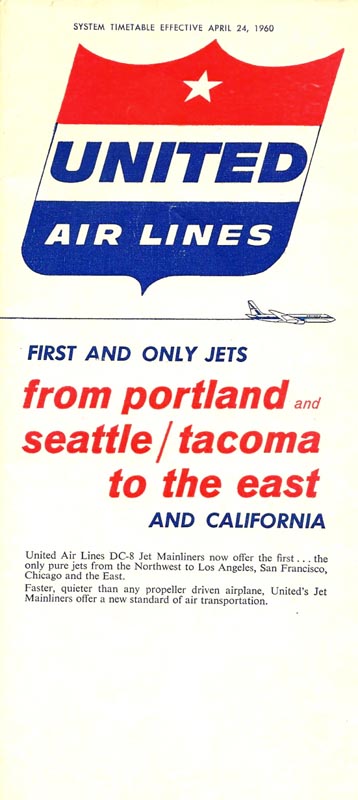
On the aviation side, I remember when airlines published their own timetables too, often promoting their advanced aircraft: American Airline’s 707 Astrojet, United’s DC-8 Mainliner and Braniff Airlines “Conquistador” DC-6.

The illustrations were always of well-dressed travelers smiling as they boarded their planes using ground-stairs, long before airports had jetways.  The seating looked roomy and comfortable, and was tended by well-coiffed stewardesses serving elaborate meals.

But the grand-daddy of all airline timetables was the OAG, the Official Airlines Guide, a phone book-sized (look it up, kids) compendium of every flight in the country.  As a one-time road warrior, I even subscribed to the “pocket” version, which was about an inch thick.  Miss a flight?  Your OAG would show you the alternatives.

What I enjoyed most reading the OAG’s railroad-style timetable wasn’t the flight times, and later, the on-time performance percentage, but the kind of aircraft used on each flight.  I took a liking to TWA’s iconic L-1011’s and avoided American’s DC-10’s after the deadly 1979 crash at O’Hare.

And after 9/11, I always opted for any airline flying Airbus equipment.  The reason?  The 9/11 terrorists had gone to flight school to learn how to fly traditional “yolk” flight controls, but only the airlines’ own simulators could train pilots on the Airbus fly-by-wire joystick controls:  i.e., Airbus jets were not going to get hijacked.  Or so I hoped.

Today there are no paper timetables.  All the information is online and on my phone … handy, yes, but definitely not as romantic.

Posted with permission of Hearst CT Media.

About the author: Jim Cameron is founder of The Commuter Action Group, and a member of the Darien RTM.  The opinions expressed in this column are only his own. You can reach him at CommuterActionGroup@gmail.com  For a full collection of  “Talking Transportation” columns, visit www.talkingtransportation.blogspot.com

Reading Uncertainly? Halloween Special! ‘Connecticut: Spooky Trails and Tall Tales’ by Local Author Gencarella

Here is an engaging, enthralling, timely, and often frightening set of stories from our Nutmeg State, subtitled “Hiking the State’s Legends, Hauntings and History”. These are stories we love to hear, tell – and retell – regardless of origin and authenticity, especially if they involve ghosts, mysteries, illnesses and deaths. And we storytellers do modify them to fit our local purposes!


It is yet another publication of a local Lyme writer: Dr. Gencarella wrote Wicked, Weird and Wily Yankees: A Celebration of New England Eccentrics and Misfits, reviewed in LymeLine on June 3, 2018. He teaches at the University of Massachusetts – Amherst and recently served as the resident folklorist at the Connecticut River Museum in Essex.

These are stories – and hiking linked to each of them – from all over this state. Locally, he explores nearby spots such as Selden Creek, Selden Cove, East Haddam, the Devil’s Hopyard and Rogers Lake.

He is a sleuth of old and questionable stories, often a confusion of clashing religious beliefs, still pertinent today. He writes, “This story is yet another compelling example of folklore operating with sensational journalism to sell newspapers,” and cites the continuing “co-dependent relationship between folklore and yellow journalism in the nineteenth century.”  Today also?

And introduces his readers to unusual words, for example, have you met a “glawackus”? Or do you know friends with these first names: Zerubbabel or Adoniram?  Read on …

Many of these stories are based on misinterpreted natural events, and then “reinterpreted”, “revised” and embellished to attract tourists and sell newspapers. The themes of these stories are common: “depiction of ‘foolish Indians’ “, or “drunken Indians” and attractions between young men and attractive young maidens, often leading to parental objections and dual suicides.

The author comments: “As a folklorist, I reluctantly understand why salacious stories about impoverished rural folk can please people who have greater means. Such tales titillate with scandal, arouse schadenfruede, and allow audiences to feel better knowing someone else is worse off.”

Having lived almost 50 years in this state, I relished these stories, as I have rowed on Lake Waramaug, Selden Creek, Rogers Lake and the Connecticut River. I wish I had known them then …

Is Captain Kidd’s buried treasure in Rogers Lake? But, at the end of each chapter is Dr. Gencarella’s “Legend Tripping” — his directions for hikes at or near each locale … and try rowing, too!

Editor’s Note: Connecticut: Spooky Trails and Tall Tales, by Stephen Gencarella is published by Falcon, Guilford, CT, 2019.

Felix Kloman

About the Author: Felix Kloman is a sailor, rower, husband, father, grandfather, retired management consultant and, above all, a curious reader and writer. He’s explored how we as human beings and organizations respond to ever-present uncertainty in two books, ‘Mumpsimus Revisited’ (2005) and ‘The Fantods of Risk’ (2008). A 20-year resident of Lyme, he now writes book reviews, mostly of non-fiction, which explores our minds, our behavior, our politics and our history. But he does throw in a novel here and there. For more than 50 years, he’s put together the 17 syllables that comprise haiku, the traditional Japanese poetry, and now serves as the self-appointed “poet laureate” of Ashlawn Farm Coffee, where he may be seen on Friday mornings. His late wife, Ann, was also a writer, but of mystery novels, all of which begin in a village in midcoast Maine, strangely reminiscent of the town she and her husband visited every summer.

Talking Transportation: Connecticut’s Own … Igor Sikorsky

Photo by Adam Bignell on Unsplash.

Jim Cameron

Have you ever flown in a helicopter?

They seem such a glamorous (if expensive) way to travel, by-passing the traffic en route to the airport or sightseeing over rugged terrain.

But do you know that the helicopter had its first flight ever right here in Connecticut, the creation of Russian immigrant and inventor Igor Sikorsky, 80 years ago.

Sure, Leonardo da Vinci made early drawings of a vertical flying machine, but that was in the 1480s.  And kids had been playing with hand-turned, propeller-driven toys for centuries before that.

Sikorsky drew his earliest concept drawings of a helicopter years before the Wright brothers ever flew at Kitty Hawk.  But when he fled Russia with his family, it was fixed-wing aircraft that gave Sikorsky his start in aviation.

At the age of 21 he designed his first airplane, the S-1, a single-engine pusher biplane. Twenty-three designs later he built the S-42 flying boat, made famous by Pan American as “The Flying Clipper”.  The four-engined craft had a range of 1200 miles carrying 37 passengers by day or 14 by night in berths, cruising at 170 mph.

Even as Pan Am was opening literally over-seas markets, Sikorsky was still working on his dreams of a helicopter.  At his plant in Stratford his VS-300 made its first flight, albeit tied to the ground, in September of 1939.

A 1942 version, the Sikorsky R-4, became the first mass-produced helicopter, quickly adopted by the armed forces of the US and UK. It had only one crew member, could carry just 500 pounds, but had a range of 130 miles flying 65 mph at up to 8000 feet.

Flash forward to the present and Sikorsky’s old company, now part of Lockheed Martin, still produces helicopters. Sikorsky’s successor companies, then part of United Aircraft Corp, even designed the short-lived (1968 -1976) Turbotrain, powered by a Pratt & Whitney turbine “jet engine.”  The train could make the 230-mile New York to Boston run in three hours and 39 minutes.  Today’s Acela can do the same run in no less than 3 hours 55 minutes.

In a competition with the electric-powered Metroliner in 1967, the Turbotrain hit 170 mph, a land-speed record for a gas turbine-powered rail vehicle. Acela does no better than 145 mph.

Today’s modern helicopters come in all sizes and speeds … from the beefy Seahawk SH-3 “Sea King” which can carry five tons over 600 miles at 166 mph … to “personal” helicopters for one person flying 60 miles at 80 mph.

For helicopter fans, New York’s east-side heliports at Wall Street and 34th Street offer the chance to see luxury craft in action, some privately owned, others offering passenger service.  BLADE Helicopters will get you to the Hamptons from midtown in 33 minutes starting at $695 one-way.

In the 1960s, NY Helicopter flew from the NY airports to the top of the Pan Am building. I took that flight once, transferred to an elevator and walked onto a train in Grand Central.  For a while they even choppered to Stamford’s heliport on Canal Street in the South End.

Much has changed in aviation in the last 80 years since Sikorsky’s first helicopter took to the air.  And to think that it all started here in Connecticut.

Posted with permission of Hearst CT Media

About the author: Jim Cameron is founder of The Commuter Action Group, and a member of the Darien RTM.  The opinions expressed in this column are only his own. You can reach him at CommuterActionGroup@gmail.com  For a full collection of  “Talking Transportation” columns, visit www.talkingtransportation.blogspot.com

The Movie Man: ‘Joker’ Justifies Great Rating

The Movie Man, Kevin Ganey

Last month I emerged from screening It: Chapter Two with great satisfaction and went on to write a review asserting that the IT movies were practically gospel for horror fans. A month has passed and in that time, I was able to see multiple variations of reviews for the film and watch the IMDb rating drop to a 7.0 out of 10, with a dip in the 6 range highly likely in the foreseeable future.

Just last night I emerged from seeing an early showing of the highly anticipated origin story for the clown prince of crime of Gotham City, and I left with the same feeling of satisfaction, particularly with the characters and their actors’ portrayals. I chatted freely with my friend about how Joaquin Phoenix could possibly win the Oscar for his performance, making this the second time in Oscars history that two separate actors have won awards for playing the same character (the first, and so far only pair has been Marlon Brando and Joker’s very own Robert de Niro for Don Vito Corleone in The Godfather and The Godfather: Part II, respectively).

Phoenix would be joining said duo with the late, great Heath Ledger, who gave one of the most phenomenal performances ever in Christopher Nolan’s Dark Knight trilogy. We parted ways for the night, and I proceeded to look up Joker on IMDb and was impressed to see that it was already on the Top 250 list at #13, but quickly saw that it holds a 62 on Metascore.

That stopped me in my tracks and made me think: “Wait a minute …”

I then proceeded to search the Rotten Tomatoes profile and saw that it held only 69 percent approval from the critics … Certified fresh, yes, but it still kept me in my spot, puzzled. I looked over to the next column to see that it holds a 92 percent rating from audiences.

This left me thinking: “Is this one of those moments when the critics don’t get what everybody loves? Or am I missing out on something?”

I will agree that there were some moments that were predictable and cliched, but that is generally the case when one is presented with an origin story for an iconic character. In this case, it is the classical fall into villainy and madness, with several rites of passage, including the first killings, that help bring Arthur Fleck to Joker, Batman’s eventual nemesis.

But I can say with pride that the movie left me satisfied when it came to finally giving the world an origin story to the Joker, whose background, until now, has been just as mysterious as it was the day he made his debut in 1940. We have been given a gritty presentation of a vulnerable man coping with mental illness clashing against a society that has so often kicked him while he was down (literally at one point).

Robert de Niro delivers, as he always does, this time as the bully talk-show host who exploits Arthur’s desperate desires to make the world smile, but while Zazie Beetz (best known from Atlanta and Deadpool 2) gave an acceptable performance, we need to acknowledge that it is because her role could have been made bigger than what she was left presented as a brief girl-next-door love interest.

So I must admit that I am hesitant to give this film a definitive, case-closed review due to my poor judgement with IT, but I can say that I would highly recommend seeing it if you have a chance. The movie may hold up, or it may very well dwindle into a disappointment, but hey, you might as well get a look while you can.

About the Author: Though no longer a resident of Lyme, Kevin knows he can never sever his roots to the tree of his identity. When not attending to his job in the elite hospitality industry of Boston, he is committed to ensuring a better grasp of current (and past) releases of cinema to his home community as he strives to leave his own mark in the same field that has always been his guide to understanding life. If you enjoy his published reviews here on LymeLine.com, why not follow him on his new website at ‘The City of Cinema and read more of his unique insights into entertainment?