The Movie Man: ‘The Christmas Chronicles 2’ Misses its Mark

Kevin Ganey is ‘The Movie Man.’

As somebody who looks for originality in nearly every aspect of life, I go into Christmas movies with a great deal of hesitation. And thus I approached The Christmas Chronicles 2.

My concern was justified.

Should anybody seek a Christmas-themed movie with an original take, The Christmas Chronicles 2 does not deliver … even for a sequel. With an abundance of unoriginal, rehashed story-elements, there are plenty of cringe-worthy cheesy moments to go around.

I originally looked forward to this installment, thinking it would be a flick that would be enjoyable in the end. That is, until I started watching it.

The movie depicts a disenchanted former elf named Belsnickel (played by Julian Dennison) hellbent on destroying Christmas, and once he appears to have the upper hand, our hero from the first Christmas Chronicles, Kate Pierce, must rise to the occasion again to save the holiday (one can already groan upon reading these details.)

Kurt Russell reprises his role of Santa Claus in the same manner as he did with the first installment. He defies the traditional depiction of St. Nick: overweight and jolly.

In these movies, the one visual detraction is his size, no longer overweight, but a slim and fit figure. He also is not happy and jolly, but rather a stud; bringing the cool vibes from Russell’s career defining action movies.

He delivers, however, the affectionate and caring Father Christmas traits that we would want in any actor depicting the man we on whom we pin our hopes as little children.

In contrast, the performance of Mrs. Claus (played by Russell’s real-life partner Goldie Hawn) does not deliver, appearing to lack the enthusiasm required for such a role. Russell’s run as Santa is probably the sole redeeming quality of this picture, in my opinion.

There are several appeasing action moments, usually involving Santa’s sled, but not every moment is spared the cheesiness (mainly seen in a sequence involving fighting off elves with a Nerf gun.) But I will concede there is a heartwarming moment or two.

Perhaps I am not taking into account that I am a cinephile and therefore not the target audience (which is most likely young families)?

But I am writing on behalf of all those who seek a good movie. There are moments when we will get excited when a child asks to watch a movie with us, and there are indeed plenty of family-oriented movies that we adults will watch on our own initiative.

But The Christmas Chronicles 2 does not fit either bill. All I can say it merits is an, “Eh, it’s the holiday season and I need to pass the time.”

About the Author: Though no longer a resident of Lyme, Kevin knows he can never sever his roots to the tree of his identity. When not attending to his job in Boston, he is committed to ensuring a better grasp of current (and past) releases of cinema to his home community as he strives to leave his own mark in the same field that has always been his guide to understanding life. If you enjoy his published reviews here on LymeLine.com, follow him on his new website at ‘The City of Cinema and read more of his unique insights into entertainment.

A la Carte: Welcome December With a Wonderful Winter Entrée

Lee White

Many decades ago, we spent a New Jersey weekend with my husband’s friend, a radiologist. I call him my husband’s friend because, once my husband died, I exited that friendship because I basically detested him.

In any case, this man talked about his radiologic partner and noted that he couldn’t stand the partner’s wife. Always curious, I asked what his wife was like. “A bitch,” he said. “Did she work,” I asked. “Nah,” he snorted. “She baked muffins or cookies. Something like that,” I then realized that she was, indeed, Rose Levy Barenbaum, one of the finest pastry chefs in the world and author, at that time, of “The Cake Bible,” the first cookbook that garnered a million dollar advance

Rose and I became friends and are, to this day, very close. Her books line my bookshelves. If you have used any of her books, you can’t miss with her careful recipes, which not only include what to do but what not to do. For a few of her cookbooks, she has asked me to test recipes.

I hope someday she will meet my new friend, Richard Swanson. Richard works at The Day and, if he decided to write cookbooks, all his recipes would be as perfect as Rose’s. He writes every recipe and reworks with every ingredient multiple times. He has entered food contests and wins!

By the time he gives me something to taste, he has probably done the same three or four or 20 times. You will love his wonderful winter entrée. 

Pork Cider Stew with Rutabaga, Potatoes and Cabbage
From Richard Swanson, Waterford, CT

1 ½ pounds pork loin
Olive oil or canola oil
1 ½ cups Vidalia (or sweet) onions
2 cloves garlic, crushed
2 cups diced rutabaga2 cups diced russet potatoes
1 small bag Dole shredded coleslaw mix with carrots (about 4 cups)
2 cups chicken broth
2 cups water
4 cups apple cider (unfermented)
1 teaspoon dried thyme
1 teaspoon caraway seed
½ teaspoon white pepper

Place 1 tablespoon oil into a Dutch oven and brown pork loin over medium heat (or on the sauté function if you are using your Instant Pot).*

Toss onion and garlic around pork and continue to cook covered until translucent, then pour chicken broth and braise the pork loin for 20 minutes covered.

Remove pork loin and place aside. Pour water, apple cider and spices into the pot and add rutabaga, potatoes and cole slaw mix. (Rich does not add the dressing packet.) Simmer uncovered for 10 to 15 minutes until rutabaga and potatoes are almost fork tender.

In the meantime, dice the pork loin add it to the pot to reheat the meat. To thicken the broth: at the end of the cooking, pull about a cup of the veggies mix out of the mix and blend them with a little bit of broth in a blender or immersion stick blender to make a thick paste. (Lee: I might mix this with a tablespoon of cornstarch and add it to the stew at high heat.)

Add the paste back into the pot and stir. Salt to taste and serve.

*Instant Pot option: you can use the pressure cooker function on the Instant Pot to completely tenderize the pork and cook the vegetables until tender, but be careful you don’t turn the potatoes and rutabaga into mush.

About the author: Lee White has been writing about restaurants and cooking since 1976 and has been extensively published in the Worcester (Mass.) Magazine, The Day, Norwich Bulletin, and Hartford Courant. She currently writes Nibbles and a cooking column called A La Carte for LymeLine.com and the Shore Publishing and the Times newspapers, both of which are owned by The Day.

Reading Uncertainly: “Tales From the Ant World” by Edward O. Wilson

Are ants far more important than we humans?

Probably!

That’s my conclusion after reading the latest from this illustrious Professor Emeritus of Harvard with some 33 books to his credit, many of which relate his life-long interest in these creatures

Ants, or the study of myrmecology using the proper scientific terminology, have existed on this earth for some 150 million years, 10 times longer than Homo sapiens. They are survivors of ice ages and hot spells. They operate on this globe in both extreme heat and cold.

Significantly for these times, they are not disease carriers.

They create societies in which females are in complete control (“benevolent matriarchies.”) Males are second-class citizens, primed to exist for one act of reproduction and then depart this life. Ouch!

And, like us, they have traveled from Africa to almost every other spot on earth. They are also “virtuosos of chemical communication,” working together soundlessly. To top it off, they will probably outlive our species by another 50 million years, or at least as this earth exists.

“Ant colonies possess superb resiliency,” suggests Professor Wilson, arguing that we humans should study them more seriously. Compared to the bulk of a human body, an ant is tiny but “ … all the living ants weigh about the same as all we living humans. We don’t go to war against ants, nor do they war against us.”

To Wilson, this proves “an important principle of parasite biology … that the most successful parasite is the one that causes the least damage.” But they are vicious warriors among themselves … very similar to human beings.

Yes, they do travel: ants are great navigators. They manage to move about, “by direct light of the sun and dead reckoning (“dead”  product of “deduced” reckoning) by the spatial gradients of polarized light, spectral composition of light, and the radiant intensity that form cover across the entire vault of the sky.” I do wish I had those capabilities when I navigated my U. S. Navy refrigerator ship across the Pacific some 60-plus years ago!

Can studying ants give us some ideas about the future of human beings? Females in total control — but the “queen” is effectively a slave of the entire colony? Incessant warfare with other colonies? But ultimately, ants are survivors, outlasting us by millions of years.

Read Professor Wilson for some challenging questions.

Editor’s Note: “Tales From the Ant World” by E. O. Wilson was published 2020

Felix Kloman

About the Author: Felix Kloman is a sailor, rower, husband, father, grandfather, retired management consultant and, above all, a curious reader and writer. He’s explored how we as human beings and organizations respond to ever-present uncertainty in two books, ‘Mumpsimus Revisited’ (2005) and ‘The Fantods of Risk’ (2008).

A 20-year resident of Lyme, Conn., he now writes book reviews, mostly of non-fiction, a subject which explores our minds, our behavior, our politics and our history. But he does throw in a novel here and there.

For more than 50 years, he’s put together the 17 syllables that comprise haiku, the traditional Japanese poetry, and now serves as the self-appointed “poet laureate” of Ashlawn Farm Coffee, where he may be seen on Friday mornings. His late wife, Ann, was also a writer, but of mystery novels, all of which begin in a village in midcoast Maine, strangely reminiscent of the town she and her husband visited every summer.

A View from My Porch: The ‘Aristocrat of the Silent Screen’, the ‘Bee & Thistle’ … and Other Thoughts

Plans have been announced for the former ‘Bee and Thistle Inn’ to become the new home of the Roger Tory Peterson Estuary Center. But do you know how this gracious residence ever came to be an inn?  If not, read on …

The recent announcement that the Connecticut Audubon Society had reached an agreement to purchase the Bee & Thistle Inn, and plans to renovate it as the future headquarters for the Roger Tory Peterson Estuary Center, piqued my curiosity regarding the Inn’s history.

This essay briefly reviews the life of an individual who was fairly instrumental in its founding, the talented and infamous Elsie Ferguson. Note that I had originally written “notorious,” but I believe only one woman in our recent history is deserving of that descriptor. My goal with this essay is to provide readers with something light, given the dismal news regarding the COVID crisis, but please read to the end as I feel obliged to return to that topic there.

Known as “The Aristocrat of the Silent Screen,” this (Public Domain) photo shows Elsie Ferguson in 1913. Image by Herman Mishkin – The Theatre, Vol. 18, July 1913.

Ms. Ferguson was considered by many as the leading Broadway and silent screen actress for much of the first half of the 20th century. She made her debut as a chorus girl in 1900 at the Madison Square Theatre in the musical comedy “The Belle of New York.”

She then starred, or was a cast member, in a remarkable number of productions on Broadway and in London, becoming known as one of the most beautiful and talented women ever to appear on the American stage. She became “the aristocrat of the silent screen”, partly because so many of her roles were elegant society women, and also for her utterly arrogant attitude. 

During the first world war, several Broadway stars organized a campaign to sell Liberty Bonds, both before performances and at events occurring at important New York City venues. Ms. Ferguson once sold $85,000 in bonds in less than an hour, which is about a million and a half today!

After appearing in “The Merchant of Venice” in 1916, she signed her first movie contract with Paramount Pictures, and in a 1917 release, made her silent screen debut in “Barbary Sheep.” After some 25 films made between 1917 and 1929, she made her first and only “talkie”, “Scarlet Pages”, in 1930. 

She was definitely “divaesque” and working with her was difficult. She actually dabbled in socialism in the 1920s, and once stated in an interview, that “… people are struggling and fretting their lives away over questions of food and education. When a man has accumulated more than, say, a million, the moneys made should revert back to those who have contributed to the amassment.” This was ironic, because she was very well-compensated for her work, and had “amassed” a large fortune.

Her personal life was marked with some turmoil; and she was even involved, albeit on the periphery, in events that triggered the murder of architect Stanford White, an utter scoundrel; the news of those events contributed to the novel and eventual Broadway musical, “Ragtime”.

Connecticut:

In 1934, the then 51-year-old Elsie Ferguson married her fourth husband, the wealthy Irish “sportsman” Victor Egan. They bought a farm in Connecticut that same year. They also maintained a home on the French Riviera, splitting their time between the two. 

The Ferguson Farm:

A “Profile” of Ms. Ferguson, published in 2013 by the Florence Griswold Museum, tracked her life to some “welcome seclusion” on that scenic 100-acre estate in East Lyme, “White Gate Farms.” She told a reporter from “The Milwaukee Journal” that she sold 150 of her farm’s eggs each day to the Government. The reporter described the surroundings as “bucolic and luxurious.” During her tenure at White Gate, she was known only as Mrs. Victor Egan. 

When the World War II theater blackout on Broadway lifted in 1943, she made her final appearance, at the age of 60, in “Outrageous Fortune”, which was written by an East Lyme neighbor, Rose Franken. She told the reporter covering her return to the theater that “once people [in Connecticut] recognized her, she would have to be very careful about how she looked; hair and all that sort of thing.”

Victor Egan died in France in 1956, and ‘Widow Ferguson’ spent her remaining years in Connecticut.

The Bee and Thistle Inn:

Her friend and contemporary, Henrietta Greenleaf Lindsay, a Hartford designer, had opened a shop in Old Lyme, and lived nearby in a large home just north of what is now the Florence Griswold Museum. She was also a widow, and rented a few extra bedrooms to guests. Ms. Ferguson suggested that Ms. Lindsay formalize her guest room business and convert her gracious home wholly to a hotel. 

Ms. Lindsay followed that advice, and opened an Inn to the public. In recognition of her friend’s encouragement, the Ferguson Clan’s crest, which included a bee on a thistle, gave the inn its name.”

Elsie Ferguson died in November, 1961, aged 78, at Lawrence & Memorial Hospital in New London with no surviving heirs. Her will directed that her $1.5 to $2 million estate be divided primarily amongst several animal welfare organizations, including NYC’s Animal Medical Center, Bide-A-Wee Home, the ASPCA, and Orphans of the Storm.

She is interred in Old Lyme’s Duck River Cemetery and her grave marker includes the first few lines of Byron’s “She Walks in Beauty.”

Some Final Thoughts

I began this piece on Nov. 19, when we had just passed the one-quarter million mark of Americans dead from COVID-19; and were looking forward to a very “low-touch” Thanksgiving. 

My next essay, “A Primer on Vaccines and Vaccination,” will be the first, in a series focusing on our response to COVID-19; and each successive column will be a thoughtful analysis of the implications of the data published in LymeLine and other media and as such will be the “color commentary.”

We have a massive public health problem, and it’s worsening daily. As I complete this essay on Monday, Nov. 23, We’ve reached 260,402 dead Americans; and yesterday, there were 142,732 new confirmed cases. The seven-day rolling average of 170,856 new cases per day grew nearly 50 percent from two weeks ago. The prediction of a “dark winter” is playing out.  

We are fortunate, however, because vaccines are approaching distribution; but unfortunately, the still-current president remains unwilling to even acknowledge this crisis and model behaviors in front of his constituency that will assist in curbing the further spread of the disease. 

There’s finally some good news regarding the election. Despite the unrelenting and outrageous interference, the states have all certified the election results, and the recalcitrant GSA Administrator has finally checked her math and enabled the formal transition. So, the President-elect finally really is the President-elect.

John Cleese couldn’t have scripted a more ridiculous theater of the absurd than the “The Bad Loser’s Guide to A Peaceful Transition,” which has been shown nearly constantly in primetime before and since the election. 

I pray that Americans’ trust in the election process has not been irrevocably damaged, and that there has been no damage done to the new administration.

As always, God save the United States of America.

This is the opinion of Thomas D. Gotowka.

Tom Gotowka

About the author: Tom Gotowka’s entire adult career has been in healthcare. He’ will sit on the Navy side at the Army/Navy football game. He always sit on the crimson side at any Harvard/Yale contest. He enjoys reading historic speeches and considers himself a scholar of the period from FDR through JFK.

A child of AM Radio, he probably knows the lyrics of every rock and roll or folk song published since 1960. He hopes these experiences give readers a sense of what he believes “qualify” him to write this column.


A la Carte: From Lee With Love — Thanksgiving Recipes Galore!

Editor’s Note: We are running a selection of Lee White’s recipes today to give readers a chance to savor her favorite Thanksgiving recipes in one place!

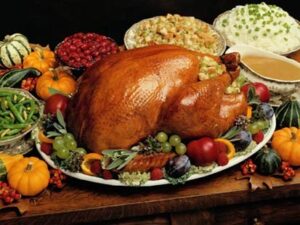
For more years than I can remember, I have been writing about turkey at Thanksgiving. I get every food magazine every month and every single month, in October, a turkey is on the covers.

My mother never cooked a turkey. We had Thanksgiving at an aunt and uncle’s home in Kinderhook, New York. There was no gravy and no stuffing and the sweet potatoes were stuffed into oranges, which made the sweet potatoes taste like oranges.

The first Thanksgiving with my husband and daughter was in Houston, and I ordered turkey and sides from a restaurant. The gravy was white. In following years, I made turkey and sides by myself, sometimes for 20 or more friends and family. The first few times, I called the Butterball Hot Line for help.

Some years later I stopped using the throwaway aluminum pans and bought a $200 roasting pan, which I still use for every kind of roast I have ever made. It was one terrific buy.

Over the years I brined turkey in a huge cooler. I bought organic turkeys. Last year I went to a friend who made a heritage turkey. I made all kinds of stuffing and once placed slices of bacon on top of the fowl. A few times I put buttered cheesecloth on the turkey. But these days I buy the least expensive turkey I can get and buy it frozen.

I make my stuffing the night before and put it in the refrigerator in an enormous plastic bag. The next morning I stuff as much dressing as possible into the thawed (but cold) turkey’s cavity. I put the rest in a casserole and when the roasted turkey come out of the oven, I add some juice to the casserole and bake it.

Forget all those other “new” ways to make turkey for Thanksgiving. Here is my favorite recipe. 

Turkey

1 14- to 16-pound turkey
salt
1 stick butter
½ (one-half) cup good white wine

Gravy

¼ (one-quarter) cup all-purpose flour
cold water
Gravy Master (optional)
salt and pepper to taste

Remove giblets from turkey (I don’t use them; instead, I boiled them for the kitties, less bones). Rinse and dry turkey inside and out. Rub salt inside cavity of bird. Fill cavity with cold stuffing made the night before or early morning. Place bird in a rack (or upside glass pie pan) atop a large, heavy-duty roasting pan. Place in a 350-degree oven.

Add butter and wine in a saucepan, bring to a boil, then simmer for about 10 to 15 minutes. Open oven, pour wine-butter over turkey and close oven. Every half hour baste liquid over turkey. Bake until turkey is done (when the thermometer plunged into the thickest part of the thigh registered 175 to 180 degrees, 10 to 12 minutes per pound if not stuffed or 12 to 15 minutes stuffed).

Turn off the oven, remove turkey from the oven, Place the turkey on a platter and spooned the Stuffing into a bowl; cover each with aluminum foil and return both to still-warm oven. (Extra stuffing can be heated in a casserole dish; it is not as tasty but if you spoon some juice on the dish before heating, it’s pretty good.)

Remove grease from roasting pan. and place the pan on the stove. Turn heat to medium. In a large jar, add all-purpose flour and about 2 cups of water. Screw jar cover and shake. When the brown bits are hot, add flour-water mixture and, over medium-high heat, whisk constantly. If you need more water, add some. Once the gravy is ready, add and stir in Gravy Master to taste (optional). Add salt and pepper to taste.

Roasted Grape, Apple and Cranberry Sauce
From Cooking Light, November 2018
Serves 12

Cooking spray
2 cups seedless black grapes (about 10 ounces)
1 and three-quarter cups chopped Honeycrisp apple (or Gala or ????)
2 tablespoons chopped scallop
1 cup fresh or frozen whole cranberries
1 and one half tablespoons unsalted butter
3 and one-half teaspoons pure maple syrup
One-eighth teaspoon kosher salt
One-quarter teaspoon fresh thyme leaves or sprigs (optional)

Preheat oven to 325 degrees. Lightly coat a rimmed baking sheet with spray. Place grapes, apple and shallot on prepared baking sheet and lightly coat with cooking spray. Bake until shallots begin to soften, about 5 minutes.

Add cranberries to baking sheet. Bake at 425 degrees until cranberries burst, apple is tender and grape skins are beginning to burst, about 20 more minutes. Remove from oven and transfer mixture to a medium bowl. Stir in butter, maple syrup and salt. Cool completely, about one hour. Sprinkle with thyme, if desired.

Stuffing

I make the stuffing at least the day ahead,, because it should be cold when you put it in the turkey, which is also cold. This is probably more stuffing you will use. You can put the rest in a casserole and bake for Thanksgiving, or freeze it for another turkey or chicken dinner.

I large Pepperidge Farms herb-seasoned stuffing mix
6 to 8 tablespoons butter
1 cup onions, minced
1 cup celery, minced
1 small can of diced mushrooms
1 cup walnuts, chopped (I chop it with my hands because I don’t want it chopped fine)
salt and pepper, to taste
Bell’s seasoning, to taste

Make Pepperidge Farms stuffing according to package instructions.

In a skillet, add butter and melt over medium heat. Add onions, celery, mushrooms and walnuts. Saute for about 10 minutes. Add salt, pepper and Bell’s seasoning to taste. Add to stuffing mix and stir. Refrigerate until cold (I often put the stuffing in a large plastic bag and put it in the porch, since I rarely have much space in my refrigerator.)

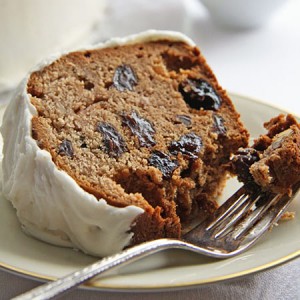
Old Fashioned Spice Cake


Adapted from Linnea Rufo of San Miguel de Allende, Mexico
Yield: serves 10 to 12 people
Preheat oven to 350 degrees. Grease a 10-inch tube pan.

1 cup sugar
one-half cup (1 stick) butter
one-half cup currants or raisins or dried cherries (optional)
one-half cup candied ginger, chopped
2 eggs
2 tablespoons molasses
2 cups flour
1 teaspoon baking soda
1 teaspoon cinnamon
one-quarter teaspoon cloves
one-half teaspoon ginger
one-teaspoon salt
1 cup milk

Preheat oven to 350º F. Grease a 10-inch tube pan.

Cream butter and sugar until light and fluffy. Beat in eggs, one at a time, blending well after each addition.

Whisk together flour, baking soda, cinnamon, cloves, ginger and salt. Stir dry ingredients into egg mixture alternately with milk, beginning and ending with dry ingredients.

Pour batter into prepared tube pan. Set on the middle rack of the oven and bake for 1 hour and 5 minutes, or until cake pulls away from sides of pan and a tester inserted in the center comes out clean.

Cool cake in the pan, set on a rack, for 10 minutes. Remove cake from pan and spread on icing at once, while cake is still warm.

Espresso Icing

1 and one-half cups of confectioners’ sugar
1 tablespoon of espresso (use a teaspoon or so of cold coffee)
1 tablespoon milk

Whisk icing ingredients together.

About the author: Lee White has been writing about restaurants and cooking since 1976 and has been extensively published in the Worcester (Mass.) Magazine, The Day, Norwich Bulletin, and Hartford Courant. She currently writes Nibbles and a cooking column called A La Carte for LymeLine.com and the Shore Publishing and the Times newspapers, both of which are owned by The Day.