
Senior Moments: A New Year’s Message from our California Correspondent

John Guy LaPlante

Happy New Year, my Friends!

Yes, I’m late, I know. Good intentions sometimes go wrong.  But still I want to wish each and every one of you a happy and prosperous and satisfying New Year!

For more than 99 percent of you this is already 2021, though a tiny number of you are living in far-off lands on a different time clock.

As always, I’ve made my New Year’s resolutions and that’s always a great start.

Sadly 2020 has been an awful year, as we all know. The Covid-19 pandemic has been killing so many and making so many others so terribly ill.

And what a severe impact it has had on business, putting so many people out of work, making it difficult to buy food, pay the electric and water bill or put gas in the car, or make routine payments for the rent or the mortgage or insurance policies of various kinds and so, so many other things. 

And think of all the people who usually travel near and far to spend time with their loved ones. Very difficult this year. For some, impossible.

But my younger son, Mark, a professor of finance at the University of Wisconsin in Madison, made it here to Morro Bay [on the Californian coast] to spend a week with me. He managed that by flying first class, which he normally does not do. He thought there would be more empty seats up there. And he was right.

And think of the difficulty of students from grade school all the way up through graduate school continuing their education because of social distancing imperatives and so forth.

Plus so many other difficulties that do not come readily to mind.

So right now wishing somebody a Happy New Year is really a tough order.

But things are brightening up.

We will very soon have a new president and vice-president …

And out of the blue, so to say, we have had the incredibly good news that we have at least three new vaccines that have proven to be effective! And have been approved! And will begin helping people not many months from now but probably as soon as late spring or so!

Notice those three exclamation marks? They deserve to be there!

This afternoon I stopped by my neighborhood Rite Aid pharmacy and asked the head pharmacist, “When do you think we’ll be getting the vaccine?”

“We’ve been told by late March!”

I considered that very good news.

And soon our Treasury in Washington will be doling out more money to help people get by.   

All which will make the near future easier for life to get back to normal for just about all of us. All things really worth celebrating. I doubt anybody would deny that 

Speaking for myself, I have been most fortunate. Less than a year ago I was living in an assisted living community. A very nice one. But I definitely wanted out because I no longer needed that. 

I wanted  to live a normal life again on my own. And I was judged able to do that. Which  I yearned to do. What a happy day!

And as we know, the news has been full about how Covid-19 has severely affected the life of people in such facilities. So many residents have died as a result. 

And people still living there are going through hell because of new rules imposed to keep them safe. 

Now think about this. Just before moving into that nice place, I was hospitalized with a case of double pneumonia.

And that awful diagnosis plus my very old age made it a nearly sure thing that I would become infected.

But I have been tested and found to be negative. How about that?

Which is very ironic. Because my older son, Athur, age 63, a lawyer, came down with the virus and was hospitalized. As was his wife Marita, a super-duper intensive-care R.N., though more lightly.  

But it will be weeks before they will be able to get back to work.

So again the nasty question comes up.  Why did these two hard workers, whose calling is to help people, become infected, but I, so much older and 99 percent retired, was spared?  Well, anyway so far.

The further good news is that nobody else in my family, who span three generations, has been affected medically or economically. That’s really worth celebrating

In just a few months I will be starting my 93rd year on this earth. And I am still living by myself on my own. But with my loving daughter Monique and son-in-law David living nearby. How fortunate I am!

So let us hope that at the end of this brand-new year of 2021, life will be back to normal for New Year 2022! 

Oh, I want you to know that wherever you are, I’m thinking of you, cheering for you, and hoping that for New Year 2022 all kinds of good things will be coming your way.  And even sooner, I hope.

Editor’s Note: John Guy LaPlante is a veteran writer and journalist, who prior to his move to Morro Bay, Calif., lived in Deep River, Conn. His award-winning columns and articles were previously published in the ‘Main Street News’. He is the author of two books, “Around the World at 75. Alone! Dammit!” and “Asia in 80 Days. Oops, 83! Dammit!” He completed his service as a Peace Corps Volunteer in Ukraine in early 2010 after a 27-month tour of duty. He was the oldest Peace Corps Volunteer ever to serve. John always welcomes comments on his articles. Email him at johnguylaplante@yahoo.com

Letter From Paris: After 47 Years, UK Leaves EU with ‘Thin’ Post-Brexit Deal

Nicole Prévost Logan

After 47 years of co-habitation, the UK has left the European Union (EU) with a “thin” post-Brexit deal.

An end-of-year need for holiday food delicacies, such as caviar, lobster or foie gras, panic about running short of fresh produce — such as lettuce, combined with the Covid-19 procedure slowing down the traffic, caused spectacular chaos with thousands of trucks lining up on highways or parked in Kent’s makeshift areas.

It was a sort of a preview of what a no-deal Brexit would bring.

The atmosphere in the country was unreal.

On Christmas Eve at four in the afternoon, the news broke: The UK and the European Union (EU) have reached an agreement on a narrow trade deal.  There will not be a “hard Brexit” as everybody had feared, with a brutal departure of the British Isles from the continent.  The two sides will remain friends and look forward to building up a commercial partnership and intensifying cooperation in transport, security, police, nuclear power, research and many other areas.

An 11th hour agreement

Reaching an agreement was quite an accomplishment. As late as Dec. 20, the mood was grim on both sides of the English Channel. On that date I wrote an article, entitled: “Betting on a “thin” Brexit deal”.

As follows, is part of my article:

Time is running out.  The transition period, which followed the departure of the UK from the EU on Jan. 31, 2020, is ending on Dec. 31.  If the two sides – UK and EU – do not reach an agreement by then, the “hard Brexit” will feel like falling off a cliff. The alternative is a “soft” Brexit.

On Dec. 13, 2019 , UK Prime Minister Boris Johnson led a successful campaign, the problem is that he based that campaign on three fateful words: “Get Brexit done”  He locked himself in an impasse,  making it hard for him to negotiate further.  He is under pressure from all sides to satisfy the hard-Brexiter Tories, the business circles rejecting Brexit for fear of a tariff war and  public opinion increasingly against a departure from the EU.   

The impossibility to bridge the positions from both sides of the Channel is clear:  the differences are more than deep. They are existential.  

For the British, sovereignty is paramount and the constraints of the Single Market unacceptable. The EU lies on the principles of the “Schengen Space”, consisting of free movement of people, capital, goods and services. Those principles constitute the main asset of the Single Market and are sacred, declared Christine Okrent, a French seasoned journalist and an authority on foreign affairs.

One should not forget that the UK has never been part of the Schengen “Space” nor of the Eurozone.

“Zanny” Minton  Beddoes, editor-in-chief of the Economist describes the negotiators as “playing on their voters’ audiences”.  It may be true in England, but definitely not in the EU. The EU is not budging from its core proposals, and its 27 members remain totally united. It would be miscalculation on Johnson’s part to count on the EU backing down.  

A hard Brexit would be a lose-lose proposition, but the UK would be more affected. Half its trading activities are with Europe, its economy is intertwined with Europe’s, as Beddoes pointed out. In contrast, Brexit has ceased to be a priority for the EU, commented Christine Okrent

In an interview, Michel Barnier, chief negotiator of the EU, declared that a nine month transition was too short. Most trading agreements take at least five years. He said: “Two prerequisites are needed: a free and fair competition (no “Singapore on the Thames”) and a reciprocal access to markets and waters.” 

I predict – and am going out on a limb now – that enough concessions will take place on both sides to reach a “thin” deal (to use Beddoes’ words ) allowing  the negotiations to continue after Dec. 31.  More time is needed to create a tailor-made arrangement to satisfy the UK and help it access the Customs Union or the European Economic Area (EEA), like Norway.  

Those were my predictions on Dec. 20.

The British Union Jack flag flies alongside the EU flag … but not for much longer. Photo by Rocco Dipoppa on Unsplash.

Back to Dec. 24, when the post-Brexit “deal'” was reached. What was fascinating on that historical day, was to hear, in real time, the comments coming from all sides of the political spectrum as well as reactions from the general public.

Johnson was exultant, raising his arms in a victory gesture. The trilingual Ursula von der Leyen , president of the European Commission was the one to announce (in excellent French) that, “a good, fair, and well balanced” deal has been reached.  Towering over her Michel  Barnier added his voice to the official announcement.  It was thanks to his fairness and persistence, that he made the deal happen.

Declaring, “We have kept our promise,” Johnson continued, “We have taken back the control of our economy. Freed from the EU Single Market bureaucracy, we can act very fast. The rapid vaccination program is an illustration of this. Our relationship with the EU will be comparable to the one between Canada and the EU (CETA).”

This is not exactly accurate however because CETA makes it easier to export both and goods and services, whereas the post-Brexit deal does not include the suppression of tariffs on services. The most important thing for Johnson was to say, “I have done it”.  He did succeed unlike other prime ministers – Thatcher, Major, Cameron and May – who failed in their attempts.

Denis MacShane, a Member of Parliament (MP), Minister of State for Europe under Tony Blair, and formerly a member of the Labor party said the population had had enough and wanted to turn the page of the Brexit.

A professor of the French School of Political Sciences was lukewarm about the deal.  The accord does not warrant taking the champagne out to celebrate, he said.  To lose one member of the EU is a loss, a form of “disintegration”

Reuters press agency announced that the British Parliament was expected to approve the deal. Both Houses will be recalled to vote on the decision on Dec. 30.  Johnson has a comfortable majority of 364 out of 650 in the House of Commons.  Many of the 200 Labor MPs will vote in favor of the agreement since they supported the post-Brexit trade deal from the beginning.

The European Parliament will make its decision known in 2021. The agreement text will have to be translated into 23 languages before being approved by the 27 EU member states.

As a 1,246-page agreement, it will take a while to fully comprehend the complex and lengthy text.

Professor Anand Menon, director of “The UK in a Changing World” Think Tank, commented that the lifting of tariffs and quotas will favor the EU since it is where it has a surplus. France has a surplus of 12 billion in her trade balance with the UK. The biggest amount is food products. 150,00 French companies export them to the UK.  Furthermore 80 percent of food and wine transit through France to reach Great Britain.

Quotas and tariffs will not be imposed on products. However, custom and various administrative formalities and procedures at the borders might become cumbersome for both sides. Times will be difficult in the short term for British companies and a cost of 4 percent of the GDP  is expected.

However, from now on the UK will be free to reach bilateral agreements with outside countries, such as New Zealand for the import of meat.

Tariffs will remain on the services . With the post-Brexit deal, the UK becomes a third country in regards to the EU,  80 percent of its economy is immaterial and tied to services and therefore not part of this post-Brexit deal. In order to exercise its financial activities  and access to the Single Market or the Customs Union, the  “passporting” (meaning selling financial services freely) will no longer be an option unless the UK joins the EEA, as Norway has done.

The main sticky point will be to preserve the level playing field and guarantee fair competition on both sides of the Channel.. This will be resolved by the principle of “managed divergence” the parties reserving the right to retaliate.  In other words any hope of creating a “Singapore on Tames “will be under strict scrutiny by the EU.

Dominic Raab, acabinet minister and conservative MP declared that the provisions included in the agreement  are not the end of the story. The “deal” is a living document that will need to be revisited in the future. The rules will  evolve.

As an example, a system has been put in place to settle litigations and will be re-examined in four years. Next February there will be more rules. Raab added that for the next five or six years, the UK will be working on re-establishing new ties with Europe.

On a positive note for Johnson: the UK will not be bound by judgments made by the European Court of Justice

The Irish border

The Irish premier Micheal Martin approved the fact that a hard border between the two Irelands was avoided ; The Common Travel Area with Great Britain will be maintained ; the deal preserves Ireland’s position in the Single Market, he said, it will avoid quotas and tariffs imposed on farmers, businesses and exporters.

Varadkar, another Irish politician seems also satisfied with the deal. Northern Ireland will remain effectively in the EU Single Market. Custom checks will take place in the Irish Sea instead of on land. Sea.

Still unknown but likely to emerge soon  is the question of Scotland. First Minister of Scotland Nicola Sturgeon lashed out at the agreement within minutes.  In 2016, 62 percent of Scottish people voted to remain in Europe.  The Flag of Scotland still flew above the Parliament.  Scotland will probably not wait for the spring to organize another referendum.

Fishing rights
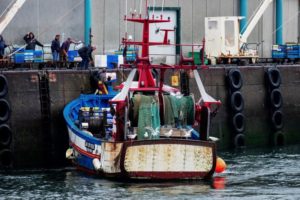
A commercial fishing boat comes into port. Photo by Thomas Millot on Unsplash

Johnson declared, “We have regained the control of our waters.  Although it represents a minute part of the GDP of both sides , this issue occupied a major place in the negotiations because it is essentially the symbol of the British sovereignty.  Barnier knows a lot of about fishing rights.  He was minister of Agriculture and Fishing from 2007 to 2009.

There will be “fishing committees” enforcing control. Johnson demanded that 80 percent of the proceeds from the fishing industry be returned to the UK. He achieved 25 percent, during a transition period of five and a half years.  He will grant 100 millions of UK pounds sterling to help the fishermen.

The fish catch by the Europeans last year was worth 650 million Euros last year. The British waters are richer in fish population than the European waters. The Brits don’t eat much fish. They sell back most of their catch to the EU. During his speech Johnson was wearing a tie covered with fish.

The devil is in the details and annoying changes are going to take place. There will be no more mutual recognition of professional qualifications. British doctors, architects, veterinarians, engineers will have to seek new certification.

Freedom of movement will disappear, and a visa will have to be obtained for a stay longer than 90 days. An EU pet passport will cease to be valid.

The Erasmus student exchange program will not include the UK any more. Instead of a fee of 170 Euros paid to  European universities, foreign students studying in the UK will be charged tens of thousands pounds. To work in England, a permit will be required. In other words a post-Brexit deal will not be “business as usual.”  There will be many changes.

On the last day of 2020, Sky News announced that Johnson’s father, Stanley Johnson, was asking for French nationality.  He is French on his wife’s side and very much a Europhile. In a book coming out later in January, author Christian de Bourbon-Parme has written a biography of Boris Johnson.

Surprisingly, we learn that his name was not Boris but Alexander, that he lived in Belgium when his father was working for the European Commission in 1973. In the book, Johnson is depicted as a person full of humanity. He always loved Europe and was very attached to it — but not the EU.

In spite of of the enthusiastic attitude of the British Prime Minister, the mood was rather somber on both sides of the Channel.

Michel Barnier commented ” There was no winner in this deal. We all lost,” while Ursula von der Leyen added a lyrical note, saying, “Parting is such sweet sorrow.”

Editor’s Note: This is the opinion of Nicole Prévost Logan.

Nicole Prévost Logan

About the author: Nicole Prévost Logan divides her time between Essex and Paris, spending summers in the former and winters in the latter. She writes a regular column for us from her Paris home where her topics will include politics, economy, social unrest — mostly in France — but also in other European countries. She also covers a variety of art exhibits and the performing arts in Europe. Logan is the author of ‘Forever on the Road: A Franco-American Family’s Thirty Years in the Foreign Service,’ an autobiography of her life as the wife of an overseas diplomat, who lived in 10 foreign countries on three continents. Her experiences during her foreign service life included being in Lebanon when civil war erupted, excavating a medieval city in Moscow and spending a week under house arrest in Guinea.


A la Carte: Lee’s Last Recipe for 2020, Instant Pot Beef Bourguignon

Lee White

I have a good kitchen in my condo although not as nice as the one I had in Old Lyme, where my husband knocked down walls between two rooms, then got rid of a hallway. When he was done, and with help from a carpenter neighbor, that kitchen was 24 ft. by 17 ft., the center island could hold 10 people, my 42-inch gas stove had six burners and there was a separate pantry that held all my ingredients.

Today my stove is electric and I was sure I would ruin my pots and pans, but I have not. It is just a galley kitchen, and most of my foodstuff takes up two-thirds of the hall closet.

But I have lots of kitchen counter space, the kitchen sink is almost as big as the one I had in Old Lyme and I am able, on a shelf under the bay window, to have all my small appliances close by: a big KitchenAid mixer, a Ninja that purees in a fraction of a second, a big and a little Cuisinart, a Rival Crock-Pot, two little grinders (one for spices, one for coffee) and one that has become a favorite, a 6-quart Instant Pot. It sat in its own box for a year, until a friend in Groton came to my house and showed me how to use it. 

Last week, I found some stew meat in the freezer and decided to make my stew in the Instant Pot. Originally, it makes a big mess in the kitchen and takes hours of prep and, sautéeing in a large Le Creuset first on the stovetop and later in the oven. Then it takes more time afterward to reduce the sauce. This time it took less than an hour, and most of that time was allowing the IP to get to pressure. The cooking took 35 minutes. In one pot!

Here’s the recipe:

Beef Bourguignon in the Instant Pot

A delicious dish of Beef Bourguignon. Photo by Slayschips. This file is licensed under the Creative Commons Attribution-Share Alike 4.0 International license.

Yield: Serves 8 to 10 people 

2 pounds of beef (bought as stew beef or cut from a chuck roast into 2-inch chunks)
Olive oil for sautéeing in the Instant Pot
Flour with salt and freshly ground black pepper
1 large onion, chopped
3 tablespoons fresh garlic, minced
16 ounces sliced mushrooms
2 cans low-sodium beef broth
1 broth can of fairly good red wine
1 tablespoon cornstarch mixed in one 2 tablespoons cold water

Open your Instant Pot and turn it to Sauté and add olive oil.  Place flour, salt and pepper in a large soup bowl. In batches, toss beef and sauté, adding more oil as needed. Place sautéed beef in a large bowl. Add onion, mushrooms and garlic, stirring, until translucent, about 5 to 8 minutes. Cancel Sauté. Pour in beef broth and red wine and stir. Add beef and stir. Turn lid on and turn on Pressure Cook to 35 minutes. Go watch television or read a book.

It will take maybe 30 minutes to start to Pressure Cook. When it is done, use a bottom of a wooden spoon to allow the steam to disappear.

When you open the lid ladle the vegetables and beef into a big bowl. Turn the Instant Pot to Sauté. When it gets hot, stir in the cornstarch and cold water and stir until thickened. Turn Cancel and add back the beef and vegetables. Season to taste.

Serve over mashed potatoes or egg noodles.

About the author: Lee White has been writing about restaurants and cooking since 1976 and has been extensively published in the Worcester (Mass.) Magazine, The Day, Norwich Bulletin, and Hartford Courant. She currently writes Nibbles and a cooking column called A La Carte for LymeLine.com and the Shore Publishing and the Times newspapers, both of which are owned by The Day. She was a resident of Old Lyme for many years but now lives in Groton, Conn.

A la Carte: All About Apricots … in a Pie … for Christmas

Lee White

With Christmas just around the corner, we are probably looking toward another different holiday. In my heart of heart, I believe that our next festive holiday, if not Easter, will be Memorial Day weekend with backyard barbecues and parades with marching bands.

I really do believe this.

In the meantime, many of us have been cooking and baking for Christmas. Perhaps dinner will be a baked ham with pineapple and brown sugar, scalloped potatoes, Brussels sprouts with bacon and, of course, pies. My friend Jean Howard, whose son, Lee Howard is my New London Times’ editor, makes an apricot pie that should be awarded medals. She evidently made one for Thanksgiving and Lee and his Libby saved a piece for me.

Jean explained that the recipe is simple, but the dried apricots are important. They must be California apricots, she explained, not the Turkish ones. I looked up the difference. The former are dried whole, without the pits, while the California ones are halved, less sweet but have are more “apricot” flavor. I found them at Trader Joe’s. 

I had never made a dried fruit pie, but I have hydrated fruits for other recipes (and for braising) and love the very intense flavor that hydrating brings to food. I also looked into other recipes and added a few fillips to Jean’s recipe. And, for me, I needed a little more sugar.

I also remembered that my friend, Rose Levy Beranbaum, also reduced fruit liquid to some pies. I also added some grated lemon and a whisper of pure almond extract.

Below is Jean Howard’s recipe for one of the best recipes you will ever make. 

Photo by Maša Žekš on Unsplash.

Jean Howard’s Apricot Pie

Adapted with love from me and Nick Malgieri

1 pound California (or slab) apricots, diced into ½ –inch dice
3 cups water
¾ cups sugar
3 tablespoons unbleached all-purpose flour
2 teaspoon grated lemon
2 tablespoons unsalted butter
½ teaspoon pure almond extract
1 prepared dough for a 8- to 9-inch pie*

Cook apricots and water to a boil in a medium unreactive pan; bring to a boil, remove from the heat and cool for about 2 hours.

Transfer apricots and water to a bowl. Set a strainer over the saucepan in which the apricots soaked and drain the apricots well, letting the liquid fall back into then pan

Combine sugar and flour and whisk the mixture into the apricot liquid. Place pan on low heat, stirring constantly, until it comes to a low boil. Stir in zest, butter and almond extract. Pour liquid over apricots and allow to cool.

When ready to assemble and bake the pie, set a rack on the lowest level in the oven and preheat to 375. Roll the dough around the pie pan, saving some for some lattice, if you like. Put the pie in the oven and decrease the temperature to 350 degrees. Bake until filling is simmering, about 45 minutes. 

*Seems like everyone is using a prepared dough these days, but if you would like my recipe, which my late friend, Deb Jensen, gave me, write me at leeawhite@aol.com.

About the author: Lee White has been writing about restaurants and cooking since 1976 and has been extensively published in the Worcester (Mass.) Magazine, The Day, Norwich Bulletin, and Hartford Courant. She currently writes Nibbles and a cooking column called A La Carte for LymeLine.com and the Shore Publishing and the Times newspapers, both of which are owned by The Day. She was a resident of Old Lyme for many years but now lives in Groton, Conn.

Gardening with The English Lady for December: “The Last Month so be the Best One”  

Winter is here … so what to do in the garden?

Hello everyone; so much to do and so little time in this holiday season.

Remember to breathe, stretch and take time out for yourself each day. On a pleasant December day, you can be in the garden and you can still plant your spring bulbs. The earth is still workable so enjoy the fresh air and the gentle exercise to work off your Thanksgiving feast and before you indulge in the Holiday festivities. 

Think spring … but plant in winter!  Photo by Sarah Mitchell-Baker on Unsplash.

Plant the bulbs three times as deep as they measure upright.  For example, the Daffodils should be planted nine inches down below the frost line. I suggested last month for you to have a bag of composted manure in the shed or garage to spread around the bulb area after planting.   However, if you do not have the manure right now, then when the bulbs peak up from the soil in spring, you can obtain the composted manure and sprinkle it around the emerging bulbs.

At this moment, I am sitting in my armchair with a delicious cup of Earl Grey tea and from the kitchen I am inhaling the air fragrant with cloves.  This is an old family tradition that each December I fill my great grandmother’s brass saucepan with water – add whole cloves – bring it to the boil, then turn it down to simmer.  The fragrance is wonderful memory of Christmas in the kitchen in gran’s thatched roof cottage on the grounds of our plant nursery in England. 

Back on this side of The Pond, in early winter before heavy snow falls or even on a sunny day with snow on the ground, there are construction projects that can be done – patios, decks, ponds, and dry stonewalls to repair and build. By accomplishing these tasks in winter, you will be ready to plant in spring. 

With that being said, if you are not into heavy work, I suggest you call a landscape company that you trust to give you an estimate for your project. In fact, if you would like get in touch with my son Ian, at LandscapesByIan.com for an estimate or a consult on design for the spring. As Ian tells me that there is a scarcity of building supplies because of the pandemic, which might hinder your projects for your garden, unless you act right now.

Snow fell this week (the photo above shows Lyme Street on Thursday, Dec. 17) so I hope you have the snow shovel handy or perhaps you require a new one? If so, buy a lightweight wood handled and plastic shovel instead of heavy metal. When the storm has passed and you ready for cleanup, don’t load the shovel heavily, scoop lighter loads. You will get done faster and with less aches and pains, or chance of injury.

If you are not able to clear the snow yourself from driveways, walkways and steps; I’m sure there are some teenagers in your neighborhood who would be willing to help you out. We need the moisture of the snow for the soil and our plants and  hope we also get a good amount of rain to carry us through to spring.  

If you have not already done so, mulch and manure around the trunks of roses, mound at least six to nine inches up the stems. As I mentioned earlier, buy a few extra bags of mulch and topsoil and store them in the garage or shed.  

Tie down the long whip like rose canes of climbers to supporting structures so they are not broken off in strong winds. If the shrub roses are planted in an exposed area, cover them with a rose cone or if they are larger, cover lightly with burlap until April.  

Photo by Tim Mossholder on Unsplash

I just walked into my living room to check on my Amaryllis bulbs – these particular bulbs have striped blooms (see photo above.)  Amaryllis can be enjoyed for a long time with little effort.  As the flower buds begin to open, remove the pollen bearing anthers with tweezers, before they begin to shed, this will add days to the flowering period and remember to water.

Once the bloom is finished, deadhead it, remove the bulb from the soil and let it dry off. Store in a cool dark basement or some other cool dry place at about 55 degrees for ten weeks without watering.  When you want to start it again pot up the bulb tightly in fresh potting soil and begin to water again.  By the way, Amaryllis is poisonous so do not let children or animals eat the flowers.

Outside my kitchen window I can see the holly bush with lovely red berries, some of which I cut to decorate the house.  Holly is a good weather predictor; few berries mean a mild winter, whilst many berries denote a harsh one.  My red and black friends, the ladybugs, have begun to come indoors, earning their keep by consuming white fly and aphids, which often gather on houseplants.   

Photo by Jonathan Diemel on Unsplash.

In my home,  I am planting up my first group of paper white narcissus this week to get a head start on bloom in a few weeks.  I store two dozen bulbs in the vegetable keeper of the refrigerator, away from the food.  I plant half of them now and store the rest in a paper bag in the refrigerator, away from food, to plant later. With this method I will have continuous bloom and fragrance through the winter months. By keeping the bulbs in the refrigerator, they stay dormant, until planted. 

I plant my bulbs in pebbles, with just enough pebbles to anchor the bulbs and enough depth for the roots to grow. Cram a lot of bulbs in the pot so they are touching – the more bulbs, the more vibrant the display. Make sure the bulb pots do not have drainage holes; if they do, cover the holes with shards of broken pots.  

I place the planted bulbs in a dark cool room, keeping the pebbles moist at all times. When the shoots of the narcissus are about six inches tall I take the vases into another cool room on the south side of the house. I place them about six feet away from the window in indirect light where they remain, keeping the pebbles moist until the buds appear. When the buds appear and the stems are about 12 inches tall, bring them into the area of the house to be enjoyed. Still placed about six foot from a sunny window and away from draughts and heat. Keep the soil or pebbles moist.

I know that the stems of paper whites get leggy and often topple over. My tall glass vases do not allow this to occur but if you don’t have tall containers, here is a suggestion to keep the plant upright. An English gardening colleague of mine gave me his ‘gin tip’.  He pours a dessertspoon of gin (not the expensive stuff) on the soil or pebbles around the plants every couple of weeks after he has watered them. This limits the height of the stems so they do not collapse and the gin does not affect the bloom.

On the subject of alcohol, another tip my grandmother whispered is to add a few drops of brandy or port to invigorate potpourri that has gone stale. Personally, I pour a few drops of either lemon oil or lavender oil on the potpourri. 

I know that many of you spread salt on walkways, driveways to thaw ice. However, the salt ruins plants, when it seeps into borders.  Use an alternative like unscented kitty litter or sand that works well. In spring, just hose off steps and paths; the sand and kitty litter are good additions to your soil.

There is still time to prune dead or diseased branches from established deciduous trees and shrubs, its easier task to do at this time of year, as you are able to see what needs to be done without foliage obstructing your view. If you would like to have a fall pruning, call a reputable arborist to give you a quote and whose team will come and use their practiced eyes to give you a great result.    

Last winter, squirrels, raccoons or whoever, got into the birdseed in the milk shed.  I bought out the supermarket’s supply of cayenne pepper that week and sprinkled it everywhere to keep the marauders at bay. This trick will also keep those critters out of your garbage. I also sprinkle cayenne pepper in the bird seeders for the feeders and on the suet blocks – the heat of the pepper does not affect the birds – they do not feel the heat.   

To keep moths and bugs away from cupboards and in clothes, collect some remaining herbs still available perhaps sage and lavender. Tie them into bunches with string and slip over a hanger in your closet or in drawers. I put bunches of dried sage in my closets and drawers just this week. Insects do not like fragrance and will keep away. 

The few bags of soil, mulch and soil in the garage or shed will be useful after a heavy frost. Often the frost heaves plants above the soil and exposes the roots. The plants roots can be covered and protected with the soil and mulch, until they can be resettled again when spring arrives.   

When a plant is knocked askew by wind, ice or snow, do not be in a hurry to straighten it, quite often the plant will bounce back on its own. However, uprooted trees or shrubs should be straightened immediately, staked and mulched, If the ground is frozen, cover the exposed roots with topsoil, and mulch and reset the plant in the spring. When snow is heavy on the branches of the evergreens gently brush the snow off with a broom.  Gently being the operative word.   

When you receive or buy cut flowers during the holiday you want them to last. To accomplish this, vases need to be squeaky clean.  If there is a build up of dirty residue that regular soap and water wont budge, try adding a little coarse sand to dislodge the mucky residue then use soap and rinse well.  For a narrow- or globe-shaped vase, use a bottlebrush. 

Photo by Jessica Johnston on Unsplash.


Poinsettias – I get lot of questions about how to keep them alive.  

A close friend has kept the same poinsettia alive for eight years. After blooming, she places the plant in a cool room watering when the top of the soil feels dry, then in late May puts it, in its container in the garden. In September she brings it into her porch and begins gentle watering. 

By November, the blooms appear for yet another holiday season. A combination I enjoy is poinsettias in a container with ivy and forced spring bulbs.  

I was always curious as to how Poinsettias got their name. Last year I heard an old story on that very subject. It goes like this:

In a tiny village in Mexico, the tradition on Christmas Eve was to put gifts before the Crèche at the Church.  A poor young boy, who had nothing to offer, went outside and knelt in the snow praying for a gift to give the newborn king.  Where he knelt, a beautiful plant with vivid scarlet leaves appeared beside him and the boy joyfully presented his gift to the Christ Child.  Thus, Mexicans call the plant Flor de la Noche Buena (Flower of the Holy Night), as many believe the plant resembles the Star of Bethlehem.  Dr Joel Roberts Poinsett, the first minister to Mexico in the 1830’s brought the plant to the United States and it is for him that the plant is now named.’

On a delicious note to end my tips this – I present my recipe for English trifle – a simply scrumptious dessert at Christmas!

ENGLISH TRIFLE

This dessert is made of layers, made over a three-day period; it requires this length of time for each layer to set. I use a nine- inch tall glass bowl, as the appearance of this dessert is as mouth-watering as the taste.  

Ingredients:

2 pints of strawberries or raspberries  (you can use frozen strawberries or raspberries, and omit the sugar)
2 tablespoons of sugar on fresh fruit
1-package ladyfingers or sponge cake or pound cake
1-cup Harvey’s Bristol Cream Sherry (omit the sherry if you do not want the alcohol) instead use water to make the Jell-O
1 small package strawberry or raspberry-flavored Jell-O
1 small package of vanilla custard mix or Birds English custard (see note)
1 pint whipped cream

Combine washed and drained fresh strawberries/raspberries and sugar in a bowl and set aside at room temperature for about an hour.

In a 9-inch glass bowl, cover the bottom of the bowl with ladyfingers or sponge cake or pound cake, cut into 2-inch slices.  Drain the strawberries, and reserve the juice.  Cover the cake with the fruit.

Add sherry to the reserved fruit juice to make one cup.  Prepare Jell-O using the fruit juice-sherry mixture as the cold-water part of the Jell-O mix, and hot water for the other part.  Pour the Jell-O over the fruit and cake layer, then refrigerate until it sets (usually about two hours or overnight).

When the Jell-O is set, prepare the custard and spread over the cake/fruit/Jell-O layer.  Refrigerate until custard is set.  

The day you serve the trifle spread a thick layer of unsweetened whipped cream over the top.    

If you are serving more people, repeat the cake, fruit, and Jell-O layers and top with the whipped cream.  

The nine-inch bowl serves 6 to 8.

Note: I use Birds English Custard mix, which can be found in specialty food stores and most supermarkets.  

Have a wonderful Holiday and I’ll see you in your garden in January.  Be safe and well and please follow the safety rules of wearing masks, being socially distant and wash hands.

Maureen Haseley-Jones is “The English Lady.”

About the author: Maureen Haseley-Jones is a member of a family of renowned horticultural artisans, whose landscaping heritage dates back to the 17th century. She is one of the founders, together with her son Ian, of, ‘The English Lady Landscape and Home Company.’ Maureen and Ian are landscape designers and garden experts, who believe that everyone deserves to live in an eco-conscious environment and enjoy the pleasure that it brings. Maureen learned her design skills from both her mother and grandmother, and honed her horticultural and construction skills while working in the family nursery and landscape business in the U.K. Her formal horticultural training was undertaken at the Royal Botanic Gardens at Kew in Surrey.
Contact Maureen at maureenhaseleyjones@gmail.com