Reading Uncertainly? ‘American Scripture: Making the Declaration of Independence’ by Pauline Maier

Have we over-sanctified the American past in the last 50 years? It may well be, argues Pauline Maier, a professor of history at MIT, in her now-classic analysis of the creation of our Declaration of Independence.

Three key documents epitomize the start of “these” United States: the Declaration, the Constitution, and its following initial amendments, the Bill of Rights. They are indeed worthwhile documents to study, but are they as perfect as we have been led to believe?

Professor Maier argues the Declaration was a product of “the grubby world of eighteenth-century politics,” with contributions from “a cast of thousands.” Its impetus came from a growing belief that monarchy and hereditary rule were “major constitutional errors.”

The simple distance from Great Britain had much to do with their dissatisfaction, too, coupled with insensitive colonial taxation.

She recalls the history that led to the Declaration. First came the English Declaration of Rights that permitted the nobility to restrain the monarch in 1689. But a short sequence of events in 1775 pushed the Continental Congress to action: the Battle of Lexington on April 18-19, 1775, the capture of Fort Ticonderoga by some out-of-control colonials on May 9, Bunker Hill on June 17, the British destruction of Falmouth (now Portland), Maine on Oct. 17, and a similar assault on Norfolk, Va., in January 1776.

By then many states had already declared their removal from English authority, creating enormous pressure on the delegates In Philadelphia during the spring, that pressure spurred the delegates to take joint action. Many state and local governments had already declared their “independence” by July 1776.

As Professor Maier notes, “ . . . the society that adopted Independence was national to a remarkable extent considering that before 1764 the North American colonies had no connection with each other except through Britain.” After 1764 they expressed their “sense of shared grievances.”

While the prime movers of the rushed Declaration in Philadelphia were indeed Thomas Jefferson and his designated “committee,” including John Adams, Roger Sherman, and Thomas Pickering, and, belatedly, Benjamin Franklin, the author argues that many others contributed to its phraseology through prior words and documents, and indeed the Congress altered the Committee’s draft afterwards, before it was published.

It is a fascinating story, especially in that the Declaration seems to have been largely disregarded after it initial acceptance, only to become sanctified when the Federalists and Republicans tussled with each other in the 1820s.

And only more recently have we tried to deify both the words and its creators.

Professor Maier carefully dissects words, phrases, and their contributors, creating a convincing thesis that the Declaration was the work of hundreds, not a few, and that, as a “peculiar document,” it hardly deserves its later sanctification.

She concludes: “The symbolism is all wrong; it suggests a tradition locked in a glorious but dead past, reinforces the passive instincts of an anti-political age, and undercuts the acknowledgement and exercise of public responsibilities essential to the survival of the republic and its ideals.”

By all means read the Declaration, but let’s move on and deal with the present using all that we now know.

It is not “scripture.”

Editor’s Note: ‘American Scripture: Making the Declaration of Independence,’ by Pauline Maier is published by Vintage Books, New York 1998.

Felix Kloman

About the Author: Felix Kloman is a sailor, rower, husband, father, grandfather, retired management consultant and, above all, a curious reader and writer. He’s explored how we as human beings and organizations respond to ever-present uncertainty in two books, ‘Mumpsimus Revisited’ (2005) and ‘The Fantods of Risk’ (2008). A 20-year resident of Lyme, Conn., he now writes book reviews, mostly of non-fiction, a subject which explores our minds, our behavior, our politics and our history. But he does throw in a novel here and there. For more than 50 years, he’s put together the 17 syllables that comprise haiku, the traditional Japanese poetry, and now serves as the self-appointed “poet laureate” of Ashlawn Farm Coffee, where he may be seen on Friday mornings.
His late wife, Ann, was also a writer, but of mystery novels, all of which begin in a village in midcoast Maine, strangely reminiscent of the town she and her husband visited every summer.

A la Carte: Smart Spice Veggie Soup Goes Easy on Calories, But Big on Taste

Lee White

I had such a lovely weekend in Newburyport, Mass., two weeks ago. My granddaughter Casey, a junior at UMass-Amherst, is still in on campus learning in-person, but Sydney, whose 26th birthday we were celebrating, was there, as was middle-granddaughter Laurel, a tennis teacher/elementary school teacher.

We all met at my daughter-in-law’s house and my son, Peter (the two are divorced, but still friendly and very involved with their daughters) was there for dinner. It seemed odd that we were all enjoying wine (if the girls are drinking, I am definitely old.) I made Bolognese, pasta, salad, dressing and garlic bread that I’d made at home. 

We waited a few hours before we dove into the red velvet cake. We each had a slice with our coffee, but I took three quarters of it home. I sent a big slice to my friend Richard and had a tiny slice on Sunday, but today I will remove the frosting, cut the rest of the cake into chunks and freeze them.

When there is another celebration, I will make a trifle, layering the cake with strawberry jam, pudding, sliced bananas and sliced strawberries, topping the trifle with whipped cream and shaved chocolate.

In the meantime, I am trying to lower my pandemic 20 via intermittent fasting. For me, I can eat from 11 a.m. until 6 p.m., then fast until the next day at 11 a.m. I don’t get hungry because my dinner salad takes me half an hour finish and I go to bed early.

I must lose at least those 20 pounds and there is no way I would try on my old bathing suits after 12 months of eating through pantry and refrigerator.

In addition, this week I will have my first in-person interview. For a year, my biggest decision was what to wear from the living room to the kitchen. For these interviews, sweatpants and a UConn sweatshirt will not do. 

As for the diet, this is one delicious soup and each serving is about 250 calories with the chicken, 198 without. If you don’t have kale, use any kind of lettuce, the greener the better.

Smart Spice Veggie Soup

Adapted from Power Spicing by Rachel Beller (Clarkson Potter, New York, 2019)

Yield: serves 6

1 tablespoon olive oil
1 medium onion, shopped
3 cloves garlic, chopped
1 medium carrot, sliced into 1/4-inch rounds
2 stalks celery, chopped
1 tablespoon ground turmeric
½ teaspoon ground ginger
¼ teaspoon pepper
¼ teaspoon cayenne pepper or 1 teaspoon red curry paste
8 cups low-sodium vegetable chicken broth
1 head cauliflower, cored and cut into florets
2 zucchini, diced
4 cups chopped kale
2 cups cannellini beans, drained and rinsed

In a large saucepan, heat oil over medium heat. Cook onion 3 to 4 minutes, until softened. Add garlic and cook another minute more.

Add carrots and celery; cook 3 minutes. Add turmeric, ginger, black pepper and cayenne (or red curry paste). Stir until veggies are coated with spices.

Increase heat to medium-high, add broth and bring mixture to a boil. Reduce heat to low and add chicken (if using),  cauliflower and zucchini. Cover and simmer 15 to 20 minutes, until cauliflower is very tender.

Stir in kale and beans and cook a few minutes, until kale is wilted.

About the author: Lee White has been writing about restaurants and cooking since 1976 and has been extensively published in the Worcester (Mass.) Magazine, The Day, Norwich Bulletin, and Hartford Courant. She currently writes Nibbles and a cooking column called A La Carte for LymeLine.com and the Shore Publishing and the Times newspapers, both of which are owned by The Day. She was a resident of Old Lyme for many years, but now lives in Groton, Conn.

A la Carte: Crepes Cake is Beyond Delicious

Lee White

I guess I thought, once I had had my second dose of COVID vaccine, plus waited the two-plus week to make sure I was safe from the infection and to be around people, but still safely masked most of the time, friends old or older than I could go out to dinner, in a restaurant.

I was wrong. Nobody wanted to go out and play.

I am still reading two to three books a week, watching too much television, finishing Sunday’s New York Times often by Monday night and still tired of my own food. Both UConn basketball teams have made the NCAA brackets (the men by a hair’s breadth, the women one of four in the highest bracket), but there is no college basketball this week.

I called my friend Nancy Trimble and she said there is America’s Cup sailing from New Zealand but says I don’t stay awake long enough to watch it. She is right, but I can DVR the finals and I have NBCSN. 

But am I that bored? Yup.

While a friend of mine once said watching sailing is like watching paint dry, Nancy promised me it isn’t these days. Is it multihulls? I asked. To me, that is not sailing. She said these are single-hulled boats and each of the finals last around 25 minutes. She is right. These boats are fast, we can watch it from four different angles (three different cameras and one digitized), it is exciting and, for a woman of any age, the men are gorgeous.

The boats are, too. 

I still am reading a lot, writing a lot, watching too much television (my latest is the Morning Show, on Apple TV) and still a bit tired of my own cooking. But I haven’t made crepes in years and they freeze easily, layered with piece of waxed paper.

They are great for savory or sweet leftovers and I love a crepes cake. You can layer the crepes with chopped walnuts, maple syrup, bitter or sweet jam or even orange butter. I made the crepes in under half an hour and had them in the freezer in no time.

They are so delicious. Your first or second crepe might not look good. On the other hand, they taste delicious. Eat them. Your new ones will be gorgeous. 

Grand Marnier Crepe Cake

From Gourmet magazine, March, 2008
Yield: at least 24 to 40 crepes, depending on size of pan

6 eggs
1 cup of whole milk (2 percent is fine)
3 cups chilled heavy cream, divided1 teaspoon pure vanilla extract, divided
1 cup all-purpose flour
1/8 teaspoon salt
1 cup confectioners’ sugar, divided
2 teaspoons grated orange zest, divided
2 tablespoons unsalted butter, melted
1 tablespoon Grand Marnier or Cointreau

Blend eggs, milk, one-half cup cream and one-half teaspoon vanilla with flour, salt, one-quarter confectioners’ sugar and 1 teaspoon zest in a blender until just smooth.

Brush a 10-inch nonstick skillet lightly with some of the melted butter, then heat over medium-high heat until hot. Pour in a scant one-quarter cup of batter, immediately tilting and rotating skillet to coat bottom. (If batter sets before skillet is coated, reduce heat slightly for next crepe.)

Cook until underside is golden and top is just set, 15 to 45 seconds. Loosen edge of crepe with a heatproof rubber spatula (I used my finger nails), then flip crepe over with your fingertip and cook 15 seconds more. Transfer to a plate. Continue making crepes, brushing skillet with butter each or every couple of times and stacking crepes on plate.

Beat remaining 2 and one-half cup of cream, one-half teaspoon vanilla, three-quarters cup confectioners’ sugar, 1 teaspoon orange zest and Grand Marnier in a large deep bowl with an electric mixer until cream holds stiff peaks.

Center a crepe on a serving plate and spread with one-quarter cream. Continue stacking crepes and spreading with cream, endings with a crepe. Chill, covered, at least 4 hours or up to 24 hours. Serve with fresh berries for garnish, if you like.

About the author: Lee White has been writing about restaurants and cooking since 1976 and has been extensively published in the Worcester (Mass.) Magazine, The Day, Norwich Bulletin, and Hartford Courant. She currently writes Nibbles and a cooking column called A La Carte for LymeLine.com and the Shore Publishing and the Times newspapers, both of which are owned by The Day. She was a resident of Old Lyme for many years, but now lives in Groton, Conn.

A View from My Porch:  Is it Time for Americans to Acknowledge Climate Change?

Last April, LymeLine.com published a “Primer on Global Warming and Climate Change

Since that time, there has been a change in Presidential leadership; and, in January, the United States transitioned from a science-averse, to a science-centric Executive Branch, which may have an impact on how the Country views climate change. 

This essay is a “refresh” of the April essay, and reviews a few recent weather events, in light of the consequences predicted by climate scientists; and lays out the climate priorities proposed by the Biden Administration. My goal in this essay is logically and concisely to present the issue of climate change for the reader’s consideration. 

The Fundamentals:

Global warming is one symptom of the overarching phenomenon of climate change. The “side effects” of that warming include some significant shifts in weather patterns, and an increase in the frequency of abnormal and severe weather events. 

The Paris Carousel:

In 2015, representatives of 196 nations negotiated the Paris Climate Agreement under the auspices of the United Nation’s Convention on Climate Change. The goal, when signed in 2016, was to strengthen the international response to climate change mitigation. 

The Obama Administration pledged that, by 2025, the United States would cut carbon emissions by 26 percent below 2005 levels. He hailed our leadership in developing this Agreement as one of his major accomplishments.

His successor, Donald Trump, announced, in mid-2017, that the United States would terminate all participation in the Paris Agreement. He stated, “The climate deal was less about the climate, and more about other countries gaining a financial advantage over the United States. We don’t want other leaders and other countries laughing at us anymore.” 

As the first and only country formally to pull out of the Agreement, his decision stunned our allies. He also then went on to roll back or loosen many of America’s key environmental policies and regulations.

President Biden signed an Executive Order soon after his inauguration that initiated the process for the United States to reenter the Paris Agreement. In February, Secretary of State Tony Blinken called it, “A good day in our fight against the climate crisis,” and promised that the United States would, “Waste no time in engaging our partners around the world to build our global resilience.”

The Focus on Fossil Fuels:

Burning carbon-rich fossil fuels produces water vapor, carbon dioxide (CO2), and trace gases like methane and nitrous oxide, which are collectively referred to as “greenhouse” gases, Photo by Anne Nygård on Unsplash.

Since the mid-20th century, human activities have had an extraordinary impact on the Earth’s climate; and scientists have concluded that burning carbon-rich fossil fuels, like oil, coal, and natural gas, is the largest driver of that impact.

When they burn, fossil fuels produce water vapor, carbon dioxide (CO2), and trace gases like methane and nitrous oxide, which are collectively referred to as “greenhouse” gases.

Their accumulation in the atmosphere is responsible for the “greenhouse effect”, which is the warming that occurs when these gases trap heat in the lower atmosphere; i.e., in a manner that’s similar to the heat-trapping glass on a greenhouse.

The most important of these gases is CO2. Although it absorbs less heat per molecule than methane or nitrous oxide, it is remarkably more abundant and remains in the atmosphere much longer. 

Data from NASA’s Orbiting Carbon Observatory show that we now add about 40 billion tons of CO2 to the atmosphere every year, mostly by burning fossil fuels. Scientists estimate that this increase in atmospheric carbon dioxide is responsible for about two-thirds of the total energy imbalance that is causing the Earth’s temperature to rise.

In 2019, coal accounted for 40 percent of global CO2 emissions, oil for 34 percent, and natural gas, 20 percent. Note that, worldwide, China and the United States rank first and second, respectively, in annual volume of CO2 emissions. 

Carbon dioxide levels today are higher than at any point in recorded history. According to Princeton University-led research published in the journal “Nature Climate Change,” even if we immediately stop all new CO2 emissions, the carbon dioxide that is already in the Earth’s atmosphere could continue to warm our planet for hundreds of years. 

It’s been well said by Theodor Geisel: “How did it get so late so soon?”

Recent Unusual Weather Events:

I have selected a few events to illustrate the outcomes predicted by climate scientists.

You might argue that these examples do not really reflect climate change, but are more akin to changes observed by, and often attributed to, Mark Twain: “If you don’t like the weather in New England now, just wait a few minutes.”

The Lefthand Canyon fire, pictured above, started on Oct. 18, 2020. The fire burned 460 acres of brush and timber approximately one mile west of the town of Ward in the area of Lefthand Canyon and Spring Gulch in Boulder County, Colorado.

Last year, five of the six largest fires in California history, and three of the four largest in Colorado history, all burned.

By the end of the year, more than four percent of California’s landmass had been consumed by fire, making 2020 the worst wildfire season in California’s modern history. The U.S. Forest Service observed that California’s mean air temperatures have risen since 1980, resulting in increased evaporation, drier brush, and, with concomitant reductions in rainfall through recent decades, had generated one of the worst “megadroughts” in California history. 

A “perfect storm” of weather events, which included a prolonged heat wave followed by a remarkable and unprecedented lightning siege of over 10,000 strikes over several days, finally precipitated the conflagration. 

Earlier this year, the Texas “deep freeze” brought the coldest temperatures in over a quarter century to the state. Most of the state was covered with snow, a freak event, and their under-prepared and poorly-designed power grid was brought down for almost 4.5 million Texans, many of whom were forced to remain in poorly insulated, freezing homes for more than a week.

At least one elected official decided to flee to Mexico.

Extreme weather events have also been on the increase in the northeastern United States. Major winter storms impacted the region in both December 2020 and February 2021; and a study recently published in the journal, “Nature Climate Change”, reported that the 27 major Northeast winter storms that occurred in the decade spanning the winter of 2008-9 through 2017-18, were three to four times the totals for each of the previous five decades. 

The Administration’s Climate Agenda:

President Joe Biden

In January, President Biden said, “We’ve already waited too long to deal with this climate crisis, we can’t wait any longer. We see it with our own eyes. We know it in our bones, and it’s time to act,” (Come on, Jack!)

He ordered a pause on new oil and gas leases on public lands and waters, setting a goal to conserve 30 percent of U.S. lands and ocean waters over the next 10 years. He also added new regulations targeted at reducing greenhouse gas emissions, and directed federal agencies to eliminate fossil fuel subsidies.

He reiterated his daunting climate goals. I’ve listed the highlights of his $2 trillion plan in the following:

  1. Achieve net-zero emissions by 2050. (i.e., we can still produce some emissions, as long as they are offset by activities that reduce greenhouse gases already in the atmosphere (e.g., planting new forests.)
  2. Make the electricity sector free of carbon pollution by 2035.
  3. Make all new U.S.-made buses zero-emissions by 2030.
  4. Create jobs for construction workers, scientists, and engineers to build electricity-producing sources from wind and solar. 
  5. Develop an Energy Efficiency and Clean Electricity Standard for utilities and grid operators.
  6. Create a climate research agency that works to make nuclear reactors safer and more efficient.

Final Thoughts:

The issue of mitigating climate change will be very contentious, and it appears that Republicans are already digging in against the President’s plans. 

For example, Wyoming’s Senator John Barrasso (R) has said, “I’m not going to sit idly by, or my colleagues, if this administration enforces policies that threaten my State’s economy …” As a point of reference, Wyoming produced 102.1 million barrels of crude oil in 2019, up from 87.9 million barrels in 2018.”

In contrast, the President insists that a shift to clean energy will create better paying jobs, saying, “We can put millions of Americans to work modernizing our water systems, transportation, and our energy infrastructure.” 

I just don’t know, after more than a year of dealing with COVID, whether a divided United States will have the mettle for climate. The biggest hurdle I see is transportation. Americans are buying more cars and driving more miles. We’ll soon be flying more. Prior to the pandemic, air travel had been up 5 percent a year over the past few years. 

Electric cars are becoming increasingly popular, but there is no equivalent for air travel. Photo by Ernest Ojeh on Unsplash.

Unlike the promise of electric cars, there is no electrical alternative for long distance air travel. 

Further, in Climate Change: The Science of Global Warming and Our Energy Future, the authors observe, “Many Americans view the findings of climate science through a partisan or ideological lens. For those who reject the scientific consensus, their views are based more on emotional reactions than rational responses. It is of course also true that some people who accept the consensus are doing so for reasons that are not exclusively rational.”

I mentioned “planting new forests” above. I realize that climate mitigation efforts like planting trees may be a long-term and certainly idealistic solution, but there is also the option of slowing down or putting a halt to deforestation. We should probably do both.

In closing, my next essay considers the epic poems of folk and rock music.

In starting the transition, I wonder how Dylan would revise the lyrics of Subterranean Homesick Blues to reflect climate change. Would he still say, “You don’t need a weather man to know which way the wind blows”?

This is the opinion of Thomas D. Gotowka.

Tom Gotowka

About the author: Tom Gotowka’s entire adult career has been in healthcare. He’ will sit on the Navy side at the Army/Navy football game. He always sit on the crimson side at any Harvard/Yale contest. He enjoys reading historic speeches and considers himself a scholar of the period from FDR through JFK.

A child of AM Radio, he probably knows the lyrics of every rock and roll or folk song published since 1960. He hopes these experiences give readers a sense of what he believes “qualify” him to write this column.

Gardening Tips for March from The English Lady: Spring is in the Air, Making it a Busy Month in the Garden

Spring has sprung! Let Maureen Haseley-Jones guide you through your many tasks in the garden during March.

March is a month of ‘wait and see’ as we anticipate walking around our gardens. This morning I walked outside, into a southwesterly breeze and a pleasantly warm sun. I took a deep breath and as I did, I caught the rich fragrance of the soil beginning to awaken.

All of us are itching to get into the garden and I believe that foray will be earlier than last year owing to our mild winter and the fact that frost did not penetrate deep into the ground.

The sodden soil will dry out in the next few weeks however, I urge you to tread gently as you tend our precious commodity of Mother Nature – soil. In that regard I am asking that you do not till the soil as tilling damages soil structure and can break friable root systems.

I am asking you to be patient right now and I know it’s not easy after being house-bound for so long with the pandemic. However, patience is what is necessary for ‘dyed in the wool’ gardeners for the next few weeks as all of us are chafing at the bit to get hands into the soil.

In the meantime, I suggest you go full steam ahead with planning for the upcoming season. Planning means organizing, which prevents gardening mistakes that can occur later in the season if you do not plan.

TREES

For example, let’s look at your trees – check the trees in your garden to evaluate any work that needs to be accomplished. It is less expensive for arborists to do tree work before the foliage appears and when the branches and the overall shape of the trees can be seen more clearly, the labor goes quickly and is less expensive with less strain on your budget.

What to look for:

  • Are there broken or dead limbs?
  • What branches require cabling?
  • If a tree appears to be 50% dead or unhealthy looking then it should be removed.

Also, think about whether

  • To change a medium shade area into a dappled shade area, allowing more sunlight in by thinning out the upper tree branches or tree canopy.
  • To remove a tree to transform a shade area into a sunny spot, which allows for a larger choice of plants available to you.

I always hesitate to remove a healthy tree but sometimes a tree may have been planted too close to the house and consequently the roots have undermined your home’s foundation and the shading over the roof has resulted in mold and mildew. If you need any of the above work to be done, please contact a licensed arborist.

There is an art to tree work knowing how, when and why to cut. Tree work  should to be carried out by a professional so that at the completion of the work, the effect is both practical and aesthetically pleasing.

An experienced arborist will also take into consideration the health of the trees. Having the work done by an arborist also avoids injury to yourself from falling from ladders or perhaps tree branches or trees falling on you.

PRUNING TASKS THAT YOU CAN ACCOMPLISH NOW

March is the month to prune evergreens before the new growth appears.

Hedges can be sheared for shape, so that any stubby ends will be concealed by new spring growth.  Please keep to the natural shape of the shrub – no round balls.

Prune Spirea to six inches from the ground.

In April, prune Lavender to three inches.

In late March, prune Sweet Pepper Bush (Clethra), cutting out the oldest branches.

Lilac – Prune back all old branches to various lengths before leaf growth begins, from two to five feet, retaining a natural shape. Sprinkle lime around the base of the Lilac and add manure in May.  Lilacs enjoy alkaline soil benefitting from lime.

Prune Butterfly Bush to two feet from the ground and in May apply composted manure around the base.

Prune Forsythia (pictured above) after it has bloomed, pruning out sparse flowering old wood.

Prune roses when the forsythia blooms.  If the roses have only been in the ground for one year, do not prune, wait until October.

Do not remove the protective mulch from around the base of the roses, wait until mid May, and then apply a dressing of manure and fine bark mulch.

You may be asking, ‘Why wait until May to apply manure’ The answer is that the soil needs to warm up to 55 degrees otherwise the nutrient benefits of the manure bacteria working with plant roots and soil organisms are not activated. I suggest you invest in an inexpensive soil thermometer to check the soil temperature. At soil temperature of 55 degrees apply a three- to four- inch layer of composted manure.

When April arrives, carefully begin to clear away winter debris, treading carefully on the soil to avoid damaging soil structure and friable root systems. When you have carefully cleared away the debris, make a clean edge to the borders with a sharp spade; this makes a pleasing effect on the look of your garden.

The best tool to use is a sharpened lawn edger, the blade is a half circle 9 inches wide and 4.5 inches deep with a flat top – this tool creates a deep edge. Face the bed and thrust the edger down to its full depth and push the cut soil into the bed. Continue along and then remove the spade and surplus clumps of soil and grass.

Edging was one of the first lessons I was taught at our family nursery in England; my great- grandfather was a strict taskmaster standing over me for quite a few days until I got the edging correct.

If you are contemplating the location of a new planting bed or expanding an existing one, here are some tips:

  • Think in terms of where you spend your leisure time outdoors where you can sit in close proximity to the new bed in order to enjoy the bloom, fragrance and structure of your plantings.
  • From indoors are you able to view and enjoy the new border?
  • Is it an area where there will not be drainage problems, erosion concerns or water pooling?
  • Is it convenient to tend and enjoy where you can place a bench or chair?
  • Will you be abler to water it with relative ease?

For an informal garden I prefer a curved bed – a curved line gives grace and fluidity. I lay out a garden hose in the desired shape and size of bed, adjust the hose until you are satisfied with the gentle curves.

As previously mentioned, the best tool to use to edge or cut out a new bed is a sharpened lawn edger, the blade is a half circle 9 inches wide and 4.5 inches deep with a flat top – this tool creates a deep edge. Face the bed and thrust the edger down to its full depth and push the cut soil into the bed. Continue along and then remove the hose and surplus clumps of soil and grass.

Manure – do not apply manure until the soil temperature has reached 55 degrees which is usually in May, but with a soil thermometer you can check earlier. Many of you who have been my radio listeners and lecture audiences know how I feel about that wonderful natural product.

Manure is not a fertilizer – it builds soil structure, aids in drainage and its bacteria encourages the millions of soil animals below the surface to come alive and work with the manure bacteria to produce nutrients for the roots of the plants.

TYPES OF MANURE:

Poultry manure – I know the odor can be rather objectionable, however, this manure contains about 2% nitrogen, one of the highest levels in any manure. If you have access to poultry manure, allow it to age for two months and then add it to the garden.

Horse manure is about 0.5 % nitrogen. If you obtain horse manure from a stable, which has sawdust on its floors – it should be pretty weed free. What I have done in the past is obtain horse and cow manure from stables and farms in April.  When you get it home, spread manure out in a flat area (not in a planting bed) then cover it with a tarp for a month.  This method will suffocate the weed seeds and encourage the manures to continue to decompose. A week before using horse and cow manure remove the tarp to allow the sun to further decompose it.

Cow manure is 0.25 % nitrogen and is the most available manure.  If you get horse and cow manure from the farm, ask the farmer to give you manure from the bottom of the pile so that it is already partially decomposed.

Compost pile:

If you do not have a compost pile, maybe it could go on your list for this season. Vegetable waste from the kitchen plus grass clippings, and wood pruning can be added to the pile. The high temperature in the compost kills the weed seed and cooks all those other necessary ingredients.  The ratio of compost and manure for your garden is 1 part compost to 3 parts manure – but if you do not have compost – manure will do the trick

**DO NOT apply fresh manure to the garden, as it will burn the plants.  If you do not have a source of manures from a farm, purchase composted manure in bags from the garden center.

To produce the best-planting environment, resulting in a soil that is ‘black gold’ apply 3 inches of composted manure to all planted areas in May, July and October.

Natural fine bark Mulch can be added later in May. Do not use buckwheat mulch as it flies everywhere. Do not, I repeat do no use cocoa mulch, which is poisonous to dogs and cats and please do not use the chemically colored red mulch.  The benefits of natural fine bark mulch is that mulch helps to retain the beneficial moisture in the soil and also aids to retard weeds as does Bradfield organics, a corn gluten based weed pre emergent.

THE HUMUS COMPONENT:

I know I have written about the importance of the Humus component for the soil but I feel I must continue to stress this fact.

In 1937 Franklin D Roosevelt told us ‘that the nation that destroys its soil destroys itself.’

Unfortunately, America has not heeded that warning. Precious soils in this country and around the world are being destroyed by dangerous practices used in industrialized agriculture as well as poisonous chemicals, which completely disrupts our eco system and poisons all living things.

In your own garden you can build and retain a rich growing environment by building the Humus component -We are all carbon-based creatures as is all life on earth. Not only humans but also our soil microbes need carbon to flourish. To attract carbon from the atmosphere into your soil you need to build the humus component.

HOW TO BUILD THE HUMUS COMPONENT:

Do not till soil – tilling breaks up soil structure.

First step – Add composted manure three times – in spring when the soil has reached a temperature of 55 degrees.  If the soil has not reached that temperature, the soil organisms are not able to work with the bacteria in the manure to produce nutrients for the roots of the plants.

This year, as we have not experienced deep frost therefore, the soil temperature may reach 55 degrees by the end of April or early May.  Add the manure again in July to continue to nourish your growing plants and again in October to protect and nourish your plants and roots through winter.    Manure is not a fertilizer; it builds soil structure and works with all the soil animals to keep a healthy disease- free growing environment.

Second step – Add wood chips in the form of brown fine bark mulch or wood chips that you produce from your garden;  these are aged wood chips combined with leaves, twigs and branches.

These two major steps build the humus component. If you do this in your own garden – not only will you be  helping to heal the planet but also produce the healthiest of gardens.

A question I am often asked is ‘can I put manure over mulch for example in my July garden’? The answer is ‘yes’ – the manure together with nature’s moisture and your own irrigation enables the manure to find its way easily into the soil and the roots of your plants.

WHAT EXACTLY DOES HUMUS DO?

Humus acts like a sponge and can hold 90% of its weight in water.

Because of its negative charge – plant nutrients stick to humus for nitrogen, calcium, phosphorus and minerals, which prevents these from washing away and acts as nature’s slow release fertilizer throughout the year.

Humus improves soil structure making it loose and friable, which helps plants to root in this soil to get better access to nutrients, water and oxygen.

Humus also helps’ filter’ toxic chemicals from the soil, mulch like carbon-based water filtration systems filter toxins from your water.

We are not able to control industrialized agricultural practices – but in your own garden you can make a difference. Feed the soil and it will feed the plants.

Once again, I’m getting a little ahead of myself. So back to a cloudy day at the end of March, at this time you can gradually begin to remove protective covering from shrubs and small trees. In exposed garden areas, where wind is a problem, leave the covering on until mid April. Cold wind is more damaging and drying to plants than extreme cold and frost.

FROST HEAVE:
If some perennials, trees and shrubs have heaved out of the ground, cover the roots with fresh topsoil or mulch until mid May when they can be settled back in place.

I just walked around the corner of my house to check on my trellis on the chimney where I have roses and clematis planted together. Roses and clematis are a delightful combination in a companion planting.

A companion  planting means the rose and the clematis planted together have the same growing needs, ‘feet in the shade and heads in the sun’. Each month beginning in May, add manure and mulch around the base of both. Discontinue feeding roses and clematis in mid August; this enables both plants to go into a necessary slow dormancy.

BACKSCRATCH:

When the lawn has dried out in April, rake lightly and remove excess debris such as leaves and dead twigs.  Raking gently raises the mat of the lawn, which enables the emerging grass to breathe again.

Aerating machines are useful to develop a healthy lawn.  Puncture holes with the aerator and pull out plugs of soil every four to six inches; following this treatment, root development takes off and thatch is reduced.  Do not use the large thatching machines, as these machines damage the grass.

GRASS FERTILIZER:

In April apply an organic fertilizer and organic grub control before the grass begins to grow.

Reseed bare or sparse spots after gently loosening the soil, liming and fertilizing, then cover the seed with salt hay to keep the seed warm and to prevent wind from blowing the seed away.  Water the seed for the first three weeks. Do not blast the area with water, which will scatter the seeds. As with lilacs, grass enjoys alkaline soil which is why we use lime for this purpose.

MOLES:
To keep the mole population at a minimum in your garden; apply organic grub control once a month from March for two months; less grubs, less food for the moles. When you see signs of moles, find the mole holes and insert Exlax which contains Senna, an organic herb. The moles eat the exlax, become dehydrated from defecation and die.  Apply organic Pre-emergent crabgrass killers in March and April.

VOLES:
Spread castor oil around the base of plants and keep mulch away from the base of the plants so that voles, which are canny little creatures are not able to hide there and gnaw on plants and roots.

DEADHEADING:
Do not cut off the leaves of the crocus as they bloom; the leaves make food for the bulbs for next season’s bloom.

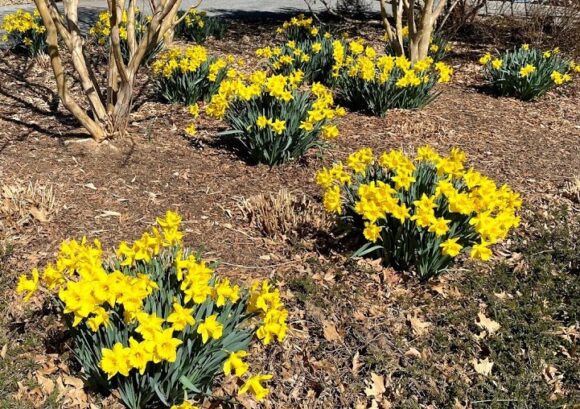
DAFFODILS:
When the green shoots emerge; spread composted manure around the plants.

‘A host of golden daffodils.’ Photo by Sarah Mitchell-Baker on Unsplash.

CUTTING  DAFFODILS FOR DISPLAY INDOORS:
The stems release a sap like “goop” that harms other flowers.  Before adding Daffodils to an arrangement, cut the stems at an angle, and leave them in a vase half filled with lukewarm water for a couple of hours.  Discard that water and add the Daffodils to the other flowers.  If you recut the stems you will need to repeat the process. Change the water in the vase often.

PERENNIALS:
When perennials are about four inches above soil level, in May when soil is 55 degrees, apply composted manure around them to further encourage healthy growth.

DIVIDING PLANTS:
At the end of April or beginning of May, you can divide late blooming perennials that have been in the ground for four years or more; these divisions encourage stronger bloom.

Discard the older, inner parts of the clumps and plant the new outside portions.  Do not plant the new divisions any deeper than they were originally in the ground.

When dividing irises, barely cover the root system so they do not fall over – if Irises are planted too deep they will not bloom.

Pansies: pick the flowers regularly to encourage more bloom.

March is the time to plant the following seeds indoors: gaillardia, salvia, marigold, zinnia, petunia, snapdragon, stock and verbena. Before planting these seeds, soak seeds in warm water and plant them in sphagnum moss or coir. Coir is the outer shell or fiber of the Coconut, either of these two mediums prevents a disease called “damping off”, which can cause seeds to rot before germination.

Cover pots and seed trays with plastic wrap, which creates a mini-greenhouse, which provides moisture that seeds need to germinate.

Note: Remove the plastic once the seeds have germinated, as the soil needs to drain and needs air circulation around the emerging stems.

If you are going away on business, or on vacation reapply the plastic wrap over the pots and trays and prop some sticks or skewers in the corners. While you are away the seedlings will stay moist, make sure the seedlings do not come in contact with the plastic.

Start tuberous begonias, and caladiums indoors.

DORMANT SPRING SPRAYING of fruit trees, flowering cherry, crabapple, hawthorn, mountain ash and lilac can be done before the leaf buds open.

Call in a professional company and request that they use only organic products.

Houseplants – repot them if they need repotting in April.

GERANIUMS:

The plants that you brought indoors at the end of last season check them and when the new side shoots appear, cut them back to four inches and repot them in clean pots about and inch and a half larger with fresh potting soil.

Well, fellow gardeners I know you are getting excited to be in your gardens this season and I hope that these tips have given you plenty to think about to keep you busy for a while. Enjoy photo of lovely gardens that my son Ian and I have designed on Facebook and if you wish I suggest you contact Ian for a consultation and enjoy the photos on his website LlandscapesbyIan.co.

Enjoy being outdoors in spring sunshine and I look forward to seeing  you in your garden in April!

Contact Maureen at maureenhaseleyjones@gmail.com

About the author: Maureen Haseley-Jones, pictured left, is a member of a family of renowned horticultural artisans, whose landscaping heritage dates back to the 17th century. She is one of the founders, together with her son Ian, of, ‘The English Lady Landscape and Home Company.’ Maureen and Ian are landscape designers and garden experts, who believe that everyone deserves to live in an eco-conscious environment and enjoy the pleasure that it brings. Maureen learned her design skills from both her mother and grandmother, and honed her horticultural and construction skills while working in the family nursery and landscape business in the U.K. Her formal horticultural training was undertaken at the Royal Botanic Gardens at Kew in Surrey.