Gardening Tips for Late September/Early October from ‘The English Lady’

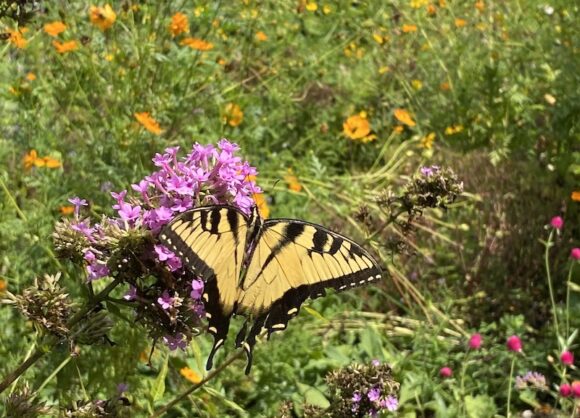
A swallowtail butterfly lands on late summer flowers.

Rain through August and September has been quite plentiful, that said, our gardens need rain as do our reservoirs.   

In the meantime, if you are planning to plant evergreens; late September going into October is the best time to plant evergreens in our zone. Evergreens planted now can begin to establish strong roots before winter and providing them with adequate water is essential.

I suggest making a hole in the soil with an iron stake or other piercing instrument and feeding the hose into the hole and allowing water to reach the roots in a slow manner for at least a half hour after planting and continue to do so a few times each week until the ground freezes in November. Cover the earth around the plants with a light layer of composted manure and mulch. However, do not mulch right up to the bark of the plants as this encourages rodents to nest and gnaw on the bark of the plants. 

HYDRANGEAS

Blue hydrangeas. Photo by Gemma Evans on Unsplash.

I receive many questions on pruning Hydrangeas, with fellow gardeners asking me, ‘Maureen, why did my Hydrangeas not bloom this year’? The reason that Hydrangeas do not bloom is that gardeners prune them at the wrong time. If you feel that your Hydrangea macrophylla has become too large and requires pruning, then go ahead and prune them in the first few weeks of September. The reason for so doing is that Hydrangeas set their buds for next season by the end of September; pruning any later will cut off those buds, which will negate any chance of bloom for next season or even the following season.  

Prune any old woody stems that have not bloomed well and any weak new shoots.  After pruning, apply a few inches of composted manure, and some peat, followed by a top dressing of natural brown bark mulch. The peat aids acidity in the soil, which is necessary as Hydrangeas may become chlorotic if the soil is too alkaline. By the way, chlorotic means abnormal reduction or loss of normal green coloration of the leaves of plants.

On another note, Hydrangeas do not like to be transplanted; transplanting them can result in little to no bloom for many seasons. For that reason, I suggest when planting new Hydrangeas, make sure they are at least five feet apart, so they have room to grow and to receive adequate ventilation and this way they will never need to be transplanted. 

This fall, as you contemplate your landscape, think on the past season as to what worked for you and what you will never try again. 

Unfortunately, mint has taken over the border beneath my Franklinia tree. Many years ago, my friend Roz was kindly lending a hand in the garden and planted mint in the garden instead of a large container that I placed for that very purpose. I was busy with other garden chores at that moment, so by the time I noticed the error, six months later, the mint was running rampant among the blue myrtle edging the borders. So folks, please take note that mint is extremely invasive and should only be planted in containers where its wayward habits can be controlled.

‘It is said that ‘a gardener’s work is never done’, but now with the season’s hard labor behind you, take a break. Sit outside and inhale the late garden fragrances and allow Mother Nature to anchor and relax you. 

In the early morning I enjoy sitting on my patio near my herb garden, inhaling the fragrance of the sage, which I will snip later to dry indoors and use in my recipes. I will also gather extra sage and lavender, which I will tie with string into small bunches to hang in my closets, as Lavender and Sage are natural moth repellents. That being said, a few Lavender bunches are tucked into my drawers to keep moths from devouring my woolens; this works fantastically as insects do not like fragrance. 

VEGETABLE GARDENS
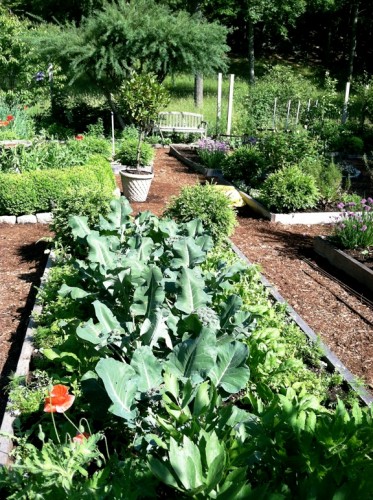
A thriving vegetable garden is the reward of fall labors.

In your vegetable garden, sow spinach for spring harvest and sow a cover crop like winter rye, which can be dug in next spring together with composted manure as green manure. Green manure produces an excellent growing environment for next year’s crop of vegetables. 

Now is the time to get your fall compost pile cooking with the last of the grass clippings, spent perennials, leaves and small woody twigs.  

Now is also the time to dig up, divide and replant overgrown perennials. Follow this method every three to four years to ensure vibrant bloom from these plants. Never plant or transplant any division or transplant any deeper in the soil than it is now or any deeper than the plant sits in the pot.

In the less hectic pace of fall, early autumn is the time to re-think your gardens. The garden’s pre-winter grooming will wait for a few weeks. Or you may feel that you would like to have a professional design as you have noticed that your borders are not living up to your expectations. 

If that is so, then contact someone whom you trust to create a plan in the fall and winter, which can then be phased in beginning next spring. Engage someone who will listen to your thoughts and stay within your budget. I will give you a suggestion for a plantsman and that is my son Ian whose company and website is LandscapesByIan.com. I know you would enjoy speaking with him and the saying goes, ’The apple does not fall far from the tree!’ I am sure you will enjoy meeting with him and checking out his creative talents. 

PEONIES

September is the month to plant and transplant Peonies. Do not plant them deeply or they will not bloom, that means have just enough soil to hold them erect with the ‘pink eyes’ on the roots barely covered. Plant them with a light application of composted manure around the plant. In November, following the first hard frost, cut down the Peony foliage to about four inches from the ground. 

AUTUMN COLORS, HEALTHY SOIL and SPENT PERENNIALS

The stunning colors of fall. Photo by Dan Freeman on Unsplash.

In a few weeks, the bright vibrancy of autumn color will appear on the Maples. Fall’s brilliant autumn finery is the last hurrah, before winter sets in. Climbing up the red milk shed near the barn, the buds on the white autumn clematis are beginning to unfurl and in the herb garden, autumn crocus, asters and sedum are taking their curtain calls. 

For your soil to remain healthy, add a light layer of composted manure to all the borders now or in early October, together with a two-inch layer of fine bark mulch around all newly-planted and transplanted perennials and shrubs. With the application of the manure and mulch you are continuing to build the humus component, which will ensure a rich growing environment for spring and also protect the plants from winter’s harsh conditions.  

I do not cut down my spent perennials but leave them up for the birds; the ripened seed heads are a delicious treat for them to peck at. Following the vibrancy of summer bloom, I enjoy the softer subtle colors of gray, brown and yellow of the spent perennials and ornamental grasses blending naturally with the muted winter landscape, which to me offers a resting of the senses. 

FALL PLANTING
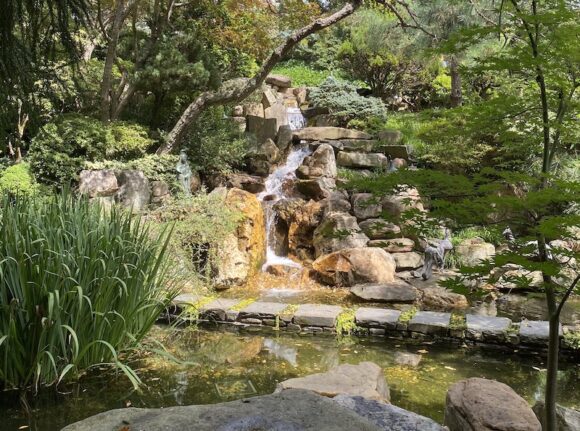
Fall is a good time to rethink your garden and perhaps consider new ideas such as a water feature.

Early- to mid-October is a great time to be planting. The benefits of fall planting for trees, shrubs and perennials gives them a head start with root development over those planted in the spring.  This is especially so when we experience a late spring when planting cannot begin until late April. 

In New England’s fall, the cooler temperatures and still warm soil encourages the plants to direct their energy to produce strong roots.   

The following trees are not good candidates for fall planting: 

Birches, Larches, Gingko, Oaks, Magnolia, and all flowering fruit and flowering trees as well as the Eastern Red Cedar.  These trees have fleshy roots and their feeder roots are not large when young and take time to establish and therefore are susceptible to frost heave.

Some perennials that do not like to be planted in fall are Artemisia, Lambs Ears, Foxglove, Penstemon, Anemone, Campanula, Kniphofia, Lupines, Scabiosa, Ferns and Grasses. 

Plant garlic this month for harvest next June – garlic is the antibiotic of the garden. Plant it under fruit trees to avoid scab and root disease, near to ponds or standing water to control mosquito larvae or pour garlic water into ponds, bird baths and fountains to deter adult mosquitoes. 

BARGAINS

This is a good time to pick up end-of-season plant bargains. Most nurseries and garden centers have lowered their prices so they do not have to winter plants over in the nursery. If you do purchase a few plants, keep your eyes open for the following problems:

> POTBOUND PLANTS – check the bottom of the pot to see if the roots are growing through the holes.  If not, gently tap the plant out of the container to see if it has a network of overlapping roots that wrap around the root ball.  It is possible to salvage a root bound plant, which is suffering from water and nutrient deficiencies over the summer, but it will be slow to root. Before you plant this one in your garden, cut the encircling roots – the roots will now be shorter and will take to rooting easier. 

> DISEASED PLANTS – plants that have been in containers all summer and have been fed high nitrogen fertilizers are easy targets for pests and diseases.  Check for spots on the foliage, wilted or curling leaves and discolored roots. As well as visible signs of pest damage and infestation such as webbing or sticky residue on foliage.  Not only would these plants do poorly in the garden but could infect your other plants and the soil.  Soil born diseases are the most difficult to deal with.

> BADLY SHAPED PLANTS – Badly shaped plants are the ‘Charlie Brown’ Christmas trees of the plant world, the unwanted orphans that have been passed over year after year; these are the runts of the litter!  Do not set yourself up for disappointment looking at an ugly tree or shrub just to save a few dollars.

> MIS-LABLED PLANTS – At the end of the season many plant tags have been lost or mixed up, which means you are likely to get a perennial with flowers that are not the color you expected. Or you may buy a deciduous tree or shrub when you were looking for an evergreen variety.  Stick to the plants that are part of large displays of identically labeled plants or with labels so firmly attached that look like they have been there for a while.

With all the above-mentioned plants – always add composted manure around the plant and do not plant any deeper than it is in its pot or burlap wrapping. Always wear gloves when working with manure; there is bacteria in the manure – great for the soil but not healthy for you. 

Please note that the bargain you get is often not worth the discount price. 

NEW LAWN OR PATCH SEEDING
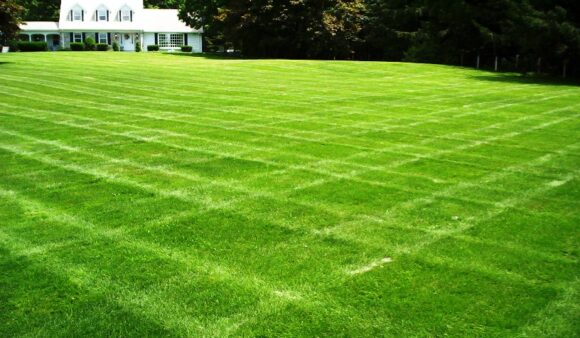
September and early October is an excellent time to plant new grass, the young grass plants will have the advantage over weeds. Do not buy cheap seed, you reap what you sow! 

Gently de-thatch the areas that you wish to overseed or patch. Do not use the large thatching machines, which can damage existing grass. Add some composted manure to the area, broadcast the seed and cover the newly seeded grass area with salt hay (free from weed seed). Do not allow the soil surface to dry out, keep it moist. Water gently, and do not saturate the area or the seed will wash away. 

When the grass appears, stay off it, do not mow and leave the salt hay to rot. Next spring, a healthy lawn will emerge and if there are a few bare patches in April, you can fill in the bare spots. 

SPRING BULBS

I hope your spring bulb orders are in by now. Be adventurous this year and go for masses of a single color for the greatest impact. No matter how small your planting area, it is the intensity that counts, with two or three dozen red Tulips or a hundred Daffodils planted on your woodland edge. 

Buying daffodils in large numbers is less expensive, the bulbs are usually smaller – this is not a problem as daffodil bulbs grow larger each year. Even though many say the spacing between these larger bulbs should be six inches, there is no reason they cannot touch.  

Put some composted manure or bulb food on the soil where the bulbs are planted. Make sure you plant the Daffodils eight inches below the frost line, with the pointed end up. Wear gloves when you plant bulbs as they have a skin irritant, which may cause a rash.

If you cannot plant your bulbs when you receive them, store them in a cool, dry place in paper bags.  The best time to plant spring bulbs in the Northeast is the end of October to the middle of November.

Lily of the Valley can be transplanted this month, but wear gloves because there is toxicity in this plant.  

Dig up your gladioli corms, Calla bulbs, Elephant Ear bulbs and Dahlia tubers when the foliage turns yellow.  Lay them in the sun to “cure” and store them in a cool, dry dark place. When you dig the Dahlia tubers, do not pull them, pulling can break the tubers. 

HOUSEPLANTS & STONEWORK

Transfer any houseplants that you placed outside in the summer to an indoor location at this time.

In early September after their summer sojourn outdoors, take your houseplants indoors and wash the foliage gently and repot with new potting soil into a clean container. Repot those plants that have outgrown their pots to a clean container that is only one size larger. 

Fall and early winter is a great time to do stonework – dry laid paths, walls and patios. As well as repairing fences, arbors and pergolas and build decks. Paint wooden outdoor furniture with eco-conscious paint before putting them undercover for winter.    

September is a gardener’s paradise; the air is cooler, the soil easy to work and you will not overheat with the effort. Stay awhile in your garden and enjoy the comforting fragrance of fall.       

I’ll see you in your garden next time.  Feel free to e-mail me with gardening questions at MaureenHaseleyJones@gmail.com

About the author: Maureen Haseley-Jones is a member of a family of renowned horticultural artisans, whose landscaping heritage dates back to the 17th century. She is one of the founders, together with her son Ian, of, The English Lady Landscape and Home Company. Maureen and Ian are landscape designers and garden experts, who believe that everyone deserves to live in an eco-conscious environment and enjoy the pleasure that it brings. Maureen learned her design skills from both her mother and grandmother, and honed her horticultural and construction skills while working in the family nursery and landscape business in the U.K. Her formal horticultural training was undertaken at the Royal Botanic Gardens at Kew in Surrey. 

Letter From Paris … or, in this case, Saint-Émilion: A Day In Wine Country

Nicole Prévost Logan

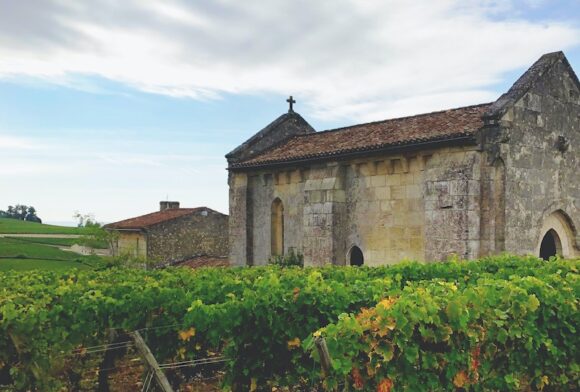
Saint-Émilion is a small village perched on the hills overlooking the Dordogne river about 28 miles east of Bordeaux It is surrounded by some of the most prestigious  vineyards in the world and in 1999, the “cultural village”of St. Emilion was added to the list of UNESCO World Heritage sites.

In winter, the population of Saint-Émilion is not more than 200 but in summer the place turns into one of the tourist hot spots of France. Crowds start showing up early in the morning and people fill the café terraces, climb the steep and narrow streets, and look at the small shops selling cannelets and macarons. Unwelcome cars, bumper to bumper, search desperately for a parking place.

The town has over 1.3. million visitors a year.  

A view of Saint-Émilion. Photo by Sigmund on Unsplash.

 A family friend, now an enthusiastic guide, led us through the long history of the village with a series of colorful anecdotes. The first traces of human occupation in Saint-Émilion date back 35,000 years. We plunged into the past with our guide, who showed us the catacombs and some of the 200-km long tunnels, which turn the hill into something resembling a Gruyère cheese .

Saint-Émilion acquired its name from brother Aemilianus or Emilion — a monk who arrived from Brittany in the 8th century AD. He was a master in the art of making bread. In doing so he earned money, which was stolen by other monks, according to our guide. He then became a hermit and lived in a cave. He is remembered for accomplishing several miracles. 

Word of these miracles attracted other monks and pilgrims on their way to Santiago de Compostela in Spain. Vestiges from the 8th to the 12th century are still visible underground, including wall paintings, wall carvings, altars and medieval chapels. The most striking is the “Monolith church” built in the early 12th century. Its gigantic 12-meter-high arch is made of a single block of stone. The best residences of Bordeaux are built out of the limestone found in the Saint-Émilion quarry.   

In 1152 Eleanor of Aquitaine married Henri II Plantagenet. Two years later Henry became king of England and the region fell under British rule, where it remained for three centuries.This perhaps explains why the British still feel very much at home in this area.

The “One Hundred Year War” ended when the English army was defeated by the French at battle of Castillion in 1453.

In 1199, the youngest son of Eleanor, John Lackland, sealed the “Charter of Falaise” (Falaise is a town in Normandy) conferring rights to the Jurade – an association that is unique in the world. The Jurats of Saint-Émilion controlled all civic, legal and administrative affairs of the city. In the 15th century, the French kings reaffirmed those rights. The association was dissolved during the French Revolution. 

Today the Jurade association exists again. Its 140 Jurats members wear the medieval scarlet robes during their annual celebration the third week in June. Quite a spectacle to watch on the top of the ruin of the Tour du Roy – the only intact Roman donjon (the great tower or innermost keep of a castle) remaining in the Gironde Département.  

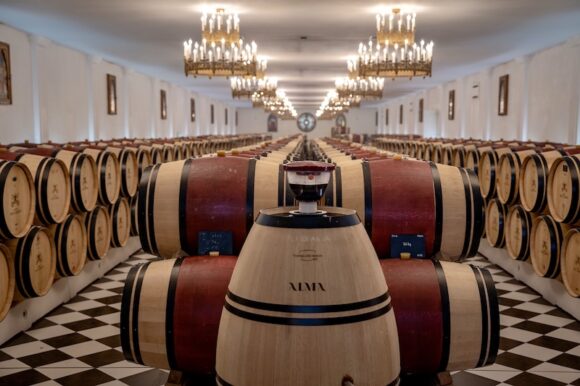
Barrels of Saint-Émilion wine are left to age in cool cellars. Photo by Brian Ashley Harris, www.brian-ashley.com.

The art of wine-making started as far back as 6,000 BC. In the Saint-Émilion area, the first wine amphora date from 56BC. The culture of wine intensified after the spread of Christianity in the 5th century AD.  Archaeological excavations are ongoing in the Gallo-Roman villa du Pilat. Beautiful mosaics reveal the great wealth of that villa, which is probably related to the production of wine. 

Wine-growing is a multimillion industry. It is highly regulated and fiercely competitive. It is also a vulnerable industry.

In the 1870s, a pest insect called phylloxera devastated French vineyards. It took them 30 years to recover by grafting resistant American rootstocks. Today close to up one third of the Bordeaux wine is again threatened by a double crisis, over-production and the vagaries of climate changes. A “sanitary plan” consisting of pulling vines, started in June 2023.  

I obtained lots of information about Saint-Émilion while talking to a young student pursuing her university studies in Bordeaux in tourism, culinary art and oenology.

How are the Saint-Émilion wines ranked? At the 1855 Exposition Universelle held in Paris, Napoleon III, appointed a commission to rank the Bordeaux wines. That ranking has remained frozen since then for the Bordeaux wines, but only on the left bank of the Garonne River (Medoc and Graves.) 

But since 1955 the ranking of the Saint-Émilion wines can be revised every 10 years. In 2022, the latest selection retained only two Premiers Grands Crus classés A: Chateau Pavie and Chateau Figeac, 12 “Premiers Grands Crus Classés B, and 72 “Grands Crus Classés. The expression “grand cru” can. be translated “first growth” in English.

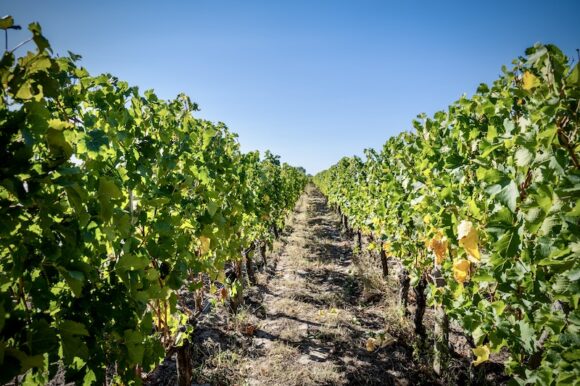
Looking down the neat rows of vines in a Saint-Émilion vineyard. Photo by Brian Ashley Harris, www.brian-ashley.com.

Saint-Émilion vineyards cover 5,400 hectares (out of 115,000 for the entire Bordelais region.) One hectare (or Ha) is the equivalent of three acres. Most of the plots in Saint-Émilion are small at 20 Ha or less. 

In fact, keeping down the size helps make the wine rare and therefore more expensive. 

The gaps between rows of vines are one meter or less to force the work to be done manually and not by machine. 

To keep production as low as possible, the workers may even trim bunch of grapes if they are not in exact alignment. The lifespan of a wine can reach 65 years, but on our country road, I saw plots planted with brand new vines.

We approached Saint-Émilion from the main BergeracLibourne road in the lower plain on the right bank of the Dordogne river. A 68-meter high church steeple dominates a skyline of houses nestled among ruins of cloisters and medieval fortifications. It felt as if the winding road was taking us to the Holy Grail. On each side, we could see manicured rows of vines. Here land is worth gold and one hectare (about three acres) can be worth seven million Euros.

On top of the ridge, we notice an elegant house with a turret. Unfolding down the hill are impeccable rows of vines and low sustaining walls. This if the Chateau Belair-Monange, the residence of the Moueix family. They have been wine growers for three generations, as well as “négociants”  (wine merchants) doing business in France and also the Napa valley. Their wine is “only” Premier Grand Cru Classé.

What makes the Moueix family different from other producers is that they keep buying plots and now own 10 vineyards. In the 1960s, Jean Pierre, the head of the dynasty, made the brilliant move of buying Chateau Petrus located in Pomerol, an area adjacent to Saint-Émilion in the west. 

To the surprise of everybody, the family sold 20 percent of the Petrus vineyard to a Colombian-American businessman in 2018.

Edouard Moueix, born in 1977, heads wine production today. His wife, Kelley, is American and runs a store in the village that sells bags and other luxury items. 

Chateau Angelus is big in Saint-Émilion. In fact, very big.

Its offices, chais (local term for storerooms), shops and showrooms are quite conspicuous in the area. On the hill, the imposing main building where clients come to taste the wines has a beautiful roof. When foreign guests enter the building, the bells in the belfry above the entrance door will play the music of their country. The 85-Ha. vineyard is situated in a natural amphitheater near the center of town — a priceless location. 

Until last year it ranked in the highest category of St Emilion wines but was excluded in 2022 and lost its “A”. The owner – Hubert Boüard de la Foresti – is the last of eight generations since 1785.

The reason for this earth-shaking development is that M. Bouard de la Foresti violated his responsibilities as head of the Confrérie du Grand Conseil du vin de Bordeaux where he served three years. He was convicted of fraud.

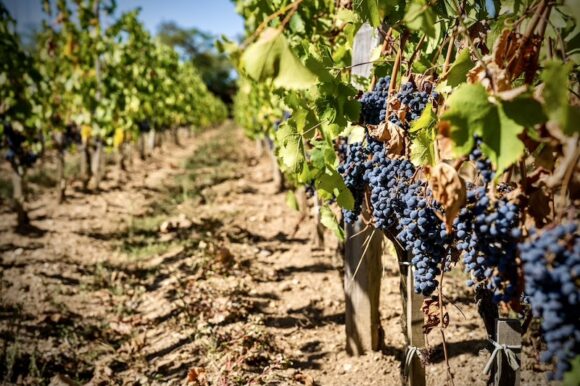
The vines are loaded with grapes prior to the ‘vendage’ when the grapes are harvested. Photo by Brian Ashley Harris, www.brian-ashley.com.

Although located not in Saint-Émilion proper but nearby in the west in the Pomerol region, Chateau Petrus is well worth mentioning. Its path to celebrity is different from the others since it received remarkable publicity through some really high-profile events.

Queen Elizabeth II chose Chateau Petrus to be served at her marriage in 1947.

John F. Kennedy offered Chateau Petrus as a gift to Jackie. 

James Bond was served the Chateau Petrus in one of his films. 

The acreage is quite small:- only 11 Ha.but a bottle can reach 2,300 to 5,000 Euros — and as much as 10,000 Euros — at auction.

Bernard Arnault, the richest man in France (LVMH), until 2022 owned a small plot in Saint-Émilion producing Cheval Blanc, Grand Cru Classé Catégorie A, until 2022. A 1947 bottle sells for $770.

The culture of wine in Saint-Émilion is strictly regulated. Fertilizers are not permitted, composts are but not more than every three to four years, since the earth does not need many nutrients. Watering is only allowed at times of drought. 

Besides the wine growers must abide by the European Union blueprint to generate a sustainable production by respecting the environment. The label  “AOC” or Appelation d’ Origine Controlée is granted to protect the production of a defined area – the terroir – using traditional know-how specific to the geographical area.

Do not miss a chance, next time you are in Saint-Émilion to do some wine-tasting by tilting the glass to see the color, twirl the glass to bring out the flavor and/or smell the wine to detect its alcohol content, aroma or acidity. You can taste the wine in one of the many wine caves àvins (wine cellars) in the village.

One can also visit estates such as the elegant Chateau Soutard — their wine-tasting package costs $800 for a group of four. A votre santé!

Editor’s Note:This is the opinion of Nicole Prévost Logan.

Nicole Prévost Logan

About the author: Nicole Prévost Logan divides her time between Essex and Paris, spending summers in the former and winters in the latter. She writes an occasional column for us from her Paris home where her topics will include politics, economy, social unrest — mostly in France — but also in other European countries. She also covers a variety of art exhibits and the performing arts in Europe. Logan is the author of ‘Forever on the Road: A Franco-American Family’s Thirty Years in the Foreign Service,’ an autobiography of her life as the wife of an overseas diplomat, who lived in 10 foreign countries on three continents. Her experiences during her foreign service life included being in Lebanon when civil war erupted, excavating a medieval city in Moscow and spending a week under house arrest in Guinea.

A View From My Porch: The Beach Boys Redux — Surfing with Gen. Alpha

Tom Gotowka

I hypothesized in a “View” published in early August that “The Beach Boys,” whose music regularly celebrated muscle cars, the power of the internal combustion engine, and California car culture had an influence on Americans’ early reluctance to buy electric vehicles.

I did not expect to ever consider their music in another essay, or in this case, a little bit of their musical homage to the beach and surfing; but we are approaching the fall of the year and my grandson, “H”, who turned seven earlier this summer, graduated last summer with a few of his New Jersey cousins from surfing camp and returned home, schooled in, “The practices and values of the surf and ocean lifestyle.” 

My impression of his surf camp experience is that this coaching focused on technique and safety rather than the physics and science of the sport; and did not even acknowledge the robust body of music that contributed to “surfer-cool.” 

Consequently, as duty called, I present some of the science of the sport in this essay, and like the essay on electric vehicles, refer, but only briefly, to the surfing song list published by “The Beach Boys.” 

This essay is also presented as something light as we enter Old Lyme’s campaign season 2023.

Generation Alpha:

“Gen. Alpha,” is the cohort born between the early-2010s and the mid-2020s.They are the most globally-connected generation of children ever and could also end up being the most formally educated. They are the children of millennials and the immediate successors of the “Zoomers” of “Gen. Z,” and are the first generation to be born entirely within the 21st century. 

COVID-19 had a substantial impact on their childhood and acclaimed social demographer and futurist, Mark McCrindle, who coined the term Generation Alpha, defines and analyzes the generations in this article. He notes, “Generation Alpha will be the largest generation than ever before. Each week there are over 2.7 million Gen Alphas born. They will live for longer and are more culturally diverse compared to their older counterparts.”

All of Christina’s and my grandchildren are Alphas. “H” was born in mid-2016, a remarkable year; which I illustrate below:

  • The Denver Broncos defeated the Carolina Panthers, 24 to 10 in Super Bowl 50 on Feb.7; and a month later, Denver QB, Peyton Manning retired after 18 seasons in the NFL.
  • “Spotlight”, a very troubling “docudrama” that dramatized the “Boston Globe’s year-long Pulitzer Prize-winning investigation of the Catholic Archdiocese of Boston, won two Academy Awards on Feb. 28:– “Best Picture” and “Best Original Screenplay”.
  • That same evening, Leonardo DiCaprio won his first Academy Award, “Best Actor”, for his role as a frontiersman mauled by a bear in “The Revenant.”
  • President Obama and his family visited Cuba in March — the first visit by a sitting POTUS since Calvin Coolidge in 1928. His visit included talks with Cuba’s leader, Raul Castro, the Cuban people, some dissidents; and served as a symbolic capstone on more than a year’s effort to normalize economic and diplomatic relations between the United States and Cuba, after more than 50 years of Cold War hostility. Notably, the Obamas and the Castros attended a baseball game together at Havana’s 55,000 seat “Estadio Latinoamericano” between the Cuban National Team and the Tampa Bay Rays, marking the first visit to the island by a Major League Baseball team since 1999. Note, Rays, 4 to1.
  • The Atlantic hurricane season, which began on June 1, was the deadliest hurricane season since 2008, and the first above-average hurricane season since 2012.
  • On June 19, the Cleveland Cavaliers won the NBA Championship by defeating the Golden State Warriors — their city’s first professional sports championship in more than 50 years. 
  • Unlike the Academy Awards, a fantasy-based drama, “Game of Thrones,” won 12 Emmys on Sept. 18, the year’s top winner. 
  • On Nov. 2, the Chicago Cubs won their first World Series since 1908, snapping the “Billy Goat Curse,” one of the more infamous curses in sports, and baseball’s longest World Series title drought; surpassing Boston’s own “Curse of the Bambino” by almost a quarter-century. 
  • On Dec 10, Army finally beat Navy 21 to17 in double overtime; after blocking a Navy field goal with essentially no time left in the game — the first win over Navy since 2001. Army’s 14-game losing streak was the longest by either academy in a series that began in 1890.

Clearly, I have no idea whether surfing will be a long-term interest for “H,” and if so, whether his family will support his quest for the perfect wave. Nevertheless, here is some of the science that impacts the sport.

He is, however, an early and eager reader, and also a fan of the “View; and so, this essay might provide the basis for some, “What I did on my summer vacation” presentations, or a paragraph or two as he moves beyond first grade. 

Making Waves:

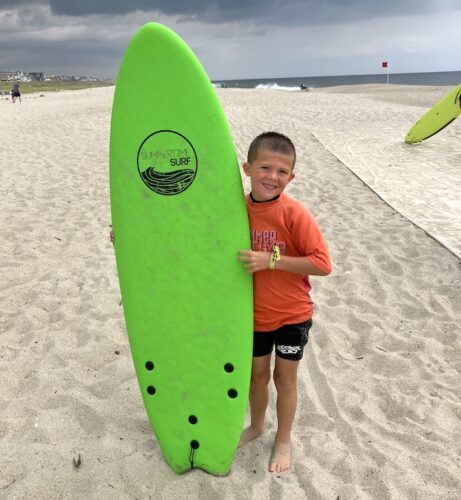
The author’s grandson, ‘H’, holds his board after another successful day at Surf Camp.

Waves form when the wind blows across the surface of the ocean, transferring energy through friction. Several factors affect the size and shape of waves. These include wind speed, wind duration, fetch (i.e., the distance over which the wind blows), water depth, and shoreline shape.

Generally, waves on the West Coast of the United States are bigger than those on the East Coast. The prevailing winds on the West Coast are behind the waves, which increases the waves’ energy; while on the East Coast, the prevailing winds usually blow against the incoming waves, decreasing the waves’ energy.

Further, the Pacific Ocean has a greater expanse than the Atlantic Ocean, which means that the fetch is greater on the West Coast.

Applied Physics:

Surfing is a good example of how several forces act together to enable a ride on the waves. I am going to discuss a few: gravity, buoyancy, and inertia; and consider the “center of gravity” (COG).

The forces of gravity and buoyancy work against each other. Gravity pulls the surfboard down, while buoyancy pushes it up. “H” will eventually understand that the latter force is referred to as “Archimedes’ Principle,” which states, in simple terms, that, “A body at rest that is completely or partially submerged in a fluid is acted upon by an upward, or buoyant, force.”

Because the materials used in contemporary surfboards are much lighter and less dense than the materials used in the past, the boards are more buoyant.

The early surfboards on the California beaches were essentially long redwood planks, sanded smooth; which absorbed water and became very heavy, even with the best protective finishes available at the time. These boards ranged from 10 to 20 ft. long and were not maneuverable, versus the modern boards that are much shorter and “steerable”.

An understanding of the COG is also important. Conceptually, the COG is the point around which the body’s weight is evenly distributed or balanced in all directions. The COG affects the stability of objects. The lower the COG, the more stable the object. The higher it is, the more likely the object is to topple over if it is pushed. 

Beyond surfing, the COG is also important in designing buildings and bridges; aircraft, race cars, and Humvees. (Note to “H”: It is also why you do not stand up in your dinghy and why you keep low when mountain biking.)

In practice, managing the COG is one of the most important skills a surfer can master. For example, to remain balanced, surfers crouch, keeping their center of gravity low. Surfers can also change their position on the board. If a surfer stands in the middle of the board where buoyancy and weight are balanced, the board will be flat. If the surfer moves back, the nose of the board will go up, making it much easier to turn in the water compared to the long wooden boards described above.  

This difference is due to the physical principle known as inertia, which describes how difficult it is to change something’s motion once it has started moving. Of course, “H” will eventually know it as “Newton’s First Law,” which states that an object at rest remains at rest, and an object in motion remains in motion at constant speed and in a straight line unless acted on by an external force.

Although long boards may not be as nimble as short boards, they reach higher speeds, mainly because their larger surface provides more area for water to push the surfer along. 

Connecticut Surf:

According to the “experts”, Long Island Sound has only modest fetch, so epic waves are hard to come by, but the following beaches are worth checking out:

  • The prime surfing season in Connecticut is typically from late summer through fall when hurricanes and tropical storms can generate larger swells.
  • Rocky Neck State Park has a sandy beach with a mix of sandbars and rocky sections that can create some challenging waves. 
  • Hammonasset Beach is good for longboarding and beginner surfers.
  • Fairfield Beach offers a consistent break with hollow waves that can be quite powerful during the right conditions. 

However, if you want an ocean experience that is close by, there are a few places in Rhode Island worth considering: 

  • Misquamicut Beach has reliable,  consistent, and beginner-friendly” surf. Like Connecticut, the best time of year to surf Misquamicut is Spring and often, the month of September; when you’ll get rideable swells and light offshore winds.
  • East Beach in Charlestown also has consistent waves, and can be challenging.

If a surfer’s search takes him or her beyond New England, The Beach Boys also chronicled a possible surfers’ travel program, identifying sites with “cooking” surf on three continents, Hawaii, and the Caribbean in two songs from the early-1960s, whose abridged lyrics follow below:

Let’s go surfing now, everybody’s learning how;
Come on a safari with me.
At Huntington and Malibu they’re shooting the pier;

At Rincon they’re walking the nose.
We’re going on safari to the islands this year, so if you’re coming, get ready to go.

They’re angling in Laguna in Cerro Azul;
they’re kicking out in Doheny, too.
Surfing’s mighty wild, getting bigger every day,
from Hawaii to the shores of Peru

And further:

You’ll catch them surfing’ at Del Mar,
Ventura county line,
Santa Cruz and Trestle,
Australia’s Narrabeen.
All over Manhattan
And down Doheny way,  

Haggerties and Swamies
Pacific Palisades.
San Onofre and Sunset,
Redondo Beach, L.A.
All over La Jolla; 
At Waimea Bay.

The Perils of Surfing:

In 1866, Mark Twain spent a few months in the Sandwich Islands (i.e., Hawaii) as a correspondent for “The Sacramento Union” newspaper. He reported on his own attempts at surfing: “I got the board placed right, and at the right moment, too; but missed the connection myself. The board struck the shore in three-quarters of a second… and I struck the bottom about the same time, with a couple of barrels of water in me.”

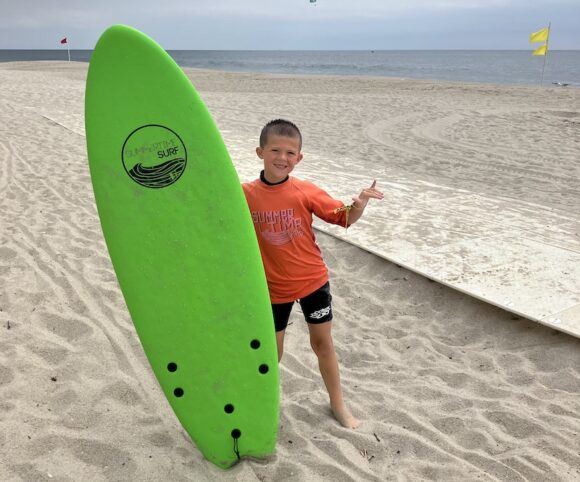
‘H’ gives the Shaka sign with his left hand. It is a friendly hand gesture usually associated with the surfing culture.

Author’s Thoughts:

Should you meet “H” on the beach, he may greet you with the Shaka sign, which is a friendly hand gesture usually associated with the surfing culture.  He’ll extend the thumb and pinky finger of his hand while holding the three middle fingers curled, Depending on the context, the gesture can mean ”hang loose”, “chill out,” or just hello. ” You might also warrant a “Cowabunga, Dude!”, which is an expression of amazement or enthusiasm. Remember, he turned seven a few months ago.

I anticipate that my next “View” will be about children’s books.

Editor’s Note: This is the opinion of Thomas D. Gotowka.

About the Author: Tom Gotowka is a resident of Old Lyme, whose entire adult career has been in healthcare. He will sit on the Navy side at the Army/Navy football game. He always sit on the crimson side at any Harvard/Yale contest. He enjoys reading historic speeches and considers himself a scholar of the period from FDR through JFK. A child of AM Radio, he probably knows the lyrics of every rock and roll or folk song published since 1960. He hopes these experiences give readers a sense of what he believes “qualify” him to write this column.

Author’s Sources:

Carter, Christine M. “The Complete Guide To Generation Alpha, The Children Of Millennials”. Forbes.08/18/2019.
Francis, J.F. “The Ultimate Guide to Surfing in Connecticut.” Surf Atlas. 12/04/2021.
Hall, D. “Currents, Waves, and Tides”. Smithsonian Ocean. 08/2020.
Kesten, P. “The Physics of Surfing.” Santa Clara University. Illuminate.08/19/2019.
Klein, C. “What Was the Curse of the Bambino—and How Was Baseball’s Greatest Hex Broken”? History. 09/30/2021.
Larson, S. “Spotlight and its Revelations.” The New Yorker. 12/08/2015. 
McCrindle, M. and Fell, A. (2023). ”Generation Alpha”. Sydney: Hachette Book Group. 2021. 
Sanchez, R. “What is the Chicago Cubs’ billy goat curse”? CNN. 10/28/2016
Spotlight Team. “Church Allowed Abuse by Priest for Years. The Boston Globe. 01/06/2002.
Trinastic, J. “Waves of Physics: The Science of surfing”. Science Connected. 05/11/2021
Twain, M. “Roughing it”. The American Publishing Company. 1872.

Song List:

Surfing Safari (The Beach Boys, 1962)
Surfing U.S.A. (The Beach Boys, 1963)

Letter From Paris: Let the Games Begin … in Paris … in 2024!

Nicole Prévost Logan

The countdown has started for the Summer Olympic Games 2024 (or J.O. [Jeux Olympiques] 2024 as the French say) and the excitement is growing. The dates are July 26 through Aug. 11, and Aug. 28 through Sept. 8 for the Special Olympics . Paris will be the host of the events.

The interface of an historical city like Paris with venues for sporting events should be magical while also being a challenge.  Imagine watching beach volley ball under the Tour Eiffel or breakdancing on the Place de la Concorde !

Photo by Luca Dugaro on Unsplash.

The J.O. 2024 mark the centenary of 1924 inauguration of the first modern Olympic games. It will be the sixth time for France to host the event, and also represents the  largest event ever organized in the country. There will be total parity between men and women athletes – a first in the history of the games.   

On Aug.  26, 2023, a disappointing announcement was made: because of a series of spring downpours, the sewers overflowed and ran into the Seine, which was declared too polluted to serve as a venue for water sports. The preparatory work for the competition on the Alexander III bridge had to be dismantled. 

In order to prevent the recurrent surge of polluting water into the Seine after storms, a gigantic project has been undertaken.  Between the Gare d’Austerlitz and the Hopital Salpêtrière east of the city, several blocks of apartment buildings were razed to make room for a “bassin de rétention”  50 meters in diameter. At the bottom of a 30 meter-deep well a massive “tunnnelier” machine will dig a tunnel under the Seine for huge pipes to be laid.   Other bassins will be constructed upstream east of Paris.

In a way the scheduling of the games in 2024 is helping to speed up this huge project of assainissement (sanitation).  Some day soon, maybe one will be able to swim in the Seine!

Logistics will be a major headache for the games officials, mostly to organize transport. Flying taxis will turn the skies of summer 2024 into a science-fiction scene of the future. A 10-minute flight from Charles DeGaulle airport can certainly beat a two-hour long ride by public transport.

Additional buses and trams will compensate for the closure of many metro and bus stops in central Paris and on the Périph (Beltway), a special lane will be reserved for athletes and games officials. 

The fully automated subway ligne 14 will be extended to include Orly airport and a new métro station will open near the Stade de France.

In order to assist in welcoming at least 13 million visitors, 40,000 volunteers positions were offered and filled up immediately.   

Security will be a top priority , particularly during the opening ceremony which will be watched by 600,000 spectators. All of them are obliged to have a ticket, including the 400,000, holding free tickets. 

Photo by Sebastien Gabriel on Unsplash.

Order will be maintained by 35,000 police. According to Gerald Darmanin, Minister of the Interior, the scope of the security plan is unprecedented, since it will cover six kilometers along the banks of the Seine when a parade of 115 boats will end up at the Trocadéro and the foot of the Tour Eiffel

A security perimeter will be installed around the city against any possible acts of terrorism. More than 4,000 video-surveillance cameras will function with “smart” AI algorithms to protect private data.

Anti-drones will be there also. During the Tokyo games, 400 million cyberattacks were detected. In Paris, the organizers will be ready for such a possibility. 

How expensive will the tickets be?  It is hard to give the exact prices since they depend on the competition. Just to give an idea, the most expensive seat at the opening ceremony will cost 2,700 Euros and the cheapest 90. 

At the closing ceremony, the respective prices are 1,600 and 45 Euros. 

Two of the most expensive competitions to watch will be Athletics at 900 Euros and swimming at 690 Euros. At the other end of the price range, tickets to watch the marathon or the urban games on Place de la Concorde will be either quite low or even free. In spite of the fact that many tickets have been made available for free,  people complain that prices are much too high. 

Given the politically-poisoned environment existing at present in France, it is hoped that the social unrest in the streets will not flare up again and add to the huge logistics problems of managing millions of spectators. As expected, criticisms of Paris 2024 abound centered primarily on protests against the entrance tickets being so expensive that the average person cannot afford them.

In fact, most Parisians will probably want to flee the capital during the games. Hotel rooms and AirBnB apartments will be offered at exorbitant prices. 

Most of the infrastructure to accommodate the Olympic sporting events already exists. The Aquatics Center for swimming and diving competitions is an exception. 

Close to 95 percent of the financing comes from the private sector. Private investors will bear the cost – estimated at 1.3 billion Euros – of the Olympic village. This is where the 10,500 athletes will stay in the Saint Dénis area, north-west of Paris. Architects have designed the temporary lodgings to be easily transformed into permanent apartments for low-income French residents. 

Except for the surfing competitions, which will be held in Tahiti, 9,800  miles away from Paris  (certainly not next door!), all the sporting events will take place in 30 sites equally divided between Olympic and Special Olympics throughout France but mostly in and around Paris. 

If you enjoy sightseeing in the old city, you might be interested in knowing that some key historical sites will be turned into “Sport Arenas” for various disciplines. Examples are:-

Place de la Concorde : skateboard (first time in J.O.) ; breakdancing; BMX bicycle free style,  basketball

Les Invalides: Archery

Eiffel Tower stadium and Champ de Mars: Judo and Wrestling;  Special Olympics (wheelchair rugby) 

Rolland Garros: Tennis

Chateau de Versailles:  Equestrian events, Dressage, Horse-jumping

Hotel de Ville to Les Invalides:  a 42km-long marathon touching on many historical monuments of Paris. On the first day, 80 men will run.  On the second day, 80 women .

Pont d’Iena: a beautiful location for spectator stands

Grand Palais: Fencing, Taekwondo  (Korean martial art)

Trocadero: Start of the road cycling races, 273 km

Parc de la Villette (north of Paris) largest cultural park in Europe.

Celebration Centers during the Games to meet athletes are:

Parc des Princes: Football

Vaires sur Marne Nautical Stadium: Rowing, Canoeing/Kayaking

Marseille: Sailing

La Défense Arena, Aquatics Center: Swimming and diving

Stade de France (also called Stade Olympique):  Athletics. This is the oldest discipline, going back to 776 BC in Greece

St Quentin-en-Yvelines: cycling track

A view of Notre Dame before the devastating fire.

To top it all, President Emmanuel Macron has a vision of Notre Cathedral opening for the public with a celebration of mass to coincide with J.O. 2024.  That would indeed make these ‘The Games of the Century’!

Editor’s Note:This is the opinion of Nicole Prévost Logan.

Nicole Prévost Logan

About the author: Nicole Prévost Logan divides her time between Essex and Paris, spending summers in the former and winters in the latter. She writes an occasional column for us from her Paris home where her topics will include politics, economy, social unrest — mostly in France — but also in other European countries. She also covers a variety of art exhibits and the performing arts in Europe. Logan is the author of ‘Forever on the Road: A Franco-American Family’s Thirty Years in the Foreign Service,’ an autobiography of her life as the wife of an overseas diplomat, who lived in 10 foreign countries on three continents. Her experiences during her foreign service life included being in Lebanon when civil war erupted, excavating a medieval city in Moscow and spending a week under house arrest in Guinea.

Gardening Tips from ‘The English Lady’ for August, ‘The Border Between Summer And Fall’

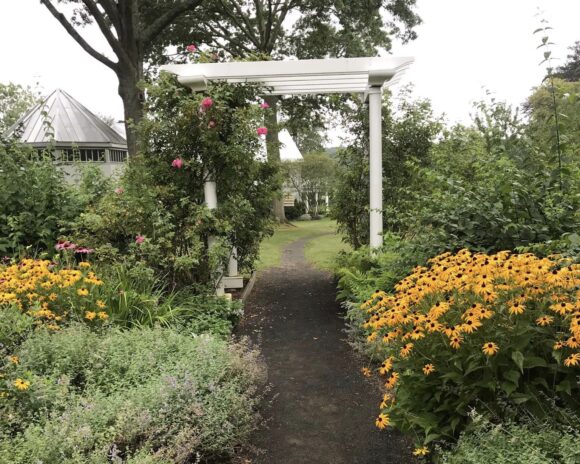
Beautiful borders can be seen at the Florence Griswold Museum in August.

August has always been one my least favorite months in the garden; but plentiful spring rain has resulted in bountiful fragrance, bloom and foliage.  We have a relatively short growing season here in New England and to enjoy a healthy colorful border is so satisfying. However, by this time in the season, when early perennials have gone by, there are a few gaps to fill in with annuals or later blooming perennials. 

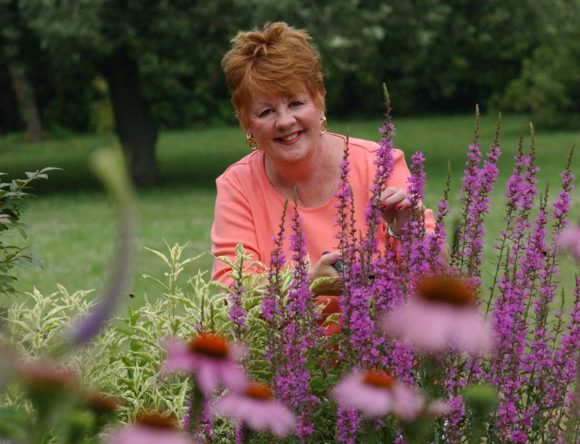
Maureen Haseley-Jones is “The English Lady.”

Gardens are a constantly changing scene of beauty in motion and plantings that looked good last year, may be oversized, and in need of division or transplant. When the weather is cooler in September, transplanting can be tackled on some overgrown specimens, so that every plant has its own space with good air circulation and are able to perform at their best.

Divide those plants that have been in the soil for four years or more. You may have noticed that these plants are not blooming as profusely as they did when first planted. When you divide and set aside the divisions, as there are always fellow gardeners who will be grateful to receive some transplants. 

Now, continue to keep up the deadheading; by doing so your garden will always appear fresh and perky. After the hot, dry days we have had of late, watering is of major importance. In this regard, make sure your garden receives at least one inch of water a week and that your containers receive a daily dose of water, in the early morning and early evening.  Soaker hoses in the borders are a much more efficient method of watering; using this method, the water goes straight to the roots where it is needed. By using soaker hoses you will not lose 40 percent of moisture to evaporation and you are also preventing water from landing on plant foliage, which can result in disease and mildew.

When you cut back tired looking annuals, a new flush of bloom will appear in a few short weeks.   On closer inspection some of you may notice that the borders are looking somewhat weary and need a bright boost of new specimens to perk things up.  These specimens may be found right now as many garden centers are offering late season bargains. When the perennial Coreopsis and Spirea have finished blooming; cut off the dead bloom with the garden shears and enjoy the appearance of vibrant bright bloom shortly.  

Roses

It is of the utmost importance to stop feeding roses now, in August. The reason for this is that roses require at least nine weeks to gently go into a slow healthy dormancy before the first frost. In my September tips, I will give you suggestions on partially pruning roses in early fall, followed by a second pruning the following April. This double pruning method produces the healthiest and most prolific bloom. 

Containers

Containers always add color to any garden. Photo by L. Ahnert.

Every couple of weeks give your containers a little extra composted manure when watering which will keep these miniature gardens bright and cheerful into early fall. Add the manure on top of the natural brown mulch as both manure and mulch help retain moisture and help to retard weeds. In the morning if you do not have time to water the containers before you go to work or run errands, simply empty your ice trays into the containers, this will provide slow -release watering until you are able to add more when you return home.   

With the high heat and humidity which we have been experiencing recently, powdery mildew may be appearing on certain species like Summer Phlox, Monarda and Hydrangeas.  If you notice this problem, I suggest spraying my remedy of one gallon of water in a spray container, adding one tablespoon of baking soda and a dash of vegetable oil.  Always spray in the morning before the temperature and humidity numbers combined together equal 160.  

Continue adding more composted manure to vegetables each month, as vegetables, particularly annual vegetables are heavy feeders. To prevent animals from munching on your precious bounty, place an old sneaker or a piece of carpet that your dog had lain on in among the vegetables; these odors help keep furry marauders away. 

Peonies

Place your orders for Peonies now so they can be delivered for September planting. Photo by Jaroslava Petrášová on Unsplash.

September is the month to transplant, divide or plant  Peonies. Following the first hard frost in November cut any existing Peonies down to within six inches from the ground and add a little natural brown mulch around them to protect the pink-eyed roots, which are close to the soil surface. When planting Peonies or transplanting make sure that the ‘pink eyes’ on the roots are barely covered with soil, if the Peonies are planted any deeper, it is likely that you may not have bloom next year.  

Begin compiling your list of spring bulbs now for the best choice of bulbs to be available for you. Please feel free to email me with any gardening questions to MaureenHaseleyJones@gmail.com. I look forward to seeing you in your garden in September, in the meantime enjoy being outdoors and remember to stretch, hydrate and take time to smell the bloom.

If you would like a garden consultation or conversation with my son Ian, of LandscapesbyIan.com, feel free to get in touch with him.  As the saying goes ‘ the apple does not fall far from the tree’ and, in my estimation, Ian has outpaced me with regard to creativity and production!

About the author: Maureen Haseley-Jones is a member of a family of renowned horticultural artisans, whose landscaping heritage dates back to the 17th century. She is one of the founders, together with her son Ian, of, The English Lady Landscape and Home Company. Maureen and Ian are landscape designers and garden experts, who believe that everyone deserves to live in an eco-conscious environment and enjoy the pleasure that it brings. Maureen learned her design skills from both her mother and grandmother, and honed her horticultural and construction skills while working in the family nursery and landscape business in the U.K. Her formal horticultural training was undertaken at the Royal Botanic Gardens at Kew in Surrey.