Inside Out 2 is a warranted sequel. So often studios will crank out sequels for business reasons, despite the fact there is either no way to continue a story that has already been resolved; or that the sequel could not live up to the standard set by the original. Thankfully that is not the case, here.
In 2015’s Inside Out, Pixar gave, what I consider, to be one of their most creative and original movies as we saw the inner-thoughts of 11-year-old Riley personified by a committee of five emotions: Joy, Anger, Fear, Disgust, and Sadness (an example of some of the best casting decisions in film history).
Two years later, just as Riley is getting used to her five main emotions, puberty begins, accompanied by the arrival of four new emotions: Envy, Embarrassment, and Ennui, all led by Anxiety. While Riley’s emotions dealt with her move across the country in the first movie, the four new emotions take Riley in a different direction as she navigates unfamiliar territory with the social pressures that are a part of the teenage experience (such as self-esteem and ethical dilemmas.)
Anxiety guides an ambitious and competitive Riley towards poor decision-making, justifying it all as an attempt to make a good first impression at a hockey camp for talented youth. What makes her a powerful antagonist is that her rationale appears to be sound. While we know better as we watch the movie, our suspension of disbelief believes her ideas to be reasonable (kudos to the writing team for this.)
Beyond the overall narrative and performances, I must give credit to Pixar for keeping the creative spark going through metaphors about the subconscious. But what I truly must commend is Pixar’s depiction of mental health in teenagers and how these years are a vulnerable era as teens seek to establish their own identities, experience the popularity contest, and understand right and wrong.
While Pixar movies are family-themed movies, I think this installment is incredibly relevant to teenagers (even the ones who are going through the brief aversion of anything from their childhoods to be avoid being lame.) I hope it consoles them and lets them know it that they are human, it is okay to not be perfect, and, above all: to love themselves.
I have learned over the years that I should be suspicious over sequels as they are often unnecessary, but Pixar has given me another reason to still hope for them despite the prospects of let-downs. Inside Out 2 gave its original characters another opportunity to prove themselves and they nailed it.
With the success of this sequel, I believe a third installment is inevitable. I cannot help but wonder how Riley’s subconscious committee would handle young adult life down the road?
Who knows?
I just hope I don’t jinx it.
About the Author: Though no longer a resident of Lyme, Conn., Kevin knows he can never sever his roots to the tree of his identity. When not attending to his job in Boston, he is committed to ensuring a better grasp of current (and past) releases of cinema to his home community as he strives to leave his own mark in the same field that has always been his guide to understanding life. If you enjoy his published reviews here on LymeLine.com, follow him on his website at ‘The City of Cinema‘ and read more of his unique insights into entertainment.
“The darling buds of May” is such an apt phrase for one of the most enchanting months with bloom on spring bulbs and flowering trees, the Amelanchier, the Dogwood and the Cherry to name a few and the new awakening red foliage of Maples winking in the sun.
By now, you have probably removed most of the winter debris, pruned broken branches and re-edged borders. Do not apply composted manure before the soil warms up to 60 degrees. The reason why, you may ask, is that the soil at this temperature awakens soil organisms, which work with the bacteria of the manure to produce nutrients for the roots of the plants. I suggest therefore, when shopping for garden supplies, pick up a soil thermometer to check soil temperature which I feel will reach 60 degrees in a few weeks.
As I walk around the garden, I am seeing my old nemesis, weeds, emerging everywhere. Pull these marauders up by hand, without breaking the weeds and the roots. If you use a tool, this will break the weeds and the broken weed pieces will take root and then you will be facing hundreds of these unwanted visitors more to dispose of yet again.
After weeding, lightly spread on the clean area, an organic corn gluten- based weed pre-emergent by Bradfield Organics; this organic product will keep weeds at bay for quite a few weeks.
In early May, apply composted manure around daffodils and other spring bulbs so that the manure and soil organisms can produce nutrients to feed the bulbs for next year’s bloom. Also, I am asking that you do not cut down the Daffodil foliage as the nutrition from the foliage is absorbed into the bulb for bloom next spring.
In mid -May, with warmed-up soil, apply composted manure and a light layer of fine bark mulch to all maintained areas of the garden, repeat this procedure again in July and finally in October before putting the garden to bed. By giving this attention to the garden, the manure and mulch will begin to build the important humus component.
Types of mulch:
Only use the natural brown wood mulch and please do not use the colored mulches and rubber mulch, which contain poisonous chemicals.
A word of caution on Cocoa Mulch. This product is highly toxic to dogs and cats. This product is manufactured by Hershey and sold in many large garden centers. It is made from the residue of chocolate products and other ingredients and contains a lethal ingredient that has resulted in the reported deaths of cats and dogs that are attracted by the chocolate odor. This mulch contains Theobromine, which is a Xanthine compound with caffeine and theophylline, a dangerous combination. When animals eat this product; it causes seizures and death within hours.
At this point once again, I need to emphasize the importance of the humus component for your soil continuing to build it as part of your garden regimen.
All living things including us humans, are all carbon-based creatures. The Humus you are building in your soil encourages carbon from the air to enter and blend with the soil.
Humus acts like a sponge and holds 90 percent of its weight in water. Because of its negative charge, plant nutrients stick to humus bringing nitrogen, calcium, phosphorus and other important elements to the plants, which prevents these nutrients from washing away and acts like nature’s slow- release fertilizer.
Humus improves soil structure making it loose and friable, which helps plants to root in this environment with easier access to nutrients, water and oxygen. Humus also helps to filter toxic chemicals from soil, much like carbon-based water filtration systems filter toxins from your water.
Roundup
I recommend, when you have a few moments after gardening, that you go online to Scientific American.com/article/Weed-Whacking Herbicide to check out the dangers of Round up. This is the most dangerous herbicide not only because of Glyphosate, which is on the list by the WHO as a chelating agent that causes cancer together with its inert ingredients. I ask that you are not swayed by the word ‘inert’ as the ingredients are anything but inert and those ingredients combined with Glyphosate are deadly to human cells.
Forsythia brings its own version of sunshine into the world!
Forsythia is in bloom with lovely fresh yellow blossoms. If the bloom on your shrub is not as prolific as it was in previous years, prune out the old sparse wood after bloom ends.
A favorite native tree of mine is the Amelanchier (common name is Shadblow Serviceberry, named for the Shad fish that run in the rivers at this time to swim upstream to spawn). This early spring blooming tree has creamy panicle blooms, followed by small green leaves and within weeks, produces red fruit, which is a delicious treat for our feathered friends. Before the birds eat all the fruit, you may want to pick some of the fruit as it makes a delicious jelly for your morning toast.
Here in my town of Old Lyme, the Magnolias, Cherries and Eastern Redbud are vying with one another to show off their finery together with the buds and foliage of the graceful Dogwoods beginning to emerge. Following the recent rains many of these trees are blooming at the same time or within a few weeks of one another. Their bloom will soon be over but then we can look forward to Rhododendrons, Azaleas, which are followed by Mountain Laurel in early June.
A special favorite of mine is a shrub; the Carlesii viburnum (also known as Korean Spice) with its pink buds, opening to white flowers and their delightful fragrance fills the air outside my kitchen door. This viburnum grows to about five feet and can be tucked into many a border particularly in an area where you often walk by to inhale the fragrance.
Blue climbing hydrangeas make a stunning display. Photo by Gemma Evans on Unsplash.
Covering the barn wall and scrambling up to the barn roof is my climbing hydrangea – bright green leaves are emerging with hundreds of buds, which indicates that this beautiful climber will be laden with blossoms in summer.
Tulips, creeping phlox, forget-me-nots, primroses and candytuft are bringing much needed color to borders and rock gardens.
If you have not had the opportunity yet, for another couple of weeks, you can still prune your roses. Pull back the old mulch from around the base of the roses and in two to three weeks apply manure about six inches from the trunk of the plant. Then a week later reapply a layer of the brown natural mulch on top of the composted manure. As well as building the humus component, these layers keep the roots cool, keep weeds at bay and help retain moisture. Do not mulch right up against the base of any plants as this encourages rodents to nest and gnaw on the plants.
Beware of fungi that look like weird mushrooms in your mulch; this is Artillery fungus, which can adhere to the walls of your home and cause problems. If you notice this fungus, you will need to remove all the mulch and get it off your property.
Apply a small amount of lime and about three inches of manure around the lilacs which like sweeter alkaline soil, indicating the use of the lime. By now, you may have already applied lime to the grass, which also enjoys sweeter soil and spread organic grub control which eliminates the Japanese beetle
larvae therefore reducing the chance of moles as you are cutting off some of their food source.
If you are making an organic vegetable garden this year; a garden measuring 16 x 24 can feed a family of four for a year; but keep the size within your needs and capability.
Don’t dig soil if it is too wet or too dry.
Double digging the vegetable garden takes time but is always worth the effort.
Double digging for the vegetable garden is the best method although this takes time and effort but its well worth it – dig down about one foot and remove the topsoil, put the soil to one side, then dig down and loosen the next six inches of soil and add about three inches of composted manure then put back the topsoil and add another three to four inches of manure.
Do not rototill the vegetable garden, as this destroys soil structure. Gently loosening the top few inches of the soil to aerate it, makes it friable and results in an excellent yield of fruits and vegetables.
I prefer 6 x 4ft beds rather than rows; beds produce a larger yield of crops. In addition, beds make for ease of weeding and harvesting by having narrow compacted soil or grass paths (having removed lawn from the area) in-between the beds.
The vegetable garden should be situated on the south or southwest side of the property for maximum sun exposure.
You need a water source close by as vegetables require lots of water, particularly annual fruiting vegetables like tomatoes, which are hydroponic which means they consist of a large amount of water.
Crop Rotation, by that I mean, do not plant the same vegetables in the same place as the previous year. Using this method helps to prevent any soil- born diseases occurring.
In the loosened soil, plant the vegetables plants so that they are touching, this forms a natural canopy, shading out weeds and helps retain moisture.
I prefer to mulch the vegetable garden with composted manure, the reason being that manure, as mulch, does not cap. Capping is when mulch forms a crust, which does not allow water or air to penetrate to the roots of the plants.
Fence in the vegetable garden with a tall fence to keep animals out. At the base of the fence install eight inches of fine mesh chicken wire above ground and eight inches below ground to keep out the digging and burrowing animals.
Organic insect control
Insects do not like fragrance so plant fragrant plants like marigolds, nasturtium, lavender, nepeta, honeysuckle and roses to name a few.
Encourage lacewings, which feed on aphids by planting marigolds and sunflowers,
Attract ground beetles by laying a log or a rock on the earth, under which the beetles can hide. These useful insects are nocturnal and eat slug and snail eggs, cabbage maggots, cutworms and even climb trees to feed on armyworms and tent caterpillars.
Following all the rain, your grass is hopefully a vibrant shade of green; when mowing keep the blades of grass at about three inches tall; the taller blades attracts sunlight, promoting a healthier lawn. The taller blades also shade out weeds and help to retain moisture in the grass.
When mowing, leave grass clippings on the lawn, the clippings are a natural source of nitrogen. If you have clover in the grass, clover is an added benefit as clover takes nitrogen from the air and fixes it in the soil, which is an additional nutrient for plant growth.
After flowering is over, prune flowering shrubs by 25 percent – do this task immediately before new buds set for next year.
On a rainy day go shopping for any garden supplies that may be needed, then when the weather is dry you can be outdoors doing what you love and not indoors shopping. Buy good hoses, cheap ones will bend and crack.
Peonies are a wonderful addition to any yard. Photo by Jaroslava Petrášová on Unsplash.
Peonies need plenty of water to produce flower buds. I had a thirty-foot long stand of Peonies in my field. The Peonies have been in the ground for over fifty years and are a sight to behold when in bloom. I gave them lots of loving care with a light dressing of aged manure in early May. In a few weeks, I pinch off the side buds while they are still small, leaving the terminal flower bud on each stalk, which develops into a large main bloom.
Hydrangeas are a wetland plant and require plenty of water during the season, with the addition of manure and mulch around the base. If you have blue Hydrangeas and want a deeper color of blue, also add some peat around the base of the plant, the acidity in the peat produces the bright blue color.
If you need to prune a Hydrangea, which has become too large then prune it immediately after flowering, in EARLY SEPTEMBER, prune about 1/3 of the old wood and the weakest shoots. DO NOT WAIT, as Hydrangeas begin to develop bloom buds for next year later in September. If you wait to prune it is likely that you will not have bloom for next year.
The much-beloved Lily of the Valley has a delightful fragrance.
My maternal grandmother’s favorite plant, the Lily of the Valley will bloom in another couple of weeks. These lovely flowers are tucked on the small rise on the west side of my apartment, and I am so looking forward to gathering a few fragrant blooms to enjoy indoors.
When the lilacs have finished blooming, pinch off the withered flower clusters, and do the same on the mountain laurel and rhododendrons in late June to ensure good blossoms next year.
In mid May apply composted manure, a light application of peat and fine bark mulch around all evergreens and rhododendrons, mountain laurel and azaleas; these plants are shallow- rooted and the mulch will keep the roots nourished, protected, warm and moist.
Some annual seeds that may be planted outside in mid May are: Calendula, Coreopsis, Marigold, Nasturtium, Nicotiana and Zinnia.
FROST, FOLKS TAKE NOTE – If you purchase annuals, on Mother’s Day weekend, place them in a sheltered spot on the south side of your home. Plant them no earlier than Memorial weekend as we can still get a late frost.
Tuberous-rooted begonias, caladiums, cannas and elephant ears can be moved from porch or cold frame to a part shade area as the weather becomes warmer and there is no sign of frost in the forecast.
If you staked trees, when they were planted last year, cut the stakes off at ground level, do not pull them out otherwise the roots of the trees could break and be damaged.
Aphid tip: squish a few in your hand; dead aphids release a chemical that causes other aphids to drop off the plants.
Another ants and aphids tip – if you drink mint tea, any leftover tea sprinkle on the bugs, as they do not like the smell of mint.
Mint spreads vigorously in the yard.
A WORD OF CAUTION ON MINT – plant mint only in containers, mint is tremendously invasive and can take over your garden.
When planting annuals, perennials, vegetables, trees, shrubs or evergreens keep them watered.
Houseplants can be moved outdoors for their summer sojourn at the end of May. However, do not put your African violets outdoors as they will burn, move the violets to a porch that is covered and shaded, or keep them indoors in a window that does not receive direct rays from the sun.
Wait until the soil warms up at the end of May to set out Dahlia tubers.
ROSES – I like to plant David Austin roses; these shrub roses are repeat bloomers with lovely fragrances.
Roses need at least five hours of sun per day, good air circulation, and excellent drainage. During their growing period from the beginning of June to mid August; add a little extra composted manure each month; it may be applied over the mulch. Stop adding the manure in August so that the roses can go into a slow dormancy.
Roses like the same growing conditions as Clematis and can be planted together in a ‘companion planting’, which means they grow well together, with feet in the shade and head in the sun. I planted a climbing pink Rose and purple Clematis on a trellis on the chimney breast on the west side of my house, which was a lovely combination. Before you top up the soil around the roses, when planting add water and check if the soil drains, roses need good drainage. Deep watering is recommended at least once a week.
Plenty of stuff to keep you hopping folks and remember to keep your eye out for any pest trouble and when you spot it get on the ball immediately to avoid further problems. Carefully discard all herbicides and pesticides; these poisons have the same effect on your health as second- hand smoke.
Your garden offers an anchor for peace and quiet enjoyment. Enjoy the warmth, the gentle breeze, the earth’s fragrance and bloom and please remember to breathe and stretch before any garden labor. Enjoy and I will see you in your garden next month.
If you would like my son Ian of LandscapesbyIan to visit your home for a consultation, feel free to contact him.. As the old saying goes, ‘the apple does not fall far from the tree’ and you will not be disappointed in his work!
About the author: Maureen Haseley-Jones is a member of a family of renowned horticultural artisans, whose landscaping heritage dates back to the 17th century. She is one of the founders, together with her son Ian, of, The English Lady Landscape and Home Company. Maureen and Ian are landscape designers and garden experts, who believe that everyone deserves to live in an eco-conscious environment and enjoy the pleasure that it brings. Maureen learned her design skills from both her mother and grandmother, and honed her horticultural and construction skills while working in the family nursery and landscape business in the U.K. Her formal horticultural training was undertaken at the Royal Botanic Gardens at Kew in Surrey.
Jerry Seinfeld’s Unfrosted, a non-canonical biopic of the invention of the pop-tart, contains a star-studded cast (led by Seinfeld, Melissa McCarthy, and Jim Gaffigan … along with cameo after cameo from A-list entertainers) that goes full-on ridiculous in this outrageous campy satire of The Sixties, and guarantees constant laughs throughout.
For the record, I doubt this will be considered for film festivals or award shows (just check out the ratings on Rotten Tomatoes of IMDb, after all.) But simply: it is amusing, captivating, entertaining and worth the watch.
The story is predictable: rival corporations (Kellogg’s and Post) fight to be the first to put a simple breakfast treat in grocery stores (mirroring the Space Race.) It involves secrets, betrayal, mafia-like tactics, cameos from iconic performers … but Unfrosted goes farther than any business rivalry could go, adding acts of treason and the loss of lives.
A predictable plot line, but fun jokes layered throughout its duration. To be truthful, it reminds me a great deal of the movies by Mel Brooks (Spaceballs in particular.)
What makes a satire great is pointing out social issues that we have subconsciously conditioned ourselves to and pointing out the absurdities that we have gone along with for years. Unfrosted contains joke after joke directed at the ideas of The Sixties that clearly did not age well (the Vietnam War, high fructose corn syrup, and above all: the Cold War).
But this satire is completely unrealistic. How so?
An award show that demonstrates the rivalry between Kellogg’s and Post is held at a local Holiday Inn, milkmen imitate the Teamsters, and the creation of Kellogg’s products mirrors that of a top-secret science lab. In fact, there is almost a cartoonish fantasy element to its storytelling.
But what is most appealing about this movie is not its jokes, but its length: only an hour and a half. The time will fly by and will be over before you know it.
It’s clear the creator of the show about nothing heeded the wisdom of the Master of Suspense, Alfred Hitchcock, who quipped that a film’s length should match the endurance of the human bladder. And in this case, since it has been released through Netflix, one can conveniently stop and continue this quick film at one’s own pace anyway.
Again, this is not a groundbreaking film that will redefine cinema and comedy, as we know it. But it is a fun watch filled with entertainers that have been amusing us for decades, and makes a nice way to spend an hour and a half of our time.
Not all movies worth watching push the limits of art and define a generation.
It is no secret that I am a fan of the Criterion Collection/Channel, and can often recommend movies that could be considered “dry” by my peers … but I also consider Billy Madison and The Waterboy to be among my favorite movies (with no disrespect to Adam Sandler, who has always been lionized for how he has never given into his ego in pursuit of celebrity-status.)
About the Author: Though no longer a resident of Lyme, Kevin knows he can never sever his roots to the tree of his identity. When not attending to his job in Boston, he is committed to ensuring a better grasp of current (and past) releases of cinema to his home community as he strives to leave his own mark in the same field that has always been his guide to understanding life. If you enjoy his published reviews here on LymeLine.com, follow him on his website at ‘The City of Cinema‘ and read more of his unique insights into entertainment.
Several weeks ago, my nine-year-old grandson, William, was introduced to the expression, “Let’s blow this popsicle stand;” and he asked his dad what was it all about. He was referred to me with a, “He used to say it all the time,” which I do not recall.
Tom Gotowka
Please note that he now prefers to be called “Will,” like the playwright; and so, I told him that this might be a good subject for a future “View,” and promised to get back to him with some information.
So in this essay, I set out to answer my grandson’s question regarding ”popsicle stand” and will consider the broader subject of American idioms and colloquial expressions in a subsequent “View,” in which I will provide abundant examples of this form of “figurative language,” suggest several that are worthy of retirement from the lexicon; and consider a few “Britishisms” like “everything is tickety-boo.”
I have “peppered” this essay with familiar idioms to illustrate just how frequently they appear in conversation.
”Let’s blow this popsicle stand” is really just a cool and humorous way to say, “Let’s leave this place;” or more obstinately, to express one’s boredom with the current situation and your readiness to quickly move onto something new. You can use it to refer to your departure from any location or activity—wherever you are at the time. The expression is not inherently derogatory when used casually, but might be inappropriate in some settings (see “Thoughts” below.)
I anticipate that William will master the two terms defined below and, as importantly, keep his younger brother, Henry “in the loop.” He may need to read this essay with his dad, who will help him understand the more arcane references that might otherwise “go over his head.”
The Terms:
An idiom is a phrase that has a figurative meaning, which is different from its literal meaning. Hence, keep him “in the loop” means keep him informed; and “go over his head,” as I have used it, suggests that the information may be too complex or subtle for him to understand.
Idioms are often specific to a particular language or culture, and can be difficult for non-native speakers to understand. For example, “kick the bucket” is an idiom that means to die.
A colloquialism, on the other hand, is a word or phrase that is often used in everyday conversation, but may be specific to a particular region or group of people.
If William travels south from his home in Maryland, he will hear “y’all” used as a contraction of “you all,” the farther south he travels.
However, in Pittsburgh and areas of western Pennsylvania, just a few hundred miles north of his home, “Yinz” developed as the local equivalent of “y’all.” And then there’s also the term “youse” or “youse guys,” commonly heard in some neighborhoods of Buffalo, Chicago, New York City, Philadelphia; and New Jersey; to convey the same meaning as “y’all” and “yinz.”
These forms of address are all part of the regional dialects that developed to distinguish between singular and plural forms of “you” in English.
William’s father did his graduate work at M.I.T. in Cambridge, Mass. He and his classmates were “wicked smart,” and when he walked amongst the buildings early on a February morning, he felt “wicked cold.”
“Wicked” is not used to connote something evil. It means “very” or “extremely.” in the Greater Boston area and some other parts of New England. I suggest viewing the movie, “Good Will Hunting” to observe Bostonians using “wicked” in their conversations. Another interpretation can be found in theHarryPotter series of books by J.K. Rowling, where the kids often say, “That’s wicked,” when excited or fascinated.
Clearly, this can be confusing for we “non-English majors,” and there is overlap with “dialect,” “vernacular,” or “slang.”
I do not want to further “muddy the waters” for William—i.e., create confusion or make this even more complex; but “… popsicle stand” has both the characteristics of an idiomatic expression and a colloquialism.
Origin and Variations:
“Let’s blow this popsicle stand” began to grow inpopular culture in the mid-20th century, but is not as commonly used today as in the past. I thought that this quest to find the expression’s origin would be a “piece of cake” rather than what Mercutio referred to as a “wild goose chase” in Shakespeare’s “Romeo and Juliet.”
The actual origin is murky, but it had to have been coined after 1924, the year a patent for popsicles was issued to Frank W. Epperson; who is generally considered to have invented the “frozen confection” as a youngster in 1905 on an unseasonably cold night in San Francisco.
One theory, which I consider as no more than an urban myth, attributes the expression to a Jamaican “conspiracist” in the late-1940s, Antoine Cleo; who planned to somehow establish world supremacy by selling popsicles in radioactive popsicle stands.
According to the myth, his plans were thwarted by the “Kindred Spirits” cult, who attacked popsicle stands in major cities, killing Antoine. Some have asserted its origin as the “Beat Generation” in San Francisco or New York City’s Greenwich Village or Columbia University neighborhoods.
Others have attributed the expression to an old (but unnamed) Humphrey Bogart gangster movie from the 1940s, i.e., “it just sounds like Bogart.” There were five Bogart films released in the 1940s: “The Maltese Falcon” (1941), “Casablanca” (1942), “The Treasure of the Sierra Madre” (1948), “The Big Sleep” (1946), and “Key Largo”(1948). These are all on the shelf at the Phoebe or available via inter-library loan.
Some consensus seemed to be developing around the 1955 film noir, “Kiss Me Deadly,” which was based on a novel by Mickey Spillane, as the earliest known use of the phrase in a movie and the likely origin of the expression.
I watched them all, a couple with Christina, and did not find the exact phrase, although there were several scenes in the movies when I/we thought it would be coming right up.
The expression, or a variation, has also appeared in older movies and television shows (below).
Variations:
Many may use “pop stand” or “joint” instead of “popsicle stand;” and, “Let’s blow this joint,” is probably in greater use across all age groups, especially with Gen X and the Boomer generation. However, Millennials and the “Zoomers” of Gen. Z will also be familiar with this phrase.
Movies and Television:
The following are a few examples of the expression used in the entertainment media.
Marlon Brando, as Johnny Strabler, says, “Where’s my gold? I’m ‘gonna’ blow this joint” in the 1953 movie ,“The Wild One.”
Robin Williams, as Mork, an alien from the planet Ork sent to observe human behavior on Earth; used the expression, “How about you and me blow this Popsicle stand?” in a 1980 episode of “Mork & Mindy,“ which is an American television sitcom that aired on ABC from 1978 through 1982.
Danny Hassel, as Dan Jordan in the 1989 movie, “A Nightmare on Elm Street: The Dream Child.” thinks about the world after high school and says, As adults, we must now prepare for our new life outside this wonderful environment known as Springwood High; So, let’s blow this pop stand!”
Sonic said the line “Yo Sal, we’re going to blow this pop stand.” in rescuing his good friend, Sally the Hedgehog in an episode of “The Adventures of Sonic the Hedgehog,” an animated television series that ran on ABC from September, 1993, to December 1994; and was based on the Sonic series of video games and followed with a movie released in 2020.
I also include “We Gotta Get Out of this Place,” a rock song written by Barry Mann and Cynthia Weil and released in 1965 by the English band, The Animals, because it expresses the same sentiment as “… popsicle stand;” and it was the song most requested on Armed Forces Radio by American soldiers during the Vietnam War, according to the late radio personality Adrian Cronauer, whose life inspired the 1987 film, “Good Morning, Vietnam.”
Author’s Thoughts: I did not fully answer William’s questions, but it was “not for the want of trying.” However, I believe that I did provide him with enough information “to chew on.”
William: keep in mind that not everyone will understand the expression, so use it in casual conversations or when you hang out with your friends and family. I would not use it at a town meeting or at the end of a church service or any formal school event.
In closing, I’ll “catch you on the flip side,” (goodbye.)
A Note to the Editor: Kevin Ganey, who writes “The Movie Man” column on LymeLine, may have some insight on the origin of “Let’s blow this popsicle stand.” I would appreciate his wisdom.
Editor’s Note: This is the opinion of Thomas D. Gotowka.
About the Author: Tom Gotowka is a resident of Old Lyme, whose entire adult career has been in healthcare. He will sit on the Navy side at the Army/Navy football game. He always sit on the crimson side at any Harvard/Yale contest. He enjoys reading historic speeches and considers himself a scholar of the period from FDR through JFK. A child of AM Radio, he probably knows the lyrics of every rock and roll or folk song published since 1960. He hopes these experiences give readers a sense of what he believes “qualify” him to write this column.
Sources: “Let’s Blow This Popsicle Stand” – Part 1 Aldrich, R. (Director). (1955). “Kiss me Deadly.” [Film]. Metro-Goldwyn-Mayer Studios Butler, S. “Frozen History: The Story of the Popsicle.” History Classics. 08/24/2023. Lighter, J. (1994) “The Random House Historical Dictionary of American Slang.” New York: Random House.(1994) Perlman, M. “Yinz, youse, and y’all.” Columbia Journalism Review. 01/19/2016. Rowling, J.K. (1998) “Harry Potter and the Sorcerer’s Stone.” Pittsburgh: Scholastic Corporation. Spillane, M. (1952) “Kiss Me Deadly.” New York E.P. Dutton & Co. Van Sant, G.(Director). (1997) “Good Will Hunting.” [Film]. Miramax White, M. “100 American Idioms and Popular US Expressions Explained.” Your Dictionary.com 05/14/2021. Winter, L. (editor) ““Slang Origin: Why Does New England Say “Wicked” (and What Does It Mean?.” Owlcation.11/19/2023.
Those April showers that come our way They bring the flowers that bloom in May. And when it’s raining, let’s not forget, It isn’t raining rain at all, it’s raining violets. ~From a song by Al Jolson~
Maureen Haseley-Jones is “The English Lady.”
April is the month of activity in the garden, and our old nemesis, weeds are beginning to rear their heads, so we need to extract the little devils before they take hold and are difficult to remove.
Having said that, I must point out the benefits of many weeds. Nettles are food for butterflies, clover extracts nitrogen from the air which is then absorbed into the soil and the oil from jewel weed soothes poison ivy rash. The young foliage of Dandelions is great in salads and when lightly cooked it tastes like spinach with the added advantage of containing many healthy nutrients.
In this group, I do not want to forget our songbirds and other wildlife who depend on weed seeds as a food source.
Weed removal – weeds must be pulled gently so that the weed and roots do not break apart, because if this happens, thousands of weed seeds will reseed and you will find yourself with an endless cycle of unnecessary weeding. When careful weeding has been accomplished, apply an organic weed pre-emergent, with a corn gluten base by Bradfield Organics; this natural product will keep weeds at bay for about six weeks. :
The end of April is the time to plant bare-root roses. Photo by Bailey Chenevey on Unsplash.
Plant bare-root roses at the end of April and plant container roses in mid-May. In the middle of May when the soil temperature has reached 55 degrees, add manure and on top of the manure add a fine bark mulch about one foot from the base of the roses. Check my March tips to remind yourself on pruning roses.
Be careful clearing winter debris from around rhododendrons, mountain laurel and azaleas; these evergreens have shallow roots and do not appreciate having their roots exposed. If winter weather did erode soil around some roots, add soil to cover the exposed roots and at the same time resettle the plant in place. In the middle of May apply manure and fine bark mulch as well as some peat, which adds much needed acidity for evergreens.
Plant Gladioli corms at two-week intervals in late April. Planting in two- week intervals ensure you will get a succession of bloom. Plant the corms eight inches below the surface; this extra depth helps to keep the heavy blooms erect.
The Red Lily Beetle will soon appear and I suggest applying organic Neem oil on the Lilies when they are about four inches above ground which helps to halt this beetle problem.
SOIL SOLARIZATION is an effective way to control many soil- borne problems, specifically the tomato blight that causes fruit rot. Covering the soil with clear plastic at the end of April, for one to two months can generate high enough temperatures in the top six to 12 inches of soil to kill pests, nematodes, weed seeds and many disease organisms like the tomato blight. This process has proved invaluable for home gardeners and the beneficial effects last for several seasons.
To solarize, dig a trench several inches deep around the soil bed, and spread a thin, clear plastic film (1-4mils) over the bed. Press the plastic into close contact with the soil and seal the edges by filling the trench with soil. Leave the plastic on the soil until you are ready to plant tomatoes or other vegetables in about six weeks.
When the soil temperature reaches 55 degrees, manure all the borders with composted manure in bags from the garden center or aged manure from the bottom of the farmer’s pile, then mulch with a fine brown hardwood mulch.
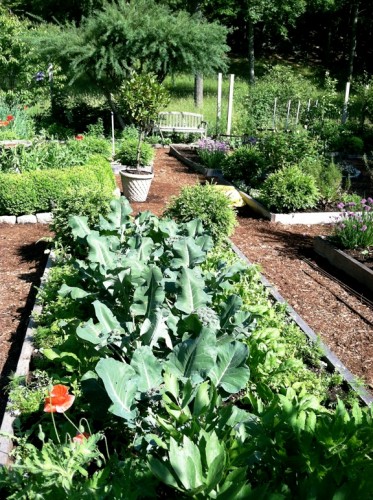
Mulch in April with composted manure in order to achieve a vegetable patch like this later in the season.
In the vegetable garden after preparation and planting, then it is time to mulch. Mulch with the composted manure, which will not ‘cap’—this means, that it does not form a crust like other mulches so that air and water can get through to the roots of the plants where it is needed.
If you did not apply an organic grub control on the grass in March, apply now to reduce the grubs, which are the food source for Moles and therefore cut down on the mole population.
Soil is the most important component of production in the garden; with compost, organic manure and peat to amend soil and rebuild its structure. The ratio to use is one part compost to three parts manure and apply peat to the planting mix in the ratio of one part peat to three parts manure when planting evergreens. And as mentioned above, peat adds the acidity which evergreens require.
Good soil structure assists with drainage, prevents compaction, and the rich nutrients with the amendments break down and encourage the soil animals beneath the surface to work at full capacity. In a sandy soil, humus is needed to produce micronutrients for this soil, which are the combination of manure, mulch and carbon from the atmosphere that binds the sand particles together therefore producing a healthy workable soil. In heavy soil such as clay, the humus separates the clay particles which allows for air and drainage.
GROWING CONDITIONS IN APRIL are very favorable for new plant-root development. This month is the best time to transplant evergreen shrubs and plant new evergreens. Apply composted manure and peat together with the topsoil in the planting hole. Then give the roots a workout with your hands before planting. Separating the roots in this way gives them the freedom to reach into the surrounding soil for nutrients and water and not dry out in the heat of summer.
Many years ago, when I moved into my farmhouse on the shoreline, I discovered that my soil was sandy, which is good for drainage but sadly lacking in nutrients. I began adding a few inches of manure to all planted borders in April, July and October. The result today is when I put a spade in the ground to check the color of the soil in spring it’s ‘black gold’.
Gloves should be worn when handling manure which contains bacteria; the bacteria is great for the plants and the soil but not good for your health. These natural soil amendments tend to be slow acting; gradually making the nutrients available to the plants and the rewards are infinite. Composted manure is applied in spring around mid May when the soil temperature has reached 55 degrees and when the plant shows about six inches of growth. This method allows for the nutrients and soil animals to become active at the time when plant growth is occurring at a rapid pace.
DAFFODILS, which are my favorite flower, are appearing in gardens and on roadways, which is a lovely sight. When the Daffodil bloom has past, do not cut the leaves from Daffodils or any of your spring flowering bulbs, the leaves send down energy into the bulbs to store for next season’s bloom.
April is the time to tackle a new lawn or patch seed, use only good quality grass seed, organic fertilizers and lime, which provides the alkaline and not acid for the grass.
Do not be lulled into complacency with a few back-to-back warm days; we can still get frost, so I caution that you not to plant annuals until Memorial weekend. Do not cultivate around the perennials in the borders until mid-May.
Do not panic if you were not able to get the April tasks done until May, your garden will wait for you and the constancy that is Mother Nature will continue to keep your patch of earth flourishing.
Enjoy the pleasure of being outdoors in warmer temperatures, inhaling the pungency of awakening soil and your connection with Mother Nature. Do not overdo it; warm up the body before the garden labor and stay well hydrated with lots of water.
We are inexorably entwined with the earth and know that even the smallest gesture of a garden has positive rewards; the effects are not only on you but on our planet.
It is important to have a well thought out plan before creating a new garden or landscape. My son Ian is a landscape designer and creator for the last 30 years and you can arrange your consultation at LandscapesByIan.com
I will see you in your garden with more gardening tips in May and if you have any gardening questions, please email MaureenHaseleyJones@gmail.com
About the author: Maureen Haseley-Jones is a member of a family of renowned horticultural artisans, whose landscaping heritage dates back to the 17th century. She is one of the founders, together with her son Ian, of, The English Lady Landscape and Home Company. Maureen and Ian are landscape designers and garden experts, who believe that everyone deserves to live in an eco-conscious environment and enjoy the pleasure that it brings. Maureen learned her design skills from both her mother and grandmother, and honed her horticultural and construction skills while working in the family nursery and landscape business in the U.K. Her formal horticultural training was undertaken at the Royal Botanic Gardens at Kew in Surrey.