Letter from Paris: ‘Francofonia’ Explores German Attitude to Louvre Art During Occupation, But Gives Broader Message

Nicole Prévost Logan
Nicole Prévost Logan

Like irritating mosquitoes on a hot summer afternoon, three fighter planes of the German Luftwaffe fly over a majestic and impregnable Louvre museum. This is the opening image of Francofonia, a documentary reflecting on art and the courage of men fighting to protect it against forces of destruction. A most appropriate and needed interlude at this particularly tense time for the humanity.

Although labeled a documentary, Francofonia – a Russian-German-French production – is part newsreels, part fiction, part poetic images. The film, directed by the well-known Alexander Sokurov, won an award at the September 2015 Venice Film Festival.

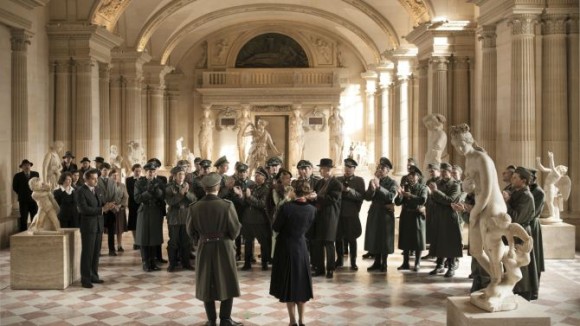
Count Wolff Metternich, a German officer of Prussian origin, walks down a vaulted hallway. He is there to meet Jacques Jaujard, the French director of the Louvre. The two men are stiff and on their respective guards. Metternich asks Jaujard, “Do you speak German?” “No,” responds Jaujard, “The answer is, I am very French.”

A scene from 'Francophonia.' Image courtesy of Films Boutique.

A scene from ‘Francophonia.’ Image courtesy of Films Boutique.

Ironically both men are on an identical mission. In 1939, most of the Louvre’s art work, including the “Victory of Samothrace” – the museum’s most illustrious treasure – was removed by the staff and hidden in the cellars of French castles. Metternich had done precisely the same thing with the collections of the Cologne cathedral before the start of the war.

With an element of pathos, Sokurov imagines the visit of German military to the Louvre. Did they realize it was an empty place except for Assyrian winged bulls and other monumental sculptures, which might have been left on purpose to act as the watchdogs of an idea?

Two iconic guides take us through the deserted Grande Gallery. A fat-bellied Napoleon, behaving like the host, points at the David’s painting of his coronation. “This is me,” he says proudly. But it is with irony that Sukurov shows “Napoleon crossing the Alps” by Delaroche as an undignified and tired man riding a mule rather than the dashing rider imagined by David. Our other guide, Marianne, wearing the distinctive Phrygian bonnet, repeats over and over “Liberté, égalité, fraternité.”

Sukorov accompanies us through an empty museum filled with the memory of treasures now gone. A hand touches the diaphanous finger tips of a statue; Clouet’s delicate portraits come alive; and so do Millet’s peasants, sitting by the fire, their deeply-lined faces showing their exhaustion. The greyish, almost sepia, quality of the photographs adds to the eerie feeling.

The camera moves in and out of the Louvre and depicts difficult scenes, which demand pause for thought. A tanker is struggling in the fury of the Baltic. Will the works of art it carries in its containers survive or be crushed by the waves? The frozen body of a well-dressed little girl lying on a street during the siege of Leningrad evokes the human suffering caused by war.

Francofonia is a complex film, which can be read on several levels. It came on the Paris screens not long after the blasting of Palmyra and other archaeological sites by Daesh (ISIS). The message is crystal clear — art, which is the legacy of our civilization, is too precious to die.

Nicole Prévost LoganAbout the author: Nicole Prévost Logan divides her time between Essex and Paris, spending summers in the former and winters in the latter. She writes a regular column for us from her Paris home where her topics will include politics, economy, social unrest — mostly in France — but also in other European countries. She also covers a variety of art exhibits and the performing arts in Europe. Logan is the author of ‘Forever on the Road: A Franco-American Family’s Thirty Years in the Foreign Service,’ an autobiography of her life as the wife of an overseas diplomat, who lived in 10 foreign countries on three continents. Her experiences during her foreign service life included being in Lebanon when civil war erupted, excavating a medieval city in Moscow and spending a week under house arrest in Guinea.

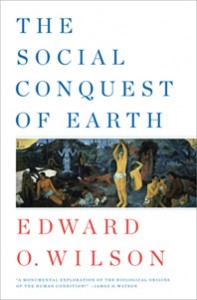
Reading Uncertainly? ‘The Social Conquest of Earth’ by Edward O. Wilson

SocialConquest_Mech.inddWho are we?

This has been the eternal question of our curious and self-reflective species. Paul Gauguin, in Tahiti in 1897 in his final painting, expanded this question into three: D’ou Venons Nous? Que Sommes Nous? Ou Allons Nous? (Where do we come from? What are we? And where are we going?) As the weather finally begins to cool, it is time for some serious reading …

Edward O. Wilson, the noted Harvard chronicler of ants, has embarked on a trilogy to try and answer all three. The first, The Social Conquest of Earth, addresses the Gauguin threesome in short, pithy chapters, easy for today’s creatures accustomed to electronic social networks. No Proustian rambling for him!

“We have created a Star Wars civilization,” he begins, “with Stone Age emotions, medieval institutions, and god-like technology. We thrash about. We are terribly confused by the mere fact of our existence, and a danger to ourselves and to the rest of life.” His argument, which represents the story of the evolution of social life and its driving forces, is controversial.

It goes like this: “The social conquerors of Earth” dominate today, but they include not only homo sapiens but also ants, bees, wasps, and termites, species that are possibly more than 100 million years older than us (we emerged several 100,000 years ago, only spreading across this globe over the past 60,000 years). It is altogether probable that these other “eusocial species” — less than two percent of the one million known species — will remain long after we disappear.

Our human condition is both selfish and selfless: “the two impulses are conflated … the worst of our nature coexists with the best, and so it will ever be.” Our “hereditary curse” is “our innate pugnacity … our bloody nature (in which) individuals prefer the company of others of the same race, nation, clan, and religion.”

Wilson continues, “The biological human mind is our province. With all its quirks, irrationality, and risky productions, and all its conflict and inefficiency, the biological mind is the essence and the very meaning of the human condition.”

In answering the question, “What are we?” Wilson explores the origins of culture, language, cultural variation, morality, honor, religions and creative art, suggesting “human beings are enmeshed in social networks.” And in these networks, we express our “relentless ambivalence and ambiguity … the fruits of the strange primate inheritance that rules the human mind.”

Wilson submits that religions are logical hallucinations in response to the ever-unanswered question, determining that, “ … religious faith is better interpreted as an unseen trap unavoidable during the biological history of our species. Humankind deserves better … than surrender and enslavement.”

The final chapter of this engrossing and illuminating exploration asks, “Where are we going?” Do we have free will? Wilson answers his question thus: “We are free as independent beings, but our decisions are not free of all the organic processes that created our personal brains and minds. Free will therefore appears to be ultimately biological.” Are we social creatures? Wilson suggests, ” … group selection (is) the driving force of where we have been and where we are going.”

We, a convoluted and introspective species, live in an “extremely complex biosphere” in which we must respect the “equilibrium created by all the other species, plants, animals, and microorganisms around us.” Failure to do so may mean our collapse or even that of the entire system.

But Wilson concludes on an optimistic note, saying, “Earth, by the twenty-second century, can be turned, if we so wish, into a permanent paradise for human beings, or at least the strong beginnings of one.”

This first philosophical exploration of human existence has been followed by the second, The Meaning of Human Existence, published in early 2015, and the third, The End of the Anthropocene will follow shortly.

Together they require serious reflection.

Editor’s Note: The Social Conquest of Earth, by Edward O.Wilson was published by W. W. Norton & Co., New York 2012.

Felix Kloman_headshot_2005_284x331-150x150About the Author: Felix Kloman is a sailor, rower, husband, father, grandfather, retired management consultant and, above all, a curious reader and writer. He’s explored how we as human beings and organizations respond to ever-present uncertainty in two books, ‘Mumpsimus Revisited’ (2005) and ‘The Fantods of Risk’ (2008). A 20-year resident of Lyme, he now writes book reviews, mostly of non-fiction that explores our minds, our behavior, our politics and our history. But he does throw in a novel here and there. For more than 50 years, he’s put together the 17 syllables that comprise haiku, the traditional Japanese poetry, and now serves as the self-appointed “poet laureate” of Ashlawn Farms Coffee, where he may be seen on Friday mornings. His wife, Ann, is also a writer, but of mystery novels, all of which begin in a bubbling village in midcoast Maine, strangely reminiscent of the town she and her husband visit every summer.

The Movie Man: See ‘Spectre’ … Though It’s Not Bond’s Best

Headshot_v2We’re delighted to welcome a new writer to our fold today. Kevin Ganey joins us as our movie critic and will be submitting regular reviews of a variety of genres of movies. He has lived in the Lyme/Old Lyme area since he was three-years-old, attended Xavier High School in Middletown and recently graduated from Quinnipiac University with a degree in Media Studies. Prior to his involvement here at LymeLine.com, he worked for Hall Radio in Norwich, as well as interned under the Director of Communications at High Hopes Therapeutic Riding Center. Kevin has a passion for movies, literature, baseball, and all things New England-based … especially chowder.

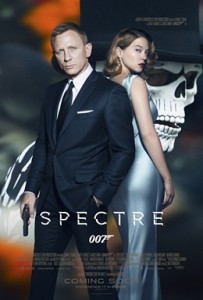
He opens his column series with a review of the latest Bond movie, ‘Spectre’

"Spectre poster" by Source. Licensed under Fair use via Wikipedia.

“Spectre poster” by Source. Licensed under Fair use via Wikipedia.

“Bond. James Bond.”

Since the 1962 release of Dr. No, six actors have had the pleasure of playing the iconic James Bond, or 007. For many years, it had been consider blasphemy to assert that any of the six actors aside from Sean Connery was Bond, as in he truly embodied the character and was the first actor moviegoers would think of when somebody brought 007 up in conversations. However, on a cold night in November of 2012, as I left the Niantic Cinema after seeing Skyfall, I literally proclaimed to others that Daniel Craig, not Connery, was Bond.

I do not think that I am alone when it comes to this opinion. My younger brother shares it, and he also proudly tells people that he knows every line to Craig’s first film as Bond, Casino Royale. We are fans of Craig’s gritty approach to the character, a quiet man with a killer’s stare, a force with which to be reckoned. He was not as comical as Roger Moore, or as suave as Pierce Brosnan, or, as my mom says, “campy” like Sean Connery. Each actor brings a new approach to Ian Fleming’s iconic spy, and I must say that I am more than satisfied with Daniel Craig’s interpretation.

So, it was with great pleasure that I embarked on a journey to Westbrook’s Marquee Cinema 12 on the premiere date for Eon Production’s 24th film about the secret agent, Spectre. When I was 11-years-old, my parents gave me a DVD collection that contained seven Bond films, which included Dr. No, Goldfinger, The Man with the Golden Gun, The Spy Who Loved Me, Licensed to Kill, Goldeneye, and Tomorrow Never Dies, and I was quickly captivated by this heroic figure. As soon as I learned this film’s title, I immediately remembered the organization of the same name that Bond was constantly combating in the earlier films. The name stood for SPecial Executive for Counter-intelligence, Terrorism, Revenge, and Extortion.

This film begins just weeks after Skyfall left off, with Judi Dench’s M still in the memories of all MI6 agents, replaced by Ralph Fiennes. Bond has just completed a semi-rogue mission in Mexico City (ordered by Judi Dench’s M just before she died in a video message), thwarting a terrorist attack during a Day of the Dead celebration. Grounded by the new M, Bond requests help from Moneypenny and Q to make him disappear in order to find more information in regards to the mission he just completed.

He is led back to a member of QUANTUM, a criminal organization — Mr. White, whom he encountered in Casino Royale and Quantum of Solace, now leads him on the trail to the even bigger organization “Spectre,” headed by a mysterious man named Franz Oberhauser, played by Christoph Waltz. M also deals with the emergence of a young government official, whom Bond calls C, running a new organization that monitors criminal activity, who also seeks to bury the Double-O system.

This film brings the previous four Bond films together, as all the villains were connected somehow before, and, without giving away too many spoilers, Oberhauser reveals this to be a form of revenge against Bond, as he knew him very intimately in the past. And I take a further risk by saying this to ardent Bond fans: Oberhauser reveals himself to be a memorable character from the earlier films.

I was expecting a great performance from Waltz, since he has won two Academy Awards over the last five years, but sadly, I was unhappy with his portrayal of a Bond villain. And my disappointment was compounded because Javier Bardem, who played the villain in Skyfall, and is also an Academy Award winner, gave what I consider to be one of greatest performances as a bad guy in that movie.

But Spectre does have its redeeming qualities. Sam Smith’s credit song, “Writing’s on the Wall” (I think this was also a reference to an exchange between Bond and Q in the 1995 installation, Goldeneye) was enjoyable and had a similar approach to Adele’s “Skyfall.” Q provided entertaining gadgets, including the classic donation of a multi-purposed watch, as well as humorously “giving” Bond an incomplete Aston Martin.

The main team that we are familiar with at MI6 (M, Q, and Moneypenny) is much more hands-on than they have been in the past, with all members in the field, partaking in the missions, in contrast to previous installments when Q stays in his lab, Moneypenny helps brief Bond and shows hints of her crush, and M behind the desk scolding Bond for going rogue.

But the way I saw it as I entered the movie theater, as long as you did not have a song by Madonna or an invisible car (both came from Die Another Day, which was the reason for rebooting the series), we were in for a good Bond film. Granted I should not enter a movie theater thinking “as long as it was not as bad as X, then it’s a great movie!”

What I will say is that it was a decent film, worthy of being a part of the Bond series. It is not the best, as I came in expecting greater things, but nonetheless, I have no problem including this on a list of Bond films to binge watch (an interesting millennial term) in a weekend. I would definitely recommend this movie to fellow movie-goers, not because of its critical value, but simply because it is an installment of the world’s most famous spy.

Who’s the other guy again? Jack Ryan?

Letter From Paris: Thoughts on the Aftermath of Friday the 13th

Nicole Prévost Logan

Nicole Prévost Logan

Screen Shot 2015-11-25 at 1.10.55 PMThe Nov. 13 attack was not the end of it.

The Parisians lived through a first somber weekend listening to the non-stop sirens of police cars.  On Nov. 18, RAID (Recherche-Assistance-Intervention-Dissuasion), assisted by hundreds of special police forces launched a massive assault  in St Denis, barely one kilometer from the Stade de France and next to the 12th century basilica of the kings of France.  At four in the morning and for seven hours the tiny street became a war scene of incredible violence.  Explosions shook the shabby buildings so much that walls and floors collapsed.

Two suspects, a woman and a man, unidentified for almost two days, were found in the rubble. Terrorist Salah Abdelslam was still on the run.  Every day the police uncovered new details about the terrorists — in Montreuil and in the 18th arrondissement.  On Nov. 23, a belt with explosives was found on a sidewalk in Montrouge, south of Paris.  The Belgium connection intensified, particularly in Melenbeek, a town with a mostly Moslem population and 85 mosques.  One week after the French attack, a major terrorist threat forced the Belgian capital to shut down for several days.

How are the French coping?  They feel “80 percent anger and 15 percent pain,” commented Thierry Pech, head of the Terra Nova Fondation.  One feels outraged that petty delinquents, often on drugs, would commit such atrocities.  A mood of mourning and solidarity spread throughout France.

We are now in another era, prime minister Manuel Valls declared,  and we will have to learn how to live with terror but must not give in to it.  The French people have heard this sobering message and are behaving with great dignity, albeit with nervousness.  At no point did the citizens feel an infringement on their personal freedom. Public debates , such as the Friday night TV show “Ce soir ou Jamais”, are more heated than ever.

There was a temporary disconnect between the politicians and the general public.  During a stormy session at the Assemblée NationaleLes Republicains (LR) (new name of UMP) gave a hard time to the prime minister.  Catcalls and jeers made his speeches barely audible.  The right wing daily Le Figaro explained how Christian Jacob, leader of the LR parliamentary group, instructed his party to calm down.  On the following day, the behavior of the deputés was exemplary as they voted unanimously to prolong the Etat d’urgence (state of emergency) for three months.

To reassure the population, the government took several security measures including the creation of 10,000 posts in the police and border control personnel.  A major change in the Code Pénal was put in place to facilitate searches of private homes and house arrests, as well as preventive arrests without the intervention of a judge.  Close to one thousand searches were carried out last week, which is more than during a full year under normal circumstances.  To enhance the efficiency of the police, the definition of legitimate defence is being altered.

The Patriot Act, signed into law by the US Congress on Oct. 21 2001, developed surveillance on the whole nation and the gathering of “metadata.”  It is very different in France,  since the new administrative and judiciary steps, taken by the Executive, are targeted at a concrete enemy of about 11,000 dangerous individuals, registered on the “S” form, living in the midst of the population, practically next door.   In the US, the task of protecting the country is shared between the Justice Department, the Homeland Security, the FBI and the 50 states.  In France, overall responsibility lies with the Ministre de l’Interieur – at present Bernard Cazeneuve.

When it became known that Abdelhamid Abaaoud, who was finally identified in the St. Denis assault, a co-author of the terrorist attack of Nov. 13,  had been on the loose for several months, it literally infuriated public opinion.  Flaws in the surveillance system became obvious.  That man was well known by the Intelligence officials, had taken part in four out of six recent aborted attacks, and, at one time, was convicted to 20 years in prison.  He made several round trips to Syria and apparently passed easily through porous airports, including Istanbul.

Close to one million migrants have entered Europe since the beginning of the year and there is no end in sight.  Should the Schengen principle of free circulation of people and goods within the European Union (EU) be suspended?  The Paris correspondent of the Frankfurter Allgemeine Zeitung thinks that, to abandon Schengen, would be a very serious threat to the survival of Europe.

But many disagree with that opinion.

The  “Schengen Space” was created in 1985 for six countries and intended to function in peaceful and normal times when the external frontiers were real.  That is not the case any more.  How can Greece, financially broke, stop or at least control 80 percent of the migrants who have landed on their shores?

The European Commission is trying to alleviate the situation somewhat.  One decision is to apply the PNR (passenger name record) even on EU nationals entering the continent.  The other is to intensify the controls of arms and assault weapons’ spare parts coming mainly from the Balkans.  The idea of depriving bi-national  jihadists of one of their nationalities is also being considered.

On the diplomatic and military scenes, the repercussions of Nov. 13 have been huge.  It seems to have caused a major turn- around in the main powers’ policy – a 180 degree shift, one might say.  No one wanted to admit they were making concessions, but they did.  Suddenly Putin recognized that the Russian plane had indeed been blown up over the Sinai desert. He changed course and started limiting his air strikes to Daesch (ISIS) and no longer to Syrian rebels.   In a recent interview in the courtyard of the Elysée Palace, John Kerry did not mention the ousting of Bachar al-Assad as a preliminary condition to negotiations. The French, who had been the most hawkish among the warring countries prior to 2012, skipped Assad’s removal as well.  It is concentrating the action of its Rafales on Rakka, the self-proclaimed capital of Daech. At this point, none of the main powers are willing to put “boots on the ground.”  The only boots one has seen so far are Kurdish boots.

This will be a marathon week for François Hollande: Cameron on Monday,  Obama on Tuesday, Merkel on Wednesday and Putin on Thursday.  His objective is to build up a single coalition against Daech.

Intense soul-searching and analyses by experts are going on to try and understand a conflict to which we have never before been exposed.   Can we win a war against terrorism?  No, said former minister of foreign Affairs Dominique de Villepin.  We cannot defeat this invisible enemy, which we have helped create.

What is Daesch really and what does it want?  To destabilize our society by increasing the divide between Moslems and our secular values, says Gilles Keppel, professor at Sciences Po and a specialist on Islam.  Philosopher Alain Finkelkraut believes that Daesch is not just reacting to the bombings.  He says that by nature it is a conquering culture and today it is on a crusade to destroy the West.
Nicole Prévost Logan

Nicole Prévost Logan

About the author: Nicole Prévost Logan divides her time between Essex and Paris, spending summers in the former and winters in the latter. She writes a regular column for us from her Paris home where her topics will include politics, economy, social unrest — mostly in France — but also in other European countries. She also covers a variety of art exhibits and the performing arts in Europe. Logan is the author of ‘Forever on the Road: A Franco-American Family’s Thirty Years in the Foreign Service,’ an autobiography of her life as the wife of an overseas diplomat, who lived in 10 foreign countries on three continents. Her experiences during her foreign service life included being in Lebanon when civil war erupted, excavating a medieval city in Moscow and spending a week under house arrest in Guinea.
Letter from Paris: Je Suis en Terrasse — Reflections on Life in Paris After the Terrorist Attacks

Nicole Prévost Logan

Nicole Prévost Logan

For the second time in 2015, Paris was the target of  the terrorists.  But, in contrast to the “Charlie Hebdo” massacre, the attacks were not made in the name of an idea, like freedom of expression — especially of the press, or to single out the Jewish community, but aimed at French society as a whole. The blind rampage was intended to butcher the greatest number of normal Parisians having fun on a Friday night.

The killings took place almost simultaneously in five places obviously following a well prepared scenario acted by three  professional and heavily armed commandos.  Never before had the French been exposed to kamikazes.  The carnage left 129 dead, 355 injured including more than 99 in critical condition.

Logo_French_flag

It all started at 9.20 p.m. at the Stade de France, north of Paris, on Friday, Nov. 13, where the Bleus were playing against a German soccer team in front of 80,000 spectators.  President François Hollande was in the crowd.  He left discreetly at half time.  In spite of two explosions, the match went on uninterrupted to avoid the panic.  Afterwards the public lingered on the lawn, still dazed.   Spontaneously the crowd started singing the Marseillaise.  Outside the stadium, the double suicide had left a scene of destruction.  The social networks went to work.  Taxis offered free rides.  Twitter launched an operation “open doors” to disoriented people.

In rapid succession , the terrorists drove from one crowded place to another in the 10th and the 11th arrondissements to proceed with their slaughter: Le Petit Cambodge, the Carillon bar, the Cosa Nostra restaurant and finally La Belle Equipe on Rue Charonne,

An American rock group was on stage when four terrorists broke into the concert hall Bataclan packed with an audience of 1,500.  They started shooting blindly at people.  From the account of a seasoned policeman, the scene of horror  was apocalyptic.  Bodies were lying in pools of blood.  After holding a group of hostages for three hours and using them as ramparts against the assault of the special forces, the terrorists blew themselves up, using their belts padded with sophisticated explosives.

Why was the 11th arrondissement again the main target of the terrorist attack?  Since I live there, I have pondered over this question.  Ann Hidalgo, mayor of Paris, gave some of the answers during an interview on TV.  The 11th, she said with some pride, is a multi-ethnic, socially mixed population with large and visible religious communities.  It has a distinct personality, rebellious and rather impertinent.  The French call these types of people “bo-bo” (meaning bohemian-bourgeois.)  It is an unpalatable cocktail for the IS (Islamic State).

The other reason why terrorists seem to be attracted to the 11th might be the availability of good hiding places in this working class arrondissement – the largest of Paris.  Geographically the 11th is close to “difficult” suburbs.  Finally, It is near the highway leading to Brussels.  The inquiry has revealed connections between the authors of the Paris attack and the Molenbeek district, a hotbed of radical Islam in Belgium.

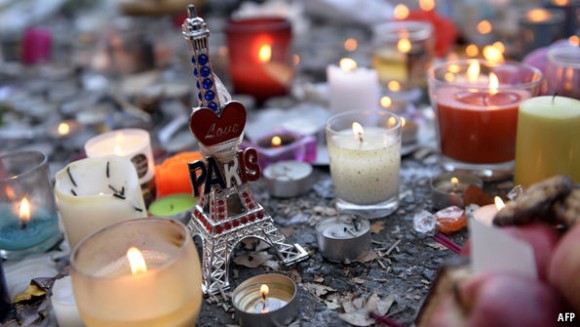
Eiffel_Tower_model_flowers

As it is often the case at time of crisis, people show their best side.  It certainly was true with the French who rose up above their usual attitude of self-disparagement.  Here are just a few examples — the police, the SAMU (ER), the Red Cross, the army, the BRI (brigade de Recherche et d’Investigation), the RAID (Recherche-Assistance-Intervention-Dissuasion) and other elite units could all be considered as heroes.   Doctors and surgeons happened to be on strike on Friday Nov. 13, but returned to work with news of the killings.  Some even volunteered in services other than their own.   At the Pompidou hospital,  dozens of volunteers waited three hours to donate blood.  People living near the attacks opened their apartments to wounded victims.

François Hollande acted as a compassionate and strong president during the crisis and announced immediate security measures to reassure the population.  He declared a etat d’urgence  or highest state of alert, suspending temporarily individual liberties and including the delay of all street manifestations, of public gatherings and the closing of monuments, etc.  It was a bleak sight for the tourists to see the Tour Eiffel lost in darkness.  To emphasize national unity, Hollande convened a Congress made up of the National Assembly and Senate in solemn Versailles.  It was the first time that had happened since the Algerian war in 1962.

The French colors appeared on monuments around the world in an amazing show of support.  President Obama was the first leader to make a declaration; Angela Merkel, who marched in the streets of Paris on Jan. 11, extended her message of friendship;  David Cameron declared – in French – Nous sommes tous solidaires.  The Moscovites laid flowers in front of the French embassy in Moscow.  In a different tone, Bashar al-Assad told the people of France: you suffered last night, but think of what the Syrian population has lived with during the past five years.

One detects an acceleration of terrorist attacks: Ankara in October, Lebanon and the crash of a Russian plane in November.   IS is now exporting its war to other countries.  It is an assymetric war since one side welcomes death.  Zero security is impossible to guarantee.  All one can do is to minimize the danger .

For the past 15 years, France has been on the front line of the war against radical Islam and acted alone in the Sahel, Mali, Nigeria, Chad.  For the past two and half months, France has taken part in the air strikes over Syria.  This is a brave but dangerous policy, probably untenable in the long term.

Bernard Guetta, specialist in geopolitics and commentator on France-Inter,  described the Nov. 13 tragedy as a shock  therapy, which might lead to a strong coalition able to defeat IS.

On Sunday, two days after the attack, the Parisions were still nervous.  I was walking on the Bastille square when  police cars suddenly cordoned off the avenue — rumor of an explosion spread.  In a panic, people started running.  I had to run also so as not to be caught in the stampede.  Thankfully, it was a false alarm!

It is your duty as a citizen, a comedian joked on the radio the other day, to sit on the terrace of a cafe and have a drink to show you are not afraid.  To-day, one does not say, “Je suis Charlie,” but rather, “Je suis en terrasse.”

Nicole Prévost Logan

Nicole Prévost Logan

About the author: Nicole Prévost Logan divides her time between Essex and Paris, spending summers in the former and winters in the latter. She writes a regular column for us from her Paris home where her topics will include politics, economy, social unrest — mostly in France — but also in other European countries. She also covers a variety of art exhibits and the performing arts in Europe. Logan is the author of ‘Forever on the Road: A Franco-American Family’s Thirty Years in the Foreign Service,’ an autobiography of her life as the wife of an overseas diplomat, who lived in 10 foreign countries on three continents. Her experiences during her foreign service life included being in Lebanon when civil war erupted, excavating a medieval city in Moscow and spending a week under house arrest in Guinea.