Letter from Paris: COP 21, Part II — Reaching Consensus was a “Tour de Force,” But Much Work Still To Do

Nicole Prévost Logan
Nicole Prévost Logan

cop21-logoAt 7.26 p.m. precisely on Saturday, Dec. 12, Laurent Fabius, president of the United Nations Framework Convention on Climate Change (UNFCCC) COP 21 , choking with emotion, announced that an universal accord had been reached. The several thousand people in the audience rose in a standing ovation and started congratulating each other.

After two sleepless nights, the “facilitators” wrenched out an agreement by consensus from the 195 Convention’s members. The suspense lasted until the absolute final minute when Nicaragua tried to interrupt. It was too late — the president had already snapped down his gavel. The conference could very well have been a failure – it had to overcome a block from the oil-producing countries such as Saudi Arabia – but on that last day, there were no grim faces, as had been seen in Copenhagen, only a general enthusiasm.

Credit should be given to the involvement of the French organizers. For two years they traveled several times around the world to meet every leader. President François Hollande was talking to president Xi Jinping just one month before the start of the Convention. All paid homage to the professionalism of Fabius who seemed on a mission throughout the process. “You did an amazing job,” commented John Kerry, while Al Gore added, “This is the finest diplomatic performance I have seen in two decades.”

In a nutshell, the agreement reads as follows:

  • its main objective is to limit the increase in temperature to “well below” two degrees by the end of this century
  • developed countries should reduce their emissions of greenhouse gas and the developing countries should “mitigate” them
  • Article 9 stipulates that “developed country parties shall provide financial resources to assist developing countries”
  • the agreement, which will be ratified in April 2016, requires an annual payment of 100 billion Euros, with a revision every five years

President Barrack Obama is expected to use an Executive Order to avoid the likely opposition of the Republican majority in the Congress; in the absence of coercion and sanctions — a mechanism of control by satellite (France is financing the “MicroCarb” satellite) — provides an attempt at transparency and ongoing verification by a committee of experts thus making the agreement de facto binding.

Never before has there been such an awareness of the threat caused by global warming. The vagaries of the climate and the fact that 2015 is the warmest year in recorded history contributed to this sense of urgency. Today any debate about climate skepticism has become obsolete.

What makes the Paris conference different from all the ones before is a groundswell of positive intentions. For the first time the main polluters of the planet – China, the US and India – are on board and are determined to make the agreement work. Already 187 out of the 195 countries have announced their voluntary contributions.

Today the action of society as a whole is crucial. It is important to note that, at the Bourget, the Non-Governmental Organizations (NGOs), private associations and a number of organizations were working just a few steps from the UN “Blue Zone” for government officials (at the Lima, Peru, COP, they had been “exiled” 15 kilometers away). Giant screens in the hallways made it possible for the general public to follow the proceedings, breaking away from the closed door policy of the past.

After the initial euphoria felt on Dec. 12, a number of questions remains unanswered, some of the objectives are unclear – no date was set as to when to reach the greenhouse gas neutrality nor when to end the use of fossil energy, no price was put on carbon – and the unfairness of many decisions has become apparent – such as the financing and the sharing of responsibilities between the “North” or rich countries and the developing countries — or to put it another way, who pays whom and for what? Until now Europe, and France in particular, have been paying a great deal. A country such as Russia has not paid one cent so far. Are China and India – the big polluters of the planet – still considered as part of the developing world and expected to be on the receiving end of hundreds of billions of Euros?

Nicolas Hulot, militant environmentalist and an icon in France, deemed the agreement very positive even though it was not perfect. “Such a movement of solidarity around the planet has never been seen before,” he stated, adding, “There is a momentum, which needs to be seized and followed by action.”
The Movie Man: “Spotlight” Explores How “Globe” Reporters Exposed Priest Sex Scandal

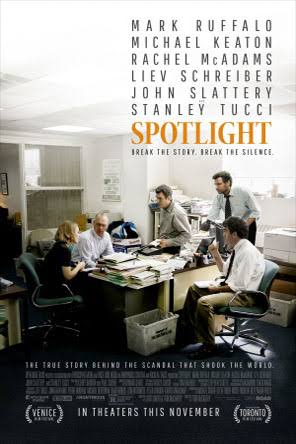
Spotlight_movieTonight, I look back to a scandal that has rocked the institution that preserved Western Civilization in the Dark Ages, transformed hospitals, and, believe it or not, science. Thirteen years ago, the Boston Globe revealed a series of stories to the public, and many in the world began to distrust her. What I speak of is the Catholic Church, and the priest sex scandal.

This is a New England film, as many big parts of New England life are displayed throughout it via product placement. Dunkin’ Donuts, W. B. Mason, and other familiar logos are seen throughout it. For those of us who know Boston well, many popular, yet not mainstream popular, or, rather “hipster” streets are seen and spoken about through dialogue.

We begin in 1976, in which a bishop visits a Boston Police station in regards to a priest who abused a young boy, and he assures the boy and his parents they will never hear from the priest again, and the bishop and the priest then drive off. Twenty-five years later, members of the Boston Globe have a goodbye party for one of their editors who is stepping down after the New York Times bought out the newspaper.

New editor Marty Baron (Liev Schreiber) comes in from Miami and expresses interest in going deeper into a case involving a priest, who severely abused countless children, as he feels there is something that is being hidden from the public.

How could somebody take on a church? This is the basic theme that is dealt with as the journalists from the Globe’s Spotlight section begin to dig deeper and deeper into this horrible scandal. A member of a survivor group, SNAP, comes to them, having previously tried to contact the paper many years prior. While his organization is small, comprised of only 10 members, Spotlight eventually catches on and realizes there has to be a scandal in their midst.

While they are presented with the same facts that we are today when we discuss the scandal, that perhaps only a very small percentage of ordained priests have engaged in such awful activities, they realize they need to take action because there are numerous victims out there with stories to be heard.

Several scenes take place in which the journalists meet with the survivors (as one asserts they are survivors because some ended up taking their lives) and they tell their stories. It is a completely heart-wrenching ordeal to listen to, as they describe being initially excited that their parish priest took an interest in them, only to violate the in the most unimaginable way.

Cardinal Bernard Law, the Archbishop of Boston at the time, is our enemy, despite his cheerful and outgoing personality. The stories of Church corruption in the Middle Ages suddenly return to 21st century America. Cardinal Law is reaching out to officials, taking advantage of loopholes to keep legal documents confirming his corruption away from the public’s eyes.

And though he only appears in three or four scenes, he does not have the lasting effect of the antagonizing villain that we see in other films, such as Anthony Hopkins’ portrayal of Dr. Hannibal Lecter in The Silence of the Lambs consisting of only 16 minutes of screen time, but earning the Academy Award for Best Actor in a Leading Role, and being ranked by the American Film Institute as the greatest villain in the history of film.

Many interesting points are made, as people bring up that these stories were brought to the newspapers on many occasions, but turned down. Michael Keaton’s character, Walter “Robby” Robinson, notes that he originally shot down the claims when he worked for a different section of the Globe 20 years prior, and another brings up that we all stumble around in the dark and only realize what has happened when the light enters. Boston is a tightly-knit community, one character says, pointing out that if it’s true it takes a village to raise a child, as he quips, it also takes a village to [destroy him].

I will not post a disclaimer to share that I am a lifelong Catholic, myself, and have been brought up in the Church in a very intimate manner. Baptism, CCD, First Communion and Reconciliation, Confirmation, Catholic high school, and even participated in campus ministry as a student at Quinnipiac. I do not intend to bash Catholicism, as journalists such as Christopher Hitchens might have done  when reviewing a film like this, nor do I seek to engage in apologies, but rather to show the honest side of the faith.

This film has been received well by the Church, of all viewers, especially by Seán Cardinal O’Malley, Law’s replacement as Archbishop of Boston, who claimed the investigation by the Globe prompted the Church “to deal with what was shameful and what was hidden.” Vatican Radio also shared similar words, calling the film honest and compelling. Anyone who is involved with their local church can describe how there is now a zero-tolerance policy for things of this nature, and how Popes Benedict XVI and Francis have made these events a main focus during their papacies.

I will close with a reference to Dante Alighieri’s epic poem, The Divine Comedy, since I read all three volumes this summer … to my surprise. Plus, who doesn’t feel super smart when they close an article with a quote from a piece of classical literature?

(Dante addresses a pope who is confined to be buried face down into a furnace, who is guilty of simony [buying of sacred things])

And were it not that I am still constrained by the reverence I owe to the Great Keys [1] you held in life, I should not have refrained from using other words and sharper still; for this avarice of yours grieves all the world, tramples the virtuous, and exalts the evil.

Of such as you was the Evangelist’s vision when he saw She Who Sits upon the Waters locked with the Kings of the earth in fornication.[2] Gold and silver are the gods you adore! In what are you different from the idolator, Save that he worships one, and you a score?

Inferno, Canto XIX

[1] Papacy, the “Keys to the Kingdom of Heaven” given to St. Peter by Christ.

[2] The Whore of Babylon, from Revelation 17-18

Kevin Ganey

Kevin Ganey

About the Author:  Kevin Ganey has lived in the Lyme/Old Lyme area since he was three-years-old, attended Xavier High School in Middletown and recently graduated from Quinnipiac University with a degree in Media Studies. Prior to his involvement here at LymeLine.com, he worked for Hall Radio in Norwich, as well as interned under the Director of Communications at High Hopes Therapeutic Riding Center. Kevin has a passion for movies, literature, baseball, and all things New England-based … especially chowder.

Letter from Paris: COP 21 Tackles Climate Change in Challenging Times

Nicole Prévost Logan

Nicole Prévost Logan

All eyes are on the COP21 United Nations conference on climate change taking place in Paris from Nov. 29 to Dec. 12. The “Conference of Parties” or COP, have been held every year since COP 1 in Berlin, in 1995.

In the middle of nowhere, in an industrial and non-descript vacant lot – a preview of what our world will become if the conference does not bring concrete results – the Bourget site has been turned into an ephemeral city of tents, movable partitions and kilometers of carpets. The recyclable constructions will all disappear at the end of the conference. More than 3,000 journalists are covering the event.

The circumstances were exceptional, barely two weeks after the Nov. 13 terrorist attacks. France is living under emergency rules and the danger is still present. More than 120,000 police, army and special forces are deployed throughout the country. Terrorism and global warming were on a collision course. It was a huge challenge for France to organize the conference. The highways and part of the beltway were closed to facilitate the arrival of the thousands of visitors. The Parisians had braced themselves for total chaos … but it turned out to be the most peaceful two days in a long time.

The inaugural day was quite a show of protocol. There was first the greetings of the 150 leaders, followed by photo-ops and smiles. Elham Aminzadeh, the vice-president of Iran, dressed in her long robes, walked past the French president and prime minister to shake hands only with Segolène Royal, French minister of the environment. Then everyone scrambled to find his or her place for the giant “family pnoto.” Leaders of Israel and Palestine or of Russia and Turkey had to stand apart to avoid a diplomatic incident.

This year the heads of States spoke at the outset of the COP. It was believed that their declarations of intent — powerful but brief (three minutes each) — would galvanize the public and give a boost to the working sessions to follow. One sensed a definite will to reach the objective of limiting the global warming to below two degrees by 2100. “Greenpeace could have signed Francois Hollande’s speech,” commented Jean Francois Julliard, the director of Greenpeace France. Indian Prime Minister Narandra Modi announced his country’s support of an ” International Solar Alliance.” China is becoming the world first producer of renewable energy. The liberal new prime minister of Canada, Justin Trudeau, is changing his country’s attitude about the environment.

Early in the conference, 11 developed countries, including the US, France, England, Germany and Sweden, made the solemn commitment to contribute 250 million Euros for a transfer of renewable technology to the poorest countries.

In the 1970s, the advocates of ecology were not taken seriously and pretty much disregarded. Things have now come a long way from the 1997 Kyoto Protocol, which so few countries ratified or from the 2009 COP 15 of Copenhagen, which ended up with a weak and non-binding text.

At the midpoint of COP 21, its president, French minister of foreign affairs Laurent Fabius, exhorted the participants to seize the momentum. He urged delegates not to wait until global warming becomes irreversible.

The pollution of the atmosphere is measured in particles per million or “ppm.” To-day it is 400 as compared to 250 in the pre-industrial era. In Peiping, pollution is 25 times higher than that of Paris on it worst day.

In 1990, the developed countries (also labeled as the “North”) produced 14,000 billion tons of carbon dioxide (CO2) and the emerging countries 7,500. In 2012, the North had slightly reduced its emissions to 13,000 and the “emerging countries “, called G77 + China , ( actually numbering 134 now), almost tripled their emissions to 20,000. It is ironic that the BRIC (Brazil, Russia, India, China) is still included among the “emerging” countries.

The main stumbling block at the COP 21 is whether the developed world will have to pay 100 billion Euros per year to the other countries even though they are profiting from the technology it created. Besides, if one has to wait for the “big emergents,” headed by China and India, in the name of “climate justice,” to catch up, the planet will be gone by then.

In the early evening of the inaugural day, I saw a convoy with blue strobe lights, going against traffic in a one-way street in front of my windows. Who could that be, I wondered? It turned out it was President Barrack Obama driving toward the very secluded three-star Ambroisie restaurant on Place des Vosges. In the elegant dining room, under crystal chandeliers, the president, John Kerry and their party seemed to have a great time with Francois Hollande and his cabinet ministers.

Nicole Prévost LoganAbout the author: Nicole Prévost Logan divides her time between Essex and Paris, spending summers in the former and winters in the latter. She writes a regular column for us from her Paris home where her topics will include politics, economy, social unrest — mostly in France — but also in other European countries. She also covers a variety of art exhibits and the performing arts in Europe. Logan is the author of ‘Forever on the Road: A Franco-American Family’s Thirty Years in the Foreign Service,’ an autobiography of her life as the wife of an overseas diplomat, who lived in 10 foreign countries on three continents. Her experiences during her foreign service life included being in Lebanon when civil war erupted, excavating a medieval city in Moscow and spending a week under house arrest in Guinea.

Nibbles: Two Culinary Memoirs, Two Delicious Recipes – Enjoy Both!

Over the past month, I have been reading interesting recipes. That’s not a big deal, since I pore over recipes daily from newspapers, cookbooks and, especially, food magazines. These days I tear recipes from magazines and newspapers, then chuck them out.

Hear&Soul_in_the_Kitchen_PepinMany of my 500 cookbooks are gone, too, living at the  Book Barn. But two food memoirs I bought recently, and which I cannot recommend highly enough, are Jacques Pepin’s “Heart and Soul in the Kitchen” and Ruth Reichl’s “My Kitchen Year.” I read each of these books in bed. I am hungry while I read them, both for the recipes (which “taste” lovely) and the prose, which is glorious.

In Jacques’ book, he talks about cooking with Shorey, his granddaughter, his best friend, Jean-Claude Szurdak, the “greats,” like Julia Child and James Beard, his wife, Gloria (no slouch in the kitchen, either) and his daughter, Claudine. And much of the book is about Connecticut, where he and his family have lived for more than 30 years.

A-Kitchen_Year_ReichlRuth Reichl’s memoir is pretty much about one year in her kitchen in upstate New York, one year during which  she and all her colleagues lost their jobs, and we lost Gourmet magazine. She wrote and cooked and wrote and cooked, through fierce winter storms and power outages. She learned how a pantry and some great recipes can keep sadness at bay. Both books should be under your menorah or Christmas tree this year…

Both these recipes include pantry items that require little money and little time at the supermarket. Most items may already be in your own pantry.

Rice with Cumin and Green Olives

From Heart and Soul in the Kitchen by Jacques Pepin (Houghton Mifflin, Boston, 2015)

Yield: serves 4

3 tablespoons unsalted butter

1 and one-half cups thinly sliced washed leek greens

1 cup diced (one-inch) onions

1 and one-half cups long-grain white rice

1 teaspoon ground cumin

Three-quarter teaspoon salt (less if stock is salty)

3 cups homemade chicken stock or canned low-sodium chicken broth

One-half cup pitted green olives, cut into three-quarter-inch pieces

Heat butter in a medium saucepan over medium heat/ Add leek greens and onions and cook for about 5 minutes, stirring occasionally.

Add rice, cumin, salt and stock and bring to a boil. Stir in olives, cover, reduce heat to very low and cook for 20 minutes, or until rice is cooked through and tender. Fluff with a fork and serve.


Spaghetti alla Carbonara

From My Kitchen Year by Ruth Reichl (Random House, New York, 2015)

Yield: serves 4

one-quarter to one-half pound bacon

1 pound spaghetti

Garlic

3 eggs

Parmesan cheese

Pepper

Bring as pot of water to a boil, salt it well and toss in the spaghetti. Most brands of spaghetti take about 10 minutes, which is all the time you need to make the sauce.

Cut anywhere from a quarter to a half-pound of bacon into small pieces and brown them in a liege skillet with a couple of whole peeled cloves of garlic.

Break eggs into a big bowl. Grate a generous amount of Parmesan cheese (about half a cup). Cook your pasta al dente.

Drain the pasta and immediately plunk it into the bowl with the eggs, tossing frantically so the hot pasta will cook them. Remove the garlic from the bacon and add the bacon, along with as much of the bacon fat as your conscience allows. Toss/ Add cheese. Toss again. Add salt to taste.

Grind a good amount of pepper over the pasta and serve. You will instantly understand why this quick, easy dish given so much comfort to so many people.

Talking Transportation: Saving Money on Metro North

MTA logoWith the holidays upon us, let’s review some money-saving tips for riding Metro-North into the city for commuters and day-trippers alike:
TRANSITCHEK: See if your employer subscribes to this great service, which allows workers to buy up to $130 per month in transit using pre-tax dollars.  If you’re in the upper tax brackets, that’s a huge savings on commutation.  A recent survey shows that 45 percent of all New York City companies offer TransitChek, which can be used on trains, subways and even ferries. 

GO OFF-PEAK: If you can arrive at Grand Central weekdays after 10 a.m. and can avoid the 4 to 8 p.m. peak return hours, you can save 25 percent.  Off-peak’s also in effect on weekends and holidays.  These tickets are good for 60 days after purchase.

BUY TICKETS IN ADVANCE: If you buy your ticket on the train you’ll pay the conductor a $5.75 – $6.50 “service charge”… a mistake you’ll make only once !  (Seniors: don’t worry, you’re exempt and can buy on-board anytime without penalty.) There are ticket machines at most stations, but the cheapest tickets are those bought online.  And go for the ten-trip tickets (Peak or Off-Peak) to save an additional 15 percent.  They can be shared among passengers and are good for six months.

KIDS, FAMILY & SENIOR FARES:   Buy tickets for your kids (ages 5 – 11) in advance and save 50 percent over adult fares.  Or pay $1 per kid on board (up to four kids traveling with an adult, but not in morning peak hours).  Seniors, the disabled and those on Medicare get 50 percent off the one-way peak fare.  But you must have proper ID and you can’t go in the morning rush hours.

FREE STATION PARKING: Even stations that require weekday parking permits usually offer free parking after 5 pm, on nights and weekends.  Check with your local town. 

METROCARDS: Forget about the old subway tokens.  These nifty cards can be bought at most stations (even combined with your Metro-North ticket) and offer some good deals:  put $5.50 on a card (bought with cash, credit or debit card) and you get a 5% bonus.  Swipe your card to ride the subway and you’ll get a free transfer to a connecting bus, or vice versa.  You can buy unlimited ride MetroCards for a week ($31) or a month ($116.50). 

BUT IS IT CHEAPER TO DRIVE?: Despite being a mass transit advocate, I’m the first to admit that there may be times when it’s truly cheaper to drive to Manhattan than to take the train, especially with three or more passengers.  You can avoid bridge tolls by taking the Major Deegan to the Willis / Third Ave. bridge, but I can’t help you with the traffic you’ll have to endure.  Check out www.bestparking.com to find a great list of parking lots and their rates close to your destination.   Or drive to Shea Stadium and take the # 7 subway from there.

The bottom line is that it isn’t cheap going into “the city”.  But with a little planning and some insider tips, you can still save money.  Happy Holidays!

Jim Cameron

Jim Cameron

Jim Cameron is founder of The Commuter Action Group, and a member of the Darien RTM.  The opinions expressed in this column are only his own.  You can reach him at CommuterActionGroup@gmail.com   For a full collection of “Talking Transportation” columns, see www.talkingtransportation.blogspot.com