
Nibbles: Pork Roast with Maple and Rum Glaze

Maple-Glazed-Pork-Roast

Maple Glazed Pork Roast, Yankee magazine

Just before I went to bed on a Sunday or two ago, I watched Lady Edith call Lady Mary a “bitch” more than once. (That’s “Downton Abbey,” for those of you not hooked on this Masterpiece Theatre show, which will end maybe by the time you read this. Sob.)

My reading matter was “Five Days at Memorial,” a nonfiction book about Memorial Hospital in New Orleans, before, during and after Hurricane Katrina. But before I began the book, I decided to read my new issue of Yankee magazine.

I have been subscribing to Yankee for years and the food editor is Amy Traverso. The recipes she chooses are always good. In the new issue, there is a story about maple syrup season. I loved a feature about two sugar shack competing owners in Vermont and a “flatlander” who decided to move to Vermont just over 10 years ago. (“Flatlanders,” according to Vermonters, are those who haven’t lived for at least a couple of generations in their gorgeous state.)

Dori Ross convinced the two owners to allow her to market their maple products. By the way, Ross, who got this article into Yankee, is a marketing guru because the owners are making a lot more money now.

There were recipes, of course, and reading them had me salivating. I don’t make pancakes or waffles at home, but I am crazy about maple anything. I was planning to make dinner for my neighbors, so when I saw a recipe for a pork roast using maple syrup, I was hooked. I rarely give you recipes I have not tried myself, but, just by reading the ingredients, I know it will be absolutely delicious.

Soon, I plan to make a spinach, feta and grape salad with maple-soy vinaigrette and maple affogato, an ice cream treat, also from that article.

Maple-and-Rum-Glazed Pork Roast
From Yankee magazine, March/April 2016

Yield: 4 to 6 servings

1 3-pound boneless pork-loin roast, tied at intervals with kitchen twine (perhaps the butcher at the supermarket will do that for you)
2 teaspoons plus 11/4 teaspoon kosher or sea salt
1 cup maple syrup
3 tablespoons Dijon mustard
3 tablespoons apple-cider vinegar
1 tablespoon dark rum
1 teaspoon ground cinnamon
1/2 teaspoon freshly ground black pepper

Preheat oven to 375 degrees and set a rack in the lowest position. Sprinkle pork all over with 2 teaspoons salt and let it sit for 10 minutes.

Now make the glaze: In a medium-sized bowl, stir together syrup, mustard, cider vinegar, rum, cinnamon, and remaining 1 1/4 teaspoon salt until blended.

Place the pork, fat side down, in a 9×13-inch roasting pan (Pyrex would be good) and pour the glaze over the meat. Transfer to the oven and cook 30 minutes, basting halfway through.

Remove meat from oven, turn it fat side up, baste and return to the oven. Cook, basting every 15 minutes until the meat reaches 150 degrees when an instant-read thermometer is inserted into the center, 30 to 40 minutes more. Remove meat from the oven and let it rest 10 to 15 minutes. Slice and serve with additional glaze on the side.

Chicken Fried Chicken at Ninety Nine Restaurant & Pub

Generally, I avoid medium-sized, medium-inexpensive franchising restaurants, the ones I used to call fern bars. There are a few that are standouts for certain menu items: the Cobb salad at Chili’s and risotto with chicken and butternut squash served with a Caesar salad at Brio. But generally, I would rather get a burger and fries at Five Guys or choose the salad bar at Ruby Tuesday.

But now I can add the chicken fried chicken at Ninety Nine Restaurant & Pub. In the group of $9.99 dinners is the chicken fried chicken, a pounded-thin chicken breast, lightly battered and fried, a lovely mound of mashed potatoes and, for a vegetable, sweet corn. Best of all, like its sister, chicken-fried steak, it is topped with white, somewhat peppered country gravy. No, it is not on my healthy, low-calorie diet, but sometimes one must splurge. This is a nice splurge.

Around the Valley Shore area, Ninety Nine Restaurant & Pub is at 117 Long Hill Road in Groton. A few Other Connecticut restaurants are in Cromwell and Glastonbury and Norwich.

About the author: Lee White has been writing about restaurants and cooking since 1976 and has been extensively published in the Worcester (Mass.) Magazine, The Day, Norwich Bulletin, and Hartford Courant. She currently writes Nibbles and a cooking column called A La Carte for LymeLine.com and the Shore Publishing and the Times newspapers, both of which are owned by The Day.

Our ‘Movie Man’ Correctly Predicts DiCaprio to Win Academy Award for “The Revenant”

therevenant10For the love of all that is good and holy in this world, give Leonardo DiCaprio his long-overdue Academy Award!


This was all I was thinking as I sat through Alejandro González Iñárritu’s new film, The Revenant. Apart from the infinite number of beautiful shots depicting the American West through virtually all climates, my attention was fixed on the memorable performance of its lead, our boy Leo. This is not the Leo from post-Titanic Leo-mania, whom my cousins fell in love with and helped contribute to James Cameron’s romantic drama’s reigning status as the highest grossing film of all time until 2010.

This is a gritty and horrific depiction of a man who survives a brutal bear attack and must endure the cold of winter in order to trek across the wilderness in order to fulfill a quest for revenge on John Fitzgerald, played by Tom Hardy, who decided to leave him for dead.

This is a memorable performance on DiCaprio’s part. And while its acclaim may not be based in eloquent command of speech, as legendary Shakespearean actors like Olivier, McKellen, Gielgud, or the chilling sophistication of Anthony Hopkins as the cannibalistic serial killer, Dr. Hannibal Lecter, DiCaprio’s run as Hugh Glass will forever be etched into our minds due to his conveyance of pain. Foaming at the mouth, shouting through his teeth and unable to make intelligible sounds, lighting gunpowder in an open wound on his neck in order to clot the bleeding, this man, we must believe, truly did survive a bear attack. There is no question.

In fact, he does not speak much throughout the movie as he journeys back home. On top of (spoiler alert) pulling a move in which he imitates Han Solo providing a seriously injured Luke Skywalker shelter in a dead tauntaun in The Empire Strikes Back … give him the Oscar right now!

Another performance that must be recognized is that of Englishman Tom Hardy, who takes on a Southern accent and ultimately gives it a creepy delivery, reminding us of the yokels seen in Deliverance or Errol Childress in the first season of True Detective. Hardy has also lent his unique voice to another character best remembered for his speech, the villain Bane in The Dark Knight Rises. It is as if the lack of speech on DiCaprio’s part is made up for by Hardy’s yokel delivery.

My complaint about this film is the depiction of Glass’ journey back to his home fort is a bit dragged out at times, and could have been cut shorter.

Award season is approaching us, and DiCaprio has already won a Golden Globe and a Screen Actors Guild Award, and he has received his fifth acting-based Academy Award nomination, having already lost to Tommy Lee Jones, Jamie Foxx, Forest Whitaker, and Matthew McConaughey. And we have all seen the internet memes poking fun at his losses, such as placing his head on Mr. Turner in a memorable scene from The Fairly Odd Parents, and losing to Jennifer Lawrence despite being the only listed candidate for an award. Another meme came forward that was not connected to his snubs, but depicted his audience with Pope Francis, in which the Pontiff tells him that he was rooting for the bear earlier in the movie.

Iñárritu may also have a great chance to win his second consecutive Best Director Oscar, having last year won for Birdman. Nobody can argue with his ability to depict the American pioneer life, as well as masterfully paint the picture of Glass’s revenge. But even if Iñárritu wins again, his victory will definitely be overshadowed by the anticipation of Leonardo DiCaprio, one of the finest living actors of our generation.

Kevin Ganey

Kevin Ganey

About the Author: Kevin Ganey has lived in the Lyme/Old Lyme area since he was three-years-old, attended Xavier High School in Middletown and recently graduated from Quinnipiac University with a degree in Media Studies. Prior to his involvement here at LymeLine.com, he worked for Hall Radio in Norwich, as well as interned under the Director of Communications at High Hopes Therapeutic Riding Center. Kevin has a passion for movies, literature, baseball, and all things New England-based … especially chowder.

Letter From Paris: Aleppo — an Orientalist’s Nostalgia

Nicole Prévost Logan

Nicole Prévost Logan

Agatha Christie stayed there. So did T.E. Lawrence, King Faysal from Iraq and General de Gaulle: at the famous Hotel Baron in downtown Aleppo, Syria. At that time, Aleppo was an exotic and cosmopolitan city where Arabic, Turkish, Kurdish and Armenian cultures coexisted.

A photo of the Citadel at Aleppo taken by Nicole Logan in 1957.

A photo of the Citadel at Aleppo taken by Nicole Logan in 1957.

But all this was before the Syrian civil war.

Aleppo, like many other historical Syrian cities, is being crushed by daily bombings. The devastation is concentrated on this region with the intent of cutting off the road to the north toward Turkey. Today the Bab el Faraj – one of the main squares – is in ruins; the 11th century minaret of the Omayyad mosque lies on the ground among fallen stones; in July 2015, a bomb placed in a tunnel destroyed part of the citadel. The second largest metropolis of Syria is now a pile of rubble.

Another photo of the medieval Citadel, which is now in ruins after repeated bombings, from the author's 1957 trip.

Another photo of the medieval Citadel — now partly in ruins after repeated bombings — from the author’s 1957 trip.

In a few magical pages, Mathias Enard, winner of the 2016 French Prix Goncourt for his novel entitled “Boussole” (compass), brings back to life the colorful Aleppo of a bygone era. His hero, Franz Ritter, is a Viennese musicologist fascinated by the Orient. He belongs to the group of “Orientalists” – archaeologists, linguists, historians, architects, diplomats, spies – writes Enard, “found side by side at Hotel Baron dabbling in the pleasure of Arab grammar and rhetoric.”

Enard’s rambling style, oozing with culture, takes the reader from Austria – the outpost of the West on the edge of the Ottoman empire – to the Middle East. Besieged by Suleiman the Magnificent in 1529, Vienna was threatened for the last time by the Ottoman Empire in 1683 in its final effort to flood the Danube valley.

Refusing to draw bitterness from the century-long tug-of-war with the Turks, Franz the hero of “Boussole” believes in cross-pollination between the Western and the Oriental worlds. As a musicologist he is able to detect in the works of Mozart, Rimsky-Korsakov, Schoenberg or Debussy, the influence of Arabic music’s harmony with its microtones and absence of tonal structure.

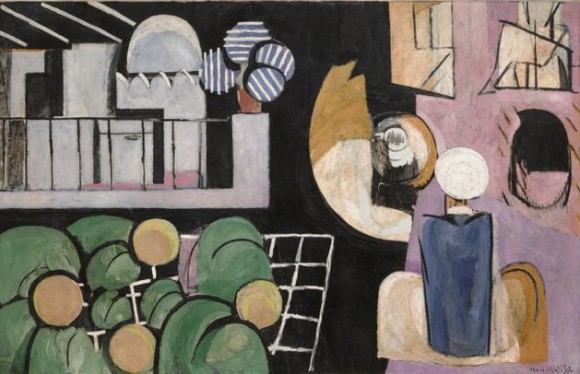
"The Moroccans" by Henri Matisse.

“The Moroccans” by Henri Matisse.

There has long been a tradition of literary and artistic attraction by the West toward the Orient. But it is Napoleon Bonaparte’s military campaign to Egypt (1798-1801), which opened the floodgates and made the 19th century West smitten with the Orient.

John Singer Sargent’s “Smoke of Ambergris.”

The “Orientalists” could be found around some of cultural centers like the French, German, English or American Institutes in Syria, Lebanon, Beirut or Baghdad. They were a privileged group, somewhat disconnected from the real world.

With some sarcasm but much honesty, the author acknowledges that the “Orientalists” took advantage of the comfort provided by the law and order of the police state of Hafez el Assad, father of Bachar. The “Orientalists” lived their dream, Enard writes, “under the amused look of the Syrians.”

At the present time Aleppo is at the epicenter of an imbroglio of violence and destruction and caught in the middle, tragically, are the refugees.

Why do we not take a brief pause and return to a more peaceful time when wars and religious intolerance were not destroying societies?

Nicole Logan

Nicole Prévost Logan

About the author: Nicole Prévost Logan divides her time between Essex and Paris, spending summers in the former and winters in the latter. She writes a regular column for us from her Paris home where her topics will include politics, economy, social unrest — mostly in France — but also in other European countries. She also covers a variety of art exhibits and the performing arts in Europe. Logan is the author of ‘Forever on the Road: A Franco-American Family’s Thirty Years in the Foreign Service,’ an autobiography of her life as the wife of an overseas diplomat, who lived in 10 foreign countries on three continents. Her experiences during her foreign service life included being in Lebanon when civil war erupted, excavating a medieval city in Moscow and spending a week under house arrest in Guinea.

Legal News You Can Use: Is My Case a Personal Injury or Worker’s Compensation Claim?

WorkersCompAs an attorney who practices both Worker’s Compensation and Personal Injury Law, I find that many people are confused as to if and where these systems overlap. Although there are many similarities between these two areas of law, there are a number of significant differences that make the representation of clients in either scenario unique.

Personal injury claims fall under the broad area of law called torts, and arise out of what is known as the “common law.” The “common law” is derived from the English legal system and is essentially a set of laws and rules that have developed over hundreds of years of court and appellate decisions.

It is a body of law that is constantly changing as courts review prior decisions and either affirm, or modify the decisions that came before. Although there are certain statutes (written laws passed by the State and Federal Legislatures) that govern personal injury actions, by and large most personal injury actions are based on common law decisions.

Specific to personal injury actions, it is the law of the land that all individuals or entities (like businesses) owe a duty to all members of society to act in a way that is reasonable and does not intrude on anyone else’s safety. If a person or entity breaches that duty and someone gets injured, that someone (who is now a potential plaintiff) has a cause of actions against the breaching party (now a potential defendant). In these claims the plaintiff must prove that the defendant is at fault. If they win, they are entitled to recover money for both economic damages (medical bills, lost wages, etc.) and non-economic damages (including pain and suffering).

In Connecticut these claims can be brought in court if the parties cannot agree to a settlement.  There the claims can either be tried before a judge or a jury of six. In the alternative, if the parties agree, the claims can be privately mediated outside the court system. If the plaintiff prevails in his or her claim, most often the damages are awarded all in one shot. No matter what though, eventually every case comes to an end by way of settlement or trial and verdict and very rarely will a plaintiff receive any type of compensation until the case is over.

Although a form of lawsuit, Worker’s Compensation is the exclusive remedy for injuries that occur on the job. Claims are brought before the Worker’s Compensation Commissioner and an injured worker cannot sue their employer at common law.  Why? Because around the turn of 20th Century, with industrial production in America in full bloom, workers injured on the job had the right to sue their employers for injuries on the job. As the advent of the contingency fee allowed people who could never afford it before, access to the courts, and employers pressured the legal system to come up with theories to limit recovery, something had to give.

It was actually employers (who wanted to be able to cap their potential exposure in the event they were sued) who pushed for Worker’s Compensation laws. Under virtually every Worker’s Compensation scheme injured workers are entitled to both economic and non-economic damages. However, a big difference between Worker’s Comp and personal injury is that Comp is a “no-fault” system. An injured worker need not prove that his/her employer was at fault for his/her injuries. He/she need only prove that they were injured while in the scope and course of their employment. How it happened is relatively unimportant.

If the injured worker can establish that, then they are entitled to benefits. But unlike personal injury, what the injured worker is entitled to is entirely dictated by statute rather than the common law. In addition, because it is “no-fault,” whatever they are entitled to, they receive as soon as it becomes due. The trade-off is that there are built in caps on these statutory benefits.

For example, there is a maximum weekly compensation rate you can receive regardless of how much money you make, and irrespective of how badly you are hurt. Likewise, there are statutory rules governing exactly how much pain and suffering you can receive based on a scheme too complex to explain in this brief article. However, unlike a personal injury suit, a Worker’s Compensation case never has to come to an end. Although Comp cases are often permanently settled, neither side is obligated to do so and the claim could remain open until the death of the claimant.

Regardless of which system you are looking at, as someone who has practiced in both areas for almost 25 years, they represent a good faith attempt to make whole those individuals who unfortunately need to avail themselves of these laws. Although far from perfect, they are part of the fairest and most accessible legal system on the planet.

About the author: Attorney Robert B. Keville is a Director at Suisman Shapiro Attorneys-at-Law, the largest law firm in eastern Connecticut.  If you have questions about these topics or other injury matters, he can be reached via email at rkeville@sswbgg.com or by phone at (860) 442-4416.

Letter from Paris: Europe and the Migrant Crisis

Nicole Prévost Logan

Nicole Prévost Logan

During the month of January 2016, 55,000 migrants have crossed the Aegean Sea, or 21 times the number that made the same journey in January 2015.   In 2015, a total of 856,000 arrived in Europe, 90 percent of them coming from Syria, Iraq and Afghanistan.

Today, there is an urgency in the face of this inexorable phenomenon, which is bound not only to continue but also to increase.  It is expected that with the spring’s milder weather, there will be a surge of four times that number.  The net result — Europe has a window of six to eight weeks to manage the crisis.

Everybody agrees on what should be done to stop the flow of refugees:  end the war in Syria; defeat ISIS; provide financial help to  the countries that have taken in the most refugees, i.e., Lebanon, Jordan and Turkey;  police the Mediterranean by destroying the derelict boats ferrying the migrants and put a stop to the profitable business of the smugglers.  But there has been an absence of a leadership in carrying out a common plan of action. 

At the outset of the crisis Angela Merkel was the only one to offer a clear strategy.  For her, Turkey was the key country to work with since three quarters of the migrants pass through its territory.  She even made the trip to meet President Erdogan in Antalya.  She supported the European Commission’s decision to pay Turkey three billion dollars for keeping 2.2 million refugees.  The Turks demanded that amount every year, Europe settled for a bi-annual payment.  Driving a hard bargain, the Turks demanded that Europe wave its  visa requirements for Turkish nationals traveling to Europe. Ankara even asked for the resumption of  the process of adhesion into Europe – a demand the European Union is refusing unanimously today as it has for 52 years..

Last September, Merkel announced she would welcome 800,000 refugees in Germany but she had not predicted the ensuing surge and her policy has backfired.  She has become increasingly isolated as those countries, at first favorable to her policies, started closing their borders, practicing more restrictive policies toward the migrants, and expelling the ones not qualifying for the status of “refugees.”

After the alleged mass rapes of women in Cologne on New Year’s Eve, German public opinion has become increasingly hostile to the presence of hundreds of thousands of young Muslim men not used to mixing with women in public places.  This event was reminiscent of the plight of many German women at the end of the Nazi period.  “The collective memory of outrage has overcome the compassion for the migrants,” declared Michaela Wieger, the French correspondent for Frankfurter Allgemeine Zeitung,  on a radio talk show Jan. 30.

ARTE, the Franco-German television channel gave an overview of the migrant’s situation on Feb. 2.  The three-hour- long documentary takes the viewer from Calais to Montenegro to Spain.

The situation in Calais in northern France is a festering problem.  The number of migrants, who live in abysmal conditions, has grown from 2,000 a year ago to 6,000.   Their lifeline is provided by humanitarian aid.  The mood is explosive and turning ugly.  The migrants are endangering the safety of the Euro-tunnel, which has been turned into a fortress.

The picture so far is positive in Germany, which finds in the migrants a much needed source of labor.  The town of Passau, Bavaria, which is situated on the Danube, is the hub of communications.  This is where the trains full of migrants converge. In an efficient manner, the new arrivals are greeted, trained and encouraged to learn German.  In Leipzig, workers are building wooden homes that can house 60 people.  The houses come in a kit and can be assembled in one day.  A German firm has outsourced the construction of containers – turned into living quarters – to a Polish factory.  The units cannot be built fast enough to meet the demand.  However, all the people interviewed in the ARTE program say that they have already reached their saturation point and will be unable to absorb more migrants

There is consensus today that the priority for Europe is to protect its external borders.  Greece is described as the number one “hotspot” whose job is to screen and process the migrants.  This task is colossal and it is understandable that Greece cannot cope.  Being reluctant to impose its own sovereignty, Brussels has decided to give the country three months to improve its work.  If it does not, a large contingent of  European Frontex officials and additional reserves will be sent as substitutes. 

In addition, the EU may decide to deactivate Article 26 of the Schengen treaty.  This will mean the suspension, for at least two years, of the free circulation of persons, goods and capital between the 28 member states.

Brussels would hate to make that very serious decision.  Schengen has been called an “accelerator of growth,” since its creation, says Wieger, but it was intended to function in normal times, which these clearly are not. The cost to reestablish internal borders will reach at least 100 billion Euros a year.  But, more importantly, the “Schengen Space”  is one of the main pillars of Europe.  Indeed, it is a core principle.   

“The problem of migrants is, in fact, in front of us,” commented Sylvie Kauffman, senior editor of the French daily Le Monde.  “Next, we will have to face massive flows of economic refugees  from Africa, due to its demography”.

It is a difficult time for Europe, and for the French in particular, to abdicate sacred principles such as the right of asylum and to see the very existence of Europe threatened.

Nicole Logan

Nicole Prévost Logan

About the author: Nicole Prévost Logan divides her time between Essex and Paris, spending summers in the former and winters in the latter.  She writes a regular column for us from her Paris home where her topics will include politics, economy, social unrest — mostly in France — but also in other European countries.  She also covers a variety of art exhibits and the performing arts in Europe.  Logan is the author of ‘Forever on the Road: A Franco-American Family’s Thirty Years in the Foreign Service,’ an autobiography of her life as the wife of an overseas diplomat, who lived in 10 foreign countries on three continents.  Her experiences during her foreign service life included being in Lebanon when civil war erupted, excavating a medieval city in Moscow and spending a week under house arrest in Guinea.