
She’s Back! Nicole Logan is Here Again With Another ‘Letter From Paris’

Nicole Prévost Logan

Nicole Prévost Logan

We are absolutely delighted to welcome back Nicole Prévost Logan and her Letter From Paris column!  Nicole stayed longer than usual in Essex this year in order to see the outcome of the election and celebrate Thanksgiving.  She has now returned to Paris and here is her first column of the 2016-17 series.  We know this will please the many readers who have been asking about Nicole’s welfare and (perhaps even more intensely) the future of her column — it also pleases us greatly. Welcome back, Nicole!

In the Wake of Election Surprises Everywhere, Where is France’s 2016-17 ‘Saison’ Headed?

Debates, elections, referendums, reshuffling of governments- the political landscape of the European Union (EU) is shifting.  It would be a mistake however to place the events under the simplistic label of “populism,” a trend following the startling votes supporting both Brexit and the election of Donald Trump.  It is more accurate to describe the ongoing turbulence in the EU as a stand taken by its members toward the future of Europe.

Au revoir, Francois

Au revoir, Francois Hollande

On Dec. 1, the decision of president Francois Hollande not to run again in next May elections, caught everyone in France by surprise.  After many months of tergiversation, Hollande, with the abysmal 7.5 percent score in the polls, made the logical — but still wrenching — announcement during an unprepared TV news hour.

It was an unprecedented move in the fifth Republic, creating , a “lame duck” a la française situation for the next five months.  What a contrast with May 2012, when, on Bastille Square, I had watched the euphoria of the population when Hollande was elected!  The new president made a point of arriving by train instead of flying, like an ordinary citizen.  A delirious crowd was celebrating the end of eight years of Nicolas Sarkozy’s rule.

What went wrong with this “ordinary” president?

Specialists pondered over the assessment of his policies.  Many of his reforms, particularly to boost the economy like  the CICE (Credit d’Impot de Croissance et d’Emploi) or the Macron law, will survive him.   His mandate was highlighted by the signing of the Paris accords on climate change, the armed forces deployment against Islamist radicals on  the African continent, and the firm measures taken to protect the country from terrorist attacks.

But Hollande’s  political management was a disaster, commented Thierry Pech, director of the Terra Nova foundation.  Although intelligent and highly educated, the president lacked a visionary plan and the ability to give a direction to his programs.  He wanted to carry out reforms but never explained them in advance.

The battle to pass the el Khomry labor law was emblematic of his shortcomings.  His objectives were sound:- facilitate the laying off of workers, reject the rigid 35 hours per week Socialist taboo, and relax the rules concerning work on evenings and Sundays.  Unfortunately he presented the law proposal as a done deal and resorted to “49-3” or executive orders, which irritated the deputies in the National Assembly.  He frequently kowtowed to the anger of the street.  When the el Khomry law was finally voted on, it had been gutted of much of its content.  The scourge of high unemployment remained throughout  his mandate.

The campaign toward the May elections started with the primaries of the right and center parties.  Francois Fillon was catapulted into the lead of Les Republicains (LR) with 66 percent of the votes versus 23 percent for Alain Juppe who had been expected to win.  Nicolas Sarkozy , coming in third position, was eliminated.
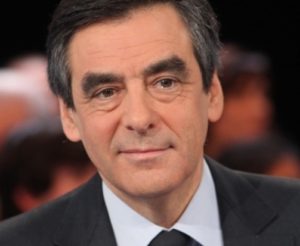
Bienvenue, Francois Fillon

Bienvenue, Francois Fillon

Fillon, several times a minister and prime minister under Sarkozy, conducted a discreet but intensive campaign for three years, using social networks rather that the traditional media.  His program is quite conservative: reduce the number of civil servants by 500,000, decrease unemployment allowances, complement the social security benefits by increasing the share of private health insurance.  He advocates a free market economy.  In foreign policy, he has a pragmatic attitude to relations with Putin, wants a strong Europe and to control the flow of migrants.  By preempting part of the program of Marine Le Pen of the far right Front National , he may be in a good position to beat her.

Fillon’s victory represented only 40 percent of the total electorate, so there is still plenty of ground to cover. Next will come the Socialist primaries.

Emmanuel Macron, former minister of the economy in the cabinet of Manuel Valls, is running as an independent.  Only 38, he is a brilliant  young man who had had a versatile career, including one year with the Rothschild investment bank.  On Dec. 9, the boisterous gathering of 16,000 supporters marked the start of the movement he is calling, “En marche,” under which he promises to modernize the labor market in order to create jobs and eliminate the old divide between right and left.

The battle has just began.

Editor’s Note: This is the opinion of Nicole Prévost Logan.

Nicole LoganAbout the author: Nicole Prévost Logan divides her time between Essex and Paris, spending summers in the former and winters in the latter. She writes a regular column for us from her Paris home where her topics will include politics, economy, social unrest — mostly in France — but also in other European countries. She also covers a variety of art exhibits and the performing arts in Europe. Logan is the author of ‘Forever on the Road: A Franco-American Family’s Thirty Years in the Foreign Service,’ an autobiography of her life as the wife of an overseas diplomat, who lived in 10 foreign countries on three continents. Her experiences during her foreign service life included being in Lebanon when civil war erupted, excavating a medieval city in Moscow and spending a week under house arrest in Guinea.

Nibbles: Turn Turkey Leftovers Into Turkey Chilli

turkey_chilliYou may be reading this column the day before Thanksgiving. If you are serving a feast for four or eight or maybe up to 20, just peruse this column. You have enough to do without reading this, but the recipe below may help you with turkey leftovers. (There is no clear segue here, but if you are hosting and see yourself in the weeds, e-mail me (leeawhite@aol.com) and we will work you through it.)
Many people make soup with the turkey carcass, although I have never loved turkey soup. To me, the flavor is gone after the gobbler has spent hours in the oven. My stepdaughter, Molly, makes a good turkey soup by roasting the bones at a high temperature in the oven and using the bones for the broth.  But I often use the leftover turkey for casseroles, enchiladas or even pad Thai.

Or chili.

This recipe calls for a pound of raw, lean ground turkey. Using it, it is the beginning of the recipe below. On the other hand, begin this recipe with the lightly sautéed vegetables After you add the broth, beans and tomatoes, add about a pound or more shredded turkey, and simmer, as the recipe explains. This recipe belongs to a friend’s daughter who adapted the recipe from Cooking Light. I doubled the recipe so it would feed more. I also changed the beans from garbanzo beans to kidney beans primarily because, if you’re on Weight Watchers, kidney beans have half the points as garbanzo beans.

Turkey Chili

Yield: Serves 8

2 tablespoons olive oil

1 (or more) pounds of lean ground turkey

3 cups chopped sweet onion, divided

2 cups chopped green bell pepper (or other sweet peppers)

4 (or more) cloves garlic, minced

2  (or more) tablespoons chili powder

4 tablespoons tomato paste

2 teaspoons cumin

2 teaspoons dried oregano

one-half teaspoon ground cinnamon

one-quarter teaspoon ground allspice

1 cup low-sodium chicken broth

2 15-ounce cans kidney beans

28-ounce can diced tomato, undrained

5 tablespoons chopped semisweet chocolate

one-half teaspoon salt

one and one-half cups (3 ounces) shredded sharp cheddar cheese

Heat a Dutch oven (like a Le Creuset pot) over medium-high heat. Add olive oil. When moderately hot, add turkey and cook for about 3 minutes, stirring to crumble. Add 2 cups onion, bell pepper and garlic; saute about 3 minutes. Stir in chili powder and next 5 ingredients (through allspice); cook 1 minute. Add broth, beans and tomatoes; bring to a boil, then cover, reduce heat and simmer 20 minutes, stirring occasionally.

Remove chili from heat and stir in chocolate and salt. Top with remaining 1 cup of onions and cheese. Stir immediately.

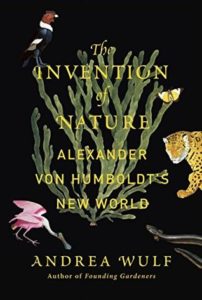
Reading Uncertainly? ‘The Invention of Nature’ by Andrea Wulf

the_invention_of_natureFor those who attended this year’s Florence Griswold Museum-sponsored Samuel Thorne Memorial Lecture, which took place on Nov. 12, this month’s book review will ring significant bells. Not entirely by coincidence, we venture, our esteemed reviewer, Felix Kloman of Lyme, selected ‘The Invention of Nature’ as his book of choice this month and its author — Andrea Wulf — was the speaker at this year’s lecture .

Who was Alexander von Humboldt, the subject of this engrossing new biography? I must admit I had only a fleeting memory of his name, but for many in the 1900s, he was acknowledged as a major icon of the previous century in science and philosophy. Humboldt was a well-born Prussian, and Wulf’s story of his life is one of an intensely curious man whose travels, meetings and writings influenced many of the key thinkers of those years.

Consider these names: Johan von Goethe, Friedrich Schiller, Simon Bolivar, Thomas Jefferson, Charles Darwin, John Muir, Henry David Thoreau, Ernest Haeckel, Joseph Banks, and George Perkins Marsh. This biography is an exultation of interconnections!

And connectivity was the theme of Humboldt’s life: “Everything seemed somehow connected – an (early) idea that would come to shape his thinking about the natural world for the rest of his life.” Nature, to him, was a “web of life and a global force … with plants and animals dependent on each other.” This “urge to understand nature, globally, as a network of forces and interrelationships” generated “ferocious activity” for his entire life.

It began with his remarkable initial expedition to South America, including a climb to the top of Chimborazo, an inactive volcano in what is now Ecuador, a search for a link to the Amazon River, then walking in Mexico and Cuba, and, finally, a visit to President Thomas Jefferson in Washington. As a note on those times, it took Humboldt and his fellow traveler three and a half days to move from Philadelphia to the capital city.

While he yearned to travel again to South America, and then to Asia, and Africa, his shortage of funds allowed him only one other extensive tour, from Prussia to Russia and its border with China. But he never lost his curiosity, even while writing his journals, publishing a later masterpiece of his thinking, Cosmos, and forever trading correspondence and ideas with everyone he had met.

Wulf writes “comparison not discovery was his guiding theme,” and Humboldt issued an early warning of three ways in which the human species adversely affected the climate, based on his travels: deforestation, “ruthless irrigation,” and the “great masses of steam and gas produced in the industrial countries.” Almost two centuries later, we still have not learned …

Charles Darwin and Humboldt had frequent communication, in person and through letters. They shared, according to the author, a “flexibility perspective … telescopic and microscopic, sweepingly panoramic and down to the cellular levels, and moving in times from the distant geological past to the future economy of native populations.”

Humboldt was an outspoken critic of colonialism and slavery, but he had to be cautious as he remained under the financial support of Prussian royalty. Those years featured the turmoil of revolutions, as Europe and the Americas shifted from absolute despotisms to emerging democracies, and often back again.

Wulf’s entrancing biography is reading history through the vision of one extraordinary man who saw “harmony in diversity.” Would that we had listened more closely to his words …

Editor’s Note: ‘The Invention of Nature’ by Andrea Wulf is published by Alfred A. Knopf, New York 2015

Felix Kloman_headshot_2005_284x331-150x150About the Author: Felix Kloman is a sailor, rower, husband, father, grandfather, retired management consultant and, above all, a curious reader and writer. He’s explored how we as human beings and organizations respond to ever-present uncertainty in two books, ‘Mumpsimus Revisited’ (2005) and ‘The Fantods of Risk’ (2008). A 20-year resident of Lyme, he now writes book reviews, mostly of non-fiction that explores our minds, our behavior, our politics and our history. But he does throw in a novel here and there. For more than 50 years, he’s put together the 17 syllables that comprise haiku, the traditional Japanese poetry, and now serves as the self-appointed “poet laureate” of Ashlawn Farms Coffee. His wife, Ann, is also a writer, but of mystery novels, all of which begin in a bubbling village in midcoast Maine, strangely reminiscent of the town she and her husband visit every summer.
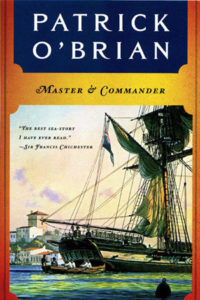
Reading Uncertainly? ‘Master and Commander’ by Patrick O’Brian

mastercommanderWhy is it that a fourth re-reading of this magnificent story of the Napoleonic Wars seems even more delicious than the first time around? There are 21 novels in this series and I’ve embarked on another voyage. “I give you joy,” as these sailors say to each other.
From listening to Locatelli’s C major quartet, that almost causes a duel, to the concluding words of acquittal in a naval court martial, we live life at sea with Jack Aubrey, the naval commander, but not quite yet a “Captain,” and the polymath physician and spy Stephen Maturin, an Irish-Catalan.

O’Brian uses a rich language that drives you to the dictionary. Ships and boats: frigate, ship-of-the line, sloop, long-boat, cutter, gig, jolly-boat, felucca, tartan, xebec, poluccas houario, barca-longa, bean-cod, cat, and herring-bus. Birds: upupa, epop (or hoopoe), ibis, mareotic grallatore. A flower: dianthus perfragans. An ant: tapinoma erraticum. Of an acquaintance, Maturin says: “I would not call him a gremial friend” (from the Latin, not a “close” friend).

And humor: a Frenchman sailed slowly “no doubt for fear of tripping over the lines of longitude.” Jack Aubrey trying to sound literate: “Alas, poor Borwick.” His sloop “the Sophie reeked of grilled sardines and fresh paint.” The sun shone “with idiot good humor.”

Or the two page delightful description of Maturin watching the mating of two praying mantises, the female then devouring the head and thorax of the male as the male ‘copulated on!” His conclusion: “You do not need a head, nor even a heart, to be all a female can require.”

On the word “death” in the English Articles of War, to be regularly read to the ship’s crew: “ . . . death had a fine, comminatory Leviticus ring, and the crew took a grave (my italics!) pleasure in it all. . . . “ I can hear O’Brian chuckling as he wrote that line.

Jack Aubrey is always urging speed: “There is not a minute to lose.” He repeats this counsel more than six times in this novel (and it is repeated in all the rest!)

And here is Maturin’s take on the human condition: “It seems to me that the greater mass of confusion and distress must arise from these less evident divergencies – the moral law, the civil, military, common laws, the code of honour, custom, the rules of practical life, of civility, of amorous conversation, gallantry, to say nothing of Christianity for those who practise it. All sometimes, indeed generally, at variance; none ever in an entirely harmonious relation to the rest; and a man is perpetually required to choose one rather than another perhaps (in his particular case) its contrary. It is as though our strings were each tuned according to a completely separate system – it is as though the poor ass were surrounded by four and twenty mangers.”

To which Jack Aubrey commented: “You are an antinomian.”

And Stephen Maturin replied: “I am a pragmatist.” A perfect description of the chaos two centuries later!

Finally, the author tossed a delightful tidbit my way, when Jack Aubrey said “ . . . how happy, felix, you would make me.” Yes, this Felix is basking in the delight of O’Brian’s words, looking forward to his fourth re-read of the remaining twenty novels.

Editor’s Note: ‘Master and Commander’ by Patrick O’Brian,  is published by W. W. Norton & Co., New York 1990 (first published in UK 1970.)

Felix Kloman_headshot_2005_284x331-150x150About the Author: Felix Kloman is a sailor, rower, husband, father, grandfather, retired management consultant and, above all, a curious reader and writer. He’s explored how we as human beings and organizations respond to ever-present uncertainty in two books, ‘Mumpsimus Revisited’ (2005) and ‘The Fantods of Risk’ (2008). A 20-year resident of Lyme, he now writes book reviews, mostly of non-fiction that explores our minds, our behavior, our politics and our history. But he does throw in a novel here and there. For more than 50 years, he’s put together the 17 syllables that comprise haiku, the traditional Japanese poetry, and now serves as the self-appointed “poet laureate” of Ashlawn Farms Coffee, where he may be seen on Friday mornings. His wife, Ann, is also a writer, but of mystery novels, all of which begin in a bubbling village in midcoast Maine, strangely reminiscent of the town she and her husband visit every summer.

Nibbles: Savor Seasonal Pumpkin Whoopie Pies

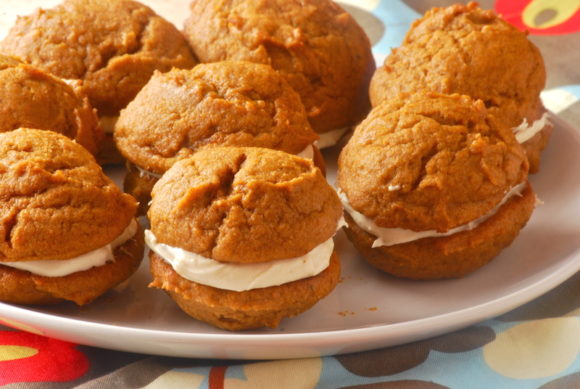
These delicious Pumpkin Whoopie Pies won't last long!

These delicious Pumpkin Whoopie Pies won’t last long!

I am not sure when chocolate began to disappear as my drug of choice or, in truth, never was. Even as a child, when given a dime for penny candy (yes, I am that old!), I chose those Mary Janes and “watermelon” slices and those wax bottles filled with juice. On the other hand, my go-to birthday cake was chocolate layer cake, filled between layers with strawberry jam, topped with crusty white chocolate icing and drizzled with dark chocolate.

Over the years, I considered chocolate an add-on. It might want one candy from a Whitman sampler but not a whole Hershey bar. I still like sweets, but favor butterscotch pudding, blondies, carrot cake and rice pudding, the last served warm with cinnamon.

Until I went to college, I had never tasted pumpkin pie, candied sweet potatoes, vanilla-scented cookies or bread pudding. Now, when I crave dessert, it is more likely to be a slice of pineapple upside down cake or Key lime pie.

As a result, I love autumn. I have in my pantry cans of pure pumpkin and the October issues of food magazines are filled with recipes for pumpkin. Here is one I have been making for years. (If you try to buy cans of pumpkin in the spring or summer, you may be out of luck, so buy a few extra this fall if you love this recipe as much as I do.)

Pennsylvania Dutch Pumpkin Whoopie Pies

Yield: 12 to 18 “pies”

4 and one-half cups flour
1 tablespoon cream of tartar
2 teaspoons baking soda
1 teaspoon baking powder
one-quarter teaspoon salt
2 tablespoons ground cinnamon
1 and one-half teaspoon ground ginger
1 and one-half teaspoon ground allspice
1 cup (2 sticks) butter, softened
1 cup flavorless vegetable oil
2 and one-third cups brown sugar
1 can real pumpkin (not pumpkin pie mix)
1 large egg
2 large egg yolks
1 tablespoon pure vanilla extract
one-half teaspoon fresh grated lemon zest
1 and one-third cups oats (quick- or regular-cooking)
milk or buttermilk, if needed, so the batter isn’t too thick to drop onto cookie sheet

Preheat oven to 350 degrees and spray several cookie sheets with Pam (or use butter).

Thoroughly stir together flour, cream of tartar, baking soda and powder, salt, cinnamon, ginger and allspice in a large bowl.

In second bowl, with a mixer, beat butter, oil and brown sugar until smooth and fluffy. Beat in pumpkin, egg, yolks, vanilla and lemon juice. Gradually beat in flour mixture, then add oats. If too thick, add some milk or buttermilk until it looks more like cookie batter.

Drop 2 and one-half tablespoons batter at a time onto the baking sheets, about 3 inches apart.* Using your index finger (dipped in water), turn cookies into circles about the same size. Place cooking sheets on the bottom third and top third of racks. Bake 10 to 12 minutes, reversing them at about half-time. Remove from oven and cool for around 3 minutes before put cookies on wire cooling racks.

For the filling: Cream 12 ounces cream cheese, 2 large egg whites, one-quarter pure vanilla extract, one-quarter teaspoon grated lemon zest. Gradually add confectioners’ sugar. Chill for about 15 minutes. To assemble, place one cookie, flat side down, on a platter, spread about 2 tablespoons of filling and top with flat-top of another cookie.

*If you would like smaller pies, use 1 tablespoon each of the batter