Legal News You Can Use: Protect Your Most Precious Cargo

As the seasons change and we transition from winter to spring, many of us also experience a change in our daily lives and schedules.  The days get longer, and children begin outdoor activities. As these inevitable changes occur, the need for parents to transport their children sometimes becomes more frequent.  This being the case, it is imperative for parents to be aware of and to employ proper car safety practices while transporting their children.

According to the Centers for Disease Control and Prevention (CDC), in the United States during 2014, 602 children ages 12 and younger died as occupants in motor vehicle accidents,  making car accidents one of leading causes of death for children under 12-years-old.  CDC studies also revealed that in 2014, more than 121,350 children under 12 year of age suffered injuries while occupants in cars involved in accidents.

In order to lessen these disturbing statistics, the CDC recommends the following to parents while driving with their young children:

  • Use proper car seats, booster seats and seat belts in the back seat on every trip. Which option is appropriate will depend on the child’s age, weight and height;
  • Use a rear-facing car seat for children under 2 years of age;
  • Use forward-facing car seats for children ages 2 through 5;
  • Use booster seats from age 5 until the seat belt fits properly. Seat belts should fit so that the lap belt lays across the upper thighs and the shoulder belt lays across the chest;
  • Never sit a child in front of an airbag. Children should ride in the back seat of the car, preferably in the back middle seat as that is the safest place in the car.
  • Use the proper restraint system on every trip, no matter how long;
  • Install and use car seats according to the owner’s manual or get help with installation from a certified Child Passenger Safety Technician;
  • If purchasing or using a pre-owned car seat, be sure to research the make and model to check for any recalls and if necessary contact the manufacturer to obtain an owner’s manual for proper installation and maintenance instructions.
  • Set a good example for children and always wear a seatbelt.

Aside from the important safety concerns discussed above, parents can face further consequences for failing to employ proper car safety practices with children.  Connecticut law not only requires all drivers to wear seatbelts, it also requires them to ensure that any occupant of their vehicle under 16 years of age wears a seat belt.  Connecticut law also requires children less than 6 years of age and under 60 pounds to ride in a proper safety seat.  Infants less than 1 year of age and under 20 pounds must ride in a rear-facing child seat at all times.  Drivers who fail to abide by these laws can face punishment including fines.

Apart from potential criminal liability, the failure to properly secure your child can affect their ability to recover civil damages for injuries they suffer as a result of a motor vehicle accident.  Such failures can be viewed as contributing causes of injuries and negate or decrease a civil settlement or verdict.

Injuries to children are some of the most difficult and emotional cases with which Suisman Shapiro deals.  We implore parents and guardians to educate themselves on and employ proper car safety practices for children.  Unfortunately, even when all proper safety steps are taken, accidents and injuries still occur.

If you or your child is injured in a car accident or due to the fault of another person, our law firm is here to help you.  Contact Suisman Shapiro today online or by telephone to arrange a free initial consultation with an experienced personal injury lawyer.

SPONSORED POST

About the Author: Roger Scully is an associate attorney at Suisman Shapiro in New London, CT, the largest law firm in eastern Connecticut. His practice focuses on civil and personal injury litigation and criminal defense. Attorney Scully has extensive jury trial experience. Prior to joining Suisman Shapiro, he served as Assistant District Attorney for the Norfolk County District Attorney’s Office, representing the Commonwealth of Massachusetts in a diverse range of criminal matters. To contact Roger Scully visit www.suismanshapiro.com or call 860-442-4416. Suisman Shapiro is located at 2 Union Plaza, P.O. Box 1591, New London, CT 06320.


Talking Transportation: Who Should Pay for Sound Barriers?

Sound barriers … great idea, but who should pay for them?

Building and maintaining our highways is expensive.  But here’s a quiz question:  on interstates 95 and 84, what costs a half-million dollars a mile to construct?  The answer:  sound barriers.

Why are we spending that kind of money to enshroud our interstates simply to protect the peace and quiet of its neighbors?  Didn’t they know that living that close to a highway came with the twin costs of increased noise and air pollution along with the benefits of proximity to the highways?

Do you have sympathy for people who live near airports and then complain about the jets?  Neither do I.  But the solution to highway noise is not to create a walled canyon paid for by others.

Sound barriers, in my view, are a waste of precious resources.  They don’t reduce accidents, improve safety or do anything about congestion.  And they’re a magnet for graffiti artists.  Three miles of sound barriers on both sides of an interstate would buy another M8 railcar for Metro-North, taking 100 passengers out of their cars.

Worse yet, sound barriers really just reflect the sound, not absorb it, sending the noise further afield.  But there are alternatives:

1)     Why not sound-proof the homes?  That has worked well for neighbors of big airports and would be a lot cheaper than miles of sound barriers.  Plus, insulation against sound also insulates against energy loss, saving money.

2)    Rubberized asphalt.  Let’s reduce the highway noise at its source, literally where the “rubber meets the road”.  Using the latest in rubberized asphalt some highways have seen a 12 decibel reduction in noise.  And rubberized asphalt, as its name implies, is made from old tires … about 12 million a year that would otherwise be junked.

3)    Pay for it yourself.  Create special taxing zones in noisy neighborhoods and let those home owners pay for their sound barriers.  They’re the ones who are benefiting, so shouldn’t they be the ones who pay?  And that investment will easily be recouped in increased property values.

4)    Penalize the noise makers.  Let’s crack down on truckers who “Jake brake,” downshifting noisily to slow their speed instead of using their real brakes.  And motorcyclists or those cars with busted mufflers, they too should be penalized.

5)    Go electric.  Electric cars are virtually silent.  And there are electronic ways of using noise cancellation technology that, on a large scale, can induce quiet at a lower price than building wooden barricades.

6)    Go absorbent.  Where there is room, erect earthen berms alongside the highway which will absorb the sound.  Or if you are constructing sound barriers, fill them with sound absorbing material, treating the noise like a sponge, not bouncing it off a hard, flat reflective surface.

Our interstates, especially I-95, are carrying far more traffic than they were ever planned to handle.  And there is no sign of it decreasing.  In Fairfield County the rush hour starts about 6 a.m. and runs continuously until 8 p.m. without a break.

If our state’s economy depends on these highways, we will have to live with the karmic cost of a little noise.  But if it’s too much to take, why ask others to pay for its remediation when they are the only ones benefiting from that spending?

Republished with permission of Hearst CT Media.

Jim Cameron


About the author:
 Jim Cameron is founder of The Commuter Action Group, and a member of the Darien RTM.  The opinions expressed in this column are only his own.  You can reach him at CommuterActionGroup@gmail.com

For a full collection of “Talking Transportation” columns, visit www.talkingtransportation.blogspot.com

Letter From Paris: A European in Washington

Nicole Prévost Logan

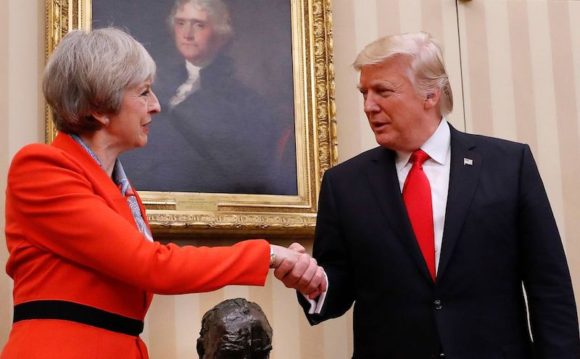
On Jan. 27,  Theresa May was the first foreign leader to visit the White House during Donald Trump’s era.  The prime minister’s red dress matched the US president’s red tie and they both seemed  determined to cheer each other for the wonderful things they were about to accomplish together.

On the eve of Brexit, it was crucial  for the British visitor to obtain US support. For Trump,  it was a chance to welcome the UK as a “privileged” partner, to stress how the latter will benefit from Brexit and become a model for Europe in freeing itself from the “Brussels consortium.”

Actually, at this point, the US is not in a position to be much help for England. It is a matter that will have to be worked out directly between the UK and the European Union (EU.)   Beyond the posturing, the British prime minister was trying to reconcile her vision of a “global England” open to the world with the protectionism policies launched by Trump.

The task for May is incredibly complex since she has made clear her intention not to sever all ties with the continent while implementing  the “hard Brexit”and also to avoid a “cliff edge” situation.  She will need all her political acumen to surmount the obstacles coming from all sides and negotiate the best deal.

British Prime Minister Theresa May meets US President Donald Trump.

The “divorce” process has not even started and already dissenting opinions are being heard, even in her own camp.  On Jan. 3, Sir Ivan Rogers, the permanent British representative to the EU,  resigned after sending warning signals, and was immediately replaced  by “euro-skeptic” Tim Barrow, former ambassador to Moscow.  On Jan. 11, the Minister of Immigration, Robert Goodwill, proposed to impose a tax of 1,000 British pounds on EU workers. The business circles protested and the government backed down.  Andrea Leadson, Minister of Agriculture,  had to reassure farmers that the hiring of seasonal labor would not come to a stop.  Philip Hammond, Chancellor of the Exchequer disagreed  with the minister of Foreign Affairs Boris Johnson and proposed a departure “a la carte” from Europe. 

On Jan. 24, the British High Court voted by eight to three to route the Brexit process through parliament.  This decision created another hurdle for the prime minister. The House of Commons passed the text overwhelmingly.  The House of Lords will be next.    

The worst enemy of the UK in the Brexit process is the timetable.  Once triggered, Article 50 of the 2007 Treaty of Lisbon will take two years to be implemented and, of course, will have to be approved by all the EU members.  After that, it will take five or possibly 10 years for Britain to be legally able to conclude free trade bilateral agreements with other countries.

On Jan. 17, May gave a major speech at Lancaster House in which she spelled out the main points of her program.  This was followed a few days later by the publication of a White Paper containing a road map.  Control of immigration is a central preoccupation for the UK government.  It is understandable,  given the fact that that, from 2015 to 2016, 650,000 immigrants entered the country  (including 284,000 coming from the EU).  Britain had opted out long ago of the Schengen Zone, which allows for free circulation of goods, people, services and capital .

Right now Britain is a member of the European Customs Union and of the European single market. * Being a member of a single market like the EU, created by the 1957 founding treaty of Rome, comes with many constraints such as the harmonization of regulations, compliance with certain standards and the required contributions to the EU budget (Britain has already  committed 40 billion euros for the period 2016-2020.)  The European Court of Justice (based in Luxembourg) enforces those regulations and this explains May’s particular dislike for that institution.

In case of the departure of Britain from the EU,  there are alternatives to its present trade arrangements such as the ones used by  Norway, Iceland, Switzerland and Lichtenstein, which are not part of the European Customs Union.  Three of them are members of the European Free Trade Association (EFTA), which puts them close to the single market. Another example is Turkey, which is not part of the EU single market, but benefits from a special free trade agreement with Europe.  After her visit to Washington, May met with President Erdogan in Ankara to discuss these matters as well as a post-Brexit trade and military partnership.

One  of the most contentious issues of the Brexit is the future of The City.  For 30 years, it has been the financial hub of activities for the huge European market of 500 million people.  By leaving the single market, The City will lose its  “European passport”  and its say over the new regulations issued by Brussels every year.

Guy Verhofstadt, called “Mr. Brexit” at the European parliament, denounced the “illusion that it is possible to leave the EU while retaining its advantages.”

Michel Barnier has been appointed by Jean Claude Yunker, president of the European Commission, to head the negotiations with Britain.  This was a good choice.  Barnier is a man of consensus, experienced and pragmatic, according to The Telegraph.   Economist by training, he has held several posts as European Commissioner of various departments including finance, banking and defense. Interestingly, it was Barnier who supported the adhesion of Britain into Europe in 1972.

*for more on Cameron’s negotiations with the EU, which led to the June 23 referendum, see Logan’s article published by VNN on March 5, 2016.

Editor’s Note: This is the opinion of Nicole Prévost Logan.

Nicole LoganAbout the author: Nicole Prévost Logan divides her time between Essex and Paris, spending summers in the former and winters in the latter. She writes a regular column for us from her Paris home where her topics will include politics, economy, social unrest — mostly in France — but also in other European countries. She also covers a variety of art exhibits and the performing arts in Europe. Logan is the author of ‘Forever on the Road: A Franco-American Family’s Thirty Years in the Foreign Service,’ an autobiography of her life as the wife of an overseas diplomat, who lived in 10 foreign countries on three continents. Her experiences during her foreign service life included being in Lebanon when civil war erupted, excavating a medieval city in Moscow and spending a week under house arrest in Guinea.

A la Carte: Craving a Crunch? Enjoy These Cashew Butterscotch Bars

Cashew Butterscotch Bars

It has been a while since we had a one-two-almost-three punch snowstorm. On the Wednesday before the storm, I had a meeting at 6 p.m. and then another at 6:30 (I was about 15 minutes late for the second one). In the first, my condo board meeting, we talked about the fact that snow was on its way.

We tried to figure out whether it was really going to be a tough one, or not. I felt it might be a real one, and I was prepared. Plenty of food for the cats (because, after all, they could not care less as long as they had a few warm velour throws, a clean litter box and cans of Fancy Feast to go with their dry food).

I do have a freezer full of people food, but that freezer is in the garage, a good walk easy when the weather is good but possibly not so if it really does snow for hours and hours. As it turned out, it snowed for around 10 hours and I couldn‘t get out of my condo for another half a day (except to shovel a path from my back door to the bird feeders).

But I had decided I wanted to cook.

It is actually my therapy, whether the weather is too hot or too cold, or too snowy. I had gotten chicken thighs from the freezer the day before and bought a big chunk of beef chuck and some ground meat for chili. For two of the recipes I used my slow cooker. I bought my first just  after my first marriage dissolved; my new one I have had for about eight years; I love my slow cooker although I usually sear the meat that will go into the crock pot these days.

The chicken thigh recipe was more work than it was worth  The pot roast was amazing (I added almost everything except the kitchen sink including half a can of Campbell’s tomato bisque from the fridge.) The chili, for which I used a package of Wick Fowler’s 2-Alarm Fire Chili, was yummy.

But a few days later, I wanted something sweet. Not chocolate, though. I found this recipe I had saved from the New York Times years ago. Boy, are these addictive.

Cashew Butterscotch Bars

From the food section of The New York Times, sometime within the past ten or so years

Yield: 36 bars*

Ingredients:

Two sticks plus 5 and one-half tablespoons unsalted butter, softened, plus butter for greasing pan
Three-quarter cup plus 2 tablespoons (packed) light-brown sugar
1 and three-quarters teaspoons kosher salt
2 and one-half cups all-purpose flour
10 ounces butterscotch chips
One-half cup plus 2 tablespoon light corn syrup
1 tablespoon and 2 and one-half teaspoons water
2 one-half cups salted cashew pieces

1. Center a rack in the oven and preheat the oven to 350 degrees. Butter a 13-by-18-inch jelly roll pan, including sides.

2. To make the crust: in a mixer with a paddle or in a bowl with a rubber spatula, best ½ (one-half) plus 2 tablespoons butter and all the brown sugar together until smooth. Stir salt into flour, then add flour to butter and sugar mixture. Mix until dough is well combined but still crumbly; if dough is mixed until a ball forms, crust will be tough.

3. Pat the dough evenly along bottom of buttered pan, taking care not to pack the dough down. Place pan in oven and bake 5 minutes. With a fork, prick dough deeply all over. Return pan to oven and bake until sough is lightly browned, dry and no longer soft to the touch, about 7 minutes. Transfer to a cooling rack; do not turn off the oven.

4. To make butterscotch topping: In a large saucepan, combine remaining 3 ½ (three and one-half) tablespoons, butterscotch chips, corn syrup and 1 tablespoon plus 2 ½ (two and one-half) teaspoons water. Place over medium heat and cook, stirring constantly, until butter and butterscotch chips are melted, about 5 minutes. Pour topping over crust, using a spatula to spread, evenly all the way to the corners. Sprinkle cashew pieces on top, pressing down light.

5. Bake until topping is bubbly and cashews are lightly browned, 11 to 13 minutes. Transfer to a rack and cool completely before cutting into two-by-three-inch bars.

Letter From Paris: How France Copes With Ongoing Terrorism Threat

Nicole Prévost Logan

Two years after the “Je suis Charlie” massacre, how does it feel to be in France today with the threat of terrorism?  

Numbers seem to speak for themselves: France, which is the most visited European country, saw a decrease last year of almost 50 percent in the number of tourists visiting – from 84 million to 42 million – while website commentaries lament empty hotels, restaurants and museums.

This observation is not quite accurate and, besides, does not take into account the complexity of the situation. In the first place, France has not become a dangerous war zone and people here still enjoy themselves: restaurants are full at lunch time, the new Paris Philarmonie orchestra is booked solid for months and there are more fantastic art exhibits – such as the Shchukin collection – than ever.

For the French, the threat of terrorism is not measured primarily by the dollar amount lost through a decrease in mass tourism (which is not the country’s vocation in any case.) There are many other serious considerations relating to the effects of terrorism on French politics and society, or the measures taken by authorities to protect the citizens.    

The cover of ‘Charlie Hebdo’ two years after the horrific attack on the magazine’s office in Paris.

In recent years, the French have been deeply marked by terrorist attacks with 237 people killed between January 2015 and July 2016. These range tragically from the murder of cartoonists; the bombing of the Bataclan night club, several bistros and restaurants; a truck plowing through the crowd on the Promenade des Anglais in Nice on Bastille Day; to the gory assassination of 85-year-old  father Jacques Hamel, whose throat was slit on the altar of his small Normandie church in front of two elderly nuns.

The impact on France’s national consciousness of the November 2015 terrorist attacks was enormous. As the two chambers of the parliament met in a joint session in Versailles, every single deputy stood up and sang the national anthem, La Marseillaise, a solemn event not seen since 1918.

François Hollande has been literally traumatized by the terrorist bombings. The president was immediately on the scenes of the attacks, even before the areas were made secure. For him, the defense against terrorism was a brutal awakening and a priority. The political price he had to pay was very high.

Under the intense pressure of the moment, he proposed a law on the déchéance de la nationalité (loss of nationality) for terrorists. This proposal caused havoc among the leftist segment of the French population. The president never recovered politically. Recently, when he announced his decision not to run again for another five years, Hollande declared, “I was wrong to make that proposal”.

The terrorist threat has become part of French people’s daily life. Alain Bauer, a professor of criminology, recently published a book titled, “How to Live in the Terrorist Era,” in which he gives practical advice on what to do in case of attack. Defense against terrorism is a major topic for the candidates in the upcoming presidential elections. .

France has come a long way since the affaire Merah in March 2012. The young Mohammed Merah had appeared all smiles on TV screens after killing seven civilians and military in the Toulouse area. At first believed to have acted as a “lone wolf,” he  turned out to be part of a whole network of siblings, relatives and friends. During the past five years, the French authorities – Intelligence, police,  judiciary and military both inside France and abroad – have made spectacular efforts to adjust to the terrorist threat, which is changing its modus operandi almost daily. 

Today the police wear bulletproof vests, carry attack weapons, and not only have the right, but also the duty, to intervene in the case of a terrorist threat.  The Direction Générale de Securiéte Interieure or DGSI (equivalent to the FBI) has stepped up its action, thwarting  90 percent of bombing attempts every year. In the past few months, it has dismantled sleeping terrorist cells in Marseille and Strasbourg.

France is the European country with the largest Moslem population. The latter is overwhelmingly considered to have nothing to do with radical Islam.  However, subjects which used to be taboo before, such as the relationship between extremism and religion, are now openly debated. Recent books also contribute to the change in thinking.

Gilles Kepel, an authority on the Arab world and Islam, demonstrates in his book, La Fracture, (‘The Divide’) that the only way to understand extreme Islamists is to analyze in depth their ideology. One should make an effort to understand  their strategy, which is to divide society, by teaching from a very young age, hatred against non-believers and the West, through brainwashing and conversion of an increasing number of people in both mosques and also in prisons. Keppel writes, “Prisons have become the ENA (Ecole Nationale d’Administration or French elite school ) for Jihadists.” 

In the fall, journalist David Thomson  published “Les Revenants” (those who returned) about the young men – and women – who joined ISIS or Islamist State in 2012 at the outset of the Syrian civil war. They would announce their plans openly on You Tube  and traveled freely through Turkey toward their final destination of Rakka. In 2013 -14 their number grew exponentially. With the loss of territory in The Levant , ISIS has changed its strategy and many of the “revenants” have gone underground and become “Jihadists of the keyboard,” to use Thomson’s expression.

Is it the end of the tunnel ? Probably not and the threat remains, the experts concur. We can be thankful, however, that the Intelligence services and police have become more successful in cracking down on radical Islam.

Editor’s Note: This is the opinion of Nicole Prévost Logan.

Nicole LoganAbout the author: Nicole Prévost Logan divides her time between Essex and Paris, spending summers in the former and winters in the latter. She writes a regular column for us from her Paris home where her topics will include politics, economy, social unrest — mostly in France — but also in other European countries. She also covers a variety of art exhibits and the performing arts in Europe. Logan is the author of ‘Forever on the Road: A Franco-American Family’s Thirty Years in the Foreign Service,’ an autobiography of her life as the wife of an overseas diplomat, who lived in 10 foreign countries on three continents. Her experiences during her foreign service life included being in Lebanon when civil war erupted, excavating a medieval city in Moscow and spending a week under house arrest in Guinea.