
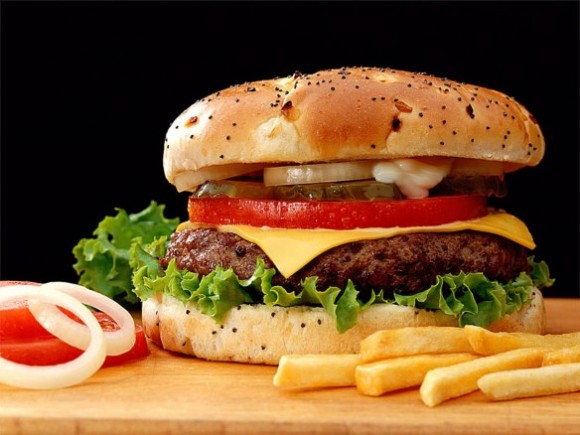
Who can resist a tasty burger on the fabulous Fourth?
I am working on the assumption that you will be firing up the grill tomorrow, July 4, for a gorgeous, dry and warm Fourth of July party at your house. And that you will be serving hamburgers.
If your Fourth is like mine, things have changed since the days when I was a child. In truth, my parents did not have a grill. My aunt and uncle did have a grill. They kept kosher at their home and one Fourth party they didn’t realize that the kosher hot dogs were covered with plastic. Those hot dogs didn’t make it to the plates. Later on, as a young mother and wife, we grilled burgers and hot dogs. I’m not sure we had a lot of sides and, since I didn’t really learn to cook until I was in my late twenties, I probably bought potato and macaroni salad.
Once grilling became so popular, we grilled lots of things, from fish and chicken to stone fruit and pineapples, which we served with homemade ice cream. Today, some people are nervous about rare burgers and nitrite-filled hotdogs. Worse still, some of my friends are vegetarians and some of their children are, too. One or two are vegans. So this column is about two things—a perfect hamburger and a luscious grilled eggplant. For me, I’ll be serving both at my next barbecue.
How to Cook a Great Burger
Yield: 4 hamburgers
1 one-half pounds excellent ground chuck *
Sea salt or kosher salt to taste
6 toasted rolls (preferably fresh hard rolls)
1. Turn grill to hot and close the lid. If you are using a charcoal grill, add charcoal, light them with a chimney stuffed with newspapers and light the charcoal. Charcoal should be gray before you begin the burgers.
2. Cut the ground chuck into six pieces and lightly turn the pieces into balls. Again, lightly, pat them into patties.
3. When grills are hot, open lids and place burgers onto the grill. Do not use a spatula to push down on the burgers and do not flip them until you can turn them without losing half the patties on the grill. Flip the burgers only once. Sprinkle with the flipped burgers, to taste. (If you are adding cheese, add after you have flipped the burgers.) If you like your burgers rare or medium rare, this whole operation will take no more than four minutes on the first side, maybe one on the second.)
4. Place hamburgers on toasted rolls and serve immediately. (This is a time when you don’t want to let the meat rest. I love my burgers when the juice makes the bottom of the roll a bit wet.)
Coal-Roasted Eggplants
From “Into the Fire” by Melissa Hamilton and Christopher Hersheimer (Bon Appetit, July 2013)
Yield: 4 servings
Prepare a hardwood-charcoal fire in a grill. Let coals cool to medium heat (coals should be covered with ash and glowing red with no black remaining).
Place two small eggplants (about 1 pound total) directly on coals and cook, turning occasionally, until skins are blackened and flesh has collapsed, 10 to 15 minutes. (Alternatively grill on the grate of a gas or charcoal grill over medium-high heat, turning occasionally, 15 to 20 minutes.) Transfer to a rimmed baking sheet and let cool slightly.
Carefully remove skins from eggplants, leaving stem intact. Place eggplants on a wire rack set inside the same rimmed baking sheet and let stand 30 minutes to allow excess water to drain. Just before servings split lengthwise and serve with the best extra-virgin olive oil and sprinkle coarse salt for a simple side. Or, since space is at a premium, buy a copy of the new Bon Appetit and make one of three sauces: Yogurt and Sumac Sauce, Smoky Tomato Sauce or Lime-Mint Sauce (or, for that matter, a good marinara sauce).
 We are so pleased to welcome back our dear friend, neighbor and food writer extraordinaire Lee White. Today, she teases our palates with a polenta served at Simsbury’s Metro Bis and attributed to cookbook writer, Kelsey Banfield. Sorry we can’t write much more about it now … must go and get cooking!