Letter From Paris: A European in Washington

Nicole Prévost Logan

On Jan. 27,  Theresa May was the first foreign leader to visit the White House during Donald Trump’s era.  The prime minister’s red dress matched the US president’s red tie and they both seemed  determined to cheer each other for the wonderful things they were about to accomplish together.

On the eve of Brexit, it was crucial  for the British visitor to obtain US support. For Trump,  it was a chance to welcome the UK as a “privileged” partner, to stress how the latter will benefit from Brexit and become a model for Europe in freeing itself from the “Brussels consortium.”

Actually, at this point, the US is not in a position to be much help for England. It is a matter that will have to be worked out directly between the UK and the European Union (EU.)   Beyond the posturing, the British prime minister was trying to reconcile her vision of a “global England” open to the world with the protectionism policies launched by Trump.

The task for May is incredibly complex since she has made clear her intention not to sever all ties with the continent while implementing  the “hard Brexit”and also to avoid a “cliff edge” situation.  She will need all her political acumen to surmount the obstacles coming from all sides and negotiate the best deal.
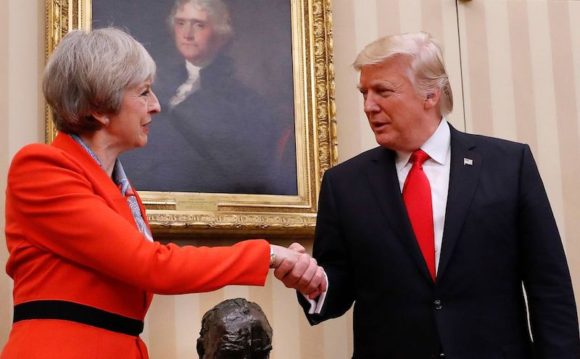
British Prime Minister Theresa May meets US President Donald Trump.

The “divorce” process has not even started and already dissenting opinions are being heard, even in her own camp.  On Jan. 3, Sir Ivan Rogers, the permanent British representative to the EU,  resigned after sending warning signals, and was immediately replaced  by “euro-skeptic” Tim Barrow, former ambassador to Moscow.  On Jan. 11, the Minister of Immigration, Robert Goodwill, proposed to impose a tax of 1,000 British pounds on EU workers. The business circles protested and the government backed down.  Andrea Leadson, Minister of Agriculture,  had to reassure farmers that the hiring of seasonal labor would not come to a stop.  Philip Hammond, Chancellor of the Exchequer disagreed  with the minister of Foreign Affairs Boris Johnson and proposed a departure “a la carte” from Europe. 

On Jan. 24, the British High Court voted by eight to three to route the Brexit process through parliament.  This decision created another hurdle for the prime minister. The House of Commons passed the text overwhelmingly.  The House of Lords will be next.    

The worst enemy of the UK in the Brexit process is the timetable.  Once triggered, Article 50 of the 2007 Treaty of Lisbon will take two years to be implemented and, of course, will have to be approved by all the EU members.  After that, it will take five or possibly 10 years for Britain to be legally able to conclude free trade bilateral agreements with other countries.

On Jan. 17, May gave a major speech at Lancaster House in which she spelled out the main points of her program.  This was followed a few days later by the publication of a White Paper containing a road map.  Control of immigration is a central preoccupation for the UK government.  It is understandable,  given the fact that that, from 2015 to 2016, 650,000 immigrants entered the country  (including 284,000 coming from the EU).  Britain had opted out long ago of the Schengen Zone, which allows for free circulation of goods, people, services and capital .

Right now Britain is a member of the European Customs Union and of the European single market. * Being a member of a single market like the EU, created by the 1957 founding treaty of Rome, comes with many constraints such as the harmonization of regulations, compliance with certain standards and the required contributions to the EU budget (Britain has already  committed 40 billion euros for the period 2016-2020.)  The European Court of Justice (based in Luxembourg) enforces those regulations and this explains May’s particular dislike for that institution.

In case of the departure of Britain from the EU,  there are alternatives to its present trade arrangements such as the ones used by  Norway, Iceland, Switzerland and Lichtenstein, which are not part of the European Customs Union.  Three of them are members of the European Free Trade Association (EFTA), which puts them close to the single market. Another example is Turkey, which is not part of the EU single market, but benefits from a special free trade agreement with Europe.  After her visit to Washington, May met with President Erdogan in Ankara to discuss these matters as well as a post-Brexit trade and military partnership.

One  of the most contentious issues of the Brexit is the future of The City.  For 30 years, it has been the financial hub of activities for the huge European market of 500 million people.  By leaving the single market, The City will lose its  “European passport”  and its say over the new regulations issued by Brussels every year.

Guy Verhofstadt, called “Mr. Brexit” at the European parliament, denounced the “illusion that it is possible to leave the EU while retaining its advantages.”

Michel Barnier has been appointed by Jean Claude Yunker, president of the European Commission, to head the negotiations with Britain.  This was a good choice.  Barnier is a man of consensus, experienced and pragmatic, according to The Telegraph.   Economist by training, he has held several posts as European Commissioner of various departments including finance, banking and defense. Interestingly, it was Barnier who supported the adhesion of Britain into Europe in 1972.

*for more on Cameron’s negotiations with the EU, which led to the June 23 referendum, see Logan’s article published by VNN on March 5, 2016.

Editor’s Note: This is the opinion of Nicole Prévost Logan.

Nicole LoganAbout the author: Nicole Prévost Logan divides her time between Essex and Paris, spending summers in the former and winters in the latter. She writes a regular column for us from her Paris home where her topics will include politics, economy, social unrest — mostly in France — but also in other European countries. She also covers a variety of art exhibits and the performing arts in Europe. Logan is the author of ‘Forever on the Road: A Franco-American Family’s Thirty Years in the Foreign Service,’ an autobiography of her life as the wife of an overseas diplomat, who lived in 10 foreign countries on three continents. Her experiences during her foreign service life included being in Lebanon when civil war erupted, excavating a medieval city in Moscow and spending a week under house arrest in Guinea.
Letter From Paris: How France Copes With Ongoing Terrorism Threat

Nicole Prévost Logan

Two years after the “Je suis Charlie” massacre, how does it feel to be in France today with the threat of terrorism?  

Numbers seem to speak for themselves: France, which is the most visited European country, saw a decrease last year of almost 50 percent in the number of tourists visiting – from 84 million to 42 million – while website commentaries lament empty hotels, restaurants and museums.

This observation is not quite accurate and, besides, does not take into account the complexity of the situation. In the first place, France has not become a dangerous war zone and people here still enjoy themselves: restaurants are full at lunch time, the new Paris Philarmonie orchestra is booked solid for months and there are more fantastic art exhibits – such as the Shchukin collection – than ever.

For the French, the threat of terrorism is not measured primarily by the dollar amount lost through a decrease in mass tourism (which is not the country’s vocation in any case.) There are many other serious considerations relating to the effects of terrorism on French politics and society, or the measures taken by authorities to protect the citizens.    

The cover of ‘Charlie Hebdo’ two years after the horrific attack on the magazine’s office in Paris.

In recent years, the French have been deeply marked by terrorist attacks with 237 people killed between January 2015 and July 2016. These range tragically from the murder of cartoonists; the bombing of the Bataclan night club, several bistros and restaurants; a truck plowing through the crowd on the Promenade des Anglais in Nice on Bastille Day; to the gory assassination of 85-year-old  father Jacques Hamel, whose throat was slit on the altar of his small Normandie church in front of two elderly nuns.

The impact on France’s national consciousness of the November 2015 terrorist attacks was enormous. As the two chambers of the parliament met in a joint session in Versailles, every single deputy stood up and sang the national anthem, La Marseillaise, a solemn event not seen since 1918.

François Hollande has been literally traumatized by the terrorist bombings. The president was immediately on the scenes of the attacks, even before the areas were made secure. For him, the defense against terrorism was a brutal awakening and a priority. The political price he had to pay was very high.

Under the intense pressure of the moment, he proposed a law on the déchéance de la nationalité (loss of nationality) for terrorists. This proposal caused havoc among the leftist segment of the French population. The president never recovered politically. Recently, when he announced his decision not to run again for another five years, Hollande declared, “I was wrong to make that proposal”.

The terrorist threat has become part of French people’s daily life. Alain Bauer, a professor of criminology, recently published a book titled, “How to Live in the Terrorist Era,” in which he gives practical advice on what to do in case of attack. Defense against terrorism is a major topic for the candidates in the upcoming presidential elections. .

France has come a long way since the affaire Merah in March 2012. The young Mohammed Merah had appeared all smiles on TV screens after killing seven civilians and military in the Toulouse area. At first believed to have acted as a “lone wolf,” he  turned out to be part of a whole network of siblings, relatives and friends. During the past five years, the French authorities – Intelligence, police,  judiciary and military both inside France and abroad – have made spectacular efforts to adjust to the terrorist threat, which is changing its modus operandi almost daily. 

Today the police wear bulletproof vests, carry attack weapons, and not only have the right, but also the duty, to intervene in the case of a terrorist threat.  The Direction Générale de Securiéte Interieure or DGSI (equivalent to the FBI) has stepped up its action, thwarting  90 percent of bombing attempts every year. In the past few months, it has dismantled sleeping terrorist cells in Marseille and Strasbourg.

France is the European country with the largest Moslem population. The latter is overwhelmingly considered to have nothing to do with radical Islam.  However, subjects which used to be taboo before, such as the relationship between extremism and religion, are now openly debated. Recent books also contribute to the change in thinking.

Gilles Kepel, an authority on the Arab world and Islam, demonstrates in his book, La Fracture, (‘The Divide’) that the only way to understand extreme Islamists is to analyze in depth their ideology. One should make an effort to understand  their strategy, which is to divide society, by teaching from a very young age, hatred against non-believers and the West, through brainwashing and conversion of an increasing number of people in both mosques and also in prisons. Keppel writes, “Prisons have become the ENA (Ecole Nationale d’Administration or French elite school ) for Jihadists.” 

In the fall, journalist David Thomson  published “Les Revenants” (those who returned) about the young men – and women – who joined ISIS or Islamist State in 2012 at the outset of the Syrian civil war. They would announce their plans openly on You Tube  and traveled freely through Turkey toward their final destination of Rakka. In 2013 -14 their number grew exponentially. With the loss of territory in The Levant , ISIS has changed its strategy and many of the “revenants” have gone underground and become “Jihadists of the keyboard,” to use Thomson’s expression.

Is it the end of the tunnel ? Probably not and the threat remains, the experts concur. We can be thankful, however, that the Intelligence services and police have become more successful in cracking down on radical Islam.

Editor’s Note: This is the opinion of Nicole Prévost Logan.

Nicole LoganAbout the author: Nicole Prévost Logan divides her time between Essex and Paris, spending summers in the former and winters in the latter. She writes a regular column for us from her Paris home where her topics will include politics, economy, social unrest — mostly in France — but also in other European countries. She also covers a variety of art exhibits and the performing arts in Europe. Logan is the author of ‘Forever on the Road: A Franco-American Family’s Thirty Years in the Foreign Service,’ an autobiography of her life as the wife of an overseas diplomat, who lived in 10 foreign countries on three continents. Her experiences during her foreign service life included being in Lebanon when civil war erupted, excavating a medieval city in Moscow and spending a week under house arrest in Guinea.

Letter From Paris: Extraordinary ‘Shchukin Collection’ Currently on View in Paris Attracts Massive Crowds

Nicole Prévost Logan

It is the first time ever that the masterpieces of the Russian art collector Sergei Ivanovich Shchukin have traveled abroad as a collection.  Until now only separate works have been seen in the West.  In the 1979 “Paris-Moscow” major retrospective at the Pompidou Center – a huge exhibition from Soviet state museums –  there was no mention anywhere of the origin of the art works.

It was not until  2010 at the “Matisse Malevich” exhibit held at the Hermitage Amsterdam that the French canvasses were identified as follows: “Origin: Museum of Modern  Western Art, formerly from the collection of Sergei Shchukin.”  So, it is a first to see more than half of the entire collection in Paris today.  Almost unnecessary to say that the astronomical insurance cost covering such important objects could only be afforded by Bernard Arnault, the 14th richest man in the world and CEO of LVMC (Louis Vuitton and Moët and Chandon).*

The Fondation Louis Art Museum in the Bois de Boulogne in Paris where the Shchukin exhibition is currently on display.

The thrill of seeing for the first time works from well-known artists – Monet, Derain, Gauguin, Cezanne, Matisse, Picasso and others – explains why the exhibit is attracting such huge crowds, happy to be in familiar territory.  The well-organized flow of people meanders through the Frank Gehry’s whimsical structure of glass panels seemingly billowing in the wind.  At each of the four levels, one catches spectacular vistas of the Eiffel Tower and Paris with its cluster of skyscrapers in the Defense business district or the vast wooded expanse of the Bois de Boulogne.

The wealthy textile merchant Shchukin was – with his friend and rival Ivan Morozov – the most illustrious Russian art collector at the turn of the 20th century.  He went into exile in France after the 1917 revolution and died there in 1936.  His collection was nationalized  and later divided between the Pushkin museum of Fine Art in Moscow and the Hermitage in St Petersburg, and then vanished into Siberian storage.  During the Cold War, the works were returned to Moscow, but remained in boxes.  By the 1960s, they gradually reappeared.

Shchukin was an avid and methodical collector.  Following the example of his older brothers (in a family of 10), he started collecting in the 1880s.  He acquired  paintings from the leading art merchants in Paris, such as Ambroise Vollard, Durand Rueil or the Swiss  Daniel-Henry Kahnweiler.  He had an exceptional ability to detect talent.  For instance, by including the constructivist Montagne Sainte-Victoire vue des Lauves, 1905, he revealed how well he understood the importance of Cezanne (26 paintings) as the spiritual father of modern art.

The organizers of the exhibit reproduced the way the canvasses were hung in Shchukin’s Moscow residence in a touhe touche fashion, that is touching each other all the way to the ceiling.

‘Pink Studio’ by Henri Matisse, 1911.

He had a special relationship with Henri Matisse and became his sponsor, commissioning  many of his 57 paintings, among them La Danse, the largest (8’6″x 12’10”) and most beautiful version of which is today on view at the Hermitage.  The painting had caused a scandal at the Salon d’Automne of 1910.  The Desserte dominates one of the rooms at the Vuitton exhibit with its decorative floral shapes and fruits scattered on a rich red background of a table dropping vertically and merging with the wall. 

‘Peasants picking apples’ by Natalian Goncharova, 1911.

His acquisition of Picasso’s works (54 canvasses) is particularly interesting.  At first  he was repelled by them, particularly by the cubist period.  Stephane Guegan, French art critic and curator at Orsay, wrote, “Shchukin compared the analytic cubism of Picasso to buckets of crushed glass.”  But gradually, he grew to appreciate the brutal forms,  such as Femme tenant an eventail (woman holding a fan) 1907.  He shared with Gertrude Stein the attraction for the preparatory studies to the seminal Demoiselles d’Avignon, 1907 .

‘Woman with a fan’ by Pablo Picasso, 1908.

Shchukin was eager to show his works and educate the public.  He turned his residence into a museum that was open several days a week.  Among the visitors were the members of the Russian avant garde. They were  stunned by what they saw.  In less than 10 years not only the talented young Russian artists assimilated Western  art but were able to grow from it and create suprematism, neo-primitivism, cubo-futurism, etc. 

The Vuitton exhibit offers a sampling of the works by the extraordinary generation of Russian artists on the eve of World War I : Casimir Malevich, Larionov, Tatlin, Klioune, Rodchenko and the acclaimed female artists: Goncharova, Popova, Rozanova, Exter, Popova, or Udaltsova. 

Shchukin heirs did not try to receive financial compensation for the art taken away by the Soviet government.   All they wanted was to restore their grandfather’s memory,  the recognition for his genius and avoid breaking up the collection among different owners. 

One century later they may have fulfilled their wish. 

Editor’s Notes:
i)   This is the opinion of Nicole Prévost Logan.

ii) *See Nicole Logan’s previous article published  on ValleyNewsNow.com, Jan. 22, 2016.
iii) ‘Icons of Modern Art – The Shchukin Collection’ is on display at the Fondation Louis Vuitton, which is housed in a Frank Gehry building in the middle of the Bois de Boulogne in Paris, France through Feb. 20, 2017.

Nicole LoganAbout the author: Nicole Prévost Logan divides her time between Essex and Paris, spending summers in the former and winters in the latter. She writes a regular column for us from her Paris home where her topics will include politics, economy, social unrest — mostly in France — but also in other European countries. She also covers a variety of art exhibits and the performing arts in Europe. Logan is the author of ‘Forever on the Road: A Franco-American Family’s Thirty Years in the Foreign Service,’ an autobiography of her life as the wife of an overseas diplomat, who lived in 10 foreign countries on three continents. Her experiences during her foreign service life included being in Lebanon when civil war erupted, excavating a medieval city in Moscow and spending a week under house arrest in Guinea.

Letter From Paris: A Transition Like No Other … And a French Take on Trump

Nicole Prévost Logan

We Americans are always interested in knowing what the world is thinking of us.  From my listening post in Paris, I can say that for months the Europeans have followed the US presidential elections with fascination.

With only a few days left until Jan. 20, everyone here is watching the transition between a cerebral Democrat president and a “sanguine, non- principled” Republican president-elect, to quote professor Jean Louis Bourlanges during the popular Sunday morning radio talk show Esprit Public. The four participants in the discussion – all representative of the French intellectual elite and well-versed in American affairs – describe what is happening as totally unprecedented.

President Obama is cramming his last days in office with long interviews, articles in magazines, laying out policies to regulate the environment, drilling of oil, or family planning.  Furthermore he just made two important foreign policy decisions.

On Dec. 23, the US abstained in the UN Security Council vote on the 2334 resolution instructing Israel to stop any further settlements on the occupied West Bank and in East Jerusalem.  This represents a striking change from President Obama’s position during his eight-year mandate, especially when, on Sept. 15, he approved the largest ever military assistance package of 38 billion dollars and committed the US for the unusually long period of 10 years.

The reaction here was, why now?  Why so late?  French analysts suggest that Obama wanted to get even with Prime Minister Benjamin Netanyahu for his repeated snubbing.

For instance, on both official visits of the American president to Israel, “by coincidence,” the Israeli government announced the building of more settlements.  But the real slap in the face took place in March 2015 when the Israeli prime minister gave a speech to the joint session of the US Congress, short-circuiting the White House.  The abstention at the Security Council  might be a way to express remorse for the failure to solve the Israeli-Palestinian conflict and an effort to set a garde-fou or safeguard for the future.

On Dec. 30,  President Obama announced the expulsion of 35 Russian “diplomats” for interfering in the US elections by hacking the headquarters of the Democratic National Committee.  His outrage at a foreign power for influencing a democratic process was such that he had to resort to a tool reminiscent of the Cold War.

President-Elect Donald Trump.

As to Donald Trump, the French are literally baffled by his behavior.

He is making a point of dissociating himself from Washington while anticipating his role as president in making political and economic decisions by tweets.  “Trump, Tweeter in Chief” writes Sylvie Kauffmann, in Le Monde.  She adds, “When you have room for only 140 characters, you have to be brief and forget nuances.”  Tweeting is apparently catching on as a form of communication.

Thierry Pech, CEO of think-tank Terra Nova, made the Esprit Public live audience laugh when he described former Mexican president Vicente Fox’s reaction to one of Trump’s announcements.  He sent his own tweet saying  “your f—ing wall, we are not going to pay for it.” Former French ambassador to the United States, François Bujon de l’Estang, commented that “carrying out diplomacy by tweets is like an oxymoron.”  He added, “tweets are the degré zéro or lowest level of diplomacy.”

All eyes are turned toward the US right now.  Europe, like the rest of the world, is bracing itself to see how the key players of the planet are going to manage world affairs, since the rules of the game  have changed.  Traditional diplomacy is now replaced by tweets.  Social networks are turning out to be more effective than propaganda in shaping the public opinion and hacking is widely used as a political tool.

Editor’s Note: This is the opinion of Nicole Prévost Logan.

Nicole LoganAbout the author: Nicole Prévost Logan divides her time between Essex and Paris, spending summers in the former and winters in the latter. She writes a regular column for us from her Paris home where her topics will include politics, economy, social unrest — mostly in France — but also in other European countries. She also covers a variety of art exhibits and the performing arts in Europe. Logan is the author of ‘Forever on the Road: A Franco-American Family’s Thirty Years in the Foreign Service,’ an autobiography of her life as the wife of an overseas diplomat, who lived in 10 foreign countries on three continents. Her experiences during her foreign service life included being in Lebanon when civil war erupted, excavating a medieval city in Moscow and spending a week under house arrest in Guinea.

Letter From Paris: Like UK’s Cameron, Italian PM Matteo Renzi Gambles His Future on a Referendum … and Loses

Nicole Prévost Logan

On Dec. 4, 2016, 60 percent of Italians responded “No” to the referendum question on constitutional reforms posed by Prime Minister Matteo Renzi. His aim was to modify the electoral laws, thus reducing the role of both the Senate and regions, and thereby enhancing his own power. This was a dangerous attempt at undoing the safeguards built into the 1948 constitution and intended to erase all traces of Mussolini’s fascist regime.

To better understand Renzi’s action, one should remember the omnipresent Italian dislike for a strong, centralized government. It was only in 1871 that the Risorgimento (meaning ‘rising again’) led to the unification of the country with Rome as its capital.

Beppe Grillo – the comedian turned populist – was quick to seize the opportunity and had his “Five Stars” party join the coalition opposing the referendum .

After the long “reign” of Silvio Berlusconi, who stepped down as prime minister in his 80s and the two-year-government of Mario Prodi, aged 70 and a long-time European Union (EU) economic commissioner, the Italian population must have found the arrival of 41-year-old former mayor of Florence as quite refreshing. Pleasant, laughing a lot and described as, “a young man in a hurry,” by a French diplomat, Renzi got along well with all the world leaders (too much so for my taste as he became close to President Erdogan of Turkey and supported that country’s accession into Europe.)

Former Italian Prime Minister Matteo Renzi.  (Photo from Press-TV.)

Renzi’s resignation may trigger political instability given the state of financial crisis in the country. Italy is one of EU’s founding members and its third largest economy, but the Italian economy is lethargic and in a state of stagnation. The public debt is 120 percent of the Gross Domestic Product, well above the level of 60 percent allowed by Brussels. In fact, Italy is called the mauvais elève (flunking student) of Europe.

After the Greek debt crisis, a number of financial mechanisms have been put in place in Brussels under the respective leaderships of Germany and France. They include a Banking Union to assure the safety of the private sector and more stringent requirements imposed on the banks under the “single rule” book.

Mario Draghi, head of the European Central Bank (ECB), supervises the 6,000 main European banks. In order to boost the growth of Europe, the ECB has been pouring 80 billion Euros per month into the monetary market, buying back poor quality obligations. Renzi has often been in disagreement with these new rules and refused to be tied by institutional constraints, particularly when they come from Brussels.

The specific problem with Italy is that its banks are undercapitalized and hold about 360 billion of “toxic” loans comparable to the US sub-primes in 2007-08. Several of the largest banks are on the verge of collapse. The Banca Monte dei Paschi di Siena (BMPS) – the oldest bank in the world, founded before Christopher Columbus – is in the worst shape and on Dec. 9, the ECB forbade Renzi to ask his government for a 20-day-prolongation of a four billion Euro financial assistance package.

Renzi’s relations with Brussels have been tense and he frequently refused to go along with its policies, blocking negotiations. For instance on Nov. 11, he did not agree with the decision made by the other EU members to protect themselves from cheap imports from China.

He also deemed insufficient the funds granted Italy to cope with the flow of refugees. (that request was justified though, since 500,000 refugees have entered the country in the past two years, and 171,000 since the beginning of 2016.) He was criticized by the other EU members for “sabotaging” the Brastislava talks last September about the European response to Brexit.

Referenda can be dangerous, particularly when the initiator bets his or her future on them.  In the case of Italy, however, it might have been a good thing. The departure of Renzi will likely bring more cohesion in the EU to face the many problems ahead.

Editor’s Note: This is the opinion of Nicole Prévost Logan.

Nicole LoganAbout the author: Nicole Prévost Logan divides her time between Essex and Paris, spending summers in the former and winters in the latter. She writes a regular column for us from her Paris home where her topics will include politics, economy, social unrest — mostly in France — but also in other European countries. She also covers a variety of art exhibits and the performing arts in Europe. Logan is the author of ‘Forever on the Road: A Franco-American Family’s Thirty Years in the Foreign Service,’ an autobiography of her life as the wife of an overseas diplomat, who lived in 10 foreign countries on three continents. Her experiences during her foreign service life included being in Lebanon when civil war erupted, excavating a medieval city in Moscow and spending a week under house arrest in Guinea.