Letter From Paris: Thoughts on the First Few Days of Brexit

Nicole Prévost Logan

This was a very good editorial,  civilized and  compassionate.  It avoided throwing oil on the fire, playing the blame game or making doomsday predictions.

On March 30, in le Monde, an editorial appeared under the following title: “An Appeal to London and the 27.”  Actually it was a collective message published simultaneously by The Guardian, Le Monde, La Vanguardia and Gazeta Wyborcza.

One cannot undo 44 years of social, economic and human ties with just a strike of a pen — that was  the four newspapers’ message.   The collateral damage will be felt on both sides of the English Channel.  Three million Europeans live in the UK and more than two million British expats live on the continent. The fate of those five million people is at stake.  

The authors of the editorial suggested the Brexit process should be started on a positive note and tend to the status of the expatriate nationals right away, before starting the negotiation process.

But the day after Donald Tusk, president of the European Council, parted emotionally with the Euroskeptic David Davis British envoy,  the head-on confrontational negotiations started in earnest.

Like a chess player, Theresa May decided that attack was the best strategy and she put the central demands of the UK on the table: first, treat simultaneously the details of the “divorce” and the future of commercial relations between the UK and the European Union (EU); second, organize the future of security cooperation. 

Europe shot back in no uncertain terms.  Angela Merkel said Germany wanted to tackle other matters first and so did Francois Holland,  Donald Tusk and Michel Barnier, the chief negotiator for Europe.  The basic position of the Europeans is that no negotiations on free trade should start until the UK has left the EU totally and become a third-party country. 

The European Union (EU) wants discussions to proceed “per phases,” starting with “reciprocal and non discriminatory” guarantees as to the status of the Europeans living the UK and the 60 billion Euros already obligated by the UK to the budget of Europe. An extremely sensitive point will be for the UK to abide by the decisions taken by the European Court of Justice located in Luxembourg.

As far as the negotiations concerning the future relations between the two parties, some topics promise to be particularly stormy, particularly the “social, fiscal and environmental dumping” or whether to preserve the “financial passport” allowing the City of London to sell financial products on the continent.  The Europeans oppose discussions per economic sector, as wanted by Theresa May, and bi-lateral agreements to be signed between the UK and any of the EU members. 
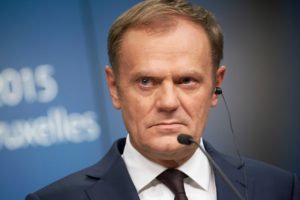
Donald Tusk, President of the European Council.

On March 31, Donald Tusk, gave a crucial six-page document to the 27 members of the EU laying down the essential principles of the negotiations to come. The text should be formally accepted by them on April 29 at a summit meeting in Brussels.

Obviously the presidential elections in France will have an impact on the negotiations.   Marine Le Pen applauds an event which will make Europe more fragile.  At the opposite end of the political spectrum, Emmanuel Macron (En Marche party) feels the access to the Common Market  has a price and should be balanced by contributions to the European budget.  François Fillon  (Les Republicains or LR ) supports a firm attitude toward the British demands. He thinks that the Le Touquet agreement needs to be modified and the borders moved from Calais to Dover.

The ideal scenario would be to have the parties agree on these first phases so that discussion on the future should be tackled by the beginning of 2018.

The tone of the difficult negotiations has been set.  It will be a roller-coaster ride for months to come.

Editor’s Note: This is the opinion of Nicole Prévost Logan.

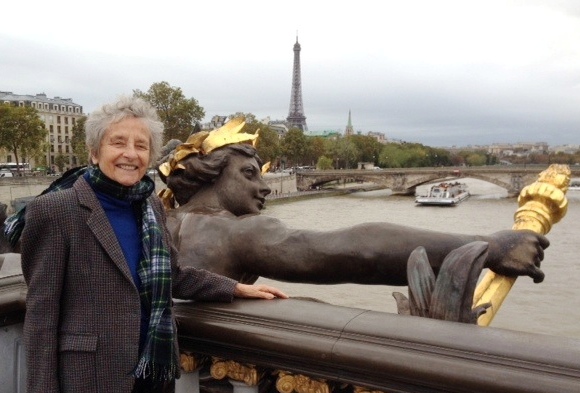
Nicole LoganAbout the author: Nicole Prévost Logan divides her time between Essex and Paris, spending summers in the former and winters in the latter. She writes a regular column for us from her Paris home where her topics will include politics, economy, social unrest — mostly in France — but also in other European countries. She also covers a variety of art exhibits and the performing arts in Europe. Logan is the author of ‘Forever on the Road: A Franco-American Family’s Thirty Years in the Foreign Service,’ an autobiography of her life as the wife of an overseas diplomat, who lived in 10 foreign countries on three continents. Her experiences during her foreign service life included being in Lebanon when civil war erupted, excavating a medieval city in Moscow and spending a week under house arrest in Guinea.
Letter From Paris: One Man’s Opinion: ‘How to Save Europe’

Nicole Prévost Logan

“The sixty years since the Treaty of Rome, on March 25, 1957, have not been a long quiet river for Europe”, commented academic Robert Frank.  This is an understatement.  Today, the disaffection for the European Union (EU) has reached such a point that the need for its re-foundation is considered a matter of survival.

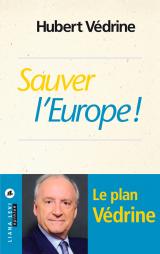
A good place to start the soul-searching process is by reading a gem of a book, written by a former diplomat and one of the most influential French scholars on foreign affairs today.  The book has the merit of being very short but so dense in meaning that every single word deserved to be pondered over. The book is called Sauver l’Europe and was published on Nov. 21, 2016.  The author, Hubert Vedrine, born in 1947,  was a collaborator of president Francois Mitterand from 1981 to 1995 and served as minister of foreign affairs from 1997 to 2002 under president Jacques Chirac.
First, the author makes a diagnosis regarding what went wrong.

  1. The EU has been working against nations instead of with them.  A federalist Europe, with a superpower in Brussels, Vedrine thinks, is a utopia.  Unlike the USA, Europe is made of nations with different cultures, languages and history.  “There is no democratic path to federalism for Europe.”
  2. The “elites” in Brussels have grown increasingly disconnected from the people.  There is a perception that an accumulation of treaties are drowning the public without acknowledging the opposition.  In the collective memory the worst grievance was when France and the Netherlands said “no” in a referendum about the 2005  constitutional project.  Two years later that project was repackaged and forced through in the treaty of Lisbon.  (Note: this is not entirely true because the second text included several positive modifications)
  3. Over the years, Brussels, has interfered too much  into the people’s lives in imposing annoying regulations:  how to make cheese, set the size of bananas or of the shower heads.  Europe cannot take care of everything. The key word is “subsidiarity.”  It means that competence not attributed to the Union by treaty should  belong to the member states.  Vedrine writes, “Europe was built upside down and should undergo a drastic cure of subsidiarity by simplifying the autistic hypertrophied regulations. “
  4. “Sovereignty” is a hard-won concept one should be proud of.   The final objective of Europe is not to dissolve the sovereignty of the member states but add to it.
  5. Many critics of Europe confuse the EU and globalization.   One by one, French factories have disappeared, for not being competitive enough.  One of the first ones to close was Moulinex.  In 2001 everybody went up in arms against the loss of jobs at the small plant of Normandy .  In 2016, when the Whirlpool plant was relocated to Poland, outsourcing had become the norm.  Whether the phenomenon occurred inside Europe or in Asia, the impact on people who lost their jobs in France was the same.
  6. With the wild expansion of Europe to 27 (nine new members entered the Union in the single year of 2003), it has become hard to run a such a cumbersome structure, especially when some of the states give the priority to their national interests.  This is particularly true with the populist attitude of the Visegrad Group – Poland, Hungary, Czech Republic and Slovakia – which showed no solidarity with the rest of Europe at the time of the refugee crisis.
  7. The arrival of more than 1.5 million refugees in 2015 and also in 2016 has shaken a system unprepared for such a brutal surge.  The huge number of immigrants created an unavoidable confrontation between different ways of life, the loss of identity, exasperated by fear of terrorism,
  8. The adoption of the Euro has meant further constraints for the 17 members of the Eurozone.  The 1992 Treaty of Maestricht set two basic rules; the general government deficit should not exceed 3 percent of the gross domestic product (GDP) and the public deficit should not exceed 60 percent of the GDP.

In the opinion of Vedrine, the solution to the problems listed above is not for more integration and certainly not more enlargement. One needs to mark a pause, to listen to the people and to re-center Europe on the essential. One should return to the values of the founding fathers.  Remember how Jacques Delors, who was president of the European Commission from 1985 to 1995, called the EU a “federation of States-Nations” .

To prepare for the celebrations making the 60th anniversary of the 1957 Treaty of Rome, Jean-Claude Juncker, president of the Commission, issued a White Paper offering several scenarios for the 2025 horizon. One of them was to “allow the member-states to move forward, if they wish, in very specific areas. ” The goal is that no one should feel excluded.

On March 6, 2017 the leaders of Germany, France, Italy and Spain met for a mini-summit in Versailles to discuss a Europe à plusieurs vitesses (going at different speeds.)  This was a format never seen before and maybe a preview of what lies ahead.

The American economist Joseph Stiglitz advocates an éclatement (breaking up) of the Euro group into four more flexible zones, until the conditions for more integration are met.”  The opinion of the IMF (International Monetary Fund) and OCDE (Organization of Cooperation and Economic Development) and other economists is that the EU had gone to too far on the method of austerity.  The priority now is to create sustainable growth, rather than reduce the deficit .

The most ambitious  proposal for European defense so far has been made by the Robert Schuman Foundation.  It calls for Germany, France and the UK to sign  an intergovernmental treaty for defense and security of the EU.  Let us show more solidarity and agree to share the burden of military expenses before pronouncing empty words like “European defense.”

The author of “Save Europe” points to the mistakes  made by Angela Merkel: abandoning nuclear, after Fukushima, without enough preparation for what to do next; extending a “generous but too personal” invitation to the refugees to come to Europe and single-handedly signing an agreement with Turkey.

Vedrine wants the European way of life  to be preserved.  Even though many complain, there is in Europe a douceur de vie (gentle pleasure of life) one should treasure.  Let Brussels set objectives and the States go their own way .

A recurrent slogan in the campaign speeches of Marine Le Pen  (and of other anti-European populists), is to put la patrie (homeland) first.  By demonstrating that it is possible to keep one ‘s sovereignty, to show it is not a sin to be a patriot and at the same time be a European, would be an effective way to obliterate her arguments. 

On March 29, Donald Tusk, president of the European Council, received with emotion the letter from the British Ambassador, marking the departure of the UK from the EU at the outset of the Brexit.  It was, however, both reassuring and encouraging to read this the upbeat remark in Sauver l’Europe , “The idea of a continental partnership between the UK and the EU, expressed by the Brussels-based Bruegel think-tank, could solve many problems.”  

Let us hope this concept is pursued.

Editor’s Note: This is the opinion of Nicole Prévost Logan.

Nicole LoganAbout the author: Nicole Prévost Logan divides her time between Essex and Paris, spending summers in the former and winters in the latter. She writes a regular column for us from her Paris home where her topics will include politics, economy, social unrest — mostly in France — but also in other European countries. She also covers a variety of art exhibits and the performing arts in Europe. Logan is the author of ‘Forever on the Road: A Franco-American Family’s Thirty Years in the Foreign Service,’ an autobiography of her life as the wife of an overseas diplomat, who lived in 10 foreign countries on three continents. Her experiences during her foreign service life included being in Lebanon when civil war erupted, excavating a medieval city in Moscow and spending a week under house arrest in Guinea.

Letter From Paris: The Netherlands to the Rescue

Nicole Prévost Logan

Thank goodness for The Netherlands!  

Their March 15 vote for their House of Representatives was exactly what Europe needed at this point – the reassuring voice of a founding member of the European Community (EU) expressing its belief in Europe while being open to the world. The result was greeted with a sigh of relief by pro-Europeans. It was another sign — after the victory of the Green Party-backed Independents in the Austrian elections of December 2016 — that populism and rejection of Europe are not inescapable. 

A brief look at history will help better understand the elections of The Netherlands and realize how coherent the Dutch position is.  During its “Golden Age” in the 16th and 17th centuries,  Holland was an opulent merchant class society marked by Calvinist ethics of discipline and frugality.  It stood out as being tolerant toward religions and a place where liberty of conscience was inscribed in the constitution.

The founding of the Dutch East India Company opened a maritime and commercial empire, becoming a hub of finances and trade. The first ever stock exchange was created in Amsterdam.  Erasmus (1466-1536), the humanist Renaissance scholar, gave his name to a most successful student exchange program established in 1987.

Someone described The Netherlands of that time as having high literacy and low interest. Rotterdam, until recently the largest port in the world, is still number one in Europe.  What was tolerance has developed into permissiveness and it is one of the dominant traits of the Dutch people today.  Finally, that small country, located well below the sea level, has shown incredible courage in carrying out its Pharaonic fight against the elements. 

“The Netherlands is the country, which has the most to lose from the Brexit” says Marc-Olivier Padis, from the Terra Nova Think Tank.  It shares with the UK an attachment to free trade policies and also to the unhindered circulation of goods and capital within the European Common Market.  Holland’s agriculture, horticulture and dairy industry have always profited from Europe’s Political Agricultural Policy (PAC). The reason the Dutch voted “No”  to the 2005 referendum on a European constitution was because they  worried about the seemingly uncontrolled expansion of Europe, especially with Holland being the largest of the small countries in the continent.

The participation in the March 15 elections was incredibly high at 77.6 percent.  The ballot system by proportional representation produces multiple parties.  In order to be able to govern, any of the 28 parties has to join a coalition with others. 

Here is a snapshot  of the votes showing the changes since the 2012 elections.  The winner was Mark Rutte (VVD), former prime minister, head of the conservative liberal centrist party with 21.3 percent votes and 33 seats. He lost eight seats.  In second place, the far-right Party for Freedom (PVV), led by Greet Wilders, obtained 13.1 percent and will have 20 seats. Two pro-European parties, Christian democrat Appeal (CDA) and centrist reformer (D66) won 19 seats each.  Those two may share an alliance with Rutte.    

Rutte said he would not join Wilders again, as he had done in 2012.  The Labour party Social democrats (PVDA) collapsed going from 29 seats to only nine seats.  The radical left also did not perform well.  One notes two interesting developments: a young 30-year-old had a spectacular rise — Jesse Klaver has a Dutch-Indonesian mother and a  father of Moroccan origin.  His party, Groenlinks (GL)  or green- left, will secure 14 seats.

A new party, Denk, meaning “think”, headed by Unahan Kuzu, received 2 percent of the votes and will have three seats.  It is 100 percent Moslem.

Wilders, the “peroxide candidate,” leader of PPV, the only extremist party,  gained five seats.  He progressed but did not win.  “We are the party, which did not lose,” he commented.”  He is well-known for his outrageous attacks against Islam.  He wants to outlaw the Koran , close all mosques and expel the Moslems.  As a consequence, he is under constant threat.

For the past 13 years he has been living in a safe house with  a “panic room,” is under police protection round the clock and rides in an armor-plated car.  “I would not wish my life to anybody”  A “buffer zone,” to use the expression of German journalist Michaela Wiegel, isolates Wilders in the parliament. 

The Dutch elections took place at a time of high tension between Ankara and Europe.  The Turkish minister of foreign affairs Mevlut Cavusoglu was about to land in Rotterdam as part of a political campaign among the Turkish diaspora of  2.8 million.  Recep Tayyip Erdogan’s objective is to gather the Turkish population’s support prior to the April 16 constitutional referendum on his increased powers.  After Erdogan called Holland the Nazi capital of the West and kept hurling other insults, Germany and Holland had the courage to forbid the Turkish officials from entering their territories.  Rutte was very firm and impressed the voters scrambling during the last minutes before the polls.

Today Dutch economy is so healthy as to make its neighbors drool with envy with 6 percent unemployment and an economic growth rate of 2.1 percent.  The government reacted quickly to the recent economic crises in 2008 and 2010-11.  In 2012, it was even able to generate a trade surplus.  Its rigorous austerity program was so efficient as to lower public expenses down from 65 to 45 percent.  The reforms were not imposed on the people but accepted by them in a form of consensus.

The main issues at stake are not so much economic nor social but a fear of losing one’s cultural identity and also anxiety about security.  Therefore immigration and the challenge of integration are at the core of the people’s concerns. 

Holland is a multicultural society with a surge of a Turkish and Moroccan immigration — something which has occurred during the past 50 years.  Half the population of Rotterdam consists of recent immigrants.  The Dutch have been working hard at establishing good relations with these populations: 70 associations act as go-between; a minister from a reformed church in Rotterdam just gave a sermon in a mosque; Ahmed Aboutaleb, mayor of Rotterdam, is of Moroccan origin, and is strongly against the radicalization of Islam.

The Netherlands should be considered as a model for the other EU members. Unfortunately, many of their qualities are not to be found in other countries.  It is hoped that the position and demands of the Dutch are heard in a restructuring of the EU, possibly to unfold in the next few months. 

Editor’s Note: This is the opinion of Nicole Prévost Logan.

Nicole LoganAbout the author: Nicole Prévost Logan divides her time between Essex and Paris, spending summers in the former and winters in the latter. She writes a regular column for us from her Paris home where her topics will include politics, economy, social unrest — mostly in France — but also in other European countries. She also covers a variety of art exhibits and the performing arts in Europe. Logan is the author of ‘Forever on the Road: A Franco-American Family’s Thirty Years in the Foreign Service,’ an autobiography of her life as the wife of an overseas diplomat, who lived in 10 foreign countries on three continents. Her experiences during her foreign service life included being in Lebanon when civil war erupted, excavating a medieval city in Moscow and spending a week under house arrest in Guinea.

Letter From Paris: The ‘Centre Pompidou’ Turns 40            

Nicole Prévost Logan

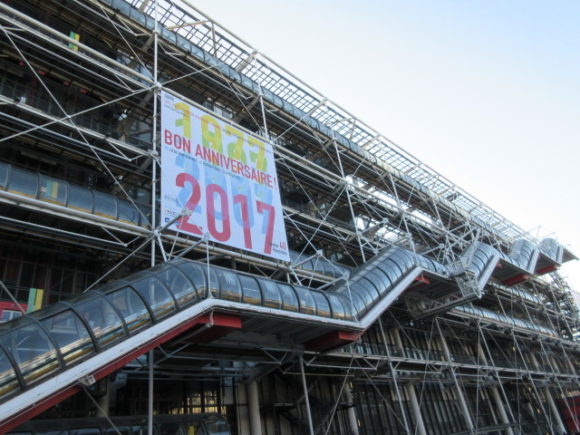
The Musée National d’Art Moderne (MNAM), better known as the Centre Pompidou – that crazy structure  with tubes, exhaust pipes, chimneys and metal rods in bright primary colors – is celebrating 40 years of existence.  Its revolutionary architecture oriented toward multidisciplinary activities, which turned it into what virulent opponents called  a “supermarket for the arts,” scandalized visitors at first, but is now the benchmark for art museums around the word.

In 1969, President Georges Pompidou and his wife Claude, wanted to create an institution accessible to everyone, innovative enough to arouse the curiosity and the interest of the general public.  He wrote in Le Monde on Oct. 17, 1972, “It is my passionate wish for Paris to have a cultural center like the ones they have created in the United States, which have thus far been an unequalled success.  It would be one that is both a museum and a center of creation where the visual arts take residence with music, films, books, audiovisual research, etc.”

The project was conceived soon after the May 1968 student contest, which shook French society to the core.  A location was found in a vacant parking lot in the dilapidated working class district of Beaubourg.  Construction lasted five years from 1972 to 1977.

Young architects – Italian Renzo Piano and Englishman Richard Rogers along with Italian Gianfranco Franchini – won the international competition and designed a project breaking away from the tradition of solemn museums.  Their innovative design consisted of a metal structure with six levels of flexible and open-plan floors.

The Centre Pompidou features a revolutionary design, which includes the external escalator known as the “caterpillar.” Photo by Nicole Logan.

The anchor of the assemblage was a giant pillar supporting a network of metal beams and interlocking parts.  The external escalator, enclosed in glass, zigzags its way up to the roof-top like a caterpillar (hence its nickname) along the face of the building.  The color-coded functional pipes – blue for the air, yellow for electricity, green for water and red for circulation – give a playful appearance to the construction.

The idea was to integrate the museum within its urban environment.  The facade is all glass and there is no threshold between the outdoors and the Forum or heart of the center.  Whenever the exhibits are too large to be set up inside – as was the case with the 1979 Dali retrospective, which attracted 800,000 visitors – they spill over the gently sloping piazza or the nearby Stravinsky Fountain.

President Valery Giscard d’Estaing inaugurated the building on Jan. 31, 1977 with high officials and celebrities in attendance.  Adding to the pageantry , the Garde Republicaine arrived on horseback , holding Andy Warhol-creation-like banners. Forty eight hours later, the Centre Pompidou opened to the general public.

The 40,000 visitors could not hold their excitement as they rode the escalator to the upper terraces, well above the roofs of Paris.  The organizers were afraid the building would collapse with the unexpected size of the crowds.  Looking at the metal structure, someone supposedly commented, “Why didn’t they take down the scaffolding?”

The permanent collections of modern art, spanning the period from 1905 until the 1960s, are on the fifth floor.  The plan layout allows for the easy flow of visitors between rooms of all sizes.  The walls are stark white.  A wide hallway leads to huge windows opening on a reflecting pool and a free-standing, 25 ft. high mobile by Alexander Calder.  Montmartre is in the background .

The art lover will see just a sampling or five per cent of the phenomenal collections owned by the museum, which includes works by Sonia and Robert Delauney, Fernand Leger,  Mondrian, Matisse, Picasso, Yves Klein, Juan Gris, Goncharova,  Larionov and many others.  One room is dedicated to Marcel Duchamp and includes the famous bicycle on a kitchen stool (MOMA has another copy), and the hard-to-understand Neuf Moules Mâlic, (generally translated as Nine Malic Moulds) 1914, which was a preparation for la Mariée mise à nu par ses celibataires (the bride stripped naked  by her nine bachelors).

Contemporary art, starting in the latter part of the 20th century, is displayed on the fifth floor. At present an exhibit entitled “Kollektsia” includes 250 works from the USSR and the new Russia from 1950-2000, donated by the Vladimir Potanin Foundation.  Fascinating videos bring back the world of the 1960s in the Soviet era.

One video shows Nikita Khrushchev in a heated discussion about modern art with the public at the Manege. Another video shows  the government’s bulldozers  destroying the open-air exhibit hurriedly organized by the dissident Russian painters.

The Centre Pompidou, as an institution offering cultural activities at all levels, includes two special departments.  One is IRCAM (Institute for Research and Coordination of Acoustics and Music.)  Founded by composer Pierre Boulez, it is a research center, using advanced technology working on ways to visualize music.  On the other hand, the Public Information Library or BPI is an enormous facility with resources in a multiplicity of media.  It is open to all and offers wonderfully convenient free access to its shelves.

The production of the Centre Pompidou, during the past 40 years, has included major retrospectives establishing links between artistic capitals such as “Paris-Moscow” or “Paris-New York,” hundreds of monograph exhibits or surprising sights such as the grand piano of German artist Beuys made of felt hanging from the ceiling.

The $64,000 question is, will the Centre Pompidou be able to sustain this feverish pace or will it ultimately run out of steam?  There is no question that the curators are fully committed to ensuring that this latter scenario does not happen.

Editor’s Note: This is the opinion of Nicole Prévost Logan.

Nicole LoganAbout the author: Nicole Prévost Logan divides her time between Essex and Paris, spending summers in the former and winters in the latter. She writes a regular column for us from her Paris home where her topics will include politics, economy, social unrest — mostly in France — but also in other European countries. She also covers a variety of art exhibits and the performing arts in Europe. Logan is the author of ‘Forever on the Road: A Franco-American Family’s Thirty Years in the Foreign Service,’ an autobiography of her life as the wife of an overseas diplomat, who lived in 10 foreign countries on three continents. Her experiences during her foreign service life included being in Lebanon when civil war erupted, excavating a medieval city in Moscow and spending a week under house arrest in Guinea.

Letter From Paris: Another Presidential Race, But French-Style This Time, Filled With Pride, Passion, Power, Intrigue

Nicole Prévost Logan

The presidential campaign in France is undergoing a series of twists and turns, often spectacular, sometimes violent.  Traditional politics are going through a crisis and may come out rejuvenated from the turmoil.  The rest of Europe is watching the developments with anxiety because its future is at stake.

By the end of February, five candidates were still in the race: François Fillon, winner of the right wing primary and candidate of Les Republicains or LR (The Republicans), Benoit Hamon, who won the Socialist primary, Jean-Luc Mélenchon, gauche de la gauche (far left), Marine Le Pen, president of the ultra right wing Front National (National Front) and Emmanuel Macron, independent, and head of the party he named, En Marche! (Let’s go!)

And then there were five … from left to right, the candidates still running in the French Presidential election are Jean-Luc Melenchon, Benoît Hamon, Emmanuel Macron, François Fillon and Marine Le Pen.

“Penelopegate” has been covered with glee by the media around the world.  It all started with the suspicion that François Fillon had been paying his British wife Penelope for fictitious jobs as his ’employee’ for more than two decades.  Until the three independent investigating judges have determined whether she did work or not, Fillon is presumed innocent.  But whatever they find, the damage has been done to the candidate, who had run on the ticket of a man of integrity.

Actually Fillon is not entirely to blame, he is just a product of the system. The main problem in France is the opaque system of generous perks granted the legislators.  A deputy receives about 13,000 euros monthly (base salary and allowances) and an “envlop”of 9,100 euros to pay for a maximum of five assistants parlementaires (parliamentary assistants).  The British receive twice as much and the Germans 130 percent more.  Members of the US Congress receive 10 times that amount and are allowed a staff of 18 people.  By hiring his wife and two children,  Fillon was using the privilege of nepotism to the hilt, which is increasingly unacceptable to public opinion.

He appeared even more blatantly as a member of a privileged caste when answering questions on the media. His defense strategy went through several stages.  At first he appeared arrogant, bristling at any questioning of his entitlement and of his wife’s right to work (with the tax-payer’s money).  Second stage: “I offer my apologies but I have done nothing wrong.” Third : “I am the victim of a conspiracy intended to destabilize my campaign ” . Fourth: “only Bercy (where the ministry of finances is located) can be the source of all the accusations.” His last resort was to ask his lawyers to discredit the financial prosecutor as not being competent to handle the case.

Marine Le Pen is in more trouble with justice than Fillon and has a number of pending lawsuits against her. She is clever enough to uses this situation to reinforce the admiration of her unshakable supporters.  She is being sued for using the European parliament’s budget to pay her assistants parlementaires who should be working in Strasbourg, not in Paris.   Her other cases include fraud linked to misappropriations of funds during electoral campaigns.

In a recent three-hour-long TV talk show, she displayed her skills as a sharp, articulate and smooth speaker.  Answering questions fired at her from all sides.  Winning arguments was no problem for her.  It is hard to understand how she manages to appeal so easily to people with her populist ideas while omitting to point out the financial and economic disastrous consequences her program would have for France.

The conditions were now favorable – the right and far right candidates being embroiled with justice, a divided socialist party not likely for the first time since 1974 to reach the final ballots – for Emmanuel Macron to continue his meteoric ascent.  And he is using that open road with passion.  On Feb. 22, he accepted with enthusiasm the offer of a coalition from the president of the centrist MoDem (democratic movement).  This was a perfect fit between François Bayrou, a politically-wise older man, and Macron, a 39-year-old, brilliant, highly educated, former minister of  finances and economy, although never elected.  Bayrou declared, “My priority will be to guarantee the moralization of French politics,” a promise which could not be more topical.

Macron’s style is very different from the  other French politicians.  He smiles a lot and is warm and friendly.  The project he just laid out is not harsh and does not sound like a punishment. For a man as young as he is, what he proposes is surprisingly down to earth and realistic.  His priority is to modernize the system, simplify the  regulations, and decentralize the decision process.  He introduces many innovating measures, which may go against the entrenched privileges of some French.

He is counting on the suppression of 120,000 posts of civil servants to reach his goal of a 60 billions economy.  Nothing like the choc therapy proposed by Fillon to eliminate 500,000 posts.

As a good economist, he has two sound proposals: one is to lower corporate taxes from 33.3 percent to 25 percent to be in sync  with the average European rates.  Another proposal  makes a great deal of sense: stop penalizing people for making investments.  By lowering high taxes on their capital, the French may stop hiding their savings under their mattresses.

To tackle the endemic French unemployment, he intends to make sure that the allowances are linked to the efforts demonstrated by job seekers to find a job. 

Macron unveiled his project to an audience of 400 journalists on March 2.  The other candidates were very quick to pull his project to shreds.  Vicious messages circulated in the social networks trying to demolish him, particularly for having worked for the Rothschild bank. No French president has ever been able to carry out even a small portion of Macron’s proposed  reforms.  The fight will be ruthless.

Fillon’s situation is becoming more unsustainable by the hour.  An indictment is probable. A growing number of his team have jumped ship.  He is determined not to quit the race.  The name of Alain Juppe, who came second in the primary, is being mentioned as a substitute.

Only 50 more days until the first round of elections on April 23, and still no way out of the crisis — probably one of the worst France has ever lived through.

Editor’s Note: This is the opinion of Nicole Prévost Logan.

Nicole LoganAbout the author: Nicole Prévost Logan divides her time between Essex and Paris, spending summers in the former and winters in the latter. She writes a regular column for us from her Paris home where her topics will include politics, economy, social unrest — mostly in France — but also in other European countries. She also covers a variety of art exhibits and the performing arts in Europe. Logan is the author of ‘Forever on the Road: A Franco-American Family’s Thirty Years in the Foreign Service,’ an autobiography of her life as the wife of an overseas diplomat, who lived in 10 foreign countries on three continents. Her experiences during her foreign service life included being in Lebanon when civil war erupted, excavating a medieval city in Moscow and spending a week under house arrest in Guinea.