The Latest Buzz about Mosquitoes

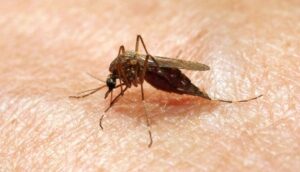
mosquito_574The mosquito season will shortly be upon us and many of us, in an effort to keep the pesky insects at a distance, will get out last year’s spray cans and bottles of DEET™ and OFF! or OFF! Backwoods (SC Johnson products.)  We may get our sprayers ready and check the hardware stores that feature the latest backyard propane mosquito traps and clip-on repellents.

The danger to public health takes the form of two diseases transmitted to humans by the bite of the mosquito, West Nile virus and Eastern Equine Encephalitis.  By the way, aerial sprays have been proven to be the least effective approach to mosquito control.  Some studies cited in the publication Beyond Pesticides indicate that DEET rapidly loses its effect over time and that it takes only one generation of mosquitoes to become insensitive to the chemicals in DEET because the insects mutate so rapidly.

Studies also indicate that DEET, especially in higher percentages, can cause severe skin reactions and can interfere with the central nervous system enzyme identified as AChE.  Read the precautionary statements on a bottle of OFF!Backwoods! to get an idea of the potential risks.  Studies indicate that under certain conditions using DEET in combination with permethrin has resulted in motor defects and memory dysfunction in humans.

In general, spraying the skin with or inhaling spray from products employing permethrin, resmethrin (Scourge), malathion (Fifanon), sumithrin (Anvil), organophosphate or piperong butoxide (PBO) should be avoided.  They can be highly toxic to certain humans, especially children and pregnant women.

So if I do decide to put my can of DEET aside and avoid products with the potentially harmful chemicals listed above, what can I do to avoid the risk of being bitten by a mosquito carrying a deadly virus?

First, make sure that you eliminate all stagnant water in your immediate area because mosquitoes lay their eggs in places like leaf-clogged gutters, discarded tires, bird baths, and rain barrels that are neither covered nor emptied every couple of days.  After only four days, mosquito eggs in stagnant water can mature into adults looking for blood.

One of the products that you can safely use in pools of water goes by the name Bt (bacillus thuringiensis israelensis). Follow the directions on the product called Mosquito Dunks which may be effective for up to 30 days.

Second, prepare before going out in the evening when mosquitoes are most active.  Cover exposed skin and apply repellents that do not include the chemicals listed above.  Instead, use products with any of the following: oil of lemon eucalyptus or eucalyptus with aloe vera, garlic oil (doesn’t smell), cedar oil, pine oil, pepper extract (picaridin), herbal extracts, and citronella.

Also available is a nontoxic mosquito repellent patch that uses a vitamin (Thiamin B1) as its deterrent. It can be used on children as young as one year old and reputedly remains effective for 36 hours.

Third, light up the good old reliable citronella candles if you want to keep mosquitoes away from your late night dinner on the patio.

So, avoid the harmful chemicals and be ready for a busy summer, one that is free from the buzz and bite of those pesky and sometimes deadly mosquitoes!
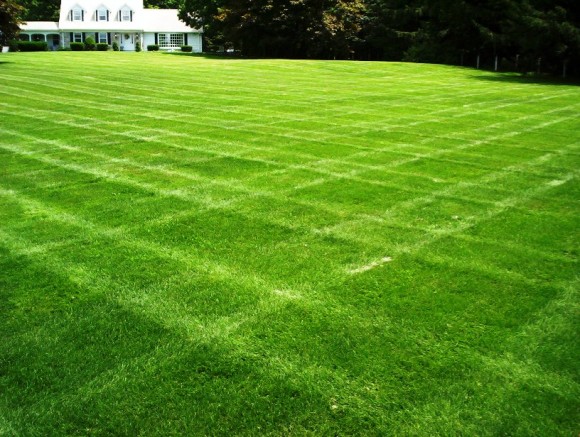

Conservation Corner: A Killer Lawn

lawn-big_smaller

It’s that time of year again.  The lawn looks dead after all you did to make it lush and verdant last year, the envy of the neighborhood.  You mowed it 33 times, spent over $300 on fertilizer and pesticides, another $55 for fuel for the brand new sit-down mower you purchased, and spent $24 on Rhode Island grass seed and fertilizer to repair the bare spots. And now it looks dead …

Biologically, it is dead.  The chemicals in those bags you bought last year contained chemical fertilizer with a heavy dose of nitrate plus weed killer, wide spectrum insect killer, clover killer, nematode killer, grub killer, various seed killers, etc. The soil was made barren and depends on those bags you buy to keep it barren and deadly to those natural “enemies” of your perfect lawn.  The chemicals may also make your children and pets sick, as well the birds and animals that come in direct contact with that lawn.

High nitrate levels in the soil in the beach communities is the reason the DEEP is issuing pollution abatement orders and ordering sewers, yet that bag of fertilizer you spread on your lawn four or more times last season probably contained 30% or more of nitrates.  Actually, only about five percent of that nitrate can be used by the grass.  The rest seeps into the ground (eventually into your well) or is washed away into the nearest water body, where it does some more killing of a wide range of aquatic life.

The Old Lyme Conservation Commission opposes the use of pesticides in general as a hazard to the health of the community, especially our children.  We oppose the use of chemical treatment of lawns specifically and recommend the organic approach instead.  Here is what we specifically recommend:

  1. Reduce the size of your lawn by planting perennial gardens and shrubs instead.
  2. Get a soil test to determine what, if any, additives your soil needs to grow grass. Email UConn for more info.
  3. Buy the perennial grass seed that is best suited for each part of your property.  Add clover seed to the mix as clover provides nitrogen to the grass roots.
  4. Compost your leaves, grass clippings, etc. and use the rich soil produced as top dressing for the lawn and garden.
  5. Water deeply once a week. Install rain barrels to supply added water for the lawn.
  6. Seek professional advice from organic experts when confronted with specific insect and weed problems.
  7. Raise the cutting bar on your mower to three inches.  A one inch cut exposes the grass to drying out and dying. Leaving the grass clippings on the lawn provides most of the nitrogen the grass needs or save the bag of clippings for the compost pile.

Note:  A new state law (12-155) that prohibits the use of a fertilizer containing phosphorous near water bodies is now in effect.  A $500 fine is imposed on violators.  A pound of phosphorous fertilizer can produce 10,000 pounds of algae in water bodies like Rogers Lake.

Op-Ed: Connecticut River System Highlights Role of People in Sustaining Nature

Dr. Frogard Ryan, State director, The Nature Conservancy in Connecticut

Dr. Frogard Ryan is State Director of The Nature Conservancy in Connecticut.

A fishway around a dam on the Mattabesset River in East Berlin might not seem to have much to do with Lyme and Old Lyme.  But the fishway The Nature Conservancy is building on the property of StanChem, a polymer manufacturing company about 35 miles from my home in Old Lyme, is good news—here and there.

As the Conservancy’s state director, I have a vested interest in the project’s success.  It’s no stretch, though, to say we all have an interest in this work.

The Mattabesset River is a tributary of the Connecticut River, and the elaborate U-shaped fishway being built near the StanChem complex will help improve the health of the river Lyme and Old Lyme area residents know and love as a neighbor.

That’s just for starters, though.

As I toured the site recently with StanChem President Jack Waller and Conservancy Connecticut Director of Migratory Fish Projects Sally Harold, I was reminded of a fundamental truth:  conservation is made possible by people, and if Connecticut’s natural resources are to be sustained into the future, it will be because people make it so.

River and stream connectivity is an important environmental issue and opportunity in our state.  The vast majority of dams in Connecticut are relatively small and privately owned.  Many of them no longer serve the purposes for which they were built; some are at risk of failures that could threaten public safety.

From an environmental perspective, dam removal can open access to upstream spawning habitats for migratory fish.  It also can restore the natural, swift-moving flows that support some native species, and it can enhance water quality by improving nutrient and sediment transport.

Removal isn’t always an option, of course, and that was the case with this project, where the impoundment created by the dam provides water that would be crucial for StanChem in case of a fire.  In such circumstances, a well-thought-out fishway is a great—if not always easy— alternative.

The fishway on the Mattabesset is designed so that American shad, alewife and blueback herring will be able to use it.  Because the old dam has been a complete barrier, none of those species has been above it in maybe 100 years.  All told, about 50 miles of habitat—including tributaries to the Mattabesset—will become available to them, improving the overall health of the Connecticut River system.

An embedded tube for migrating American eels is part of the project, too, and the Connecticut Department Energy and Environmental Protection will gather information from an observation room there for its “No Fish Left Behind” reports about monitored fish runs across the state.

Equally important, though, is how this project has happened.

A $308,000 Connecticut Department of Energy and Environmental Protection (DEEP) Ecosystem Management & Habitat Restoration grant, a $10,000 contribution from the Corporate Wetlands Restoration Partnership through Northeast Utilities, and private donations to The Nature Conservancy are helping pay for this work.  Of course, it also couldn’t happen without StanChem’s active buy-in.

With the state and the private and nonprofit sectors involved, the cooperation that characterizes this project is a model for conservation.

Still, it wouldn’t be possible without the commitment of individuals—people who want to make a difference.  Mr. Waller, whose buoyant enthusiasm for the project is infectious, comes to mind, as does DEEP Supervising Fisheries Biologist Steve Gephard, a long-time champion of the project.

A great deal of work was done last year to improve the health of Connecticut’s rivers and streams.  In East Berlin, Farmington, Stonington and elsewhere, there were real successes with dam removal and fish passage.

With so many of Connecticut’s dams privately owned, the future of this type of work depends greatly on individuals—including, I hope, some readers here—who see and cherish the opportunity to make a difference.  There are so many dams out there where work of real ecological value could be done.  Perhaps one of them is yours.

Editor’s Note: Dr. Ryan, who is the State Director of The Nature Conservancy in Connecticut, lives in Old Lyme.  The Conservancy’s Connecticut Chapter is located at 55 Church Street, Floor 3; New Haven, Conn. 06510-3029.

Old Lyme Conservation Commission – Working For a Pesticide Free Community

across_Halls_Rd

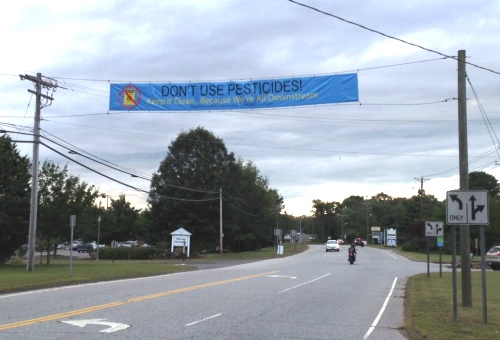
Coinciding coincidentally, with the DEEP sprayings of glyphosate on the phragmites in several locations in Old Lyme, the Old Lyme Conservation Commission’s banner (pictured above), which has been in the works for some time and its placement over Halls Road scheduled months ago, is displayed to bring awareness to reduce the use of pesticides in Old Lyme. The banner’s debut coincides with the 50th Anniversary of Rachel Carson’s Silent Spring, which is this September.

Orion publication gave this insightful look into Rachel Carson in their September issue: “Rachel Carson, the ecologist who kicked the hornet’s nest, wrote a book that needed no subtitle. Silent Spring rocketed to the top of the bestseller list, prompted a meeting with the president’s science advisers, occasioned congressional hearings, and circled her neck with medals of honor. It also let loose swarms of invective from the pesticide industry.”

The Orion article continues, “Carson hid her battle with cancer out of fear that her enemies in industry would use her medical situation to attack her scientific objectivity and, most especially, her carefully constructed argument about the role that petrochemicals (especially pesticides) played in the story of human cancer. But behind her unflappable public composure, Carson’s private writings reveal how much physical anguish she endured: bone metastases, radiation burns, and angina.”

The Old Lyme Conservation Commission believes Old Lymers can do more to keep themselves and their neighbors safe. Effective alternatives to home lawn care pesticides exist for the do-it-yourself homeowner as well as for licensed professionals.

Homeowners are asked to give more thought prior to allowing any pesticide applications, which require the posting of a yellow pesticide flag. Everyone needs to be more mindful of the role they may unwittingly be playing in adding to the toxic substances here in town.

While the Old Lyme Conservation Commission has the assigned task to bring the town information about such environmental risks, the residents must decide whether to act on that information or disregard it. In the case of spraying phragmites with glyphosate by the DEEP, we can say with certainty that it has not worked in the past, is a waste of money, and endangers fish, amphibians, honey bees, and birds.

You may recall that the DEEP has been here before. The phragmites are only getting worse. Information on glyphosate is available on the OLCC’s page on the town website and the OLCC’s pesticides pamphlet is available at the town hall and library.

While phragmites are invasive, they do play a role according to Tim Scott, Invasive Plant Medicine: The Ecological Benefits and Healing Abilities of Invasives. Scott has written that phragmites are “nature’s cleanup crew.” They exist where toxins exist.

The Nature Conservancy is supporting the spraying to bring back native plants and birds. It is important to note that they would like to spray Goose Island but cannot because of the many swallows presently there. Connecticut Audubon has publicly come out against the use of pesticides.

Are you a bit confused? Maybe Yale’s School of Forestry and Environmental Studies can help. Their brochure for prospective student’s states:

“The Relationship between Health and the Environment – Yale’s students studying the environment and human health learn both the scientific principles and the policy implications of how damage to the environment can adversely affect public health. Our health is affected by everyday behavior that brings us into contact with harmful environmental conditions – through the air we breathe, the water we drink, and the food we eat.”

The brochure continues, “While environmental degradation has widespread consequences, some of the most important are human mortality and illness. The link between the environment and human health is one of the primary reasons the general public is interested in environmental issues and is the principal driver behind most environmental legislation in many countries around the world.”

Rachel Carson said it best in Silent Spring, “If, having endured much, we have at last asserted our “right to know,” and if, knowing, we have concluded that we are being asked to take senseless and frightening risks, then we should no longer accept the counsel of those who tell us that we must fill our world with poisonous chemicals; we should look about and see what other course is open to us.”

Our own Roger Tory Peterson, the well-known birder, fought against the use of DDT. It is a safe bet that he would not be happy to have the DEEP spraying glyphosate in prime bird habitat. For those who have water views that are now becoming obstructed by this invasive plant, you can have these phragmites cut. We might add that the chemicals from lawn care products will only add to the spread of phragmites.

So, in the words of the banner: “Don’t Use Pesticides! Keep it clean…. Because we’re all downstream.”

Shades of Green: Lessons Learned from a Lawn

full_4536Have you noticed the little island of green that now graces the Old Lyme landscape?
The First Congregational Church of Old Lyme’s lawn looks wonderful and the accolades just keep rolling in.  Perhaps there are weightier issues on the minds of most residents, but the story of this little patch of grass underlies a larger issue that is sweeping through the town.

At the juncture of McCurdy Rd., Ferry Rd. and Lyme St., the Congregational Church is the town’s most recognizable architectural gem and serves as Old Lyme’s gateway to the historical district.  It was little wonder that church stewards approached the decision on lawn care with kid gloves.

The church’s Environmental Committee began to explore the idea of organic treatment for the church property.  Because of its prominent geographic location, the committee realized that the church had the opportunity to embrace responsible environmental stewardship and serve as a demonstration plot for integrated organic lawn care.

It was not until the “Church Corner” project was completed that designer and church member Sally McCracken (principle of the firm Sarah Wood McCracken, Landscape Architect) was able to get the ball rolling.

Brand new granite curbs and walks characterized the church corner’s reconstruction, but there was that church lawn … in a condition that could best be described as “spotty.”  In consideration of the church’s desire to move to organic care, Sally hired Roger McNelly of East Haddam Horticultural Services LLC.  For the past year, Roger has gently guided the lawn’s revitalization.

The organic approach undertaken at the church involved specific tailoring based on soil tests performed on the property.  The organic care program has incorporated different limes, fertilizers, gypsum, humates and compost teas.  To control grubs, an insect pathogenic nematode was introduced.  Typically, successful transition to organic care might take several years, but the results just one year into the project have already yielded exciting results.

As a member of both the church’s environmental committee and the town of Old Lyme’s Conservation Commission, I’ve come to see the church lawn project as a microcosm of an issue we are facing townwide.

In keeping with new state regulations, Lyme-Old Lyme Public Schools Facilities Director John Rhodes has guided Region 18 school fields away from the use of chemical pesticides and herbicides.  This has been no small feat considering the incorporation of the new track field and the overuse of our existing fields necessitated by the ongoing high school construction.

At the same time, the town’s Conservation Commission has worked with a town committee chaired by Phil Neaton to address the conversion of all town-owned fields from chemical applications to a sustainable “green” status.

None of these changes come easily and progress seems frustratingly slow at times.  Yet, in a small town with no municipal water system, our aquifers intimately connect us all.  The chemicals sprayed on our neighbor’s lawns find their way to our streams, our lakes, our Sound and … our water wells.

Congratulations to the First Congregational Church, Region 18, and the Town of Old Lyme for taking the initial steps toward making our town a safer and more sustainable place to raise our children.

PS: Stay tuned for the ultimate test for the church lawn … will it survive the “White Elephant Sale” this Friday and Saturday?

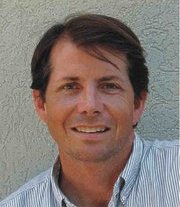
Environmentalist Tom Sherer of Old Lyme (left) is a man with a passion for the environment. A member of Old Lyme’s Conservation Commission, he also serves on the First Congregational Church of Old Lyme’s Environmental Committee.