A Special ‘View From My Porch’ in Recognition of Independence Day: CT’s General Israel Putnam was a ‘Man of Legendary Courage’, a Brooklyn ‘Rock Star’

Major General Israel Putnam, during the American Revolutionary War. Public Domain.

Prelude:

The June 9 edition of The Day reported that the team of Tessa Grethel and Sophia D’Amico — both Lyme-Old Lyme Middle School seventh graders — took first place in Connecticut in the junior group exhibit category of the National History Day Contest with their project titled “Bombings of Hiroshima and Nagasaki: The Origins of Atomic Diplomacy.”

Phil Rizzuto would have exclaimed “holy cow” for a homerun like that! 

Introduction:

I reported in my last essay that Connecticut legend credits General Israel Putnam with “increasing the popularity of cigars in New England after he returned from an expedition to Cuba with thousands of Havana cigars.”

In trying to corroborate that claim with an additional source, I discovered that there is substantial folklore surrounding the General’s life and his acclaim as a warrior and military hero. (To avoid any misinterpretation of this essay’s title, note that I use “Rock Star” to express high praise.) 

Kerri Provost, writing in “Real Hartford”, refers to Putnam as “Connecticut’s first authentic folk hero”. I am not suggesting that his story is historic fiction, just something worthy of a friendly review. All that said, he was very cool, and a fascinating American patriot, who had significant influence on freeing New England from the Redcoats, and Connecticut from predatory wolves. 

I have also considered other Connecticut Revolutionary War heroes in previous columns, including Ezra Lee, who was the first man to command a submarine in an attack on the enemy; and David Bushnell, who invented “The Turtle”, which was used by Lee in his 1776 assault on the British flagship, “HMS Eagle”, in New York harbor.

Israel Putnam was born in 1718 into a wealthy farming family in what is now Danvers, Mass. and moved to Connecticut in 1739 to establish his own farm, a “500-acre spread just south of what is now Pomfret, Conn. He had 10 children with his first wife; and much later, in 1767, established a “house for the general accommodation of the public” (i.e., a tavern) in Brooklyn, Conn. with his second wife.

He owned a slave, and as we have learned through the “Witness Stones” Project, that was not unusual in Connecticut at that time.

The Hartford Courant reported that “Israel Putnam defied the image of a classic American hero. “Stout, if not fat, he was unreserved, a man of many words who reveled in racy ballads and rum-fueled stories.” So, I guess that he bore more resemblance to Ben Franklin than George Washington. 

Putnam and the Wolf:

In 1742, after he and his neighbors had suffered repeated losses of sheep from wolf attacks, Putnam organized watches in an effort to protect the flocks and to help track the wolf back to its den. They spotted the wolf at dusk on a winter’s day and followed it to the den, a cave with a very narrow and shallow entrance.

Absent another volunteer, Putnam attached a rope to a yoke around his ankles and crawled into the cave with a lighted torch, trying to determine whether he could get within musket range of the animal … and he did come within yards of the snarling wolf. 

He signaled, and was dragged out; and then crawled back in with torch and musket and shot the wolf. His neighbors drew him out again, nearly overcome by smoke. 

After being revived, he crawled back into the cave a third time, where he grabbed the wolf by the ears; and the dead wolf and the live farmer were hauled out together. Putnam had dispatched Connecticut’s last wolf with a single shot.

The Colonial Warrior:

I’ll review a few of the notable battlefield events that contributed to Putnam’s legendary status with the following historical vignettes; and then identify some of the memorials and public works of art associated with those events. He became known for his natural leadership ability and reckless courage; and rose steadily through the ranks, ultimately gaining the rank of brigadier general before the Battle of Bunker Hill.

This is not a skirmish-by-skirmish list; just a few highlights.

French and Indian War:

In 1755, he joined Rogers’ Rangers, a New Hampshire-based militia company affiliated with the British. The Rangers were a “highly resourceful force trained in irregular warfare tactics” and stealthy reconnaissance. Ranger companies were developed because the English Regulars (i.e., the British foot soldiers) were so unaccustomed to frontier warfare. 

Rogers’ is considered as the precursor to the U.S. Army Rangers.

Putnam is said to have excelled at that form of frontier fighting. He was captured in 1758 by French-allied Mohawks while on a military mission near Crown Point, N.Y., and was saved from the ritual burning allegedly exacted by Mohawk warriors on their enemies through the intervention of a French officer. 

Putnam was then taken as a prisoner of war to a camp near Montreal. Note that many former Rogers’ Rangers’ officers eventually defected from the British ranks to fight for the Continental Army against the British.

The Siege of Havana:

He was freed from the French in an exchange of prisoners, and sailed in 1762 with a British mission that captured the Spanish garrison at Havana harbor and assumed control of the Caribbean Spanish fleet. He had survived a shipwreck during that expedition and may have been part of the British occupying force that remained on the island until the “Peace of Paris” ended the seven years of the French and Indian War in 1763. 

Putnam returned to his Connecticut farm after Cuba, and prospered.

He became a prominent member of the Connecticut Sons of Liberty and a leader in the opposition to the 1765 Stamp Act, which imposed a substantial tax on the colonies to fund the cost of the French and Indian War. He led the mob of former soldiers that forced the Mass. Colony’s Stamp administrator in Boston to resign.

The Battle of Bunker Hill:

Now 57years-old, Putnam was working in his fields with his son, Daniel, when a messenger rode into the village and proclaimed that the British had fired on the militia at Lexington, killing six men; and were on the march. This advance by the Redcoats on Lexington, and then Concord, marked the beginning of the American Revolution. 

Putnam left his plough in the field, and without changing from his working clothes, departed immediately on horseback for the home of Governor Trumbull in Lebanon, Conn., who ordered him to sound the alarm with the militia officers and the patriot assemblies in the neighboring townsm and then continue on to the conflict.

Putnam proceeded to Cambridge, where several colonial militias had encamped, and set up his headquarters. He began preparing what were untested fighters for the inevitable battle with the British. Their ranks comprised militiamen from several colonies, former soldiers, and farmers, who had signed on with “the cause”.to the revolution. 

The British ships controlling Boston’s harbor began firing their cannons on the Americans on the morning of June 17, 1775; and soon after, landed soldiers in preparation for attack.  

After General Warren, the American commander, had been seriously wounded, Putnam assumed command and then served as commanding officer in the battle. As the British approached the poorly-supplied militiamen, he ordered them to conserve their ammunition, and “Don’t fire until you see the whites of their eyes.”

The colonists repelled the first two British assaults, but ran out of ammunition during the third attack and were forced to abandon their position, returning to their lines outside the battle perimeter. The entire time, Putnam rode his horse up and down the lines, setting an example of courage and steadying the troops.

Although the battle was a tactical victory for the British, it came at a terrible price. Nearly half of the 2,200 Redcoats who entered the battle were killed or wounded in the two hours of fighting — twice as many casualties as the Americans had suffered, including many of the British officers. 

The Americans’ fierce defense demonstrated their ability to fight “toe-to-toe” with the British, and provided an important confidence boost, convincing them that they could overcome the superior power of the British military. 

Although usually referred to as the Battle of Bunker Hill, the battle actually took place on Breed’s Hill.

The Aftermath:

“The loss we have sustained is greater than we can bear,” wrote British General Thomas Gage. After the battle, patriot leader Nathanael Greene remarked “I wish we could sell them another hill at the same price.” 

George Washington arrived and assumed command of the new Continental Army in Cambridge and stayed on to direct the ongoing campaign at Boston. Afterwards, he moved the Army to New York, and Putnam was given command at Long Island.  

Unfortunately, Putnam was “outflanked, out-maneuvered and out-smarted” in the Battle for Long Island”. Washington never blamed him for the loss, but it was clear that he was past his prime as a battlefield commander; and was delegated less important commands. If Bunker Hill was Putnam’s high point, then the Battle of Long Island was his lowest. 

The Die Is Cast: 

The Americans had long felt that relations with the British were nearly irreconcilable. The bloodshed at Bunker Hill, however, virtually eliminated any chance for reconciliation and pointed the colonies on the path to independence.

When King George III received the news of the battle in London on August 23, 1775, he issued a proclamation declaring the colonies in a state of “open and avowed rebellion.” Further, in the wake of Bunker Hill, Benjamin Franklin penned a letter to an English friend and member of Parliament that he closed with, “You are now my enemy and I am yours.” Finally, the high price of victory at the Battle of Bunker Hill made the British realize that the war with the colonies would be long, tough and costly. 

Israel Putnam Public Art and Memorials:

Substantial public space has been dedicated to memorializing Israel Putnam.

The Israel Putnam Wolf Den, the site where he killed the last wolf in Connecticut, is now maintained in Mashamoquet Brook State Park in Pomfret, and is on the National Register of Historic Places.

A bronze Marker, installed by the Daughters of the American Revolution on Lake Road in Crown Point, N.Y. is inscribed, “182 feet north of this spot stood the oak to which Israel Putnam was tied and tortured by the Indians in 1758”.

The image of Putnam leaving his plough in the field after learning of the British attack on the Americans at Lexington, is carved on the east façade of the Connecticut State Capitol Building, one of five tympana on the east façade portraying the founding of Connecticut and the Revolutionary War.

Putnam’s actual plough and saddle are on display in the Entrance Hall of the Hartford Armory.

John Quincy Adams Ward’s bronze of Israel Putnam, completed in 1874, was one of the first public sculptures dedicated in Bushnell Park; and the first of six Revolutionary War memorials executed by Ward. Putnam is depicted striding forward, with his sword held under his arm. 

His remains are buried in the base of an equestrian monument on the Brooklyn Town Green. The monument was created in response to the deteriorated condition of Putnam’s original grave marker; and was funded by the Connecticut state government with the provision that it also serves as a tomb for Putnam.

Upon its completion, Putnam’s remains were reinterred under the monument.  The dedication was held on June 14, 1888 and included the governors of Connecticut and Rhode Island. The equestrian monument was criticized by contemporary reviewers, who especially criticized the horse, with one reviewer  saying  that the horse appeared to be suffering from bone spavin (i.e., Osteoarthritis).

The original grave marker is under glass and can be seen in the north alcove of the Connecticut State Capital in Hartford; his epitaph was “He dared to lead where any dared to follow”.

A statue of William Prescott was installed next to the Bunker Hill Monument in Charlestown, Mass.

Some Final Thoughts:

I want to say up front that I see absolutely no parallels between what I have presented in this essay and the activities of January 6th. 

I have read history since I got my first library card from the Darwin R. Barker Library in Fredonia NY; and not because I thought that ” those who ignore history are doomed to repeat it.” (see https://archive06371.com/2021/02/a-view-from-my-porch-the-marquis-groucho-sam-and-me/ )

I still read history and I realize that it helps me re-confirm the honor, courage, heroism and eloquence of Americans. 

Clearly, my essay presents a Connecticut-centric view of Putnam’s exploits.  

However, William Prescott (Mass.) shared leadership responsibility with Putnam on the battlefield. “Don’t shoot until you see the whites of their eyes.” has also been attributed by some to Prescott. Historians have not reached agreement on whom is responsible for that exact quote.

Regarding the original question: I still cannot confirm whether Putnam brought a cache of Cuban cigars with him on his return to Connecticut; and my original statement did come from a legitimate source, However, as a successful farmer, it is more likely that he returned with tobacco seeds; and I have since found several sources supporting “tobacco seeds”.

Finally, Robert Rogers created the ” 28 “Rules of Ranging”, a series of procedures and guidelines, in 1757 during the French and Indian War. A modified version of the “Rules” is still followed by the 75th Ranger Regiment, (i.e., the U. S. Army Rangers), and they are considered as “standing orders” for Ranger activities.  

Sources:

Niven, John. Connecticut Hero: Israel Putnam. American Revolution Bicentennial Commission of Connecticut. 1977.
Leavenworth, Jesse. Israel Putnam, A Man of Legendary Courage. Hartford Courant.  May 24, 2014.
(Note that the following two sources are available from that omnipresent online bookseller with all the blue vans):
Goodrich, Samuel G. A Tale of the Revolution: and Other Sketches. Peter Parley Children’s Series.1845
Marsh, John. Putnam And the Wolf, Or, The Monster Destroyed: An Address Delivered At Pomfret, Connecticut Before The Windham Co. Temperance Society.  October 28, 1829.

Editor’s Notes: (i) The photo above is available from the United States Library of Congress’s Prints and Photographs division under the digital ID cph.3a08971.

(ii) This is the opinion of Thomas D. Gotowka.

Tom Gotowka

 About the author: Tom Gotowka’s entire adult career has been in healthcare. He will sit on the Navy side at the Army/Navy football game. He always sit on the crimson side at any Harvard/Yale contest. He enjoys reading historic speeches and considers himself a scholar of the period from FDR through JFK. A child of AM Radio, he probably knows the lyrics of every rock and roll or folk song published since 1960. He hopes these experiences give readers a sense of what he believes “qualify” him to write this column.

A View from My Porch: The Shady History of Connecticut Tobacco — The Finale

Tom Gotowka digs deeper into The Shady History of Connecticut Tobacco. Photo by Shaun Meintjes on Unsplash.

It’s been a little while since the publication of Part 1 of The Shady History of Connecticut Tobacco , but during that hiatus, there has been other remarkable news covered in the media.

Decisions regarding COVID mitigation were moved to municipal leadership, including school superintendents. Judge Ketanjii Brown Jackson, who was nominated to the Supreme Court by President Biden, was confirmed by the Senate, and became both the first African-American woman and native Floridian to serve on the “highest court” in the U. S. Federal Judiciary. 

Without provocation, Russia brutally and relentlessly attacked Ukraine; arousing support for the courageous citizens defending their homeland by nearly the whole of the free world, and the emergence of President Volodymyr Zelensky as a leader somewhat reminiscent of a wartime Winston Churchill.

Locally, Old Lyme announced the availability of American Rescue Plan economic recovery and community initiative grants for small businesses and non-profits.

Finally, and much closer to my home, my son landed in Bahrain on an extended U.S. Navy mission with a multi- national coalition task force charged, “to provide reassurance to merchant shipping in the Middle East.” On some days, reciting the lyrics to Bob Dylan’s “A Hard Rain …” is a good distraction for his parents, along with, “Oh, where have you been, my blue-eyed son?”

Part 1 Redux:

The prior essay provided some historic context for the development of tobacco farming in Connecticut. I reviewed the initial stages of the international tobacco trade, beginning with the early voyages of the Spanish and Portuguese explorers in the “Age of Discovery”. I considered how the English developed their insatiable appetite for what King James I called a “noxious weed.”

I reflected on England’s dependence on Spain as their primary source for tobacco; which resulted in a substantial trade deficit that has been cited by many historians as a precipitating factor in the decision by King James to establish a permanent colony in the Americas in 1607.

Unfortunately, the Jamestown, Va. colony was nearly doomed to fail when the settlers disembarked onto a swampy and infertile peninsula infested with malaria – carrying mosquitos; and absent the wealth and riches that the Spanish brought home after looting the Aztec empire; nearly became a financial disaster for investors.  

The colony was on the brink of disaster by1610, when John Rolfe arrived in a convoy with additional settlers and supplies. Rolfe began cultivating tobacco and developed the colony’s first profitable export. His tobacco proved immensely popular in England; and by 1617, the colony’s tobacco exports had broken the Spanish monopoly, and strengthened the colony’s economy. 

In this essay, I review the expansion of English settlements into New England, focusing on how tobacco developed as an important cash crop in Connecticut; and discuss how Martin Luther King, Jr.’s experience on a tobacco farm in Connecticut’s Farmington River Valley in the 1940s so remarkably impacted his life.

I’ll consider both the key features of the tobacco farms landscape that we observed near West Simsbury; and the romanticization of Connecticut tobacco in literature and cinema. 

The Connecticut Colony:

Connecticut began as several separate settlements by the English separatist Puritans (the “Pilgrims”) from Plymouth, Mass. and England; all of which united under a single royal charter as the Connecticut Colony in 1663. 

One of the earliest of these adventurers was William Holmes, who in 1633 brought a party of traders from Plymouth aboard the colony’s “great new barke.” After sailing up the Connecticut River and past a hostile Dutch fort downstream from what is now Hartford, he established the first English settlement in Connecticut at the convergence of the Farmington and Connecticut rivers at present-day Windsor. 

Despite the challenge of smallpox and some sporadic combative relations with local native Americans, the Windsor settlement succeeded, and eventually contained what later became the “daughter towns” of Barkhamsted, Bloomfield, Enfield, the Granbys, Litchfield, Simsbury, Suffield, and others. 

Connecticut’s Tobacco Valley:

When the first settlers came to the Connecticut River Valley, tobacco was already being grown and consumed by native Americans (i.e., the Podunk peoples), who used it in pipes. The Windsor area’s exceptionally fertile sandy loam soil and hot, humid summers were perfect for growing tobacco; and, in less than 10 years, the settlers had imported tobacco seeds from Virginia and harvested their first tobacco crop.

The earliest Connecticut tobacco variety, ‘shoestring,’ was mainly for use in pipes, but, given the settlers’ English heritage, was also brewed and consumed as a tea.  

By 1700, tobacco was being exported to European ports; and in the mid-19th century, Connecticut’s Tobacco Valley, which runs from Hartford to Springfield, had become the center for tobacco agriculture in the state. Note that tobacco farms also flourished in Connecticut’s Farmington River Valley towns, westward from Windsor to Simsbury.  

Cigars:

Photo by Alexandre Trouvé on Unsplash.

The origin of cigars has been traced back to the 10th century Mayan civilization in Central America. There is no record of the Mayans trading with the early Windsor settlers.

Connecticut folklore credits General Israel Putnam, of Brooklyn, Conn., who fought with distinction at the Battle of Bunker Hill, with increasing the popularity of cigars in New England when he returned from an expedition to Cuba in 1762 with thousands of Havana cigars.

“Don’t fire until you see the whites of their eyes” is often attributed to Putnam at Bunker Hill.

‘Shoestring’ was replaced with ‘Broadleaf,’ a variety from Maryland, favored because the leaf was much larger, produced greater crop yields, and was suitable for cigars — although used primarily for the two outside layers, the binder and the wrapper.

Note that most cigars are comprised of three separate components: the shredded filler, the binder leaf that holds the filler together, and a wrapper leaf, which is often the highest quality leaf used.

Connecticut ‘Broadleaf’ was grown in direct sunlight, which toughened the leaf and produced a more rugged look — much rougher in texture and appearance. This eventually put Connecticut farmers at a disadvantage against others producing a more pristine leaf for cigars. 

The Origins of Connecticut Shade Tobacco:

By the turn of the 20th century, cigar makers were using tobacco from Sumatra, which competed fiercely with Connecticut-grown wrapper tobaccos, and threatened the livelihood of Connecticut growers.

Science:

W. C. Sturgis, a Connecticut botanist, had already grown Sumatra tobacco from seed in 1899, reproducing the thinner leaf. During the initial trials, natural sunlight scorched the leaves. Learning that the tobacco-growing season in Sumatra occurred predominantly in overcast weather or under jungle shade, however, he erected cheesecloth tents over the experimental crops to block direct sunlight.

Botanists from the United States Department of Agriculture (USDA) also began experimenting with tropical tobacco varieties. 

Marcus Floyd, the USDA’s leading tobacco expert at the time came to Connecticut to oversee the first crop of this experimental tobacco, now known as “shade tobacco.”

Results exceeded expectations; the tobacco leaves were more refined, and a golden leaf emerged after curing and aging; and today is considered the gold standard of cigar wrapper leaves.

Connecticut appropriated $10,00 in 1921 (over $158,000 today) for the Tobacco Research Station in Windsor to investigate cigar wrapper tobacco production and disease control. 

Note the Connecticut Agricultural Experiment Station, the first such operation in the United States, had been established in 1875.  

Connecticut’s Transition to Shade:

Connecticut farmers were accustomed to the simple cultivation process and single harvest of broadleaf tobacco. In contrast, Connecticut tobacco historian, Dawn Byron Hutchins estimates that each shade tobacco leaf is handled 12 times before it becomes part of a cigar.

She describes the cultivation of shade-grown tobacco as more labor-intensive and more complicated. To wit, the growing season begins in May with weeding and transplanting seedlings. As the plants grow, they are fastened to guide wires, and then cloth tents are spread over them to increase humidity, protect the tender plants from direct sunlight, and maximize the short New England growing season. 

The remainder of cultivation takes place by hand. Field workers spend weeks in high humidity and extreme heat moving among the rows, pulling off shoots and tobacco worms. Multiple harvests of leaves are brought to barns, where workers sew the leaves together to string on wooden lath. The laths are then hung in the rafters of barns to cure.

After curing, the tobacco is moved to sorting sheds and warehouses, where processing continues throughout the rest of the year.

“Working Tobacco”:

Prior to the First World War, the Greater Hartford-Springfield area was able to fulfill the need for seasonal tobacco workers with residents and immigrants. When war broke out, however, many workers were drafted, while those remaining home took jobs at munitions and other defense-related plants, which promised higher wages.

Consequently, Connecticut’s tobacco farms began to employ migrant laborers from the South and the Caribbean. 

The Connecticut Tobacco Company advertised in the New York World in 1915 for “500 girls to work as sorters”. The planters “gathered up 200 girls of the worst type, who straightaway proceeded to scandalize Hartford” (sic). The blunder was managed and Emmett J. Scott, secretary-treasurer of Howard University, included the incident in his 1920 book, “Negro Migration During the War”.

The Company then sought assistance from the National Urban League (NUL), who already served as a clearinghouse and civil rights advocate for African American migrants to the North. They placed advertisements in African American newspapers like The Chicago Defender, which was circulated in the South. Unfortunately, this program was similarly unable to produce a reliable labor force. 

Marcus Floyd (see USDA above), president of the Connecticut Tobacco Company since 1911, then began investigating recruitment of a special group of Southern workers: college or college-bound students. At that time, students from historically black colleges were already accompanying their professors north to work seasonal service jobs at New England resorts.

College students provided Connecticut growers with an English-speaking, educated work force, “who, as seasonal workers, would have only limited impact on the local communities”. 

The NUL introduced Floyd to Dr. John Hope, the first black president of Morehouse College. A deal was struck, and Floyd recruited the first Morehouse students for the 1916 season at Hazelwood plantation on the Windsor/East Granby border.

The Hartford Daily Courant reported in August 1916 that “students were paid $2.00 per day, and, in turn, paid $4.50 per week for room and board. Students could clear $100 for the entire summer,” which is equivalent in purchasing power to more than $2,500 today. Roundtrip transportation was covered for those who completed the entire season.

Recruiters also sought student workers from other historically black colleges, including Florida A&M, Morris Brown College, Howard University, Livingstone College, and Talladega College. Growers minimized their labor problems by developing residential camps or building dormitories on their tobacco farms and providing religious and social opportunities.

A Morehouse dormitory was built in 1938 in Simsbury, and was expanded in 1946. 

Martin Luther King, Jr.:

Martin Luther King, 1964. Photo by the Nobel Foundation. Public Domain.

After qualifying for early admission to Morehouse College, MLK left the South to work the summers of both 1944 and 1947 on the Cullman Brothers tobacco farm in Simsbury to earn money for tuition. 

“For him and a lot of the students, it’s their first time out of the South and away from segregation,” said Clayborne Carson, senior editor of “The Papers of Martin Luther King Jr.,” which included MLK’s teenage letters home describing the liberating experience of escaping the segregated South.

He was struck by the distinction between the segregation on the train ride from Atlanta to Washington D.C. and the freedom he experienced after changing trains for Connecticut. “After we passed Washington, there was no discrimination at all,” he wrote to his father; adding that up North, “We go to any place we want to and sit anywhere we want to.” 

He wrote in his autobiography, “It was a bitter feeling going back to segregation after those summers in Connecticut. It was hard to understand why I could ride wherever I pleased on the train from New York to Washington and then had to change to a Jim Crow car (i.e., racially restricted) at the nation’s capital to continue the trip to Atlanta. I could never readjust to the separate waiting rooms, eating places, and rest rooms; partly because the “separate was always unequal”; and partly because the very idea of separation did something to my sense of dignity and self-respect.”

Corey Kilgannon wrote in the New York Times that the dream of equality that MLK first glimpsed in Simsbury helped reshape his world view. He adds, “It was during those summers that King began his path to becoming a minister. He decided to attend Crozer Theological Seminary in Pennsylvania, and explained in his 1944 application that he felt, “An inescapable urge to serve society.”

He was ordained as a minister at Ebenezer Baptist Church in 1948. 

Literature and Cinema: 

The 1952 novel, East of Eden, by John Steinbeck is set primarily in the Salinas Valley, although an early portion of the novel is set on a Connecticut tobacco farm.  This is a very cruel story and describes the overlapping fates of several generations of two families, the Trasks and the Hamiltons; and the toxic relationship of bible-thumping Cyrus with his sons, Adam, and Adam’s violent half-brother, Charles.

Many reviewers cite East of Eden as Steinbeck’s best work and an allegory for the story of Cain and Abel. The 1955 movie, which is based on the fourth and final part of the novel. starred James Dean and Raymond Massey. 

The 1958 novel, Parrish, by New London native, Mildred Savage, tells the story of the shade tobacco industry in the Connecticut River Valley in the 1940s and 1950s, and the violent conflict between the established growers, who had owned vast farms for generations, and a ruthless outsider, Judd Raike, who threatened them through hostile and underhanded acquisitions of their farm lands.

Parrish McLean and his mother work for the Sala Post tobacco farm, which is engaged in a brutal conflict with Raike. Mrs. McLean marries Raike, who then insists that the recalcitrant Parrish learn the business from the ground up; and the story proceeds from the point of view of Parrish, who still has a relationship with Sala. 

The 1961 movie starred Troy Donahue (as Parrish), Claudette Colbert, and Karl Malden. It was filmed in Windsor and includes some amazing aerial panoramas of the shaded fields and farm landscapes of the time (available via Phoebe.)

I can’t close the book on Windsor without mentioning the 1941 Joseph Kesselring Broadway play and 1944 Frank Capra movie, Arsenic and Old Lace, starring Cary Grant. Arsenic was based on events at the Archer Home for Elderly People and Chronic Invalids on Prospect Street in Windsor, Conn. Sixty men died between 1907 and 1917 while in the care of Amy Archer-Gilligan. Most were proven to be victims of arsenic poisoning.

Tobacco Farms Landscape:

I mentioned last time that I was first introduced to tobacco farming when I did several years of active duty in the late 1970s at a Naval Hospital in Southern Maryland. I “mustered out” to Connecticut, and we settled in West Simsbury. We had anticipated dairy farms, and a variety of fresh fruits and vegetables, but we also got fields of shade tobacco. I reminisce a little on our initial impressions in what turned out to be our final stop in an unplanned odyssey amongst the tobacco-centric regions of the eastern United States.

Making the Shade:

Tobacco fields are arranged in a grid pattern, set with posts and connecting wires. Cheesecloth was stretched across the top and along the sides. Currently, nylon mesh is used in lieu of cheesecloth. The shade diffuses sunlight, encapsulates heat and humidity, and creates an environment whose temperature is much higher than outside the shade. 

Tobacco Barns:

Tobacco barn in Simsbury, Connecticut used for air curing of shade tobacco. By Sphilbrick – Own work, CC BY-SA 3.0, https://commons.wikimedia.org/w/index.php?curid=11530818

Adjoining the fields are very distinctive, vertically-sided weathered barns, raised for curing tobacco, which is hung on stalks in the barn’s rafters. The barns are constructed with long narrow boards, which are hinged at the top. Called “Yankee hinges”, they are designed to swing open when needed in order to lower the temperature and increase air flow in the barn.

Note that there are barn designs other than the “Yankee hinges,” which are also used for curing tobacco. They include horizontal siding with top-hinged vents and gable-end doors, or a series of large doors along one of the long sides of the building with the other sides of the building vented.

Epilogue:

Tobacco production in Connecticut today is a fraction of what it was at its peak in the 1930s, when 30,000 acres of farmland grew tobacco; reflecting an overall decline in cigar smoking from a century ago, and greater public awareness of smoking-related disease.  At present, just over 2,000 acres are dedicated to tobacco production. 

The method of growing tobacco under shade is now common in many areas, including the Dominican Republic, Nicaragua, and Cuba.

Connecticut seed tobaccos are also grown in a number of other countries; most notably, Ecuador.

The three-story Morehouse dormitory, mentioned earlier, which originally housed hundreds of tobacco workers, was still in service when we arrived in West Simsbury, but was weathered and in the early stages of disrepair and dilapidation. It was destroyed by fire in 1984 as part of a training exercise for volunteer firefighters.

In spring 2021, the vacant 288-acre site of the 1940s Cullman Brothers tobacco farm in Simsbury, then called Meadowood, was slated for a development of hundreds of homes. As noted above, MLK worked the summers of 1944 and 1947 on the farm.

Richard Curtiss, a history teacher at Simsbury High School, initiated a student project to investigate what was then a local legend. Research not only included books and old newspaper articles, but gathering oral history from people like 105-year-old Bernice Martin, who said that MLK attended her church in Simsbury, The First Congregational Church; and had been recruited to sing in the choir.

The students put their findings in a video, Summers of Freedom, which was covered by the CBS Evening News and other major outlets; and residents then followed with a grassroots citizen petition process and special town meeting that put the question of the Meadowood purchase on a referendum in May 2021.

Residents authorized $2.5 million for the purchase and preservation of the 288-acre Meadowood property by a resounding 87 percent. The property has since been nominated for historic designation.

The stage had already been set for that referendum on Martin Luther King, Jr. Day in January, with the unveiling of a permanent MLK memorial. The memorial was made up of five glass panels representing the different stages of MLK Jr.’s life. It was made possible by groups of Simsbury High School students, who raised $150,000. It will now be listed as a destination on Connecticut’s Freedom Trail. 

If you have read any of my past columns, you know that I enjoy reading history; and especially enjoy ferreting out instances of the unique. I anticipate expanding on the folklore that surrounds the life of General Israel Putnam, cited above as an “influencer,” who played a significant role in increasing the popularity of cigars.  

A prominent member of the expat community and chronicler of the local zeitgeist lamented, after publishing the first essay in this series, “The British role in the whole [tobacco] business is not a glorious one”! 

All that said, I have never used any tobacco product.

Sources: 

  • Connecticut Valley Tobacco Historical Society
  • Connecticut Valley Agricultural Museum
  • Preservation Connecticut
  • Simsbury and Windsor Historical Societies
  • The Connecticut Agriculture Experiment Station
  • Holt’s Cigar Company
  • Cigar Aficionado
  • New York Times,  Nov. 12, 2021; article by Corey Kilgannon

Editor’s Note: This is the opinion of Thomas D. Gotowka.

Tom Gotowka

 About the author: Tom Gotowka’s entire adult career has been in healthcare. He will sit on the Navy side at the Army/Navy football game. He always sit on the crimson side at any Harvard/Yale contest. He enjoys reading historic speeches and considers himself a scholar of the period from FDR through JFK. A child of AM Radio, he probably knows the lyrics of every rock and roll or folk song published since 1960. He hopes these experiences give readers a sense of what he believes “qualify” him to write this column.

A View from My Porch — The Shady History of Connecticut Tobacco, Part 1: The Age of Discovery to the Jamestown, Virginia Colony

The Shady History of Connecticut Tobacco. Photo by Shaun Meintjes on Unsplash.

It’s been a while since my last View, which was A Primer on The American Rescue Plan. Since then, I have spent some time thinking about tobacco; and frankly, that’s a subject on which I have rarely, if ever, reflected.  Then again, it’s not COVID, or its aftermath; and has nothing to do with the events of Jan. 6, 2021, or their aftermath.

George Burns in 1961. American comedian, actor, singer, and writer.  NBC/photographer-Elmer W. Holloway. 

To explain, Christina and I saw an excellent production of Say Goodnight, Gracie late last year at the venerable Ivoryton Playhouse with a CDC-compliant and COVID-cautious audience. 

Goodnight is a one-man play based on comedian George Burns’ reminiscences of his life with Gracie Allen. George was usually seen with a cigar in hand, and it became one his trademarks; and a prop in the Ivoryton production. If your knowledge of vintage television extends no further back than Seinfeld, the Burns and Allen Show was broadcast from 1950 to 1958; and Burns used “Say goodnight, Gracie” as the sign-off at the end of each episode.

Moreover, the New York Times carried a story by Corey Kilgannon in mid-November regarding a group of Morehouse College students, who traveled from Atlanta in the early-1940s to earn money for tuition by working on tobacco farms in Connecticut’s Farmington River Valley. Martin Luther King, Jr. was one of those students; and, in January, the United States commemorated what would have been the civil rights leader’s 92nd birthday.

If you’ve read any of my past columns, you know that I enjoy reading history; and especially enjoy ferreting out what’s unique. All that said, I have never used any tobacco product. 

My treatise on CT tobacco, which is presented in two parts, is not a review of the well-documented health risks associated with first- or second-hand tobacco smoke; but, ultimately, an historic review of how tobacco became a cash crop in Connecticut.

In doing my research, I was amazed at how often tobacco intersected the course of history. 

I became acquainted with tobacco farming in the late-1970s while serving my active duty at a Naval Hospital in Southern Maryland. At the time, there were several large farms growing “sot weed”, as it’s also been called, in both Calvert and St Mary’s counties; much of it in the latter by Amish and Mennonite farmers, who grew it both as a market commodity and for personal use.  

To provide some context for Part 2, which explores tobacco farming in CT, I am going to examine–albeit at a high level–the development of the international tobacco trade, beginning with the early voyages of the European explorers.

Discovery of Tobacco in the New World

Spanish and Portuguese explorers were introduced to Nicotiana tabacum in the late 15th and early 16th centuries by the indigenous peoples of the Americas and the Caribbean, who had already cultivated, consumed, and traded it for hundreds of years. The explorers returned to Europe with bales of tobacco and, more significantly, began large scale tobacco cultivation and export from their colonies in the New World.

Note that tobacco was unknown to Europe before those voyages. 

The English were probably first introduced to tobacco by Sir Walter Raleigh in 1586, on his return with the settlers rescued from the ill-fated Roanoke Island colony. However, it is likely that the use of tobacco had been passed onto British sailors by Spanish and Portuguese sailors well before the Roanoke rescue.

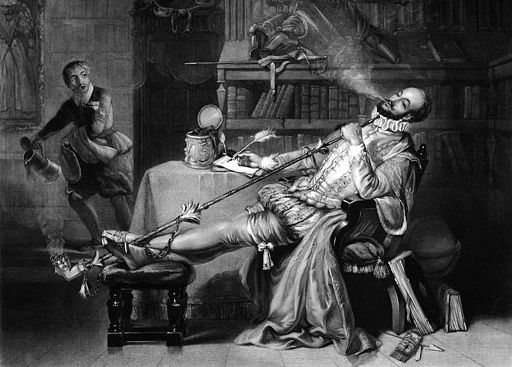
“Raleigh’s First Pipe in England” – an illustration included in Frederick William Fairholt’s Tobacco, its history and associations. 1859. 

Sir Walter became an avid and influential advocate of tobacco, and many other English nobles then also indulged. He is said to have presented tobacco to Queen Elizabeth I; and, of course, smoking then became the rage in the Royal Court.

Recreational use of the addictive stimulant soon covered England and much of Europe in smoke; and, unfortunately, many believed that it had health benefits and that smoking cured all manner of illnesses, including gout, hysteria, and cancer; and when applied externally, could be used for bites from poisonous reptiles and insects, ringworm, and to increase the growth of hair. 

Pipe-smoking then grew rapidly across all levels of English society and the English demand for tobacco became the greatest in the Old World. One historian described it as a “insatiable.” Note that the use of cigarettes as the primary vehicle for consuming tobacco did not become commonplace until well after the Industrial Revolution. 

However, the English had a serious problem — availability of tobacco. By the late 1500s, not a single English tobacco plantation existed in the New World, which meant that obtaining it relied on trade, smuggling, or capturing vessels bound for Portugal or Spain. This supply problem is cited by many historians as one of the precipitating factors in the decision to establish a permanent colony in the Americas. 

King James I, in his 1604 “Counterblaste to Tobacco,” voiced his opposition to the “noxious weed” and his concern that tobacco smoking had serious social and health implications. He then raised the taxes on tobacco in an effort to reduce use.

The Tobacco Mystique

Despite the King’s “Counterblaste,” tobacco developed an “aura” amongst the “smoking public.” For example, the opening speech of Moliere’s Don Juan begins, “There is nothing like tobacco. It’s the passion of the virtuous man; and whoever lives without tobacco isn’t worthy of living.”

A century later, Sir Arthur Conan Doyle continued in that vein in The Red Headed League, wherein a contemplative Sherlock Holmes, while considering a complex problem, informed Dr. Watson that, “It is quite a three pipe problem, and I beg that you won’t speak to me for fifty minutes.”

Finally, in World War I, General John Pershing appealed from France: “You ask me what we need to win this war”; and I answer “tobacco, as much as bullets.”

The King Addresses England’s Tobacco Deficit

In 1606, King James I granted a charter to the Virginia Company of London to establish permanent colonial settlements in the New World. Although their primary motivation was the hope of reproducing the wealth and riches that the Spanish brought home after they looted the Aztec empire; the Company also supported the English national goals of offsetting the expansion of other European nations abroad, finding a sea passage through the New World to India and Asia, and converting the indigenous peoples to the Anglican religion.

Their journey began that December and in May,1607, three ships with over 100 male colonists and another 40 crew members arrived in the New World to start a settlement at Jamestown, which they named after their king.

Location, Location, Location

Jamestown was selected because its waters were deep enough to enable the English to secure their ships at the shoreline, its position was defensible, and there was no native inhabitation. The reasons for the latter quickly became obvious.

The settlement was on a mosquito-infested, swampy peninsula, downstream from nearly 15,000 native Algonquians, who lived in more than 100 villages, and were ruled by a powerful leader, Powhatan (the “Powhatans.”)

Immediate Problems

The settlers arrived without sufficient food supplies and an inadequate group of skilled farmers, skilled tradesmen, and laborers. Their group included a large number of wealthy members of the gentry, whose background did not include much manual labor. 

Their water source was brackish and unsanitary, and they developed typhoid and dysentery. Worse still, mosquitoes in the marsh carried malaria. Their governing council, which was proscribed by the king, lacked authority and was ineffective. 

They had landed during a prolonged drought, which made finding fresh water and planting any crops at all very difficult. 

Relations with the Powhatans, whose harvests were also impacted by the drought, were tenuous; and degraded into open conflict, as the English, who were forced to rely on them for most of their food; eventually escalated from trade, to raiding the smaller villages. 

By the end of 1607, Jamestown was close to failing, and only the periodic arrival of supply ships from England held the colony together.

At this point, I am going to change tack from this play-by-play analysis of the trials and tribulations of the settlers, and discuss the activities of some key people who made the venture succeed (spoiler).

Captain Christopher Newport

Newport was an English seaman and privateer, who was captain of the largest of the three ships that carried the earliest settlers to Jamestown; and in overall command of the convoy on that first voyage. He also made several supply trips between England and Jamestown, which, as noted above, “held the colony together.” 

In 1609, he became Captain of the Company’s newly launched “Sea Venture,” which was the flagship of a new larger convoy carrying settlers, provisions, and the first group of government officials to Jamestown. On that voyage, the “Sea Venture” sailed into a fierce storm, ran aground, and was forced to temporarily land in Bermuda to make repairs.

Captain John Smith

Smith became the colony’s leader in 1608, the fourth in a succession of council leaders. His administration had the advantage of the King’s second charter, which created a much stronger form of governance under the now “Governor” John Smith, and included a period of military law that carried harsh punishments for those who did not obey.

Smith quickly instituted the policy: “He that will not work, will not eat.” Unfortunately, he was injured in late-1609 and returned to England. His departure was followed by a period of warfare with the Powhatans and the deaths of many settlers from starvation and disease.  

John Rolfe

Rolfe arrived in Jamestown in 1610 with the “Sea Venture” convoy along with 150 other settlers. He began cultivating tobacco, using seeds from Trinidad, or the West Indies, and began development of Virginia’s first profitable export. Note that how Rolfe came by the tobacco seed is not known.

In 1614, Rolfe married Powhatan’s daughter, Pocahontas. The couple traveled to London in 1616 with their infant son Thomas, with the expectation of stimulating investment in the Jamestown settlement. Pocahontas, who was christened Rebecca before the voyage, was presented to English society as an example of the “civilized savage.”

She died before returning to Virginia. Their marriage created a climate of peace between the colonists and the Powhatans; which continued for eight years as the “Peace of Pocahontas.”

Virginia Tobacco was an Unqualified Success

Rolfe’s new and milder tobacco proved immensely popular in England, helping to break the Spanish monopoly and creating a stable economy for the colony. 

By 1617, the colony was exporting 20,000 pounds of tobacco annually; doubling that amount in the following year. Historian Lee Pelham Cotton estimates that by 1640, London was importing nearly a million and a half pounds of tobacco per annum from Virginia.

James I’s “noxious weed” had become the economic staple of Virginia; and would ensure the survival of the colony.  By the beginning of the 17th century, the Virginia Colony became the wealthiest and most populated British colony in North America, which was probably the impetus for commissioning further settlements in the New World.

Indentured Servitude and Slavery

From the beginning (i.e., about 1500), the Portuguese had enslaved the indigenous natives in their colony of Brazil to work on their sugar cane, cocoa, and tobacco plantations The import of African slaves began mid-16th century, but the enslavement of indigenous peoples continued well into the 17th and 18th centuries. 

The British hesitated to establish slavery in Virginia because they relied on indentured servants for the grueling labor in the tobacco fields. However, the growing demand for Rolfe’s tobacco resulted in a huge need for more field laborers; and, unfortunately, coincided with declining numbers of indentured servants willing to emigrate from England. The number of slaves increased significantly thereafter.

Author’s Notes:

In Part 2, I will review the expansion of English settlements into New England, with particular focus on how tobacco developed as a cash crop in Connecticut

I will also consider Martin Luther King, Jr.’s experience in the early-1940s as a college student “working tobacco” in the Farmington River Valley.

I will present the literature and the cinema that romanticized Connecticut tobacco; and finally, contrast the 1998 Tobacco Settlement with the more recent Opioids Settlement 

However, before I close this essay, I wish to share my opinion that Disney got it all wrong. 

The 1995 production of “Pocahontas” tells the story of Captain John Smith’s romance with Pocahontas, which progresses, much to the disapproval of her father, Chief Powhatan. Smith’s fellow Englishmen plan to rob the Native Americans of their gold. As the story continues, her father tried to execute Smith by clubbing him to death. Pocahontas prevented the bloody killing by resting her own head on his.

Of course, I could not corroborate any of this; but, refer you to the section above on John Rolfe.

What’s troubling is that, given Disney’s probable incorrect review of history, it may also be possible that Davy Crockett was not the “King of the Wild Frontier.”

Editor’s Note: i) This is the opinion of Thomas D. Gotowka.
ii) The photo published above of George Burns is in the public domain in the United States because it was published in the United States between 1927 and 1977, inclusive, without a copyright notice.
iii) The photo published above of Sir Walter Raleigh is available from the New York Public Library’s Digital Library under the digital ID 1107712: digitalgallery.nypl.org→digitalcollections.nypl.org. {{PD-US}}

Tom Gotowka

About the author: Tom Gotowka’s entire adult career has been in healthcare. He will sit on the Navy side at the Army/Navy football game. He always sit on the crimson side at any Harvard/Yale contest. He enjoys reading historic speeches and considers himself a scholar of the period from FDR through JFK. A child of AM Radio, he probably knows the lyrics of every rock and roll or folk song published since 1960. He hopes these experiences give readers a sense of what he believes “qualify” him to write this column.


A View From My Porch: A Primer on the American Rescue Plan, What’s Happening to the Money in Old Lyme

Over the past several months, the regional media have covered American Rescue Plan (ARP) funding decisions made in several Southeast Connecticut communities. On July 26, the New London Day carried the headline, “American Rescue Plan Funding Floods Southeastern Connecticut.”

Even before that, on June 15, Old Lyme’s First Selectman Timothy Griswold reported, “The American Rescue Plan will pay the Town about $743,000, with an additional $1,419,000 share of the payment to New London County, totaling about $2,162,000.” 

I will discuss the fundamentals of ARP in this “View”; and then review the approach being taken by Old Lyme to decide how best to distribute those funds.

My objective in this essay is that readers gain some understanding of this important legislation. Note that this is not an exhaustive analysis of ARP, just what I consider the important highlights.

The American Rescue Plan Act (ARPA) of 2021 is a $1.9 trillion economic stimulus bill passed by Congress and signed into law by President Biden on March 11, 2021. The goal of the ARPA is to “accelerate the nation’s recovery from the economic and health effects of the COVID-19 pandemic.” It is actually the sixth federal COVID relief bill passed in the last year and a half; and may be the largest, in terms of funds designated for Connecticut. 

The Plan includes $65.1 billion in direct, flexible aid to every county in the United States; and then, via the counties, additional funds to some cities, towns, and villages.

Connecticut towns and cities will receive $2.55 billion, with $1.56 billion earmarked for “general government” (i.e., vital public services), and $995 million for boards of education.

Approved Uses: The Department of the Treasury has issued guidance regarding appropriate use of these funds; and will provide continuing oversight as funds are disbursed.

Eligible uses fall into five categories:-

  1. Supporting the public health response, including mitigation and medical expenses
  2. Addressing negative economic impacts, which may include assistance to households, small businesses, and non-profits; or aid to impacted industries, like tourism, travel, the arts, and hospitality
  3. Investing in water, sewers, and broadband infrastructure 
  4. Premium pay to essential workers
  5. Replacing lost public sector revenue.

Old Lyme ARP Activities:

Old Lymes’s Board of Selectmen (BOS) has appointed a committee* charged with developing and recommending (to the BOS) an approach for the distribution of ARP funds to Old Lyme residents and businesses who have been impacted by the COVID pandemic. This committee is comprised of individuals with broad expertise in public health, business, municipal infrastructure, social services, emergency services, arts, and tourism. 

The first real “hands-on” introduction to this group by residents will be over the course of the next several weeks, when the committee conducts a survey of the impact of COVID on our community. Those survey results are very important, because they will provide a framework for an estimate of Old Lyme’s collective need, and help set priorities that will be included in the recommendation to the BOS. A funding process may then be developed and publicized.

CARES Act:

Many Old Lyme residents and business owners may have already benefited from the Coronavirus Aid, Relief, and Economic Security (CARES) Act, which was signed into law on March 27, 2020 by then President Donald Trump, also for emergency relief of the economic impacts of COVID. 

CARES’ $2 trillion included one-time cash payments to eligible individuals, expanded unemployment benefits, direct payments to eligible families, and the Paycheck Protection Program, which provided grants and, “forgivable” loans to small businesses (i.e., “forgivable” when used for eligible payroll costs).

Some Final Thoughts:

Old Lyme’s ARP funds are, at present, kept in an “interest-bearing account” in a local bank. Note that those funds, including interest, must be obligated or awarded by Dec. 31, 2024.

Among regional towns and cities, Norwich received the most overall funding, nearly $30 million, followed by New London with more than $26 million. 

East Lyme, Montville, Stonington and Waterford each received more than $5 million. Lyme received $685,421.56.

A complex methodology was used to determine funding levels; I won’t try to do justice to it within the confines of this essay.

That said, the federal government used a modified version of HUD’s old Community Development Block Grant formula, with total grant size for “non-metro cities” capped at 75 percent of the municipality’s most recent budget” (i.e., as of Jan. 27, 2020). The revised formula also considered total population and the rate of local unemployment.

In closing, the Committee anticipates publicizing the survey mentioned above through the local media and other channels directly reaching residents.

*Editor’s Note: Old Lyme ARP Committee members elected the author as chairman at their first meeting.

Tom Gotowka

About the author: Tom Gotowka’s entire adult career has been in healthcare. He’ will sit on the Navy side at the Army/Navy football game. He always sit on the crimson side at any Harvard/Yale contest. He enjoys reading historic speeches and considers himself a scholar of the period from FDR through JFK.

A child of AM Radio, he probably knows the lyrics of every rock and roll or folk song published since 1960. He hopes these experiences give readers a sense of what he believes “qualify” him to write this column.

A View From My Porch: Continuing the Tikka Saga — with Slides of Trips to the UK

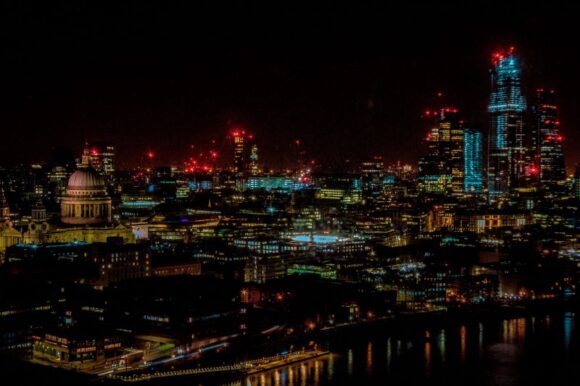
The London skyline by night with St. Paul’s Cathedral at center left. Photo by Nick Fewings on Unsplash.

Clearly, we all need a break; this lighter essay is mine.

In August, LymeLine published a recipe for chicken tikka masala from Lee White cooked in an “Instant Pot.” We made the dish, pictured below, with her recipe and found it to be an authentic and tasty interpretation of the “British staple.”

Christina and I enjoy the aromatic spices, and have some “history” with cilantro. We added steamed celery, carrots, and peas to Lee’s dish; as we often do with curries.

Coincidentally, chicken tikka masala is my “go-to” entrée in Indian restaurants, since it can be spiced mild to medium. Christina has a much more adventurous palate, and has been known to order a curry, “India spicy”, which usually piques the interest of the restaurant staff, who may hover nearby until she tastes the dish. I’ll eat all the naan; she won’t need it.

We were introduced to tikka on our first trip to England, where we visited my daughter, Erin’s (then) home in the Roman walled city of Chester, which also served as our base for Liverpool, London, and the broader countryside. 

There is no shortage of restaurants highlighting the cuisine of the subcontinent in London. Our choice was just over the London Bridge, near the entrance to the Borough Market; which, alone, is worth a visit.

I look to Madame Editor to corroborate or correct the following: former British Foreign Secretary, Robin Cook, described “tikka” as “the true British national dish.” Erin agreed, but not wholeheartedly; and went further and informed us that legend has it that the recipe actually originated in Glasgow, by Bangladeshi chefs, who created it to provide an alternative to their traditional, spicier dishes for the milder Scottish palate. 

I was surprised with the above, because I would have assumed that the national dish would be bangers and mash, fish and chips, or a bacon bap from a vendor in a train station.  I’ll defer to Madame Editor.

Author’s Notes: For the unfamiliar, an Instant Pot (IP) is, a relatively new small kitchen appliance that houses both a pressure cooker and a slow cooker. As Lee noted in her recipe, you can also sauté or brown meats in the IP. In our household, we use it once or twice a month

Here are a few vacation slides; actually, the captions.

  • We walked the Roman Wall in Chester and watched a lacrosse match at the Queen’s School for girls, which was founded in 1878, and renamed in 1882 as the “Queen’s School”, by decree of Queen Victoria, the school’s first patron
  • We were regularly within sight of the Queen Victoria Clock Tower at Chester’s East Gate. Built to celebrate Queen Victoria’s diamond jubilee, it is said to be the most photographed clock in England (after Big Ben).
  • We strolled along the canals in Chester and were impressed with the “fleets” of narrow boats, which are canal boats serving both as cruisers and residences.  
  • We visited both Penny Lane and the Cavern Club in Liverpool. The former has a famous barber; while the latter is known as the birthplace of the Beatles.
  • We visited the Roman Baths in Somerset, constructed in 70 A.D., and now considered one of the best-preserved historic sites in Roman Britain.
  • We visited the magnificent St. Paul’s Cathedral.
  • We saw the Rosetta Stone and the Pompei exhibit at the British Museum.
  • We shopped in Harrods and viewed the memorial to Princesss Diana and Dodi Fayed, which has since been removed. 
  • We visited the Churchill War Rooms, including the broadcast room where the PM recorded his wartime messages to the British public.
  • We visited some magnificent gardens on country estates, and much smaller, but meticulously maintained home gardens, whose gardeners were very willing to discuss local horticulture with we yanks. 
  • On Anglesey Island, in Wales, we were surprised to see moored sailboats with their keels resting on the seabed at low tide. We visited a church on a small off-shore island accessible only at low tides.

We want to return to the UK. And spend more time in Wales with Erin and her husband, RAF Squadron Leader Rugg, and perhaps fit Scotland into the itinerary.

Editor’s Note: i) This is the opinion of Thomas D. Gotowka.

ii) Growing up in England during the second half of the 20th century, there is no doubt that during my early years fish and chips, bangers and mash, or roast beef and Yorkshire Pudding were variously regarded as the national dish. Mr. Gotowka is correct that by the 70’s or 80’s curry in all its forms had become a major feature of the British culinary landscape. I am honestly not sure what would be considered the national dish at this point … I will consult with friends and family still located there and report back!

Tom Gotowka

About the author: Tom Gotowka’s entire adult career has been in healthcare. He’ will sit on the Navy side at the Army/Navy football game. He always sit on the crimson side at any Harvard/Yale contest. He enjoys reading historic speeches and considers himself a scholar of the period from FDR through JFK.

A child of AM Radio, he probably knows the lyrics of every rock and roll or folk song published since 1960. He hopes these experiences give readers a sense of what he believes “qualify” him to write this column.