A View from My Porch: Children’s Literature for the intrepid — Let Freedom Read!

Tom Gotowka

The American Library Association (ALA) has proclaimed “Let Freedom Read!” as the theme for this this year’s “Banned Books Week,” which just ended this past Friday (Oct. 7.) This “View” is written to acknowledge the rationale for such a week, and reflect on why it is especially pertinent in 2023 Old Lyme.

Stepping back, I said at the end of “Surfing with Gen. Alpha,” which I characterized as “something light,” that “I anticipate that my next “View” will be about children’s books.” I will present that in Part 2 of this essay, but with emphasis on challenges to children’s books, after some news from the ALA, who released its preliminary data on banned and challenged books for 2023 in mid-September.  

The data show a “record surge” in challenges to books in public libraries. The ALA identified 695 attempts to censor library materials and services and documented challenges to 1,915 unique titles” for the period from January through August, 2023 — a 20 percent increase from the same period in 2022. 

Particularly upsetting is that public libraries now account for one-half of total challenge requests. “The vast majority of challenges were for books written by or about a person of color or a member of the LGBTQIA+ community. Unfortunately, and as inferred above, the events that began last May in Old Lyme clearly put our community in their data set. 

I continue my consideration of censorship here, which began last August with “A View From My Porch: Some Funny Things Happened on the Way to the Celebration.” Accordingly, this “View” is “weightier” than surfing (less buoyant?); but before I get into that, please remember that we have a municipal election on Tuesday, November 7th.  If you are not already registered, you can pick up the forms at the Library. 

Recent Events in Old Lyme — Just a ‘kerfuffle’?

On July 28th, The Day called it a “kerfuffle”, but I do not think that the word adequately describes the anger and anxiety generated by two letters that questioned the suitability of two titles available in our library’s “Teens & Tweens” section. (Editor’s Note: This is a link to the second letter — we did not receive a copy of the first letter.) They demanded the removal of Let’s Talk About It: The Teen’s Guide to Sex, Relationships and Being a Human,”, by Erika Moen and Matthew Nolan and; You Know, Sex: Bodies, Gender, Puberty and Other Things,” by Cory Silverberg and Fiona Smyth from that section; and in addition; “a proper review of the materials in the Teens &Tweens room “in hopes that no other content like this is available in that space”.  

Coincidentally, the letters were received by the Library Director, and the Board of Trustees just as Old Lyme was preparing to celebrate the 125th anniversary of the founding of the Phoebe Griffin Noyes Library, scheduled for June 23rd.  

Note that although the Library has an established process for questioning materials in its collection, i.e., a “Request for Reconsideration;” that process would not have generated the coverage in the print and broadcast media, or produced the angst that occurred here. 

I did not see this happening in Old Lyme, but we all would eventually learn that, “The calls for removal are part of a national storm that has gained strength through the South and Midwest;” which is not very comforting. Is modern Old Lyme becoming Florida and Texas?

Nonetheless, the “Rock the Phoebe” celebration went on as planned; and a few days afterwards, more than 400 Old Lyme and Lyme residents responded formally to the book challenges in a letter overwhelmingly in opposition to the proposed actions (above). Note: see the “View” I cited above for a more thorough survey of the local situation and an appraisal of whether Old Lyme’s experience was unique in the broader context of attempts at censorship occurring statewide. 

Lest we ever forget, I lay out the Connecticut media coverage below in an annotated timeline detailing the key events that occurred after receipt of the two letters. 

With apologies to Mr. Fred Rogers, It was not, “A beautiful day in this neighborhood.”

Media coverage; a play-by-play: 

On March 31st, the CT Examiner published a Letter to the Editor from the chairman of the Old Lyme Republican Town Committee (RTC) that troubled me. The letter was an aggressive response to a March 26th sermon by the Rev. Dr. Steven R. Jungkeit, senior minister of the First Congregational Church of Old Lyme, that included some of the Rev. Jungkeit’s concerns with an RTC mailer that went out to residents with a list of priorities that included a “pledge” to exercise greater “parental rights” over the shaping of school curricula and the holdings of school and public libraries. The Rev. Jungkeit is well-known as a strong advocate for social justice and has publicly stated his concerns regarding guns, book bans, and systemic racism. 

The RTC chairman said that the sermon contained “petty, ill-informed, and disingenuous accusations.” To me, the language in the RTC chairman’s letter appeared insulting and almost threatening. Note that I am not a member of the Rev. Jungkeit’s congregation, although I respect his opinions and feel that it is not inappropriate for him to voice them from the pulpit or in written opinion (below).

The Old Lyme Democratic Town Committee held a “Freedom to Read” rally on Friday, April 28th.

On June 14th, The Day published the results of the latest report compiled by the Southern Poverty Law Center (SPLC), a non-profit legal advocacy organization that monitors extremist organizations in the United States. They identified 11 hate and anti-government extremist groups operating in Connecticut. Amongst them are two chapters of “Moms for Liberty,” who first emerged in Florida in 2021 to campaign against COVID19 public health measures like masks and vaccines. 

They were listed as an “extremist group” over accusations of harassing community members, advancing misinformation about LGBTQ+ people, and fighting to remove materials about diversity from classrooms. Their leadership denied the accusations.

However, they are well-known for their extremist agenda, which includes banning books that address gender, sexuality, and racial issues from schools and public libraries; and promoting policies that target trans youths; and opposing school curricula that mention LGBT rights or race and ethnicity. Their website states that the organization is dedicated to, “Unifying, educating and empowering parents to defend their parental rights at all levels of government.” 

Rachel Carroll Rivas, deputy director for research, reporting, and analysis at the SPLC said, “They really are seeking to undermine public education and to divide communities.” They are now widespread and influential within the Republican party. 

GOP presidential candidates who appeared this past July at the organization’s national summit in Philadelphia include Ron DeSantis, Nikki Haley, Asa Hutchinson, Vivek Ramaswamy, and Donald Trump.

On June 27th, the Hartford Courant reported that Steve Spooner, a member of the RTC, “Identifies himself in the second letter as the “lead organizer of the effort to remove the books from the Teens &Tweens shelves.”

On June 28th, the Hartford Courant published commentary by Rev. Jungkeit titled, “The banning of books – all books – is wrong;” in which he states, “The decision about what books are appropriate for any young person is one that needs to be made by that young person in conversation with his/her parents. It is not a decision that should rest with a self-appointed group of citizens seeking to act in loco parentis for all the young people in Old Lyme.”

And further, “The efforts undertaken by those seeking to ban these books can and should be understood as a form of bullying. Such efforts are mean spirited, cruel, regressive and hurtful to a population that is already forced to live precariously; and especially to those who identify as trans in the Lyme and Old Lyme region.

On July 11th, the Library Board of Trustees announced that the two books “Meet the selection criteria as stated in The Library’s Collection Development Policy for inclusion in the Library’s Teen/Tween collection”; and “the Board’s decision rested on the principles found in the ALA’s Freedom to Read statement; which espouses freedom to read for all members of the community, irrespective of the relative size or outspokenness of the opposing groups.”

The Day editorial board stated, “It’s disappointing at best, that so many jumped on this unwarranted and dangerous book banning bandwagon. While these books may not be appropriate for every young tween, they are absolutely appropriate for many tweens and teens struggling with all the age-old issues of adolescence.”

They went ever further and said that, “While the letters contend the request to remove these books from the teen-tween section of the library does not constitute book banning, it is obvious that is exactly what is being advocated here.”

On July 28th, The Day reported that an Old Lyme resident described one of the books in question as “pornography marketed to children” at a meeting of the Lyme Library Board of Trustees The book was not in the Lyme Public Library’s collection, although there were requests for the book from residents. 

Frankly, if you “do the math” above, you must ask yourself whether they’re using the ‘Moms for Liberty’ playbook?” 

In Part 2, I will review some of the challenges and bans directed at several popular titles and authors of children’s and tween’s literature, many of which are now, or once were on the bookshelves in our home. It’s time for a little healthy nostalgia.

Author’s Notes — Part 1: Over the past few months, I have read more about public libraries than I have read in public libraries, and I continue to support a parent’s right to oversee their ‘teen’s & tween’s’ book selections, but feel strongly that they do not have the right to make those decisions for other parents. Clearly, fighting against censorship is vital to preserving our First Amendment right to access information and to decide for ourselves what books we want our kids to read. Libraries should not curate their selections based on popularity of ideas but on the principle of allowing people access to a wide spectrum of ideas. Finally, my advice, based on personal experience remains that parents should talk with their children and endeavor to create an environment in which they are comfortable approaching you for advice or feedback on any number of issues.

Editor’s Note: This is the opinion of Thomas D. Gotowka.

About the Author: Tom Gotowka is a resident of Old Lyme, whose entire adult career has been in healthcare. He will sit on the Navy side at the Army/Navy football game. He always sit on the crimson side at any Harvard/Yale contest. He enjoys reading historic speeches and considers himself a scholar of the period from FDR through JFK. A child of AM Radio, he probably knows the lyrics of every rock and roll or folk song published since 1960. He hopes these experiences give readers a sense of what he believes “qualify” him to write this column.

Author’s Sources:
Cross, A. “Study: Watchdog identifies nearly a dozen active extremist, hate groups in Connecticut.” The Day. 06/14/2023.
American Library Association “American Library Association Releases Preliminary Data on 2023 Book Challenges” [Press Release]. 09/19/2023.
Aleem, Z. “The right’s censorship campaign is growing more ambitious — and threatening.” MSNBC. 09/22/2023.
The Day Editorial Board. “Let parents pick their kids’ books.The Day. 07/11/2023.
Cabello, M., and Butler, S.M. “How Public Libraries Help Build Healthy Communities.” Brookings Institution. 03/30/2017.
Dunne, S. “Old Lyme library facing calls to ban two sex-ed books from teen section”. The Hartford Courant. 06/27/2023.
Fitzgerald, W. “Op-ed: Book Banning Is About More Than Book Banning” olwenonline.com/. 07/03/2023.
Gotowka, T. “A View From My Porch: Some Funny Things Happened on the Way to the Celebration” olwenonline.com/. 08/16/2023.
Jungkeit, S. R. “Opinion: The banning of books – all books – is wrongThe Hartford Courant. 06/28/2023.
Logan, O. “Old Lyme Library Board Issues New Statement Answering Additional Questions Related to Recent Book Challenges” olwenonline.com/. 07/27/2023.
Meyer, K. “Presidential candidates court voters at ‘Moms for Liberty’ event” News Nation. 06/30/2023.
Nixon, R.A. “Sermonizing a ‘Complete Misrepresentation of the Facts’ in Old Lyme” CTExaminer. 03/31/2023.
Regan, E. “Old Lyme library refuses to remove two controversial books from its shelves” The Day. 07/11/2023.
Regan, E. “Old Lyme ‘kerfuffle’ over sex education book spills into LymeThe Day. 07/28/2023.
Regan, E. “National culture war blows through Old Lyme’s town center.” The Day. 07/29/2023
Swenson, A. “Moms for Liberty rises as power player in GOP politics after attacking schools over gender, race.” AP News. 06/12/2023.
Sarappo, E. “Read the Books That Schools Want to BanThe Atlantic. February 1, 2022
Yousef, Odette. “Moms for Liberty among conservative groups named ‘extremist’ by civil rights watchdog” NPR. 06/07/2023.

A View from My Porch: Children’s Literature for the intrepid — Let Freedom Read!

Tom Gotowka

The American Library Association (ALA) has proclaimed “Let Freedom Read!” as the theme for this this year’s “Banned Books Week,” which just ended this past Friday (Oct. 7.) This “View” is written to acknowledge the rationale for such a week, and reflect on why it is especially pertinent in 2023 Old Lyme.

Stepping back, I said at the end of “Surfing with Gen. Alpha,” which I characterized as “something light,” that “I anticipate that my next “View” will be about children’s books.” I will present that in Part 2 of this essay, but with emphasis on challenges to children’s books, after some news from the ALA, who released its preliminary data on banned and challenged books for 2023 in mid-September.  

The data show a “record surge” in challenges to books in public libraries. The ALA identified 695 attempts to censor library materials and services and documented challenges to 1,915 unique titles” for the period from January through August, 2023 — a 20 percent increase from the same period in 2022. 

Particularly upsetting is that public libraries now account for one-half of total challenge requests. “The vast majority of challenges were for books written by or about a person of color or a member of the LGBTQIA+ community. Unfortunately, and as inferred above, the events that began last May in Old Lyme clearly put our community in their data set. 

I continue my consideration of censorship here, which began last August with “A View From My Porch: Some Funny Things Happened on the Way to the Celebration.” Accordingly, this “View” is “weightier” than surfing (less buoyant?); but before I get into that, please remember that we have a municipal election on Tuesday, November 7th.  If you are not already registered, you can pick up the forms at the Library. 

Recent Events in Old Lyme — Just a ‘kerfuffle’?

On July 28th, The Day called it a “kerfuffle”, but I do not think that the word adequately describes the anger and anxiety generated by two letters that questioned the suitability of two titles available in our library’s “Teens & Tweens” section. (Editor’s Note: This is a link to the second letter — we did not receive a copy of the first letter.) They demanded the removal of Let’s Talk About It: The Teen’s Guide to Sex, Relationships and Being a Human,”, by Erika Moen and Matthew Nolan and; You Know, Sex: Bodies, Gender, Puberty and Other Things,” by Cory Silverberg and Fiona Smyth from that section; and in addition; “a proper review of the materials in the Teens &Tweens room “in hopes that no other content like this is available in that space”.  

Coincidentally, the letters were received by the Library Director, and the Board of Trustees just as Old Lyme was preparing to celebrate the 125th anniversary of the founding of the Phoebe Griffin Noyes Library, scheduled for June 23rd.  

Note that although the Library has an established process for questioning materials in its collection, i.e., a “Request for Reconsideration;” that process would not have generated the coverage in the print and broadcast media, or produced the angst that occurred here. 

I did not see this happening in Old Lyme, but we all would eventually learn that, “The calls for removal are part of a national storm that has gained strength through the South and Midwest;” which is not very comforting. Is modern Old Lyme becoming Florida and Texas?

Nonetheless, the “Rock the Phoebe” celebration went on as planned; and a few days afterwards, more than 400 Old Lyme and Lyme residents responded formally to the book challenges in a letter overwhelmingly in opposition to the proposed actions (above). Note: see the “View” I cited above for a more thorough survey of the local situation and an appraisal of whether Old Lyme’s experience was unique in the broader context of attempts at censorship occurring statewide. 

Lest we ever forget, I lay out the Connecticut media coverage below in an annotated timeline detailing the key events that occurred after receipt of the two letters. 

With apologies to Mr. Fred Rogers, It was not, “A beautiful day in this neighborhood.”

Media coverage; a play-by-play: 

On March 31st, the CT Examiner published a Letter to the Editor from the chairman of the Old Lyme Republican Town Committee (RTC) that troubled me. The letter was an aggressive response to a March 26th sermon by the Rev. Dr. Steven R. Jungkeit, senior minister of the First Congregational Church of Old Lyme, that included some of the Rev. Jungkeit’s concerns with an RTC mailer that went out to residents with a list of priorities that included a “pledge” to exercise greater “parental rights” over the shaping of school curricula and the holdings of school and public libraries. The Rev. Jungkeit is well-known as a strong advocate for social justice and has publicly stated his concerns regarding guns, book bans, and systemic racism. 

The RTC chairman said that the sermon contained “petty, ill-informed, and disingenuous accusations.” To me, the language in the RTC chairman’s letter appeared insulting and almost threatening. Note that I am not a member of the Rev. Jungkeit’s congregation, although I respect his opinions and feel that it is not inappropriate for him to voice them from the pulpit or in written opinion (below).

The Old Lyme Democratic Town Committee held a “Freedom to Read” rally on Friday, April 28th.

On June 14th, The Day published the results of the latest report compiled by the Southern Poverty Law Center (SPLC), a non-profit legal advocacy organization that monitors extremist organizations in the United States. They identified 11 hate and anti-government extremist groups operating in Connecticut. Amongst them are two chapters of “Moms for Liberty,” who first emerged in Florida in 2021 to campaign against COVID19 public health measures like masks and vaccines. 

They were listed as an “extremist group” over accusations of harassing community members, advancing misinformation about LGBTQ+ people, and fighting to remove materials about diversity from classrooms. Their leadership denied the accusations.

However, they are well-known for their extremist agenda, which includes banning books that address gender, sexuality, and racial issues from schools and public libraries; and promoting policies that target trans youths; and opposing school curricula that mention LGBT rights or race and ethnicity. Their website states that the organization is dedicated to, “Unifying, educating and empowering parents to defend their parental rights at all levels of government.” 

Rachel Carroll Rivas, deputy director for research, reporting, and analysis at the SPLC said, “They really are seeking to undermine public education and to divide communities.” They are now widespread and influential within the Republican party. 

GOP presidential candidates who appeared this past July at the organization’s national summit in Philadelphia include Ron DeSantis, Nikki Haley, Asa Hutchinson, Vivek Ramaswamy, and Donald Trump.

On June 27th, the Hartford Courant reported that Steve Spooner, a member of the RTC, “Identifies himself in the second letter as the “lead organizer of the effort to remove the books from the Teens &Tweens shelves.”

On June 28th, the Hartford Courant published commentary by Rev. Jungkeit titled, “The banning of books – all books – is wrong;” in which he states, “The decision about what books are appropriate for any young person is one that needs to be made by that young person in conversation with his/her parents. It is not a decision that should rest with a self-appointed group of citizens seeking to act in loco parentis for all the young people in Old Lyme.”

And further, “The efforts undertaken by those seeking to ban these books can and should be understood as a form of bullying. Such efforts are mean spirited, cruel, regressive and hurtful to a population that is already forced to live precariously; and especially to those who identify as trans in the Lyme and Old Lyme region.

On July 11th, the Library Board of Trustees announced that the two books “Meet the selection criteria as stated in The Library’s Collection Development Policy for inclusion in the Library’s Teen/Tween collection”; and “the Board’s decision rested on the principles found in the ALA’s Freedom to Read statement; which espouses freedom to read for all members of the community, irrespective of the relative size or outspokenness of the opposing groups.”

The Day editorial board stated, “It’s disappointing at best, that so many jumped on this unwarranted and dangerous book banning bandwagon. While these books may not be appropriate for every young tween, they are absolutely appropriate for many tweens and teens struggling with all the age-old issues of adolescence.”

They went ever further and said that, “While the letters contend the request to remove these books from the teen-tween section of the library does not constitute book banning, it is obvious that is exactly what is being advocated here.”

On July 28th, The Day reported that an Old Lyme resident described one of the books in question as “pornography marketed to children” at a meeting of the Lyme Library Board of Trustees The book was not in the Lyme Public Library’s collection, although there were requests for the book from residents. 

Frankly, if you “do the math” above, you must ask yourself whether they’re using the ‘Moms for Liberty’ playbook?” 

In Part 2, I will review some of the challenges and bans directed at several popular titles and authors of children’s and tween’s literature, many of which are now, or once were on the bookshelves in our home. It’s time for a little healthy nostalgia.

Author’s Notes — Part 1: Over the past few months, I have read more about public libraries than I have read in public libraries, and I continue to support a parent’s right to oversee their ‘teen’s & tween’s’ book selections, but feel strongly that they do not have the right to make those decisions for other parents. Clearly, fighting against censorship is vital to preserving our First Amendment right to access information and to decide for ourselves what books we want our kids to read. Libraries should not curate their selections based on popularity of ideas but on the principle of allowing people access to a wide spectrum of ideas. Finally, my advice, based on personal experience remains that parents should talk with their children and endeavor to create an environment in which they are comfortable approaching you for advice or feedback on any number of issues.

Editor’s Note: This is the opinion of Thomas D. Gotowka.

About the Author: Tom Gotowka is a resident of Old Lyme, whose entire adult career has been in healthcare. He will sit on the Navy side at the Army/Navy football game. He always sit on the crimson side at any Harvard/Yale contest. He enjoys reading historic speeches and considers himself a scholar of the period from FDR through JFK. A child of AM Radio, he probably knows the lyrics of every rock and roll or folk song published since 1960. He hopes these experiences give readers a sense of what he believes “qualify” him to write this column.

Author’s Sources:
Cross, A. “Study: Watchdog identifies nearly a dozen active extremist, hate groups in Connecticut.” The Day. 06/14/2023.
American Library Association “American Library Association Releases Preliminary Data on 2023 Book Challenges” [Press Release]. 09/19/2023.
Aleem, Z. “The right’s censorship campaign is growing more ambitious — and threatening.” MSNBC. 09/22/2023.
The Day Editorial Board. “Let parents pick their kids’ books.The Day. 07/11/2023.
Cabello, M., and Butler, S.M. “How Public Libraries Help Build Healthy Communities.” Brookings Institution. 03/30/2017.
Dunne, S. “Old Lyme library facing calls to ban two sex-ed books from teen section”. The Hartford Courant. 06/27/2023.
Fitzgerald, W. “Op-ed: Book Banning Is About More Than Book Banning” LymeLine.com. 07/03/2023.
Gotowka, T. “A View From My Porch: Some Funny Things Happened on the Way to the Celebration” LymeLine.com. 08/16/2023.
Jungkeit, S. R. “Opinion: The banning of books – all books – is wrongThe Hartford Courant. 06/28/2023.
Logan, O. “Old Lyme Library Board Issues New Statement Answering Additional Questions Related to Recent Book Challenges” LymeLine.com. 07/27/2023.
Meyer, K. “Presidential candidates court voters at ‘Moms for Liberty’ event” News Nation. 06/30/2023.
Nixon, R.A. “Sermonizing a ‘Complete Misrepresentation of the Facts’ in Old Lyme” CTExaminer. 03/31/2023.
Regan, E. “Old Lyme library refuses to remove two controversial books from its shelves” The Day. 07/11/2023.
Regan, E. “Old Lyme ‘kerfuffle’ over sex education book spills into LymeThe Day. 07/28/2023.
Regan, E. “National culture war blows through Old Lyme’s town center.” The Day. 07/29/2023
Swenson, A. “Moms for Liberty rises as power player in GOP politics after attacking schools over gender, race.” AP News. 06/12/2023.
Sarappo, E. “Read the Books That Schools Want to BanThe Atlantic. February 1, 2022
Yousef, Odette. “Moms for Liberty among conservative groups named ‘extremist’ by civil rights watchdog” NPR. 06/07/2023.
A View From My Porch: The Beach Boys Redux — Surfing with Gen. Alpha

Tom Gotowka

I hypothesized in a “View” published in early August that “The Beach Boys,” whose music regularly celebrated muscle cars, the power of the internal combustion engine, and California car culture had an influence on Americans’ early reluctance to buy electric vehicles.

I did not expect to ever consider their music in another essay, or in this case, a little bit of their musical homage to the beach and surfing; but we are approaching the fall of the year and my grandson, “H”, who turned seven earlier this summer, graduated last summer with a few of his New Jersey cousins from surfing camp and returned home, schooled in, “The practices and values of the surf and ocean lifestyle.” 

My impression of his surf camp experience is that this coaching focused on technique and safety rather than the physics and science of the sport; and did not even acknowledge the robust body of music that contributed to “surfer-cool.” 

Consequently, as duty called, I present some of the science of the sport in this essay, and like the essay on electric vehicles, refer, but only briefly, to the surfing song list published by “The Beach Boys.” 

This essay is also presented as something light as we enter Old Lyme’s campaign season 2023.

Generation Alpha:

“Gen. Alpha,” is the cohort born between the early-2010s and the mid-2020s.They are the most globally-connected generation of children ever and could also end up being the most formally educated. They are the children of millennials and the immediate successors of the “Zoomers” of “Gen. Z,” and are the first generation to be born entirely within the 21st century. 

COVID-19 had a substantial impact on their childhood and acclaimed social demographer and futurist, Mark McCrindle, who coined the term Generation Alpha, defines and analyzes the generations in this article. He notes, “Generation Alpha will be the largest generation than ever before. Each week there are over 2.7 million Gen Alphas born. They will live for longer and are more culturally diverse compared to their older counterparts.”

All of Christina’s and my grandchildren are Alphas. “H” was born in mid-2016, a remarkable year; which I illustrate below:

  • The Denver Broncos defeated the Carolina Panthers, 24 to 10 in Super Bowl 50 on Feb.7; and a month later, Denver QB, Peyton Manning retired after 18 seasons in the NFL.
  • “Spotlight”, a very troubling “docudrama” that dramatized the “Boston Globe’s year-long Pulitzer Prize-winning investigation of the Catholic Archdiocese of Boston, won two Academy Awards on Feb. 28:– “Best Picture” and “Best Original Screenplay”.
  • That same evening, Leonardo DiCaprio won his first Academy Award, “Best Actor”, for his role as a frontiersman mauled by a bear in “The Revenant.”
  • President Obama and his family visited Cuba in March — the first visit by a sitting POTUS since Calvin Coolidge in 1928. His visit included talks with Cuba’s leader, Raul Castro, the Cuban people, some dissidents; and served as a symbolic capstone on more than a year’s effort to normalize economic and diplomatic relations between the United States and Cuba, after more than 50 years of Cold War hostility. Notably, the Obamas and the Castros attended a baseball game together at Havana’s 55,000 seat “Estadio Latinoamericano” between the Cuban National Team and the Tampa Bay Rays, marking the first visit to the island by a Major League Baseball team since 1999. Note, Rays, 4 to1.
  • The Atlantic hurricane season, which began on June 1, was the deadliest hurricane season since 2008, and the first above-average hurricane season since 2012.
  • On June 19, the Cleveland Cavaliers won the NBA Championship by defeating the Golden State Warriors — their city’s first professional sports championship in more than 50 years. 
  • Unlike the Academy Awards, a fantasy-based drama, “Game of Thrones,” won 12 Emmys on Sept. 18, the year’s top winner. 
  • On Nov. 2, the Chicago Cubs won their first World Series since 1908, snapping the “Billy Goat Curse,” one of the more infamous curses in sports, and baseball’s longest World Series title drought; surpassing Boston’s own “Curse of the Bambino” by almost a quarter-century. 
  • On Dec 10, Army finally beat Navy 21 to17 in double overtime; after blocking a Navy field goal with essentially no time left in the game — the first win over Navy since 2001. Army’s 14-game losing streak was the longest by either academy in a series that began in 1890.

Clearly, I have no idea whether surfing will be a long-term interest for “H,” and if so, whether his family will support his quest for the perfect wave. Nevertheless, here is some of the science that impacts the sport.

He is, however, an early and eager reader, and also a fan of the “View; and so, this essay might provide the basis for some, “What I did on my summer vacation” presentations, or a paragraph or two as he moves beyond first grade. 

Making Waves:

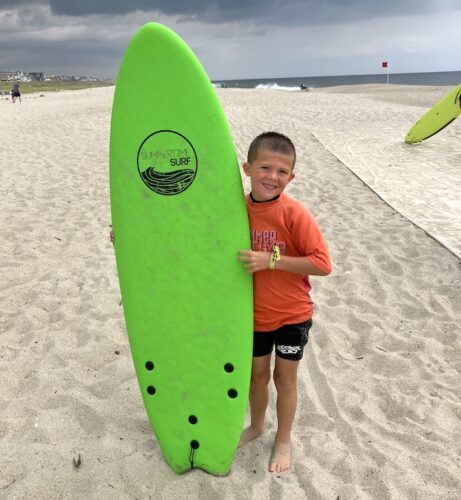
The author’s grandson, ‘H’, holds his board after another successful day at Surf Camp.

Waves form when the wind blows across the surface of the ocean, transferring energy through friction. Several factors affect the size and shape of waves. These include wind speed, wind duration, fetch (i.e., the distance over which the wind blows), water depth, and shoreline shape.

Generally, waves on the West Coast of the United States are bigger than those on the East Coast. The prevailing winds on the West Coast are behind the waves, which increases the waves’ energy; while on the East Coast, the prevailing winds usually blow against the incoming waves, decreasing the waves’ energy.

Further, the Pacific Ocean has a greater expanse than the Atlantic Ocean, which means that the fetch is greater on the West Coast.

Applied Physics:

Surfing is a good example of how several forces act together to enable a ride on the waves. I am going to discuss a few: gravity, buoyancy, and inertia; and consider the “center of gravity” (COG).

The forces of gravity and buoyancy work against each other. Gravity pulls the surfboard down, while buoyancy pushes it up. “H” will eventually understand that the latter force is referred to as “Archimedes’ Principle,” which states, in simple terms, that, “A body at rest that is completely or partially submerged in a fluid is acted upon by an upward, or buoyant, force.”

Because the materials used in contemporary surfboards are much lighter and less dense than the materials used in the past, the boards are more buoyant.

The early surfboards on the California beaches were essentially long redwood planks, sanded smooth; which absorbed water and became very heavy, even with the best protective finishes available at the time. These boards ranged from 10 to 20 ft. long and were not maneuverable, versus the modern boards that are much shorter and “steerable”.

An understanding of the COG is also important. Conceptually, the COG is the point around which the body’s weight is evenly distributed or balanced in all directions. The COG affects the stability of objects. The lower the COG, the more stable the object. The higher it is, the more likely the object is to topple over if it is pushed. 

Beyond surfing, the COG is also important in designing buildings and bridges; aircraft, race cars, and Humvees. (Note to “H”: It is also why you do not stand up in your dinghy and why you keep low when mountain biking.)

In practice, managing the COG is one of the most important skills a surfer can master. For example, to remain balanced, surfers crouch, keeping their center of gravity low. Surfers can also change their position on the board. If a surfer stands in the middle of the board where buoyancy and weight are balanced, the board will be flat. If the surfer moves back, the nose of the board will go up, making it much easier to turn in the water compared to the long wooden boards described above.  

This difference is due to the physical principle known as inertia, which describes how difficult it is to change something’s motion once it has started moving. Of course, “H” will eventually know it as “Newton’s First Law,” which states that an object at rest remains at rest, and an object in motion remains in motion at constant speed and in a straight line unless acted on by an external force.

Although long boards may not be as nimble as short boards, they reach higher speeds, mainly because their larger surface provides more area for water to push the surfer along. 

Connecticut Surf:

According to the “experts”, Long Island Sound has only modest fetch, so epic waves are hard to come by, but the following beaches are worth checking out:

  • The prime surfing season in Connecticut is typically from late summer through fall when hurricanes and tropical storms can generate larger swells.
  • Rocky Neck State Park has a sandy beach with a mix of sandbars and rocky sections that can create some challenging waves. 
  • Hammonasset Beach is good for longboarding and beginner surfers.
  • Fairfield Beach offers a consistent break with hollow waves that can be quite powerful during the right conditions. 

However, if you want an ocean experience that is close by, there are a few places in Rhode Island worth considering: 

  • Misquamicut Beach has reliable,  consistent, and beginner-friendly” surf. Like Connecticut, the best time of year to surf Misquamicut is Spring and often, the month of September; when you’ll get rideable swells and light offshore winds.
  • East Beach in Charlestown also has consistent waves, and can be challenging.

If a surfer’s search takes him or her beyond New England, The Beach Boys also chronicled a possible surfers’ travel program, identifying sites with “cooking” surf on three continents, Hawaii, and the Caribbean in two songs from the early-1960s, whose abridged lyrics follow below:

Let’s go surfing now, everybody’s learning how;
Come on a safari with me.
At Huntington and Malibu they’re shooting the pier;

At Rincon they’re walking the nose.
We’re going on safari to the islands this year, so if you’re coming, get ready to go.

They’re angling in Laguna in Cerro Azul;
they’re kicking out in Doheny, too.
Surfing’s mighty wild, getting bigger every day,
from Hawaii to the shores of Peru

And further:

You’ll catch them surfing’ at Del Mar,
Ventura county line,
Santa Cruz and Trestle,
Australia’s Narrabeen.
All over Manhattan
And down Doheny way,  

Haggerties and Swamies
Pacific Palisades.
San Onofre and Sunset,
Redondo Beach, L.A.
All over La Jolla; 
At Waimea Bay.

The Perils of Surfing:

In 1866, Mark Twain spent a few months in the Sandwich Islands (i.e., Hawaii) as a correspondent for “The Sacramento Union” newspaper. He reported on his own attempts at surfing: “I got the board placed right, and at the right moment, too; but missed the connection myself. The board struck the shore in three-quarters of a second… and I struck the bottom about the same time, with a couple of barrels of water in me.”

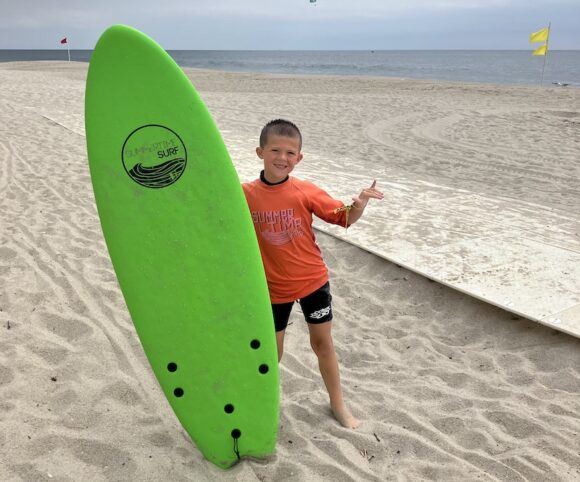
‘H’ gives the Shaka sign with his left hand. It is a friendly hand gesture usually associated with the surfing culture.

Author’s Thoughts:

Should you meet “H” on the beach, he may greet you with the Shaka sign, which is a friendly hand gesture usually associated with the surfing culture.  He’ll extend the thumb and pinky finger of his hand while holding the three middle fingers curled, Depending on the context, the gesture can mean ”hang loose”, “chill out,” or just hello. ” You might also warrant a “Cowabunga, Dude!”, which is an expression of amazement or enthusiasm. Remember, he turned seven a few months ago.

I anticipate that my next “View” will be about children’s books.

Editor’s Note: This is the opinion of Thomas D. Gotowka.

About the Author: Tom Gotowka is a resident of Old Lyme, whose entire adult career has been in healthcare. He will sit on the Navy side at the Army/Navy football game. He always sit on the crimson side at any Harvard/Yale contest. He enjoys reading historic speeches and considers himself a scholar of the period from FDR through JFK. A child of AM Radio, he probably knows the lyrics of every rock and roll or folk song published since 1960. He hopes these experiences give readers a sense of what he believes “qualify” him to write this column.

Author’s Sources:

Carter, Christine M. “The Complete Guide To Generation Alpha, The Children Of Millennials”. Forbes.08/18/2019.
Francis, J.F. “The Ultimate Guide to Surfing in Connecticut.” Surf Atlas. 12/04/2021.
Hall, D. “Currents, Waves, and Tides”. Smithsonian Ocean. 08/2020.
Kesten, P. “The Physics of Surfing.” Santa Clara University. Illuminate.08/19/2019.
Klein, C. “What Was the Curse of the Bambino—and How Was Baseball’s Greatest Hex Broken”? History. 09/30/2021.
Larson, S. “Spotlight and its Revelations.” The New Yorker. 12/08/2015. 
McCrindle, M. and Fell, A. (2023). ”Generation Alpha”. Sydney: Hachette Book Group. 2021. 
Sanchez, R. “What is the Chicago Cubs’ billy goat curse”? CNN. 10/28/2016
Spotlight Team. “Church Allowed Abuse by Priest for Years. The Boston Globe. 01/06/2002.
Trinastic, J. “Waves of Physics: The Science of surfing”. Science Connected. 05/11/2021
Twain, M. “Roughing it”. The American Publishing Company. 1872.

Song List:

Surfing Safari (The Beach Boys, 1962)
Surfing U.S.A. (The Beach Boys, 1963)

A View From My Porch: Some Funny Things Happened on the Way to the Celebration

Tom Gotowka

The celebration:

“Rock the Phoebe’s” joyful acknowledgement of the century and a quarter anniversary of the founding of Old Lyme’s Phoebe Griffin Noyes (PGN) Library in 1898 was scheduled for the evening of June 23.  

The funny things:

A letter, signed by 23 members of the Greater Old Lyme community was sent to the library on May 25. This was then followed by another letter on June 16, which was signed by 135.

The letters questioned the suitability of two titles available in the library’s “Teens & Tweens” section and called for the removal of Let’s Talk About It: The Teen’s Guide to Sex, Relationships and Being a Human, by Erika Moen and Matthew Nolan and You Know, Sex: Bodies, Gender, Puberty and Other Things, by Cory Silverberg and Fiona Smyth from that section. Perhaps even more startling they also requested a “… proper review of the materials in the ‘Teen-Tween’ room in hopes that no other content like this is available in that space.”

Nevertheless, “Rock the Phoebe” went on as planned; and a few days later, more than 400 Old Lyme and Lyme residents responded formally in a letter opposing the actions proposed in the two earlier letters.  

This “View” is not about the two ‘offending’ titles; and I am not going to present a play-by-play of the situation as it developed and was finally resolved without removal or relocation of the two books — that has all been exhaustively covered in the regional and national print and broadcast media.

I will not weigh in on the arguments regarding whether these actions represent a ban on the two books, or whether either book was “unbecoming of our community values”.

Rather, I will explore these actions in a broader context to get a feel of how unique the Old Lyme experience was, but first, I will return to the era of the “founding”. 

The Free Library Movement:

This movement really began in the 1840s when New Hampshire, followed by Massachusetts, and then Maine; authorized towns to levy taxes for the establishment and support of public libraries. The movement spread and continued through much of the second half of the 19th and early-20th centuries. 

The designation “free” means open to the public at no charge and was used to provide a distinction from the subscription libraries that were common in many communities at that time.

The movement was advanced by the philanthropy of industrialist Andrew Carnegie, whose support between 1883 and 1929 led to the construction of a system of 1,689 public libraries across the United States. These include 11 in Connecticut, but none in southeast Connecticut.

Local Activism:

Old Lyme has been blessed with an activist cleric, who is a strong advocate for social justice. The Rev. Steven R. Jungkeit, senior minister at the First Congregational Church of Old Lyme (FCCOL), has publicly stated his concerns regarding guns, book bans, and systemic racism. Apparently, a few are uncomfortable with such advocacy, especially when it came from the pulpit.

I was particularly troubled by an aggressive response to one of his sermons by a local political party leader, published at the end of March in another online source of community news. In my opinion, the language used in the response was insulting and almost threatening.

Is Old Lyme unique?

Yes, of course … but not in terms of book challenges.

Some candid observations of the broader environment: 

  • PEN America, the nonprofit organization that works to defend and celebrate free expression, identified nearly 1,477 incidents of books being prohibited during the first half of the 2022-23 academic year, up 28.5 percent from 1,149 cases in the previous semester. Overall, the organization has recorded more than 4,000 such incidents of banned books in the United States since it started tracking cases in July 2021. Such incidents are most prevalent in five states: — Texas, Florida, Missouri, Utah, and South Carolina.
  • The Connecticut Library Association has identified 38 active book challenges across the state, including Newtown, Westport, Darien, Brookfield, Fairfield, and Guilford; up from about nine at this time last year.
  • In Guilford, some residents called for parental notification for books they regarded as “vulgar and inappropriate”. Perhaps that could be called the “I’m telling on you” program? (Note: that is my own suggestion, not Guilford Memorial Library’s.)
  • Fairfield Library’s Board of Trustees unanimously voted to not remove “Let’s Talk About It,” from its shelves last October, with staff stating, “The book belongs exactly where it is.”
  • Old Lyme PGN Library Director Katie Huffman has reported that the two contested titles were the third and fourth books challenged at the library in the last two years, with no books removed so far.
  • PEN America also found that book challenges are not new, but the tactics are changing. Once provoked primarily by concerned parents, challenges are increasingly driven by organized groups, elected leaders and legislation targeting titles that “don’t align with their own values”. 
  • Of the national groups, Moms for Liberty (M4L), formed in Florida in 2021, has become widespread and militant. The group began by campaigning against COVID-19 protections, including masks and vaccines. Moms for Liberty advocates against school curricula that mention LGBTQ rights, Critical Race Theory, ethnicity, and/or discrimination. Many chapters have also campaigned to ban books that address gender and sexuality.
    The Southern Poverty Law Center characterized M4L as a far-right, extremist organization with close ties to the Republican Party rather than a genuine grassroots organization. Two chapters of this group are active in Connecticut. Is that really possible? At the very least, I will quote from the oft-banned book, Alice’s Adventures in Wonderland, in which Alice says, “Curiouser and curiouser.”
  • Aaron Sorkin’s new stage adaptation of Harper Lee’s To Kill a Mockingbird (which is based on the also frequently banned book of the same name) begins with Scout Finch telling the audience, ““Something didn’t make sense,” which, in retrospect, I could have used to introduce this “View.”
  • Avra Montazella, a senior at Lyme-Old Lyme High School, founded the Banned Books Club during her freshman year when she saw many books she loved being censored across the country.
  • Since 1982, the American Library Association’s Banned Books Week has been held in the fall as an annual awareness campaign to celebrate the freedom to read and stress the importance of ensuring access, even to unorthodox or unpopular viewpoints. The week is now co-sponsored by a coalition of organizations dedicated to free expression.

For 15 minutes of fame?

Our library has an established process for initiating a challenge to materials in its collection. It is simple and begins by filing a Request for Reconsideration … but of course, this process does not generate the media coverage or produce the angst that occurred here. 

The library’s collection development policies and reconsideration procedures can be accessed via the following link: Collection-Development-Policy-2022.pdf (oldlymelibrary.org)

Note that the “Sources” section below includes everything I reviewed in preparing this piece and, if interested in the underlying journalism, please refer to the sources that I have cited, which are readily available online.

Editor’s Note: This is the opinion of Thomas D. Gotowka.

About the Author: Tom Gotowka is a resident of Old Lyme, whose entire adult career has been in healthcare. He will sit on the Navy side at the Army/Navy football game. He always sit on the crimson side at any Harvard/Yale contest. He enjoys reading historic speeches and considers himself a scholar of the period from FDR through JFK. A child of AM Radio, he probably knows the lyrics of every rock and roll or folk song published since 1960. He hopes these experiences give readers a sense of what he believes “qualify” him to write this column.

Author’s Notes: I wholly support a parent’s right to oversee their ‘teen’s & tween’s’ book selections, but feel strongly that they do not have the right to make those decisions for other parents. My advice — based on personal experience — would be to talk with your children and endeavor to create an environment in which they are comfortable approaching you for advice or feedback on any number of issues.

The Day’s’ editorial board stated last month that, ”… while the letters contend the request to remove these books from the teen-tween section of the library does not constitute book banning, it is obvious that is exactly what is being advocated here.”

In closing, perhaps I can add some lighter perspective to this difficult subject by recalling the wisdom of Detective Sergeant Nick Yemana of NYPD’s 12th Precinct, who once told Captain Bernard “Barney” Miller, Commanding Officer of the detectives’ squad, that (sic) “What you gotta do is develop an Oriental philosophy. My grandfather used to say that many things look bleak at the moment of occurrence; but at least we ain’t got locusts.”

Sources:

Barnett, S. “’Mama bears’ may be the 2024 race’s soccer moms; some see extremism as GOP seeks votes”. The Day. 07/23/2023.

Brownstein, R. “The Book Bans Debate Has Finally Reached a Turning Point”. The Atlantic. 05/10/2023.

Chavez, N. “About a third of book bans reported in fall 2022 were a result of new state laws, free speech group says” CNN. 04/20/2023.

Chen, J. “Two adolescent sex-ed books challenged at Old Lyme library”. NBC-CT. 06/27/2023.

Dunne, S. “Old Lyme library facing calls to ban two sex-ed books from teen section”. Hartford Courant. 06/28/2023

Dunne, S. “More than 400 residents of a small CT town oppose sex-ed book ban attempt”. Hartford Courant. 08/07/2023

Editorial Board. “Let parents pick their kids’ books”. The Day. 07/11/2023.

Fitzgerald, W. “Op-ed: Book Banning Is About More Than Book Banning”. LymeLine. 07/03/2023

Gregorian, V. “Remembering Andrew Carnegie’s Legacy”. American Libraries Magazine.09/30/2019. 

Fleishman, J. “School librarians vilified as the ‘arm of Satan’ in book-banning wars”. L.A. Times. 01/27/2023. 

Friedman, J. & Farid-Johnson, N. “Banned in the USA: The Growing Movement to Censor Books in Schools”. PEN America.09/19/2022. 

Harkay, J. “Newtown is weighing a book ban. It’s not the only CT town to do so”. CT Mirror. 06/01/2023

Jungkeit, S.R., Fitzpatrick-Nager, L., & Gerber. C.  “Opinion: The banning of books – all books – is wrong”. Hartford Courant. 08/03/2023

LaBella, J. “Fairfield Library decides to not remove controversial book”. Fairfield Citizen. 10/12/2022. 

Littlefield, “The Real Agenda of Moms for Liberty”. The Nation. 08/07/2023.

Logan, O. “More Than 400 Sign Letter Supporting Old Lyme Library, Urging Rejection of Censorship Requests ‘In Their Entirety’”. LymeLine.com 06/29/1023

Mazariegos, M. “In a record year for book ban attempts, ALA says these 10 books were challenged most”. NPR. 04/04/2022 

Mongkol, C. “Old Lyme residents challenge two sex education books in library over sexual content”. NH Register. 06/28/2023.

Logan, O. “Old Lyme Library Board Issues New Statement Answering Additional Questions Related to Recent Book Challenges”. LymeLine.com 07/27/2023. 

Nixon, R.A. “Sermonizing a ‘Complete Misrepresentation of the Facts’ in Old Lyme” CT Examiner. 03/31/2023. 

Perreault, E. “Old Lyme library votes against banning sex education books after community backlash”. WTNH. 07/12/2023

Petri, A. E. “Book bans are on the rise in U.S. schools, fueled by new laws in Republican-led states”. L.A. Times. 04/22/2023. 

Putterman, A. “The national book banning debate has come to CT: ‘It’s kind of tearing the community apart’”. CTInsider. 05/30/2023. 

Regan, E. “Containing multitudes: minister, social justice activist, Marx scholar shakes things up in Old Lyme. The Day. 05/15/2021. 

Regan, E. “National culture war blows through Old Lyme’s town center”.The Day. 07/29/2023

Regan, E. “Old Lyme ‘kerfuffle’ over sex education book spills into Lyme”. The Day. 07/28/2023.

Shadmi, K. “Sketchbook/ Reality Hurts”. The NYT Book Review. 08/13/2023. 

Shakelford, K. “Opinion. — Religious Freedom Is Under Attack Like Never Before”. Newsweek. 08/05/2020. 
Sims, D. “A New Way of Looking at ‘To Kill a Mockingbird’”. The Atlantic. 12/2019.

Torres, L. C.Old Lyme library will keep two sex-education books in the teen section”. CT Public Radio. 07/11/202

A View From My Porch: A Treatise on Electric Vehicles — Baby Boomers, ‘Beach Boys’ & Battery Benefits

Tom Gotowka

After some sluggish early sales, there has been a considerable increase in the number of electric vehicles (EVs) on the roads in the United States. EVs comprised 5.8 percent of all new vehicle sales in the United States in 2022; up from 3.2 percent in 2021; and that’s more than three-quarters of a million of the roughly 14 million new cars and light trucks sold in 2022.

The Day reviewed EV registration data from the Connecticut DMV and reported that at the end of 2022, there were 30,186 EVs registered in Connecticut; of which 60 percent were all-electric vehicles, also known as battery electric vehicles (BEVs), which get all their power from energy stored in rechargeable battery packs.

The state registered only five fuel cell electric vehicles (FCEVs), which are powered by an on-board fuel cell that generates electricity using oxygen from the air and compressed hydrogen, emitting water vapor and heat. 

Notably, in the final six months of 2022, Connecticut EV registrations totaled 6,373, the most for any six-month period over the past several years. 

EV101:

I review the case for EVs in this “View”, and explore Americans’ early reluctance to make that purchase. I will also wax nostalgic on how the California car culture of the 1950s and ‘60s became embedded in the collective ethos of we baby boomers by rock bands like The Beach Boys and their contemporaries; possibly affecting our future attitudes regarding EVs;  — perhaps more so, but not exclusively, the males; I will not recommend any brand.

Note: I use either “gas-powered “equivalent or “similar conventionally-powered car” in this essay to contrast an EV to an otherwise comparable car model powered by an internal combustion engine (ICE).

Why EVs?

The transportation sector of the economy is one of the largest contributors to greenhouse gas emissions in the United States, nearly one-third of the total; — most of which comes from light-duty vehicles, i.e., passenger cars and light-duty trucks that use gasoline or diesel. BEVs, on the other hand, have zero tailpipe emissions and so, are much better for the environment.

Climate scientists consider “vehicle electrification” as one of the best ways to reduce planet-warming greenhouse gas emissions. The EPA released new pollution standards for passenger cars and trucks earlier this year; and legacy automotive companies like Ford, Volkswagen, and GM have committed to increase their development of EVs or even stop the production of gas-powered vehicles.

 An earlier LymeLine discussion of global warming can be found at this link.

The transition to EVs is expected to be beneficial for those who don’t even drive one. A large-scale study by investigators at USC’s Keck School of Medicine found that BEVs are associated with a statistically significant reduction in air pollution and respiratory diseases They demonstrated a 3.2 percent drop in the rate of asthma-related emergency room visits “for every 20 additional BEVs on the road per 1,000 people”.

While a 3.2 percent decrease may appear modest, the continued replacement of gasoline and diesel-powered vehicles with EVs should continue to yield substantial benefits for the public’s health; — i.e., with reductions in emissions and improved air quality, fewer people will inhale harmful quantities of carbon monoxide and nitrogen oxides, which have been linked to high blood pressure and respiratory problems.

Why the Early Reluctance?

Aside from the usual “wait and see” period associated with the adoption of any new or somewhat unproven core technology, EVs often had higher upfront prices than similar gas-powered automobiles. Further, prospective buyers were also concerned about driving range, i.e., the number of miles an EV can travel on a fully charged battery. The scarcity of easily accessible charging stations near home or on trips was also of concern. 

American automakers have now focused EV production on “the heart of the U.S. auto market.” Photo by Precious Madubuike on Unsplash.com.

Turning the Corner:

The Inflation Reduction Act of 2022 provides subsidies (up to $7.5 billion in total) for the development of a national network of charging stations. In addition, federal and CT tax incentives that support the purchase of EVs are now available. 

Further, an analysis by “Consumer Reports” stated that EVs are considerably cheaper to operate and maintain; and provide sizable savings to owners over the expected lifetime of the EV, when compared to similar gas or diesel- powered vehicles. 

Finally, automobile industry analysts observe that “in their first rollouts, America’s automakers targeted people who value short-range economy cars. Then came EVs for luxury buyers and drivers of pickups and delivery vans. Now, the companies are focused on “the heart of the U.S. auto market”, — the compact SUV; and promoting their new models as having the range, price and features to rival their gas-powered competitors.

It is expected that “prices are likely to more closely align with conventional vehicles, as production volumes increase and battery technologies continue to mature”. 

The Beach Boys in context:

‘The Beach Boys’ performing “I Get Around” on The Ed Sullivan Show in September 1964. Unknown author. Public Domain photo.

I was a student at the Mindszenty School, a Catholic prep school in western New York state, when the music of The Beach Boys began to reach the northeast. This was before The Beatles had made their first appearance on “The Ed Sullivan Show” or sang live before 55,000 people at Shea Stadium; and before CBS and Ed Sullivan censored the lyrics performed by The Rolling Stones.

It was a few years after the Cuban Missile crisis brought us to the brink of a nuclear confrontation with the Soviets, which was followed just about a year later by the assassination of JFK in Dallas. Moreover, the War in Vietnam was expanding rapidly and we feared, even while completing our college applications, that those future college years would be interrupted or curtailed by a draft lottery system scheduled for implementation in our near futures.

Clearly, we needed a diversion. 

I will illustrate how the music and lyrics of that era’s California-themed rock groups may have influenced the eventual EV buying decisions below with excerpts from their songs. This is not science, so if I fail in this salute to some of the music of my teen years, it is entirely feasible that “you just had to be there.”  

The genre was generally referred to as the California sound, and highlighted the So-Cal culture of surfing, the beach, and high performance cars. Drag racing and street racing were prominent lyrical motifs, as were mechanical techniques for “souping up” your car. These “muscle cars” were loud, generally American-made, and highly modified for power and acceleration.

This is only a small sample selected from almost a thousand published works of The Beach Boys and their contemporaries; and included in this essay because I felt that they characterized the car culture of the time.

Let me be clear. I am not suggesting that any of their lyrics bear any resemblance to the works of Frost, Longfellow, Whitman, or even Jerry Garcia; but the group was one of the American rock bands that sustained their standing through the sneaky British invasion of our music in the mid-1960s by The Beatles, The Rolling Stones, and The Who, amongst many others. 

High Performance Cars:

In the lyrics below, “409”, “413”, and “389” all refer to engine displacement, which is a measure of the cylinder volume in an internal combustion engine, and often used not only as an expression of the engine’s size, but a gauge of its power. Carburetors get highlighted in the lyrics; and “dual quads” and “three deuces” refer to the configuration of the carburetors in highly modified ICEs; — i.e., two “four barrel” and three “two barrel” carburetors, respectively.

Carburetors are/were used in an ICE to control the mix of fuel and air that then gets fired in the cylinders, powering the pistons The usual stock engine in a family car would typically have a single carburetor servicing all cylinders. Note that manufacturers stopped using carburetors in the late 1980s after the development of newer and more efficient technologies like fuel injection, which also appears below.

The few mentions of “rubber” refer to a car that is so powerful that the driver can spin the wheels or “lay rubber”, even when shifting to the higher gears.

The Lyrics:  

  • “When I take her to the track, she really shines; she always turns in the fastest times; — my four speed, dual quad, posi-traction 409”. 
  • “It happened on the strip where the road is wide; two cool shorts standing side by side. Yeah, my fuel injected stingray and a 413; were revving up our engines and it sounds real mean”.
  • Pedal’s to the floor, hear the dual quads drink; and now the 413’s lead is starting to shrink”.
  • “I get pushed out of shape, and it’s hard to steer; when I get rubber in all four gears”.
  • “When the flag went down, you could hear rubber burn”.
  • “Little GTO, you’re really looking fine; three deuces and a four-speed and a 389”. 

Women Drivers: 

  • “Well, she got her daddy’s car and she cruised through the hamburger stand now; seems she forgot all about the library like she told her old man now.
    And with the radio blasting goes cruising just as fast as she can now.
    Well, the girls can’t stand her ‘ause she walks, looks and drives like an ace now; she makes the Indy 500 look like the Roman chariot race now.”
  • “The little old lady from Pasadena has a pretty little flowerbed of white gardenias; but parked in a rickety, old garage is a brand new, shiny, red, super-stock Dodge. Well, she’s gonna get a ticket now sooner or later, because she can’t keep her foot off the accelerator.”

The Irony of Engineering:

EVs can accelerate faster than their gas-powered equivalents, and it’s all about torque, i.e., the twisting force that that gets the gears, axles, and wheels turning. Very, very simply, torque is produced in an internal combustion engine by firing the fuel-air mix in the cylinders, which causes the pistons to slide up and down; and as they do, rotates the crankshaft that is attached to a gearbox, which in turn, powers the car’s wheels. To speed up this process and reach maximum torque, drivers may rev up the engine.

EVs, on the other hand, have a much simpler design and their electrical drive motors have few moving parts. When you step on an EV’s accelerator, electricity is sent from the battery to the electric motor, whose rotor begins spinning rapidly.  The rotor is somewhat analogous to a crankshaft and it feeds torque to the wheels through the transmission via a differential.  This all happens instantaneously without revving because the motor can provide instant torque at the maximum level.

A larger battery pack can provide more power to the electric motor, which can result both in faster acceleration and increased range. However, electrifying vehicles adds substantial weight; — e.g., the electric version of the Ford F-150 small pickup is much heavier than the gas version of the same vehicle, weighing 35 percent more, primarily because of the massive battery and required structural support.

Most EVs weigh about one-third more than their gas-powered equivalents, which is troubling, because EVs can be more deadly during crashes than similar conventionally-powered cars and trucks because that extra weight effectively increases the force of a crash.

Author’s Notes: Note that the above artists did not invent the car-centric genre. In 1928, recording artists Billy Jones & Ernest Hare published “Henry’s Made A Lady Out Of Lizzie.”, about the brand new Ford Model A, which replaced the Model T “Tin Lizzie”. 

  • No more chug chug chug chug-bang! No more cuss words, no more slang!”.

I focused on BEVs in this essay, but if you are not yet ready to commit to a plug-in; there are many great hybrid alternatives available, which combine a conventional internal combustion engine with an electric propulsion system. Many of the EVs sold today offer both hybrid and non-hybrid models. 

EVs have rounded another corner in their drive to firm their position in the automotive mainstream. The first fully-electric Grand Prix racing series, the FIA Formula E Championship, was launched in 2014. and scheduled in 10 center-city street courses worldwide.

NASCAR is exploring the development of an all-electric racing series, which could operate as a companion to the well-established NASCAR Cup Series.

The Indianapolis 500 has not committed. I guess the question is whether feeling the rumble of the engines and hearing the roar of the exhaust is important to racing fans.

Editor’s Note: This is the opinion of Thomas D. Gotowka.

About the author: Tom Gotowka is a resident of Old Lyme, whose entire adult career has been in healthcare. He will sit on the Navy side at the Army/Navy football game. He always sit on the crimson side at any Harvard/Yale contest. He enjoys reading historic speeches and considers himself a scholar of the period from FDR through JFK. A child of AM Radio, he probably knows the lyrics of every rock and roll or folk song published since 1960. He hopes these experiences give readers a sense of what he believes “qualify” him to write this column.

Author’s Notes:
Sources:
Hallenbeck, B. “Electric vehicles continue to gain ground, —slowly”. The Day. 04/15/2023.
Harto, C. “Today’s Electric vehicles offer big savings for consumers”. Consumer Reports. 10/2020
Associated Press. “Automakers targeting average households with new crop of EVs”. Hartford Courant.07/19/2022
Moritz, J. “CT lawmakers vote to add thousands of electric vehicles in decade. CT Insider. 04/29/2022
Moore, G. “Customers Are Still Slow to Adopt Innovative New Tech. Why the Lag?” Entrepreneur. 03/21/2014. 
Ornelas, A. “Why do Electric Cars accelerate faster?”. The Motor Digest. 01/18/2022.
“Penney, V. “Electric Cars are better for the planet. – and often your budget, too”. New York Times. 01/15/2021.

Puko, T. “Biden looks to remake auto industry with toughest emissions limits ever”. The Day. 04/12/2023. 
U.S. Environmental Protection Agency. “Inventory of U.S. Greenhouse Gas Emissions and Sinks: 1990-2021”. EPA 430-R-23-002. 2023
Shaffer, B. “Make electric vehicles lighter to maximize climate and safety benefits”. Nature. 10/12/2021.
Voelcker, J. “Why are EVs So Quick?”. Car and Driver. 02/2022.

Wood. J. “Electric vehicles: The 3 main factors holding back sales”. 27th United Nations Climate Change Conference COP27. 11/2022.

Set List:
“409” (The Beach Boys; 1962)
“Shut Down” (The Beach Boys; 1963).
“Little Deuce Coupe” (The Beach Boys; 1963).
“Hey Little Cobra” ( The Rip Chords; 1963).
“Little GTO (Ronnie and the Daytonas; 1964).
“Fun, fun, fun” (The Beach Boys,1964).
“The Little Old Lady from Pasadena”; (Jan Berry and Dean Torrence, 1964).