

A View From My Porch: Just Another Day at the Beach — A Treatise on Connecticut Beach Access

Tom Gotowka

I will introduce this topic by acknowledging the courage of Ms. Kathleen Tracy and her co-plaintiffs, who have seen the most recent beach access case against the Miami Beach Association (MBA) through to its conclusion. That specific lawsuit, which really began with a fence in 2016, ultimately required more than six years of effort and anguish; and certainly, some considerable expense. 

There has been substantial media coverage of this and the earlier, nearly identical cases, so I thought it would be worthwhile to devote this “View” to an impartial chronicle of Old Lyme’s beach access skirmishes, based on that coverage — a post mortem, if you will. 

My objectives are to provide a basic understanding of how Connecticut has ensured the public’s access to its beaches, and to review 70 years of the Sound View / MBA experience. 

Prologue:

It has been more than a century and a quarter since H. J. Hilliard deeded the property then referred to as “Long Island Avenue”, and now comprising the whole of Sound View Beach and the adjacent Miami Beach, to the “unorganized general public for its perpetual use”. Despite that, members of the MBA have erected fences over the years to impede entry from Sound View, only to be repeatedly ordered to take them down. 

I begin this essay with a review of what I believe are the key events that played a role in assuring the public’s access to beaches in Connecticut and then turn to an Old Lyme “play-by-play”.          

Public Access to Connecticut Beaches:

One cannot review this topic without considering the endeavors of Connecticut activist, Ned Coll, who founded an anti-poverty and social justice agency in Hartford, the Revitalization Corps, in memory of assassinated President John F. Kennedy. Ned presented himself in every conflict as the “everyman”.

He was shocked by both the poverty and racism that he felt had kept impoverished minority residents isolated in Hartford; and the apparent indifference shown by those living in the suburbs. He wanted to confront the reality of that city vs. suburb divide, and determined that the best place to demonstrate it was probably at the private beaches in the more affluent shoreline communities, that in the late -1960s, were nearly all in private hands or limited to town residents.

A master showman, who had the willing support of the media, Coll began gathering busloads of children from Hartford’s North End in the early 1970s; and then proceeded to Long Island Sound for a day at the beach. He challenged local officials to keep the kids off the sand and out of the water. To publicize his efforts, he walked the shoreline from Old Lyme to Greenwich, even landing on a few beaches in a rubber raft. He became the face and catalyst of the contentious issue of blocking public access to Long Island Sound. 

He continued his beach trips for several years; and managed to keep the state focused on his cause. Nonetheless, the individual who got the beaches opened to the public was a Rutgers law student, Brenden Leydon, who was stopped by security while jogging on the Greenwich Point Park beach. Leydon sued the town and won. Ned Coll provided expert testimony.

In 2001, in “Leydon vs. Greenwich”, the Connecticut Supreme Court overturned the Greenwich ordinance that banned non-residents from entering the park and its beach. The court found that the beach constituted a public forum and non-residents’ access to it was protected under the First Amendment, which guarantees a citizen’s rights to free speech and association; and informed the towns on the Connecticut shoreline that they could not prohibit access to the beachfront.

Later, in 2019, the Department of Energy and Environmental Protection ordered the Shenecossett Beach Club in Groton to remove a portion of the fence it had placed along a stone jetty and a sign that said “Members only.” The legal basis for this order was that the Beach Club was violating the Public Trust Doctrine (PTD), which holds that private ownership ends at the mean high-water-line and the general public can use the area of the beach that is waterward of that line, i.e., coastal states hold the submerged lands and waters waterward of the mean high-water-line in trust for the public.

The doctrine, which is found primarily in state Common Law, is one of the main underpinnings of environmental law in the United States and requires states to manage certain natural resources for the benefit of the general public. Public Trust Doctrine provides assurance that they may freely use these lands and waters, whether they are beach, rocky shore, or open water. The PTD has been re-confirmed by the CT Supreme Court in a line of cases that date back nearly 100 years. 

The Sound View Beach Border Chronicles:
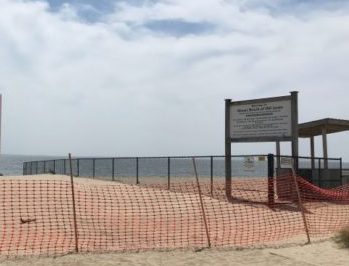
File photo of the now infamous fence (right in photo heading towards Long Island Sound) installed by the Miami Beach Association Sound View (public) Beach is to the left of the now-removed fence.

The MBA, a private beach community, was founded in 1949. They installed their first beach boundary fence in 1952 to mark the end of the Sound View public beach and the beginning of “private” Miami Beach. 

Then, in early 1953, the New London District Superior Court, in a decision on Rose Vitello et al, v. Nunzio Corsino and Miami Beach Association”, issued an injunction that prohibited the fence, proclaiming that the entire length of Sound View and Miami Beaches must remain open to the public, as spelled out by H. J. Hilliard. 

The “New London Day” reported that the MBA put up another fence in the late-1980s, only to be “promptly” removed by the Town. However, then First Selectwoman Bonnie Reemsnyder stated, “the town has concerns about the fence, but its attorneys have advised against taking legal action”; and so, “it would now be up to members of the public to challenge the fence, just as they did in the early 1950s.” 

In 2016, near the end of the beach season, the MBA put up a chain-link fence and levied a “clean beach fee” that would be charged at an entry point. Sound View resident Kathleen Tracy challenged the legality of the fence and fee in 2018 in “Kathleen Tracey et al v. Miami BeachAssociation”.

In July, 2019, Superior Court Judge Kimberly A. Knox heard testimony and ruled that, “Nothing but the recent imposition of a fee has changed since1953, when an injunction was issued; making the entire length of Sound View and Miami Beaches open to the public.” The fence must come down and the fee be abolished, although the fence was allowed to remain while an appeal was pending.

A few weeks ago, in mid-April; and after the Connecticut Supreme Court refused to review the Superior Court’s decision (above), the fence was again removed. In full, Knox ruled that the Association is prohibited, “now and hereinafter,” from maintaining or establishing any other fence or boundary, and from charging fees and issuing permits for the use of the beach.

Leave Nothing Behind but your Footprints:

I believe that the fundamental issue that prompted the MBA’s construction of fences and the 2016 “clean beach” fee was the regrettably bad behavior that some of the “unorganized general public” exhibited while visiting the beach. 

The MBA described a mess that went well beyond the little bit of litter and trash left behind, using the word, “Filthy!”and describing rude and disrespectful behavior; and inappropriate interpersonal behaviors that are better indulged in private.

Sound View Beach apparently witnessed the same, but also noted a significant increase in calls for police service.The MBA reported that they spend about $40,000 to $45,000 per year on beach security, and $13,000 on cleaning the beach, while the town covers only about $20,000.

A Meeting of the Minds:

The leaders of the two beach communities met with Old Lyme’s Board of Selectmen in July, 2021 and presented data describing the problems at the two beaches from an informal “task force”; and suggested some possible solutions, which included making it more expensive for out-of-towners to park at the beach by increasing rates in town-owned parking, and raising permit fees for private parking lots.

First Selectman Timothy Griswold requested that the two leaders put some action steps in writing with quantifying data to be presented at a future meeting. Then-Selectwoman Mary Jo Nosal said the informal “task force” should be an official group that represents the residents of Old Lyme. I am not certain whether either of those requests went any further.

Author’s Thoughts:

Conflicts regarding beach access are not unique to Old Lyme. Public access advocates are worried about a new attack on the right of way to the beaches of the 1.5-mile-long Napatree Point in Watch Hill. Officials of the Watch Hill Fire District, which owns a portion lot of the Point, have recently put the Town on notice that they do not accept the validity of a 2008 town resolution enshrining into law “a right of way for access by the public to pass and re-pass to and from Napatree Point in perpetuity”.

Watch Hill runs the risk of being only known as the home of Taylor Swift, who, I am told, sings songs.

In closing, a few words on sportsmanship. Some of my life has involved ice hockey programs for boys and girls from the newest skaters through high school and college. The games are intense and emotions can run high. At the games end, and regardless of the outcome, both teams will skate the length of the rink in parallel lines, bumping gloves, with a “good game!”

In contrast, “The Day” reported that when the fence came down for the last time, Ms. Tracy extended her hand to the President of MBA’s Board of Governors and said, “Let’s just move on; can we do that?”

He ignored the gesture.

In the NFL, if a player is flagged for unsportsmanlike conduct, the penalty is 15 yards, and an automatic first down, when committed by the defense.

Robert Frost claimed that “good fences make good neighbors”. Well, maybe in New Hampshire, but in Old Lyme?

Well, let’s see …

Sources:

  •  Burian,H. “Old Lyme woman takes legal action to rid Miami Beach of Fence”. NBC-CT. 08/23/2017.
  • Collins,D. “War over public access to Napatree Point heats up in Westerly”. New London Day. 04/19/ 2023
  • Condon, T. “Edward T. “Ned” Coll dies; Hartford activist fought racism, poverty, and closed beaches”. CT Mirror. 12/19/2022
  • Crawford, A. “Racism Kept Connecticut’s beaches white Up through the 1970s”. Smithsonian Magazine. July,2018
  • Drelich, K. “DEEP: portion of Shenecossett Beach Club fence must be removed”. New London Day. 10/26/2019
  • Hewett, C. “Fence to come down at Sound View Beach after court ruling”. The CT Examiner. 04/12/2023.
  • Howard, L. “Miami Beach fence comes down after court ruling”. New London Day. 04/13/2023
  • Kahrl, A. W. “Free the beaches: the story of Ned Coll and the battle for America’s most exclusive shoreline.” Yale University Press. 2018
  • Regan, E. “Old Lyme beach officials recommend higher parking fees to discourage out-of-towners”. New London Day. 07/07/2021
  • Regan, E. “Closing time at issue in Sound View parking lot”. New London Day. 07/20/2021
  • Florin, K. “Debate over beach rights heats up in Old Lyme.” New London Day. 07/03/2017.
  • Florin, K. “Sound View resident takes legal step to fight Miami Beach fence in Old Lyme.” New London Day. August 21, 2017.
  • Florin, K. “Judge: Old Lyme beach fence must come down.” New London Day. 01/14/ 2020.

Editor’s Note: This is the opinion of Thomas D. Gotowka.

About the author: Tom Gotowka is a resident of Old Lyme, whose entire adult career has been in healthcare. He will sit on the Navy side at the Army/Navy football game. He always sit on the crimson side at any Harvard/Yale contest. He enjoys reading historic speeches and considers himself a scholar of the period from FDR through JFK. A child of AM Radio, he probably knows the lyrics of every rock and roll or folk song published since 1960. He hopes these experiences give readers a sense of what he believes “qualify” him to write this column.


A View From My Porch: Finding Fenway — A Feline Interest Story 

Tom Gotowka

Nearly a year ago, Christina and I announced in LymeLine that we were “on the lookout for two adoptable kittens; we hope to find a pair of orange tabby sisters.” Our plan was to name them Fenway and Wrigley.

We had lost Finn, our pet of more than 15 years, as a result of an inoperable and inexplicable carcinoma of the lung, which appeared on a radiograph at an emergency visit. 

Finn was a rescue, and had spent her early months in our daughter’s NYU freshman dormitory; remaining there until expulsion appeared inevitable (i.e., the kitten’s, not the daughter’s). Devan, the freshman, was visited by her older sister, Erin, who convinced her to relocate the kitten to Old Lyme, where she remained with us. 

Those who have also had long-term pets know just how soon they become important members of the household; and how long they are mourned, when lost. 

We never really anticipated what would then lay before us as we set out on our search for kittens. 

We began our quest near the beginning of this year with the municipal animal shelters in southeast Connecticut, and then eventually, with both Finn’s and another veterinary practice, who suggested that we wait until early-summer, when kittens are often more plentiful. 

Although we were persistent with the municipal shelters and on waiting lists at several, we were unsuccessful and decided to investigate the private animal rescue shelters in the same area, where there are several. 

We learned that these shelters tend to be non-profit and/or charitable organizations that are highly reliant on volunteers, although some had a few paid staff. They are “no-kill”, and so, do not terminate healthy or treatable animals, limiting euthanasia for incurably ill animals or those who could pose a danger to public safety. 

Fenway is found, but the Gotowkas are still looking for Wrigley. This image is not Fenway but rather a file photo of another kitty by Michael Sum on Unsplash!

Adoptions at these shelters may require payment of a nominal fee (e.g., $200 to $250 per kitten) to cover expenses for veterinary services incurred by the organization while the animal was in residence. These can include a health examination, neutering, various vaccinations, and treatments for problems like fleas, ticks, ear mites. 

We felt confident that our history and experience with pets, relationships with veterinarians, and sensible and stable lifestyle would make us very suitable candidates for adopting rescued kittens. 

In addition, the “PBS News Hour” reported in February that, “Rescue shelters are feeling the pressure of too many potential pets and not enough people adopting them. Many shelters are at capacity and understaffed; pets adopted during the pandemic were returned, and inflation had made owning and caring for a pet more expensive, leaving some owners struggling to afford rising costs.” While this may have been the situation in many parts of the country, it was apparently not so for kittens in this area, as we were to experience.

The first shelter we explored had stated that their mission was, “To stop the proliferation of homeless cats living hard lives and struggling to find food and shelter on the streets of our local communities.” Their application process seemed daunting, and included the disclaimers that the organization, “Reserves the right to deny an adoption request for any, or no reason, and may choose not to reveal specific reasons;” and that they “Promote age-appropriate adoptions.”

I did some further research on this shelter, and found several unhappy reviews that cited age as a factor. A few examples follow: 

  • “To adopt a kitten from this shelter you must be no older than 60.”
  • “We were told that at 60 and 65, we were too old to adopt any of their cats that aren’t two years of age.” 
  • “When we visited, we witnessed them declining another couple because they were “too old to adopt a young cat.”
  •  (In contrast): “During this process, we walked into a section with a volunteer, June, who immediately exclaimed, “We do not let anyone under the age of 25 adopt!”

Christina and I were shocked and surprised that this organization apparently had such discriminatory age restrictions in place. We were both already “of a certain age”, and so we were discouraged and decided to regroup before exploring other similar shelters.

Frankly, these practices “fly in the face” of conventional wisdom, which is supported by several scientific studies, that pets are important for the health of older adults, especially for those who are single, living alone, and a little isolated. Pets offer socialization and companionship to lonely seniors; and provide a strong sense of purpose that may reduce stress and assist them maintain a regular routine. However, as I describe below, our explorations unexpectedly came to an end.

Celestial Interference?

We were returning home from Chester on a nice February Saturday. On the spur of the moment, we pulled into a local market in Deep River. While I wandered a few aisles on the hunt for dinner ideas, Christina checked out the bakery and bulletin board. Nothing appealed in the bakery, but there was a listing that stated, “Looking for a good home for our cat.” We called on Sunday and learning that we were not the first respondents, arranged a visit on Tuesday.  

This retired couple was moving from Connecticut to care for the wife’s elderly brother in Florida. The brother’s circumstances did not allow them to bring their pet. Faye was not a kitten, but very young; perhaps a toddler, if it was human. Faye was a long-hair with remarkable coloring — pure white with a black saddle, crown, and tail. They said she was a rescue from a litter that was abandoned in a box behind their apartment complex. 

The couple was childless and doted on Faye. They shared her veterinary records with us, which were very complete, and arranged a site visit in Old Lyme; where we passed muster. They delivered Faye about a week later. The cat’s parting from her former owners was smooth, if not a little emotional for them. 

After several weeks transition in her new digs, she now answers to Fenway. She is a nice, playful pet; has very expressive ears, and communicates well when dinner is late. There is a very active fox population in our neighborhood, so Fenway will be exclusively indoors. We are discussing whether we will resume our search for Wrigley.  Cats are social animals and tend to be happier in pairs. 

In closing, Christina is a retired professor of Human Development and Ageing and corroborates the value of pets for older adults, which I touched on above.

Sources:

Cirrillo, Anthony. “The value of pet ownership for older adults” US News and World Report. 10/16/2019
Moeller, Philip. “10 reasons older people need Pets” US News and World Report. 01/07/2010
Norris, Courtney. “Animal shelters struggle as many pets adopted during pandemic are returned” PBS News Hour (transcript). 02/20/2023
Cleveland Clinic. “The Health Benefits of Pets” Health Essentials Newsletter. 02/09/2023

About the author: Tom Gotowka is a resident of Old Lyme, whose entire adult career has been in healthcare. He will sit on the Navy side at the Army/Navy football game. He always sit on the crimson side at any Harvard/Yale contest. He enjoys reading historic speeches and considers himself a scholar of the period from FDR through JFK. A child of AM Radio, he probably knows the lyrics of every rock and roll or folk song published since 1960. He hopes these experiences give readers a sense of what he believes “qualify” him to write this column.

Letter to the Editor: Old Lyme RTC Words on ‘Parental Rights’, Rev. Jungkeit are ‘Unfortunate’, ‘Somewhat Insulting’

To the Editor:

Despite the already robust conversation on the topic, I still feel compelled to provide my bit of input on the recent letters by Mses. Thompson and Schmaus, which detailed their concerns that the Old Lyme RTC [Republican Town Committee] appears to be endorsing a “DeSantis style” of parental rights in our schools “as part of their platform and criteria for selecting candidates to run in this year’s municipal election”; i.e., the RTC would be “standing up for parental rights in the town’s school system regarding the school’s curricula and student policies”. Are the educators in Region 18 failing our children? I do not believe so. 

Further, in a letter published in the “CT Examiner” at the end of March, the RTC Chairman responded aggressively, and somewhat insultingly, to a sermon delivered by the Reverend Steven R. Jungkeit at the First Congregational Church of Old Lyme, who had voiced his concerns with the endorsement, and laid out what he considered the potential longer-term sequelae of that action. The tone of the response raised my ire.

Reverend Jungkeit is a social justice advocate, and some may be uncomfortable with such advocacy. He and his fellow ministers and congregation have: 

  • provided physical sanctuary in 2018 for over 200 days to a Pakistani couple facing deportation;
  • held a vigil and call to action with the Lyme-Old Lyme Partnership for Social Justice in May, 2022, which ended with the tolling of the bells to remember the then 32 victims of the most recent mass shootings in America; 
  • purchased a home in Old Lyme “to welcome refugees in perpetuity”, which included refugees from Syria, the Congo, and Puerto Rico (in the months following Hurricane Maria);
  • assisted many refugees secure housing, jobs, and eventually, fulfill the legal requirements to remain in the United States.

In closing, I believe that the criticism I noted above should help toughen up this “man of the cloth” and provide him the same perspective now enjoyed by both New York State Supreme Court Justice Merchan and Manhattan D.A. Bragg, who have been similarly criticized from the top of the national party.

I also feel that questioning the language unfortunately used by the RTC is entirely appropriate. Why shouldn’t those of us who follow national politics react with concern over the apparent highlighting of a key part of what I think is Governor DeSantis’ dystopian agenda, which already includes: “The Parental Rights in Education Act”, commonly referred to as the “Don’t Say Gay” law, which was passed and signed into law last year; and another bill just signed into law that apparently allows Floridians to carry concealed guns without a permit and without training.

Sincerely,

Thomas D. Gotowka,
Old Lyme.

Letter to the Editor: Negative Outcome of Old Lyme Zoning Commission’s Vote on Halls Rd. Overlay District Raises Many Questions

To the Editor:

I am writing as a follow-up to Mark Terwilliger’s Op Ed in LymeLine on the Zoning Commission’s vote against the Halls Road Overlay District proposal.

Elizabeth Regan, who covers Old Lyme for the “New London Day”, also reviewed the action in an article published in that newspaper on March 29th. 

Because the proposal had not been endorsed by our Town’s Planning Commission, approval required a supermajority of the Zoning Commission voting in favor (i.e., four of the five members in attendance); but the proposal only received three. 

Unfortunately, two members of the Commission did not attend this important meeting; and Land Use Coordinator Eric Knapp reported that Mike Miller could not attend because of an injury; and Ms. Tammy Tinnerello was absent and could not vote because she had missed the past two meetings, and not reviewed the audio recordings, which are available via the Town’s website.  Presumably, had she reviewed the recordings, she could have voted by calling in. 

Alternate members Sloan Danenhower and Michael Barnes filled in for the two absent members and voted to oppose the proposed plan.

The “New London Day” reported that “Miller had previously expressed support for the overall concept, pending assurances that the language would be clarified to prevent a ‘Costco-sized building’ from going up on Halls Road”; and such restrictions seemed to have been proposed and passed at the meeting. I could find no guesses on how Ms. Tinnerello was expected to vote. Infrastructure issues were also raised, and I ask the Commission to allow the Town some input to determine whether they should be considered as “insurmountable”.

I am concerned that, after several years of very public effort by Ms. Twining’s “Halls Road Improvement Committee”, which involved regular and frequent updates, and Q&A opportunities for the community; the project was blocked by votes from two alternate members of the Zoning Commission. I am also concerned that the Commission is again out of synch with the Town in their actions (i.e., the Town provided Ms. Twining’s group with $135,000 to support design work.)

Further, these positions are elected, not appointed, and require serious commitment. I do not feel that missing three consecutive meetings reflects strong commitment. 

Finally, the “New London Day” article also reported that horses and elephants came up in the discussion at the meeting. On her way to Oz, Dorothy only had to contend with lions and tigers and bears, but Ms. Twining. got trampled by an alternate who brought in horses and elephants.

Sincerely,

Thomas D. Gotowka,
Old Lyme.

A View from My Porch: Connecticut Adopts FDA Food Code — A Primer for the Curious 

Tom Gotowka

The Connecticut (CT) General Assembly passed the adoption of the Food and Drug Administration (FDA) Food Code into law in 2018; and it finally went into full effect on the 17th of February.

The law requires some changes for both the food service establishments (FSEs) operating in the state, and for the inspection and permitting processes conducted by the local health departments charged with regulation. For Lyme and Old Lyme, this latter is, of course, Ledge Light Health District (LLHD) along with seven other communities in Southeast CT.

In this essay, I review some of the key changes that occurred with the full enactment of this Food Code. 

The U. S. FDA publishes the Food Code as a model to assist local health departments develop or update their own food safety rules; and thus ensure that local rules have a sound scientific basis, reflect best practices, and are consistent with national food regulatory policy.

The FDA Food Code was first issued in 1993, and updated and re-issued every two years until 2001; but then moving to a four-year interval. 

Implementation did not alter the major components of CT’s food safety rules and best practices, since CT’s regulations were generally consistent with the FDA’s.  The rules still stress hand-washing along with proper cleaning and sanitizing of food preparation surfaces and equipment.

However, there are changes in temperature standards for food preparation and storage, the classification of food service establishments, and the methods for scoring and documenting inspections. 

The former CT Code required that cold foods be held at 45 degrees F. or lower, and hot foods held at 140 degrees F. or higher. The FDA Code requires 41 degrees F. or lower and 135 degrees F. or higher, respectively. 

Perhaps more important are the changes in classification of FSEs. The class affects the frequency of required inspection and the qualifications required for on-site supervisory staff. I review the classification system under the newly enacted definitions in the following. Note that this is at a high level and the examples listed for each class are only for illustration and not all-inclusive.  

Class 1 establishments provide hot or cold beverages and/or commercially prepackaged foods that are not “TCS” (i.e., foods that do not “require time and temperature control for safety”); and limited preparation or heating of commercially packaged precooked foods. This includes coffee and donut shops, and convenience stores. (inspected annually.) 

Class 2 establishments are “cook and serve” operations that offer a limited menu of “TCS” food prepared or cooked and served almost immediately. This includes fast food shops like McDonalds and Burger King. (inspected twice/year.)

Class 3 establishments are “cook and serve” operations that offer an extensive menu of “TCS food requiring complex preparation, including, but not limited to, handling of raw ingredients. This includes full-service restaurants, diners, delicatessens, and supermarket food services serving pizza and sushi. (inspected three times/ year.) 

Class 4 establishments serve a population that is highly susceptible to food-borne illnesses, and includes daycare centers, convalescent and nursing homes, and hospitals.  (inspected four times/ year.)

All Class 2, 3, and 4 establishments are required to have a Person In Charge (PIC), who has qualified as a Certified Food Protection Manager (CFPM) through a CT Department of Public Health (DPH)-approved testing organization and is fully onsite during peak hours of operation. The PIC can appoint an alternate, who does not need to pass an exam, but is only onsite during off peak hours when limited/no food preparation is occurring. 

New inspection forms are used and no longer yield a numerical score that is posted in the establishment; but rather, a simple pass or fail. Any cited violations are categorized as “Priority”, “Priority Foundation”, and “Core”; and align with the risk of that violation as it relates to foodborne illness, and the time allowed for corrective action 

Further, other changes include date-labeling of foods and notification of allergens on menus, both of which were not previously well-enforced. Product date marking will be required to ensure all refrigerated food is consumed within seven days.

My sources include: 

  • Food Protection Program-related documents  on both the  CT DPH and LLHD websites. 
  • Communications to affected food service establishments regarding the FDA Food Code from LLHD and several other CT Health Departments/Districts. 
  • Abundant Q&A with Ms. Katie Baldwin, RS (i.e., a registered sanitarian), the Supervisor of Regulated Facilities, and the local subject matter expert regarding the Food Code at LLHD.
  • The U.S. “FDA Releases 2017 Food Code” dated 02/09/2018.
  • The U.S. FDA “Benefits Associated with Complete Adoption and Implementation of the FDA Food Code” dated 06/11/2020

Author’s Comments: After the CT General Assembly passed the adoption of the FDA Food Code into law in 2018, LLHD began implementation of some of the new requirements with the FSEs in their catchment area — well in advance of the eventual Feb. 17 effective date. These included:  

  • Updated food establishment risk classification categories.
  • Changes to hot and cold temperature requirements.
  • Requirement to employ Food Protection Managers in Class 2, 3, and 4 FSEs.

Consequently, there was no difficult transition in February; as they were already operating under the new regulations. 

Finally, there are executive level staff changes at LLHD in the offing this summer. 

LLHD Health Director, Stephen Mansfield announced last July that he will retire in 2023; his final day on the job will be July 6, 2023. He has been with the organization for 25 years, the last eight as Director. 

His replacement, Ms. Jennifer Muggeo, recently marked 18 years of service with LLHD. Mr. Mansfield expanded her role several months ago from overseeing financial operations to the Deputy Director position. 

I have been on LLHD’s Board of Directors for the past several years and am comfortable saying that he leaves a very strong organization, which very visibly demonstrated its worth to SE CT during the recent pandemic.

I observed an organization with sound financials, which focused on staff development and opportunity; and held the respect of CT’s broader public health community. I had interactions with a few members of the more clinical staff, and felt their clear and prideful commitment to both the organization and the public’s health.

About the author: Tom Gotowka is a resident of Old Lyme, whose entire adult career has been in healthcare. He will sit on the Navy side at the Army/Navy football game. He always sit on the crimson side at any Harvard/Yale contest. He enjoys reading historic speeches and considers himself a scholar of the period from FDR through JFK. A child of AM Radio, he probably knows the lyrics of every rock and roll or folk song published since 1960. He hopes these experiences give readers a sense of what he believes “qualify” him to write this column.