
I See Great Things in Baseball – Part 1

Photo by Jose Morales on Unsplash

Editor’s Note: We are delighted to publish the first section of a three-part essay on the literature of baseball written by Old Lyme resident Tom Gotowka. Look for the second and third parts in the coming weeks.

Walt Whitman, editor of the Brooklyn Daily Eagle in the mid-1840s, wrote: “I see great things in baseball. It’s our game – the American game.”

I love baseball and am a lifelong reader of the baseball literature, which is remarkably rich. Right now, it’s that time of year when many of us start thinking about the baseball playoffs, the World Series, and how well the Red Sox will undoubtedly do next year. Then, in November, we’ll begin each off-season morning with, “Alexa, play “Center Field’ by John Fogerty. (i.e., “Put me in coach, I’m ready to play today.”)

I dedicate this three-part essay on the literature of baseball to my Dad, whose own baseball career was interrupted by World War II and the Battle of the Bulge. He was the first of a three – going on four – generation “dynasty” of catchers, and could still snap a laser to second base in his fifties. For me, his most unforgettable advice was, “Never be the only player on the field with a clean jersey.” He had similar wisdom for any physical outdoor sport.

I grew up reading many of the historic player biographies – which, at that time, generally targeted 12-year-olds – and didn’t cover the “less refined” side of the game. I will focus here on some of my favorite pieces, and hope that sports writer literati will continue to contribute and expand that bibliography.

Locally, New London Day sportswriter, Mike DiMauro regularly exhibits flashes of literary brilliance. For example, he recently cited “the words of Plato” in his column on the Ledyard Chamber Choir’s performance of the National Anthem at Fenway Park.

In the past, sportswriters seemed to be a fairly literary bunch.

In 1888, Ernest Thayer, a journalist at the San Francisco Examiner, wrote “Casey at the Bat: A Ballad of the Republic,” which is probably the best known of all the epic poems of baseball:
“The outlook wasn’t brilliant for the Mudville Nine that day.
The score stood four to two with but one inning left to play.
And then when Cooney died at first and Barrows did the same,
A sickly silence fell upon the patrons of the game.
A straggling few got up to go in deep despair; while the rest
clung to that hope which springs eternal in the human breast.
They thought, if only Casey could get but a whack at that;
they’d put up even money, with Casey at the bat …
But there is no joy in Mudville, mighty Casey had struck out!”

Grantland Rice was a prolific sportswriter in the early twentieth century known for his elegant style. He wrote “Casey’s Revenge” in 2007:
“There were saddened hearts in Mudville for a week or even more.
There were muttered oaths and curses – every fan in town was sore.
‘Just think, said one, how soft it looked with Casey at the bat’;
and then to think he’d go and spring a bush-league trick like that!’”

Rice is possibly best-known for a statement on sportsmanship that many of us have said or heard: “When the Great Scorer comes to write against your name, He marks, not that you won or lost, but how you played the game.”

In 1910, Franklin Pierce Adams, a columnist for the New York Evening Mail, wrote “Baseball’s Sad Lexicon” (told from the point of view of a Giants’ fan watching a game against the Cubs and its great infield):
“These are the saddest of possible words: Trio of bear cubs, and fleeter than birds;
Tinker to Evers to Chance.
Tinker and Evers and Chance.
Ruthlessly pricking our gonfalon bubble,
Making a Giant hit into a double.
Words that are heavy with nothing but trouble:
Tinker to Evers to Chance.”

So, it’s still fair to say that a 4-6-3 double play is like ballet – i.e. the second baseman (4), playing deep, fields the ground ball and throws to the charging shortstop (6) who touches second base, leaps above the sliding runner – while simultaneously throwing to first base (3). That’s ballet!

In 1948, Gerald Hern, sports editor at the Boston Post, composed a poem about the Boston Braves’ great pitching rotation of Warren Spahn and Johnny Sain: “Spahn and Sain and Pray for Rain”.
First we’ll use Spahn,
Then we’ll use Sain,
Then an off day, followed by rain.
Back will come Spahn, followed by Sain;
And followed, we hope, by two days of rain.”

Robert Frost, perhaps New England’s greatest poet, also loved baseball. He said “When I was young, I was so interested in baseball that my family was afraid I’d waste my life and be a pitcher. Later they were afraid I’d waste my life and be a poet. They were right.” In ‘Birches,’ he shows concern about any boy living too far from town to play baseball.

He also wrote: “Poets are like baseball pitchers. Both have their moments. The intervals are the tough things.” And finally, “One of the hardest things in life to accept is a called third strike”.

I want to also recognize the colorful commentary of some radio and TV sportscasters. I’ll loosely characterize those sometimes outrageous literary contributions as: “Baseball Couplets and Allegory”.

Keith Olberman’s quarter century career as a sports commentator included long stints at both ESPN and CNN. He has used the following in describing an on-field dispute: “I can read his lips and he’s not praying.”

Ernie Harwell’s half-century career as a sportscaster included 40 years with the Detroit Tigers. He described a called third strike in language somewhat reminiscent of Robert Frost: “He stood there like a house on the side of the road. Strike out!”

Reece Davis, an ESPN sports commentator, when describing a home run, said: “That ball has been voted off the island!” (which I guess is in reference to a reality TV show … not Robert Frost.)

Dave Niehaus, a sportscaster and play-by-play announcer for over 30 years with the Seattle Mariners described a grand slam in game 4 of the 1995 American League Division Series this way: “Get out the ryebread and mustard, Grandma. It is grand salami time!”

Jerry Coleman was both a player for the New York Yankees and a manager for the San Diego Padres. Like Ted Williams, he had also served as a Marine Corps pilot in both World War II and Korea. He finally capped his career as a broadcaster, and described home runs or any great play as: “Oh, doctor, you can hang a star on that one!”

And, of course, there’s Don Orsillo, who called Red Sox games for 15 years with Jerry Remy. Don loved calling home runs, frequently referring to Red Sox homers as: “La Luna” or “Buenos noches, amigos!”

In the second essay, I’ll review several contemporary baseball novels and biographies that I’ve not only enjoyed reading, but also feel that they provided me with a better understanding of the sport.
Letter to the Editor: ‘The Battle of the Beaches’; Who’s Oldest, How to Resolve it … Annually

To the Editor:

Both Revere Beach in Revere, Massachusetts; and Sound View Beach in Old Lyme proclaim themselves as “America’s oldest public beach”. Sound View history is well-documented in Jim Lampos’ wonderful “Rum Runners …”

Revere’s public beach dates back to 1896, with a rail link that actually began in 1875. Revere remains accessible today via the MBTA’s blue line. Revere was declared a national historic landmark in 2003.

Sound View Beach, on the other hand, claims that its public beach actually began in 1892, subsequent to H. J. Hilliard’s deeding of the beach property to the “unorganized general public for its perpetual use”; thus, making Sound View America’s oldest public beach.

Bad math? I don’t think so. Revere is less than 10 miles (as the drone flies) from both Harvard and M.I.T.

Incompetent Massachusetts historians? I don’t know. Perhaps a team from Yale’s Archaeologic Studies Program can sift through the ruins and ash of the Antique Shanty and corroborate our claim.

I believe that there is an opportunity to settle the issue right on the sand with an annual beach volleyball tournament between Revere and Sound View. In time this might rival both “The Race” between Harvard and Yale’s heavyweight rowers (which began in 1859); and “The Game” between Harvard and Yale’s football teams (which began in 1875). Otherwise, our respective Chambers of Commerce should get involved and resolve the dispute.

Sincerely,

Thomas D. Gotowka,
Old Lyme.

Letter to the Editor: Thoughts, Concerns, Suggestions on Halls Rd. Improvement Plan

To the Editor:

Christina and I attended both public meetings hosted by Old Lyme’s Halls Road Improvements Committee, and conducted by members of the Yale Urban Design Workshop. Yale presented the Committee’s vision statement and several conceptual renderings of what fully realizing that vision might yield. The article in the New London Day accurately summarized the vision.

The audience was skeptical of the immense breadth and scope of that vision; – requiring twenty- five or more years to complete.  Several concerns were raised about cost and the impact on taxes.

We left with a few thoughts and concerns. It was not apparent to us that current Halls Road business owners and the professionals occupying office space had participated to any extent in developing that vision. It is absolutely important to get their buy-in. Essex Bank did state that any of their future development would take Old Lyme’s plan into consideration.

We found Alan Plattus’ presentation to be a bit glib. This is important stuff, and some of the vision could be lost in presenter style. Also, know the names of our local landmarks, especially if they factor into the plan. (i.e. it’s the “Bow Bridge” that used to cross the Lieutenant River). But, after all; they’re Yale, not Harvard.

Our suggestion: parse the plan into achievable shorter- range projects that will yield some early successes. Start with the hiking/biking paths along the Lieutenant River, rebuild the foot bridge, and create the new Halls Road village green.

Sincerely, 

Thomas D. Gotowka,
Old Lyme.

Letter to the Editor: Poop Isn’t Pretty … So Let’s Make a New Year’s Resolution To Pick It Up

To the Editor:

I am writing in part to fulfill a promise to a daughter. Our daughter Erin arrived for the Christmas holidays from North Carolina with an adolescent Hungarian vizsla pup. She walked Daisy a few times each day; and always with a doggie waste disposal bag in her pocket.

She commented on the large amount of pet waste that she encountered on her walks and wondered why Old Lyme hasn’t required, – or at least encouraged – pet owners to “police” their dog’s waste. I do not know that this problem is widespread or endemic in our town, nor will I attempt to quantify the issue. It is noticeable.        

I assume that residents are largely cleaning up after their pets. However, the (hopefully) minority of dog owners who are so discourteous to their neighbors that they don’t bother to bag and dispose this waste, are leaving an unsightly and unhealthy memorial of their pet’s exercise.

Erin’s professional career has been principally in Boston/ Cambridge, MA and the United Kingdom. These places have longstanding strongly enforced ordinances regarding removal and disposal of pet waste. So, she may react to such misbehaviors earlier than many would.

I am not advocating that Old Lyme enact an ordinance regarding pet waste. Rather, I feel that we should communicate the problem better and continue with our Tennessee Williams – type approach to  resolution i.e., with apologies to T.W., we should always depend on the kindness of neighbors.

The problem is not insignificant; dog mess is not only an eyesore, but also a health hazard.

In the extreme, according to the CT Department of Energy and Environmental Protection (DEEP) and the Environmental Protection Agency (EPA), dog waste is a major pollutant and contaminant of the water supply. It is a serious health issue.

In fact, it is estimated that 1/3 of all water contamination is a result of dog waste run off entering streams and leaching into underground well water. The EPA deemed dog waste a “non-point source of pollution”, which puts it in the same category as oil and toxic chemicals. So, picking up after your pet every single time is important.

I’ll summarize the “How”: Always carry a plastic bag with you when you walk your dog.  Using the bag like a glove, you pick up the waste, turn the bag inside out around the waste, tie it in a knot and dispose of it in a trash can. 

Repurposed supermarket fresh produce bags work well. Lacking those, dog waste pickup bags are available in many  stores and online. Note: do not put this waste  in your home compost pile because it may contain parasites, bacteria, pathogens, and viruses that are harmful to humans which may not be destroyed by composting.   Those interested in digging down further into procedural details should look at: https://www.wikihow.com/Pick-Up-Dog-Poop

Sincerely,

Thomas D. Gotowka,
Old Lyme.

Recycling in Old Lyme: Electronic Waste

LymeLine.com is publishing a series of articles in association with Old Lyme’s Solid Waste and Recycling Committee — these articles lay out best recycling practices. Previous articles have covered Old Lyme’s current curbside trash and recycling program; the safe disposal of medications; the recycling of paint, and the recycling of mattresses.

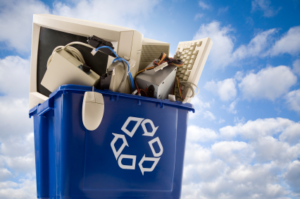
In this article we cover the more complex topic of managing electronics at the end of their useful life; i.e., what should we do with our e-waste? The topic is especially pertinent right now because — I’m certain — that more electronics move in and out of our homes during the holidays than at any other time of the year.

Scope of the Problem

Proper disposal of e-waste is a very significant issue. According to the Environmental Protection Agency (EPA), more than 2.5 million tons of e-waste are produced each year in the United States. The majority is not recycled, so most of our discarded electronics are ending up in landfills; the EPA estimates that less than one in 10 mobile phones is recycled, and only about 25 percent of all e-waste is collected for recycling.

If you’re checking the math, some of the rest gets donated; but according to EPA pundits, almost three quarters of computers sold in the United States end up stockpiled in garages, basements, and closets waiting to eventually enter the disposal stream.

Our e-waste contains materials that are toxic if improperly handled at disposal. These toxic chemicals, which can leach into the soil over time or be released into the atmosphere, include cadmium, lead, mercury, hexavalent chromium, and brominated flame retardants. Incineration releases these heavy metals into the air.

Mercury released into the atmosphere can bio-accumulate in the food chain, particularly in fish, a major route of exposure for the general public. If the products contain PVC plastic, highly toxic dioxins and furans are also released.

Moreover, electronics are made with valuable resources like precious metals, engineered plastics, glass, and other materials — all of which require energy to manufacture. When  equipment is discarded, these resources cannot be recovered and additional cost is incurred to manufacture new products from virgin materials.

Further, lanthanides, also known as rare-earth elements, are used to make magnets found in computers, cell phones, and many other consumer “gadgets.” Until recently, China was the main producer of these raw materials, giving that country an advantage in setting market prices. As a result, the U.S. Department of Energy developed an initiative to recover lanthanides from electronic waste.

An International Issue

It was/is common practice for developed countries to export their e-waste to developing countries, which may not have the resources to safely recycle and dispose of used electronics.  In the United States it is estimated that about a quarter of the waste collected for recycling is still being exported in this manner.

In 2001, the Basel Action Network (BAN), a non-governmental environmental organization based in Seattle, led an investigation of e-waste processing in China, India, and Pakistan. The investigation, which included sophisticated electronic tracking of recycled televisions, uncovered an entire area northeast of Hong Kong where migrant workers were employed breaking apart obsolete computers imported primarily from North America. The workers, who included children, were not using contemporary safety and anti-contamination precautions.

FRONTLINE’s coverage of the investigation can be viewed at: http://www.pbs.org/frontlineworld/stories/ghana804/

BAN is named after the 1989 Basel Convention, a United Nations treaty designed to control and prevent the dumping of hazardous waste from developed to less developed countries. BAN serves as a watchdog and promoter of the Basel Convention and its decisions.

Such dumping is actually “legal” in the United States because this country has not ratified the Basel Convention; although as of July 2016, 183 nations  and the European Union were already parties to the Convention. Haiti and the United States have signed the Convention but not ratified it.

There is still no federal law that requires the recycling of electronic waste or prohibits it from being exported to developing countries. There have been some efforts in Congress to pass a bill that would make overseas dumping of toxic e-waste illegal, but the Responsible Electronics Recycling Act (RERA) has been stuck in the House for more than two years.

Consequently, individual states began to take action. California passed an electronics recycling law in 2003, the first state to do so. Connecticut passed its law in 2007, and 27 other states and the District of Columbia have since followed suit.

Connecticut’s electronics recycling law requires electronics manufacturers to pay for the cost of recycling. This is another example of the producer responsibility or product stewardship  principle, which requires that those involved in production take responsibility for the safe disposal of a product.

However, unlike mattresses and paint, which were covered in past articles, where the consumer pays a fee at the time of purchase to support the recycling program, Connecticut’s law requires manufacturers to finance the transportation and recycling of these electronics. It also requires recyclers of electronics to be approved and monitored by the CT Department of Energy and Environmental Protection (DEEP).

Drop-Off Sites

The local drop-off location for recycled residential electronics is the Old Lyme Transfer Station on Four Mile River Rd. There is no charge for drop off. Large electronics retailers like Best Buy and Staples also have recycling programs in place.

Covered Electronic Devices (CEDs)

Recyclable CEDs currently include the following:

  • televisions;
  • desktop and portable computers; monitors; printers;
  • fax machines; scanners;
  • cell phones,
  • tablets, and e-readers with a video display greater than 4 inches.

In contrast, e-waste from non-residential sources (i.e., commercial, governmental, retail, etc.) is regulated under current federal and state hazardous waste and solid waste laws and should not be dropped off as recycled residential electronics.

DEEP-approved recyclers then pick up these CEDs from the various Connecticut collection points. The recyclers then sort the computers and monitors by manufacturer and submit a bill to the responsible manufacturer for the cost of transporting and recycling those CEDs with the manufacturer’s brand name on them. Television manufacturers will pay a percentage of the total cost of recycling televisions equivalent to their market share.  Recyclers then submit bills to manufacturers for covered costs.

Data security

Under Connecticut’s recycling program, approved recyclers are required to establish data security practices. They must secure hard drives until such point that they are physically destroyed for recycling. If they intend to reuse or resell the computer, they must erase (“wipe”) the hard drive to a Department of Defense standard.

If you are concerned about data security, you can erase the hard drive prior to dropping off the device for recycling. There are several ways to erase a hard drive.  It is possible to perform this yourself at home, but it may be a bit complicated for those not facile with desktop computing. Paraphrasing recent political history, it’s not just “Like with a cloth or something?” Retailers like Best Buy and Staples may also perform this task, but for a charge. About a month ago Staples in Old Saybrook quoted a price of $29.99.

DEEP has information on inexpensive software that can be used to permanently erase the data on your hard drive at: http://www.ct.gov/deep/cwp/view.asp?a=2714&q=397852&deepNav_GID=1645#Security

Our next article will cover the recycling of tires, and bulky items like appliances and furniture.

If you have questions or comments, contact: Leslie O’Connor at alete1@sbcglobal.net or Tom Gotowka at TDGotowka @aol.com.