A View From My Porch: Epic Poems of Folk and Rock, Part I

In this essay, I posit that many works of contemporary folk and rock music are the natural successors of the epic poems of antiquity. In support of that hypothesis, I begin with a brief review of the epic genre; and then, discuss a few contemporary works that I feel meet the epic standard. 

The Epic Poem:

An epic is a long, narrative poem that chronicles the extraordinary deeds and adventures of courageous men and women. The earliest epic poems generally had no discernible author, and were probably developed in the pre-literate era. Those epics were conveyed orally, usually in brief episodes, either to an audience, or to another storyteller. However, epics were also created by a clearly-identified author. 

At the Mindszenty School, where I was a college prep student many years ago, we studied epic works of both sorts. 


First page of Beowulf in Cotton Vitellius A. xv. Public domain.

“Beowulf” was written anonymously in old English, and set in the 6th century in what is now Denmark and Sweden. The hero, Beowulf, came to the aid of the Danish monarch, whose kingdom had been terrorized by the monster Grendel, who was notable as a descendent of Cain.

Although losing some of his warriors to Grendel, who then drank their blood; Beowulf finally slays the monster in a bloody encounter, and hangs the monster’s arm and claw over the rafters of the king’s great hall as proof of its death.

In a final act of heroism, Beowulf also kills Grendel’s avenging mother, though requiring a magic sword. 

The “Odyssey,” which is a sequel to Homer’s “Iliad,” is a Greek epic poem, written near the end of the eighth century BC.  The poem relates the activities of Odysseus, the hero, during the final year of the siege of Troy, and his 10-year, and epically perilous, journey home to Ithaca, after Troy’s fall.

We also considered Milton’s 17th Century “Paradise Lost,” but, absent a monster, and temptations from three sirens, the expulsion of Adam and Eve from the Garden drew only limited interest. 

Clearly, the most noteworthy characteristic of an epic poem is its length. The “Odyssey” has 15,000 lines., “Paradise” over 10,000. Further, the epic hero (or heroine) is a great warrior, and willing to engage in intense combat.   

In the following compositions, the title is followed by the author’s name and the publication date. A second name, when included, is, in my opinion, the best cover artist. A single name and date indicate that the author also performed the work. 

I provide context for each work, and include abridged lyrics. I took care in my abridgement to ensure that the song’s sense and message remained clear. The original lyrics, in their entirety, are available on the internet.

I’ve included a song by Woodie Guthrie (see number III below), who is considered one of the most influential figures in American folk music. School children are often introduced to Woodie with his song, “This Land is your Land”.

1. “The Wreck of the Edmund Fitzgerald” — Gordon Lightfoot (1976)

Album cover of ‘The Wreck of the Edmund Fitzgerald’ by Gordon Lightfoot. This image qualifies as fair use under the copyright law of the United States.

The SS Edmund Fitzgerald was an American freighter that, when launched in 1958, was the largest ship on the Great Lakes, nearly 800 ft. long and  weighing more than 13,000 tons without cargo. She hauled iron ore from mines in Minnesota to iron works in ports on the Great Lakes.

The skipper, Captain Ernest McSorley, was very experienced, and well-respected by his contemporaries and his crew. The ship sank on Nov. 10, 1975 in a storm on Lake Superior, with the loss of the entire crew of 29 men. The bodies were not recovered. 

In true epic poem style, one of the prevailing theories regarding its sinking is that it was hit by a series of three consecutive “rogue” waves, a phenomenon called “Three Sisters” on Lake Superior. Their tendency to occur without warning, and with huge force makes them especially dangerous. 

Gordon Lightfoot’s lyrics are a “play-by-play” of the disaster. Be sure to note the cook’s role in the progression of events. 

Abridged Lyrics:

The legend lives on, from the Chippewa on down; of the big lake they call ‘Gitchee Gumee’.
Superior, it’s said, never gives up her dead, when the skies of November turn gloomy.
With a load of iron ore, twenty-six thousand tons more,
than the Edmund Fitzgerald weighed empty.
That good ship and crew, was a bone to be chewed,
when the gales of November came early.
The ship was the pride of the American side,
when they left fully loaded for Cleveland.
The dawn came late and the breakfast had to wait,
when the gales of November came slashing.
When suppertime came, the cook came up top;
saying, ‘fellas, it’s too rough to feed you’.
At seven p.m., a main hatchway caved in;
and he said, ‘fellas, it’s been good to know you’.
The captain wired shore that ‘he had water coming in;
and the good ship and crew were in peril’.
Later that night, when her lights went out of sight,
came the wreck of the Edmund Fitzgerald.
And a church bell chimed, until it rang twenty-nine times;
for each man on the Edmund Fitzgerald.

2. “Charlie and the MTA” — Steiner and Hawes, (1949) / The Kingston Trio

A formal publicity shot of the original line-up of the Kingston Trio (l-r) Dave Guard, Bob Shane, Nick Reynolds. Image published under under the terms of the GNU Free Documentation License, Version 1.2.

The song was originally composed for a “left-wing” mayoral campaign in Boston’s 1949 election, to protest the five-cent fare increase by the Metropolitan Transit Authority (MTA).  Fighting the fare increase was an important plank of the Progressive Party candidate, Walter A. O’Brien Jr.’s platform. He had also advocated the removal of the complicated entry/exit fare structure, and opposed the tax-funded bailout of the system’s previous operator. 

O’Brien’s campaign had no funds for radio advertising, so he commissioned campaign songs from local folk artists, covering his themes; and played recordings from a loudspeaker on a truck driven throughout Boston.

The 1949 mayoral election was a raucous affair, with five candidates, including the amazingly popular, and notoriously corrupt incumbent, James Michael Curley, whose campaign song began, “Vote early and often for Curley”.

O’Brien finished last; and was routed by John B. Hynes, who then remained Mayor of Boston until 1960. Bostonians also approved a change in the structure of future mayoral contests (i.e., select two final candidates in advance of each general election).

Abridged Lyrics: 

Well, let me tell you the story of a man named Charlie, who on a tragic and fateful day;
put ten cents in his pocket, kissed his wife and family, and went to ride on the MTA.

Well, did he ever return? No, he never returned; and his fate is still unknown.
He may ride forever ‘neath the streets of Boston; he’s the man who never returned.

Charlie handed in his dime at the Kendall Square Station,
and he changed for Jamaica Plain.

When he got there, the conductor said, ‘one more nickel’;
Charlie couldn’t get off of that train.

Now, all night long Charlie rides through the stations, crying, ‘what will become of me’?
‘How can I afford to see my sister in Chelsea or my cousin in Roxbury?’

Charlie’s wife goes down to the Sculley Square Station every day at quarter past two,
And through the open window she hands Charlie a sandwich as the train comes rumbling through.

The Kingston Trio’s original version of the song began with a spoken introduction: “The people of Boston have rallied bravely whenever the rights of men have been threatened. Today, the MTA, is attempting to levy a burdensome tax. Citizens, hear me out! This could happen to you.”

In 2004, the “Charlie Card” was introduced as the payment method for the Massachusetts Bay Transportation Authority (MBTA).

3. “Deportee — Woody Guthrie (1948) / Joan Baez 

Woody Guthrie in 1943. World Telegram photo by Al Aumuller. Public domain.

Guthrie said that the inspiration for “Deportee” was the radio and newspaper coverage of the Los Gatos Canyon plane crash, which provided the names of the flight crew and the security guard, but not the farm workers, who were also on the flight; referring to them only as “deportees.”

The crash resulted in the deaths of 28 migrant farm workers, who were being transported back to Mexico at the end of their braceros contract. The bodies of the migrants were placed in a mass grave at Holy Cross Cemetery in Fresno, Calif. The grave was marked only, “Mexican Nationals.”

The Bracero Agreement:

During World War II, the United States negotiated a series of treaties with the Mexican government to recruit Mexican seasonal workers, all men and without their families, to work on short-term contracts on farms and in other war industries (braceros.)

The program was developed because of severe labor shortages caused by the war. The labor contractors were expected to provide transportation to and from the Mexican border.

The first Mexican bracero workers were admitted in September, 1942, and by the program’s end in 1964, nearly 4.6 million Mexican citizens had been hired to work in the United States, mainly on farms in Texas, Calif., and the Pacific Northwest.

Abridged Lyrics: 

The crops are all in and the peaches are rotting;
the oranges are piled in their creosote dumps.
They’re flying you back to the Mexico border,
to pay all your money to wade back again. 

Some of us illegal, and others not wanted,
our work contract’s out and we have to move on.

Goodbye to my Juan, goodbye, Rosalita;
adios mis amigos, Jesus y Maria.
you won’t have your names when you ride the big airplane;
all they will call you will be ‘deportees’.

The sky plane caught fire over Los Gatos Canyon;
a fireball of lightning, that shook all our hills.
Who are these friends, all scattered like dry leaves?
The radio says, ‘They are just deportees.’

Is this the best way we can grow our big orchards?
Is this the best way we can grow our good fruit?

Author’s Notes: First, I want to acknowledge the persistence of Messrs. Jakubowski and Corsi, English faculty at the Mindszenty School, who never assigned required readings that were also available in “Classics Illustrated” comics.

It is ironic that the United States has not yet addressed, in a bipartisan and humanitarian manner, immigration from Mexico, especially because we welcomed millions as migrant workers during and after World War II, (described above in “The Bracero Agreement”). 

Our policy seems to remain: “They chase us like outlaws, like rustlers, like thieves,” which is also a Guthrie lyric.

Even American television recognized braceros. You may recall a late 1950s, and early ‘60s television series, “The Real McCoys”, which included a character, Pepino, who, I now realize, was a bracero worker on the McCoy farm in the San Fernando Valley. 

We all first heard the Ojibwe term: “Gitchee Gumee” in Longfellow’s 1855 epic poemThe Song of Hiawatha”. 

If Madame Editor agrees, I will continue this “epic poems” theme in the next essay, where I consider contemporary epic poems of conflict.

Editor’s Note to Mr. Gotowka: She agrees.

This is the opinion of Thomas D. Gotowka.

Tom Gotowka

About the author: Tom Gotowka’s entire adult career has been in healthcare. He’ will sit on the Navy side at the Army/Navy football game. He always sit on the crimson side at any Harvard/Yale contest. He enjoys reading historic speeches and considers himself a scholar of the period from FDR through JFK.

A child of AM Radio, he probably knows the lyrics of every rock and roll or folk song published since 1960. He hopes these experiences give readers a sense of what he believes “qualify” him to write this column.

A View from My Porch:  Is it Time for Americans to Acknowledge Climate Change?

Last April, LymeLine.com published a “Primer on Global Warming and Climate Change

Since that time, there has been a change in Presidential leadership; and, in January, the United States transitioned from a science-averse, to a science-centric Executive Branch, which may have an impact on how the Country views climate change. 

This essay is a “refresh” of the April essay, and reviews a few recent weather events, in light of the consequences predicted by climate scientists; and lays out the climate priorities proposed by the Biden Administration. My goal in this essay is logically and concisely to present the issue of climate change for the reader’s consideration. 

The Fundamentals:

Global warming is one symptom of the overarching phenomenon of climate change. The “side effects” of that warming include some significant shifts in weather patterns, and an increase in the frequency of abnormal and severe weather events. 

The Paris Carousel:

In 2015, representatives of 196 nations negotiated the Paris Climate Agreement under the auspices of the United Nation’s Convention on Climate Change. The goal, when signed in 2016, was to strengthen the international response to climate change mitigation. 

The Obama Administration pledged that, by 2025, the United States would cut carbon emissions by 26 percent below 2005 levels. He hailed our leadership in developing this Agreement as one of his major accomplishments.

His successor, Donald Trump, announced, in mid-2017, that the United States would terminate all participation in the Paris Agreement. He stated, “The climate deal was less about the climate, and more about other countries gaining a financial advantage over the United States. We don’t want other leaders and other countries laughing at us anymore.” 

As the first and only country formally to pull out of the Agreement, his decision stunned our allies. He also then went on to roll back or loosen many of America’s key environmental policies and regulations.

President Biden signed an Executive Order soon after his inauguration that initiated the process for the United States to reenter the Paris Agreement. In February, Secretary of State Tony Blinken called it, “A good day in our fight against the climate crisis,” and promised that the United States would, “Waste no time in engaging our partners around the world to build our global resilience.”

The Focus on Fossil Fuels:

Burning carbon-rich fossil fuels produces water vapor, carbon dioxide (CO2), and trace gases like methane and nitrous oxide, which are collectively referred to as “greenhouse” gases, Photo by Anne Nygård on Unsplash.

Since the mid-20th century, human activities have had an extraordinary impact on the Earth’s climate; and scientists have concluded that burning carbon-rich fossil fuels, like oil, coal, and natural gas, is the largest driver of that impact.

When they burn, fossil fuels produce water vapor, carbon dioxide (CO2), and trace gases like methane and nitrous oxide, which are collectively referred to as “greenhouse” gases.

Their accumulation in the atmosphere is responsible for the “greenhouse effect”, which is the warming that occurs when these gases trap heat in the lower atmosphere; i.e., in a manner that’s similar to the heat-trapping glass on a greenhouse.

The most important of these gases is CO2. Although it absorbs less heat per molecule than methane or nitrous oxide, it is remarkably more abundant and remains in the atmosphere much longer. 

Data from NASA’s Orbiting Carbon Observatory show that we now add about 40 billion tons of CO2 to the atmosphere every year, mostly by burning fossil fuels. Scientists estimate that this increase in atmospheric carbon dioxide is responsible for about two-thirds of the total energy imbalance that is causing the Earth’s temperature to rise.

In 2019, coal accounted for 40 percent of global CO2 emissions, oil for 34 percent, and natural gas, 20 percent. Note that, worldwide, China and the United States rank first and second, respectively, in annual volume of CO2 emissions. 

Carbon dioxide levels today are higher than at any point in recorded history. According to Princeton University-led research published in the journal “Nature Climate Change,” even if we immediately stop all new CO2 emissions, the carbon dioxide that is already in the Earth’s atmosphere could continue to warm our planet for hundreds of years. 

It’s been well said by Theodor Geisel: “How did it get so late so soon?”

Recent Unusual Weather Events:

I have selected a few events to illustrate the outcomes predicted by climate scientists.

You might argue that these examples do not really reflect climate change, but are more akin to changes observed by, and often attributed to, Mark Twain: “If you don’t like the weather in New England now, just wait a few minutes.”

The Lefthand Canyon fire, pictured above, started on Oct. 18, 2020. The fire burned 460 acres of brush and timber approximately one mile west of the town of Ward in the area of Lefthand Canyon and Spring Gulch in Boulder County, Colorado.

Last year, five of the six largest fires in California history, and three of the four largest in Colorado history, all burned.

By the end of the year, more than four percent of California’s landmass had been consumed by fire, making 2020 the worst wildfire season in California’s modern history. The U.S. Forest Service observed that California’s mean air temperatures have risen since 1980, resulting in increased evaporation, drier brush, and, with concomitant reductions in rainfall through recent decades, had generated one of the worst “megadroughts” in California history. 

A “perfect storm” of weather events, which included a prolonged heat wave followed by a remarkable and unprecedented lightning siege of over 10,000 strikes over several days, finally precipitated the conflagration. 

Earlier this year, the Texas “deep freeze” brought the coldest temperatures in over a quarter century to the state. Most of the state was covered with snow, a freak event, and their under-prepared and poorly-designed power grid was brought down for almost 4.5 million Texans, many of whom were forced to remain in poorly insulated, freezing homes for more than a week.

At least one elected official decided to flee to Mexico.

Extreme weather events have also been on the increase in the northeastern United States. Major winter storms impacted the region in both December 2020 and February 2021; and a study recently published in the journal, “Nature Climate Change”, reported that the 27 major Northeast winter storms that occurred in the decade spanning the winter of 2008-9 through 2017-18, were three to four times the totals for each of the previous five decades. 

The Administration’s Climate Agenda:

President Joe Biden

In January, President Biden said, “We’ve already waited too long to deal with this climate crisis, we can’t wait any longer. We see it with our own eyes. We know it in our bones, and it’s time to act,” (Come on, Jack!)

He ordered a pause on new oil and gas leases on public lands and waters, setting a goal to conserve 30 percent of U.S. lands and ocean waters over the next 10 years. He also added new regulations targeted at reducing greenhouse gas emissions, and directed federal agencies to eliminate fossil fuel subsidies.

He reiterated his daunting climate goals. I’ve listed the highlights of his $2 trillion plan in the following:

  1. Achieve net-zero emissions by 2050. (i.e., we can still produce some emissions, as long as they are offset by activities that reduce greenhouse gases already in the atmosphere (e.g., planting new forests.)
  2. Make the electricity sector free of carbon pollution by 2035.
  3. Make all new U.S.-made buses zero-emissions by 2030.
  4. Create jobs for construction workers, scientists, and engineers to build electricity-producing sources from wind and solar. 
  5. Develop an Energy Efficiency and Clean Electricity Standard for utilities and grid operators.
  6. Create a climate research agency that works to make nuclear reactors safer and more efficient.

Final Thoughts:

The issue of mitigating climate change will be very contentious, and it appears that Republicans are already digging in against the President’s plans. 

For example, Wyoming’s Senator John Barrasso (R) has said, “I’m not going to sit idly by, or my colleagues, if this administration enforces policies that threaten my State’s economy …” As a point of reference, Wyoming produced 102.1 million barrels of crude oil in 2019, up from 87.9 million barrels in 2018.”

In contrast, the President insists that a shift to clean energy will create better paying jobs, saying, “We can put millions of Americans to work modernizing our water systems, transportation, and our energy infrastructure.” 

I just don’t know, after more than a year of dealing with COVID, whether a divided United States will have the mettle for climate. The biggest hurdle I see is transportation. Americans are buying more cars and driving more miles. We’ll soon be flying more. Prior to the pandemic, air travel had been up 5 percent a year over the past few years. 

Electric cars are becoming increasingly popular, but there is no equivalent for air travel. Photo by Ernest Ojeh on Unsplash.

Unlike the promise of electric cars, there is no electrical alternative for long distance air travel. 

Further, in Climate Change: The Science of Global Warming and Our Energy Future, the authors observe, “Many Americans view the findings of climate science through a partisan or ideological lens. For those who reject the scientific consensus, their views are based more on emotional reactions than rational responses. It is of course also true that some people who accept the consensus are doing so for reasons that are not exclusively rational.”

I mentioned “planting new forests” above. I realize that climate mitigation efforts like planting trees may be a long-term and certainly idealistic solution, but there is also the option of slowing down or putting a halt to deforestation. We should probably do both.

In closing, my next essay considers the epic poems of folk and rock music.

In starting the transition, I wonder how Dylan would revise the lyrics of Subterranean Homesick Blues to reflect climate change. Would he still say, “You don’t need a weather man to know which way the wind blows”?

This is the opinion of Thomas D. Gotowka.

Tom Gotowka

About the author: Tom Gotowka’s entire adult career has been in healthcare. He’ will sit on the Navy side at the Army/Navy football game. He always sit on the crimson side at any Harvard/Yale contest. He enjoys reading historic speeches and considers himself a scholar of the period from FDR through JFK.

A child of AM Radio, he probably knows the lyrics of every rock and roll or folk song published since 1960. He hopes these experiences give readers a sense of what he believes “qualify” him to write this column.

A View from My Porch: The Marquis, Groucho, Sam … and Me

There are several events in American history for which I will always recall where I was, and what I was doing, on those dates. I just added the Jan. 6, 2021 violent attack on the Capitol by domestic terrorists, provoked by a defeated president at the end of his term, to my personal list of infamous events.

Given the above, I decided to reconfirm my values; and so I am looking inward in this essay, which is a tribute to a unique small town. Please bear with me as I share my nostalgia. 

I grew up in Fredonia, N.Y., a college town that sits in the midst of New York’ s western lakes district (my own geographic description). My hometown is less than an hour from three lakes, each of which contributed to my developing world view and sense of history.

Three Lakes

Chautauqua Lake, N.Y. Photo from the Chautauqua County Visitors Bureau website.

The first, Chautauqua Lake gave rise, late in the 19th century, to the “Chautauqua Movement”, which became a national forum for discussion of public issues, international relations, literature, and science. William Jennings Bryan, Booker T. Washington, Susan B. Anthony, and Amelia Earhart have all spoken there. 

President Franklin Delano Roosevelt delivered his historic “I hate war” speech at Chautauqua on Aug. 14, 1936: “I have seen war on land and sea. I have seen blood running from the wounded. I have seen men coughing out their gassed lungs. I have seen the dead in the mud. I have seen children starving. I have seen the agony of mothers and wives. I hate war”.

The second, Cassadaga Lake, was home to the Lily Dale Assembly, which was a camp and meeting place for Spiritualists and “Freethinkers”. The purpose of the Assembly was to further the science, philosophy, and religion of Spiritualism.

Finally, the third, Lake Erie, produced a generation of environmentalists and ecologists. My experience on its shores began with kayaks, small sailboats, and water skiing. However, in my last summers before leaving for University, the lake was declared “dead” and inaccessible for recreational use. 

Erie was surrounded by agriculture and dairy herds. Its waters became overloaded with nutrients from fertilizer runoff, cattle manure, and poorly managed waste water. Its warm waters became a breeding ground for bacteria that contaminated drinking water and created oxygen-deprived “dead zones” that destroyed the fresh water fishing industry. 

This disaster, coupled with several other similar disasters across the United States, like the June, 1969 oil slick fire on the surface of Cleveland’s Cuyahoga River; and the hyper-polluted Charles River in Boston, (featured in the hit song, “Dirty Water”, by the Standells); finally ended with the creation of the EPA in 1970, and the passage of the Clean Water Act, and the joint Great Lakes Water Quality Agreement with Canada, in 1972; all of which resulted in strict regulations on pollutants, sewage treatment, and fertilizer.

These laws also led to eliminating phosphates in laundry detergents and phosphorous in fertilizers.

There has since been some discernible improvement in Lake Erie’s water quality, but, unfortunately, full recovery to a less-spoiled state will still require decades of careful management.

The Marquis:  

The Marquis de Lafayette by Gilbert du Motier. Public Domain.

One could not be a regular patron of Fredonia’s public library without gaining an appreciation for the Marquis de Lafayette’s role in our War of Independence, which included command of American troops at the battle of Yorktown. 

In 1824, at the invitation of President Monroe, he began a farewell tour of the then 24 states, of the United States, travelling by horse-drawn coach and steamboat. 

He arrived in Fredonia on June 4, 1825 to a hero’s welcome.  On his arrival, the Leverett Barker mansion, which eventually became the community’s library, was lighted with several candles at each window. A window sash was scorched. Never repaired or re-painted, a brass marker still commemorates Lafayette’s visit. Ironically, the visit coincided with the ceremonial re-lighting of a gaslight connected to America’s first natural gas well. 

The restored house remains much as it was in 1825, and the library has expanded via a large attached contemporary wing. 

From Fredonia, Lafayette proceeded to Buffalo, via a steamboat on Lake Erie, and he was greeted by a large crowd in the public square that now bears his name; and then, to Boston, where he participated in the 50th anniversary of the battle of Bunker Hill.

Groucho: 

The Marx Brothers made the movie ″Duck Soup″ in 1933, which was set in the mythical kingdom of Freedonia (note the spelling); and the then Fredonia Mayor, Harry B. Hickey, complained to Paramount Pictures: “it is my duty as mayor to question your intentions in using the name of our city in your picture”. 

Groucho Marx in ‘Copacabana (1947).’ Public Domain.

The Marx Brothers quickly and eloquently replied: ″Our advice is that you change the name of your town. It is hurting our picture. What makes you think you are mayor of Fredonia? Do you wear a black moustache, play the harp, speak with an Italian accent or chase girls, like Harpo? We are certain you do not. Therefore, we must be the mayor of Fredonia, not you″. Thus, an historic connection was formed between them and my home town. 

Italian dictator Benito Mussolini also had concerns with the movie, and banned the film in Italy.  Indeed, the Brothers had intended the film to be a farcical representation of fascist regimes, like Mussolini’s.

In 1987, the annual “Freedonia Marxonia: Marx Brothers Film Festival and Symposium” began at The State University of New York at Fredonia.  Each year, in the fall, and near Groucho’s October 2nd birthday, activities are held to honor the Marx Brothers and their relationship to local, national, and film history. The two-day event includes presentations by film historians, “re-interpretation” of movie scenes and locally produced short films by members of the performing arts departments; and the movie themselves, in the restored 1891 Fredonia Opera House. Freedonia Marxonia 2020 was a virtual event.

Sam:

Mark Twain by AF Bradley. Public Domain.

Samuel Langhorne Clemens (Mark Twain) was part owner and editor of the “Buffalo Express” newspaper from 1869 to 1871. Twain fell in love with Fredonia as an invited speaker in January,1870 at the Normal School. After that lecture, he initiated a move to Fredonia for his mother, sister and niece.

He told his sister “I went in there by night and was out by night, so I saw none of it, but I had an intelligent, attractive audience” for my lecture, “Our Fellow Savages of the Sandwich Islands”; and so, his decision to move his family was based entirely on how that audience had responded to his lecture. 

His family moved to Fredonia in the spring of 1870, and Twain and his wife were frequent visitors. Twain’s sister, Pamelia was one of the first women to join the Woman’s Christian Association in Fredonia, and worked to open the WCA Home for Aged women in 1892. Today, the home still operates as an assisted living facility

Unfortunately, Twain’s memories of life in Fredonia weren’t all positive. Charles L. Webster, of Fredonia, was his business manager, and was eventually named the head of Twain’s publishing company, Charles L. Webster and Co. of New York. It was with Webster and the bankrupting of their shared publishing company that his relationship with Fredonia went awry. 

Scholars believe that the village became the setting for Twain’s novella, “The Man Who Corrupted Hadleyburg”, which was written in 1898. “Hadleyburg enjoys the reputation of being an “incorruptible” town known for its responsible, honest people that are trained to avoid temptation. However, at some point the people of Hadleyburg manage to offend a passing stranger, and he vows to get his revenge by corrupting the town”.

Author’s Closing Thoughts:

My sources for this essay were The Darwin R. Barker Library and Historical Museum, and the archives of the Dunkirk Evening Observer, where, as a twelve-year-old, working in distribution, my interest in journalism first began to develop. If I was maudlin in the above, you can also review another treatise on the subject at John Mellencamp – Small Town Lyrics – Bing

And now, returning to reality, it is my opinion that “The World’s Greatest Deliberative Body” can no longer hold claim to that distinction. Sadly, some members of Congress have been censured for “voting their conscience.” And finally, there are others, who need to search their souls, and then determine whether they helped fuel this siege on the Capitol by perpetuating the notion of a fraudulent election.

God save the United States of America.

This is the opinion of Thomas D. Gotowka.

Tom Gotowka

About the author: Tom Gotowka’s entire adult career has been in healthcare. He’ will sit on the Navy side at the Army/Navy football game. He always sit on the crimson side at any Harvard/Yale contest. He enjoys reading historic speeches and considers himself a scholar of the period from FDR through JFK.

A child of AM Radio, he probably knows the lyrics of every rock and roll or folk song published since 1960. He hopes these experiences give readers a sense of what he believes “qualify” him to write this column.

A View from My Porch: Thoughts on the Occasion of the Inauguration

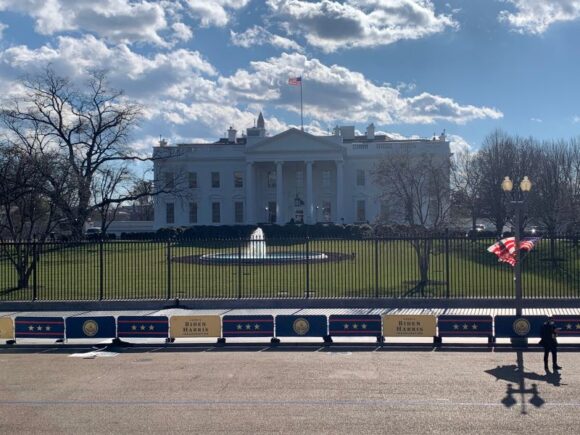
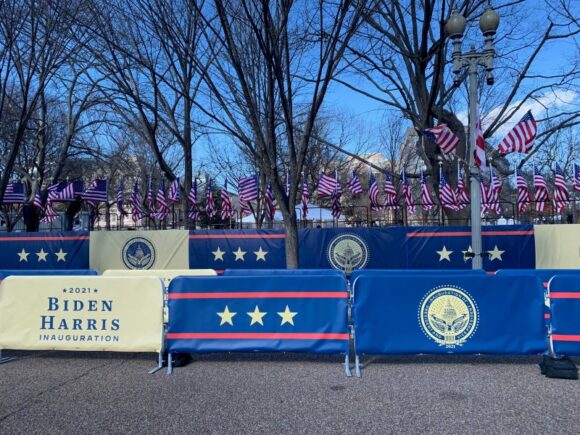
The White House on Inauguration Day. All photos by Erin O’Donnell.

At noon on this past Wednesday, Jan. 20, 2021, President-elect Joseph R. Biden was inaugurated in a ceremony on the West Front of the Capitol. This was the culminating event in what has been a hostile transfer of power from former President Donald Trump to President Biden. 

The Environment:

The then President Trump had claimed, repeatedly and without evidence, that the election result was fraudulent and “stolen” from him. Regrettably, many of his supporters have yet to acknowledge that this claim was untrue.

Consequently, there was a violent and dystopian siege on the Capitol by domestic terrorists, incited by his “Big Lie,” just two weeks before the Inauguration.

Unexpectedly, on Tuesday night, the then Senate Majority Leader Mitch McConnell affirmed that “… the president and other powerful people,” had provoked the violent attacks on the Capitol building. I am uncertain how firm he is in his conviction.

Fortunately, amidst all that turmoil, the Inauguration proceeded forward, albeit with immense security and what was  described officially as a “show of force” in place well in advance of the 20th. 

My outlet, in such chaotic and troubling times, has always been reviewing historic accounts of great men and women. I am a fan of the spoken word. A masterful presentation always stirs me. 

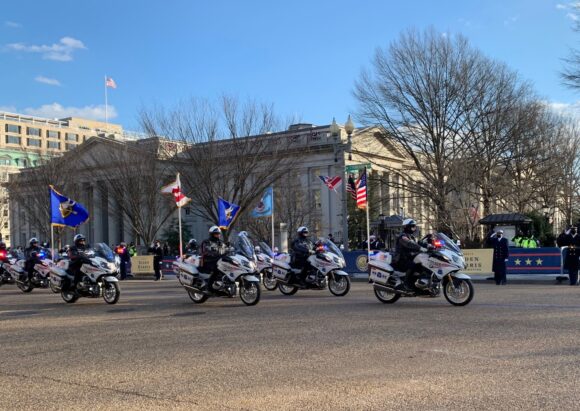
Motorcycles lead the parade up Pennsylvania Avenue following the Inauguration.

I’m going to reflect on the Inauguration in this essay; but, first, I’ll share a few written works and speeches that buoyed me during this chaotic period.

In 2005, a self-described “skinny Kid with a funny name” asserted to the American Library Association’s Annual Conference assembly that “the moment we persuade a child to cross the threshold into a library, we’ve changed their lives forever, and for the better.” The then-Senator Obama also said that “librarians are the ones who’ve been on the frontlines of the fight for privacy and freedom. Libraries remind us that truth isn’t about who yells the loudest, but who has the right information.” 

Likewise, Phoebe Griffin Noyes Library Director Katie Huffman has noted, “Libraries have long served as stewards of free speech, and we are proud and passionate to be a part of that tradition.”

One of my family’s most enduring favorites is “The Wind in the Willows” by Kenneth Grahame; in which he recounts the adventures of four friends, Mole, Water Rat, Badger, and the irascible Toad; on the river and in the wild woods. 

A particularly memorable passage, which is slightly abridged here, occurs when Rat convinces land-bound Mole to step into his boat and enjoy a day on the river.

Rat says, “Believe me, my young friend; there is nothing, absolutely nothing, half so much worth doing as simply messing about in boats. In them, or out of them, it doesn’t matter. Nothing seems really to matter; that’s the charm of it. Whether you arrive at your destination, or you reach somewhere else; or whether you never get anywhere at all, you’re always busy.”

Memorable Commencement Speeches:

In his 2014 commencement address at the University of Texas, Austin, retired Four-Star Admiral, William McRaven, provided this advice to the graduates: “If you want to change the world, start off each day by making your bed.”

He added, “You will have completed the first task of the day. That little sense of pride and achievement will encourage you to complete another task; and another, and another. And that will reinforce the fact that even the little things in life matter. If you can’t do the little things well, you won’t do the big things well.” 

Prior to appointment as Chancellor of The University of Texas System, his career included service as Head of the U.S. Special Operations Command; where he is known for orchestrating the mission, and leading the Navy SEAL team that conducted the successful 2011 raid that resulted in the death of Osama bin Laden.

An international celebrity, and another amphibian, gave the 1996 commencement address at Long Island University’s Southampton College School of Environmental Science. After acknowledging the importance of the environmental sciences in preserving the world’s ecosystems, Kermit the Frog (yes, really!) advised the graduates, “Never lose sight of the fact that you are not just saving the environment; you are saving the homes and lives of so many of my relatives.” He closed his address with the challenge, “You are no longer tadpoles. The time has come for you to drop your tails and leave this swamp.”

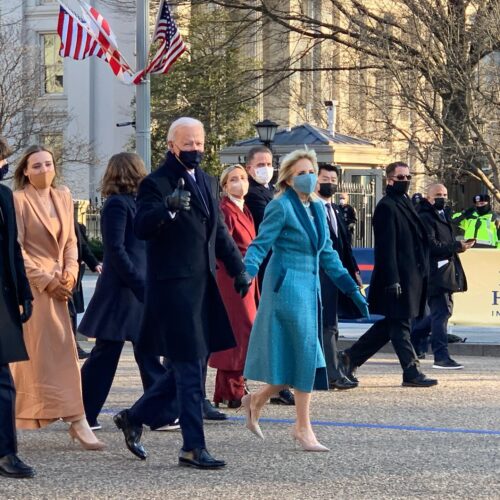
President Joe Biden and Dr. Jill Biden walk up Pennsylvania Ave. after the Inauguration on Wednesday, Jan. 20.

Reflections on the Inauguration:

There were several points in this two-day event at which I felt tears welling in my eyes. Thank you, Mr. President, and Madame Vice President. We needed that. 

I have been impressed with President Biden’s religious piety, and his pride in his family’s working-class background. He has experienced great loss in his past. His ability to convert that loss into honest and sincere empathy was demonstrated in his words on Tuesday evening, as the 400 lights around the Lincoln Memorial’s reflecting pool were lit to remember and honor the 400,000 Americans, who have died from COVID-19.

“To heal, we must remember,” Biden said. His predecessor, in contrast, never really acknowledged the tragic loss of life. 

In addition, a magnificent illuminated display of 200,000 American flags stood in the National Mall, to honor the COVID deaths. They were also in recognition of those thousands and thousands of people unable to attend the Inauguration in person amid the pandemic, and due to the intense security put in place after the violent attack on the Capitol.

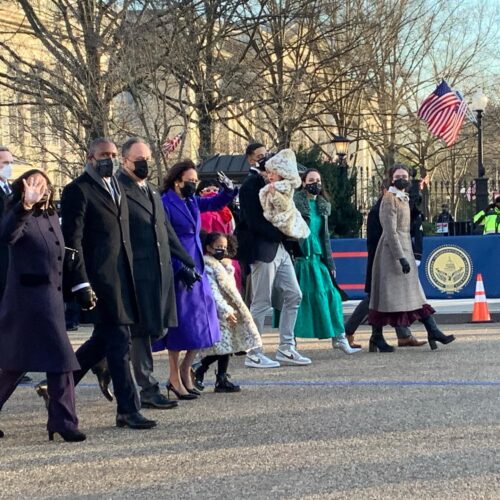
Second Gentleman Doug Emhoff (third from left) and Vice President Kamala Harris (fourth from left) and their families walk up Pennsylvania Avenue after the Jan. 20 Inauguration.

President Biden was joined on the Capitol platform by former President(s) Barack Obama, George W. Bush, William Clinton, and former Vice President Mike Pence along with the former First (or Second) Ladies. President Carter and former First Lady Rosalynn Carter, who are age 96 and 93, respectively, were unable to attend the Inauguration, but had called then-President Elect Biden the night before.

President Trump refused to attend the Inauguration and bear witness to the ceremonial transfer of power, thus becoming the first outgoing president in over 150 years to leave the city before his successor had been sworn in. 

In his inaugural address, President Biden recognized the attempted insurrection, but asserted, “Democracy has prevailed.” He called for Americans to unite and confront the perilous challenges before them:- a deadly coronavirus pandemic, economic turmoil and divisions over American leadership.

The then-President-elect had told supporters as he departed from Delaware on Tuesday for Washington and the Inauguration, “These are dark times, but there’s always light.”

Marine One flies over Washington DC carrying former President and First Lady Donald and Melania Trump for the last time.

My hopes for this new Administration:

The President has promised to use the Defense Production Act and redouble the federal government’s support of COVID testing, vaccine production, and vaccine distribution.

He has also promised that the COVID-relief package passed at the end of 2020 was only a down-payment and that greater relief would be on the way. Keep your eye on the ball, Mr. President.

I hope this Administration will move beyond governance by Executive Order and actually pass some legislation.  

Finally, it is time to restore America’s greatness, its dignity, and its world leadership.

This is the opinion of Thomas D. Gotowka.

Tom Gotowka

About the author: Tom Gotowka’s entire adult career has been in healthcare. He’ will sit on the Navy side at the Army/Navy football game. He always sit on the crimson side at any Harvard/Yale contest. He enjoys reading historic speeches and considers himself a scholar of the period from FDR through JFK.

A child of AM Radio, he probably knows the lyrics of every rock and roll or folk song published since 1960. He hopes these experiences give readers a sense of what he believes “qualify” him to write this column.

Letter to the Editor: Less Than Two Weeks for This President, But Now New Concerns

To the Editor:

The least of our worries is not whether the outgoing president pardons unrepentant criminals, or to whom he awards the Presidential Medal of Freedom.

Rather, consider the following: in the final days of Nixon’s presidency, Defense Secretary James Schlesinger had issued a set of orders that, if the president gave any military strike orders, or, God forbid, a nuclear launch order, commanders should check with him or Secretary of State Henry Kissinger before execution. Schlesinger feared that the president, who appeared out of touch with reality, might start a war, or initiate nuclear Armageddon.

Today [Friday, Jan. 8], the Speaker of the House of Representatives began discussions with the Chairman of the Joint Chiefs of Staff regarding appropriate  precautions that may be taken during the period before the inauguration.

God save the United States of America.

Sincerely,

Thomas D. Gotowka,
Old Lyme.