Letter from Paris: Europe and the Migrant Crisis

Nicole Prévost Logan

Nicole Prévost Logan

During the month of January 2016, 55,000 migrants have crossed the Aegean Sea, or 21 times the number that made the same journey in January 2015.   In 2015, a total of 856,000 arrived in Europe, 90 percent of them coming from Syria, Iraq and Afghanistan.

Today, there is an urgency in the face of this inexorable phenomenon, which is bound not only to continue but also to increase.  It is expected that with the spring’s milder weather, there will be a surge of four times that number.  The net result — Europe has a window of six to eight weeks to manage the crisis.

Everybody agrees on what should be done to stop the flow of refugees:  end the war in Syria; defeat ISIS; provide financial help to  the countries that have taken in the most refugees, i.e., Lebanon, Jordan and Turkey;  police the Mediterranean by destroying the derelict boats ferrying the migrants and put a stop to the profitable business of the smugglers.  But there has been an absence of a leadership in carrying out a common plan of action. 

At the outset of the crisis Angela Merkel was the only one to offer a clear strategy.  For her, Turkey was the key country to work with since three quarters of the migrants pass through its territory.  She even made the trip to meet President Erdogan in Antalya.  She supported the European Commission’s decision to pay Turkey three billion dollars for keeping 2.2 million refugees.  The Turks demanded that amount every year, Europe settled for a bi-annual payment.  Driving a hard bargain, the Turks demanded that Europe wave its  visa requirements for Turkish nationals traveling to Europe. Ankara even asked for the resumption of  the process of adhesion into Europe – a demand the European Union is refusing unanimously today as it has for 52 years..

Last September, Merkel announced she would welcome 800,000 refugees in Germany but she had not predicted the ensuing surge and her policy has backfired.  She has become increasingly isolated as those countries, at first favorable to her policies, started closing their borders, practicing more restrictive policies toward the migrants, and expelling the ones not qualifying for the status of “refugees.”

After the alleged mass rapes of women in Cologne on New Year’s Eve, German public opinion has become increasingly hostile to the presence of hundreds of thousands of young Muslim men not used to mixing with women in public places.  This event was reminiscent of the plight of many German women at the end of the Nazi period.  “The collective memory of outrage has overcome the compassion for the migrants,” declared Michaela Wieger, the French correspondent for Frankfurter Allgemeine Zeitung,  on a radio talk show Jan. 30.

ARTE, the Franco-German television channel gave an overview of the migrant’s situation on Feb. 2.  The three-hour- long documentary takes the viewer from Calais to Montenegro to Spain.

The situation in Calais in northern France is a festering problem.  The number of migrants, who live in abysmal conditions, has grown from 2,000 a year ago to 6,000.   Their lifeline is provided by humanitarian aid.  The mood is explosive and turning ugly.  The migrants are endangering the safety of the Euro-tunnel, which has been turned into a fortress.

The picture so far is positive in Germany, which finds in the migrants a much needed source of labor.  The town of Passau, Bavaria, which is situated on the Danube, is the hub of communications.  This is where the trains full of migrants converge. In an efficient manner, the new arrivals are greeted, trained and encouraged to learn German.  In Leipzig, workers are building wooden homes that can house 60 people.  The houses come in a kit and can be assembled in one day.  A German firm has outsourced the construction of containers – turned into living quarters – to a Polish factory.  The units cannot be built fast enough to meet the demand.  However, all the people interviewed in the ARTE program say that they have already reached their saturation point and will be unable to absorb more migrants

There is consensus today that the priority for Europe is to protect its external borders.  Greece is described as the number one “hotspot” whose job is to screen and process the migrants.  This task is colossal and it is understandable that Greece cannot cope.  Being reluctant to impose its own sovereignty, Brussels has decided to give the country three months to improve its work.  If it does not, a large contingent of  European Frontex officials and additional reserves will be sent as substitutes. 

In addition, the EU may decide to deactivate Article 26 of the Schengen treaty.  This will mean the suspension, for at least two years, of the free circulation of persons, goods and capital between the 28 member states.

Brussels would hate to make that very serious decision.  Schengen has been called an “accelerator of growth,” since its creation, says Wieger, but it was intended to function in normal times, which these clearly are not. The cost to reestablish internal borders will reach at least 100 billion Euros a year.  But, more importantly, the “Schengen Space”  is one of the main pillars of Europe.  Indeed, it is a core principle.   

“The problem of migrants is, in fact, in front of us,” commented Sylvie Kauffman, senior editor of the French daily Le Monde.  “Next, we will have to face massive flows of economic refugees  from Africa, due to its demography”.

It is a difficult time for Europe, and for the French in particular, to abdicate sacred principles such as the right of asylum and to see the very existence of Europe threatened.

Nicole Logan

Nicole Prévost Logan

About the author: Nicole Prévost Logan divides her time between Essex and Paris, spending summers in the former and winters in the latter.  She writes a regular column for us from her Paris home where her topics will include politics, economy, social unrest — mostly in France — but also in other European countries.  She also covers a variety of art exhibits and the performing arts in Europe.  Logan is the author of ‘Forever on the Road: A Franco-American Family’s Thirty Years in the Foreign Service,’ an autobiography of her life as the wife of an overseas diplomat, who lived in 10 foreign countries on three continents.  Her experiences during her foreign service life included being in Lebanon when civil war erupted, excavating a medieval city in Moscow and spending a week under house arrest in Guinea.
Letter from Paris: Marmottan Monet Museum Offers Rare Glimpse of Villa Flora’s ‘Enchanting Times’

Nicole Prévost Logan

Nicole Prévost Logan

It is a well kept secret that Switzerland’s private foundations own a wealth of  art works.  Swiss law does not require them to be registered commercially and offers them favorable tax and legal conditions, creating thus a “paradise” for art collectors.  The Villa Flora, in Winterthur near Zurich, is one of the richest of these family foundations.  Since the museum is under renovation this winter, its contents found a temporary home at the Marmottan Monet museum in Paris and currently form the Villa Flora exhibition subtitled, “A Time of Enchantment.”

In 1898  Hedy Hahnloser inherited from her father, a well-to-do textile  industrialist, a large house and moved in with Arthur, her husband.  For a short time, Arthur practiced ophthalmology in the clinic he installed on the property but soon the couple became fully engaged in the passion of their life, which was to create long-lasting friendships with painters and to collect their works.

Over the years, the rambling house was turned into a studio and an art gallery — every available space was used to place the paintings.  Hedy had always been interested in arts and crafts and in the English movement by that name.  She decorated her house’s parquets and wainscots with the geometric designs characteristic  of the 1897 “Viennese Recession” led by Gustav Klimt.

A trip to Paris in 1908 was for the couple a total immersion into the frantic artistic scene of the French capital.  Braque and Picasso were experimenting with cubism, while the Fauvist movement was at its pinnacle.  The natural flair of the Hahnlosers in selecting art work was sharpened by their contacts with art merchants like Ambroise Vollard and Gaston Bernheim.

During that trip they met and struck up a friendship with Felix Valloton (1865-1925), who became a close friend, spent much time at the Villa Flora and also introduced them to the artistic circles of Paris.  They remained friends until his death.  For the Swiss couple to welcome artists and hold Tuesday coffees became a way of life.

One can compare their creative and welcoming home with the boarding house in Old Lyme, Conn., where Florence Griswold invited American Impressionists.  Or consider Gertrude Stein and her brother Leo who, like Arthur and Hedy, opened their “salon” on 27 rue de Fleurus to artists and writers.  And in yet another example, in the late 19th century, Russia also had its own artist colonies, which grew around enlightened members of the nobility.  The best known was Abramtsevo, near Moscow, created by  the industrialist Savva Mamontov.

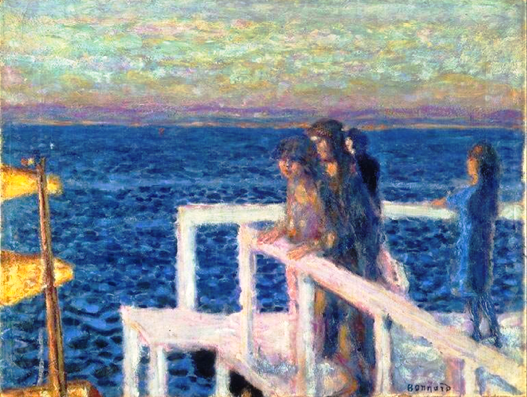
Pierre Bonnard, Débarcadère (or L’Embarcadère) de Cannes, 1928-1934

Pierre Bonnard, Débarcadère (or L’Embarcadère)
de Cannes, 1928-1934

The Hahnlosers’ collection contained works by Cezanne, Van Gogh,  Manet, Renoir, Matisse, Toulouse-Lautrec, the symbolist Odilon Redon and many others. But it is the abundance of  Nabis’ art, which made  it quite unique.

It was a post-impressionist movement in the mid 1890s.  “Nabi” means prophet in Hebrew and Arabic.  The leading members of this group — Maurice Denis, Felix Vallotton , Pierre Bonnard, Edouard Vuillard — considered themselves as the prophets of a new era in the arts.  Each one had his distinctive style, but there was always a message behind their way of depicting reality, whether it was religious, intellectual or emotional.  They were versatile artists, working in oil, and also lithography, wood cuts, satirical drawings, and book or poster illustration.

Vallotton stylized his subjects and used the technique of  “aplats” or flat areas of contrasting colors with sharp outlines.  There is a feeling of enigmatic  emptiness in his works. “La Charette” or cart drives away on a deserted dirt road, two slender umbrella pines contrast with the darker mass of trees bordering the road.

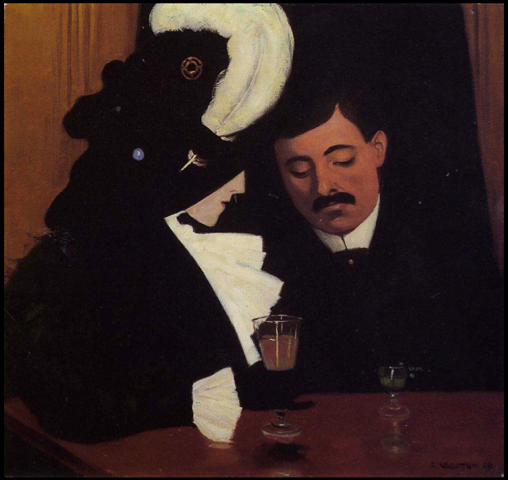
man&woman
Le provincial,” pictured above, shows a couple in a cafe.  One barely sees  the profile of the elegant woman wearing a huge hat.  The feather on the hat and the ruffled blouse are the only bright notes in this scene of a non-communicating couple in the male chauvinistic society at the turn of the 20th century.

Vallotton’ masterpiece is “La Blanche et la Noire”  (The White and the Black).  A white woman is lying, unabashedly naked, on a bed while a black woman is staring at her with insolence and a sort of inappropriate familiarity, a cigarette is sticking out of  her mouth. The painting is reminiscent of  the “Olympia” by Manet but with a different underlying story.

At the opposite end of the spectrum, Bonnard’s paintings have an effusive and warm quality.  His colors are luminous, his brush strokes seem unbridled, full of life.  He is inspired by the intimacy of domestic scenes — “Le Tub” is a picture within a picture thanks to the mirror placed at the center of the composition.   A plunging angle reveals Marthe, his wife and beloved model, near the tub.

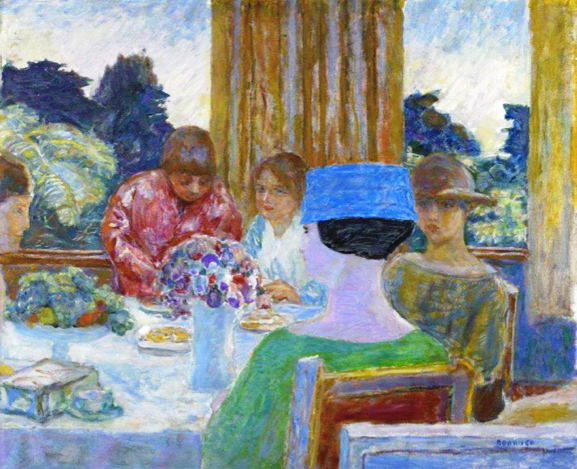
Pierre Bonnard, Le Thé, 1917

Pierre Bonnard, Le Thé, 1917

Bonnard cherished his villa in the Var, not far from Cannes.  “Le Thé” is a peaceful scene of young women having tea . He plays with an array of hat colors.  The vegetation seems to overflow into the porch.  On “Le Debarcadère” or pier,  young people lean over a railing, as if frozen in the contemplation of the rough Mediterranean waters.

This is indeed a rare opportunity to see an exceptional private art collection created by two extraordinary citizens, who according to the exhibition’s guide, lived their lives by following a simple mantra, “Living for art. Collecting. Such was the raison d’être of [this] couple.”

Nicole Prévost LoganAbout the author: Nicole Prévost Logan divides her time between Essex and Paris, spending summers in the former and winters in the latter. She writes a regular column for us from her Paris home where her topics will include politics, economy, social unrest — mostly in France — but also in other European countries. She also covers a variety of art exhibits and the performing arts in Europe. Logan is the author of ‘Forever on the Road: A Franco-American Family’s Thirty Years in the Foreign Service,’ an autobiography of her life as the wife of an overseas diplomat, who lived in 10 foreign countries on three continents. Her experiences during her foreign service life included being in Lebanon when civil war erupted, excavating a medieval city in Moscow and spending a week under house arrest in Guinea.
Letter from Paris: Exhibition Explores the Elegance, History of Louis Vuitton’s Luggage

Nicole Prévost Logan

Nicole Prévost Logan

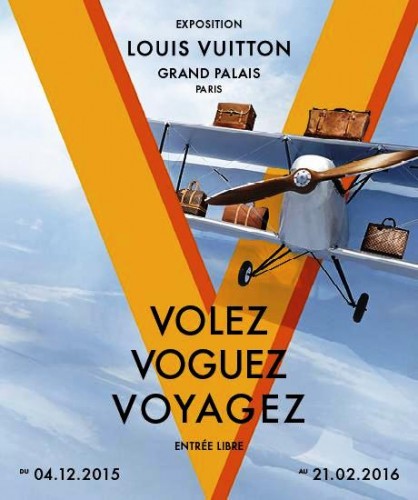
The exhibit “Volez, Voguez, Voyagez” (Fly, Sail, Travel) at the Grand Palais takes the visitor to the elegant world of travel in the early 20th century. It is a retrospective of the luggage, which created the Vuitton dynasty’s fame. Every item is beautifully crafted of wood, cloth and leather, such as the famous “sac Noé” created in 1932.

caroussel_grandpalais_460x550_v02These luxurious objects make travel by air, train or sea glamorous and modern. The visitor rides an old-fashioned, wood-paneled train and feels transported into the “Out of Africa” world of Karen Blixen, as the Kenya savannah speeds outside the windows. Several pieces of the Vuitton family’s private luggage — first seen by the public at the 1900 Exposition Universelle (World Fair) — are scattered on sand dunes, evoking the beautifully photographed scene of a couple riding in the desert near the Pyramids in the 1978 Agatha Christy’s movie “Death on the Nile.”

A huge sail reaches all the way to the ceiling. On the deck of a yacht are displayed a wooden trunk, fragrant with camphor wood and rosewood; a “wardrobe” trunk whose drawers and hangers contain an elegant passenger’s apparel; a gentleman’s personal case complete with crystal flasks; and fancy hair brushes.

Luxury goods – labeled as “consumer discretionary” in Wall Street jargon – are an important sector of the French economy. They combine traditional savoir-faire acquired over many generations (the Maison Vuitton has existed since 1835; the Maison Hermes since 1837) with the creative talent of artists and decorators along with the highly complex robotic machinery used to fabricate, clothes, bags, shoes and more.

At Hermes, silk screen scarves are made from raw silk spun under the constant scrutiny of a worker; artists, assisted by colorists, create the designs.

For decades, not a single famous woman – from Jacqueline Kennedy to French actress Catherine Deneuve – has been seen without the iconic Chanel purse. The making of the little black purse, with its gold chain, and its distinctive padded outer shell stitched in lozenges, requires the skilled delicate work of 17 people.

The world of fashion and luxury objects could not exist without money — lots of money. In 1987, the merger of Louis Vuitton fashion house with Moët et Chandon and Hennessy champagne – produced the LVMH multinational conglomerate. It brought together 90 of the most famous brands of wines and spirits, fashion and luxury goods, as well as perfume and cosmetics. Dior is the major shareholder with 40 percent of the shares.

Bernard Arnault is CEO of both Dior and LVMH. He is the richest man of France and holds the fifth largest fortune in the world — his worth is about 30 billion dollars. When Arnault arrived in Shanghai for the opening of a new Vuitton boutique, he was received like a head of state.

It is not uncommon for a tycoon to be a philantropist and an art collector. In the late 19th century, two Russian businessmen were instrumental in bringing French art to their home country — Sergei Ivanovich Shchukin introduced Impressionist art to Russia after a trip to Paris, and similarly, Ivan Morozov was a major collector of French avant-garde art.

Arnault won a resounding victory over his rival Francois Pinault when he was able to build his art museum on the edge of the Bois de Boulogne in Paris. (Pinault “only” owns a few islands of Venice.) In order to promote artistic creation, Arnault built a museum, which he called the Fondation LVMH — it was designed by the American architect Frank Gehry. At the time of its inauguration in 2014, it was met with a mixed reaction but gradually it has become part of the landscape. It did help rejuvenate the dilapidated Jardin d’Acclimatation, a 100-year-old zoo and children’s attraction park, beloved by the Parisians.

Gehry created a wild structure of huge, curved glass panels flying in all directions, like spinnakers blowing in the wind. To create an area of 125,000 square feet of molded glass, 100 engineers were employed who were supported by Dassault Systèmes, the leading French company specializing in aeronautics and space.

The inside structure, called the “iceberg,” is erratic and disorients visitors. Several intricate levels and vertiginous staircases lead to the upper terrace offering a view over the Bois in which the skyscrapers of La Défense district appear to be framed by the glass panels.

Nicole Prévost LoganAbout the author: Nicole Prévost Logan divides her time between Essex and Paris, spending summers in the former and winters in the latter. She writes a regular column for us from her Paris home where her topics will include politics, economy, social unrest — mostly in France — but also in other European countries. She also covers a variety of art exhibits and the performing arts in Europe. Logan is the author of ‘Forever on the Road: A Franco-American Family’s Thirty Years in the Foreign Service,’ an autobiography of her life as the wife of an overseas diplomat, who lived in 10 foreign countries on three continents. Her experiences during her foreign service life included being in Lebanon when civil war erupted, excavating a medieval city in Moscow and spending a week under house arrest in Guinea.
Letter From Paris: Welcome ‘Le Grand Paris!’ New Geographical Region Becomes a Reality

Nicole Prévost Logan

Nicole Prévost Logan

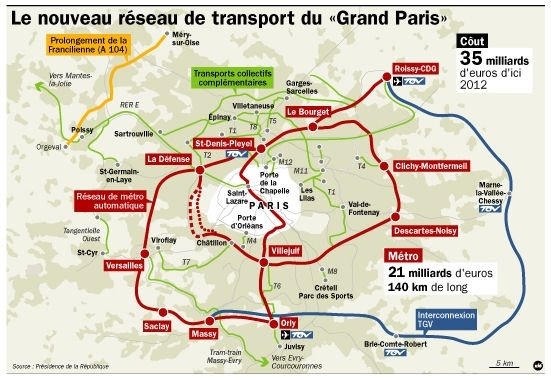
On January 1st, 2016 the “Metropole du Grand Paris” became official .  This new territorial organization, named Etablissement Public de Cooperation Intercommunale (EPCI),  includes Paris plus parts of three departements Hauts de Seine, Seine St Denis and Val de Marne– with seven millions inhabitants.

What is the Grand Paris ?  Why is it a necessity?  Is it a decisive step forward? Does it have models in other countries?  What are the  problems it is facing ?  Anyone curious to learn how France works and what lies in the future might be interested in having a look at this new concept.

The project was born in 2007 under President Sarkozy’s mandate.  When the Socialists came to power in 2012, they immediately modified the initial proposal.  But the authors of the project kept plodding away.  Its official status represents a progress toward the long term objective, which is to be ready for the Olympic Games in 2024 and the 2025 World Fair, in the event Paris is chosen.

The French capital is choking inside the beltway and something had to be done:  the town of Paris is too small and too expensive even to accommodate the middle class; suburbia, which used to provide a labor force in the former industrial economy, is hit today by unemployment ; this same suburbia feels isolated because of inadequate public transport (if you drive into work you might spend hours in bouchons or traffic jams on the highway).  The RERs (Regional Rapid Transit) are overcrowded and often unsafe.

reseau-de-transport-grand-paris-1

In the new project (see map above), the backbone of public transport will be the Grand Paris Express, six new lines of totally automated trains circling the Paris agglomeration  and connecting, for the first time, the suburbs.  For instance it will be possible to go directly from Boulogne at the west of Paris to Marne la Vallée  (the location of Euro-Disney) in the east.

Until now any change has been hampered by administrative complexity – layer upon layer of  authorities, like a millefeuille  – (a well known and sinful pastry).

The Grand Paris will  include 132 communes.  Mayors wield enormous power in France.  That power is particularly obvious at election time when building permits seem to multiply.  The mayors will have to learn how to live together and adapt to the new administrative structure, which now includes other layers of the bureaucratic millefeuille, namely the departements and the regions (this year they have been reduced from 22 to 13), piled on top.

France is essentially a centralized state.  Culture, finance, education of the elite,  research and development, luxury shops,  are heavily concentrated in Paris and the Ile de France.  Napoleon, Baron Haussmann, General De Gaulle are the great historical figures who left their imprint in the centralization process.  What we are witnessing today is an explosion of the center.  It is even likely that the boundaries of the Grand Paris may expand.

The Grand Paris will be made of ‘clusters’ (in English in the French text) to bring Paris to par with New York , London or Tokyo.  According to the official description of the project, “Greater Paris relies on seven thematic competitive clusters.”  The list includes : Air Space, Trade, Sustainable City, Digital Creation, International Trade, and Life Sciences.  A financial center already exists in the Defense district, which looks like a mini-Manhattan. ,

Saclay, 20 kilometers south of Paris, is the most impressive and modernistic of these clusters.  Until recently an agricultural land, it is now the hub of Research and Development.  Many élite Grandes Ecoles, like Polytechnique,  have  moved there, as well as 23 universities and the headquarters of major companies.  Its emblematic building, spreading over the fields like a giant flying saucer, is the Synchroton Soleil with its accelerators to study light.  Pierre Veltz, an engineer and former head of Saclay, is confident that it will become an European Silicon Valley.

Nicole Prévost LoganAbout the author: Nicole Prévost Logan divides her time between Essex and Paris, spending summers in the former and winters in the latter. She writes a regular column for us from her Paris home where her topics will include politics, economy, social unrest — mostly in France — but also in other European countries. She also covers a variety of art exhibits and the performing arts in Europe. Logan is the author of ‘Forever on the Road: A Franco-American Family’s Thirty Years in the Foreign Service,’ an autobiography of her life as the wife of an overseas diplomat, who lived in 10 foreign countries on three continents. Her experiences during her foreign service life included being in Lebanon when civil war erupted, excavating a medieval city in Moscow and spending a week under house arrest in Guinea.

Letter from Paris: COP 21, Part II — Reaching Consensus was a “Tour de Force,” But Much Work Still To Do

Nicole Prévost Logan

Nicole Prévost Logan

cop21-logoAt 7.26 p.m. precisely on Saturday, Dec. 12, Laurent Fabius, president of the United Nations Framework Convention on Climate Change (UNFCCC) COP 21 , choking with emotion, announced that an universal accord had been reached. The several thousand people in the audience rose in a standing ovation and started congratulating each other.

After two sleepless nights, the “facilitators” wrenched out an agreement by consensus from the 195 Convention’s members. The suspense lasted until the absolute final minute when Nicaragua tried to interrupt. It was too late — the president had already snapped down his gavel. The conference could very well have been a failure – it had to overcome a block from the oil-producing countries such as Saudi Arabia – but on that last day, there were no grim faces, as had been seen in Copenhagen, only a general enthusiasm.

Credit should be given to the involvement of the French organizers. For two years they traveled several times around the world to meet every leader. President François Hollande was talking to president Xi Jinping just one month before the start of the Convention. All paid homage to the professionalism of Fabius who seemed on a mission throughout the process. “You did an amazing job,” commented John Kerry, while Al Gore added, “This is the finest diplomatic performance I have seen in two decades.”

In a nutshell, the agreement reads as follows:

  • its main objective is to limit the increase in temperature to “well below” two degrees by the end of this century
  • developed countries should reduce their emissions of greenhouse gas and the developing countries should “mitigate” them
  • Article 9 stipulates that “developed country parties shall provide financial resources to assist developing countries”
  • the agreement, which will be ratified in April 2016, requires an annual payment of 100 billion Euros, with a revision every five years

President Barrack Obama is expected to use an Executive Order to avoid the likely opposition of the Republican majority in the Congress; in the absence of coercion and sanctions — a mechanism of control by satellite (France is financing the “MicroCarb” satellite) — provides an attempt at transparency and ongoing verification by a committee of experts thus making the agreement de facto binding.

Never before has there been such an awareness of the threat caused by global warming. The vagaries of the climate and the fact that 2015 is the warmest year in recorded history contributed to this sense of urgency. Today any debate about climate skepticism has become obsolete.

What makes the Paris conference different from all the ones before is a groundswell of positive intentions. For the first time the main polluters of the planet – China, the US and India – are on board and are determined to make the agreement work. Already 187 out of the 195 countries have announced their voluntary contributions.

Today the action of society as a whole is crucial. It is important to note that, at the Bourget, the Non-Governmental Organizations (NGOs), private associations and a number of organizations were working just a few steps from the UN “Blue Zone” for government officials (at the Lima, Peru, COP, they had been “exiled” 15 kilometers away). Giant screens in the hallways made it possible for the general public to follow the proceedings, breaking away from the closed door policy of the past.

After the initial euphoria felt on Dec. 12, a number of questions remains unanswered, some of the objectives are unclear – no date was set as to when to reach the greenhouse gas neutrality nor when to end the use of fossil energy, no price was put on carbon – and the unfairness of many decisions has become apparent – such as the financing and the sharing of responsibilities between the “North” or rich countries and the developing countries — or to put it another way, who pays whom and for what? Until now Europe, and France in particular, have been paying a great deal. A country such as Russia has not paid one cent so far. Are China and India – the big polluters of the planet – still considered as part of the developing world and expected to be on the receiving end of hundreds of billions of Euros?

Nicolas Hulot, militant environmentalist and an icon in France, deemed the agreement very positive even though it was not perfect. “Such a movement of solidarity around the planet has never been seen before,” he stated, adding, “There is a momentum, which needs to be seized and followed by action.”