She’s Back! Nicole Logan is Here Again With Another ‘Letter From Paris’

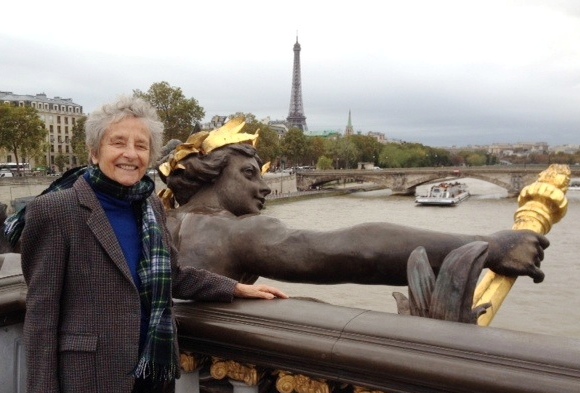
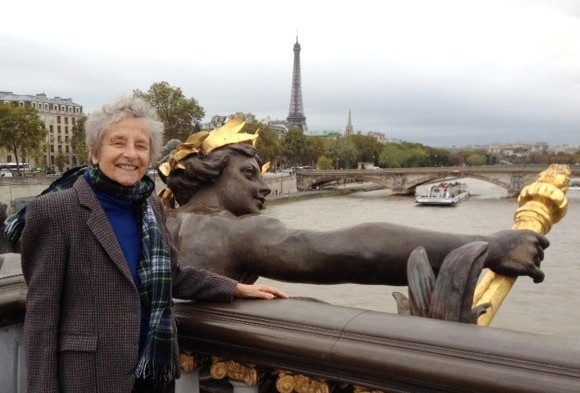
Nicole Prévost Logan

Nicole Prévost Logan

We are absolutely delighted to welcome back Nicole Prévost Logan and her Letter From Paris column!  Nicole stayed longer than usual in Essex this year in order to see the outcome of the election and celebrate Thanksgiving.  She has now returned to Paris and here is her first column of the 2016-17 series.  We know this will please the many readers who have been asking about Nicole’s welfare and (perhaps even more intensely) the future of her column — it also pleases us greatly. Welcome back, Nicole!

In the Wake of Election Surprises Everywhere, Where is France’s 2016-17 ‘Saison’ Headed?

Debates, elections, referendums, reshuffling of governments- the political landscape of the European Union (EU) is shifting.  It would be a mistake however to place the events under the simplistic label of “populism,” a trend following the startling votes supporting both Brexit and the election of Donald Trump.  It is more accurate to describe the ongoing turbulence in the EU as a stand taken by its members toward the future of Europe.

Au revoir, Francois

Au revoir, Francois Hollande

On Dec. 1, the decision of president Francois Hollande not to run again in next May elections, caught everyone in France by surprise.  After many months of tergiversation, Hollande, with the abysmal 7.5 percent score in the polls, made the logical — but still wrenching — announcement during an unprepared TV news hour.

It was an unprecedented move in the fifth Republic, creating , a “lame duck” a la française situation for the next five months.  What a contrast with May 2012, when, on Bastille Square, I had watched the euphoria of the population when Hollande was elected!  The new president made a point of arriving by train instead of flying, like an ordinary citizen.  A delirious crowd was celebrating the end of eight years of Nicolas Sarkozy’s rule.

What went wrong with this “ordinary” president?

Specialists pondered over the assessment of his policies.  Many of his reforms, particularly to boost the economy like  the CICE (Credit d’Impot de Croissance et d’Emploi) or the Macron law, will survive him.   His mandate was highlighted by the signing of the Paris accords on climate change, the armed forces deployment against Islamist radicals on  the African continent, and the firm measures taken to protect the country from terrorist attacks.

But Hollande’s  political management was a disaster, commented Thierry Pech, director of the Terra Nova foundation.  Although intelligent and highly educated, the president lacked a visionary plan and the ability to give a direction to his programs.  He wanted to carry out reforms but never explained them in advance.

The battle to pass the el Khomry labor law was emblematic of his shortcomings.  His objectives were sound:- facilitate the laying off of workers, reject the rigid 35 hours per week Socialist taboo, and relax the rules concerning work on evenings and Sundays.  Unfortunately he presented the law proposal as a done deal and resorted to “49-3” or executive orders, which irritated the deputies in the National Assembly.  He frequently kowtowed to the anger of the street.  When the el Khomry law was finally voted on, it had been gutted of much of its content.  The scourge of high unemployment remained throughout  his mandate.

The campaign toward the May elections started with the primaries of the right and center parties.  Francois Fillon was catapulted into the lead of Les Republicains (LR) with 66 percent of the votes versus 23 percent for Alain Juppe who had been expected to win.  Nicolas Sarkozy , coming in third position, was eliminated.
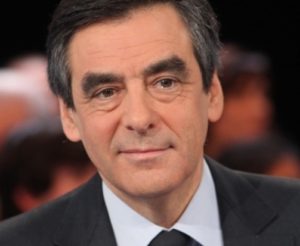
Bienvenue, Francois Fillon

Bienvenue, Francois Fillon

Fillon, several times a minister and prime minister under Sarkozy, conducted a discreet but intensive campaign for three years, using social networks rather that the traditional media.  His program is quite conservative: reduce the number of civil servants by 500,000, decrease unemployment allowances, complement the social security benefits by increasing the share of private health insurance.  He advocates a free market economy.  In foreign policy, he has a pragmatic attitude to relations with Putin, wants a strong Europe and to control the flow of migrants.  By preempting part of the program of Marine Le Pen of the far right Front National , he may be in a good position to beat her.

Fillon’s victory represented only 40 percent of the total electorate, so there is still plenty of ground to cover. Next will come the Socialist primaries.

Emmanuel Macron, former minister of the economy in the cabinet of Manuel Valls, is running as an independent.  Only 38, he is a brilliant  young man who had had a versatile career, including one year with the Rothschild investment bank.  On Dec. 9, the boisterous gathering of 16,000 supporters marked the start of the movement he is calling, “En marche,” under which he promises to modernize the labor market in order to create jobs and eliminate the old divide between right and left.

The battle has just began.

Editor’s Note: This is the opinion of Nicole Prévost Logan.

Nicole LoganAbout the author: Nicole Prévost Logan divides her time between Essex and Paris, spending summers in the former and winters in the latter. She writes a regular column for us from her Paris home where her topics will include politics, economy, social unrest — mostly in France — but also in other European countries. She also covers a variety of art exhibits and the performing arts in Europe. Logan is the author of ‘Forever on the Road: A Franco-American Family’s Thirty Years in the Foreign Service,’ an autobiography of her life as the wife of an overseas diplomat, who lived in 10 foreign countries on three continents. Her experiences during her foreign service life included being in Lebanon when civil war erupted, excavating a medieval city in Moscow and spending a week under house arrest in Guinea.

Letter From Paris – No, Now It’s Essex!  A Brave, New Museum Opens in DC

Nicole Prevost Logan

Nicole Prevost Logan

Editor’s Note:  Our popular writer from Paris, Nicole Prevost Logan, is back in Essex, CT, for the winter.  She does not normally write for us from Essex, but this year, she is making an exception and will be continuing to contribute articles to ValleyNewsNow.com and LymeLine.com during the winter months.  Here is her inaugural column from Essex about the opening of  a very special museum in Washington DC.

The Grand Opening of the National Museum of African American History and Culture (NMAAHC) will take place in Washington DC this coming Saturday, Sept. 24.  The NMAAHC, the 19th and newest of the Smithsonian museums, was established by a bi-partisan Act of Congress in 2003.

The Smithsonian's National Museum of African American History and Culture, Nov. 6, 2015. (Photo by Michael Barnes from http://newsdesk.si.edu/photos)

The Smithsonian’s National Museum of African American History and Culture, Nov. 6, 2015. (Photo by Michael Barnes / Smithsonian Institution.)

The massive structure occupies a prime location next to the Washington Monument and contrasts with the 555 ft. slender obelisk.  The dark bronze-colored metal lattice that covers the ‘Corona” also stands out from the white marble classical architecture of most of the other museums standing on the National Mall.

It has been a long struggle for the supporters, such as Congressman John Lewis (D-Georgia), to make the project a reality.  They needed to overcome the resistance from several senators who advocated another location. The final approval  was more than a triumph — it might be considered a miracle.  It succeeded in making a strong statement as to the importance of Black history and culture in the American nation.

The lead designer was David Adjaye, son of a Ghanaian diplomat and the lead architect Philip Freehon, who died in 2009.  Founding Director Lonnie B. Bunch III is the visionary and driving force of the project.  During some of the many interviews he gave to the press and to a variety of audiences, including select ones like the Aspen institute, he explains the building process and his objective with a very contagious enthusiasm.

The NMAAHC is not intended to be a Holocaust museum, he explains . Its mission is to show the pain but also the joy and the creativity of African-Americans.  A daunting fund-raising goal of 450,000 million dollars had to be reached.

The three-tier effect of the construction incorporates elements from African culture, such as the Yoruban crowns from Nigeria.  Inside the building, high tech designs and the enormity of the space will make it possible to be versatile in organizing several exhibits simultaneously.

The collections had to be created from zero.  It required a treasure hunt into the attics, trunks and basements of the population.  To date 35,000 artifacts have been collected.  A segregated train from outside Chattanooga (TN) was lowered by crane and the museum built around it.  All traffic stopped on Constitution Ave. when an oversized truck delivered the control tower from a federal prison.

Artifacts showing the terrible fate of the slaves are very moving.  Such is an amulet created by the Lombi tribe in the form of a shackle.  More tragic still were the shackles for children.

But fun and the world of entertainment are also present in the displays , such as Louis Armstrong and his trumpet, Lena Horne or Marianne Andersen . The film archives will be essential to build up history, from Harriet Tubman to the human rights movements of the 1950s and 1960s.

According to Washington insiders , the opening of the new museum is the hottest event in a decade.  More than 150,000 special tickets have been distributed to dignitaries while long lines of visitors gather at the entrances of the building to purchase tickets for general admission after the opening.

Editor’s Note: This is the opinion of Nicole Prévost Logan.

Nicole LoganAbout the author: Nicole Prévost Logan divides her time between Essex and Paris, spending summers in the former and winters in the latter. She writes a regular column for us from her Paris home where her topics will include politics, economy, social unrest — mostly in France — but also in other European countries. She also covers a variety of art exhibits and the performing arts in Europe. Logan is the author of ‘Forever on the Road: A Franco-American Family’s Thirty Years in the Foreign Service,’ an autobiography of her life as the wife of an overseas diplomat, who lived in 10 foreign countries on three continents. Her experiences during her foreign service life included being in Lebanon when civil war erupted, excavating a medieval city in Moscow and spending a week under house arrest in Guinea.
Letter From Paris: The Grand Palais in Paris to Old Lyme — CT Impressionist Exhibits Both Sides of ‘The Pond’

Nicole Prévost Logan

Nicole Prévost Logan

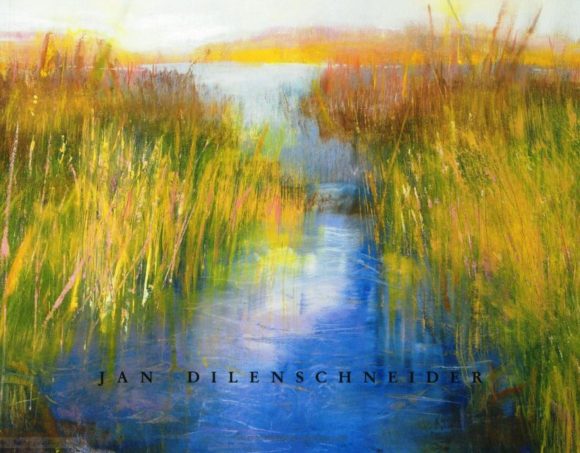
Talking with Jan Dilenschneider is entering a beautiful world of marshes, rushes swaying in the breeze, ponds reflecting the sky,  and clusters of trees taking on the many hues from the painter’s palette contrasting with the softness of the wild flowers.

Dilenschneider is a Darien artist who has recently been making inroads on the Paris art scene. She was one of only a very few artists to participate in the “Art Paris Art Fair” held in March 2016 at the Grand Palais and, in a switch of continents, she will have a solo exhibition at the Sill House Gallery of the Lyme Academy College of Fine Arts in October of this year. For an artist, whose work so closely resembles Impressionism, to exhibit her paintings in the same year both in Paris and in Old Lyme – the home of the American Impressionism –  is a remarkable and very special event.

A classic work by Jan Dilenschneider.

A classic work by Jan Dilenschneider.

For the past three years, Dilenschneider has shown her work in Paris at the upscale Galerie Pierre-Alain Challier in the Marais district, close to the Picasso Museum. I was treated to a private showing of Jan’s paintings by the gallery’s owner, who knows her well.  Then I had the pleasure of meeting Jan personally at the Grand Palais.  Thanks to the badge Challier obtained for me, I was able to enter the giant steel and glass 1900 structure through the cavernous entrance reserved for the exhibitors. 

The Paris artistic calendar is overcrowded and art professionals are scrambling to find a time slot.  The “Journal des Arts” describes the artistic events taking place in the spring as a “galaxy in fusion.”  The last weekend in March is particularly in demand.  It was therefore a real breakthrough for “Art Paris Art Fair” to be able to establish itself under the nave of the Grand Palais at that time.  The Fair has a special format — only galleries can participate, not individual artists.  This year, 143 major galleries from from 22 countries around the world showed their collections.  All media are allowed, including sculpture, design, photographs or digital art.

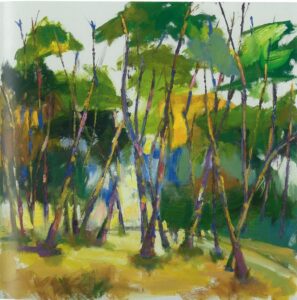
"Trees with broken color" by Jan Dilenschneider

“Trees with broken color #2,” oil on canvas, 36″ x 36″, by Jan Dilenschneider.

As I approached the Challier space, several potential buyers were looking at the gallery’s collection.  A striking blonde woman was standing in front of one of her paintings – an icy white and blue landscape – being interviewed by a French television team from the Canal Sat network channel “Luxe.”  It transpired the woman was Dilenschneider and after the TV crew left, she and I started chatting and did so for a long time.  I immediately liked her as a person and was attracted to her sunny personality.  Her passion for nature was contagious.

“Any work starts from the abstract, and the abstract is never far under the painting,” she explained, adding, “Each artist makes a contribution to art history.”  In one of the handsome catalogues the Galerie Pierre-Alain Challier has published relating to her exhibits, she writes, “If I were to have lunch with four artists, I would choose Wolf Kahn, Henri Matisse, Franz Kline and Michelangelo.”

In a video series named “Nec plus ultra,” produced by the “Magazine de l’art de vivre” of TV 5 Monde, Dilenschneider is shown caught in the throes of her creating process.  She paints with gusto, happily digging into the colors lying heavily on her palette.  She uses spatulas, all sizes of brushes, and even squeegees to diversify her technique.

Painting is her way of meditating, which she says she can do eight hours a day.  Even when she is not painting, she is taking photographs from trains, at airports … wherever she is, to be used in her future work.   

Dilenschneider has a remarkable way with words and writes, “I become the water, I become the trees, I become the birds and reeds — but I don’t need to tell you [that] — my paintings already do.  Living on Long Island Sound, the beauty of the world is my inspiration.”

She wants to make people enjoy the beauty of nature and is happy to use her privileged situation to make an impact.  With the help of her influential husband, whose communications counseling company is based on the 57th floor of the Chrysler building in New York City, she has created the “Janet Hennessey Dilenschneider Scholar Rescue Award in the Arts.”  This year she rescued a Syrian artist, her husband and two sons.

Although she has been painting since the age of 17, she has not exhibited her work until recently.  Thus, she has long been a hidden treasure, which now finally all can enjoy.

Editor’s Note (i): Dilenschneider’s exhibition at Lyme Academy College of Fine Arts opens Friday, Oct. 7.

Editor’s Note (ii): This is the opinion of Nicole Prévost Logan.

Nicole LoganAbout the author: Nicole Prévost Logan divides her time between Essex and Paris, spending summers in the former and winters in the latter. She writes a regular column for us from her Paris home where her topics will include politics, economy, social unrest — mostly in France — but also in other European countries. She also covers a variety of art exhibits and the performing arts in Europe. Logan is the author of ‘Forever on the Road: A Franco-American Family’s Thirty Years in the Foreign Service,’ an autobiography of her life as the wife of an overseas diplomat, who lived in 10 foreign countries on three continents. Her experiences during her foreign service life included being in Lebanon when civil war erupted, excavating a medieval city in Moscow and spending a week under house arrest in Guinea.
Letter from Paris: Moderate, Radical Islamists in France — a Difficult Cohabitation

Nicole Prévost Logan

Nicole Prévost Logan

Introduction 

For years the buzz word in France has been “amalgam.” On ne doit pas faire l’amalgame entre Islam modéreé et Islamisme radical. (One must not confuse moderate Islam and radical Islamism.)  After the repeated terrorist attacks in France and Belgium and with the discovery of other jihadist enclaves, it is hard to keep making that distinction.  The voice of moderate Muslims has been barely audible lately.  Until they start speaking with a stronger voice, the cohabitation within our democratic and secular society is becoming more difficult.

Belgium

Belgium was the last victim of terrorist attacks when, on March 22, 34 people died at Zaventem airport and at Malbeek metro station (close to the European Commission offices) combined.

Why Belgium?  For the past two decades, it has been a divided country between Flemish and Walloon languages and cultures.   It remained without a central government for 18 months.  How can such country produce six parliaments and six governments? asked David Van Reybrouck, a Dutch-speaking Belgian writer in Le Monde dated March 28.  The author of the article adds with irony, “… and the icing on the cake is the creation by the government of a Commission communautaire commune” (joint Commission of communities.)

It was in Molenbeek that the four and a half month-long chase of Salah Abdeslam, who was involved in the Nov. 13 Paris attack, ended.  Molenbeek is one of  the 19 Brussels municipalities — it has a population of 93,000 with 80 percent of them Muslim, 56 percent of them unemployed and 24 mosques.  After the closing of the coal mines and the steel plants in northern France in the 1980s and 1990s, many of the workers  emigrated to Belgium.  Molenbeek is a typical agglomeration of a second generation Maghreb population – more specifically of Rifains, coming from the Rif mountains of Morocco.  It constitutes almost a self-ruled community, many of whose members are related and even siblings.  No better safe haven for people running away from the law. 

Belgium has been described as the “ventre mou” (litterally the soft belly), in other words, the weak link, of Europe. Patrick Kanner, one of the French ministers made the chilling remark, “but there are tens of Molenbeeks in France “.

France on the front line

France is, in fact, on the front line of the confrontation with radical Islamism.

The weekly Le Point‘s issue of March 24 describes the long history of France’s interaction with the Arabs. It started with the 732 AD defeat of the Saracens at Poitiers by Charles Martel, grandfather of Charlemagne. Then came The Crusades and subsequently Napoleon Bonaparte’s expedition to Egypt in 1798.  The French began their conquest of Algeria in 1830 and made it a part of France.  The country gained its independence after the bloody war of  1954-1962.  France established protectorates in Tunisia in 1881 and in Morocco in 1912 until 1955.  At the present time, France has become the “gendarme” across the Sahel region, ready to deploy its forces to stop extremist groups. 

Gilles Kepel, professor at Sciences Po and an authority on Islam, has  just published “Terreur dans l’Hexagone – Genèse du Dhihad Français,” in which he stresses the deep-rooted antagonism of the North African population for the former colonial power and the existence of a specific French jihadism.  Acts of terrorism in France are accomplished by individuals with French nationality. The country holds the sad record of having the highest number of jihadists in theEuropean Union who have gone to Syria. 

Eiffel-Tower-322x252Kepel, sees a correlation between politics and the spread of Islamism in France.  He remarks that, during the 2012 elections, François Hollande benefited from 93 percent of the Muslim electorate voting for him.  Kepel believes, as most other Islam scholars do, that the problem our society is facing is cultural.  He criticizes the unpreparedness of the political elites for the ongoing debate about religions.  He deplores the fact that insufficient public funds have been allocated both to research and Middle East studies.

Mohammed Sifaoui is a brillant French journalist born in Algeria, who is quite forthright in expressing his opinions.  He advocates a relentless reprisal against the preachers of violence in the 2,000 mosques and Koranic schools of France.  Sifaoui’s opinion is that we have to abandon the attitude that only the FN (Front National party) has a right to fight back against the Islamists.  Besides, he says, we should stop treating these people as victims from discrimination.

Daesch

After the fall and occupation of Fallouja in Irak in 2014, Abou Bakr al-Baghdadi became the self-appointed ruler of the Islamic State organization or Daesch. (The “ch” sound stands for “sham” meaning Levant in Arabic ) The objective of this organization is to re-create a caliphate reminiscent of the golden years of  the 661-750 AD Ommayad and 750-1258 AD Abbasid caliphates. The totalitarian organization banished the Wahhabism and any other doctrines of Islam and has broken all ties with Al-Qaeda.  Al-Baghdadi gave his founding speech at the great mosque of Mossoul, dressed in black like the Abbasids. 

Mathieu Guidère, professor of Islamic Studies at the University of Toulouse 2, a learned scholar in geopolitics with a PhD in the Arabic language, believes that the objective of Daesch is to build a state, anchored solidly in a territory, with the elimination of the 1916 Sykes-Picot borders.  Its aim is also to break up the cohesion of Europe.  So far, we are still only at the initial stage of “collateral terrorism,” comments Guidère. 

The riposte

Alain Bauer, professor of  applied criminology at the Conservatoire  des Arts et Metiers, former advisor to Nicolas Sarkozy and Manuel Valls on security and counter-espionage, says, “The problem is that we seem to have too much information and not enough analysis.  We still do not have the ability to connect the dots.  We have a brain and two ears and four ears will not help ” He concludes, “What we need is a return to Human Intelligence.”  Bauer and Guidère agree that there should be a European Intelligence agency but several states oppose it for fear of losing part of their sovereignty.  The creation of a PNR (personal name register) still awaits a vote.

Euro 2016 – the European soccer championship – will be held in France in June. This means, on the one hand, a great deal of excitement for millions of spectators, but on the other, an equal — or even greater amount — of nervousness for the security forces.

Editor’s Note: This is the opinion of Nicole Prévost Logan.

Nicole LoganAbout the author: Nicole Prévost Logan divides her time between Essex and Paris, spending summers in the former and winters in the latter. She writes a regular column for us from her Paris home where her topics will include politics, economy, social unrest — mostly in France — but also in other European countries. She also covers a variety of art exhibits and the performing arts in Europe. Logan is the author of ‘Forever on the Road: A Franco-American Family’s Thirty Years in the Foreign Service,’ an autobiography of her life as the wife of an overseas diplomat, who lived in 10 foreign countries on three continents. Her experiences during her foreign service life included being in Lebanon when civil war erupted, excavating a medieval city in Moscow and spending a week under house arrest in Guinea.
Letter From Paris: Immortal Chekhov Rises Again in Paris

Nicole Prévost Logan

Nicole Prévost Logan

Chekhov will never die!

This winter four of his plays appeared on the Paris stages: two short one-act plays (“The Swan” and “The Bear”) at the Studio de la Comédie Française, “Three Sisters” at theTheatre de la Colline and “The Cherry Orchard” at the Theatre de l’Ile Saint Louis-Paul Rey. I chose the latter.

The first time I saw a play by Chekhov was at the Moscow Art Theater (MXAT) in downtown Moscow in the mid 1960s. The production and the reception by the public were electric. In those days, theater was the only possible evasion from a drab and controlled life for Soviet citizens. The audience knew by heart and relished every single line beautifully spoken by the adulated actors. Period clothes, settings and furnishing provided an authentic reconstitution of life in a run-down country estate.

What is amazing is that Anton Chekhov’s plays, written under the Tsarist regime, lasted through the Soviet era, although he depicted members of the idle bourgeoisie, about to disappear from the surface of the earth. Other playwrights were not so lucky. Some of the controversial plays – Bulgakov’s for instance – did not make it through censorship and were suddenly removed from Moscow stages.

Chekhov’s universal message explains why his plays still attract huge audiences around the world — in different languages and re-adapted by directors. His “inward-looking” realism came from a traditional line of dramatic art founded by Constantin Stanislavsky (1863-1938), one of the greatest founders of theater staging and philosophy of all times.

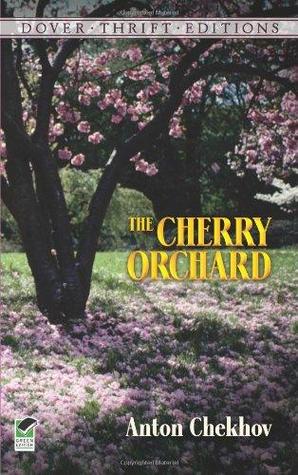
The_cherry_Orchard‘The Cherry Orchard,’ created at MXAT in January, 1904, was Chekhov’s last play. Six months later he died in his Yalta “white house.” Obliged to live far away from Moscow, in the warmer climate of the Crimea because of his tuberculosis, it was hard for him to give long-distance stage directions to his high-spirited wife, actress Olga Knipper.

In the play, Liubov Andreevna Ranevskaya, her daughter Ania, age 17, and adopted daughter Varia, age 30, just returned to Russia from five years spent in France. The family was crippled with debts and the creditors were forcing the sale. A retinue of servants, some of them providing a light touch of vaudeville, and penniless hangers-on, are part of the large household.

The main character is Ermolai Alekseevich Lopakhin, full of energy, ideas, and, apparently money. He is trying to convince Liubov Andreevna to sell the estate with the cherry orchard to a developer who will build small houses for vacationers. But she is not interested in money; if things do not work out, she will return to Paris and live off an inheritance. Lopakhin was a slave or “soul” owned by the Liubov’s family. This former muzhik is now rich and ambitious.

His antithesis is Petr Sergueevich Trofimov, the eternal student who lives in a world of noble ideas, philosophy and poetry. He tells Lopakhin, “Soon you will be a millionaire. Sharks are needed also.” Such archetypes exist in many countries.

The Theater of Ile St Louis is the smallest theater in Paris with only 50 seats. The full cast of 12 characters barely fitted on the tiny stage and looked like giants. The set was limited to two benches and the period clothes to the slim laced-up boots of the women. When, at the end of the play, the spectators heard the chain saw felling the cherry trees and noticed the very old servant forgotten in the locked-up house, the emotion was intense.

I went on feeling that emotion while walking along the rushing grey waters of the Seine river.

Editor’s Note: This is the opinion of Nicole Prévost Logan.

Nicole LoganAbout the author: Nicole Prévost Logan divides her time between Essex and Paris, spending summers in the former and winters in the latter. She writes a regular column for us from her Paris home where her topics will include politics, economy, social unrest — mostly in France — but also in other European countries. She also covers a variety of art exhibits and the performing arts in Europe. Logan is the author of ‘Forever on the Road: A Franco-American Family’s Thirty Years in the Foreign Service,’ an autobiography of her life as the wife of an overseas diplomat, who lived in 10 foreign countries on three continents. Her experiences during her foreign service life included being in Lebanon when civil war erupted, excavating a medieval city in Moscow and spending a week under house arrest in Guinea.