
Talking Transportation: “Traffic Calming”

You’ve seen the bumper stickers:  “Slow down in town”.  They’re an often futile attempt to encourage speeding motorists to be more respectful of the neighborhoods they are zooming through, especially of the pedestrians.  I wouldn’t exactly call it road rage, but why is it that when we’re behind the wheel, our goal is to get on down the road as fast as traffic will allow, the speed limit be damned?

Of course in our own neighborhoods our interests are reversed.  We curse “those idiots” who speed down our local streets ignoring the signs (“Drive Like Your Kids Lived Here”).

Increasingly, local neighborhoods are serving as short-cuts around clogged arterial streets, spreading out the traffic into our sleepy, bucolic ‘burbs.  But there is a way to enforce the speed limit without radar traps.  It’s what traffic engineers call “traffic calming”.

You might not know that the first US city to develop a master plan for neighborhood traffic calming was Hartford.  And the second city will be Stamford.  Work is also underway in New Canaan and New Haven.  More than just “speed bumps”, engineers have a slew of street re-designs in their repertoire that can force us to reduce our speed.  Among them …

Speed Tables:  Think of these as extended speed bumps with a six-foot-long ramp up, a ten-foot-long flat table and a six-foot-long ramp down.

Roundabouts:  Small traffic circles with landscaping in the center make us slow down as we go around them, eventually taking a right turn to continue our journey.

Chicanes:  These are the stubby, picket-fence-like, mini-roadblocks seen on some private streets, alternating their placement on the right and left sides of the road, forcing drivers to make a zigzag maneuver down the street.  The same effect can be achieved by placing parking spaces alternately on the right and left sides.

Bulb-Outs or Neck-Downs:  These are extensions of the sidewalk into car parking areas at corner crossings.  Again, you gotta slow down.

Sidewalks:  It’s amazing how many of our communities lack these pedestrian amenities, forcing hoofers to compete for space on the asphalt with cars.  Sidewalks get pedestrians out of the traffic and encourage us to walk and leave the car at home.

Crosswalks:  What a concept!  A place where pedestrians have the right-of-way over cars, sometimes even mid-block and without the need for stop signs or red lights.

Roadblocks and Mazes:  These were inspired by anti-crime efforts in drug dealing neighborhoods (“crime calming”), making it hard for drive-through drug buyers to find their way in and out of a neighborhood.  Local residents know how to maneuver the maze, but casual short-cutters won’t try it again.

Of course, all of these traffic calming techniques assume that the major traffic arterials, where the cars belong, can be kept flowing with their own traffic tricks.  Otherwise, we’re just spreading the gridlock into the neighborhoods.

Jim Cameron

Jim Cameron

Editor’s Note: Jim Cameron has been a Darien resident for 23 years.  He is the founder of the Commuter Action Group and also serves on the Darien RTM.  The opinions expressed in this column are only his own.  You can reach him at CommuterActionGroup@gmail.com
Talking Transportation: Things Are Getting Better on Metro-North

I know it may be hard to believe, but I think things are getting better on Metro-North.

Last week I finally met Joseph Giulietti, the new President of Metro-North.  I found him to be very smart, quite candid and equipped with a reasonable plan to bring this railroad back to its once-deserved world-class status.

On May 11th a new timetable will become effective, aimed at achieving two goals:  safety and reliability.  The timetable will mean running trains on-time but still allowing for track and catenary work to keep the railroad in a state of good repair.

At a Commuter Forum in Westport, Giulietti was the first to admit that the railroad was in bad shape, that trains are running slower and later, often with standees.  But unlike GM’s Chairman explaining delays in safety recalls and blaming it on “the old GM”, Giulietti is taking ownership of the problems. That’s refreshing.

Yes, trains are not on time (just 76 percent in February), but that’s because after the last May’s Bridgeport derailment the FRA issued speed restrictions on bridges and curves.  The current timetable is, as one commuter put it in our recent survey, “more of a suggestion” than anything else.

So for the past months the railroad has been analyzing the entire timetable, looking at the reasons for every late train and being open to revising everything.  The new timetable will rationalize the current running times, adding 2-4 minutes for trains between New Haven and Stamford, but cutting two to four minutes for runs from Stamford to GCT.

That means that your 7:35 a.m. train to work, usually arriving this winter at 7:40 or 7:45, may be rescheduled to arrive at 7:40 and, probably, will.  This means you can plan your life with reliability and not be wasting time on the platform peering down the track.

The problem of standees on trains will hopefully lessen when people return to a routine commuting cycle and extra railcars will be provided on trains where ridership shows the demand for more seats.

The good news is that with increased reliability, we may also see greater frequency of service … four trains an hour in the a.m. peak instead of three trains every half-hour off-peak.  Yes, the run may take a bit longer, but you’ll have more options, always knowing the scheduled departure and arrival times will be achieved.

But is the railroad safe?  Yes, insist both Giulietti and CDOT Commissioner Jim Redeker.  But so too was airline safety / security after 9-11.  And our bridges became safer after the collapse of the Mianus River Bridge 30 years ago.  Even in the “land of steady habits,” we hopefully learn from our mistakes.

We’re now about half-way through Mr. Giulietti’s 100 day plan to get Metro-North back on track.  I, for one, am hopeful he will achieve his goals.  But on day 100, June 11th, I’ll be checking the scorecard and seeing what he’s achieved versus what was promised.

Jim Cameron

Jim Cameron


Jim Cameron has been a Darien resident for 22 years.  He is the founder of the Commuter Action Group and also serves on the Darien RTM.  The opinions expressed in this column are only his own.  You can reach him at CommuterActionGroup@gmail.com

Eight Little Known Facts About Flying

We may never know what happened to that Malaysia Airlines 777, but there’s plenty more we should know about flying, even domestically.  Here are some little-known truths of aviation as shared by pilots and flight attendants:

Lavatory Doors Don’t Really Lock:

They can be opened from the outside by just sliding the “occupied” sign to one side.  This isn’t so attendants can catch “mile high club” wannabies, but so they can be sure the lavs are empty on take-off and landing.  And those ashtrays in the lavs?  Even though smoking has been banned for decades, the FAA still requires them.

Oxygen Masks Can Save Your Life:    

But only if you get them on fast!  In a rapid decompression at 35,000 feet, the oxygen is sucked from your lungs and you have 15 – 30 seconds to get that mask on or die.  And the on-board oxygen is only good for 15 minutes, so expect an express ride down to safer altitudes.

Airlines Are Suffering from a Pilot Shortage:

New regulations for increased rest time and more experience aviators are making it tough for airlines to keep their cockpits filled.  Boeing alone estimates that aviation growth worldwide will create demand for a half-million new pilots.  And just like Metro-North, airlines are now losing their most experienced crews to retirement.

Your Pilot May Be Asleep:

Actually, that’s a good thing during most of the flight, which can be pretty boring as the auto-pilot runs the plane.  And a good nap should make your pilot refreshed for landing.  But the FAA is also proposing to test ‘heavy’ pilots for potential sleep disorders so they don’t nod off at a crucial moment.

Keep Your Seatbelt On:

Otherwise, unexpected turbulence will see you bounce off the luggage racks like a ping-pong ball.  In an incident like that the hysterical screaming is bad enough, so stay belted.

Flight Attendants Aren’t In It for the Glamour:

They don’t get paid when they arrive at the airport or when they greet you boarding the plane.  For most, their pay starts ticking only at take-off.  They travel for a living and have to endure endless abuse for things that are not their fault.  For all that, median salary for flight attendants is about $37,000.  Food stamps they have to apply for separately.

Planes Are Germ Factories:

Most older jets recycle cabin air to conserve fuel, so if one passenger sneezes, everyone’s susceptible to a cold.  The air is also dry and the blankets and pillows (if you get them) haven’t been cleaned since the previous use.  The same is true of the headphones they pass out.  And your seatback tray table?  Just imagine whose baby diaper was seated there where you lay out your in-flight snack.  Moral to the story:  BYO sanitizer!

Don’t Drink the Water:

Unless it comes from a bottle, water on planes comes from onboard tanks that are rarely cleaned.  At least when they use it to make coffee it’s heated.  Again, BYO.

Overall, based on passenger miles, flying is the safest form of transportation in the world.  But it’s not without its risks, some of which you can help minimize using common sense.

Jim Cameron

Jim Cameron


Jim Cameron has been a Darien resident for 22 years.  He is the founder of the Commuter Action Group and also serves on the Darien RTM.  The opinions expressed in this column are only his own.  You can reach him at CommuterActionGroup@gmail.com

Talking Transportation: The Commuter Manifesto

Jim Cameron

Jim Cameron

“Quit your moaning!”  “You’re not a railroad person, what do you know?”  “You don’t like the train, try driving.”

These are the reactions I get, especially from railroad employees, when I have been critical of Metro-North in the last few calamitous months.  They think I’m a “moaner”, though I try just as hard to be positive about the railroad as to criticize its failures.

But it’s not about me.  Mine is not the only voice calling for sweeping changes at the railroad.

So in launching the Commuter Action Group I knew it was important to be specific about riders’ expectations of service… to define a few basics of what Metro-North customers deserve in return for the highest rail fares in the US.

Thus was born, “The Commuter Manifesto” which I ‘nailed’ to the waiting room wall at several train stations:

We, the riders of commuter railroads in Connecticut, are tired of deteriorating service, rising fares and indifference and ineptitude from Metro-North.  As customers and taxpayers we deserve better and expect change.  Our expectations are few, and simple:

SAFETY FIRST

We expect a clean, safe, on-time, seated ride on trains with heat / AC and lights.  Don’t treat us like cattle making us ride on railcars you wouldn’t ride on yourself.

We want to know that you make our safety your top priority.  Make every employee understand that responsibility.  If they do anything that jeopardizes safety, discipline them or fire them.  There is no excuse for stupid mistakes.

FAST, ACCURATE AND HONEST COMMUNICATIONS

When things go wrong, immediately tell us what’s happened, why and when it will be fixed.  When you make a mistake, admit it.  Stop making apologies; get things fixed and don’t repeat the same errors over and over again.

RESPONSIVE CUSTOMER SERVICE

When we see a problem, give us an easy way to report it to you.  Then get it fixed and follow up with us to tell us it’s been resolved. Our complaints shouldn’t fall into a black hole.

Train your employees to be courteous and efficient, treating us like valued customers.  When they don’t meet those standards, train them again.  There should be zero tolerance for rude behavior by employees … or commuters.

OPEN & TRANSPARENT OPERATIONS

Let us know how you make decisions that affect us by opening all of your meetings to the public and media.  Share your goals and self-evaluations and ask our opinions as well.  The way you run the railroad affects our lives and we should have input.

LEADERSHIP THAT LISTENS

Meet with commuters on a regular basis at times and locations convenient to us.  Hear our complaints and suggestions and answer our questions.  We will listen to you if you will listen to us:  we’re in this together.

That’s it.  A few simple expectations the commuters of Metro-North have of their railroad.

The reaction so far?  Enthusiasm from commuters … back-patting by the pols … but from the CDOT and Metro-North, silence.

Really?  Are we asking for so much?

Editor’s Note: Jim Cameron has been a Darien resident for 22 years.  He was a member of the CT Rail Commuter Council for 19 years and still serves on the Darien RTM.  The opinions expressed in this column are only his own.  You can reach him at CommuterActionGroup@gmail.com  

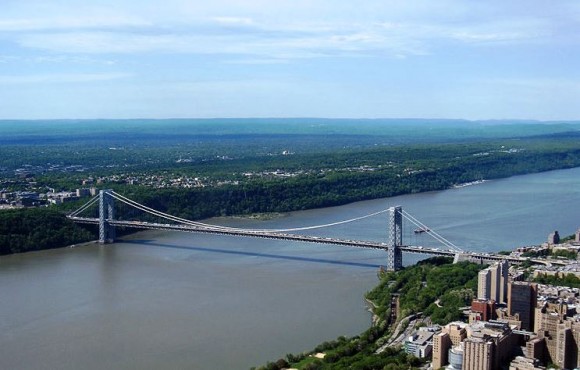
Talking Transportation: The George Washington Bridge

The George Washington bridge is the busiest vehicular traffic bridge in the world.

The George Washington bridge is the busiest vehicular traffic bridge in the world.

We’ve read a lot about the George Washington Bridge (GWB) in recent weeks.  And the scandal over who ordered closure of approach lanes from Fort Lee, N.J., only underscores how crucial this bridge is to the entire region.  All of which got me thinking about the GWB and its history.

Surprisingly, the GWB was not the first bridge design to cross the Hudson River.  As early as 1885, there were discussions of building a suspension bridge to bring the Pennsylvania Railroad into Manhattan at about 23rdSt.  A later design in the 1920’s foresaw a double deck, 16-lane-wide roadway (with 12 tracks for railroad trains on the lower level) at 57th Street.

But it was in 1927 that work began on the GWB much farther uptown at 179th Street.  The $75 million single-level bridge carrying six lanes of traffic opened in 1931 and was widened by two lanes in 1946.

Originally the bridge was going to be called The Bi-State Bridge, The Bridge of Prosperity or The Gate of Paradise (really!), but it was a campaign by school kids that ended up honoring our first President.

The original designers had planned for the future and, in 1961, the lower level, six-lane “Martha Washington” bridge opened to traffic, increasing total capacity by 75%.

Because we usually approach the bridge from the east or west, it’s hard to appreciate its enormity until you’re right on the structure.  But from any angle it’s a beautiful bridge, showing its bare criss-cross girders and bracing, which were originally to have been clad in concrete and granite.

The GWB is recognized by civil engineers and architects alike as one of the most beautiful in the world.

In its first year of operation the bridge carried five million vehicles.  Last year it carried 102 million.  On opening day, the toll was 50 cents each way.  Today the one-way toll for autos (only collected eastbound) ranges from $9 (EZ Pass off-peak) to $13 (cash).  But pedestrians can still walk across for free (when the sidewalk is open).

Those walkways, while affording a wonderful view of the city, also have a dark side as the GWB was scene of a record 18 suicides (and 43 attempts) in 2012.

On an average weekday, 17,000 bus passengers rely on the GWB’s own bus terminal built atop the Trans-Manhattan Expressway (not the Cross Bronx) on the Manhattan side.  There they can catch the A train or the Seventh Avenue IRT.  The bus station is undergoing a $180 million renovation.

The bridge itself is a living thing.  It creaks and groans, moves and sways and it needs constant maintenance.  In 2011, the Port Authority announced an eight-year, $1 billion project to replace the bridge’s 529 vertical suspender wire ropes.  In addition, lanes on the upper level are being closed (at night) to replace steel plates on the road surface.

All of which means more jobs and, eventually, higher tolls.

jimcameronJim Cameron has been a Darien resident for 22 years.  He was a member of the CT Rail Commuter Council for 19 years and still serves on the Darien RTM.  The opinions expressed in this column are only his own.  You can reach him at Jim@MediaTrainer.tv