Republican Sen. Art Linares Wins Third Term in 33rd District

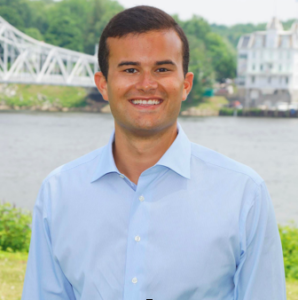
State Senator Art Linares (R-33rd) File photo.

State Senator Art Linares (R-33rd) File photo.

AREAWIDE — Republican State Senator Art Linares of Westbrook was re-elected for a third term Tuesday , defeating his Democratic challenger, Essex First Selectman Norman Needleman, by a decisive margin in the 12- town 33rd District.

Linares, 28, carried at least six district towns, including Clinton, East Haddam, East Hampton, Portland, Old Saybrook, and Westbrook.

Neeedleman, 65, carried Chester, Deep River, Essex, and Lyme. The margin in Deep River was a close 12 votes 1,268 for Needleman to 1,256 for Linares,. Results were still outstanding as of 10 p.m. from Haddam and Colchester. Excluding those two towns, the total vote was 22,950 for Linares to 17,643 for Needleman.

Linares, was first elected in 2012, taking the seat that had been held for the previous two decades by the late former State Sen. Eileen Daily of Westbrook. He won a second term in 2014, defeating Democrat Emily Bjornberg of Lyme on a 22,673-17,326 vote.  Needleman is serving his third term as first selectman of Essex.

Linares claimed victory around 9:30 p.m., entering the ballroom at Water Edge Resort in Westbrook to cheers from about 100 supporters. “Not bad for a close race in the 33rd, I mean how big do we have to win by,” he quipped. Linares offered special thanks to his younger brother, Ryan, who has managed his three winning election campaigns .
Needleman greeted supporters at the Ivoryton Tavern in Essex.

Republican State Sen. Linares, Democratic Challenger Needleman Spar in 33rd Senate District Debate

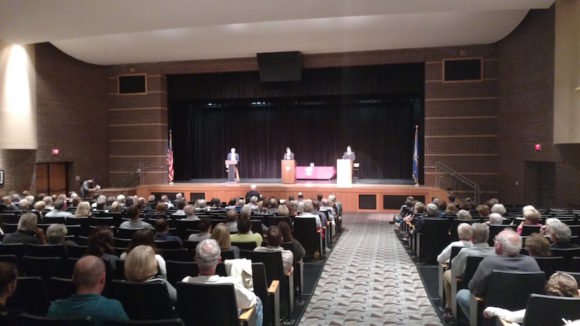
A view of the debate stage from the rear of the Valley Regional High School auditorium

A view of the debate stage from the rear of the Valley Regional High School auditorium

Republican State Senator Art Linares of Westbrook and his Democratic challenger, Essex First Selectman Norman Needleman, sparred Monday in a public debate for the 33rd Senate District contest.

More than 150 voters from the 12 district towns turned out for the 90-minute debate held in the auditorium at Valley Regional High School in Deep River, with the question of which candidate represents the “political class” in Connecticut overshadowing the specific issues where the candidates differed, or nearly as often, concurred.

The session was moderated by Essex Library Director Richard Conroy, who selected questions that had been submitted in advance by district voters.

The debate began with a walk-out by Green Party candidate Colin Bennett of Westbrook. Bennett, who has run previously for the seat and participated in all debates during the 2014 campaign, began with an opening statement where he said his goals are to end hunger, provide access to health care, protect the environment and affirm that black lives matter.

Bennett then claimed that Conroy had attempted to exclude him from the debate based on comments at an Oct. 5 debate in Westbrook where he criticized Needleman and urged people not supporting him to vote for Linares. “I don’t want to be where I am not wanted,” Bennett said before walking off the stage. Linares said later he had told Conroy he would not participate in the debate if Bennett was arbitrarily excluded from the outset.

The term political class entered the discussion soon after the opening statement from Needleman, where the three-term first selectman said he had been urged to run the seat this year by the Senate Democratic leadership because they wanted a candidate with experience in business and municipal government. Needleman said he told party leaders he would not be a rubber stamp, and could become their “worst nightmare,” if elected.

Linares, who was first elected in 2012 and re-elected in 2014, scoffed at the claim, questioning why the Senate leadership would provide Needleman with a full-time campaign manager on leave from the caucus staff if they believed his election would be a nightmare. Linares contended Needleman has been a loyal supporter of Democratic “Governor Dan Malloy and the political class,” contributing funds to Malloy’s two gubernatorial campaigns in 2010 and 2014.

Needleman said Linares is the “career politician,” running for the senate seat at age 23 and laying the groundwork for a future campaign for the 2nd District congressional seat or statewide office.

But despite the sharp exchange, the two rivals agreed on several issues, including support for recently approved incentive package for Sikorsky in Stratford, providing some degree of contract preferences for in-state companies, and reducing, or for Linares eliminating, the estate or inheritance tax. The candidates agreed state employee unions would have to make contract concessions on both wages and pensions if the state faces another large budget deficit in 2017.

From left to right, Norman Needleman (D), incumbent Sen. Art Linares (R) and Colin Bennett (Green Party) make their opening statements at Monday night's debate.

From left to right, Norman Needleman (D), incumbent Sen. Art Linares (R) and Colin Bennett (Green Party) make their opening statements at Monday night’s debate.

Needleman said his experience negotiating contracts with public employee unions in Essex would be helpful in any discussions with state employee unions, though he questioned whether unions could be forced into concession talks. Linares called for mandatory legislative votes on all union contracts, and suggested a need for “additional leverage” to bring unions to the table. “The unions have not come to the table, we’ve tried that, everyone has tried that,” he said.

The candidates differed somewhat on the question of welcoming refugees from war-torn Syria to Connecticut. Needleman said while “vetting is critical,” an arbitrary exclusion based on a refugee’s country of origin or religion is “un-American.” Linares, whose family fled Cuba in the early 1960s, said he would insist on “clearance from the FBI,” because the United States does not have intelligence capabilities in Syria to screen refugees, including those who reach Europe before possible entry in to the United States.

The candidates also differed on possible increases to the state minimum wage, and gun control measures. Needleman said he supports measured increases in the minimum wage, but believes a hike to $15 per hour, as advocated by some Democrats, “is a very bad idea.’ Linares said he favors a national standard for the minimum wage, suggesting that further increases at the state level would hurt small businesses and cost the state jobs. He said the earned income tax credit is a better way to provide assistance to low income workers.

On gun control, Needleman said he is a “2nd Amendment Democrat,” but favors some additional gun control measures. He criticized Linares for opposing legislation approved earlier this year that allows guns to be seized from persons who are subject to a court restraining order where domestic violence is a factor.

Linares said Needleman is “trying to take both sides of the issue,” by referring to gun ownership and the 2nd Amendment. Linares said he opposed the temporary restraining order gun bill because it was an “overreach” that takes away due process for gun owners, and discretion for judges.

The 33rd Senate District includes the Town of Lyme along with Chester, Clinton, Colchester, Deep River, East Haddam, East Hampton, Essex, Haddam, Portland, Westbrook, and portions of Old Saybrook.

Hundreds Join Elected Officials to Oppose Possible Amtrak Railroad Bypass

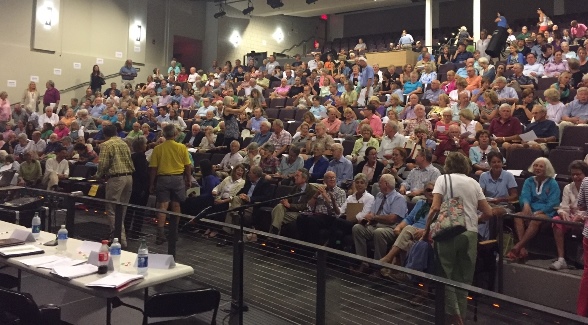
The auditorium was packed for the meeting. Daniel Mackay photo

The auditorium was packed for Wednesday afternoon’s public session with the FRA. Daniel Mackay photo

A crowd of more than 500 area residents turned out Wednesday to join elected officials in opposing a possible Amtrak railroad bypass project that would run from Old Saybrook through southeastern Connecticut to Kenyon, R.I.

The auditorium at Lyme-Old Lyme High School was packed to capacity for a public session with representatives of the Federal Railroad Administration (FRA). Also on hand were elected officials, including U.S. Senator Richard Blumenthal and Congressman Joe Courtney, state legislators, and chief elected officials for seven area cities and towns.

The concern is focused on an option that has emerged as part of a long-range plan to improve and expand passenger rail service along the Northeast Corridor from Washington D.C. to Boston, Mass. The option, called the Old Saybrook-Kenyon, R.I. Bypass, would require construction of a second rail line that would cross the Connecticut River and run north of the existing rail line and Interstate-95 through historic and environmentally sensitive areas of Old Lyme and other towns.

Representatives from the FRA along with elected state and local officials were on hand for the public session. Daniel Mackay photo

Representatives from the FRA along with elected state and local officials were on hand for the public session. Daniel Mackay photo

In the session that was held in response to pressure from elected representatives and the public after months of local controversy over the bypass option, two representatives of the FRA, Rebecca Reyes-Alicea and Anishi Castelli, explained the preliminary plans and review process before responding to questions and comments from the elected officials. The “roundtable” did not include questions or comments from the large audience.

Reyes-Alecea said the Northeast Corridor improvements would be completed over the coming decades, and would require congressional approval of funding and probably state funding contributions.

Though the FRA is expected to make some decisions on future project options by the end of the year, Reyes-Alecea said the review process is still in an “early stage.” She added the turnout for Wednesday’s session was the largest officials have seen for any of the public meetings held at locations throughout the 457-mile Washington-Boston corridor.

But the comments from federal, state, and local officials made it clear any decision to pursue the bypass plan, estimated to cost at least $68 billion, would face determined bipartisan resistance every step of the way.

Blumenthal said the bypass plan is “unfeasible, unworkable, and unnecessary,” adding, “I will fight as long and as hard as possible to block any route with an adverse impact on historic, cultural, and environmental values.” Courtney said the bypass plan seemed like something “from an alternate universe” and suggested there is a “long to-do list,” including bridge and grade crossing replacements, that must be completed before any consideration of a second rail line through the region.

State and local officials were equally firm in their opposition to the bypass plan. New London Mayor Michael Passero said previous railroad and urban renewal projects have hurt his city by claiming taxable property and isolating neighborhoods. Passero said there is no way to construct a second rail line through or around New London “without destroying our little city.”

State Rep. Devin Carney, R-Old Saybrook, described the plan as “a dark cloud hovering over these towns.” Stonington First Selectman Rob Simmons, a former second district congressman, and Waterford First Selectman David Stewart urged the federal agency to focus first on improvements to the existing rail line. “Why can’t we fix what we have,” Simmons said. Old Saybrook First Selectman Carl Fortuna said all seven municipalities along the possible bypass route would “stand with Old Lyme” in resisting the plan.

Reyes-Alecea said any recommendation filed later this year would set the stage for a Tier 2” analysis process and report that would include more specific plans and cost estimates for improvement projects. She said it could take years before any construction begins, even on the specific improvement to the existing line that are encouraged by the local elected leaders.

Asked after the meeting for his reaction, Gregory Stroud, Executive Director of SECoast – the non-profit constructively opposing the proposed bpass – said, “There is no doubt, that every member of the press, Senator Blumenthal and Representative Courtney came away impressed. A huge crowd. A great coming together of all the towns in southeastern Connecticut. A bipartisan, unified delegation, with one curious exception. Where is Governor Malloy?”

Republicans Nominate Art Linares for Third Term in 33rd Senate District

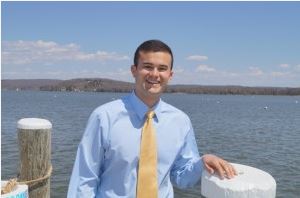
Art Linares (file photo)

Art Linares (file photo)

Republicans Tuesday nominated incumbent State Senator Art Linares of Westbrook for a third term in the 12-town 33rd Senate District. Linares was the unanimous choice of about 45 delegates and alternates gathered for the nominating convention at the Old Town Hall in East Haddam.

Linares is facing a challenge in the Nov. 8 vote from Democratic First Selectman Norman Needleman of Essex, who is expected to be nominated for the seat at the Democratic convention on May 23 in East Hampton. Needleman, 64, has served as first selectman of Essex since 2011. As well as the Town of Lyme, the district includes the towns of Chester, Clinton, Colchester, Deep River, East Haddam, East Hampton, Essex, Haddam, Portland, Westbrook, and portions of Old Saybrook.

Linares was nominated by State Rep. Melissa Ziobron of East Hampton, who described the incumbent as a “great advocate for all of the towns,” in the district. The nomination was seconded by Edward Marcolini of Old Saybrook, who described Linares as, “young, vibrant and personable.”

In brief remarks, Linares said he has worked for spending reform and fiscal responsibility at the capitol, contending that overly optimistic budget planning by legislative Democrats had led to first ever cuts in the state ECS (Education Cost Sharing) grants for cities and towns. Linares, 27, said he is ready for the election challenge. “I stand before you a four-year-veteran, a little more seasoned, but just as ready to knock on thousands of doors and wear out shoes as that 23-year-old kid was four years ago,” he said.

Linares declined to comment on Needleman’s candidacy, but confirmed he is ready to debate his opponent on more than one occasion during the fall campaign.

Linares, a co-founder of the Middletown-based Greenskies solar energy company, was elected in 2012 in a district that has been represented for 20 years by the late former Democratic State Senator Eileen Daily of Westbrook. He won a second term in 2014, defeating democrat Emily Bjornberg of Lyme on a 22,672-17,326 vote in a race where Bjornberg also had the Working Families Party ballot line and Linares had the ballot line of the Connecticut Independent Party.

Hundreds Vigil for Late First Selectman Richard Smith, Selectmen to Meet Thursday to Discuss Succession

Candles are lit in honor of " a remarkable legacy to service, commitment, and dedication to the people of Deep River." Photo by Kim Tyler.

Candles are lit in honor of Dick Smith’s “… remarkable legacy to service, commitment, and dedication to the people of Deep River.” (Angus McDonald Jr.) Photo by Kim Tyler.

DEEP RIVER — The town showed its affection and appreciation for the late First Selectman Richard H. “Smitty” Smith Monday as hundreds gathered at sunset around town hall in a vigil for the longtime municipal leader who died suddenly Friday at age 65.

Hundreds gathered at Deep River Town Hall yesterday evening to pay tribute to their beloved First Selectman Dick Smith, who passed away Friday afternoon.Hundreds gathered at Deep River Town Hall Monday evening to pay tribute to their beloved First Selectman Dick Smith, who passed away Friday afternoon.

The vigil, which precedes the funeral for Smith Thursday at 11 a.m. at St. Joseph Church in Chester, came as the two remaining members of the board of selectman, Democrat Angus McDonald Jr. and Republican David Oliveria, scheduled a special meeting for Thursday to discuss the process for filling the vacancy for the remainder of Smith’s term that runs through November 2017.

A quiet, candlelit moment of contemplation on a life well lived.A quiet, candlelit moment of contemplation on a life well lived. Photo by Kim Tyler.

McDonald, who joined Oliveria to meet with town hall employees Monday afternoon, said the special meeting that begins at 5:30 p.m. in town hall would review “temporary organizational changes to cover leadership in the coming month.” McDonald, who was first elected with Smith in 2011, said he and Oliveria are still discussing who would assume the full-time job of interim first selectman through the unexpired term. The appointment of either McDonald or Oliveria to the top job would also create a new vacancy on the board of selectman.

A boy sets a candle in remembrance of Deep River First Selectman Dick Smith, who passed away last Friday, March 25.During the vigil, a boy places a candle on the town hall steps in remembrance of Deep River First Selectman Dick Smith, who passed away Friday, March 25. Photo by Kim Tyler.

“Dick Smith leaves a remarkable legacy to service, commitment, and dedication to the people of Deep River,” McDonald said. “While we know we can never replace him, we have an obligation to our community to move quickly to fill the vacancy.”

Photo by Kim Tyler.Candles light the faces of those gathered to remember Deep River First Selectman Richard “Smitty” Smith. Photo by Kim Tyler.

Town officials from both political parties joined elected officials from around the state in praising Smith, a Democrat whose 26-year tenure made him one of the longest serving municipal chief elected officials for both Middlesex County and the entire state. A South Carolina native who arrived in Connecticut around 1970, Smith was elected first selectman in 1989, and had been unopposed for a 14th consecutive term in the town election last fall. Smith had also served as a part-time town police officer since 1973.

Candles and roses are held in remembrance of Richard “Smitty” Smith at Monday night’s vigil. Photo by Kim Tyler.

Oliveria, first elected to the board in 2009, said Smith had done “an incredible job as first selectman running all aspects of the town.” Town Treasurer Tom Lindner, a Republican who was elected to the part-time position in 1989, said Smith was “always there for everybody in Deep River.”
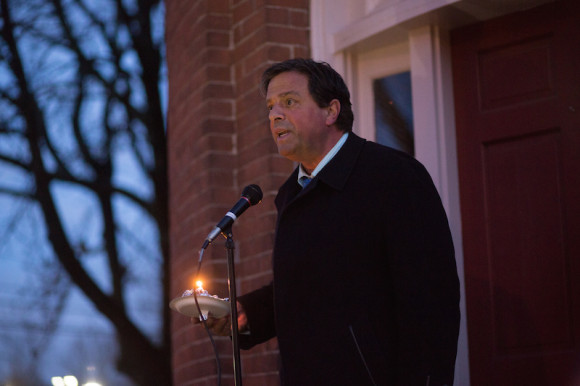
State Senator Phil Miller addresses the vigil participants.State Senator Phil Miller speaks at Monday’s vigil. Photo by Kim Tyler.

Speakers at the vigil, where residents of Deep River and other nearby towns held lighted candles and roses in honor of the longtime town leader, recalled Smith’s tireless dedication to the town and its people. Jonathan Kastner, the first selectman’s assistant and friend, said Smith was “a problem solver who somehow found a way to keep adversaries from being too adversarial.” State Rep. Phil Miller, a former first selectman of Essex, said Smith was “a role model for anyone in any kind of public service.”
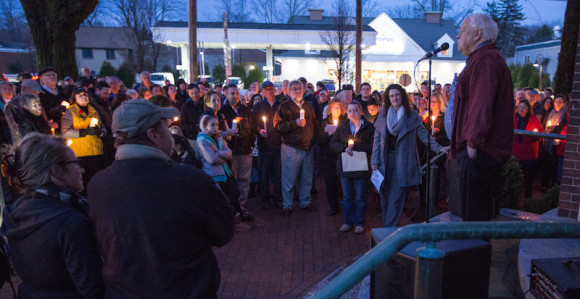
Photo by Kim Tyler.Remembering a leader who Sen. Phil Miller described as, “a role model for anyone in any kind of public service.” Photo by Kim Tyler.

Smith built a record of accomplishment that changed and improved Deep River during his 26 years as first selectman. There is the row of fully occupied industrial buildings at the Plattwood Park Industrial Area off Rte. 80, a 20-year- development process where Smith earned statewide recognition for using state and federal grant funds to construct buildings for small or start-up businesses as a way to help grow the town’s tax base. One of Smith’s most recent accomplishments was a Main Street redevelopment effort that began in 2005, and concluded in 2009 with construction of a Walgreen’s pharmacy on the former Deep River Inn parcel, along with various streetscape improvements for the entire length of Main Street.

Photo by Kim Tyler.Richard “Smitty” Smith: In Memoriam. Photo by Kim Tyler.

State statute gives the two remaining selectmen up to 30 days from March 26, the day after Smith’s death, to appoint an interim first selectman who would serve until November 2017. The appointment could be forced to a special election by a petition with signatures from five percent of the town’s total voter registration, or about 158 voter signatures, that must be submitted within 15 days after any appointment to fill the vacancy.

Roses in remembrance of Richard "Smitty" Smith. Photo by Kim Tyler.Roses in remembrance of Richard “Smitty” Smith. Photo by Kim Tyler.

Editor’s Note: Deep River resident and professional photographer Kim Tyler, who graciously supplied all of the photos published in this article to ValleyNewsNow.com, has also generously agreed to make many of the photos that she took at the vigil available to our readers at no charge. We applaud her wonderful act of public service. The photos have now been uploaded at this link. For more information about Kim Tyler Photography, visit ktphoto.net