

“The 39 Steps,” Zany Spoof of Hitchcock Movies, Opens at Ivoryton Playhouse

Dan Fenaughty and Larissa Klinger. Photo by Ivoryton Playhouse

Dan Fenaughty and Larissa Klinger. Photo by Ivoryton Playhouse

Mix a Hitchcock masterpiece with a juicy spy novel, add a dash of Monty Python and you have “The 39 Steps,” a fast-paced whodunit for anyone who loves the magic of theater! This two-time Tony and Drama Desk Award-winning treat is packed with nonstop laughs, over 150 zany characters (played by a ridiculously talented cast of four), an on-stage plane crash, handcuffs, missing fingers and some good old-fashioned romance!

“The 39 Steps” is set in England, just before the war. A young man bored with life meets a woman with a mysterious accent who says she’s a spy and needs to take refuge in his apartment. Murder and mayhem soon follow as our hero is chased across the wild and wooly British countryside, meeting a host of ridiculous characters and climaxing in a death-defying finale! A riotous blend of virtuoso performances and wildly inventive stagecraft, “The 39 Steps” amounts to an unforgettable evening of pure pleasure!

The first version of the play was written by Simon Corble and Nobby Dimon for a cast of four actors and funded by a £1,000 Yorkshire Arts Grant. It premiered in 1995 at the Georgian Theatre Royal in Richmond, North Yorkshire, before embarking on a tour of village halls across the north of England. In 2005, Patrick Barlow rewrote the script, keeping the scenes, staging and small-scale feel, and in June 2005 this re-adaption premiered at the West Yorkshire Playhouse. In 2006, it opened in the West End and in 2008 it premiered on Broadway to rave reviews. The New York Times proclaimed, “Theatre at its finest!… Absurdly enjoyable! This gleefully theatrical riff on Hitchcock’s film is fast and frothy, performed by a cast of four that seems like a cast of thousands.”

This production introduces Ivoryton audiences to the husband and wife team of Dan Fenaughty and Larissa Klinger, who have both performed these roles before in the national tour. The clowns are played by Ivoryton favorite, David Edwards, and Jonathan Brody, making his Ivoryton debut. All four actors are members of Actors Equity. The play is directed by Erik Bloomquist, a two-time Emmy-nominated writer/director/producer and former Top 200 Director on Project Greenlight. Erik is currently in post-production on the television adaptation of “The Cobblestone Corridor,” a seriocomic mystery series based on his internationally acclaimed short film of the same name. The set design is by Dan Nischan, lighting design by Marcus Abbott and costume design by Cully Long.

“The 39 Steps” opened at the Ivoryton Playhouse on June 1 and runs through June 19. Performance times are Wednesday and Sunday matinees at 2 p.m. Evening performances are Wednesday and Thursday at 7:30 p.m., Friday and Saturday at 8 p.m.

Tickets are $44 for adults; $39 for seniors; $22 for students and $17 for children and are available by calling the Playhouse box office at 860-767-7318 or by visiting www.ivorytonplayhouse.org

Ticket prices go up on June 1 to $50 for adults and $45 for seniors, so purchase tickets now for all the summer shows for the best prices. (Group rates are available by calling the box office for information.) The Playhouse is located at 103 Main Street in Ivoryton.

They’re Everywhere! All About Gypsy Moth Caterpillars — Advice from CT Agricultural Experiment Station

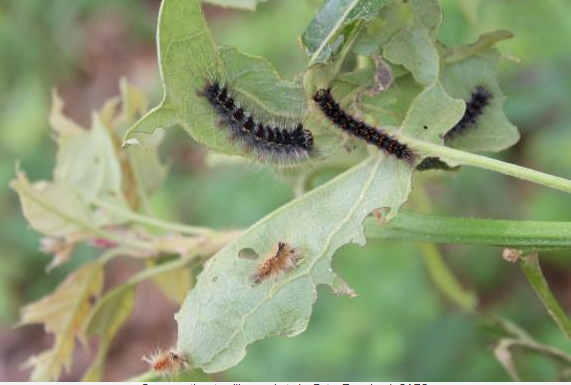
Gypsy moth caterpillar

Gypsy moth caterpillars – photo by Peter Trenchard, CAES.

The potential for gypsy moth outbreak exists every year in our community.

Dr. Kirby Stafford III, head of the Department of Entomology at the Connecticut Agricultural Experiment Station, has written a fact sheet on the gypsy moth available on the CAES website. The following information is from this fact sheet.

The gypsy moth, Lymantria dispar, was introduced into the US (Massachusetts) by Etienne Leopold Trouvelot in about 1860. The escaped larvae led to small outbreaks in the area in 1882, increasing rapidly. It was first detected in Connecticut in 1905. By 1952, it had spread to 169 towns. In 1981, 1.5 million acres were defoliated in Connecticut. During the outbreak of 1989, CAES scientists discovered that an entomopathogenic fungus, Entomophaga maimaiga, was killing the caterpillars. Since then the fungus has been the most important agent suppressing gypsy moth activity.

The fungus, however, cannot prevent all outbreaks and hotspots have been reported in some areas, in 2005-06 and again in 2015.

The life cycle of the gypsy moth is one generation a year. Caterpillars hatch from buff-colored egg masses in late April to early May. An egg mass may contain 100 to more than 1000 eggs and are laid in several layers. The caterpillars (larvae) hatch a few days later and ascend the host trees and begin to feed on new leaves. The young caterpillars, buff to black-colored, lay down silk safety lines as they crawl and, as they drop from branches on these threads, they may be picked up on the wind and spread.

There are four or five larval stages (instars) each lasting 4-10 days. Instars 1-3 remain in the trees. The fourth instar caterpillars, with distinctive double rows of blue and red spots, crawl up and down the tree trunks feeding mainly at night. They seek cool, shaded protective sites during the day, often on the ground. If the outbreak is dense, caterpillars may feed continuously and crawl at any time.

With the feeding completed late June to early July, caterpillars seek a protected place to pupate and transform into a moth in about 10-14 days. Male moths are brown and fly. Female moths are white and cannot fly despite having wings. They do not feed and live for only 6-10 days. After mating, the female will lay a single egg mass and die. The egg masses can be laid anywhere: trees, fence posts, brick/rock walls, outdoor furniture, cars, recreational vehicles, firewood. The egg masses are hard. The eggs will survive the winter and larvae hatch the following spring during late April through early May.

The impact of the gypsy moth can be extensive since the caterpillar will feed on a wide diversity of trees and shrubs. Oak trees are their preferred food. Other favored tree species include apple, birch, poplar and willow. If the infestation is heavy, they will also attack certain conifers and other less favored species. The feeding causes extensive defoliation.

Healthy trees can generally withstand one or two partial to one complete defoliation. Trees will regrow leaves before the end of the summer. Nonetheless, there can be die-back of branches. Older trees may become more vulnerable to stress after defoliation. Weakened trees can also be attacked by other organisms or lack energy reserves for winter dormancy and growth during the following spring. Three years of heavy defoliation may result in high oak mortality.

The gypsy moth caterpillars drop leaf fragments and frass (droppings) while feeding creating a mess for decks, patios, outdoor furniture, cars and driveways. Crawling caterpillars can be a nuisance and their hairs irritating. The egg masses can be transported by vehicles to areas where the moth is not yet established. Under state quarantine laws, the CAES inspects certain plant shipments destined to areas free of the gypsy moth, particularly for egg masses.

There are several ways to manage the gypsy moth: biological, physical and chemical.

Biologically, the major gypsy moth control agent has been the fungus E. maimaiga. This fungus can provide complete control of the gypsy moth but is dependent on early season moisture from rains in May and June to achieve effective infection rates and propagation of the fungus to other caterpillars. The dry spring of 2015 resulted in little or no apparent fungal inoculation or spread until it killed late-stage caterpillars in some areas of the state, after most defoliation.

Infected caterpillars hang vertically from the tree trunk, head down. Some die in an upside down “V” position, a characteristic of caterpillars killed by the less common gypsy moth nucleopolyhedrosis virus (NPV). This was not detected in caterpillars examined in 2015.

Physical controls include removing and destroying egg masses, which can be drowned in a soapy water and disposed of. Another method is to use burlap refuge/barrier bands wrapped around tree trunks so that migrating caterpillars will crawl into or under the folded burlap or be trapped by the sticky band.

There are a number of crop protection chemicals labeled for the control of gypsy moth on ornamental trees and shrubs. There are treatments for egg masses, larvae and adult moths. Detailed information about these chemical treatments is available in the CAES factsheet.

For complete information about the gypsy moth and its management, visit the CAES website and look for the fact sheet on gypsy moth.

Law Enforcement Officers to Carry Torch for Special Olympics Across CT, June 8-10

LETR_Mark_Connecticut_Color_1.1The 30th Annual Law Enforcement Torch Run for Special Olympics Connecticut will take place Wednesday through Friday, June 8 through 10, in communities across the state. Officers will volunteer their time to serve as torchbearers and carry the Special Olympics “Flame of Hope” through their towns and cities to raise awareness and funds to benefit Special Olympics athletes and inspire communities to accept and respect people of all abilities. To find out more about the Law Enforcement Torch Run, including dates and times it will be coming through your town, visit www.soct.org.

Over 1,500 local law enforcement officers are expected to participate in the Run, along with Special Olympics athletes in some areas, and cover more than 530 miles. Spectators are encouraged to come out and cheer on their local officers and show their support for the Special Olympics movement. In addition, and also to celebrate the 30th anniversary of the Torch Run in Connecticut, rallies will take place at Foxwoods Resort Casino on Day 1 and at the State Capitol on Day 2 of the Run.

The three-day event will conclude at Southern Connecticut State University on Friday, June 10, when officers will run a “Final Leg” into Jess Dow Field on the university’s campus and light the ceremonial cauldron during Opening Ceremonies for the 2016 Special Olympics Connecticut Summer Games, which begin at 7:15 p.m.

Over 2,400 athletes and Unified Sport® partners are expected to participate in Summer Games and compete in cycling, swimming, soccer, tennis and track & field throughout the weekend at Southern Connecticut State University, 501 Crescent Avenue, New Haven and Hamden Hall Athletic Fields, 225 Skiff Street, Hamden. The public is invited and encouraged to attend Opening Ceremonies and Summer Games events throughout the weekend at no cost.

For more information about the Law Enforcement Torch Run and Special Olympics Connecticut, visit www.soct.org, email specialolympicsct@soct or call 203-230-1201. And, follow Special Olympics Connecticut and the Law Enforcement Torch Run for Special Olympics Connecticut on Facebook, Twitter and Instagram.

Law Enforcement Torch Run Platinum Sponsor include Dream Ride, JN Phillips Auto Glass, The Bearingstar Insurance Charitable Fund, Whelen Engineering and WWE. Gold Sponsors are Adams Hometown Markets / IGA Hometown Supermarkets and Papa’s Dodge. Media Sponsors are NBC Connecticut, iHeart Radio Connecticut and the New Haven Register.

The Law Enforcement Torch Run® for Special Olympics Connecticut is one of the movement’s largest grass-roots fundraiser and public awareness vehicles. This year-round program involves law enforcement officers from across the state who volunteer their time to raise awareness and funds through events including Tip-a-Cops, Cop-on-Tops, and Jail N’ Bail fundraisers.In addition, each year in June, over 1,500 officers and athletes carry the Special Olympics “Flame of Hope” through hundreds of cities and towns across the state, and run the Final Leg as part of Opening Ceremonies for the Special Olympics Connecticut Summer Games.


Essex Wellness Center Hosts Free Talk, Discussion on Prescription Drug Abuse, This Afternoon

Joanna Crowell, LPC, LADC

Joanna Crowell, LPC, LADC

ESSEX — Abuse of prescription painkillers and opioid drugs has become an epidemic that has worked its way into many Connecticut families.

On Saturday, May 21, at the Essex Wellness Center from 1:30 to 3 p.m., Joanna Crowell, LPC, LADC, psychotherapist, drug and alcohol counselor, will talk about abuse of certain medications – opioids, central nervous system depressants and stimulants – and adverse health effects, including addiction, accidental overdose and death.

When people lose their access to prescription narcotics, they often turn to heroin in both affluent suburbs and inner cities alike. Addiction to prescription painkillers is common and dangerous.

Join this open dialogue and candid discussion that includes a variety of treatment options available to begin the healing process for people in trouble. This event is free, but preregistration is required as space is limited. Call 860-767-7770 or email info@essexwellnessctr.com.

This program is part of Essex Wellness Center’s free Live Well Lecture series. Essex Wellness Center is at 8 Novelty Lane (upstairs), Essex Village.


Cappella Cantorum Presents Men’s Chorus Concert, June 11

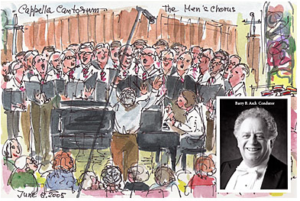
Cappella CantorumCappella Cantorum Men’s Chorus presents its annual concert on Saturday, June 11, at 8 p.m., at St. Paul Lutheran Church, 56 Great Hammock Rd. Old Saybrook.

The music will include “For the Beauty of the Earth,” “Rutter,” selections from “Guys & Dolls,” “Lullaby of Broadway,” “Men of Harlech,” “Ride the Chariot,” “Va Pensiero” and “When the Saints Go Marching In.”

Tickets are $20 (age 18 and under are free) and can be purchased at the door or through CappellaCantorum.org. Contact Barry at 860-388-2871 for more information.