The Halls Road Overlay District Plan offers our community the opportunity to develop a small but vibrant town and community center. This area has been in urgent need of long-range planning & development and now we have it – after years of dedicated committee work, multiple surveys, community input sessions, and revisions in response to every conceivable authority.
Today, people are demanding mixed use because it provides convenience, flexibility, and a range of experiences within a smaller neighborhood. To reject this plan is to choose to maintain a 1950s approach to 21st century conditions, retaining a commercial district that is a relic of a time when enthusiasm for the automobile and suburban life put greater distances between people and their town centers.
Without at least the potential for a mixed-use, walkable town center where people can live, work and shop, our little shopping district will continue to limp along without the support that a mixed-use neighborhood provides for retail. There is no pedestrian traffic and no walk-in trade, which is the one remaining attraction for retail investment in the era of Amazon. Instead, new off-ramp convenience stores and franchises will continue to replace local merchants.
I personally know several people whose professional and personal contribution to this community is unique and highly valued but who choose to live elsewhere because they cannot access the resources that are convenient for their young families and lifestyle here.
For some, the idea of any change to our beloved community is scary, indeed some appear to find it so threatening as to suggest nefarious and corrupt motives on the part of the planners. I urge you not to be influenced by those who harbor these irrational fears and suspicions. Without a plan that at least allows (does not require!) change that will make Old Lyme more attractive to younger families, single households and other individuals who want and need to live within walking distance of essential services, the aging and unattractive traffic strip that has become half of our town center will continue to be an embarrassment and a lost opportunity which will not come again in our lifetimes.
The Halls Road Overlay District plan now presents the Zoning Commission with an opportunity to choose: between the potential for a walkable town center where people can live, work, shop, and enjoy participation in a neighborhood and a community, or a Route 1 extension allowing drivers to speed quickly though and out of town, bordered by half-empty parking lots and decaying strip-malls where the only available new business options are gas stations and convenience stores.
I urge the Zoning Commission to make the right choice.
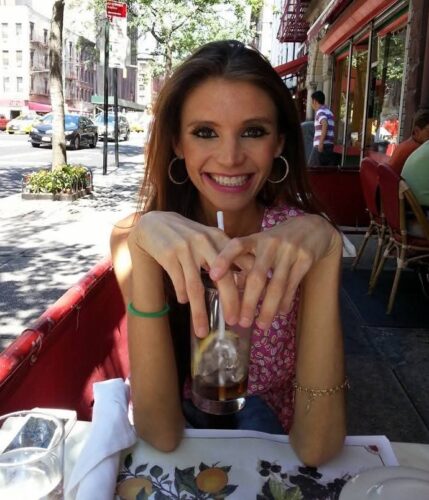
OLD LYME —Lilliane Phoebe Spratt (b. January 23, 1989), of Palm Beach, FL, Watch Hill, RI, and Old Lyme, CT, passed from this terrestrial realm to the heavens on January 9, 2025, surrounded by her loving family in her lakeside Old Lyme home. A private funeral was held at the Grassy Hill Congregational Church of Lyme, CT, and a ceremony celebrating her life is being planned.
Lilly grew up surrounded by water in Old Lyme and Watch Hill, the youngest of four siblings. She graduated with honors from Lyme-Old Lyme High School, before attending Pepperdine University in Malibu, CA, and Connecticut College, where she graduated with a double-major in English and Art. Both an exceptional installation artist and a poet, having published her first poem in middle school, creativity beamed through all her endeavors and lent to her defining hyperintelligence. From an early age she found inspiration observing her mother’s design and textile business. Also a standout athlete, Lilly was a varsity track and cross-country runner at all of the schools she attended, and enjoyed running marathons. She was the coxswain for the Connecticut College crew team and liked to kayak. As a young adult, she trained in gymnastics, which positioned her to later pursue the art of the flying trapeze. Her revelry in fire eating, a skill she mastered while at a circus academy, was, however, most emblematic of her magical approach to the world.
Lilly’s enchantment and exceptional beauty did not go unnoticed, as Vogue sought her for an acrobatic photo shoot. On account of her talent for writing and remarkable work ethic, she gained design, photography, marketing, and publishing experience in the fashion world with Bergdorf Goodman, Alice + Olivia, and Shape magazine in New York City. She also worked for the executives of Rolling Stone magazine and pursued her master’s degree at Parsons School of Design. These experiences ultimately led her to create her own company, Love Lilly, a resort clothing company based in Palm Beach and Old Lyme. The company designed, marketed, and sold wholesale dresses throughout the U.S., Canada, and the Caribbean, yet most importantly celebrated the power of color and light in textiles to foster positivity. Like her brand, Lilly’s fellowship program for aspiring highschool fashionistas to gain first-hand experience in the industry brought inspiration and love to all who benefited from her mentorship.
Wherever Lilly traveled, she left her mark with her kindness, grace, compassion, generosity, and unforgettably luminous dark brown eyes. She had the fondest of memories volunteering at an orphanage in Chennai, India, doing an art residency in Lucca, Italy, building boats with her beloved sister Meredith in Bequia, St. Vincent and the Grenadines, participating in Parsons’ international business and fashion program in Paris, tracking wolves in Yellowstone National Park with her friends, and exploring the tropics with her dearest mother. She loved special nights out in Los Angeles and New York City discovering new places with her sisters or friends, but also appreciated quietude. The poetry of Mary Oliver brought her solace, and Lilly wrote remarkable poems throughout her life. Her joy in baking irresistibly delicious cakes and cookies for others symbolized the incredible love she bestowed upon her family and friends, always through the most thoughtful gifts.
Lilly had an uncanny ability to unveil the truth in most things, which made her the best of friends—as the privilege of knowing Lilly well was synonymous with being completely understood—and riotously funny, given her quick-witted tongue. This also made Lilly a formidable foe as a Scrabble player and an excellent strategist in real estate and property makeovers. Her highly remarked upon Connecticut College art installation, “An Apple a Day,” points to her depth of character and complexity. In it she critiqued the saccharine beauty of the quotidian by way of its routine entrapments. In this regard, she hinted at her struggle to manage the chronic disease that she courageously fought for over a decade. Nevertheless, she exuded optimism, selflessness, kindness, compassion, and cordiality in all of her interactions. She also exercised an incredible capacity for forgiveness and understanding. During extended hospital stays you would find her giving counsel and an empathetic ear to other patients, visitors, and the staff. No matter how she was, she would ask you how you were and genuinely care to know your answer.
Lilly’s friends best describe her infectious personality as larger than life. Her impeccable fashion sense and signature oversized sunglasses typically paired with the perfect shade of pink or black accoutrements was iconic. To witness her joy—elegantly soaking in the warmth of the Palm Beach breeze, driving her convertible with her long, chestnut hair gracefully blowing in the wind with the best music blasting, or owning the road in her Hummer—was to see life cinematically transform to her perfected design. For Lilly, an essential component of her inimitable stamp on life was the presence of her most devoted dogs, Bambi and Armani, in everything that she did. Lilly loved her dogs tremendously and this joy for her pets, especially her notable connection to Bambi, gave her strength and comfort in the hardest of challenges.
In this untimely winter passing, let Lilly’s poetry give us the hope and love she would have wanted us to conjure now, “For winter’s touch is never long / and seasons do change,” as she writes in Roots. Lilly is survived by her mother Patricia and her father John, her siblings Emily, John, and Meredith, and her nieces Violet and Lyra. In lieu of flowers, please honor Lilly’s memory through acts of kindness and compassion.
Editor’s Note: This op-ed was submitted by the Rev. Steven R. Jungkeit, Ph.D., who serves as Senior Minister at the First Congregational Church of Old Lyme.All are welcome to attend the vigil tomorrow evening. The First Congregational Church of Old Lyme is located at 2 Ferry Rd., Old Lyme, CT 06371.
In the congregation I serve (The First Congregational Church of Old Lyme), I’ve been sharing since the November election that we are in a position similar to that of the biblical character Miriam in the second chapter of Exodus. Faced with a terrible catastrophe (a threat against all Hebrew male children, including her baby brother, soon to be named Moses), Miriam “watches from a distance” as a small basket carrying her brother bobs up and down along the Nile River. Since November, we too have been forced to watch and to wait in the bulrushes with Miriam, as if from a distance, using the time to gain perspective and to gather our wits as the current of history swirls around us. In the Exodus story, Miriam watched and waited for the opportune moment to act, and when it arrived, she seized it.
People of faith and conscience will need to be continually vigilant in this new political environment. We’ll need to seize opportune moments whenever we can to stand with the most vulnerable around us.
Now is the first of those moments. Now is the time to emerge from the bulrushes, as Miriam eventually did.
In these early days of the new administration, federal funding for a host of worthy agencies has been suspended, eliminated, and then, (maybe?) partially reinstated. Few who depend upon that funding believe that the threat has gone away. Meanwhile, livelihoods and support services throughout the country hang in the balance.
Among the many worthy agencies affected across Connecticut, IRIS (Integrated Refugee and Immigration Services) in New Haven has experienced tremendous whiplash. Depending on which order is being considered, and when, it appears that IRIS stands to lose millions of dollars in funding, preventing them not only from helping to resettle refugees, but also hindering their ability to assist people in need all across the state. Losing that funding would place thousands of people in jeopardy.
The First Congregational Church of Old Lyme, together with two other churches in town (St. Ann’s and Christ the King) as well as many other residents of no particular faith, have partnered with IRIS for the past decade, ever since the beginning of the Syrian refugee crisis in 2015. Indeed, our community was the first in the state to reach out to IRIS during that crisis, though many others soon did the same. Before long, a Syrian family arrived in Old Lyme and has remained here ever since, just the way Syrians arrived in communities all across Connecticut. Since that time, we have helped resettle five additional families in our area from many different parts of the world, a pattern that has unfolded all up and down the Connecticut Shoreline, and throughout the entirety of the state.
IRIS is one of the crown jewels of Connecticut, helping to make us the welcoming, hospitable, and culturally rich state that we are. Our communities have been improved by welcoming refugees, and supporting immigrants, which IRIS has facilitated.
If this is an opening salvo from a hostile new administration, then the time is right for Connecticut residents who continue to believe in the sanctity of hospitality to come together, and to push back the night.
With that in mind, the First Congregational Church of Old Lyme invites friends and supporters of IRIS to join us for a candlelight vigil on Wednesday evening, February 5th, at 6:00 PM. We’ll sing, we’ll offer words of prayer, and we’ll light up the night. But we also have a goal: to raise $100,000 as a gesture of goodwill and support for IRIS. That won’t be enough. But if similar events took place around the state, it would go a long way.
IRIS has given our communities so much. They have offered support and protection to so many, and they have enriched our lives for the relationships they helped to create. It’s time to give a little back.
But more to the point, it’s now time, like Miriam, to emerge from the bulrushes, and to push back against the Pharaohs that continue to afflict the vulnerable.
It’s time to show who we are as residents of a diverse and welcoming state, one that we can all be proud to live in.
There’s been a lot of wild talk about Halls Road and the plan to make it a neighborhood in our town center rather than a highway services plaza. The people behind this raft of lies and exaggerations fear change, and preach that by doing nothing, we can prevent change. They are dead wrong.
Doing nothing will allow Halls Road to become truck stops: the best investment opportunity under current zoning. In the last several years, nearly all of the investor interest in Halls Road has been for new gas stations: three proposals, narrowly fended off. There will be more, and we cannot fend them off forever under the current commercial-only C-30s zoning.
The best thing we can do is to provide optional zoning that will allow Halls Road to become something better and something that serves multiple, significant needs of the town.
The Halls Road Overlay District (HROD) proposal does that, providing better returns for investors than they get from gas stations and convenience stores. It also allows the creation of a mixed-use neighborhood with smaller-scale housing and retail that faces Halls Road, not buried back behind empty parking lots. A walkable, mixed-use neighborhood with real neighbors is the best encouragement to businesses that serve the town, not the highway. We need these different types of housing, not just for older folks down-sizing, but also for new families moving in. Our emergency services are all-volunteer. We need younger people to keep them staffed. Smaller-scale housing is crucial to serving their needs.
Of course, those who hate and fear all change are spreading wild exaggerations and outright lies about HROD. Everything you read in their posts is nonsense. Because they’re not really interested in the truth, they feel free to make things up with crackpot logic and nightmare fantasies. It’s easier than reading the actual HROD document (available online) and doing the hard work to go through the regulations in detail to understand what the real limits on development are.
If you do the math (and I have done it) the various limitations and requirements (e.g. parking) in the HROD proposal mean that, in 20 or 30 years, there may be as many as 400 apartments or condos in all of Halls Road, along with a shopping street that runs for perhaps a third of its length. The density of dwelling units per acre at full development is within the range already long-established in Old Lyme zoning for multi-family residential anywhere in town. The hysterical numbers and idiotic cartoons are all fantasy.
Note that my numbers are based only on the HROD regulations, and do not consider all the other constraints on development, such as septic and environmental, which must certainly be considered in any new construction.
People who came to Old Lyme from towns that were grossly over-developed are particularly prone to think that allowing any development will be the thin end of the wedge. I remind them that we in Old Lyme are firmly against suburban sprawl. That’s why we suggested putting the much-needed smaller-scale housing in a place that is already covered with paving, and where it can help keep our local businesses profitable. Doing so spares the last bits of open space. If you forbid it at Halls Road, you may be sure you’ll find it built out in the countryside, where it will do less good and more harm.
HROD is good for Old Lyme, and the folks telling lies to terrify their neighbors are harming the town.
OLD LYME—Frank Watrous Hamilton, III (“Ted”) was born in Franklin, New Jersey in 1948 …
Ted graduated from Blair Academy and the University of Pennsylvania before starting a career on Wall Street. Over an almost 50 year career, Ted was well known for his industriousness, perseverance and ingenuity.
Ted was an accomplished executive, including as a Senior Managing Director at Promontory Interfinancial Network at the time of its sale. He was a former pillar of his communities in both New York City and Old Lyme, CT, where he served as President of the Board of Trustees of the Florence Griswold Museum …
The last several years of his life were made difficult after a serious stroke …
In January, Ted passed away in Vero Beach, FL after a short illness …
He is survived by his sons Frank and Grant Hamilton, daughter-in-law, Diana Hamilton, granddaughters Edie and Grace Hamilton, sisters Stephanie Moore and Amy Rice and his beloved nieces and nephews …