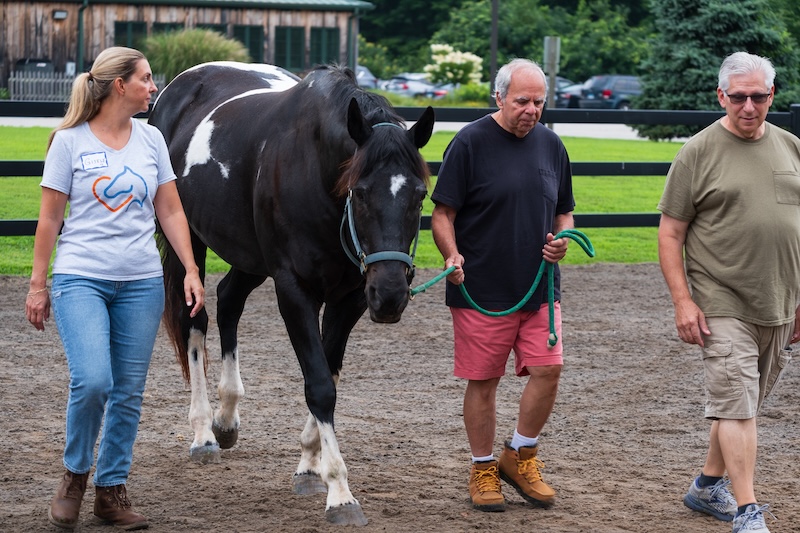
Parkinson’s program participants Michael Bigiarelli (second from right) and David Plat (right ) lead High Hopes horse Addie in the outdoor arena. High Hopes volunteer Gisele Kurns stands by for support.
Program Creates Pathways to Wellness, Relaxation, and Connection
OLD LYME—High Hopes Therapeutic Riding, Inc. has announced the continued success and expansion of its pioneering Equine-Assisted Services Program for people with Parkinson’s disease. What began as a pilot program just one year ago has blossomed into a transformative, life-changing initiative, helping participants experience improved movement, relaxation, and a unique connection with horses.
The program, which meets weekly on Tuesdays from 10:30 to 11:30 a.m., offers gentle stretching exercises, grooming, and leading of horses as part of a therapeutic regimen designed to encourage physical activity, relieve muscle tension, and promote relaxation. The natural, calming presence of the horses fosters a sense of mindfulness, helping participants to be fully present while they engage in each activity.
A year ago, a compassionate High Hopes volunteer and participant, Carol Merkt, recognized a growing need in the community for services tailored to people living with Parkinson’s disease. Merkt, whose deep connection with the High Hopes community led her to identify this gap, approached the center with the idea for a specialized program.
Her insight into and dedication to improving the lives of others has been instrumental in shaping this initiative. “I couldn’t be more impressed with the progress of this program,” says Merkt. “When I first brought the idea to High Hopes, I was hopeful, but what’s been created is better than I ever expected. The benefits for participants are truly remarkable.”
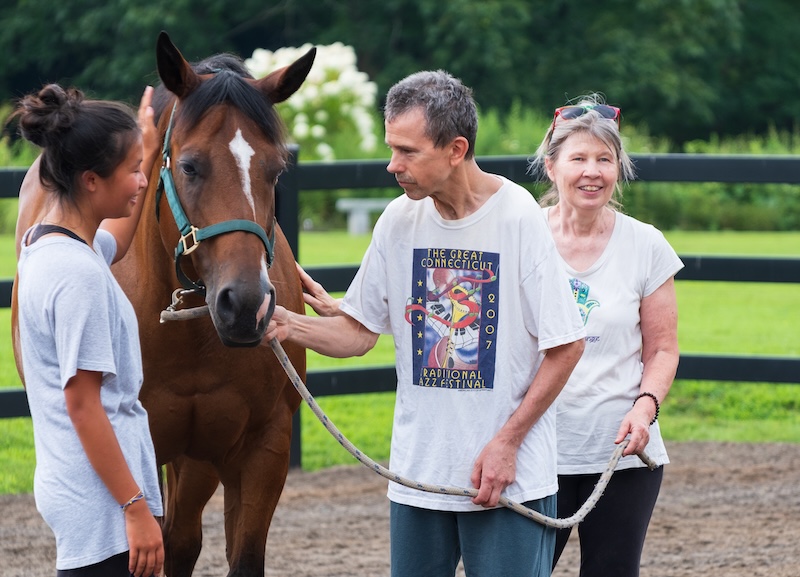
James Bendinzski, a program participant (second from right), praises his horse, Savannah, after completing an obstacle course. Bendinzski’s wife Karen Nichols (right) and High Hopes volunteer Danielle Liston greet both Bendinzski and Savannah at the finish line.
The Parkinson’s Program is facilitated by several High Hopes instructors, who are certified in ‘Equine Mental Health and Learning.’
One of the instructors, who co-facilitates the program, explains more about the program saying, “[It] is about more than physical benefits—it’s about building relationships and finding joy.” She continues, “Horses have an incredible ability to meet people where they are, offering connection and understanding that goes beyond words. Seeing participants light up during these sessions is what makes this work so rewarding.”
The High Hopes Parkinson’s Program is funded by the generous support of the Kitchings Family Foundation, whose contributions cover over 95 percent of the program’s costs through scholarships, ensuring accessibility for all participants regardless of financial circumstances.
Another facilitator of the program comments, “We’re honored to help make this program possible. Our goal is to create a safe and supportive environment where participants feel empowered. The horses are truly the heart of what we do—they offer nonjudgmental companionship and help participants find moments of peace and accomplishment.”
The program is open to new participants at any time, welcoming individuals with Parkinson’s disease to join the classes and experience the benefits of equine-assisted services. For those who wish to reflect on their experience, there is an optional group “coffee session” following each class.
“This program exemplifies the mission of High Hopes—to inspire, support, and transform through the power of horses,” says Missy Lamont, Executive Director of High Hopes, adding, “Thanks to the incredible support from the Kitchings Family Foundation, we’re able to provide life-changing experiences to individuals living with Parkinson’s disease.”
Lamont concludes, “At High Hopes, we believe in the power of horses to inspire, heal, and transform. Our equine-assisted services are designed to meet the diverse needs of our community, and we are excited to see how the program continues to grow, improving the lives of people with Parkinson’s disease.”
Over 100 people attended the OL Zoning Commission hearing on Monday evening. They frequently applauded the many speakers who disapproved of the proposed 11,000 square foot house proposed beside the Smith Neck Boat launch. Speakers described site violations of regulations, excessive water use and un-permitted clearcutting. The CT River Gateway Commission has recommended denial of the zoning application. Over many decades, Old Lyme residents have developed and agreed on our zoning regulations to protect the quality of our environment and the character of our towns.
The Applicant’s architect asserted many surprising defenses as to why they should be allowed to build a house that does not comply with the zoning regulations. One main point was that the other houses in the neighborhood didn’t comply with the regulations but she forgot to add that the other houses were built in the 30’s before the regulations existed.
Perhaps the Applicants most bizarre claim was that the requirement to locate the house behind the crest of the hill doesn’t apply. They actually asserted that the property is not really on a hill, so there isn’t really a crest of the hill, because there can’t be a crest if there isn’t a hill. Anyone with two feet knows that there is a hill and a crest at the boat launch and this house must be located behind the crest according to the regulations.
The hearing reinforced the need for town residents to support the CT River Gateway Commission denial and let the volunteers on the Zoning Commission know that we support them in enforcing our regulations. The hearing process for this Application is closed but Old Lyme’s need for regulatory clarity and compliance is not. The Zoning Commission rules apply to everyone and failure to enforce them puts us all at risk of living in a community with unchecked development, with no hills.
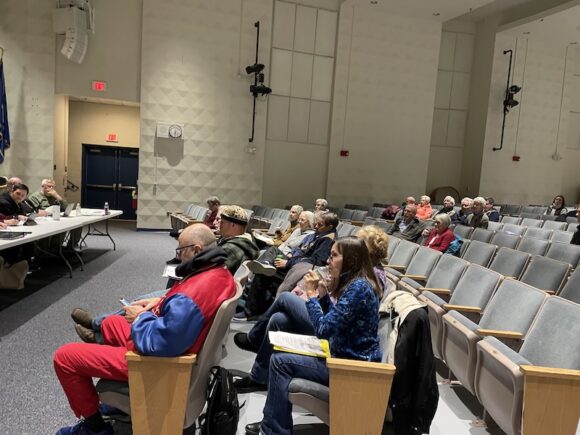
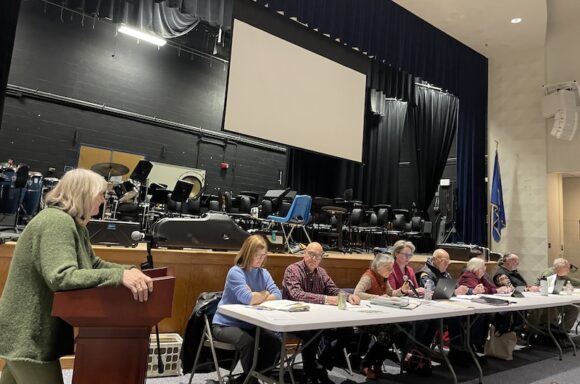
The audience for Wednesday’s Special Meeting of the Old Lyme Zoning Commission ultimately numbered around 60.
OLD LYME—Around 60 people turned out for last night’s Old Lyme Zoning Commission Special Meeting, which had originally been scheduled for Monday, Jan. 13, but was postponed due to the number in attendance at that meeting. The audience exceeded the permitted fire regulations.
The agenda for Wednesday’s meeting featured both an Old Business item and a Continued Public Hearing related to a Petition to Amend the Old Lyme Zoning Regulations, Section 5.15, to create a Halls Road Overlay District (HROD) allowing, among other items, mixed zoning use along Halls Road and the entire C-30S Zoning District, with associated architectural design guidelines.
Edie Twining, Halls Road Improvement Committee Chair, answered questions from the podium.
The Town of Old Lyme is the applicant.
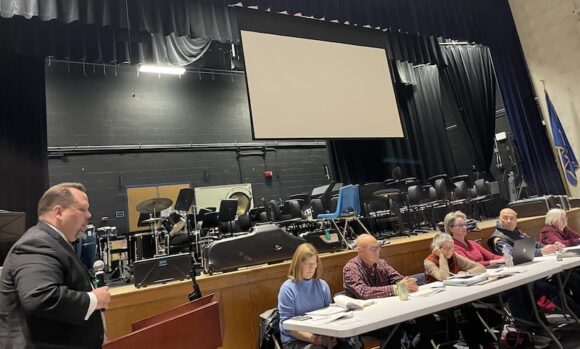
After the details of this optional Overlay District proposal had been presented by Atty. William Sweeney, public comment was opened and a variety of comments, both in support of and opposed to the proposal were made.
Atty. William Sweeney (left) presented details of the proposed HROD plan.
Old Lyme Economic Development Commission Chairman Cheryl Poirier spoke in support of the proposal as did Old Lyme Democratic Town Committee Chairwoman Kim Thompson.
A number of other people spoke against it.
The Zoning Commission proposed some changes to the wording in the proposal, which the HRIC appeared willing to make.
The meeting ended around 9:40 p.m. with the Public Hearing being continued through to a Special Meeting scheduled for Thursday, Feb. 27, at 6:30 p.m. in the Old Lyme Town Hall.
Editor’s Note: This article is based on the transcript of a talk on the reopening of Notre Dame de Paris given by Nicole Prévost Logan to the residents of Essex Meadows on Dec.10, 2024.
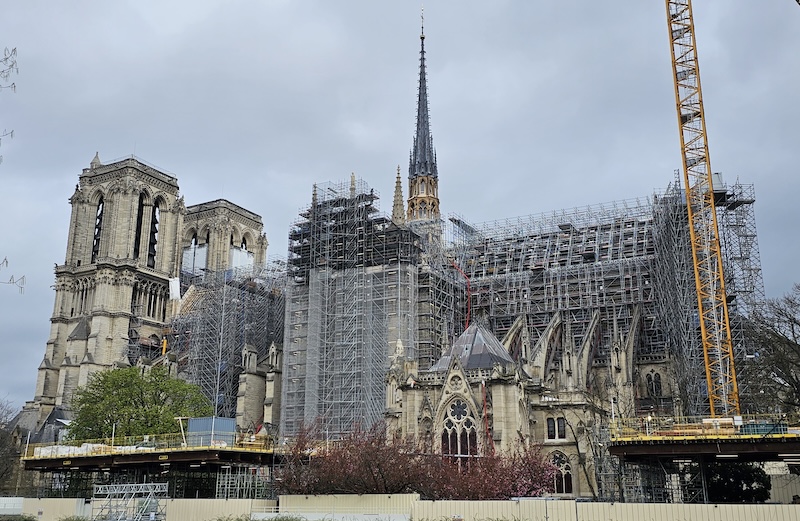
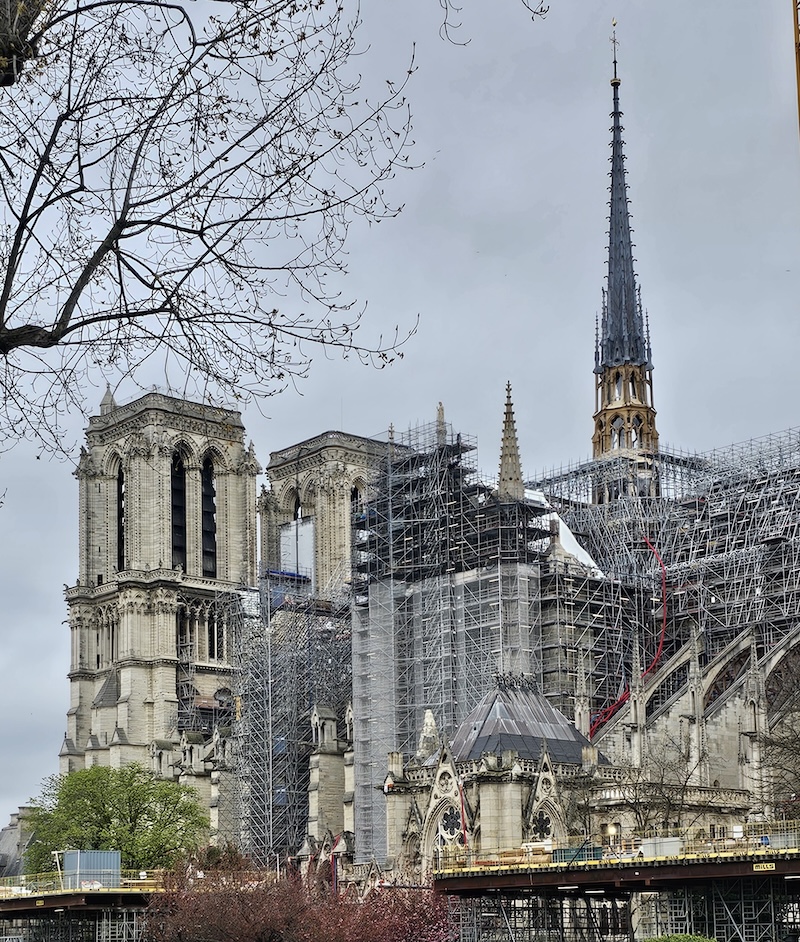
The Cathedral of Notre Dame was under extensive scaffolding during its restoration. Photo by Philip Logan.
The reopening of Notre Dame has been covered by the world media, including the New York Times, the Financial Times, National Geographic and many other publications. Striking images of the restored cathedral have been made available to all of us in numerous TV programs. The interest shown by the American public is particularly impressive.
My children and myself, dividing our time between the US and France, have been privileged to watch first-hand the restoration process. I was able to make three slide presentations in Connecticut, respectively in 2019, 2020 and 2023, using the photographs sent by my children from Paris, including the professional shots taken by my architect son. It had become a family project to cover the story.
December 7 was a day which will live in infamy, said FDR, but it marked also the joyous celebration that we had all been waiting for: the official reopening of the cathedral. I must admit I was glued to my computer to see the live report of the event on the French TV channels.
France is living through difficult times with the political deadlock and the frigid relations between Ursula Von der Leyen, president of the EU Commission and President Macron. Von der Leyen turned down the invitation to attend the ceremony and chose to be in Uruguay to promote a trade agreement with South America, which France and other EU countries strongly oppose.
Contrasting with the Middle East and Ukraine, which are being devastated and tens of thousands of people killed, the restoration of Notre Dame of Paris is an uplifting source of inspiration. Carried out by an international surge of enthusiasm, the cathedral, not only survived after being on the verge of collapse for several months but resurrected to become more beautiful than ever .
Before the fire of April 15, 2019, the monument was a decrepit old building. During the years I lived in Paris, I always saw it disfigured by scaffoldings. The apse and its flying buttresses were in bad shape and had to be repaired. The 19th century spire was crumbling and metal scaffolding had been erected to fix it. In fact, it is likely that the fire was caused by a short occurring in that pre-2019 scaffolding .
On the very evening of the fire, French President Emmanuel Macron made a promise to have the church reopened within five years. Philippe Villeneuve, chief architect of Notre Dame since 2013, supported that view. The excellent Sixty Minutes CBS show, aired on Dec. 1, 2024, stressed the importance of the president’s vision and continued support.
Another important remark made in Sixty Minutes was the excellence of the architects, artists, and artisans, who carried out the project, many of them part of The Companions duDevoir , an association dating back to the Middle Ages. They became a model and attracted the best arts and crafts workers in the world.
One of them was a carpenter named Jackson Dubois from New York (a good name for a carpenter since “bois” means wood in French.) Dedication and pride characterized the more than 2000 people, working on the restoration site of the cathedral and of the many other places throughout the country. These workers were motivated by the importance of sharing their knowledge. Tools, methods and materials were traditional. Much of the work was done by hand, and nails were not used in the making of the wooden framework for the roof and spire.
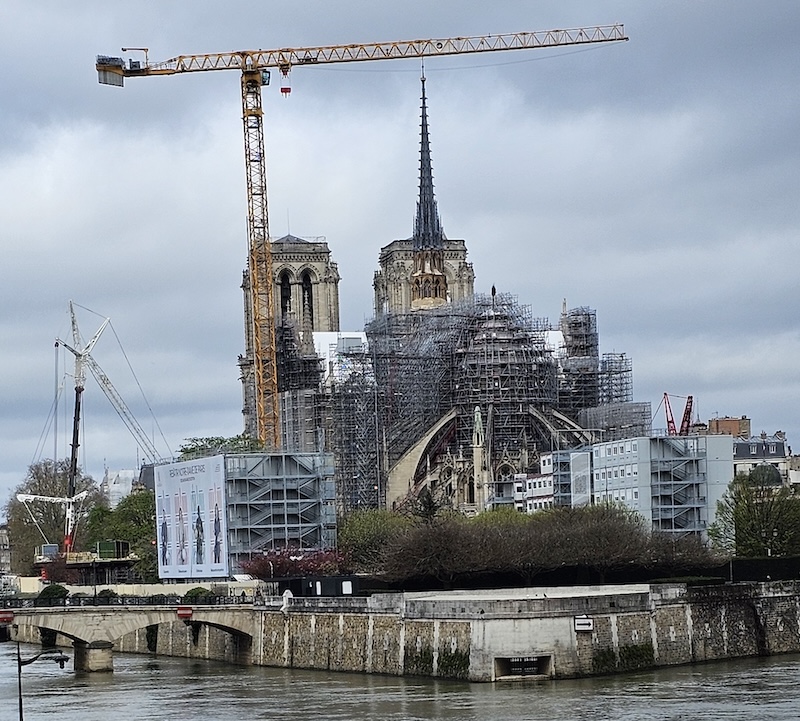
The sheer amount of work involved in the restoration is almost unfathomable. Photo by Philip Logan.
The restoration work of the cathedral was helped by an amazing amount of donations reaching 840 million Euros contributed by 240,000 donors around the world, the Americans coming in second place. Two of the richest men of France—Bernard Arnaut, the owner of luxury good LVMH, and François Pinault, another billionaire, who owns Gucci—competed.
Arnaud gave 200 millions and Pinault donated “only” 100 million, but Pinault boasted that he did not ask for tax deduction. Two years ago Peter Bulkeley, during a fascinating tour of Fenwick in Old Saybrook, pointed out the house under construction of Francois Henri Pinault, the son of the billionaire and now head of the Christie’s auction house. Pinault’s summer “cottage” overlooking the Sound in Fenwick has now been completed.
CTA BBC commentator summarized the Notre Dame project thus: no public funds, on time and on budget.
The objective of the incredible task accomplished since the 2019 fire was not only to restore the cathedral but also to integrate into the reconstruction new features to prevent any future safety threat or any disaster such as a fire.
Here are two examples. In order to avoid the run-off of rain water from the lead roof, special filters have been installed to filter that water so that toxicity will be reduced to zero. Dozens of thermal cameras have been installed in the new oak framework of the roof and of the spire. If a fire were to start, it would immediately be detected and water pipes activated to spray a mist over the area. “A fire will never happen again” declared Philippe Jost who now supervises the completion of the work at Notre Dame.
Among the events which have taken place in the cathedral, an incident is rarely mentioned. General De Gaulle, on August 26 1944, after walking down the Champs Elysees was scheduled to attend a thanksgiving mass at Notre Dame. As he approached the church, snipers started shooting. Unperturbed, the general continued to walk.
Another view of the Cathedral of Notre Dame during its reconstruction.. Photo by Philip Logan.
Should there be an admission price to enter the cathedral? Rachida Dati, French Minister of Culture and former mayor of the seventh arrondissement in Paris, suggested five euros . An interesting clipping was published in The Day discussing the pros and cons.
As a frequent visitor to Notre Dame my own experience has been of a disorganized system to face the huge lines. Everyone—that is people going to mass, individual tourists, groups—all entered through the same main portal. A single church attendant would try to handle crowds. Inside the monument, people attending mass were bothered by the herds of visitors tramping through the aisles with their cameras flashing non-stop.
The Catholic church made an alternative decision to an entrance fee: at no time there will be more than 3,000 persons inside the building , each person will have only 45 minutes allowed in, reservations will be required three days in advance, different access doors will be used for individuals versus groups, church-goers or tourists.
Hopefully this will help alleviate the nuisance caused by the even larger of visitors expected in 2025. Our cultural heritage should to be treated with care. The cave of Lascaux, in south west France, had to be closed because human presence was detrimental to the mural paintings. The Pope himself, in his letter read during the opening of the cathedral, insisted that entrance had to remain free.
I have always seen long lines of people wanting to see the view from the top of the cathedral. Someone commented : if they want to see Paris they should climb on the Eiffel Tower . Did you know that until 1889, when the Eiffel Tower was built, Notre Dame was the tallest building in Paris?
The first impression of the recent visitors to the cathedral is its luminosity. Light is pouring in. The stone, which used to have turned dark grey with grime, soot and lead dust is now blonde. Colors are the new magic. It is a shock to see the vivid blues of the stained glass Rose windows, For the first time one is surprised to see the Viollet le Duc mural paintings in some of the 26 chapels The scenes of Christ life on the carved wall which separate the choir from the deambulatory, now has colors.
In the Soviet Union, bells were silent for 70 years. People felt quite emotional when hearing them again. It was the same feeling in France after five years of silence. Emmanuel is the largest of all the Notre Dame bells. It dates from the 17th century, in Louis XIV time. It hangs in the South Tower and weighs 14 tons. It plays a low sharp F note. The eight smaller bells are in the North tower. Sound is important in a cathedral, as remarked the first violinist in the Radio France symphony orchestra which performed in concert in the cathedral The “reverberation”-or time during which the sounds lingers on- is seven seconds
Guillaume Bardet, designer of the liturgical furniture, created a minimalist altar, cast in bronze. The altar was produced in a foundry in the Rhone Valley region . The 1500 chairs, made of solid oak were designed and created in the Vautrin workshop, in the Landes region. The metal work decorating the spire was created in a Normandie foundry . The excellence of the artisans working in all these workshops in the country were an important part of the restoring team.
A final touch to the restoring process was the laying of the new, beautifully waxed checkerboard marble floor.
Now for the official opening of the cathedral. I listened and watched every minute of the proceedings so shown on the French TV, I could share with the details you in the US.
Actually three events were happening simultaneously. The ceremony was strongly affected by an uninvited guest: the Darragh storm After a brief photo op, the guests , fighting wind and a pouring rain, struggled from their cars to enter the building. The large tent with hundreds of chairs where French president had been scheduled to make a speech, was now empty.
Fifty royals, chiefs of state, and personalities from France and the entire world had been invited. An important moment for diplomatic and political exchanges. President Zelensky was greeted with loud applause. The Baltic states were all present. Prince Albert II of Monaco was there without his wife and so was Prince William of the United Kingdom, representing his father King Charles III. The presidents of Finland and Poland were there.
President-elect Donald Trump alighted from his massive armored black car. He was wearing a yellowish tie. The cameras never left him. After shaking many hands, he reached the front row in the knave.
How to sit the guests on that row must have given the protocol people an ulcer. Macron was first, then Trump, then Brigitte Macron and, next to her, Jill Biden and her daughter Ashley. The President of Georgia and her husband—she leads the pro-Europe movement in that country—were the last. Twenty years ago she renounced French nationality to become Georgian.
Elon Musk entered and disappeared from the camera’s field. I saw him later gazing at the beautifully restored arched ceiling and keystones. The presence of certain personalities shocked some, for being out of place in a religious monument. There were two noticeable absentees: Ursula Von der Leyen, president of the EU Commission, and Pope Francis.
The second theme of the ceremony was praise for all those who saved the cathedral and carried out the restoration. This is what Macron did in a brief speech. It was the first time since the Concordat of 1905, separating Church and State, that a French president has spoken inside a cathedral. The tempestuous weather left him no choice The arrival of the firefighters—in their intervention red suits—and of the Companions who worked on the site, were greeted with long and loud applause.
Finally, in the third place, the guests were invited to witness the powerful rituals marking the transmission of the secular to the religious authority over the cathedral. The Most Reverend Laurent Ulrich knocked three times with his crosier on the main portal before entering the cathedral. Emmanuel Macron returned the keys of to the archbishop.
The archbishop thanked profusely Macron for his continued support and for being there every step of the way. One remembers how the president, apparently not afraid of heights, climbed to the very top of scaffolding over the new spire. From now on Philippe Jost, as Director of the Etablissement Public, will supervise the completion of the restoration work.
“Organ wake up” the archbishop pronounced those words three times. In a dramatic way, the lights went on the 18th century great organ with its shiny 8000 pipes. Three organists sat in succession at the console in response to the exhortations of the archbishop and filled the cathedral with the most beautiful chords in the world. “This the breath of God”, concluded the bishop. When played at its fullest volume, the organ—called grandes orgues in French—makes a gothic cathedral soar.
* * *
The restoration of Notre Dame is not over. One can still see the giant cranes and the scaffoldings around the apse. The wood braces, which had been put in place to reinforce the flying buttresses, will be removed, and some contemporary stained glass windows will be installed.
The creation of a “in situ” museum is now being proposed. It would be located in parts of the Hotel Dieu hospital opening on the cathedral square and contain medieval artifacts.
Editor’s Note:This is the opinion of Nicole Prévost Logan.
Nicole Prévost Logan
About the author: Nicole Prévost Logan divides her time between Essex and Paris, spending summers in the former and winters in the latter. She writes an occasional column for us from her Paris home where her topics will include politics, economy, social unrest — mostly in France — but also in other European countries. She also covers a variety of art exhibits and the performing arts in Europe. Logan is the author of ‘Forever on the Road: A Franco-American Family’s Thirty Years in the Foreign Service,’ an autobiography of her life as the wife of an overseas diplomat, who lived in 10 foreign countries on three continents. Her experiences during her foreign service life included being in Lebanon when civil war erupted, excavating a medieval city in Moscow and spending a week under house arrest in Guinea.
OLD LYME—UPDATED 1/14 at 9pm with additional details on the speakers for the applicant: Last night’s Old Lyme (OL) Zoning Commission meeting drew such a large audience, which not only filled the Meeting Room but also spilled out into the Lobby, that OL Fire Marshal David Roberge determined the spaces were over-capacity from a fire safety angle.
Asked in a phone call how he handled the situation, he told LymeLIne that his estimate was that there were around 135 people in attendance with over 110 in the Meeting Room and the remainder out in the Lobby.
He continued, “We discussed the problem with the Zoning Chair and gave them (sic) a couple of options.” Commission members decided to postpone the second item on the agenda relating to the Halls Rd. Overlay District until Wednesday. That meeting will now be held in the Lyme-Old Lyme Middle School Auditorium starting at 6:30 p.m.
With that announcement, Roberge estimated the audience reduced to around 85, thus falling within the fire-safety parameters for the Meeting Room.
When the business of the evening finally began, the proceedings opened with a number of people speaking on behalf of the applicants, Jeffrey and Emily Merriam, including their attorney, Lewis K. Wise; Senior Design Architect for Cardello Architects Sarah Finch (the main speaker), along with an additional architect; and engineer Seamus Moran PE of H+H Engineering.
The second speaker was ‘the Intervener’—Peter McKillop—a Smiths Neck Rd. resident, who spoke on behalf of the non-profit Great Island Foundation, Inc.
Finally, roughly an hour later, the public had a chance to speak. Some 17 individuals offered opinions and concerns, exclusively with a negative point of view towards the proposal. Those commenting variously asked the Commission outright to deny the application for an 11,000 sq. ft. eight-bedroom, seven-bathroom house with two laundries, a swimming pool, and extensive gardens; or send it back to the Connecticut River Gateway Commission for further review; or to request answers to the numerous still unanswered questions by the applicant; or other questions.
The applicant then responded to comments from both the ‘Intervener’ and the public.
The Zoning Chair then closed the Hearing at around 9:15 p.m., which meant no further comments can be accepted from this point onwards.
The meeting itself ended around 30 minutes later. The Commission now has 65 days to render a decision.
Editor’s Note: We have been advised that since last month’s meeting, the applicant has removed the proposed pool from the application, and added more landscaping.