I just know I can’t really do this book justice. I love it and writing about it immediately takes some of the magic away but I suppose if Susannah Clarke could do it, I can at least try.
Who is Piranesi? Where is he?
He is writing this book as a journal from a place that is both a world and a house. This house has tides. This world has floors and wings and grand halls. There are ballrooms and statues and sweeping staircases that are underwater as the tides change.
Piranesi navigates the halls as the moon cycles to anticipate the waters. He salvages bones and seaweed to wear in his tangled hair. He visits his favored statues as honored ancestors. He lives as a recluse, who is both aware of and in respectful fear of the Other.
This Other shows himself occasionally to bestow gifts or shower food as tokens from above.
It becomes increasingly more apparent that Piranesi is less alone than he thought. There may have been others here before him.
He finds human bones. Animal bones. His anthropological worship of these, honoring them with flowers, is touching.
What is really happening around him?
He appears innocently unaware of something much more sinister. Is someone named Ketterley attempting to control the uncontrollable?
From the journals that become less unfettered in their hallucinations, we see patterns. We see hints at something.
Where are these offerings really coming from? Who is this ‘other’ person? Who indeed is Piranesi? It has a very Neil Gaiman-esque otherworldly tone that I like and mixed with very concise, interesting writing, sets a fascinating—almost scientific—perspective.
It reads like a lab journal from an experiment, which we find out is very close to a truth.
It’s just wonderful to be in Piranesi’s mind as he unravels the mystery of the magnificent world.
About the author: Jen Petty Hilger grew up in New York and London, England, but finds herself happily quiet living by the water in Old Lyme.
She and her husband have six children between them and a myriad of rescued animals.
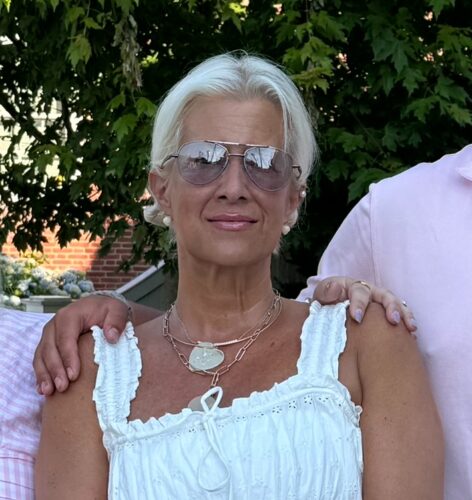
OLD LYME—Born May 16, 1955, Margaret “Peg” Stroup, formerly of Old Lyme, passed away July 2, 2024. Peg is survived by her two sons, Kevin Leaver and Kyle (Kayleigh) Leaver; three sisters, Michele, Nancy and Laura; and two nephews, Brian and Alex.
Peg was an enthusiastic enterpriser. She was proud of her accomplishment of joining the Mystic Highland Pipe Band as a bagpiper in the late 90s, during which time she performed at multiple parades along the shoreline.
Peg loved helping others …
Written through Kevin and Kyle, by Peg
A Catholic Memorial Service and Mass will be held at 11 a.m. Aug. 24, at Christ the King Church in Old Lyme. In lieu of flowers, donations can be made to “Safe Futures” of New London, CT.
OLD LYME—Denise Rowena (Dye) Lee, 75, of Old Lyme, died peacefully Wednesday July 24, 2024, after a lengthy battle with Alzheimer’s Disease, with her loving husband of 54 years Larry by her side, and surrounded by family.
Denise was born on January 28, 1949, in Baltimore, Maryland … attended Catholic schools and graduated from the Boston University School of Nursing in 1970.
Denise met her husband Larry in October 1969; they were engaged 6 weeks later, married 6 months after that, and spent the next 54 years together.
As a nurse, Denise held positions in visiting nursing; on the children’s unit at CT Valley Hospital; on the drug and alcohol detox unit at Norwich State Hospital; in group homes; and as a Hospice nurse …
… As a martial arts instructor, she passed wisdom and knowledge to the hundreds of students that she taught over her 28-year career. “Integrity, Intent, Indomitable Spirit” was the motto at Lees’ Martial Arts, … “The Karate Lady” as she was fondly known could easily be identified around town through her license plate “INTENT.” Denise lived every day with the intent to leave the world a better place because she had been in it, a mission she certainly accomplished.
Denise is survived by her husband of 54 years, Lawrence John Lee of Old Lyme, CT and her siblings Noelle Dye and Ian Dye and their families. Denise’s legacy will live on in her children, Dylan (Sally Ann) of Old Saybrook, CT and Ryan (Melanie) of Old Lyme, CT, and her grandchildren Lauren, Colin, Parker, and Brody. She is predeceased by her parents and her younger brother, Justin Dye.
A memorial gathering to celebrate Denise’s remarkable life will be held from 1-4 pm, Sunday August 11, 2024, at Scotch Plains Tavern in Essex, CT.
In lieu of flowers, we ask that you spend that money or time reaching out to a loved one …
I followed up on a few “leads” that suggested the expression came from a Bogart movie from the 1940s and ‘50s, and watched the six Bogart films that were released in that period, a few with Christina; but did not find the exact phrase, although there were several points in each movie when I/we were certain that it would come up in the next scene. I also introduced Will to regionalisms like “wicked,” “ya’ll,” and y’ins.”
I continue my review of figurative language in this essay and present idioms originating in sports and the military, some that boomers will deny ever saying, and a few deserving of retirement.
Today’s “View” is an effort to provide a bit of nostalgia to serve as a backdrop to another divisive and frightening election and an unusual period of bad political theater in America; where the GOP candidate appears to rely wholly on second-rate and seventh grade insults and nicknames.
I will try to not stray into my observations regarding the events and threats that have occurred in that party’s campaign, although I anticipate that, with Madam Editor’s forbearance, the subject will be covered in a future “View;” well before November. However, there is an important public service announcement in the penultimate section of this “View.”
I begin with a consideration of the title’s origin, which has morphed unintentionally into a profile of an iconic star of the cinema. Note that like last May’s “View,” I have “peppered” this essay with familiar idioms to illustrate just how frequently they appear in conversation.
Origins:
“Wassup?”, sometimes, “Waddup?”, is considered by some as a “cool” variant of the phrase, “What’s up?”, which appeared in O. Henry’s short story, “The adventures of Shamrock Jolnes,” (1904) and Jack London’s “The Sea-Wolf”, also published in 1904. Remarkably, “Wassup?” may be one of the most common, first texts sent by many teens.
Beyond O. Henry and Jack London, you should also reflect on Bugs Bunny’s characteristic greeting, “What’s up, Doc?”; which he used to surprise his two heavily-armed nemeses, Elmer Fudd (shotgun) and Yosemite Sam (two “six-guns.”)
According to CBS News, Bugs made his debutin theaterson July 27, 1940 in an animated short film (a ‘short’), “A Wild Hare;” marking the beginning of a fabled career where he starred in over 160 shorts that aired between 1940 and 1964.
Bugs Bunny made his debut in 1940. Image qualifies as Fair Use under US copyright law.
Warner Brothers reports that Bugs was born in a burrow beneath the turf of Ebbets Field; which was, of course, the home field for the Brooklyn Dodgers from 1913 to 1957, when they were forced to “get outta here” by team owners; who relocated them from Brooklyn’s Flatbush neighborhood to Los Angeles’ Chavez Ravine.
Voice actor, Mel Blanc, gave Bugs a Flatbush accent; and so, Bugs is a bona fide Brooklynite, not unlike Tony Manero, who was played by John Travolta in the 1977 movie, “Saturday Night Fever,” or poet Walt Whitman, who wrote for several Brooklyn newspapers and was editor of the Brooklyn Daily Eagle from 1846 to 1848.
Bugs starred in several WW2 propaganda shorts and the USMC named him an honorary Marine Master Sergeant in 1943, following his performance in “Super-Rabbit,” in which he donned a Marine uniform and sang the Marine Corps Hymn. In “Herr Meets Hare,” Bugs disguised himself as Hitler, encountering Goering in the Black Forest.
Despite Bugs’ impact on popular culture, “Wassup?” did not gain broad popularity until it was featured in an Anheuser Bush Budweiser commercial campaign that first aired on Monday Night Football on December 20, 1999; where the actors appeared to slur “what’s up?” as “Wassup?” on the telephone.
Nevertheless, a second series of the Bugs’ commemorative was issued as “forever” stamps in 2020, celebrating the 80th anniversary of his debut in “A Wild Hare.”
Warner Bros. disarmed Fudd and Sam in their new “Looney Tunes Cartoons” series on HBO Max in 2020; responding to concerns over gun violence in the United States.
There was a somewhat heated response from guns’ rights groups regarding this “violation” of the Second Amendment.
The show’s executive producer, Peter Browngardt, stated that, “Even though those two characters have been disarmed, viewers can still expect some cartoon violence. Elmer Fudd will be more “creative” in his attempts to catch Bugs Bunny, using a scythe instead of a shotgun; and there will be sticks of Acme dynamite exploding in characters’ faces.”
Especially relevant today is the children’s book “Daffy Duck for President,” which was published in 1997 by Warner Bros. and the USPS. It explores Daffy’s entry into politics in an attempt to change the law to favor perpetual rabbit season over duck season. During his pursuit of office, candidate Duck learned about the U.S. Constitution, the separation of powers, and our system of checks and balances. In 2004, a four-minute animated short, based on the book, was released, coinciding with that year’s Presidential election, in which incumbent George W. Bush defeated Senator John Kerry.
Although I promised above not to “stray,” readers may want to assess their level of comfort with the Heritage Foundation’s / Trump allies’ Project 2025, a collection of ultra-conservative and right-wing plans to reshape the federal government and consolidate power in the presidency, thus allowing Trump, should he be elected, to use that power to go after his critics. Project 2025 will certainly be included in my next “View” in a play-by-play of the presidential campaign(s).
I return now to my review of idiomatic expressions.
Idioms from Sports:
A “game changer”refers to an athlete or decisive play that suddenly changes the outcome of a game or series. I illustrate with Willie Mays’ amazing over-the-shoulder catch of a 425-ft. drive to center field by Cleveland Indians’ first baseman Vic Wertz during Game 1 of the 1954 World Series at the Polo Grounds; which stopped a Cleveland rally. The New York Giants then went on to sweep the series in four games over highly-favored Cleveland, securing their first championship since 1933.
More significantly, the segregated Jim Crow policies of baseball changed forever on October 23, 1945 when Dodgers GM, Branch Rickey signed Jackie Robinson of the Negro League’s Kansas City Monarchs to a minor league contract that would bring Robinson into the majors on April 15, 1947 in Brooklyn. Robinson went on that year to become baseball’s first “Rookie of the Year;” and the Dodgers went on to the World Series against the Yankees.
Staying with baseball, if “you “hit a home run” in business, you do something that is very successful.
Notably, an American trucks manufacturer recently began touting its new EV model as a “game-changer in the pickup truck segment.”
More broadly, Henry Ford revolutionized the automobile industry in 1913 when he installed the first moving assembly line at his Highland Park, MI plant; significantly reducing the time it took to build a car; and so, making cars more affordable for the general public.
The term will certainly be used by analysts in reviewing key election events.
If you are a fan of basketball, you are probably familiar with the “slam dunk,” a scoring play where the player leaps in the air, and jams the ball straight through the basket while touching the rim with one or both hands.
Off the court, “slam dunk” is often used as an expression of confidence and to describe a situation or action that is expected to be successful or easily accomplished. In other words, the action is a sure thing or a no-brainer.
Idioms from the Military:
The expression, take a “deep-dive” into the data,” suggests a more comprehensive analysis that goes beyond surface-level observations or assumptions; and can be traced back to a diving technique used by USN deep-sea divers during World War II, who would descend to great depths to inspect and repair damage on the ship’s hull from enemy attacks. In addition, contemporary submarines will take a deep dive after maintenance to confirm the integrity of the pressure hull.
The British will use the expression “Everything’s gone pear-shaped” to describe situations that end badly or go awry or to indicate that a scheme has not been perfectly executed. My research suggests that the phrase originated in the Royal Air Force (RAF) during WW2, where it was used to describe the difficulty that pilots in training faced when attempting to perform aerial maneuvers, often resulting in pear-shaped, rather than perfectly round aerial loops. Note that “loops may be employed by a skilled fighter pilot as an evasive maneuver used in aerial combat; aka a “dog fight.”
It was also suggested that “pear shaped” was RAF slang describing, in exaggerated terms, the shape of an aircraft that crashes in a nose-dive.
The expression, “in harm’s way,” is often used to describe a dangerous place or situation, particularly when applied to members of the armed services in war. It is attributed to America’s Revolutionary War naval hero, and founder of the United States Navy, John Paul Jones (JPJ).
In 1778, while seeking a ship from the supportive French government, he wrote, “I wish to have no connection with any ship that does not sail fast; for I intend to go in harm’s way”.
JPJ is also credited with another important USN expression: “I have not yet begun to fight;” which was his response when asked by Captain Richard Pearson of HMS Serapis if he had struck his colors (i.e. lowered his flag as an indication of surrender), after Jones’ ship, the Bonhomme Richard, had sustained significant damage during the Battle of Flamborough Head on September 23, 1779. This defiant response has since become a symbol of determination and resilience for the United States Navy.
“I got your six” originated with WW1 pilots and refers to the rear of an airplane as the six o’clock position. The pilot sits directly in front in the cockpit at twelve o’clock. On a battlefield, your “six” is the most vulnerable; so, when someone tells you that they’ve “got your six,” it means they are watching your back.
The phrase, “Stay frosty,” means to stay alert, while keeping one’s emotions under control. People in the military, particularly those in combat, may need to be reminded by their fellow soldiers to keep a cool head when things get rough. However, the popular term now means “Keep cool,” and can be used as a farewell between friends.
A “Snafu”is a military acronym that stands for the expression “Situation normal: all fouled up.” — i.e., the situation is bad, but that’s the normal state of affairs. The acronym originated during WW2; and “Private Snafu” was a series of instructional cartoons created by director Frank Capra, chairman of the U.S. Army Air Force First Motion Picture Unit; and produced by Warner Brothers. Remarkably, most shorts were written by Theodor Geisel, aka “Dr. Seuss.” (Note that there are other coarser definitions for “Snafu.”)
Author’s Thoughts: My goal in this “View” was to provide a bit of distraction for those of us losing sleep over the rhetoric produced by one of the candidates in this election, which is one for the history books with a former prosecutor versus a convicted felon. Next time, as mentioned above, I will dig deep into campaign events and associated rhetoric and provide a play-by-play of how we arrived at this point, less than 100 days from the polls.Ironically, given the section on pronunciation above, both Project 2025 and the 2024 GOP platform propose eliminating the U.S. Department of Education.
Public Service Announcement (PSA): The GOP candidate repeatedly botched Kamala Harris’ name while speaking recently at the “Believers Summit,” an event held by in West Palm Beach, Fla., by the conservative Christian group “Turning Point Action.” “Some people think I mispronounce it on purpose, but actually I’ve heard it said about seven different ways.” “There are a lot of ways.” “I could not care less if I mispronounce it or not. I couldn’t care less.”
For everyone’s information, “Kamala” is pronounced “COM-mah-lah,” with the emphasis on the first syllable. It sounds like comma-la when said correctly and aligns with the Sanskrit origins of her name — meaning lotus. She released a PSA during her 2016 Senate run where a cast of kids explain which pronunciations were incorrect for her name.
This is especially bizarre because J.D. Vance’s wife, Usha Vance, whose maiden name is Usha Chilukuri also has a name that can be difficult to pronounce. Her first name is pronounced “OO-shah,” and her maiden name, Chilukuri, is typically pronounced “chee-loo-KOO-ree,” with the emphasis on the third syllable.
Editor’s Note: This is the opinion of Thomas D. Gotowka.
About the Author: Tom Gotowka is a resident of Old Lyme, whose entire adult career has been in healthcare. He will sit on the Navy side at the Army/Navy football game. He always sit on the crimson side at any Harvard/Yale contest. He enjoys reading historic speeches and considers himself a scholar of the period from FDR through JFK. A child of AM Radio, he probably knows the lyrics of every rock and roll or folk song published since 1960. He hopes these experiences give readers a sense of what he believes “qualify” him to write this column.