Richard Hopkins Miller, Jr. A magnetic leader in the U.S. property industry and beloved family man, dies at age 62
Richard Hopkins Miller, Jr.
HINGHAM, MA—Richard Hopkins Miller Jr. of Hingham, MA, a man admired for his unwavering spirit, dedication to family and professional success, passed away peacefully on April 24, 2024, at the age of sixty-two. He fought a short but valiant battle with kidney cancer, leaving behind a legacy of love and accomplishment.
Rick was born on January 25, 1962 in Hartford, CT and was a graduate of Conard High School in West Hartford, CT. He was a proud Boston College Eagle (1984), where he met his wife, Jennifer; and was a devoted father to Amanda and Richard.
His storied career in the insurance business began at Industrial Risk Insurers and Alexander & Alexander in New York, before flourishing at AON for the past 20 years. Rick’s exceptional leadership at AON, culminating in his role as U.S. Property Leader, was characterized by his rare blend of sharp business acumen and his uncanny ability to forge genuine connections. Never one to seek the spotlight, he used his position to empower others, celebrate their successes and treated everyone with respect, from CEOs to interns.
An avid golfer with a single-digit handicap, Rick found joy, camaraderie and friendship at the Boston Golf Club, his “happy place.” It was there that he enjoyed countless hours in the company of friends that he adored and who loved him beyond measure.
A true outdoorsman, Rick, Jen and their children loved exploring the walking trails near his Hingham, MA home with their beloved dog, where his sibling passions, hiking and birds, could be enjoyed boundlessly.
Rick was a Renaissance man – a history buff, an enthusiastic gardener and an accomplished skier.
He is lovingly remembered by his wife of 36 years Jennifer; his wonderful children, Amanda and Richard; his Australian Shepherd, Ollie; his mother, Mary Gilmore Miller; sister, Cynthia Miller Aird and her husband, Stephen of Old Lyme, CT; and many nieces and nephews.
It is with great sadness he says good-bye to his wide circle of friends and colleagues, all who mourn his loss deeply. In the words he often shared, “Keep the Faith.”
A Memorial Mass to Celebrate Rick’s Life and spirit will be held at a future date. In lieu of flowers, the family asks that gifts be made to support the Brigham Cancer Fund/Brigham and Women’s Hospital in memory of Rick Miller and/or the First Tee as a tribute gift in memory of Rick Miller.
OLD LYME – The Lyme Academy of Fine Arts announces the opening on May 19 of Beyond the Figure: A Student and Faculty Exhibition. The exhibition will be on view to the public until Sept. 1, 2024.
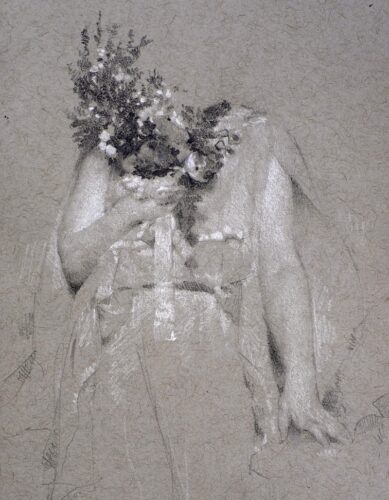
‘Study of Alama-Tadema’s ‘Between Hope and Fear’ by first-year Core Drawing student Jude Dutton is the signature work for the upcoming ‘Beyond the Figure’ exhibition at Lyme Academy.
In 2021, with fresh leadership at its helm, the Lyme Academy of Fine Arts reopened its doors to students and welcomed a new generation of artists to its Core Programs. Beyond the Figure: A Student and Faculty Exhibition is the first opportunity to witness the results of this rebirth, through the work of its faculty and their students.
Lyme Academy is quickly being recognized nationally and internationally for its innovative arts curriculum and as an epicenter for drawing, painting, and sculpture in the figurative tradition. This exhibition is an invitation to learn more about the Lyme Academy’s uniqueness and impact today, as it trains the success stories of tomorrow.
The Academy’s Co-Artistic Director Jordan Sokol comments, “The Lyme Academy of Fine Arts is forging a new educational model, one that bucks the current trend of deskilling in art education. We’re thrilled to see such a surge of interest among aspiring artists in our mission to reintroduce time-honored traditions in a modern idiom. This exhibition is an exciting opportunity to learn more about the students, who are coming from all over the country to study here, as well as the world-renowned faculty that is instructing them.”
Faculty members that are represented in the exhibition include: Todd Casey, Hollis Dunlap, Chad Fisher, Michael Grimaldi, Amaya Gurpide, Zachary Kainz, Rick Lacey, Thomas Lapine, Mina Mohtasham, Alicia Ponzio, Edmond Rochat, Alex Venezia, Gary Weisman, and Treacy Ziegler.
The events begin at 4 p.m. with In Conversation with the WSJ’s Lance Esplund, which will take place in the Academy’s Cole Studio. This will be followed by an exhibition preview and reception in the Academy’s Chauncey-Stillman Gallery from 5 to 6:30 p.m. Note that select artworks from this exhibition will be offered for sale throughout the evening.
Lance Esplund writes about art forThe Wall Street Journal. Previously, he was US art critic for Bloomberg News and chief art critic for the New York Sun.
He has taught studio art and art history at the Parsons School of Design and Rider University, and has served as visiting MFA critic at the New York Studio School. His essays have appeared in Art in America, Harper’s, Modern Painters, and The New Republic, among others.
Esplund lives in Brooklyn, New York.
Emily Weeks received her Ph.D. from the Department of the History of Art at Yale University in December 2004. Currently she is an independent art historian and consultant for museums, academic institutions, auction houses, private collectors, and multimedia organizations in America, Britain, Europe, and the Middle East.
She also serves as Principal Lecturer in the Histories of Art at Lyme Academy of Fine Arts in Old Lyme, Conn. Dr. Weeks is a leading expert on Orientalism and 19th-century British and European visual culture; she is also the acknowledged expert on the artist Jean-Léon Gérôme, about whom she is curating a major exhibition in Doha, Qatar.
On May 14, the property at 5-1 Pilgrim Landing (pictured above) closed for $4,019,500—the highest ever home sale in Old Lyme. Photo by Frank DiNardi.
OLD LYME — On Tuesday, May 14, William Pitt-Julia B. Fee Sotheby’s International Realty announced today the closing of the highest-ever residential real estate sale in Old Lyme, Conn. The Connecticut River-front estate located at 5-1 Pilgrim Landing Rd, listed with Colette Harron and Beth Cote, sold for $4,019,500.
“We are honored to have the highest sale in Old Lyme with this beautiful property, and so pleased that the sale makes such a significant statement about the desirability of this area,” said Harron. “Exuding classic Americana charm, this estate is one of the most remarkable homes on the Connecticut Shoreline. It sits on 48 private acres at the edge of the Connecticut River, offering incredible views and rich architectural heritage.”
Known as Quarry House, the property overlooks Pilgrims Landing, the Connecticut River, and Goose and Calves Island, with more than 1,000 feet of linear water frontage, a deep water dock and a boat launch. The home was built in 1930 by architect Dudley St. Clair Donnelly, who is known for Renaissance and Colonial Revival designs, and modified in 1972 by Thomas Greer Coles to add a master suite, office and guest house.
The 5,158 sq. ft. Colonial main home offers a spacious and open floor plan with elegant dental moldings and built-ins, custom millwork, arched top doors and hardwood floors throughout the living spaces. Adjacent to the main home, the guest house features a kitchenette, bedroom, full bath and water views from every room. The expansive property includes a fishing pond, granite ledges, hiking trails, a private beach and a gunite swimming pool with a bluestone patio and elevated spa.
“This is a classic and elegant home that brings together the best of past and present,” Cote said. “We are thrilled to complete this sale and find new owners who will have a chance to preserve its legacy.”
Editor’s Note Founded in 1949, William Pitt Sotheby’s International Realty and Julia B. Fee Sotheby’s International Realty manages a $5.8 billion portfolio with more than 1,100 sales associates in 29 brokerages spanning Connecticut, Massachusetts and New York. The company is one of the largest Sotheby’s International Realty(R) affiliates globally and the 35th-largest real estate company by sales volume in the United States. For more information, visit the website at williampitt.com.
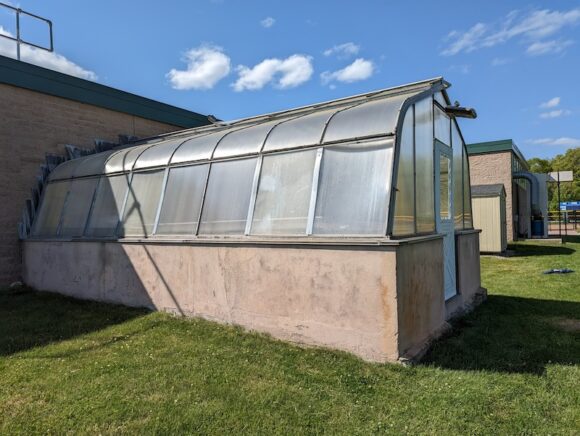
The Lyme-Old Lyme Middle School greenhouse pictured above will be renovated by a mutually beneficial partnership comprising the Lyme-Old Lyme Food Share Garden and Lyme-Old Lyme Schools.
Joint Project Will Reduce Local Food Insecurity, Advance Student Engagement
LYME/OLD LYME—The Lyme-Old Lyme Food Share Garden (LOLFSG) is partnering with the Region 18 School District to renovate the Lyme-Old Lyme Middle School greenhouse. The project will advance the garden’s mission to reduce local food insecurity while serving as a site to foster student curiosity and engagement.
The LOLFSG share of the project is $8000, which represents approximately 40 percent of the renovation costs. The LOLFSG is raising money through a crowd-sourcing effort supported by Sustainable CT. If LOLFSG can raise $4000, then Sustainable CT’s innovative Community Match Fund will match the remaining $4000. Donations in any amount are welcome. To view an insightful video about the project and/or to donate, visit http://patronicity.com/greenhouserenovation.
This Sustainable CT Fund provides fast, flexible funding to implement projects that align with a variety of sustainability actions. The Fund is structured to support and amplify grassroots efforts that strive to transform their community, neighborhood, and town for the good.
Access to a greenhouse will allow the LOLFSG to increase production by starting and maintaining plants for late-season crops. While researching greenhouse options, Jim Ward, LOLFSG President, noticed that the aging middle school greenhouse was currently unusable.
Ward approached RSD 18 administration about a potential partnership to renovate and modernize the structure. Following a series of conversations between school personnel, garden members, and greenhouse professionals, the idea took root.
This photo shows the current interior of the Lyme-Old Lyme Middle School greenhouse prior to the renovation project.
Garden volunteers will also maintain educational exhibits for use by students such as a vermicomposting (worm) bin and a hydroponic display. Teachers and students will have access to the greenhouse for classroom use or club projects.
The Lyme-Old Lyme Food Share Garden is a nonprofit organization started in 2021 to reduce food insecurity in local communities by growing and donating fresh produce. Located at Town Woods Park, the LOLFSG is a fully volunteer organization. In the past two growing seasons, more than 5000 pounds of fresh produce has been donated to the Shoreline Soup Kitchen and Pantries and the United Way.
Garden volunteers also compost food waste and maintain a pollinator pathway.
Several weeks ago, my nine-year-old grandson, William, was introduced to the expression, “Let’s blow this popsicle stand;” and he asked his dad what was it all about. He was referred to me with a, “He used to say it all the time,” which I do not recall.
Tom Gotowka
Please note that he now prefers to be called “Will,” like the playwright; and so, I told him that this might be a good subject for a future “View,” and promised to get back to him with some information.
So in this essay, I set out to answer my grandson’s question regarding ”popsicle stand” and will consider the broader subject of American idioms and colloquial expressions in a subsequent “View,” in which I will provide abundant examples of this form of “figurative language,” suggest several that are worthy of retirement from the lexicon; and consider a few “Britishisms” like “everything is tickety-boo.”
I have “peppered” this essay with familiar idioms to illustrate just how frequently they appear in conversation.
”Let’s blow this popsicle stand” is really just a cool and humorous way to say, “Let’s leave this place;” or more obstinately, to express one’s boredom with the current situation and your readiness to quickly move onto something new. You can use it to refer to your departure from any location or activity—wherever you are at the time. The expression is not inherently derogatory when used casually, but might be inappropriate in some settings (see “Thoughts” below.)
I anticipate that William will master the two terms defined below and, as importantly, keep his younger brother, Henry “in the loop.” He may need to read this essay with his dad, who will help him understand the more arcane references that might otherwise “go over his head.”
The Terms:
An idiom is a phrase that has a figurative meaning, which is different from its literal meaning. Hence, keep him “in the loop” means keep him informed; and “go over his head,” as I have used it, suggests that the information may be too complex or subtle for him to understand.
Idioms are often specific to a particular language or culture, and can be difficult for non-native speakers to understand. For example, “kick the bucket” is an idiom that means to die.
A colloquialism, on the other hand, is a word or phrase that is often used in everyday conversation, but may be specific to a particular region or group of people.
If William travels south from his home in Maryland, he will hear “y’all” used as a contraction of “you all,” the farther south he travels.
However, in Pittsburgh and areas of western Pennsylvania, just a few hundred miles north of his home, “Yinz” developed as the local equivalent of “y’all.” And then there’s also the term “youse” or “youse guys,” commonly heard in some neighborhoods of Buffalo, Chicago, New York City, Philadelphia; and New Jersey; to convey the same meaning as “y’all” and “yinz.”
These forms of address are all part of the regional dialects that developed to distinguish between singular and plural forms of “you” in English.
William’s father did his graduate work at M.I.T. in Cambridge, Mass. He and his classmates were “wicked smart,” and when he walked amongst the buildings early on a February morning, he felt “wicked cold.”
“Wicked” is not used to connote something evil. It means “very” or “extremely.” in the Greater Boston area and some other parts of New England. I suggest viewing the movie, “Good Will Hunting” to observe Bostonians using “wicked” in their conversations. Another interpretation can be found in theHarryPotter series of books by J.K. Rowling, where the kids often say, “That’s wicked,” when excited or fascinated.
Clearly, this can be confusing for we “non-English majors,” and there is overlap with “dialect,” “vernacular,” or “slang.”
I do not want to further “muddy the waters” for William—i.e., create confusion or make this even more complex; but “… popsicle stand” has both the characteristics of an idiomatic expression and a colloquialism.
Origin and Variations:
“Let’s blow this popsicle stand” began to grow inpopular culture in the mid-20th century, but is not as commonly used today as in the past. I thought that this quest to find the expression’s origin would be a “piece of cake” rather than what Mercutio referred to as a “wild goose chase” in Shakespeare’s “Romeo and Juliet.”
The actual origin is murky, but it had to have been coined after 1924, the year a patent for popsicles was issued to Frank W. Epperson; who is generally considered to have invented the “frozen confection” as a youngster in 1905 on an unseasonably cold night in San Francisco.
One theory, which I consider as no more than an urban myth, attributes the expression to a Jamaican “conspiracist” in the late-1940s, Antoine Cleo; who planned to somehow establish world supremacy by selling popsicles in radioactive popsicle stands.
According to the myth, his plans were thwarted by the “Kindred Spirits” cult, who attacked popsicle stands in major cities, killing Antoine. Some have asserted its origin as the “Beat Generation” in San Francisco or New York City’s Greenwich Village or Columbia University neighborhoods.
Others have attributed the expression to an old (but unnamed) Humphrey Bogart gangster movie from the 1940s, i.e., “it just sounds like Bogart.” There were five Bogart films released in the 1940s: “The Maltese Falcon” (1941), “Casablanca” (1942), “The Treasure of the Sierra Madre” (1948), “The Big Sleep” (1946), and “Key Largo”(1948). These are all on the shelf at the Phoebe or available via inter-library loan.
Some consensus seemed to be developing around the 1955 film noir, “Kiss Me Deadly,” which was based on a novel by Mickey Spillane, as the earliest known use of the phrase in a movie and the likely origin of the expression.
I watched them all, a couple with Christina, and did not find the exact phrase, although there were several scenes in the movies when I/we thought it would be coming right up.
The expression, or a variation, has also appeared in older movies and television shows (below).
Variations:
Many may use “pop stand” or “joint” instead of “popsicle stand;” and, “Let’s blow this joint,” is probably in greater use across all age groups, especially with Gen X and the Boomer generation. However, Millennials and the “Zoomers” of Gen. Z will also be familiar with this phrase.
Movies and Television:
The following are a few examples of the expression used in the entertainment media.
Marlon Brando, as Johnny Strabler, says, “Where’s my gold? I’m ‘gonna’ blow this joint” in the 1953 movie ,“The Wild One.”
Robin Williams, as Mork, an alien from the planet Ork sent to observe human behavior on Earth; used the expression, “How about you and me blow this Popsicle stand?” in a 1980 episode of “Mork & Mindy,“ which is an American television sitcom that aired on ABC from 1978 through 1982.
Danny Hassel, as Dan Jordan in the 1989 movie, “A Nightmare on Elm Street: The Dream Child.” thinks about the world after high school and says, As adults, we must now prepare for our new life outside this wonderful environment known as Springwood High; So, let’s blow this pop stand!”
Sonic said the line “Yo Sal, we’re going to blow this pop stand.” in rescuing his good friend, Sally the Hedgehog in an episode of “The Adventures of Sonic the Hedgehog,” an animated television series that ran on ABC from September, 1993, to December 1994; and was based on the Sonic series of video games and followed with a movie released in 2020.
I also include “We Gotta Get Out of this Place,” a rock song written by Barry Mann and Cynthia Weil and released in 1965 by the English band, The Animals, because it expresses the same sentiment as “… popsicle stand;” and it was the song most requested on Armed Forces Radio by American soldiers during the Vietnam War, according to the late radio personality Adrian Cronauer, whose life inspired the 1987 film, “Good Morning, Vietnam.”
Author’s Thoughts: I did not fully answer William’s questions, but it was “not for the want of trying.” However, I believe that I did provide him with enough information “to chew on.”
William: keep in mind that not everyone will understand the expression, so use it in casual conversations or when you hang out with your friends and family. I would not use it at a town meeting or at the end of a church service or any formal school event.
In closing, I’ll “catch you on the flip side,” (goodbye.)
A Note to the Editor: Kevin Ganey, who writes “The Movie Man” column on LymeLine, may have some insight on the origin of “Let’s blow this popsicle stand.” I would appreciate his wisdom.
Editor’s Note: This is the opinion of Thomas D. Gotowka.
About the Author: Tom Gotowka is a resident of Old Lyme, whose entire adult career has been in healthcare. He will sit on the Navy side at the Army/Navy football game. He always sit on the crimson side at any Harvard/Yale contest. He enjoys reading historic speeches and considers himself a scholar of the period from FDR through JFK. A child of AM Radio, he probably knows the lyrics of every rock and roll or folk song published since 1960. He hopes these experiences give readers a sense of what he believes “qualify” him to write this column.
Sources: “Let’s Blow This Popsicle Stand” – Part 1 Aldrich, R. (Director). (1955). “Kiss me Deadly.” [Film]. Metro-Goldwyn-Mayer Studios Butler, S. “Frozen History: The Story of the Popsicle.” History Classics. 08/24/2023. Lighter, J. (1994) “The Random House Historical Dictionary of American Slang.” New York: Random House.(1994) Perlman, M. “Yinz, youse, and y’all.” Columbia Journalism Review. 01/19/2016. Rowling, J.K. (1998) “Harry Potter and the Sorcerer’s Stone.” Pittsburgh: Scholastic Corporation. Spillane, M. (1952) “Kiss Me Deadly.” New York E.P. Dutton & Co. Van Sant, G.(Director). (1997) “Good Will Hunting.” [Film]. Miramax White, M. “100 American Idioms and Popular US Expressions Explained.” Your Dictionary.com 05/14/2021. Winter, L. (editor) ““Slang Origin: Why Does New England Say “Wicked” (and What Does It Mean?.” Owlcation.11/19/2023.