The Old Lyme girls’ 4×400 and 4×800 relay team of Maddy Morgado, Aggie Hunt, Lyla Powers, and Chase Gilbert (right) won the 4×800, came second in the 4×400, and broke school records in both events at the Class S Championships held Thursday in New Haven. Gilbert also won the 3200m race, also breaking that school record.
NEW HAVEN — On Thursday, the Old Lyme Girls Indoor Track & Field team came second in the State Class S championship behind Bloomfield, and ahead of Old Saybrook, while the Old Lyme boys notched 11th place overall.
Chase Gilbert took first place in the girls 3200m setting a new school record time of 10:54.12.
She was also a member of the 4 x 800 and 4 x 400 relay teams, which finished first and second respectively, and both of which set new school records.
The girls’ relay team of Maddy Morgado, Aggie Hunt, Lyla Powers, and Gilbert recorded times of 4.32.83 and 9:49.96 in the 4 x 400 and 4 x 800 respectively.
The girls’ split times in the winning 4 x 800 race were 2:30, 2:31, 2:31, 2:16 respectively and in the 4 x 400, in which they finished second, their split times were 65.8, 65.7, 64.1, 64.1 respectively.
With these times, the 4 x 800 girls’ team and Gilbert in the 3200m have now qualified for the State Opens at Hillhouse in New Haven on Feb. 18.
Other key results for both Old Lyme teams were:
The Old Lyme Boys’ 4×800 team of Eric Dagher, Gabe Tooker, Dylan Hovey, and Marco Supersano finished third with a time of 8:41.79 .
3rd place Boys 4×800: Eric Dagher, Gabe Tooker, Dylan Hovey, Marco Supersano 8:41.79 (splits: 2:11, 2:09, 2:10, 2:09 respectively)
1st place boys shot put: Dylan Sheehan 51’2″
3rd place girls 600m: Lyla Powers 1:43.45
4th place girls 1000m: Maddy Morgado 3:11.95
2nd place girls 55 Hurdles: Zoe Eastman-Grossel 9.09 (9.05 during the prelims)
Additional Old Lyme athletes may qualify for the State Open dependent on the remainder of the Class S results achieved in subsequent day events.
Congratulations from all of us at LymeLine to both teams on such a remarkable season!
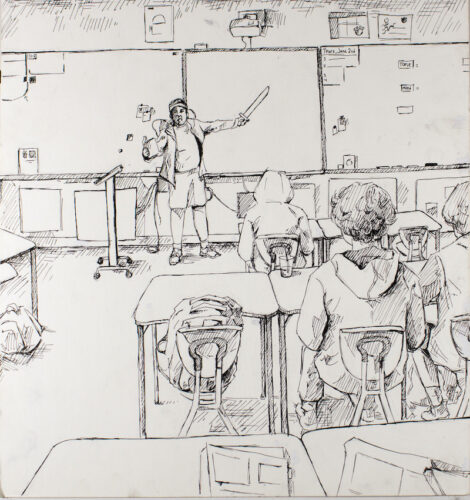
LYME-OLD LYME — Five Lyme-Old Lyme High School students were recognized at this year’s Connecticut Scholastic Art Awards.
Senior Abby Patana deserves special recognition for receiving a Gold Key for her portfolio, Enveloped in Gold. She also earned a scholarship offer from the University of Hartford Art School worth $116,000 over four years, and her portfolio will go on to be juried at the national level.
‘Burnt Up’ by Lea Wilson.
Senior Lea Wilson won a Silver Key in Printmaking and Honorable Mentions in both Portfolio and Comic Art, while Senior Kennedy McCormick earned two Honorable Mentions in Printmaking.
‘Dramatic Reading’ by Grace Phaneuf.
In the competitive Drawing and Illustration category Junior Grace Phaneuf and Sophomore Aven Kellert both also won Honorable Mentions.
Self-portrait by Aven Kellert.
Jurying was competitive, with only seven percent of juried work accepted for this year’s show.
OLD LYME — Dolores Stella Green of Old Lyme, passed away Feb. 3, 2023. She was the widow of LeRoy Green …
She is survived by her children Gina Rolfe of Westbrook, John Green of San Francisco, and Gregory Green and his wife Rachel Green of Old Lyme …
Calling hours will be held from 3 to 5 p.m. Sunday, Feb. 12, at Fulton-Theroux Funeral Home, 13 Beckwith Ln., Old Lyme. A Mass of Christian Burial will be held at 11 a.m. Monday, Feb. 13, in Christ the King Church, Old Lyme. Burial will follow at Duck River Cemetery, Old Lyme …
Much has been made of the required changes to the Old Lyme Zoning Regulations to accommodate a new Arts Overlay District to the sole benefit the Lyme Academy of Fine Arts.
I find it difficult to understand how an institution, much beloved in the community, has failed financially twice in the last decade. The Town has assisted in many ways to help this struggling entity in its quest to retain its cultural contribution to our community. So here we are for a third try, being asked to change our Town zoning laws to accommodate one organization. The Lyme Academy of Fine Arts did not fail because zoning was too difficult, most applications by the institution for Special Exceptions have been granted. The financial insecurity of the Academy is based in a poor business model. Its base problem is too much overhead and not enough income. How should this relate to Zoning? It shouldn’t.
The goal of the applicant is to make it easier to get permission to adjust their income stream by expanding their previously “student only” art store to a retail business and to expand their existing café area to a full service restaurant. On the face of it, and if you did not live in the residential zone of the Historic District, reasonable attempts at shoring up the balance sheet. The rub is that once these uses are allowed, they travel with the property. So if the Academy finds itself again in unfortunately familiar circumstances and must sell the property, the uses allowed to that lovely institution to help it along, now will travel to the new owner. That means two new commercial properties will have been allowed in a residential district.
We have zoning laws in place to prevent just this circumstance. While this may not be considered “spot zoning”, if the underlying property changes use from an educational institution to anything else, it will be the creation of commercial use property within a pre-existing residential zone.
Which leads me to wonder if the Board of the Academy truly believes a small retail store and a restaurant are going to save the institution or are there other plans not known to the public that will be facilitated by these changes in Zoning?
The Applicant complains the current Special Exception process is difficult. It should be. It’s meant to protect the residents of this Residential Zone.
LYME/OLD LYME — Cannabis is now legal for adult use in Connecticut and retail sales officially began in January. How do we support our children and parents through this change and what it means moving forward?
Learning more about today’s marijuana, its impact on our youth, and the new law is a great way to start.
Over the next few months, the Lyme-Old Lyme Prevention Coalition and Lymes’ Youth Service Bureau (LYSB) will be running a youth cannabis education and prevention campaign, including a six-part direct mail Tool Kit for Parents that will be in mailboxes all over Lyme and Old Lyme.
This postcard will be arriving soon in Lyme and Old Lyme mailboxes. It is the first of a six-part direct mail Tool Kit for Parents regarding cannabis legalization in Connecticut and how to deal with its impact on our youth.
Why is Youth Cannabis Use a Problem?
The 2021 Lyme-Old Lyme (LOL) Youth Survey assessing current youth substance use/misuse trends in students grades 7-12 offers insight.
By 12th grade, nearly a quarter of all seniors reported trying marijuana in their lifetime, with 13.3% reporting recent use. Of equal concern is society’s view of marijuana use and reduced perception of its harm by youth. By 12th grade, only 20 percent of LOLHS students report great risk for using marijuana one to two times a week, while 68 percent of surveyed parents reporting that weekly marijuana use is risky for youth.
Teens (and often parents) believe the myth that today’s marijuana is neither dangerous nor addictive. What some do not fully understand is that today’s marijuana is incredibly potent, containing at least three times more THC (Tetrahydrocannabinol – the primary psychoactive cannabinoid extracted from the cannabis (marijuana) plant) than the weed of most adults’ youth, and rising to 99 percent THC content. This rise in potency means a comparable rise in risk.
Just because adult cannabis-use is legal and it is on retail shelves in Connecticut, it does not mean that this retail marijuana is “better” for youth if they experiment with it or use on a regular basis.
Alli Behnke, LYSB Prevention Coordinator, explains, “Sometimes people share with me that they feel legalizing marijuana was the safest thing for kids. If they experiment now at least it will be “safe.” This argument might make sense on the outside, but if you really look at the facts, you will find that youth use increased dramatically in other states post-legalization, and cannabis sold in dispensaries is still incredibly high in THC.”
She adds, “Our kids are at risk for some very serious consequences. It is important to know the facts and be prepared to talk to your children about cannabis,” emphasizing, “The legal age is 21 for a reason.”
It is important for parents, caregivers, and other adults who interact with youth to understand that adolescents are at the most risk for developing Cannabis Use Disorder. Many people believe that marijuana is not addictive, but that is a complete misconception.
In fact, around 10% of all cannabis users will develop a Cannabis Use Disorder (CUD) and 1 in 6 teens, who try marijuana, will become addicted – around 11% of teen users becoming addicted within the first year of use.
The effects of teen marijuana use can result in lower grades, poorer mood, low attention span, lack of motivation, and more. Some teens may experience rapid heartbeat, feelings of paranoia, and hallucinations. Weekly use of marijuana doubles a teen’s risk of having depression and/or anxiety. Teens who are daily marijuana users are seven times more likely to attempt suicide.
For more information about teen marijuana use and its effects, visit www.lysb.org/prevention
Cannabis is now legal for adult use in Connecticut and retail sales officially began in January. Photo by Panos Sakalakis on Unsplash
Cannabis Law in Connecticut
Understanding Connecticut’s new Cannabis Laws is a key first step. A 2016 study in the legal state of Washington found that 1/3 of parents incorrectly believed that the minimum legal age for cannabis was 18 rather than 21. In Connecticut, it is legal for adults (21+) to possess 1.5 ounces of cannabis at home or transporting it to home. Adults may also have up to 5 ounces stored in a locked container.
Cannabis can’t be used just anywhere – it is strictly prohibited at Connecticut State Parks, State Beaches, or on State Waters.
In every case, possessing and using cannabis under the age of 21 is illegal.
Much like Connecticut’s Social Host Law, permitting any person under the age of 21 to possess cannabis is a Class A misdemeanor and punishable by law. The Lyme-Old Lyme 2021 Youth Survey reports that 76.6% of youth, who use marijuana, do so in the homes of other people and 69% in their own homes. In fact, 50% of LOL 12th graders, who use marijuana, report that they use at a party with an adult present. This is illegal and harmful to all youth involved.
In October 2021, the Old Lyme Zoning Commission voted unanimously to prohibit all marijuana establishments “to prevent negative unintended consequences of its sale, production, or distribution.”
Keep in mind that surrounding communities (e.g., East Lyme, New London and Westbrook) have not banned sales and retail establishments will start selling shortly. Waterford and Clinton rejected retail marijuana sales.
Increased access, decreased perception of harm, and normalization of marijuana use will impact our youth in the coming years.
What Can Parents Do?
Adult-use marijuana may now be legal in Connecticut, but parents and other adults are strongly encouraged to avoid using cannabis in front of any youth. Lyme-Old Lyme youth report that they watch, listen, and learn about substance use and beliefs from their parents and adults around them. This includes cannabis use role modeling, positive coping skills, and ways to relax and have fun that don’t involve substance use, which can only pay off as youth develop their own behaviors and skills.
If cannabis is in your home, lock it up in accordance with CT State Law and away from children or adolescents. Children can and are being hospitalized for accidental exposure and overdose from adult cannabis.
It is highly recommended to keep track of what you possess so you can confirm that no one else is using it. Lock boxes can be purchased from many retailers with a limited amount available for free at LYSB for the LOL Community.
Remember that the most important tool in prevention, including the prevention of an adolescent Cannabis Use Disorder, is setting clear rules and talking often and early to your children. Learn the facts, create family rules, and work together to develop a strategy that will support your child’s health, well-being, and future.
Although talking about cannabis to your teens can be awkward at first, it is critical to communicate your expectations and reinforce that its use is illegal for those under 21. By helping kids choose to not use marijuana, we can together prevent countless cases of substance use disorders.
For more information about the Tool Kit for Parents or to learn more about the Lyme-Old Lyme Prevention Coalition, visit www.lysb.org/prevention or contact Alli Behnke, Prevention Coordinator, abehnke@lysb.org
Editor’s Note: This article was submitted by LYSB Prevention Coordinator Alli Behnke. Here at LymeLine, we are committed to supporting all LYSB’s determined efforts in the field of prevention to keep our youth safe and support their health, well-beingand future.