Update From Congressman Courtney on Hurricane Henri

The following is an important update sent out by Congressman Joe Courtney to the residents of the 2nd District.

Congressman Joe Courtney (CT-02)

OLD LYME/LYME — Tropical Storm Henri has intensified to a Category 1 hurricane, and it could make landfall in our region. As of this morning, the National Hurricane Center is projecting the storm to come ashore over Long Island and to move into Connecticut on Sunday afternoon or evening, and a hurricane watch has been issued for New London and Middlesex County. A tropical storm warning has been issued for the rest of the state.


Be careful out there—nothing is more important than protecting yourself and your family. Our local first responders are already making preparations to help our towns get through this, and Governor Lamont has already made a pre-land fall disaster request to FEMA to make sure our state is fully reimbursed for storm preparation and response, which I fully support. To all of our local firefighters, police officers, health care workers and other first responders: we are thankful for your service to our communities.

If you haven’t yet, you can take some steps now to get prepared. Below I’ve shared some information and resources from FEMA on how to get ready and stay safe. For more information from FEMA, click here. My office is monitoring the situation, and we’ll be ready to help anyone who needs to get connected to recovery resources.


Prepare Now for Hurricane Henri

Information from the Federal Emergency Management Agency (FEMA)

The National Oceanic and Atmospheric Administration’s National Weather Service National Hurricane Center expects hurricane conditions to begin late tonight or Sunday in portions of Connecticut and Long Island, New York. Storm surge watches are in effect for portions of Connecticut, New York, Massachusetts and Rhode Island.

Storm surge could be up to 5 feet in areas from coastal New Jersey to Cape Cod Bay in Massachusetts. Heavy rainfall may result in flash, urban and small stream flooding.

Key Highlights

  • Anyone in the forecast path of the storm should monitor their local news for updates and directions provided by their local officials and heed local evacuation orders. Gather supplies for your entire household now. Include medication, disinfectant supplies, face masks and pet supplies. After a hurricane, you may not have access to these supplies for several days.
  • FEMA is positioning supplies such as meals, water and generators to assist states anticipating impacts from Tropical Storm Henri. FEMA Incident Management Assistance Teams and liaison officers are in place, while other teams are on standby for deployment if necessary.
  • Download the free FEMA app (available in English and Spanish) to receive emergency alerts and real-time safety notifications, emergency preparedness tips and disaster resources. The app is available for Apple and Android devices

Prepare to evacuate if ordered to do so

  • Storm Path: Hurricanes and tropical storms can produce high winds and heavy rains far from the storm’s center. Focus on the storm’s impact, not the predicted storm path. Now is the time to prepare for severe weather. Visit Ready.gov or listo.gov to learn how you can keep yourself, your family and your pets safe.
  • Evacuating: If you are in potentially affected areas, you should be familiar with evacuation routes, have a family emergency communications plan, keep a battery-powered radio handy and have plans for your family members and pets.
  • Personal Safety: Evacuate if told to do so. If you go to a community or group shelter, remember to follow the latest recommendations from the Centers for Disease Control and Prevention (CDC) for protecting yourself and family from COVID-19.

Be prepared for power outages before and after the storm

  • Use only flashlights or battery-powered lanterns for emergency lighting. NEVER use candles during a blackout or power outage due to extreme risk of fire.
  • Avoid carbon monoxide poisoning. A grill, camp stove or other gasoline, propane, natural gas or charcoal burning devices should never be used inside a home, garage, basement, crawlspace or any partially enclosed area. These should only be used outdoors and at least 20 feet away from windows.
  • Use a generator safely. Never use a generator inside a home, basement, shed or garage even if doors and windows are open.
  • Keep generators outside and far away from your home. Windows, doors and vents could allow carbon monoxide to come indoors. Read both the label on your generator and the owner’s manual and follow the instructions.

Keep yourself safe before and after flooding 

  • Don’t drive through flood waters: Almost half of all flash flood deaths happen in vehicles. When in your car, look out for flooding in low lying areas at bridges and at highway dips. As little as 6 inches of water may cause you to lose control of your vehicle.
  • If you are a person with disabilities, you may need to take additional steps to plan for the needs of yourself and your service animal if you have one. Visit Ready.gov/floods to learn how to stay safe before, during and after a flood.
  • Stay out of floodwater. Standing water may be electrically charged from underground or downed power lines or contain hazards such as human and livestock waste, dangerous debris, contaminates that can lead to illness, or wild or stray animals.
  • Flood Insurance: Your National Flood Insurance Program policy will cover and reimburse certain actions you take to minimize damage to your home and belongings before a flood.

What to do if your home has been damaged by a flood 

  • Report your flood loss and damage immediately: Contact your insurance agent or carrier and be sure to ask them about advance payments. For finding your insurance agent or carrier, call the National Flood Insurance Program at 877-336-2627.

Volunteers Requested to Help With Henri Recovery

Old Lyme Selectwoman Mary Jo Nosal (File photo)

OLD LYME — In light of Henri’s anticipated arrival as a hurricane on the southeastern Connecticut shore on Sunday, Old Lyme Selectwoman Mary Jo Nosal has sent out a request for residents, “Who could make themselves available to volunteer, if needed, to support the Town during the storm and during the recovery from Henri.”

She says in an email shared with LymeLine, “I suspect that we will need a group of volunteers to be flexible as this storm progresses.”
Nosal explains that teams of volunteers are usually needed to:
  • Support the Respite Center at the Senior Center, if it opens.  Specifically, to welcome people, serve food and beverages, and just be a comfort.  The Respite Center will be staffed with Red Cross-trained individuals for food preparation.
  • Deliver water to residents if needed during the recovery.
  • Hand-out ice at the Middle School if needed during recovery.
  • Call people to check on them or return calls.
Nosal asks that anyone willing to volunteer should contact her by email at maryjonosal@gmail.com indicating preference of support or just availability to help where needed. She requests that you provide your name, all contact information (cell phone, home phone, email and address), and any special training you may have to assist.
The Town’s Emergency Management Operations will be on full stand-by for this storm, but it is essential all residents ensure that they and their family members are well-prepared for around four days without power.
The State will open up the Regional Center for evacuees and their pets, at the East Lyme Middle School, if needed. The facility will also provide a location for COVID-positive people.

Be Prepared for Hurricane Henri, Text OLSTORM to 888777 to Get Text Updates from Town of Old Lyme. 

OLD LYME — Old Lyme Emergency Management is urging residents to be prepared as Tropical Storm Henri works its way up the East coast, and seems likely to become a hurricane over the weekend. Text OLSTORM to 888777 to receive text updates from the Town of Old Lyme. 

David Roberge, Old Lyme’s Emergency Management Director, contacted LymeLine to ask us to remind our readers that every home should have a basic plan that can be used for any emergency.  Lyme and Old Lyme residents should know what potential risks their neighborhood may face, such as the effects of storm or tidal surge, flooding, or roadway closures.

It is recommended that all local residents take three simple preparedness steps now:

  • Get a kit
  • Make a plan
  • Stay informed

In summary, this means residents should carefully monitor the summer’s weather reports, have a personal plan in place in case a storm hits and stay informed of any special information from local and state officials if a storm approaches.

Roberge urges residents to register immediately at OLD LYME ALERTS with your cell phone, work number, or other phone numbers for automated phone messaging during an emergency. You can choose to be notified by e-mail, phone or text message.

Do NOT wait for a power outage: visit www.ct.gov/ctalert and click on the blue Register for Alerts button.

Old Lyme Emergency Management offers the following preparedness tips:

Recommended Items to Include in a Basic Emergency Supply Kit

  • One gallon of water per person per day for at least three to five days, for drinking and sanitation
  • At least a three to five day supply of non-perishable food on hand
  • Battery-powered or hand-crank radio and a NOAA Weather Radio with tone alert and extra batteries for both
  • Flashlight and extra batteries
  • First aid kit
  • Chargers, inverter or solar charger for cell phones and electronic devices
  • A whistle to signal for help
  • Moist towelettes, garbage bags and plastic ties for personal sanitation
  • A manual can opener for food (if kit contains canned food)
  • Local and state road maps to aid in an evacuation

Family Emergency Plan

  • Identify an out-of town contact.  It may be easier to make a long-distance phone call than to call across town, so an out-of-town contact may be in a better position to communicate among separated family members
  • Be sure every member of your family knows the phone number and has a cell phone, coins, or a prepaid phone card to call the emergency contact.  If you have a cell phone, enter that person(s) as “ICE” (In Case of Emergency) in your phone.  If you are in an accident, emergency personnel will often check your ICE listings in order to get a hold of someone you know.  Make sure to tell your family and friends that you’ve listed them as emergency contacts
  • Teach family members how to use text messaging.  Text messages can often get around network disruptions when a phone call might not be able to be connected.

Stay Informed

In addition to using local TV and radio, Old Lyme Emergency Management utilizes the Town of Old Lyme website and social media such as Facebook and Twitter to share important storm related information to its residents.  Old Lyme Emergency Management also stays in close touch with LymeLine.com and we work with them to ensure we always have the latest information and publish all their announcements promptly.

Follow Old Lyme Emergency Management on Facebook and Twitter.

For further preparedness information, contact the Old Lyme Office of Emergency Management at 860-434-1605 extension 231 or visit the additional resources at the attached links.

Weather and storm information:

Emergency planning and homeowner information

The National Hurricane Center has developed the following video guides on hurricane preparedness:

State and Federal Information:

Aug. 19 COVID-19 Update: Grim Picture Statewide, Old Lyme Back in Orange (Second Highest) Zone for Case Rates, Lyme Stays Gray (Lowest) for 22nd Week; No New Cases in LOL Since Tuesday

This map, updated Aug. 19, 2021 shows the average daily rate of new cases of COVID-19 by town during the past two weeks. Lyme is still in the (lowest) Gray Zone, while Old Lyme has moved back down into the Yellow Zone. Only cases among persons living in community settings are included in this map; the map does not include cases among people who reside in nursing home, assisted living, or correctional facilities.) Map: Ver 12.1.2020 Source: CT Department of Public Health Get the data Created with Datawrapper. Details in italics are the same for each of the maps included in this article.

LYME/OLD LYME — The Daily Data Report for Connecticut issued Thursday, Aug. 19, by the Connecticut Department of Public Health  (CT-DPH) for data as at 8:30 p.m. Wednesday, Aug. 18, shows the latest average daily rate of new cases of COVID-19 by town during the past two weeks (see map above.)

The map paints a grim picture clearly reflecting the national surge in COVID-19 cases with 73 towns now in the Red Zone, which is up from 39 a week ago on Aug. 12, and six on Aug. 5. See detailed description of the zones in italics below. These significant increases are due primarily to the increased contagiousness of the Delta Variant.

This latest report shows that Fairfield County now joins New London, New Haven, Middlesex, and Hartford Counties as “high” transmission areas. The latter four were already listed in that category last week.

Old Lyme is back in the Orange (second highest case rate) Zone with a two-week case rate per 100,000 of 11.7. Other towns in the Orange Zone, which are within the Ledge Light Health District (LLHD), are East Lyme (10.4) and Stonington (12.7).

Almost 50 towns in the state remain in the Orange Zone, which is around the same number as last week including non-LLHD members Westbrook, Old Saybrook, Chester, and Salem locally.

Towns in the Red Zone in the LLHD are Groton – Town & City (15.6), New London (26.3), Ledyard (21.0), and North Stonington (17.9). Locally, Norwich and Waterford are also categorized as red, but they are not in the LLHD.

Less than 20 Connecticut towns are now in the Yellow (second lowest) Zone down from 40 last week. Locally, these include including Deep River, Essex and East Haddam.

The remaining 20 towns in the state, including Lyme, are in the Gray (lowest rate) Zone. This is the 22nd straight week for Lyme in the Gray Zone.

  • The Gray category is defined as when the Average Daily Rate of COVID-19 Cases Among Persons Living in Community Settings per 100,000 Population By Town is less than five or less than five reported cases.
  • The Yellow category is defined as when the Average Daily Rate of COVID-19 Cases Among Persons Living in Community Settings per 100,000 Population By Town is between five and nine reported cases.
  • The Orange category is defined as when the Average Daily Rate of COVID-19 Cases Among Persons Living in Community Settings per 100,000 Population By Town is between 10 and 14.
  • The Red category is defined as when the Average Daily Rate of COVID-19 Cases Among Persons Living in Community Settings per 100,000 Population By Town exceeds 15.
  • In all cases, this rate does not include cases or tests among residents of nursing home, assisted living, or correctional facilities.

No New Cases in Lyme, Old Lyme Since Tuesday

The Daily Data Report issued Thursday, Aug. 19, by the Connecticut Department of Health (CT DPH) shows that neither Lyme nor Old Lyme has reported any new, confirmed COVID-19 case since the previous CT DPH report issued Tuesday, Aug. 17.

This means Old Lyme’s cumulative total of confirmed cases remains at 367 while Lyme’s cumulative total holds at 114.

Weekly Report from Ledge Light Health District (LLHD)

Stephen Mansfield, LLHD Director of Health, prefaced the weekly LLHD report sent out yesterday, Aug. 19, with these words, “As noted in the data, we continue to see a significant increase in new cases in most of our municipalities.”

He added, “Although we are making great strides with our COVID vaccination program, it is imperative that we remain diligent in our mitigation strategies. We strongly advise everyone to wear masks indoors in public settings, regardless of vaccination status”

Mansfield noted in addition, “LLHD encourages everyone 12 and older to get vaccinated. Information regarding vaccination opportunities and other relevant information can be found at Ledge Light Health District | Promoting Healthy Communities (llhd.org)

Vaccination Rates

Vaccination rates in Lyme and Old Lyme are encouraging with 83.51 percent of the population in Lyme having received at least one dose of the COVID-19 vaccine and the equivalent number for Old Lyme being 75.57 percent.

Percentages for the fully vaccinated are 80.4 for Lyme and 71.79 for Old Lyme.

These rates remain among the higher percentages in the state.

COVID-19 Cases Over Time: Dec. 2020-Aug. 2021

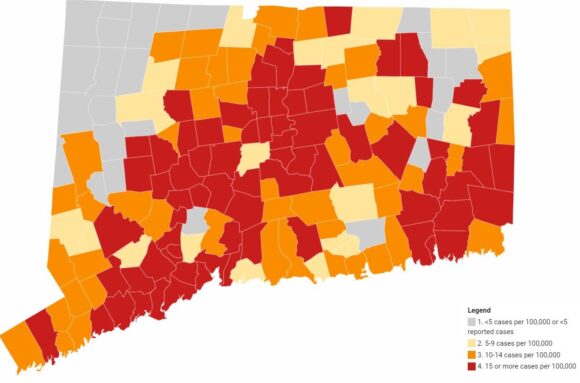
The following maps show has the picture of COVID-19 cases has gone from an almost totally red map back in Dec. 2020 to an almost all-gray map on June 17, 2021 and then back to a map with all colors represented in substantial number again.

The map below is from Aug. 12 and shows that Old Lyme had fallen out of the Orange (second highest case rate) Zone into the Yellow (second lowest) Zone — but only by a fraction. Old Lyme’s two-week case rate per 100,000 was 9.8 — if it were 10.0, then it would have still been in the Orange Zone.

Towns in the Red Zone, which are within the Ledge Light Health District (LLHD), included New London, Ledyard, Stonington and North Stonington. Locally, Norwich and Waterford were also categorized as red, but they are not in the LLHD.

Other towns in the red category included Ansonia, Beacon Falls, Cheshire, East Haven, Easton, Hartford, Meriden, Middletown, New Britain, New Haven, North Branford, North Haven, Norwich, Plymouth, Stamford, Thomaston and Waterbury. At least three of these towns — Easton, Hartford and Thomaston — were in the Red Zone for the second consecutive week.

Almost 50 towns were in the Orange (second highest case rate) Zone — up from 33 the previous week — including Westbrook and Salem locally.

Old Lyme joined the Yellow (second lowest) Zone along with around 40 other Connecticut towns, including Old Saybrook, East Lyme, and Essex.

All remaining towns in the state, including Lyme, along with Deep River and Chester, were in the Gray (lowest rate) Zone. This was the 21st straight week for Lyme in the Gray Zone.
This map, updated Aug. 12, 2021 shows the average daily rate of new cases of COVID-19 by town during the past two weeks. Lyme is still in the (lowest) Gray Zone, but Old Lyme has moved into the Orange Zone. Only cases among persons living in community settings are included in this map; the map does not include cases among people who reside in nursing home, assisted living, or correctional facilities.) Map: Ver 12.1.2020 Source: CT Department of Public Health Get the data Created with Datawrapper. Details in italics are the same for each of the maps included in this article.


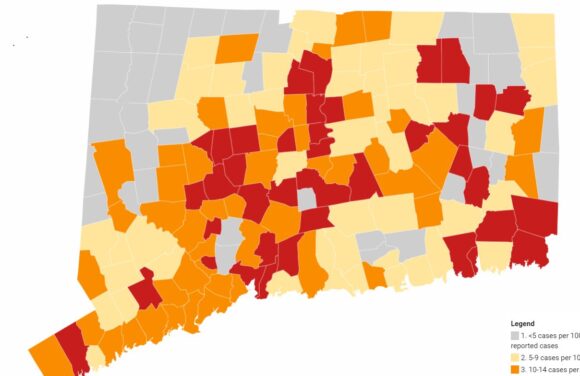
The map below is from Aug. 5 when six towns were in the Red (highest case rate) Zone (the previous week’s number was four) and 33 in the Orange (second highest case rate) Zone — the previous week’s number was four.

The towns in the Red Zone were East Hampton, Easton, Hampton, Hartford, Hartland, North Stonington*, and Thomaston.

There were 33 towns in the Orange Zone including Old Lyme, Waterford, New London, Groton, Ledyard and Stonington, all of which are in the Ledge Light Health District, as are the towns denoted with an * in the other zones.

East Lyme* had reentered the Yellow (second lowest) Zone along with more than 50 other Connecticut towns.

All remaining towns in the state, including Lyme*, were in the Gray (lowest rate) Zone. This was the 20th straight week for Lyme in the Gray Zone.
This map, updated Aug. 5, 2021 shows the average daily rate of new cases of COVID-19 by town during the past two weeks. Lyme is still in the (lowest) Gray Zone, but Old Lyme has moved into the Orange Zone.

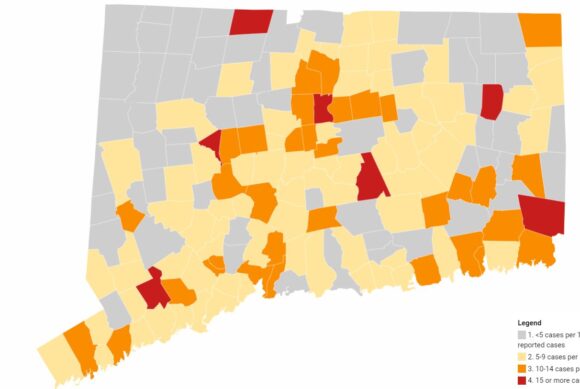
The map below is from July 29, when four towns were in the Red Zone –Harland, Salem, Bozrah and Sprague — and four towns were in the Orange Zone — Easton, East Hampton, Ledyard and Thompson.

Old Lyme had reentered the Yellow (second lowest) Zone along with more than 50 other Connecticut towns. All remaining towns in the state, including Lyme, were in the Gray (lowest rate) Zone. This was the 19th straight week for Lyme in the Gray Zone.
This map, updated July 29, 2021 shows the average daily rate of new cases of COVID-19 by town during the past two weeks. Lyme is still in the (lowest) Gray Zone, but Old Lyme has moved into the Yellow Zone.

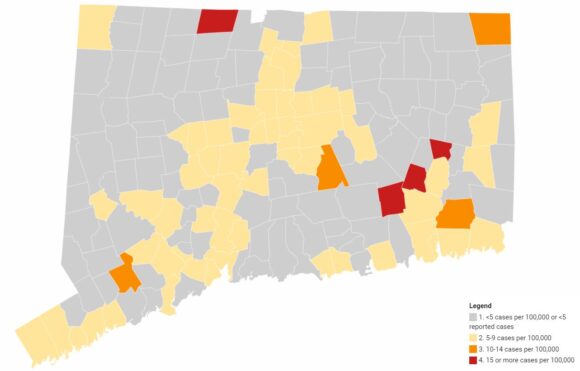
The map below is from July 22, when two towns, Franklin and Salem, were in the Red Zone (indicating the highest rate of COVID-19 new cases), which is up one from the previous week, and Andover remained in the (second highest rate) Orange Zone (down from two towns last week.)

Eight towns were in the Yellow Zone (indicating the lowest but one rate of COVID-19 new cases), which is up from two last week. They were Clinton, East Hampton, Manchester, Newington, Stonington, Westbrook, Windsor and Windsor Locks.

This map, updated July 22, 2021 shows the average daily rate of new cases of COVID-19 by town during the past two weeks. Both Lyme and Old Lyme are still in the (lowest) Gray Zone.

The map below is from July 15, when one town, Franklin, was in the Red Zone (indicating the highest rate of COVID-19 new cases) and another two, Salem and Andover, were in the (second highest rate) Orange Zone. New Hartford and Griswold were in the Yellow Zone (indicating the lowest but one rate of COVID-19 new cases.)

This map, updated July 15, 2021 shows the average daily rate of new cases of COVID-19 by town during the past two weeks. Both Lyme and Old Lyme are still in the (lowest) Gray Zone.

The map below is from July 8, when New Hartford was the sole town in the Yellow Zone.

This map, updated July 8, 2021 shows the average daily rate of new cases of COVID-19 by town during the past two weeks. Both Lyme and Old Lyme are still in the (lowest) Gray Zone.

The map below is from July 1, when Marlborough and Prospect were in the Yellow Zone.

This map, updated July 1, 2021 shows the average daily rate of new cases of COVID-19 by town during the past two weeks. Both Lyme and Old Lyme are still in the (lowest) Gray Zone.

The map below is from June 24, when Somers, Prospect and Bolton were in the Yellow Zone.

This map, updated June 24, shows the average daily rate of new cases of COVID-19 by town during the past two weeks. Both Lyme and Old Lyme are still in the (lowest) Gray Zone.

This is the June 17 map, when just one town, Bolton, was in the Yellow Zone.

This map, updated June 17, shows the average daily rate of new cases of COVID-19 by town during the past two weeks. Both Lyme and Old Lyme are still in the (lowest) Gray Zone.

For comparison, the map below is from June 3 and shows one town, Waterbury, in the Orange Zone and 21 towns in the Yellow Zone, down from 48 the previous week. The towns in the Yellow Zone were: Ansonia, Beacon Falls, Bloomfield, Brooklyn, Coventry, Cromwell, Derby, East Hartford, East Haven, Granby, Hamden, Hartford, Manchester, New Britain, New Haven, New London, Putnam, Rocky Hill, Shelton, Waterford and Windsor.

This map, updated June 3, shows the average daily rate of new cases of COVID-19 by town during the previous two weeks. Both Lyme and Old Lyme are in the (lowest) Gray Zone.

Below is the map from May 27 that showed one town in the Red Zone, Putnam, and 10 towns in the Orange Zone.

This map, updated May 27, shows the average daily rate of new cases of COVID-19 by town during the past two weeks. Both Lyme and Old Lyme were still in the (lowest) Gray Zone.

Compare the maps above with the one we published Dec. 18, 2020 to see the remarkable progress that has been made with controlling the spread of the virus through expansion of vaccination rates and improved mitigation strategies.
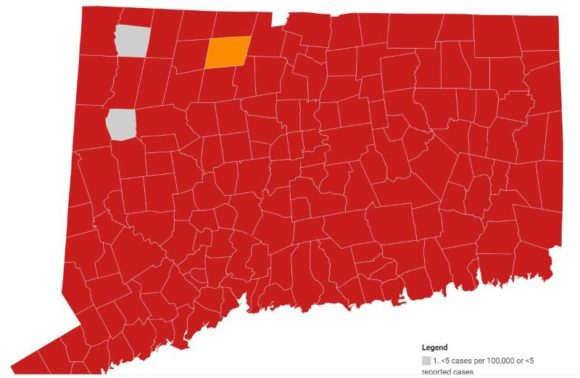
Map of Connecticut dated Dec. 17, 2020 showing both Lyme and Old Lyme now in the CT DPH-identified ‘Red Zone.’ This is defined as when the Average Daily Rate of COVID-19 Cases Among Persons Living in Community Settings per 100,000 Population By Town is over 15.

The following link provides centralized access to Connecticut COVID data: https://data.ct.gov/stories/s/COVID-19-data/wa3g-tfvc/

Aug. 19 COVID-19 Update: No New Cases in Lyme, OL Since Tuesday; OL’s Cumulative Case Total Holds at 367, Lyme’s at 114

LYME/OLD LYME — The Daily Data Report issued Thursday, Aug. 19, by the Connecticut Department of Health (CT DPH) shows that neither Lyme nor Old Lyme has reported any new, confirmed COVID-19 case since the previous CT DPH report issued Tuesday, Aug. 17.

This means Old Lyme’s cumulative total of confirmed cases remains at 367 while Lyme’s cumulative total holds at 114.

Fatalities Due to COVID-19 in Lyme, Old Lyme

There is no change in the number of fatalities reported in either Lyme (0) or Old Lyme (3).

The first two fatalities from Old Lyme, which were reported in 2020, were a 61-year-old female and an 82-year-old male. Details of the third, which was reported in 2021, have not been made available.

Visit this link for our Aug. 12 update, which includes statewide data.