Photographer Leads Walk Through Thach Preserve in Lyme, Feb 27; Join to Experience Changing Light

Light over Lyme. Photo by Joe Standart.

LYME — 2/20 UPDATE: This walk has been postponed from Feb. 20 to Feb. 27. The walk is full — send an email to be put on the waiting list. Join a walk through the Thach Preserve, guided by photographer Joe Standart this Saturday, Feb. 20, from 4 to 6 p.m. to experience light before and after the sun sets.

Reservations are required. To register, email education@lymelandtrust.org

Space is limited to 10 people including the leaders. Be safe- wear a mask when meeting in the parking lot. Social distancing guidelines will be followed.

The walk is part of the Lyme Land Trust amateur photography program: Imagining Lyme – A Visual Exploration of Lyme’s Preserves, which encourages people to expand their visual awareness while highlighting the beauty of Lyme Preserves through photographs. For more information, visit ImaginingLyme.org.

The deadline for submission of photos for the fall/winter season using the category “Light” is March 19, 2021. Three photos of distinction will be chosen.

The Thach Preserve is located at 131 Brush Hill Rd., Lyme CT.


Death of Alan R. Bernier, 65, Announced; Brother of Joanne Slezycki of Lyme

THOMPSON, CT – Alan R. Bernier, 65 of Thompson passed away peacefully on February 12, 2021. He was the loving husband of Patrice (Mikolajczak) Bernier for 38 years. Born in Putnam October 16, 1955, son of the late Roland and Lauretta (Nadeau) Bernier.

Alan was the Pathology Manager at St. Vincent’s Hospital in Worcester until he retired …

… He leaves his wife Patrice, children Danielle Wallace and her husband Jeffrey of Thompson, CT, David Bernier and his wife Stephanie of Arvada, CO, siblings Jeanne Johnson and her husband Richard of Thompson, CT, Joanne Slezycki and her husband Ray of Lyme, CT …

Visit this link to read the full obituary published Feb. 14, in Worcester Telegram & Gazette.

Feb. 18 COVID-19 Update: Old Lyme’s Case Rate Moves Down Into Orange Zone, Lyme Goes Back Into Red: OL Cumulative Cases Up One to 277, Lyme Steady at 84

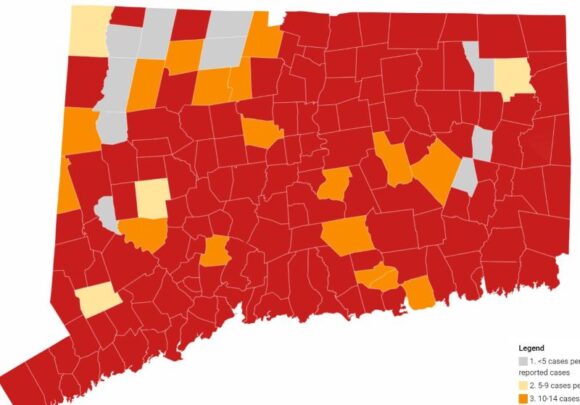
This map shows the average daily rate of new cases of COVID-19 by town during the past two weeks. The Town of Old Lyme is now recorded in the Orange Zone while Lyme has moved back into the Red Zone. (Only cases among persons living in community settings are included in this map; the map does not include cases among people who reside in nursing home, assisted living, or correctional facilities.)

LYME/OLD LYME — The Daily Data Report for Connecticut issued Thursday, Feb. 18, by the Connecticut Department of Public Health (CT DPH) for data as at 8:30 p.m., Wednesday, Feb. 17, shows that cumulative cases (confirmed and probable) since the pandemic began in Old Lyme have increased by one since the previous day to 277, while in Lyme they are still at 84.

Old Lyme Moves Down into Orange (Second Highest) Zone for Two-Week New Case Rate, Lyme Moves Back into (Highest) Red

The report issued Thursday, Feb. 18, by the CT DPH for the average daily rate of new cases of COVID-19 by town during the past two weeks shows that Old Lyme has finally moved into the (second highest) Orange Zone — down from the state-identified Red Zone, where it has been since early December 2020. Unfortunately, Lyme has moved back into the ‘Red Zone’ with the highest rate of new cases.

Overall, the report contains good news with 10 towns now in the Gray Zone, four in the Yellow Zone and 16 in the Orange Zone.  This is a far cry from the map we published back in November when every town in the state was in the Red Zone.

As of the Feb. 18 report, Old Lyme now joins 16 other towns — Essex, Deep River, Kent, Sherman, Goshen, Granby, Winchester, New Hartford, Canton, Farmington, Portland, Haddam, Hebron, Lebanon, Bethany and Southbury — in the Orange Zone.

Redding, Woodbury, Pomfret and Salisbury are in the Yellow Zone.

The Gray Zone includes Bridgewater, Canaan, Cornwall,  Norfolk, Scotland, Hartland, Barkamsted, Eastford, Franklin and Warren.

  • The gray category is defined as when the Average Daily Rate of COVID-19 Cases Among Persons Living in Community Settings per 100,000 Population By Town is less than five or less than five reported cases.
  • The yellow category is defined as when the Average Daily Rate of COVID-19 Cases Among Persons Living in Community Settings per 100,000 Population By Town is between five and nine reported cases.
  • The orange category is defined as when the Average Daily Rate of COVID-19 Cases Among Persons Living in Community Settings per 100,000 Population By Town is between 10 and 14.
  • The red category is defined as when the Average Daily Rate of COVID-19 Cases Among Persons Living in Community Settings per 100,000 Population By Town exceeds 15.

In all cases, this rate does not include cases or tests among residents of nursing home, assisted living, or correctional facilities.

Old Lyme – Confirmed Cases Up One

Old Lyme now has a cumulative total (since the outbreak began) of 270 confirmed COVID-19 cases and SEVEN probable cases, making a TOTAL of 277 cases. (The numbers reported Wednesday, Feb. 17, were respectively 269 confirmed and 7 probable cases.)

This represents an INCREASE of ONE in the cumulative number of confirmed cases and NO CHANGE in the number of probable cases.

The total number of Old Lyme residents tested is 4,590, up three from the previous day’s number.

Lyme – No Change in Confirmed Cases 

Lyme now has a cumulative total (since the outbreak began) of 77 confirmed cases and SEVEN probable cases, making a TOTAL of 84 cases.

This represents NO CHANGE in the cumulative number of confirmed or probable cases over the number reported Wednesday, Feb. 17.

The total number of Lyme residents tested is 1,225, up one from the previous day’s number.

Three Fatalities in Old Lyme Since Pandemic Began, None in Lyme

According to the report mentioned above, there have now been THREE fatalities in Old Lyme. Asked Tuesday, Feb. 9, for details of this third fatality, Ledge Light Health Department Director of Health Stephen Mansfield responded, “We have not been notified of any recent deaths in Old Lyme. Keep in mind that that report is compiled by the Connecticut Department of Public Health; deaths are not reportable to local health districts.”

He added, “I can’t speak for their data sources.”

The two fatalities from Old Lyme previously reported in 2020 were a 61-year-old female and an 82-year-old male.

There have been no fatalities in Lyme.

More Detail on Two-Week Case Rates

On Thursday, Feb. 18, Ledge Light Health District (LLHD) also issued their latest two-week  report of COVID data for the municipalities within their District. Ledge Light Director of Health Stephen Mansfield prefaces the report with the comment, “We are encouraged to see a moderate decrease in cases for the 4th consecutive reporting period, and are hopeful that this trend will continue.”

The latest two-week case rate announced Thursday, Feb. 18, for the period 1/31 to 2/13 per 100,000 population (compared with the previous two-week case rate for 1/24 to 2/06) has fallen in Old Lyme but increased in Lyme.

The two-week case rates are as follows:

  • Old Lyme from 25.2 to 11.6
  • Lyme from 12.2 to 21.4

The same report shows that the number of cases in Week 1 and Week 2 recorded for the period 1/31 to 2/13 (compared with the previous two-week case rate for 1/24 to 2/06 shown in parentheses) are as follows:

  • Lyme had(2) cases in Week 1 and(2) in Week 2
  • Old Lyme had 9 (17) cases in Week 1 and 3 (9) in Week 2

This data was updated Feb. 18, 2021.

Connecticut Hospital Occupancy

At the request of several readers, we are adding a new report today showing the respective rates of hospital occupancy at local hospitals. The data for this report is obtained from the Connecticut Hospital Occupancy Report published weekly by the CT DPH and extracted from the United States Department of Health and Human Services (HHS) facility-level data for hospital utilization aggregated on a weekly basis (Friday to Thursday).

[table id=10 /]

Editor’s Note: The state issues a COVID-19 metric report daily around 4 p.m. Monday through Friday, which includes current data up to the previous evening. In light of the serious rise in Coronavirus cases, we publish a new weekday update reporting confirmed and probable COVID-19 cases in Lyme and Old Lyme. The next CT DPH Daily Data Report for Connecticut will be issued in the afternoon of Friday, Feb. 19.

A View from My Porch: The Marquis, Groucho, Sam … and Me

There are several events in American history for which I will always recall where I was, and what I was doing, on those dates. I just added the Jan. 6, 2021 violent attack on the Capitol by domestic terrorists, provoked by a defeated president at the end of his term, to my personal list of infamous events.

Given the above, I decided to reconfirm my values; and so I am looking inward in this essay, which is a tribute to a unique small town. Please bear with me as I share my nostalgia. 

I grew up in Fredonia, N.Y., a college town that sits in the midst of New York’ s western lakes district (my own geographic description). My hometown is less than an hour from three lakes, each of which contributed to my developing world view and sense of history.

Three Lakes

Chautauqua Lake, N.Y. Photo from the Chautauqua County Visitors Bureau website.

The first, Chautauqua Lake gave rise, late in the 19th century, to the “Chautauqua Movement”, which became a national forum for discussion of public issues, international relations, literature, and science. William Jennings Bryan, Booker T. Washington, Susan B. Anthony, and Amelia Earhart have all spoken there. 

President Franklin Delano Roosevelt delivered his historic “I hate war” speech at Chautauqua on Aug. 14, 1936: “I have seen war on land and sea. I have seen blood running from the wounded. I have seen men coughing out their gassed lungs. I have seen the dead in the mud. I have seen children starving. I have seen the agony of mothers and wives. I hate war”.

The second, Cassadaga Lake, was home to the Lily Dale Assembly, which was a camp and meeting place for Spiritualists and “Freethinkers”. The purpose of the Assembly was to further the science, philosophy, and religion of Spiritualism.

Finally, the third, Lake Erie, produced a generation of environmentalists and ecologists. My experience on its shores began with kayaks, small sailboats, and water skiing. However, in my last summers before leaving for University, the lake was declared “dead” and inaccessible for recreational use. 

Erie was surrounded by agriculture and dairy herds. Its waters became overloaded with nutrients from fertilizer runoff, cattle manure, and poorly managed waste water. Its warm waters became a breeding ground for bacteria that contaminated drinking water and created oxygen-deprived “dead zones” that destroyed the fresh water fishing industry. 

This disaster, coupled with several other similar disasters across the United States, like the June, 1969 oil slick fire on the surface of Cleveland’s Cuyahoga River; and the hyper-polluted Charles River in Boston, (featured in the hit song, “Dirty Water”, by the Standells); finally ended with the creation of the EPA in 1970, and the passage of the Clean Water Act, and the joint Great Lakes Water Quality Agreement with Canada, in 1972; all of which resulted in strict regulations on pollutants, sewage treatment, and fertilizer.

These laws also led to eliminating phosphates in laundry detergents and phosphorous in fertilizers.

There has since been some discernible improvement in Lake Erie’s water quality, but, unfortunately, full recovery to a less-spoiled state will still require decades of careful management.

The Marquis:  

The Marquis de Lafayette by Gilbert du Motier. Public Domain.

One could not be a regular patron of Fredonia’s public library without gaining an appreciation for the Marquis de Lafayette’s role in our War of Independence, which included command of American troops at the battle of Yorktown. 

In 1824, at the invitation of President Monroe, he began a farewell tour of the then 24 states, of the United States, travelling by horse-drawn coach and steamboat. 

He arrived in Fredonia on June 4, 1825 to a hero’s welcome.  On his arrival, the Leverett Barker mansion, which eventually became the community’s library, was lighted with several candles at each window. A window sash was scorched. Never repaired or re-painted, a brass marker still commemorates Lafayette’s visit. Ironically, the visit coincided with the ceremonial re-lighting of a gaslight connected to America’s first natural gas well. 

The restored house remains much as it was in 1825, and the library has expanded via a large attached contemporary wing. 

From Fredonia, Lafayette proceeded to Buffalo, via a steamboat on Lake Erie, and he was greeted by a large crowd in the public square that now bears his name; and then, to Boston, where he participated in the 50th anniversary of the battle of Bunker Hill.

Groucho: 

The Marx Brothers made the movie ″Duck Soup″ in 1933, which was set in the mythical kingdom of Freedonia (note the spelling); and the then Fredonia Mayor, Harry B. Hickey, complained to Paramount Pictures: “it is my duty as mayor to question your intentions in using the name of our city in your picture”. 

Groucho Marx in ‘Copacabana (1947).’ Public Domain.

The Marx Brothers quickly and eloquently replied: ″Our advice is that you change the name of your town. It is hurting our picture. What makes you think you are mayor of Fredonia? Do you wear a black moustache, play the harp, speak with an Italian accent or chase girls, like Harpo? We are certain you do not. Therefore, we must be the mayor of Fredonia, not you″. Thus, an historic connection was formed between them and my home town. 

Italian dictator Benito Mussolini also had concerns with the movie, and banned the film in Italy.  Indeed, the Brothers had intended the film to be a farcical representation of fascist regimes, like Mussolini’s.

In 1987, the annual “Freedonia Marxonia: Marx Brothers Film Festival and Symposium” began at The State University of New York at Fredonia.  Each year, in the fall, and near Groucho’s October 2nd birthday, activities are held to honor the Marx Brothers and their relationship to local, national, and film history. The two-day event includes presentations by film historians, “re-interpretation” of movie scenes and locally produced short films by members of the performing arts departments; and the movie themselves, in the restored 1891 Fredonia Opera House. Freedonia Marxonia 2020 was a virtual event.

Sam:

Mark Twain by AF Bradley. Public Domain.

Samuel Langhorne Clemens (Mark Twain) was part owner and editor of the “Buffalo Express” newspaper from 1869 to 1871. Twain fell in love with Fredonia as an invited speaker in January,1870 at the Normal School. After that lecture, he initiated a move to Fredonia for his mother, sister and niece.

He told his sister “I went in there by night and was out by night, so I saw none of it, but I had an intelligent, attractive audience” for my lecture, “Our Fellow Savages of the Sandwich Islands”; and so, his decision to move his family was based entirely on how that audience had responded to his lecture. 

His family moved to Fredonia in the spring of 1870, and Twain and his wife were frequent visitors. Twain’s sister, Pamelia was one of the first women to join the Woman’s Christian Association in Fredonia, and worked to open the WCA Home for Aged women in 1892. Today, the home still operates as an assisted living facility

Unfortunately, Twain’s memories of life in Fredonia weren’t all positive. Charles L. Webster, of Fredonia, was his business manager, and was eventually named the head of Twain’s publishing company, Charles L. Webster and Co. of New York. It was with Webster and the bankrupting of their shared publishing company that his relationship with Fredonia went awry. 

Scholars believe that the village became the setting for Twain’s novella, “The Man Who Corrupted Hadleyburg”, which was written in 1898. “Hadleyburg enjoys the reputation of being an “incorruptible” town known for its responsible, honest people that are trained to avoid temptation. However, at some point the people of Hadleyburg manage to offend a passing stranger, and he vows to get his revenge by corrupting the town”.

Author’s Closing Thoughts:

My sources for this essay were The Darwin R. Barker Library and Historical Museum, and the archives of the Dunkirk Evening Observer, where, as a twelve-year-old, working in distribution, my interest in journalism first began to develop. If I was maudlin in the above, you can also review another treatise on the subject at John Mellencamp – Small Town Lyrics – Bing

And now, returning to reality, it is my opinion that “The World’s Greatest Deliberative Body” can no longer hold claim to that distinction. Sadly, some members of Congress have been censured for “voting their conscience.” And finally, there are others, who need to search their souls, and then determine whether they helped fuel this siege on the Capitol by perpetuating the notion of a fraudulent election.

God save the United States of America.

This is the opinion of Thomas D. Gotowka.

Tom Gotowka

About the author: Tom Gotowka’s entire adult career has been in healthcare. He’ will sit on the Navy side at the Army/Navy football game. He always sit on the crimson side at any Harvard/Yale contest. He enjoys reading historic speeches and considers himself a scholar of the period from FDR through JFK.

A child of AM Radio, he probably knows the lyrics of every rock and roll or folk song published since 1960. He hopes these experiences give readers a sense of what he believes “qualify” him to write this column.


Mass COVID-19 Vaccination Site Opens at Mohegan Sun, Operating on Appointment-Only Basis for Eligible CT Residents

HARTFORD, CT – In a continued effort to meet public health needs relating to the ongoing COVID-19 pandemic, Governor Ned Lamont, the Mohegan Tribe, and Yale New Haven Health System today announced plans to open a large-scale community vaccination site at Mohegan Sun.

The clinic will open Friday, Feb. 19, and be located at Mohegan Sun’s Earth Expo & Convention Center. It will operate on an appointment-only basis, weather permitting, and is available for Connecticut residents.

On the first day of operations, the clinic is expected to serve up to 300 Connecticut residents with the ability to increase vaccine distribution based on availability.

Additional appointments will be added regularly as more supply of the vaccine becomes available by the federal government. It will operate in accordance with existing state rules and procedures relating to vaccine eligibility.

Connecticut residents, who are currently eligible to be vaccinated, can schedule an appointment for the clinic by visiting www.ynhhs.org/covidvaccine and selecting the Mohegan Sun location. Appointments will also be available through the state’s COVID Vaccine Appointment Assist Line at 877-918-2224, which is open seven days a week from 8 a.m. to 8 p.m.

“This latest mass vaccination site shows the coordinated effort our state is making with our tribal partners, and our partners in healthcare,” Governor Lamont said

“The Mohegan Tribe has a long-held philosophy of cooperation and working together with our neighbors, and throughout this pandemic we have practiced those values each and every day,” James Gessner, Chairman of the Mohegan Tribe, said

“We are excited to provide more COVID-19 vaccinations to the residents in southeastern Connecticut,” Patrick Green, President and CEO of L+M Healthcare, said

Under the current phase of Connecticut’s vaccination program, individuals aged 65 and over are eligible to be vaccinated, and will soon expand to include more eligible groups.

For updates on the state’s phased rollout, visit ct.gov/covidvaccine.

Editor’s Note: This article is based on a press release issued by the Office of the Governor.