Winter is here … so what to do in the garden?
Hello everyone; so much to do and so little time in this holiday season.
Remember to breathe, stretch and take time out for yourself each day. On a pleasant December day, you can be in the garden and you can still plant your spring bulbs. The earth is still workable so enjoy the fresh air and the gentle exercise to work off your Thanksgiving feast and before you indulge in the Holiday festivities.

Think spring … but plant in winter! Photo by Sarah Mitchell-Baker on Unsplash.
Plant the bulbs three times as deep as they measure upright. For example, the Daffodils should be planted nine inches down below the frost line. I suggested last month for you to have a bag of composted manure in the shed or garage to spread around the bulb area after planting. However, if you do not have the manure right now, then when the bulbs peak up from the soil in spring, you can obtain the composted manure and sprinkle it around the emerging bulbs.
At this moment, I am sitting in my armchair with a delicious cup of Earl Grey tea and from the kitchen I am inhaling the air fragrant with cloves. This is an old family tradition that each December I fill my great grandmother’s brass saucepan with water – add whole cloves – bring it to the boil, then turn it down to simmer. The fragrance is wonderful memory of Christmas in the kitchen in gran’s thatched roof cottage on the grounds of our plant nursery in England.
Back on this side of The Pond, in early winter before heavy snow falls or even on a sunny day with snow on the ground, there are construction projects that can be done – patios, decks, ponds, and dry stonewalls to repair and build. By accomplishing these tasks in winter, you will be ready to plant in spring.
With that being said, if you are not into heavy work, I suggest you call a landscape company that you trust to give you an estimate for your project. In fact, if you would like get in touch with my son Ian, at LandscapesByIan.com for an estimate or a consult on design for the spring. As Ian tells me that there is a scarcity of building supplies because of the pandemic, which might hinder your projects for your garden, unless you act right now.

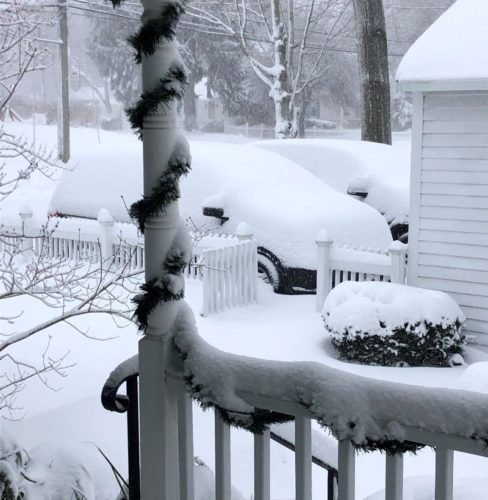
Snow fell this week (the photo above shows Lyme Street on Thursday, Dec. 17) so I hope you have the snow shovel handy or perhaps you require a new one? If so, buy a lightweight wood handled and plastic shovel instead of heavy metal. When the storm has passed and you ready for cleanup, don’t load the shovel heavily, scoop lighter loads. You will get done faster and with less aches and pains, or chance of injury.
If you are not able to clear the snow yourself from driveways, walkways and steps; I’m sure there are some teenagers in your neighborhood who would be willing to help you out. We need the moisture of the snow for the soil and our plants and hope we also get a good amount of rain to carry us through to spring.
If you have not already done so, mulch and manure around the trunks of roses, mound at least six to nine inches up the stems. As I mentioned earlier, buy a few extra bags of mulch and topsoil and store them in the garage or shed.
Tie down the long whip like rose canes of climbers to supporting structures so they are not broken off in strong winds. If the shrub roses are planted in an exposed area, cover them with a rose cone or if they are larger, cover lightly with burlap until April.

Photo by Tim Mossholder on Unsplash
I just walked into my living room to check on my Amaryllis bulbs – these particular bulbs have striped blooms (see photo above.) Amaryllis can be enjoyed for a long time with little effort. As the flower buds begin to open, remove the pollen bearing anthers with tweezers, before they begin to shed, this will add days to the flowering period and remember to water.
Once the bloom is finished, deadhead it, remove the bulb from the soil and let it dry off. Store in a cool dark basement or some other cool dry place at about 55 degrees for ten weeks without watering. When you want to start it again pot up the bulb tightly in fresh potting soil and begin to water again. By the way, Amaryllis is poisonous so do not let children or animals eat the flowers.
Outside my kitchen window I can see the holly bush with lovely red berries, some of which I cut to decorate the house. Holly is a good weather predictor; few berries mean a mild winter, whilst many berries denote a harsh one. My red and black friends, the ladybugs, have begun to come indoors, earning their keep by consuming white fly and aphids, which often gather on houseplants.

Photo by Jonathan Diemel on Unsplash.
In my home, I am planting up my first group of paper white narcissus this week to get a head start on bloom in a few weeks. I store two dozen bulbs in the vegetable keeper of the refrigerator, away from the food. I plant half of them now and store the rest in a paper bag in the refrigerator, away from food, to plant later. With this method I will have continuous bloom and fragrance through the winter months. By keeping the bulbs in the refrigerator, they stay dormant, until planted.
I plant my bulbs in pebbles, with just enough pebbles to anchor the bulbs and enough depth for the roots to grow. Cram a lot of bulbs in the pot so they are touching – the more bulbs, the more vibrant the display. Make sure the bulb pots do not have drainage holes; if they do, cover the holes with shards of broken pots.
I place the planted bulbs in a dark cool room, keeping the pebbles moist at all times. When the shoots of the narcissus are about six inches tall I take the vases into another cool room on the south side of the house. I place them about six feet away from the window in indirect light where they remain, keeping the pebbles moist until the buds appear. When the buds appear and the stems are about 12 inches tall, bring them into the area of the house to be enjoyed. Still placed about six foot from a sunny window and away from draughts and heat. Keep the soil or pebbles moist.
I know that the stems of paper whites get leggy and often topple over. My tall glass vases do not allow this to occur but if you don’t have tall containers, here is a suggestion to keep the plant upright. An English gardening colleague of mine gave me his ‘gin tip’. He pours a dessertspoon of gin (not the expensive stuff) on the soil or pebbles around the plants every couple of weeks after he has watered them. This limits the height of the stems so they do not collapse and the gin does not affect the bloom.
On the subject of alcohol, another tip my grandmother whispered is to add a few drops of brandy or port to invigorate potpourri that has gone stale. Personally, I pour a few drops of either lemon oil or lavender oil on the potpourri.
I know that many of you spread salt on walkways, driveways to thaw ice. However, the salt ruins plants, when it seeps into borders. Use an alternative like unscented kitty litter or sand that works well. In spring, just hose off steps and paths; the sand and kitty litter are good additions to your soil.
There is still time to prune dead or diseased branches from established deciduous trees and shrubs, its easier task to do at this time of year, as you are able to see what needs to be done without foliage obstructing your view. If you would like to have a fall pruning, call a reputable arborist to give you a quote and whose team will come and use their practiced eyes to give you a great result.
Last winter, squirrels, raccoons or whoever, got into the birdseed in the milk shed. I bought out the supermarket’s supply of cayenne pepper that week and sprinkled it everywhere to keep the marauders at bay. This trick will also keep those critters out of your garbage. I also sprinkle cayenne pepper in the bird seeders for the feeders and on the suet blocks – the heat of the pepper does not affect the birds – they do not feel the heat.
To keep moths and bugs away from cupboards and in clothes, collect some remaining herbs still available perhaps sage and lavender. Tie them into bunches with string and slip over a hanger in your closet or in drawers. I put bunches of dried sage in my closets and drawers just this week. Insects do not like fragrance and will keep away.
The few bags of soil, mulch and soil in the garage or shed will be useful after a heavy frost. Often the frost heaves plants above the soil and exposes the roots. The plants roots can be covered and protected with the soil and mulch, until they can be resettled again when spring arrives.
When a plant is knocked askew by wind, ice or snow, do not be in a hurry to straighten it, quite often the plant will bounce back on its own. However, uprooted trees or shrubs should be straightened immediately, staked and mulched, If the ground is frozen, cover the exposed roots with topsoil, and mulch and reset the plant in the spring. When snow is heavy on the branches of the evergreens gently brush the snow off with a broom. Gently being the operative word.
When you receive or buy cut flowers during the holiday you want them to last. To accomplish this, vases need to be squeaky clean. If there is a build up of dirty residue that regular soap and water wont budge, try adding a little coarse sand to dislodge the mucky residue then use soap and rinse well. For a narrow- or globe-shaped vase, use a bottlebrush.

Photo by Jessica Johnston on Unsplash.
Poinsettias – I get lot of questions about how to keep them alive.
A close friend has kept the same poinsettia alive for eight years. After blooming, she places the plant in a cool room watering when the top of the soil feels dry, then in late May puts it, in its container in the garden. In September she brings it into her porch and begins gentle watering.
By November, the blooms appear for yet another holiday season. A combination I enjoy is poinsettias in a container with ivy and forced spring bulbs.
I was always curious as to how Poinsettias got their name. Last year I heard an old story on that very subject. It goes like this:
‘In a tiny village in Mexico, the tradition on Christmas Eve was to put gifts before the Crèche at the Church. A poor young boy, who had nothing to offer, went outside and knelt in the snow praying for a gift to give the newborn king. Where he knelt, a beautiful plant with vivid scarlet leaves appeared beside him and the boy joyfully presented his gift to the Christ Child. Thus, Mexicans call the plant Flor de la Noche Buena (Flower of the Holy Night), as many believe the plant resembles the Star of Bethlehem. Dr Joel Roberts Poinsett, the first minister to Mexico in the 1830’s brought the plant to the United States and it is for him that the plant is now named.’
On a delicious note to end my tips this – I present my recipe for English trifle – a simply scrumptious dessert at Christmas!
ENGLISH TRIFLE
This dessert is made of layers, made over a three-day period; it requires this length of time for each layer to set. I use a nine- inch tall glass bowl, as the appearance of this dessert is as mouth-watering as the taste.
Ingredients:
2 pints of strawberries or raspberries (you can use frozen strawberries or raspberries, and omit the sugar)
2 tablespoons of sugar on fresh fruit
1-package ladyfingers or sponge cake or pound cake
1-cup Harvey’s Bristol Cream Sherry (omit the sherry if you do not want the alcohol) instead use water to make the Jell-O
1 small package strawberry or raspberry-flavored Jell-O
1 small package of vanilla custard mix or Birds English custard (see note)
1 pint whipped cream
Combine washed and drained fresh strawberries/raspberries and sugar in a bowl and set aside at room temperature for about an hour.
In a 9-inch glass bowl, cover the bottom of the bowl with ladyfingers or sponge cake or pound cake, cut into 2-inch slices. Drain the strawberries, and reserve the juice. Cover the cake with the fruit.
Add sherry to the reserved fruit juice to make one cup. Prepare Jell-O using the fruit juice-sherry mixture as the cold-water part of the Jell-O mix, and hot water for the other part. Pour the Jell-O over the fruit and cake layer, then refrigerate until it sets (usually about two hours or overnight).
When the Jell-O is set, prepare the custard and spread over the cake/fruit/Jell-O layer. Refrigerate until custard is set.
The day you serve the trifle spread a thick layer of unsweetened whipped cream over the top.
If you are serving more people, repeat the cake, fruit, and Jell-O layers and top with the whipped cream.
The nine-inch bowl serves 6 to 8.
Note: I use Birds English Custard mix, which can be found in specialty food stores and most supermarkets.
Have a wonderful Holiday and I’ll see you in your garden in January. Be safe and well and please follow the safety rules of wearing masks, being socially distant and wash hands.

Maureen Haseley-Jones is “The English Lady.”
About the author: Maureen Haseley-Jones is a member of a family of renowned horticultural artisans, whose landscaping heritage dates back to the 17th century. She is one of the founders, together with her son Ian, of, ‘The English Lady Landscape and Home Company.’ Maureen and Ian are landscape designers and garden experts, who believe that everyone deserves to live in an eco-conscious environment and enjoy the pleasure that it brings. Maureen learned her design skills from both her mother and grandmother, and honed her horticultural and construction skills while working in the family nursery and landscape business in the U.K. Her formal horticultural training was undertaken at the Royal Botanic Gardens at Kew in Surrey.
Contact Maureen at maureenhaseleyjones@gmail.com