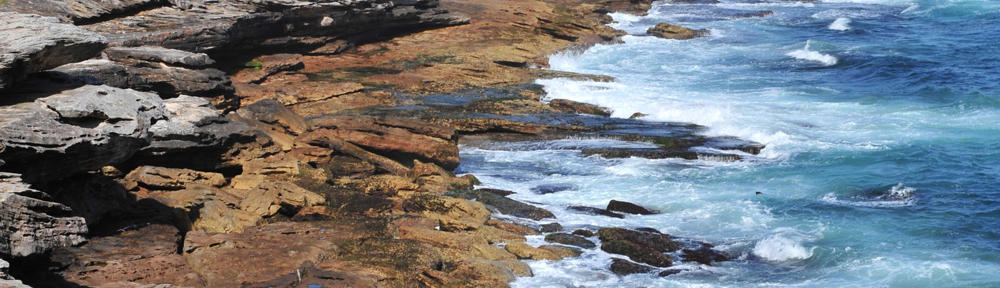
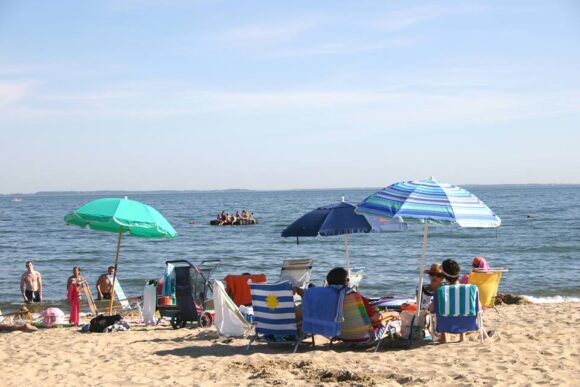
A peaceful summer scene at White Sand Beach in Old Lyme, but what does the future hold for Long Island Sound?
POSTSCRIPT ADDED 04/14: Our home is on a salt marsh alongside a small, tidal river. Over the past several years, we have observed gradual changes in the breadth and height of high tide. Eventually, the borders of our yard directly adjacent to the river were covered with brackish water at high tide to about 25 ft. beyond the riverbank. This occurs regardless of moon phase or the presence of a storm surge.
So, I investigated the scientific literature to seek out the wisdom of the experts in an effort to explain our localized tidal surge. I reviewed reports from respected scientific sources and data from state and federal agencies. The data are troubling. This essay summarizes the conclusions of those scientific and government sources.
I considered postponing this essay pending greater progress on resolution of the COVID-19 crisis, but a recent Mike Lukovich editorial comic in The New London Day showed the “grim reaper” at the front door, complete with hooded black robe and scythe, wearing a sign that says “Climate Change”. The caption reads “Whew, I thought you were coronavirus!”
Life will continue after we finally beat this disease, and return to some sense of normalcy; and we’ll still have those old and ongoing problems like global warming and sea level rise that require our collective attention.
Some Sobering Facts:
The National Oceanic and Atmospheric Administration (NOAA) reports that Long Island Sound’s levels have been rising for decades, and its waters are warming; as is Connecticut’s air temperature. Sea level has risen at a rate of 10 to 11 inches per century along the Connecticut coast, which is faster than the global rate. Longer-range projections are that global sea levels will rise one to four feet by 2100. James O’Donnell, executive director of the Connecticut Institute for Resilience & Climate Adaptation (CIRCA) predicts that Long Island Sound levels could rise by 20 inches by 2050.
There is general agreement among climate scientists in Connecticut and across the world that global warming is occurring and human activity is making it worse. The fear is that, unless more is done to curb pollution, the long-term effects of climate change will be devastating. Although there is some occasional dissent in academic opinion, the majority of climate scientists also agree that the rising seas are linked to warmer global temperatures.
The Fundamental Causes of Global Warming:

The impact of climate change is in our hands. Photo by Bill Oxford on Unsplash.
There are gases in the atmosphere that absorb radiation. These “greenhouse gases” are largely responsible for the “greenhouse effect”, which is the warming that occurs when certain gases in the Earth’s atmosphere trap heat; these gases let in light. but keep heat from escaping.
This concept is not new, and was first studied in the late 19th century by Swedish scientist Svante Arrhenius, who concluded that fossil fuel combustion may eventually result in enhanced global warming. He proposed a relationship between atmospheric carbon dioxide concentrations and temperature. His research was corroborated in the late 1980s, when scientists began investigating the gradual increase in the temperature of the earth’s atmosphere.
Greenhouse gases include carbon dioxide, methane, nitrous oxide, ozone, and water vapor. Of considerable impact are the fluorinated gases, which include the hydrofluorocarbons, sulfur hexafluoride, and several others; all of which are generated as by-products of industrial processes. Although the fluorinates are present in small concentrations, they trap heat very effectively. Note that chlorofluorocarbons, once used as refrigerants and aerosol propellants, were phased out in the 1980s by international agreement.
Other factors that clearly contribute to the Earth’s warming include the accelerated ice loss from the polar ice caps, which are now melting six times faster than in the 1990s. While rising seas may be the most damaging long-term impact of this ice loss, we are also losing the Earth’s natural cooling resource. Finally, the rapid deforestation of the Amazon rain forest in Brazil through unchecked harvesting of trees, clearing and expansion of land for agriculture, and housing development seriously reduces the natural capacity of the rainforest to absorb heat-trapping carbon dioxide; and much more carbon dioxide is released into the atmosphere.
The Carnegie Institution for Science reports that Americans contribute more than twice as much carbon dioxide per capita than the Chinese or the Europeans, and have accounted for most of the greenhouse gas that is currently in the air.
The Impacts of Climate Change:
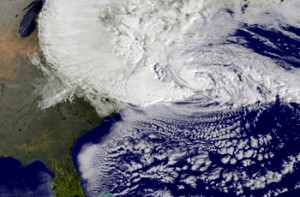
Aerial image of Hurricane Sandy.
New England’s geography makes it particularly susceptible to the impacts of climate change, which include an increased frequency of abnormal and severe weather events. Shoreline flooding is more frequent, and intense wind and rainfall has become much more common across Connecticut.
Long Island Sound is a fairly shallow body of water, averaging just 63 ft. in depth, so small changes in sea levels can have an exaggerated effect when storms come through. Rising water levels, when combined with bigger storms, may produce surges that hit the coast harder and penetrate farther, resulting in flooding that’s more damaging. Two fairly recent examples include Hurricanes Irene and Sandy, which battered our shoreline in 2011 and 2012 respectively, destroying homes, flooding roads and threatening sewage and power plants.
If you want to observe the power of such storms on our local shoreline, walk along White Sand Beach, past the break wall and over our “world class” moon snail shell shingle in a southwest direction up to, and around the Point. You may be astonished with the dramatic changes in beach topography and the amazing size of the timbers that have been deposited far above the high tide mark.
Long Island Sound Lobsters:
In 1999, the lobster population in Long Island Sound crashed; it has never recovered. Although many then considered pesticide pollution as the cause for the dramatic decline in lobsters, most scientists now agree that the warming of the Sound’s waters was the primary cause.
Reversing Global Warming:
Unfortunately, there is no single technological silver bullet emerging to resolve this immense problem. Further, given the geographic, meteorological, and political scope of the situation, it is probably better to focus only on mitigating the problem by stabilizing the concentration of carbon dioxide in the atmosphere.
International Efforts to Curb Climate Change:
The United Nations Intergovernmental Panel on Climate Change (IPCC) has stated that “without rapid cuts to carbon emissions, there could be, by the end of the century, a rise in sea levels that would leave 400 million people exposed to coastal flooding each year. They go further and state that, “Scientific evidence for warming of the climate system is unequivocal. There is direct evidence that humans are the main cause of the rise of atmospheric carbon dioxide.”
 Consequently, the Paris Agreement was negotiated by representatives of 196 member nations within the United Nation’s Framework Convention on Climate Change (UNFCCC). The Agreement’s goal was to strengthen the international response to climate change mitigation by keeping the Earth’s temperature increase to less than 2 degrees Celsius above pre-industrial levels, and to pursue efforts to limit the temperature increase even further to 1.5 degrees. The language was adopted by consensus on December 12, 2015, and signed in 2016. As of February 2020, all UNFCCC members have signed the agreement, 189 have become party to it, and the only significant emitters, which were not parties to the agreement, are Iran and Turkey.
Unfortunately, on June 1, 2017, and only about six months past inauguration, a new “science-light” American president announced that the United States would terminate all participation in the Paris Agreement. He stated that withdrawal would be in accordance with his “America First” policy.
This decision stunned our allies, and German Chancellor Angela Merkel said that “it’s time to look ahead. This decision can’t and won’t stop all those of us who feel obliged to protect the planet; on the contrary. we in Germany, Europe and the world will combine our forces more resolutely than ever to address and successfully tackle challenges for humanity such as climate change.”
The President’s decision to withdraw could accelerate and worsen the impacts that global warming is already having on Long Island Sound and Connecticut’s environment. He has also proposed cutting federal funding for environmental programs in Long Island Sound and is easing anti-pollution regulations over various industries. He argued that those changes will help the economy.
Despite that decision, Connecticut, Delaware, Hawaii, Massachusetts, Minnesota, Oregon, Puerto Rico, Rhode Island, Vermont and Virginia have all joined a coalition committed to upholding the Paris Agreement and taking aggressive action on climate change.
A Few Final Thoughts:
These are the data. None of this is really new and much of it factored into the Paris Agreement. I don’t know whether “accepting” climate change and sea level rise require a certain belief system or just the ability to understand and embrace scientific fact.
We’re at the point where we need to cut carbon pollution as quickly as feasibly possible. That’s true, whether Earth has warmed 1.0 or 1.1 or 1.2°C above “pre-industrial” temperatures. I believe that these “seemingly modest” increases have given us an unfortunate sense of security regarding the impacts of our changing climate.
In the speech announcing his decision to leave the Paris Agreement, President Trump argued that “even if all the goals in the agreement were met, it would cut global temperatures by only two-tenths of one degree by 2100.” He did not go further and explain why that supported his decision. In contrast, MIT researchers have said: “The real risk with global warming is if it accelerates so quickly that we can’t respond fast enough.”
My next column will examine some of history’s key speeches. I am a reader of speeches made by both American and World leaders. I often find them to be very inspirational.
In closing, former Connecticut resident Mark Twain is supposed to have said: “Everybody talks about the weather, but nobody does anything about it”. I am not certain that he actually said that, but this is our chance to prove him wrong.
Postscript to: A View from My Porch: A Primer on Global Warming and Climate Change
By Thomas D. Gotowka
Published April 14, 2020
On April 11, the Washington Post, the New York Times, and several other newspapers published the obituary of S. Fred Singer, a scientist who made key advances in rocketry and atmospheric research in the 1950s and 1960s, who died on April 6 in Rockville, Md. According to the Washington Post, he was “President Trump’s most senior expert on climate change,” presumably assisting in decisions regarding termination of America’s participation in the Paris Agreement.
He was better known in the later years of his life for an unrelenting criticism of the scientific consensus surrounding climate change and global warming.
Siegfried Frederick Singer was born Sept. 27, 1924, in Vienna, Austria. However, after the Nazi invasion of Austria, he was sent to England as part of the “Kindertransport” program that resettled Jewish children.
He came to the United States in the early 1940s and served in the Navy during World War II, and worked on weapons programs.
He received a Bachelor’s degree in electrical engineering from Ohio State University in 1943, and both Master’s and Doctoral degrees in physics from Princeton University in 1944 and 1948 respectively.
His career was somewhat peripatetic. He conducted some of the initial experiments with high-altitude rockets and satellites, also enabling measurement of cosmic rays and other components of the upper atmosphere. He was a consultant during the start-up of the U.S. space program in the 1950s and later, while working for what is now the National Oceanic and Atmospheric Administration (NOAA), participated in early efforts to use satellites in weather forecasting.
He held senior academic positions at the Universities of Maryland, Miami and Virginia; and was also chief scientist at the U.S. Transportation Department in the late 1980s and a research professor at George Mason University in the 1990s. He also held senior-level positions at the United States Department of the Interior and the Environmental Protection Agency.
He had “very public” views and promulgated predictions that were usually considered as intentionally outside accepted scientific norms. For example, he wrote that the “melting of ice caps and the redirecting of rivers could help irrigate the arid Southwest and produce a general improvement to the climate of the North American Arctic.”
As many of his statements were proven spurious, Singer began a new phase in his scientific career. He adopted a new purpose as an “outsider” seeking to denigrate other scientists, who warned the public about secondhand smoke, greenhouse gas emissions, acid rain and the dangers of a steadily warming climate. “It’s all bunk,” he often said.
In a 2011 presentation at Colorado State University, he attempted to convince the audience that climate change is harmless and helpful to humans. He stated, “Stop worrying; nothing you do will have any effect on the carbon dioxide level in the atmosphere; and, even if it did, it won’t affect the planet.” Worrying about climate change, is a “psychosis.”
Singer founded the Virginia-based Science and Environmental Policy Project to “challenge” government environmental policies based on what he defined as “poor science.” In 2007, he also assisted in the launch of the Non-Governmental International Panel on Climate Change (NIPCC), which was a climate change-doubting counterpart to the United Nations’ Intergovernmental Panel on Climate Change (IPCC), which was established by the United Nations Environment Programme (UNEP) and the World Meteorological Organization (WMO), and endorsed by the UN General Assembly in 1988.
Over time, his primary focus became climate change, becoming perhaps the best-known scientist speaking in opposition to a growing body of evidence that rising global temperatures could have a catastrophic effect on the planet.
As I stated in the original essay, “There is general agreement among climate scientists in Connecticut and across the world that global warming is occurring and human activity is making it worse.”
He had a regular column in the Washington Post. He wrote in 1991 that “There is nothing remotely like scientific consensus that global warming is occurring, or if it is, that it will have disastrous consequences,” and that, “A respectable body of opinion in the international scientific community holds that any climate warming is as likely to be beneficial as harmful, acting as a hedge against global cooling.”
In 1995, he condemned the Royal Swedish Academy of Sciences for making a “political statement” by awarding the Nobel Prize in chemistry to three scientists, who demonstrated that chlorofluorocarbon emissions were depleting the ozone layer. I refer you to my essay, wherein I also note that “chlorofluorocarbons, once used as refrigerants and aerosol propellants, were phased out in the 1980s by international agreement.”
Singer was eventually regarded within the mainstream scientific community as a fringe figure and a crank.
Britain’s ‘Guardian’ newspaper called him the “grandfather of climate denial.” His false assertions about climate change have been largely discredited by scientists from the American Academy of Sciences, the American Association for the Advancement of Science, NASA and NOAA.
Finally, I am only adding this postscript to the essay because his faulty declarations seemed to be heard by lawmakers and some officials who called for the United States to withdraw from international agreements on climate and the environment. As I stated above, he was “President Trump’s most senior expert on climate change,” presumably assisting in decisions regarding termination of America’s participation in the Paris Agreement.

 OLD SAYBROOK/LYME/OLD LYME — The Estuary Council of Seniors, Inc. (ECSI) announced last Thursday that, although the senior center building will remain closed through the end of April, the organization will continue providing Meals on Wheels uninterrupted. A Grab and Go service was also introduced for seniors who are not homebound, but who are self-isolating and avoiding crowded grocery stores.