LYSB Hosts a Community Conversation on Underage Drinking This Evening

OLD LYME — Lyme-Old Lyme Prevention Coalition invites all LymeLine.com readers to a Community Talk on Underage Drinking this evening, Monday, Nov. 25, from 6 to 8 p.m.at Lymes’ Youth Service Bureau, 59 Lyme St., Old Lyme.

The event, which is appropriate for all community members including youth, includes dinner, discussion, and activities with special guests from Mothers Against Drnk Driving (MADD).

Topics to be covered will include:
• Alcohol and the brain
• Alcohol conversations
• Brain games

Join LYSB and MADD representatives for dinner.

For further information, call 860-434-7208.

It’s Thanksgiving … So Let’s Talk Turkey

As you busy yourself making plans for Thursday’s feast, we are delighted to take the opportunity to republish a topical article about the evolution of this quintessential American meal that our dear friend — and wonderful writer — Linda Ahnert of Old Lyme wrote for us all the way back in 2007.  Enjoy!

Who Doesn’t Love Thanksgiving?
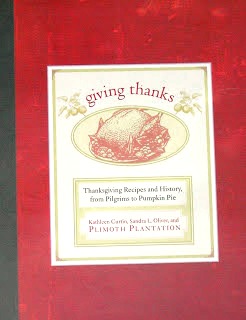
Giving thanks_bookA few years ago, a book entitled “Giving Thanks: Thanksgiving Recipes and History, from Pilgrims to Pumpkin Pie” was published.  The co-authors are Kathleen Curtin, food historian at the Plimoth Plantation, Mass., and Sandra L. Oliver, food historian and publisher of the newsletter “Food History News.”

The book is a fascinating look at how an autumnal feast evolved into a “quintessential American holiday.”

Most Americans, introduced to the story of the Pilgrims and Indians during childhood, assume there is a direct link between the traditional holiday menu and the first Thanksgiving.  But we learn from the book that many of those food items—such as mashed potatoes and apple pie—were simply impossible in Plymouth, Mass., in 1621.  Potatoes were not introduced to New England until much later and those first settlers did not yet have ovens to bake pies.

What we do know about the bill of fare at the first celebration in 1621 comes from a letter written by colonist Edward Winslow to a friend in England:  “Our harvest being gotten in, our governor sent four men on fowling, that so we might after a special manner rejoice together after we had gathered the fruit of our labors.”

Later 90 Indians joined the party with “their great king Massasoit whom for three days we entertained and feasted.”  Then the Indians “went out and killed five deer which they brought to the plantation.”

So venison was a principal food on the menu.  It also seems safe to assume that mussels, clams, and lobsters (all in plentiful supply) were served as well.   According to other journals of the colonists, the “fowl” that Winslow described were probably ducks and geese.  But wild turkeys were also bountiful in 1621, and so it is very likely that they were on the Pilgrims’ table.  Thank goodness for that.

Throughout the New England colonies, it became common to proclaim a day of thanksgiving sometime in the autumn.  In period diaries, there are many descriptions of food preparation—such as butchering and pie baking—followed by the notation that “today was the general thanksgiving.”

By the 19th century, Americans were taking the idea of a “thanksgiving” to a whole new level.  The religious connotations were dropping away in favor of a holiday celebrating family and food.  Roast turkey had become the centerpiece of these fall celebrations.

Turkeys, of course, were native to North America.  (Benjamin Franklin, in a letter, had even proposed the turkey as the official U.S. bird!)  And turkey was considered to be a fashionable food back in the mother country.  Just think of the significance of turkey in Charles’ Dickens’ “A Christmas Carol.”  When Scrooge wakes up in a joyful mood on Christmas morning, he calls to a boy in the street to deliver the prize turkey in the poulterer’s shop to the Cratchit family.  (Earlier in the story, the poor Cratchits were dining on goose.)

It is thanks to a New England woman that Thanksgiving became an American holiday.  Sarah Hale was a native of New Hampshire and the editor of “Godey’s Lady’s  Book,”  a popular women’s magazine.  She lobbied for years for a national observance of Thanksgiving.  She wrote editorials and sent letters to the president, all state governors, and members of Congress.

Finally, in 1863, she convinced Abraham Lincoln that a national Thanksgiving Day might help to unite the Civil War-stricken country.   The fourth Thursday in November was now officially on the American calendar.

“… that endless variety of vegetables …”

Connecticut’s own Harriet Beecher Stowe wrote this description of a New England Thanksgiving in one of her novels—“But who shall . . .describe the turkey, and chickens, and chicken pies, with all that endless variety of vegetables which the American soil and climate have contributed to the table . . . After the meat came the plum-puddings, and then the endless array of pies. . .”

The autumnal feast became a national holiday, but each region of the country put its own spin on the menu.   Not to mention that immigrants have also added diversity.  The result is a true “melting pot” of America.  The second half of “Giving Thanks” contains recipes that reflect what Americans eat for Thanksgiving in the 21st century.

In the South, for instance, the turkey might be stuffed with cornbread and there would be pecan and sweet potato pies on the table.  In New Mexico, chiles and Southwestern flavors may be added to the stuffing.

There’s the “time-honored traditional bread stuffing” recipe.  There’s also one for a Chinese American rice dressing and directions for a Cuban turkey stuffed with black beans and rice.  Desserts run the gamut from an (authentic) Indian pudding to an (exotic) coconut rice pudding.  Old-fashioned pumpkin pie is included as well as the newfangled pumpkin cheesecake.

But no matter what food items grace our Thanksgiving tables, it seems that we all end up stuffing ourselves silly.  Perhaps overeating started at that very first harvest celebration in 1621.  In Edward Winslow’s letter describing the feast with the Indians, he noted that food was not always this plentiful. But he wrote his friend in England “ … yet by the goodness of God, we are so far from want that we often wish you partakers of our plenty.”

Where Art Meets Nature: I-Park Hosts Nov. Open Studios & Holiday Party This Afternoon

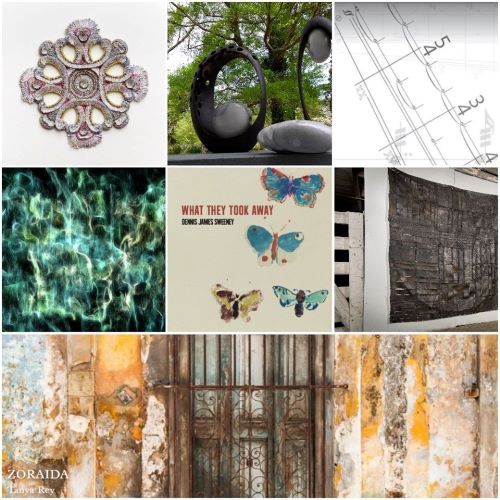
November Artists Artwork Photo Collage. Top row: Jaynie Crimmins, Miroslaw Baca, Joshua Hey; Middle row: Teresa Connors, Dennis James Sweeney, Shane Charles Smith; Bottom row: Tanya Rey. Photo submitted by I-Park.

EAST HADDAM — The public is invited to come to I-Park this afternoon from 1 to 4 p.m. for its final Open Studios of the 2019 season and for some holiday cheer.  Visitors will experience a multi-disciplinary group of artists from around the globe and can also enjoy a walk of the art-filled trails.

I-Park has been supporting artists from around the country and the globe since its first residency in 2001 and continues to offer fully-funded residencies to writers, composers, visual artists, film-makers, architects, etc.  Visitors will be able to meet these seven talented artists on this afternoon at I-Park, 428 Hopyard Rd. in East Haddam.

Once a month, at the conclusion of each residency, I-Park holds Open Studios when visitors are invited to meet the artists in their studios, attend a presentation featuring some of their work, enjoy complimentary refreshments, and stroll the trails winding through I-Park’s scenic, art-filled campus.  Generally closed to visitors, I-Park gives resident artists undisturbed time to work on their creative endeavors.

The event schedule for Sundayis as follows:

1:00 to 2:30     Visitors artists in their Studios

2:30 to 3:00     Artists Presentations

3:00 to 5:00     Holiday Party + Art Trail Walk

The artists are:

Miroslaw Baca is a Polish sculptor focused on abstract form and classical material.  He has realized both public and private commissioned sculptures around the world.

Teresa Connors is a Canadian-based creative coder, acoustic/electroacoustic composer, opera singer and audiovisual installation artist. Her creative works have received numerous awards and have been presented at conferences, festivals and galleries around the world.

Jaynie Crimmins a Brooklyn-based visual artist who creates alternative narratives from quotidian materials.  Her work has been exhibited at ART on PAPER; SPRING/BREAK Art Show; Governor’s Island Art Fair and many other museums around the country.

Joshua Hey is a composer based in Philadelphia. His work has been performed by musicians such as the Daedalus Quartet, International Contemporary Ensemble, Dal Niente, PRISM, Omaha Symphony and others.

Tanya Rey is an Oakland-based writer. Her writing has appeared in Guernica, Granta, Catapult, Roads & Kingdoms and McSweeney’s Internet Tendency, among others.     

Shane Charles Smith is a visual artist from Brooklyn and Maine. He creates mural-sized painting installations. His work is informed by his father, a lifelong land surveyor and Penobscot Nation member, and his grandfather who was a mapmaker.

Dennis James Sweeney is a writer and poet currently living in Amherst, MA.  His fiction, nonfiction, and poetry have appeared in Crazyhorse, Five Points, Ninth Letter, The New York Times, and The Southern Review, among many others.

Although admission to Open Studios is free, advance reservations are requested. To reserve your space, visit i-park.org.

For additional information, write events@i-park.org or call 860-873-2468.

 I‐Park is an artists-in-residence program offering fully funded residencies in visual arts, creative writing, music composition/sound art, moving image, and architecture/landscape design. Since its founding in 2001, I-Park has sponsored almost 1,000 residencies, and has developed cross‐disciplinary projects of cultural significance and brought them into the public domain.

Set within a 450-acre nature preserve, I-Park encourages dialogue between the natural and built environments, and has been the setting for exhibitions, performances, symposia, and programs that facilitate artistic collaboration. For more information, visit i-park.org.


Old Lyme Soccer Girls Fall to 1-0 Holy Cross in Class S State Final

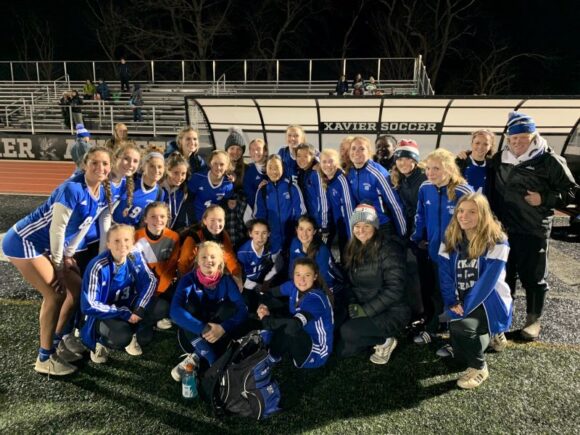
The Old Lyme girls gather happily for a team photo with Coach Paul Gleason (at right) after defeating NW Catholic 2-0 at Xavier High School in the Class S State Championship semifinal. Photo by Ally Gleason.

11/23 Update: Despite playing an excellent game, the Wildcats were defeated 1-0 this morning by Holy Cross.  Devon Bushka scored for Holy Cross 10 minutes into the second half. Congratulations to the Old Lyme girls on an incredible season — you end it with your heads held high. Visit this link to read a game report by Sean Begin and published on the Courant.com

LYME-OLD LYME — The eighth-seeded Old Lyme girls varsity soccer team faces #3 Holy Cross at 10 a.m. today at Veteran’s Park in New Britain in their bid to become Class S state champions for the fifth time in a row. Fan buses are being run from Old Lyme and it is anticipated that a huge crowd of hometown supporters will be there to cheer on the girls.

Old Lyme defeated NW Catholic 2-0 in the semifinals on Wednesday when Lydia Tinnerello, one of five team captains for Old Lyme, scored twice at Xavier High School to lift #8 Old Lyme to a convincing victory. 

Tinnerello’s first goal found the net just shy of eight minutes into the game and then she followed up in the last minute of the first half with a shot assisted by Abby Manthous. The move that culminated in the second goal had started with a free kick by another team captain Emily DeRoehn. The other captains are Katie Funaro, Melissa Mauro  and Kaylee Armenia.

Paul Gleason’s Wildcats held onto their lead through the second half to the delight of all the spectators who had traveled from Old Lyme to support the team.

After the game, Tinnerello, who will play lacross at Merrimack next year, told LymeLine in a text, “I feel great about the game. It was a complete team effort. And I’m really proud of my teammates for always working their hardest.”

GO WILDCATS!

State Rep. Carney Named Environmental Champion by Connecticut League of Conservation Voters

State Rep. Devin Carney (R- 23rd)

HARTFORD – (from a press release) The Connecticut League of Conservation Voters (CTLCV) have recognized State Representative Devin Carney (R-23), naming him an Environmental Champion for his efforts and support of proposals that focus on various green initiatives throughout the state.

Each year, the Connecticut League of Conservation Voters release an Environmental Scorecard and names “Environmental Champions,” legislators who advocated for particular pro-environment bills. Only 16 legislators received this designation and Rep. Carney’s leadership on clean energy legislation was highlighted.

“It is truly an honor to be recognized by the League of Conservation Voters as an Environmental Champion,” saidRep. Carney. As the State Representative for an environmentally precious district, I was proud to advocate for and support many pieces of legislation to improve and protect Connecticut’s environment. As the Co-Chair of the Clean Energy Caucus, I was proud of the work I was able to achieve, particularly involving solar net-metering. I look forward to continuing making environmentally-friendly legislation a priority.”

The organization stated Rep. Carney was “instrumental in passing the temporary fix for solar net-metering that became part of the Green Economy Act (HB 5002) and that “he also argued for a more comprehensive set of clean energy policies to grow our economy and address our climate crisis.”

In addition, Rep. Carney also co-sponsored two other environment-related bills during this legislative session. SB-753 expands the statewide fracking ban to apply to all gas and oil extraction activities and HB-7156 to authorize the procurement of energy derived from offshore wind. Both bills passed and were signed into law by the governor earlier this summer.