Hear Old Lyme’s Suzanne Thompson’s Interview with ‘Tossing Lines’ Author John Steward Anytime on WLIS Website

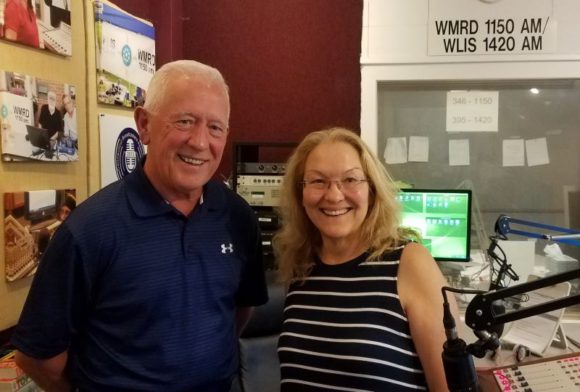
Radio host Suzanne Thompson shares a moment with John Steward in the WMRD/WLIS studio after recording the interview with him, which will be broadcast twice this weekend.

OLD LYME — If you’re a fan of John Steward, a regular contributor to Lyme Times, you can hear how his Tossing Lines column came about on CT Outdoors with Old Lyme’s Suzanne Thompson this weekend. Steward, a Groton native, reflects on a wide range of topics, from local history to his bicycle rides through New London County.

Look for his reflections on the 50th anniversary of Woodstock in this week’s Lyme Times or online at theday.com  (Olwen, here’s the full link) https://www.theday.com/article/20190910/NWS01/190919999
Listen to CT Outdoors with Suzanne Thompson, Saturday, Sept. 14, 1-1:30 p.m., Sunday, Sept. 15, 7-7:30 a.m., on WLIS 1420 AM/Old Saybrook & WMRD 1150 AM/Middletown, streaming at http://www.wliswmrd.net. Or play back John’s interview on your PC or Mac from the website On Demand archives. Click on the microphone icon, look for pop-up screen from radio.securenetsystems.net, and scroll to CT-Outdoors-91019—John-Steward-Tossing-Lines.

Old Lyme Church Hosts Concert Tonight to Benefit Work of Immigration Assistance Committee

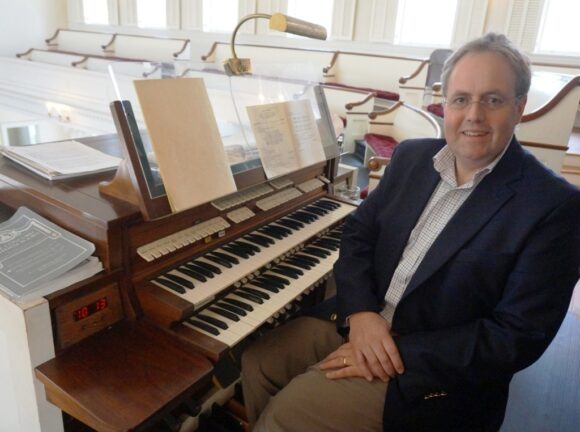
First Congregational Church of Old Lyme’s Director of Music Simon Holt, will perform the Sept. 14 ‘Immigration’s Inspirations’ concert.

OLD LYME — The First Congregational Church of Old Lyme (FCCOL) presents a special fund-raising concert Saturday, Sept. 14, from 7 to 9 p.m. in its Meetinghouse that will help raise money for the church’s ongoing efforts to help area families facing deportation crises.  Admission to the concert will be a free-will donation.  The concert will be followed by refreshments and raffles in the Fellowship Hall.

The benefit concert, arranged and performed by FCCOL’s Director of Music Simon Holt, is called ‘Immigration’s Inspirations: A Celebration of Foreign-Born Composers Whose Works Influenced American Music & Culture’ – and features musical selections by foreign composers, who either emigrated to America, whose U.S. tours and works heavily influenced American composers, or whose works celebrated iconic overseas buildings that influenced American architecture.

All proceeds will benefit the charitable work of FCCOL’s Immigration Assistance Committee (IAC), which connects immigrant families with free or low-cost legal aid before and during deportation proceedings; and helps them understand their rights under federal and state law, particularly when their families include members who are U.S. residents.

The IAC played an instrumental role in helping a New Britain couple, Malik bin Rehman and Zahida Altaf – whose daughter is a U.S. citizen – win a stay of deportation after initially seeking sanctuary in FCCOL. The family is currently awaiting a ruling from the 2nd Circuit Court of Appeals.

The IAC is also working to reunite the Torres family from Waterbury. In August 2018, Miguel Torres and his two children, all of whom are U.S. citizens, watched helplessly as their wife and mother, Glenda Cardenas Caballero, was deported to Honduras even though she had complied with all Immigration and Customs Enforcement (ICE) directives and her immigration case was under appeal.

Pieces performed during the benefit concert will include:

  • “Humoresque” by Pietro Yon, who was born in Italy and moved to the U.S. in 1907
  • “Sonata II” by Paul Hindeminth, who was born in Germany and moved to the U.S. in 1940
  • “Grand Chorus in March Form” by Alexandre Guilmant, whose U.S. tours were instrumental in establishing American improvisational styles
  • “Suite Gothique” by Loen Boellmann, who composed a piece celebrating Notre Dame, an iconic building that influenced American architecture
  • “Imperial March” by Edward Elgar, an English composer whose U.S. tours were immensely popular
  • “Fantasia in G major BWV 572” by J.S. Bach, the German-born father of all composers of music for the organ
  • “Thema met Variaties” by Hendrik Andriessen, which was written for Lady Susi Jeans, the Austrian-born organist, teacher and musicologist who taught several influential 21st Century European organists
  • “Carillon de Westminster” by Louis Vierne, a Frenchman who composed a piece celebrating Westminster Abbey, another iconic building that influenced American architecture

If readers are unable to attend but would like to support the IAC, send a tax-deductible contribution via check or money order to the Immigration Assistance Fund, FCCOL, 2 Ferry Road, Old Lyme, CT 06371.

Today is Final Day of Intake for King’s Rummage Sale at Old Lyme Church

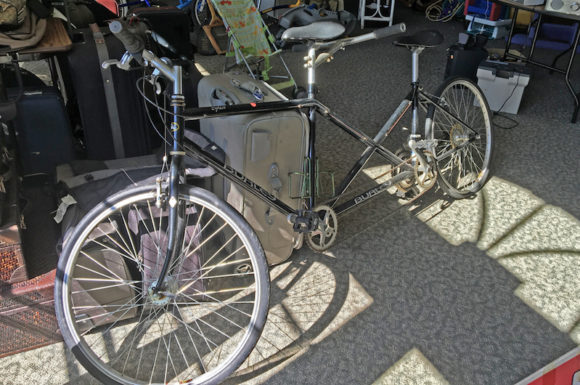
Got a bike in the basement? Why not donate it to the King’s Rummage Sale?

OLD LYME — Summer’s over. The kids are back in school.

It’s a great time to clean out the house and get it ready for autumn. But what to do with all the gently used toys, books, dishes, jewelry, tennis racquets, bicycles, Christmas decorations, furniture, etc., that you don’t need anymore?

The answer is donate them to the King’s Rummage Sale at Christ the King Church’s Harvest Fun Day!

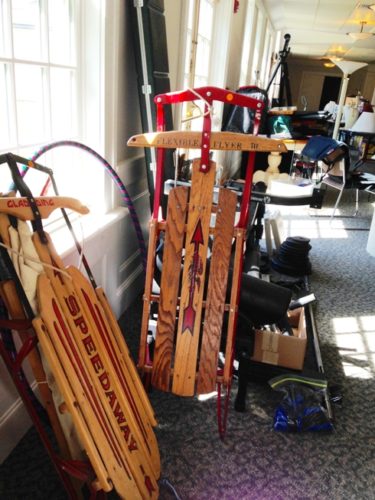
Toboggans are great to donate to the King’s Rummage Sale!

Donations are being accepted from today, Sept. 3, through Sept. 7, and Sept. 9 through Sept. 14,from 9 a.m. to 12 noon at Christ the King Church, 1 McCurdy Rd., Old Lyme (at the Parish Hall entrance).

All donated items should be in good condition and saleable. No clothes, shoes, or textbooks will be accepted. Visit this link  for a complete list of items that will not be accepted.

Call the parish office at 860-434-1669 if you have large or upholstered items to donate.

The annual Harvest Festival takes place at Christ the King Church (1 McCurdy Rd., Old Lyme) on Saturday, Sept. 21, from 8:30 a.m. to 3 p.m., and features the rummage sale, a silent auction, a bake sale, kids games and crafts, great food, live music, and an autumn plant sale.

The rummage sale, bake sale, and plant sale will continue Sunday morning, Sept. 22, from 9 a.m. to noon (with steep discounts on rummage sale items, while supplies last.)

Visit www.christthekingchurch.net for directions and updates. Follow the church on Facebook @christthekingchurcholdlyme.

For more information, call 860-434-1669.


Old Lyme Boy’s Soccer Notches Convincing Win Over N. Branford in Season Opener

Old Lyme Boys Soccer opened their 2019-20 season at North Branford High School with a crushing defeat of the Thunderbirds by 10-0

Angus Tresnan scored two goals for the Wildcats, joining teammates Mike Milazzo, Sam Roth, Garrett Smith, Jesper Silberberg, Anders Silberberg, Aidan Kerrigan, Nevin Joshy and Paul Nelson in the scoring bonanza.
In goal for Old Lyme was senior Ryan Tetreault and freshman Jonah Lathrop, the latter of whom had one save for the Wildcats.

I See Great Things in Baseball – Part 1

Photo by Jose Morales on Unsplash

Editor’s Note: We are delighted to publish the first section of a three-part essay on the literature of baseball written by Old Lyme resident Tom Gotowka. Look for the second and third parts in the coming weeks.

Walt Whitman, editor of the Brooklyn Daily Eagle in the mid-1840s, wrote: “I see great things in baseball. It’s our game – the American game.”

I love baseball and am a lifelong reader of the baseball literature, which is remarkably rich. Right now, it’s that time of year when many of us start thinking about the baseball playoffs, the World Series, and how well the Red Sox will undoubtedly do next year. Then, in November, we’ll begin each off-season morning with, “Alexa, play “Center Field’ by John Fogerty. (i.e., “Put me in coach, I’m ready to play today.”)

I dedicate this three-part essay on the literature of baseball to my Dad, whose own baseball career was interrupted by World War II and the Battle of the Bulge. He was the first of a three – going on four – generation “dynasty” of catchers, and could still snap a laser to second base in his fifties. For me, his most unforgettable advice was, “Never be the only player on the field with a clean jersey.” He had similar wisdom for any physical outdoor sport.

I grew up reading many of the historic player biographies – which, at that time, generally targeted 12-year-olds – and didn’t cover the “less refined” side of the game. I will focus here on some of my favorite pieces, and hope that sports writer literati will continue to contribute and expand that bibliography.

Locally, New London Day sportswriter, Mike DiMauro regularly exhibits flashes of literary brilliance. For example, he recently cited “the words of Plato” in his column on the Ledyard Chamber Choir’s performance of the National Anthem at Fenway Park.

In the past, sportswriters seemed to be a fairly literary bunch.

In 1888, Ernest Thayer, a journalist at the San Francisco Examiner, wrote “Casey at the Bat: A Ballad of the Republic,” which is probably the best known of all the epic poems of baseball:
“The outlook wasn’t brilliant for the Mudville Nine that day.
The score stood four to two with but one inning left to play.
And then when Cooney died at first and Barrows did the same,
A sickly silence fell upon the patrons of the game.
A straggling few got up to go in deep despair; while the rest
clung to that hope which springs eternal in the human breast.
They thought, if only Casey could get but a whack at that;
they’d put up even money, with Casey at the bat …
But there is no joy in Mudville, mighty Casey had struck out!”

Grantland Rice was a prolific sportswriter in the early twentieth century known for his elegant style. He wrote “Casey’s Revenge” in 2007:
“There were saddened hearts in Mudville for a week or even more.
There were muttered oaths and curses – every fan in town was sore.
‘Just think, said one, how soft it looked with Casey at the bat’;
and then to think he’d go and spring a bush-league trick like that!’”

Rice is possibly best-known for a statement on sportsmanship that many of us have said or heard: “When the Great Scorer comes to write against your name, He marks, not that you won or lost, but how you played the game.”

In 1910, Franklin Pierce Adams, a columnist for the New York Evening Mail, wrote “Baseball’s Sad Lexicon” (told from the point of view of a Giants’ fan watching a game against the Cubs and its great infield):
“These are the saddest of possible words: Trio of bear cubs, and fleeter than birds;
Tinker to Evers to Chance.
Tinker and Evers and Chance.
Ruthlessly pricking our gonfalon bubble,
Making a Giant hit into a double.
Words that are heavy with nothing but trouble:
Tinker to Evers to Chance.”

So, it’s still fair to say that a 4-6-3 double play is like ballet – i.e. the second baseman (4), playing deep, fields the ground ball and throws to the charging shortstop (6) who touches second base, leaps above the sliding runner – while simultaneously throwing to first base (3). That’s ballet!

In 1948, Gerald Hern, sports editor at the Boston Post, composed a poem about the Boston Braves’ great pitching rotation of Warren Spahn and Johnny Sain: “Spahn and Sain and Pray for Rain”.
First we’ll use Spahn,
Then we’ll use Sain,
Then an off day, followed by rain.
Back will come Spahn, followed by Sain;
And followed, we hope, by two days of rain.”

Robert Frost, perhaps New England’s greatest poet, also loved baseball. He said “When I was young, I was so interested in baseball that my family was afraid I’d waste my life and be a pitcher. Later they were afraid I’d waste my life and be a poet. They were right.” In ‘Birches,’ he shows concern about any boy living too far from town to play baseball.

He also wrote: “Poets are like baseball pitchers. Both have their moments. The intervals are the tough things.” And finally, “One of the hardest things in life to accept is a called third strike”.

I want to also recognize the colorful commentary of some radio and TV sportscasters. I’ll loosely characterize those sometimes outrageous literary contributions as: “Baseball Couplets and Allegory”.

Keith Olberman’s quarter century career as a sports commentator included long stints at both ESPN and CNN. He has used the following in describing an on-field dispute: “I can read his lips and he’s not praying.”

Ernie Harwell’s half-century career as a sportscaster included 40 years with the Detroit Tigers. He described a called third strike in language somewhat reminiscent of Robert Frost: “He stood there like a house on the side of the road. Strike out!”

Reece Davis, an ESPN sports commentator, when describing a home run, said: “That ball has been voted off the island!” (which I guess is in reference to a reality TV show … not Robert Frost.)

Dave Niehaus, a sportscaster and play-by-play announcer for over 30 years with the Seattle Mariners described a grand slam in game 4 of the 1995 American League Division Series this way: “Get out the ryebread and mustard, Grandma. It is grand salami time!”

Jerry Coleman was both a player for the New York Yankees and a manager for the San Diego Padres. Like Ted Williams, he had also served as a Marine Corps pilot in both World War II and Korea. He finally capped his career as a broadcaster, and described home runs or any great play as: “Oh, doctor, you can hang a star on that one!”

And, of course, there’s Don Orsillo, who called Red Sox games for 15 years with Jerry Remy. Don loved calling home runs, frequently referring to Red Sox homers as: “La Luna” or “Buenos noches, amigos!”

In the second essay, I’ll review several contemporary baseball novels and biographies that I’ve not only enjoyed reading, but also feel that they provided me with a better understanding of the sport.