Join a ‘Leading Together’ Conversation This Afternoon at Old Lyme Library, Hosted by Community Foundation of Eastern CT

The Community Foundation of Eastern Connecticut (CFECT) is committed to hearing the voices of residents and convening state leaders, experts and communities to discuss issues affecting Eastern Connecticut. In recent years, the CFECT has held Thriving Community Conversations on women, arts, youth, animal welfare and environmental issues, as well as Connecticut’s fiscal crisis and its impact on the nonprofit sector in our region.

The next LeadingTOGETHER Thriving Community Conversation will be held at the Phoebe Griffin Noyes Old Lyme Library on Tuesday, June 4, from 4 to 5:30 p.m. The discussions will help to inform and inspire the Foundation’s work while offering the opportunity for participants to think creatively about community solutions, sparking new or deeper connections to lead together for change.

In addition, the Phoebe Griffin Noyes Old Lyme Library will be sharing information about their current and upcoming programs and invite community members to engage in further conversations and opportunities.

All Old Lyme and Lyme residents are invited to join the conversation. Those interested in attending should RSVP by email to events@cfect.org or call Pam Mola at 860.442.3572.

Serving 42 towns and comprised of over 500 charitable funds, the Community Foundation of Eastern Connecticut puts philanthropy into action to address the needs, rights and interests of the region. The Foundation stewards net assets of over $88 million and has awarded more than $56 million in grants and scholarships to nonprofits and students since its founding in 1983. To learn more, visit cfect.org.

Two Lyme-Old Lyme Organizations Combine Their Talents to Build a Beautiful Butterfly Garden

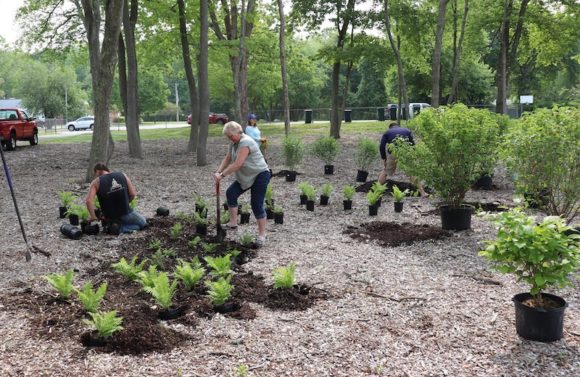
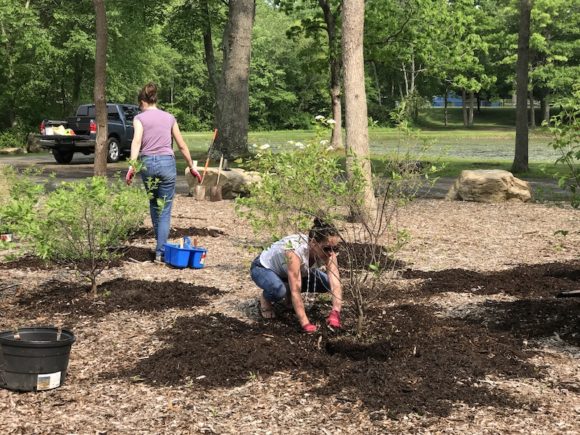
Duck River Garden Club member Fay Wilkman digs deep during Saturday’s event with the Lyme-Old Lyme Junior Women’s Club to plant a butterfly garden at the Cross Lane Playground. Meanwhile, Old Lyme Selectwoman Mary Jo Nosal (standing to rear of photo) takes a break from her digging. Photo by Kimberly Russell Thompson.

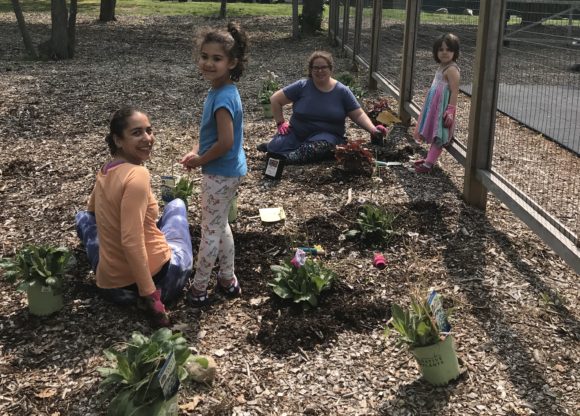
A wonderful example of community cooperation took place in Old Lyme last Saturday, which generated not only a great deal of fun and camaraderie at the time, but also a beautiful garden for the future.

It all began with the Lyme-Old Lyme Junior Women’s Club (LOLJWC)’s multi-year campaign to raise funds for new playground equipment at Cross Lane Park, which came to fruition with the official opening of the playground in April 2018.  During the campaign, the Club received a generous sum, to which the donor attached two requests.  The first was that it should remain anonymous and the second that it be used to create a butterfly garden at the renovated playground as a memorial.

Due to the timing of the playground’s installation, it was not possible to plant the butterfly garden last year but this year everything came together.

Sarah Michaelson plants more perennial pollinator bushes.  Photo by Suzanne Thompson.

Petie Reed, owner of Perennial Harmony Garden and Landscape in East Lyme, who is a member of both the LOLJWC and the Duck River Garden Club (DRGC), proposed that the LOLJWC should share development of the project with the DRGC and the DRGC enthusiastically embraced the idea.  Reed was assisted throughout the project by her partner, Rich Oliver.
Reed worked with numerous members of both organizations including Suzanne Thompson of the DRGC and Anna Reiter, outgoing LOLJWC President. The group designed it to be a wildlife garden of native plants well-suited for the shaded, boggy terrain.  The selection of native shrubs and perennials includes aromatic sumacs, viburnum, huchera, black-eyed susans and baptisia will support many pollinator insects and birds.

Reiter explained that during design discussions, Reed, “suggested we allow for a more community feel to the garden, by allowing families to “adopt” a garden plot.” Reiter continued, “For a nominal fee, we supplied some specific native plants that will encourage local wildlife and pollinators for each of the community garden plots, and families were encouraged to bring their own non-invasive plants for their plot.”

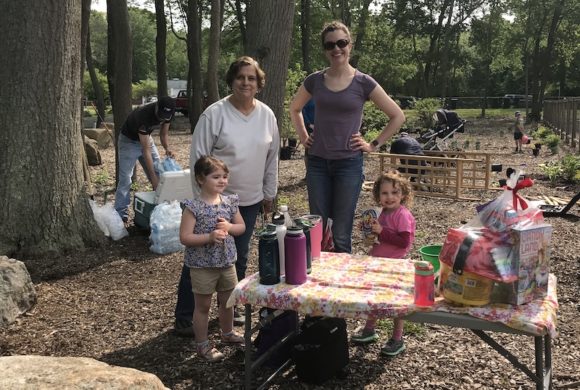
From left to right, Kay Reiter stands with long-time DRGC member Mim Beardsley, incoming LOLJWC President Kim Russell Thompson, and Izzy Thompson.  Photo by Suzanne Thompson.

The finishing touch was that the LOLJWC also supplied a ceramic garden stake, which families can take to Ocean Art Studio in Old Saybrook to customize and then place in their garden.

Reiter noted there are still some plots available for purchase, emphasizing that the owner families and LOLJWC members will be watering the gardens throughout the summer to get them established.  Once settled in, these native plants will need minimal watering and will continue to spread and naturalize the area around the playground.
A large group of DRGC and LOLJWC members of all ages along with spouses, children, relatives and friends turned out Saturday to spend the morning cheerfully planting and watering. Fay Wilkman and Mim Beardsley, both members of the DRGC, also assisted with the installation, and incoming LOLJWC President Kimberly Russell Thompson summed up the universal feeling at the end of the successful event when she said simply, “It was a very fun day!”

Fun and flowers … and smiles! An LOLJWC member and her daughter (in foreground) and incoming LOLJWC Vice President Angela Mock and her daughter Ally all take a well-earned break from their labors.  Photo by Suzanne Thompson.

Looking to the future, Reiter commented, “Petie and I hope these beds also will provide inspiration and ideas to families who want to plant more native flowers and shrubs in their own yards,” while Thompson added,  “Next steps are to seek grant funding so we can put up educational signs in the beds, to identify the plants and their benefits to wildlife.”
After expressing sincere thanks to the anonymous donor and all those who had made creation of the butterfly garden a reality, Reiter concluded positively, “We are hoping the community will walk through the gardens and enjoy the beauty of the park and the wildlife — this was a very special gift!”

Editor’s Note: Garden plots are still available for purchase at $30 each.  The purchaser must agree to tend and water their garden throughout this season.  A rain barrel and water cans are available to make watering fun and easy.  If you wish to purchase a plot, visit the LOLJWC website at www.loljwc.com or email Anna Reiter at loljrwomencub@gmail.com. There is a link to purchase a plot on the website. 

CT Valley Camera Club Hosts Renowned Photographer George Fellner This Evening: All Welcome

George Fellner will give a talk titled “Pictures at an Exhibition: A Mindset for Creative Photography” on June 3 at the CT Valley Camera Club

The guest speaker at the Monday, June 3, meeting of the Connecticut Valley Camera Club (CVCC) will be professional photographer George Fellner, who will give a talk titled, “ Pictures at an Exhibition: A Mindset for Creative Photography.” The meeting will be held at 7 p.m. at the Lymes’ Senior Center, 26 Town Woods Rd., Old Lyme, Conn. All are welcome. There is no admission charge.

This program explores the characteristics and attributes that make a photograph successful.  While there are numerous categories and genres of subject material, there are nonetheless certain common denominators that can be implemented for making a good photograph.  One can determine a preferred genre as well as a theme that relates to a personal frame of reference for creating a body of work.

Specifically, there is a set of criteria that can be defined as objectives.  For example, an image should have impact and possess a certain attraction that is both compelling as well as captivating for the viewer.  A creative expression that is unique and imaginative, helping to convey a message is paramount for a photograph that is intended to leave a lasting impression.

Furthermore, drama and emotion have the propensity to affect the viewer’s experience.  The elements of composition certainly are a part of the equation, as well as the technical understanding of proper lighting, color balance, resolution, detail, contrast, tonal gradation, among other specific aspects.

Through a discussion of concepts, strategies, and process, George Fellner presents a mindset for creative photography.  His use of visual examples helps to illustrate the positive and negative aspects of a photograph in a descriptive and revealing manner.  The intent is to provide an understanding of what makes a photograph creative and what is involved in judging images in a photo show.  Ultimately, as photographers, we all strive to learn what works for Pictures at an Exhibition.

George Fellner

As a photographer and architect, Fellner is committed to a dual life-path involving visual discovery and design, relating to both the natural and built environments.  He has been presenting photography programs to camera clubs, art guilds, professional organizations, historical societies, community groups, and schools since 2004.  His subjects include landscape, architecture, travel, and elements of nature.

Fellner received his Bachelor of Architecture degree from Virginia Polytechnic Institute and State University, and his Master of Architecture degree from the University of Florida.  Now, with over 30 years as principal of Fellner Architects, he continues to utilize his design sensitivities for creative photography.

Fellner’s photographs have been published in books, journals, magazines, newspapers, and travel guides.  INK Publications magazine (Feb 2013) featured the article Photographer George Fellner: Architect for Body and Spirit.  The book Artists’ Homes and Studios (2015) by E. Ashley Rooney features Fellner’s studio, art, and creative process.  He wrote and published his first book Imaginary Realms: The Visual Language of Stones and Crystals (2016).

His latest book Essence of Architecture in East Haddam: Expressions of a Connecticut River Town is being published in May of 2019.

Fellner’s work has been exhibited in art galleries and museums, both in group shows and solo shows.  A series of his images are exhibited in permanent art collections at the Yale School of Medicine, the Jackson Laboratory at the University of Connecticut, and the NYC offices for Nature Genetics, an international science journal.

The CVCC is dedicated to offering its membership the opportunity to become better photographers. The group offers a variety of presentations and interactive workshops to help members expand their technical and creative skills. Photographers of all levels of experience are welcomed.  The club draws members from up and down the river, from Middletown to Old Saybrook; from East Hampton to Old Lyme; and along the shoreline from Guilford to Gales Ferry.

For more information, visit the club’s website at https://ctvalleycameraclub.smugmug.com/ . CVCC meeting dates, speakers/topics, and other notices are also published on the club’s Facebook page at http://www.facebook.com/CTValleyCameraClubPage .

Letter From Paris: Seeing “Red” at the Grand Palais

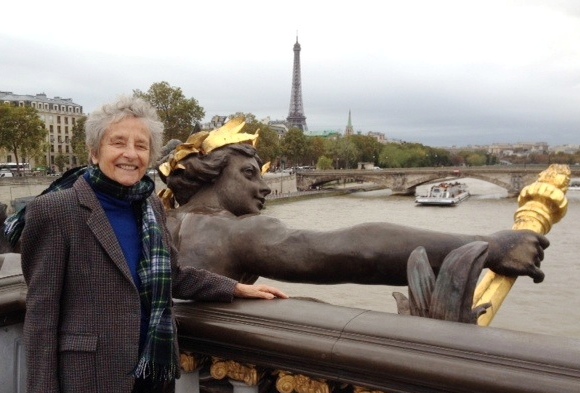
Nicole Prévost Logan

The year 1917 in Russia marked a unique moment of history when art and  revolution fused together into a mutual source of inspiration. The creativity and energy fed on each other for a short few years, to eventually vanish under the brutal repression and purges of Stalin to become an official and bland art form called “Socialist Realism.”

The exhibit “Red – Art and Utopia in the Soviet Country” at the Grand Palais, Paris, in the spring of 2019 is breaking new ground in describing that unique moment.

All forms of arts were impacted by the October Revolution, from the visual arts to architecture, theater, cinema, music and, of course, literature.  In addition to major artists, already well known before World War I, such as Malevich, the Bolchevik government did welcome all talented artists eager to experiment with new art forms.

Mayakovsky (1893-1930) was the voice of the Revolution – a giant with a booming voice, who galvanized the crowds when he read his poetry.  His emblematic play, the “Bedbug,” is a satire of the NEP (New Economic Policy.)  A young man of that period is frozen and found himself  in a perfect communist world 50 years later where there was no drunkenness nor swearing. 

He decided he was not made for the future.  As a journalist, Mayakovsky used  simple street  language.  A gifted artist, he drew satirical cartoons, making fun of the “petty bourgeoisie.” One of the main metro stations in central Moscow was named after him. He shot himself in 1930 at the age of 37.

Malevich (1878-1935), a major artist of the 20th century, was inspired until 1914, by Gauguin, Matisse and Cezanne, and then moved to abstraction and geometric forms until he reached his extreme “White on White” in 1918.  He was the theoretician of art par excellence. 

His book “From Cubism to Suprematism in Art …” is considered one of the most important reference works of the 20th century. Toward the end of his life he was  forced to reintroduce figurative characters into his paintings.  He never left the Soviet Union where he died of cancer in 1935.

Tatlin (1885-1953) was associated with the concept of “constructivism,” based on the use of materials, the exploitation of movement and tension in matter.  He aimed at the harmonization of artistic form with utilitarian goals.

Artists’ association multiplied at that time.  AKhRR  (Association of Russian Artists of Revolutionary Russia) was founded in 1922.  Vkhutemas (higher Institutes of art and technique) were created as early as 1920 all over the country.  Both Malevich and Tatlin occupied important positions in those institutions .

Vsevolod Mayerhold, (1874-1940) following in the footsteps of Stanislavsky (master of the stage in the 19th century – particularly Chekhov plays), revolutionized theatrical techniques, suppressed settings and replaced them by “constructivist” space, trained the actors according to a new system of “bio-mechanic” and how to form human pyramids. His stage production of Mayakovsky’s  “Bed Bug” is emblematic of the Soviet era.

Rodchenko  (1891-1956) was the leading innovator of the 1917 revolution-inspired  art.  He wanted to bring art down from its pedestal.  He stood against estheticism and “art for art” and made art the champion of productivity. He created a new artistic language by experimenting with photography, using photo-montage, double exposures, and unexpected angles. He gloried the machine in a factory or objects of daily life rather than still life motives in traditional art.

Among this group of brilliant artists were two women – Lioubov Popova, (1889-1924), who died of scarlet fever, and  Varvara Stepanova (1894-1958i), Rodchenko’s wife.
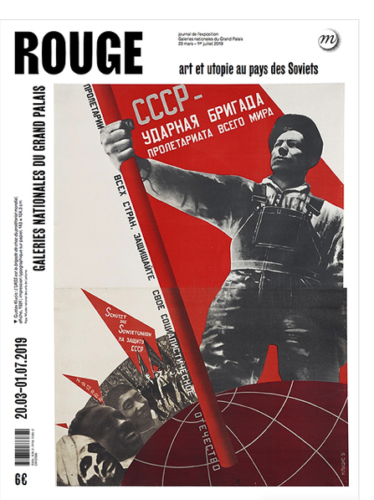
A poster by Gustav Klutsis.

Posters became a new art form used as the most important tool of propaganda. They were intended to make a strong and immediate impact on the viewer.  Using a graphic art medium with calligraphy and geometric designs, they carried a simple message.  The color red was used extensively  (it is interesting to note that, in Russian, “red” and “beautiful” are the same word.)

Oversize paintings like “Bolchevik” by Kustodiev are easy to understand.  A giant man walks through dwarfed  city landscape with churches, holding a huge red banner.  The messages of the October revolution were spread throughout the country in the “agit-prop trains”  to educate the masses.  Some figures are impressive: in 1917 the literacy of the population  was 25 percent whereas by 1939, it had risen to 81 percent.

Gustav Klutsis (1895-1935), born in Latvia, was also one of the best at using photo-montage and posters . He wrote: “Put color, slogan at the service of class war.”  Klutsis was arrested and shot in 1938.

Sergei Eisenstein  (1898-1948) – a pioneer of the cinema – created his own style characterized by melodramatic acting, close-up shots and theatrical editing.  A sequence of “Battlefield Potemkin” has become an absolute classic: during an attack by the Cossacks against Odessa civilians, a baby carriage falls all the way down the long steps.

Eisenstein ‘s mob scenes are so realistic (such as the storming of the Winter Palace in St Petersburg) that they are often mistaken for newsreels in documentaries.

Architecture played a crucial role in bringing about utopia of the proletariat.  Plans for grand buildings, squares and majestic avenues are intended to impress the masses, who are more important than the individuals.  Still standing today is the workers’ club Roussatov designed by Melnikov.
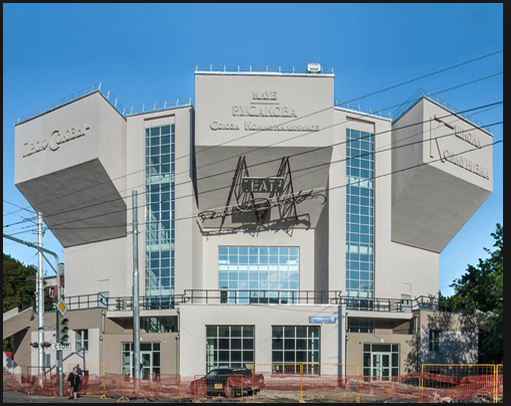
Roussakov Workers’ Club designed by Melnikov, 1927-28.

After the death of Lenin in 1924, power became concentrated in the hands of Stalin, who tightened his control over artists.  In 1932  all artistic associations were suppressed — artists were forced to join the official Union.

The creative, innovative productions had to bend and conform to rules of the new doctrine of Socialist Realism formulated by Andrei Zhdanov in a speech to the Writer’s Union in 1934.  In art,  it can be defined as representation of the bright future of communism through the representation of idealized  workers in healthy bodies.

Therefore, at the 1937 Universal Fair held in Paris, a double statue of a vigorous factory worker and a strong woman kolkhoz farmer stood on top of the Soviet building.

Most representative of this period was Alexander Deïneka, who painted naked, young factory workers taking a break on the beach in the Donbass or Lenin riding in an open sports car through bucolic countryside with several blonde children.

Somehow out of place in 1937 is a delightful painting by Yuri Pimenov called, “The New Moscow.”  A young woman is driving a convertible car on one of the main thoroughfares of central Moscow.  The style is very much in the Impressionist style.

Already in the 1990s, the Tretiakov Gallery of Moscow held exhibits on the 1920s and 1930s Soviet art.  At that time, the Soviet posters were readily available in the book stores of the Arbat pedestrian street.  

Although a large part of the exhibited works included in the “Red” exhibit come from the permanent collection of the Centre Pompidou, Paris, it is interesting to note that in the 1979 Paris-Moscow exhibit organized by that same museum, Soviet art was barely mentioned.

Editor’s Note: This is the opinion of Nicole Prévost Logan.

Nicole Prévost Logan

About the author: Nicole Prévost Logan divides her time between Essex and Paris, spending summers in the former and winters in the latter. She writes a regular column for us from her Paris home where her topics will include politics, economy, social unrest — mostly in France — but also in other European countries. She also covers a variety of art exhibits and the performing arts in Europe. Logan is the author of ‘Forever on the Road: A Franco-American Family’s Thirty Years in the Foreign Service,’ an autobiography of her life as the wife of an overseas diplomat, who lived in 10 foreign countries on three continents. Her experiences during her foreign service life included being in Lebanon when civil war erupted, excavating a medieval city in Moscow and spending a week under house arrest in Guinea.