
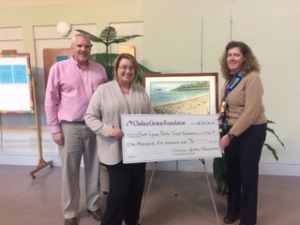
Chelsea Groton Bank Awards Grant to East Lyme Public Trust to Improve Accessibility to Niantic Boardwalk

The award was presented by Jessica Todd, Vice President & Comptroller, Chelsea Groton Bank. Shown receiving the award are David Putnam, E.L. Parks and Recreation Director, and Kathie Cassidy, Treasurer- E.L. Public Trust Foundation.

As part of their fall grant cycle, the Chelsea Groton Bank has awarded to the East Lyme Public Trust Foundation $1,500 to be used toward the purchase of an ADA compliant beach accessibility surface mats to allow wheelchair access to the Niantic Boardwalk beaches.

Since 1999, The Chelsea Groton Foundation has provided over $2.3 million in total grants to the community. These grants are awarded to organization that impact the region in health, human and social services, education, economic development, and arts and culture.

Michael Rauh, President and CEO of Chelsea Groton Bank noted, “Through the Chelsea Groton Foundation, we are able to support non-profits who play a critical role in our communities.”

Kathie Cassidy is the chairperson, who has organized the project to install mats on the beach. She commented, “It is the desire of the East Lyme Public Trust Foundation to make Niantic Bay Beach and Hole in the Wall Beach a wheelchair-accessible, friendly place. We want to allow people with mobility impairment to visit and enjoy these beaches.”

Cassidy is continuing to solicit grants from other entities for this project. The Public Trust Foundation is hoping to have the mats installed this spring.

New Start Date for LYSB’s Free, Four-session Substance Abuse Education, Prevention Program for Parents, Jan. 17

Lymes’ Youth Service Bureau presents a free, four-session substance abuse education and prevention program for parents on Wednesdays in January (Jan. 17, 24 & 31 and Feb. 7) at 7 p.m. in the Lyme-Old Lyme Middle School Library.  The start date has been revised from the originally published date of Jan. 10.
This workshop series was developed by LYSB and CASFY to help parents understand substance abuse and its impact on children and youth.
Guest speakers and relevant resource materials will be offered at each session.
This program is free and for parents of children of all ages. Register at www.lysb.org

Topics covered during the workshop series:

  • Current drug trends among youth in CT and US.
  • How to have the drug discussion with your kids
  • Risk factors
  • Marijuana –  what’s the real story?
  • Teachable moments
  • Prescription drugs
  • Paraphernalia and vaping
  • What to do if you suspect your child is using
  • Current laws and school rules regarding substances
  • Resources

Editorial: During This Bitter Cold, Be a Cold Weather Companion to a Senior

As the new year brings new concerns as another blast of brutally cold air blasts our area, it is a good time to remind people in the region to become a Cold Weather Companion to a local senior – whether they are a loved one, a neighbor or a stranger.

It’s tough enough to cope with this weather, but when you’re a senior, you face even more danger. The drop in degrees has already proved deadly so we urge readers to check-in on seniors to make sure their homes have heat, the fridge is stocked, and prescriptions are filled.

Families taking care of a loved one with Alzheimer’s should take extra precautions to ensure their loved one doesn’t wander outside in the frigid temperatures. Did you know three out of five Alzheimer’s patients will wander?

Nearly half of all hypothermia deaths happen to people over age 65. Many of these deaths can occur right in their own homes because seniors don’t feel the dip in degrees due to dementia or medication that can affect awareness.

If families don’t live close enough, they should reach out to a neighbor or a caregiver to check on their elderly loved ones.  This simple gesture could make a life or death difference to a senior.

Letter to the Editor: Poop Isn’t Pretty … So Let’s Make a New Year’s Resolution To Pick It Up

To the Editor:

I am writing in part to fulfill a promise to a daughter. Our daughter Erin arrived for the Christmas holidays from North Carolina with an adolescent Hungarian vizsla pup. She walked Daisy a few times each day; and always with a doggie waste disposal bag in her pocket.

She commented on the large amount of pet waste that she encountered on her walks and wondered why Old Lyme hasn’t required, – or at least encouraged – pet owners to “police” their dog’s waste. I do not know that this problem is widespread or endemic in our town, nor will I attempt to quantify the issue. It is noticeable.        

I assume that residents are largely cleaning up after their pets. However, the (hopefully) minority of dog owners who are so discourteous to their neighbors that they don’t bother to bag and dispose this waste, are leaving an unsightly and unhealthy memorial of their pet’s exercise.

Erin’s professional career has been principally in Boston/ Cambridge, MA and the United Kingdom. These places have longstanding strongly enforced ordinances regarding removal and disposal of pet waste. So, she may react to such misbehaviors earlier than many would.

I am not advocating that Old Lyme enact an ordinance regarding pet waste. Rather, I feel that we should communicate the problem better and continue with our Tennessee Williams – type approach to  resolution i.e., with apologies to T.W., we should always depend on the kindness of neighbors.

The problem is not insignificant; dog mess is not only an eyesore, but also a health hazard.

In the extreme, according to the CT Department of Energy and Environmental Protection (DEEP) and the Environmental Protection Agency (EPA), dog waste is a major pollutant and contaminant of the water supply. It is a serious health issue.

In fact, it is estimated that 1/3 of all water contamination is a result of dog waste run off entering streams and leaching into underground well water. The EPA deemed dog waste a “non-point source of pollution”, which puts it in the same category as oil and toxic chemicals. So, picking up after your pet every single time is important.

I’ll summarize the “How”: Always carry a plastic bag with you when you walk your dog.  Using the bag like a glove, you pick up the waste, turn the bag inside out around the waste, tie it in a knot and dispose of it in a trash can. 

Repurposed supermarket fresh produce bags work well. Lacking those, dog waste pickup bags are available in many  stores and online. Note: do not put this waste  in your home compost pile because it may contain parasites, bacteria, pathogens, and viruses that are harmful to humans which may not be destroyed by composting.   Those interested in digging down further into procedural details should look at: https://www.wikihow.com/Pick-Up-Dog-Poop

Sincerely,

Thomas D. Gotowka,
Old Lyme.

Old Lyme Library Presents Speaker on Opioid Epidemic, Jan.18

Dr. Michael Saxe will present The Rise and Fall (?) of the Opioid Epidemic on Jan. 10, 2018 at  6 p.m. at the Old Lyme Library.

The Opioid Epidemic is claiming more American lives every year.  In 2016,  64,000 Americans died from drug overdoses, more than the number of deaths from motor vehicle accidents and gun deaths combined.

Dr. Michael Saxe, an Emergency Physician with 32 years of experience in Connecticut, will explain the history of opioid drugs, the causes and impact of today’s Opioid Epidemic, and what must be done—by healthcare providers and laypeople—to end this deadly crisis.

Click here to register.