Recycling in Old Lyme: Dealing With Left-Over Paint

paint_cansLymeLine.com is pleased to be publishing a series of articles written by Old Lyme’s Solid Waste & Recycling Committee that lay out best recycling practices.  To date, the committee’s articles have covered the town’s current curbside program, and the safe disposal of prescription and over-the counter medications in previous articles. This article covers paint recycling.

The U.S. Environmental Protection Agency estimates that about 10 percent of all paint purchased in the United States is left-over – around 64 million gallons annually. This left-over and unused paint can cause pollution when disposed of improperly and, in the past, was costly for municipalities to manage. 

So, Connecticut enacted a paint stewardship law in 2011, which required that paint manufacturers assume the costs of managing unwanted latex and oil-based paints, including collection, recycling, and/or disposal of unwanted paint products. Connecticut was the third state in the country to pass paint legislation, following Oregon and California.

As a result of the paint stewardship law, a non-profit program was rolled out in 2012 by the American Coatings Association, which is a trade group of paint manufacturers. The program is funded by a fee paid by the consumer at the time of purchase.

“PaintCare” has resulted in a network of drop-off locations for that left-over paint (now 142 sites in the state.) Locations near Old Lyme include Sherwin Williams in Old Saybrook, True Value Hardware in East Lyme, and Rings End Lumber in Niantic. PaintCare now operates in the nine states that have enacted paint stewardship laws. There is no charge at the drop-off site. As noted, the program is wholly funded by fees assessed at the point of sale.

PaintCare drop-off sites accept latex and oil-based house paints, primers, stains, sealers, and clear coatings like shellac and varnish. All of these must be in the original container (no larger than five gallons) with the original printed label and a secured lid (i.e., no open or leaking containers.)  They do not accept aerosols, paint thinners, mineral spirits, and solvents.

You should review the PaintCare website (http://www.paintcare.org) before loading your trunk with your left-over paint.  The site has a complete list of accepted and non-accepted paint products and any drop-off limits.

What happens to the excess paint after drop-off?  PaintCare’s haulers move the paint from the drop-off sites to their facility for sorting. Their goal is to then recycle as much as possible according to a policy of “highest, best use”.

Most of the oil-based paint is taken to a plant where it is processed into a fuel and then burned to recover the energy value.

Clean latex paint (i.e., not rusty, dirty, molding or spoiled) is sent to recycling facilities and reprocessed into “new” paint; most latex paint that doesn’t contain mercury or foreign contaminants can be processed into recycled-content paint.

There are two types of recycled paint: re-blended and re-processed. Re-blended paint contains a much higher percentage of recycled paint than re-processed paint (which mixes old paint with new paint and other new materials).

Paint that is nearly new and in good condition is given to charitable organizations for re-sale. Habitat for Humanity’s ReStores also accept clean surplus paints.

According to the PaintCare 2014 Annual Report, 240,798 gallons of used paint were collected in the first year of the program; 81 percent of the latex paint was recycled into recycled-content paint, 4 percent ended as a landfill cover product, 6 percent was fuel-blended, and 9 percent was unrecyclable and sent to landfill as solids. All of the oil-based paint was used for fuel.

Our next article covers the recycling of mattresses.

If you have questions or comments related to this article or recycling in general, contact Leslie O’Connor at alete1@sbcglobal.net or Tom Gotowka at TDGotowka@aol.com.
Lyme Fire Company Hosts 60th Annual Steak Dinner, Oct. 15: All Welcome

Lyme Fire Company (LFC) will hold its 60th Annual Steak Dinner on Saturday, Oct. 15 from 5 to 7:30 p.m. at the Hamburg Station, 213 Hamburg Rd. (Rte. 156), in Lyme, CT.

Tickets are $25 for adults and $8 for children and can be purchased at the door.

This is LFC’s major fundraising event of the year.  A new permanent outdoor grill was built in time for this year’s dinner.

Boathouse Construction Hits Early Snags: First Round of Change Orders Totals Almost $100, 000

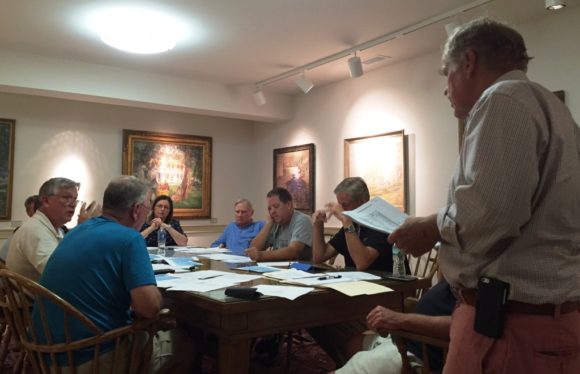
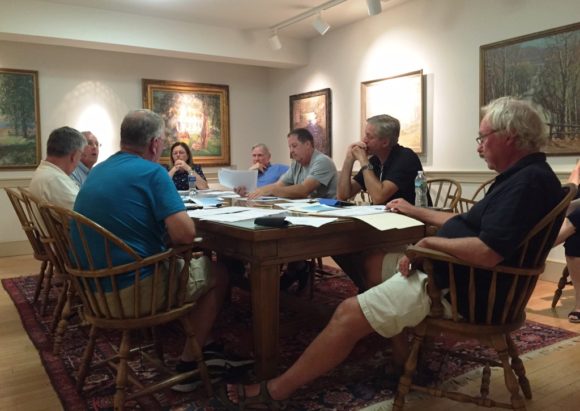
Members of the Boathouse/Hains Park Improvements Committee gathered in Old Lyme Town Hall's mezzanine conference room for last Monday's meeting.

Members of the Boathouse/Hains Park Improvements Committee gathered in Old Lyme Town Hall’s mezzanine conference room for last Monday’s Special Meeting.

Members of the Boathouse/Hains Park Improvements Committee (BHPIC) clashed repeatedly at a Special Meeting held last Monday (Sept. 12) in the Old Lyme Town Hall.  Tensions were high since work on the boathouse — which had begun in mid-August — had been subject to various delays and cost increases.

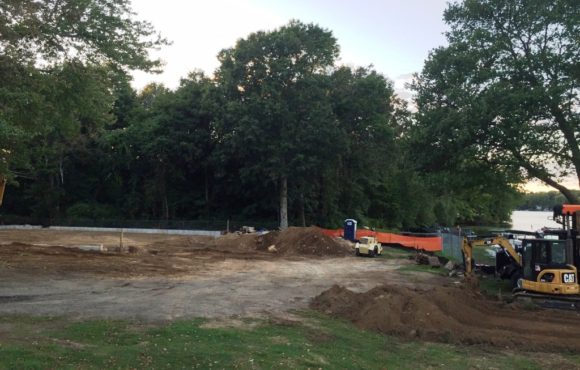
The delays had arisen after it was determined that the existing foundation on which it had been planned to construct the new boathouse, was not strong enough for the new building. This, in turn, meant significant additional costs were about to be incurred to demolish and rebuild the foundation.

The old boathouse has been demolished and construction has begun on the boathouse at Hains Park.

The old boathouse has been demolished and construction has begun on the boathouse at Hains Park.

The first item on the agenda was to review a draft project budget, which had been requested some three weeks previously by Old Lyme’s Finance Director Nicole Stajduhar and Old Lyme Town Treasurer Timothy Griswold.

Paul Gianquinto, BHPIC Co-Chairman, had distributed a draft budget dated Sept. 8, to the committee but Old Lyme Parks and Recreation Committee Chairman Robert Dunn maintained the document, “… is not a budget.”  He described it as an “expenditure budget” and contended that the committee should not move forward with any further expenditures until a “proper budget” was not only established but also agreed with Stajduhar and Griswold.

Dunn declared unequivocally, “This project has escalated to anything beyond what we thought.”  To support that contention, he noted the original project budget of $883,000, which was approved by the town at an Oct. 6, 2014, meeting (based on numbers agreed by the BHPIC on Sept. 30, 2014) showed $44,000 budgeted for the architect, but he noted that number now stands at over $63,000.

Similarly, Dunn said the estimated (proposed and committed) construction costs for Phase 1 (construction of the boathouse) had risen from the budgeted amount of over $533,000 to over $706,000, representing a 30 percent increase. The original number ($533,900) had been presented to the community in a update by the Old Lyme Selectmen on Jan. 25, 2016.

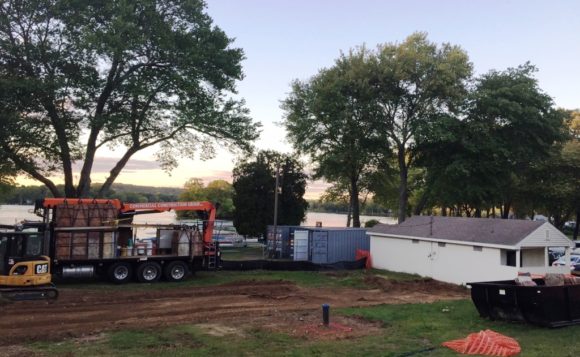
Construction equipment being used during the project stands on the site in front of Rogers Lake.

Construction equipment being used during the project stands on the site in front of Rogers Lake.

The project is funded by a State of Connecticut Small Town Economic Assistance Program (STEAP) grant in the amount of $478,000, which was approved in 2013, and an additional $405,000 that was approved at the Oct. 6, 2014, Old Lyme Special Town Meeting.  An additional $50,800 was raised from private donations and added to the funds for the project.  The total available for the project is therefore $933,500.

Dunn explained his major concern regarding the cost overruns relates the fact that as costs rise beyond the original budget for Phase 1 (boathouse construction), the amount remaining for the items that benefit the broader community (Phase 2) diminishes.  That amount related to Phase 2, which the Old Lyme Selectmen noted in their Jan. 25, 2016, update to residents was $219,988, was intended for upgrades to the bathrooms, improvements to the parking lot and a community gazebo.

With the cost overruns to date, Dunn contended that the project was now “ … going up to over one million dollars.” Throughout the meeting, there was general agreement that costs had risen on the project and that, as First Selectwoman Bonnie Reemsnyder said, “We have to look for savings wherever we can.”

Old Lyme Town Treasurer Tim Griswold (standing) makes a point during the meeting.

Old Lyme Town Treasurer Tim Griswold (standing) makes a point during the meeting.

Dunn made a motion to table all further expenses until the committee had established a budget that was approved by the Town’s Finance Director and Treasurer.  During discussion of the motion, Gianquinto stated, “A budget was never approved or established by the town.”  Griswold, who was in the audience, noted, “After the project was approved at town meeting, [it would be expected] a budget would be prepared that would build in all allocations and expenditures.”

Griswold added that since the project had changed substantially subsequent to the town meeting (the second floor has been removed due to requirements related to the building being considered an “educational facility”) and “the scope of the project became less, [one] would think the committee would prepare a new budget.”

Old Lyme Parks and Recreation Director Don Bugbee, who is a voting member of the BHPIC, commented, “This is a hot-button topic. The committee needs to be fiscally responsible to the town.” He added, “A lot of people ask me questions [about the budget] and I can’t answer them.”  Gianquinto countered firmly, “I believe this is a budget.”

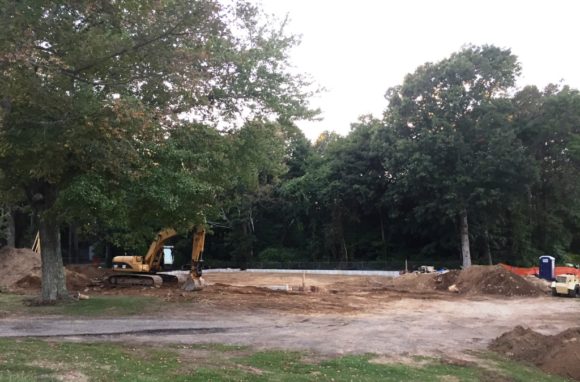
A new foundation must now be laid for the boathouse.

A new foundation must now be laid for the boathouse.

Griswold offered to work with Gianquinto to prepare a budget that included the additional information required to monitor actual expenses against proposed line item budgeted amounts so that, in Griswold’s words, “As costs increase, the budget would say you’re getting close to the maximum budget … [thus ensuring] there is no wolf at the door.”

There was considerable heated discussion about what the cost would be if the project were stopped, which was the predicted result of Dunn’s motion. Dunn said he hoped a budget could be agreed the next day, but Gianquinto was adamant, “The committee needs to make decisions tonight and to move forward.”

Bugbee asked what would happen if there were insufficient funds to “do a bathhouse.” Gianquinto responded that there were three possibilities — to collect additional funds, to reduce cost of the boathouse through value engineering or to place the bathhouse in the capital plan and treat it as a separate project.  Reemsnyder pointed out that a similar situation had arisen with the Sound View project, which had originally included restrooms and a green, but that for cost reasons those items had now been removed from the plans.

When the vote was taken on the motion, it was defeated five to one with BHPIC Co-chairmen Gianquinto and Paul Fuchs voting against it joined by Old Lyme Rowing Association Chairman Gregory Hack along with BHPIC members John Parker and Philip Carney.  Dunn voted in favor of the measure and Bugbee abstained.

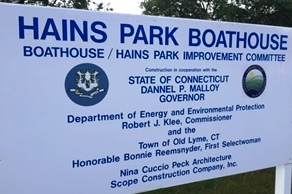
hains_pk_sign_292x194After that vote, which enabled the committee to proceed with discussion of the draft budget that Gianquinto had prepared, Griswold commented, “You know a large expense is looming,” pointing out that “This is a snapshot as at right now — there’s no mention of a $100,000 change order.” Gianquinto submitted, “We can add additional lines,” to which Griswold responded, “[To prepare a budget] you will have to tell me… things that might come up.”

The change order Griswold mentioned was to demolish and replace the foundation. When it was discussed at the previous week’s Old Lyme Selectmen’s meeting, an amount of approximately $110,000 was being considered, but Gianquinto had negotiated during the ensuing week with the contractor and achieved a cost reduction to a little over $103, 000.  He stated he was not happy to be paying the amount but did not feel there was much choice.  That change order was approved along with one to delete the cupolas from the boathouse, which saved $5,900, and two others relating to hardware, which both will result in small credits to the budget totaling just over $1,000.

At the end of the meeting, Old Lyme Selectwoman MaryJo Nosal commented it had been, “A very tough meeting.”  She thanked all the members for their patience and Griswold for being there to help explain and resolve the budget matters.  Finally, she concluded, “The community wants this done.  We are a leader in this [type of project.]  Let’s get it done.”

Talking Transportation: Don’t Blame Malloy for the Fare Hikes

metro-north-railroad-620x400Sure, it was sleazy of Governor Malloy and the CDOT to release news of a proposed five percent fare hike on Metro-North on a Friday afternoon in July, hoping nobody would notice.  But the more I dig into the proposal, the more I realize the Governor and CDOT are not to blame.

It’s the Connecticut legislature that’s really responsible for this fare hike.

Lawmakers this session left the Governor with a $192 million budget shortfall and every other branch of government has taken budget cuts and layoffs as a result.  Now it’s transportation’s turn to feel the pinch.

Pol’s on both sides of the aisle tell me Malloy could have saved millions by facing down the state employees’ unions and their rich benefits package.  Could’ve, maybe should’ve … but didn’t.

So now we’re looking at a five percent hike in train fares on Metro-North and Shore Line East and a 16 percent boost in bus fares starting in December.  Plus closing ticket windows, reduced maintenance and fuel savings.  And that’s just on the transit side.

Highway work will also be cut, hiring postponed and less salt purchased for the winter.  Service areas will be closed overnight and the volunteers who work in the Visitor Centers will be fired. Welcome to Connecticut!

So when you calculate the impact of all these cuts on your commute, by road or rail, call your State Rep and Senator and ask “why”?

Why are they allowing the Special Transportation Fund to run dry due to the dwindling revenues from the gas tax?

Ask Senate Majority leader Bob Duff (D-Norwalk) and the usually pro-transportation Senator Toni Boucher (R-Wilton) why they have opposed alternative funding mechanisms like the VMT (Vehicle Miles Tax), calling it “dead on arrival” before it was even explained, let alone studied.

Ask your elected officials what their plan is to pay for our existing transportation network, let alone expand it by the $100 billion Malloy has suggested.  They won’t have an answer.

Why?  Because they are running for re-election this November.  And none of them has the guts to tell you the truth:  we will all have to pay more to drive or commute by rail … as you’ll find out after the election when they approve new taxes.

What can we do in the meantime (aside from holding them accountable during the campaign)?  There have been some public hearings in September on the fare hikes with more to come* … and we should all turn out.

It will be political theater, but cathartic.  Commuters will rant and the folks from CDOT will listen and then do what they proposed.  Aside from cutting train service, a fare hike is about the only option.

And, of course as upstate lawmakers constantly remind us, those of us living on the “gold coast” are all millionaires, and we can afford it, right?

*9 Town Transit will hold a public hearing on its proposed price increases Thursday, Sept. 29, in Old Saybrook Town Hall at 4 p.m. and 7 p.m.

Jim Cameron - Chairman of the CT Metro-North / Shore Line East Rail Commuter Council

Jim Cameron

About the author: Jim Cameron is founder of The Commuter Action Group, and a member of the Darien RTM.  The opinions expressed in this column are only his own.  You can reach him at CommuterActionGroup@gmail.com

For a full collection of “Talking Transportation” columns, visit www.talkingtransportation.blogspot.com

Lyme DTC Invites Readers to ‘Meet the Candidates’ Tonight at Gelston House

Essex First Selectman and Democratic candidate for the 33rd District, Norman Needleman

Essex First Selectman and Democratic candidate for the 33rd District, Norman Needleman

US Senator Joe Courtney

US Senator Joe Courtney

The Democratic Town Committees of Lyme, Haddam and East Haddam are jointly sponsoring a “Meet the Candidates” event with Norm Needleman and Joe Courtney at the Gelston House in East Haddam on Monday, Sept. 19, from 6:30 to 8:30 p.m.  All are welcome.

Needleman (D) is challenging two-term incumbent Art Linares (R) for the position of 33rd District State Representative. Courtney is running for another term as US Representative for Connecticut’s Second Congressional District, a position he has held since 2007..

Light refreshments will be served.  A cash bar will be available.

A $10 donation is suggested.