
“The 39 Steps,” Zany Spoof of Hitchcock Movies, Opens at Ivoryton Playhouse

Dan Fenaughty and Larissa Klinger. Photo by Ivoryton Playhouse

Dan Fenaughty and Larissa Klinger. Photo by Ivoryton Playhouse

Mix a Hitchcock masterpiece with a juicy spy novel, add a dash of Monty Python and you have “The 39 Steps,” a fast-paced whodunit for anyone who loves the magic of theater! This two-time Tony and Drama Desk Award-winning treat is packed with nonstop laughs, over 150 zany characters (played by a ridiculously talented cast of four), an on-stage plane crash, handcuffs, missing fingers and some good old-fashioned romance!

“The 39 Steps” is set in England, just before the war. A young man bored with life meets a woman with a mysterious accent who says she’s a spy and needs to take refuge in his apartment. Murder and mayhem soon follow as our hero is chased across the wild and wooly British countryside, meeting a host of ridiculous characters and climaxing in a death-defying finale! A riotous blend of virtuoso performances and wildly inventive stagecraft, “The 39 Steps” amounts to an unforgettable evening of pure pleasure!

The first version of the play was written by Simon Corble and Nobby Dimon for a cast of four actors and funded by a £1,000 Yorkshire Arts Grant. It premiered in 1995 at the Georgian Theatre Royal in Richmond, North Yorkshire, before embarking on a tour of village halls across the north of England. In 2005, Patrick Barlow rewrote the script, keeping the scenes, staging and small-scale feel, and in June 2005 this re-adaption premiered at the West Yorkshire Playhouse. In 2006, it opened in the West End and in 2008 it premiered on Broadway to rave reviews. The New York Times proclaimed, “Theatre at its finest!… Absurdly enjoyable! This gleefully theatrical riff on Hitchcock’s film is fast and frothy, performed by a cast of four that seems like a cast of thousands.”

This production introduces Ivoryton audiences to the husband and wife team of Dan Fenaughty and Larissa Klinger, who have both performed these roles before in the national tour. The clowns are played by Ivoryton favorite, David Edwards, and Jonathan Brody, making his Ivoryton debut. All four actors are members of Actors Equity. The play is directed by Erik Bloomquist, a two-time Emmy-nominated writer/director/producer and former Top 200 Director on Project Greenlight. Erik is currently in post-production on the television adaptation of “The Cobblestone Corridor,” a seriocomic mystery series based on his internationally acclaimed short film of the same name. The set design is by Dan Nischan, lighting design by Marcus Abbott and costume design by Cully Long.

“The 39 Steps” opened at the Ivoryton Playhouse on June 1 and runs through June 19. Performance times are Wednesday and Sunday matinees at 2 p.m. Evening performances are Wednesday and Thursday at 7:30 p.m., Friday and Saturday at 8 p.m.

Tickets are $44 for adults; $39 for seniors; $22 for students and $17 for children and are available by calling the Playhouse box office at 860-767-7318 or by visiting www.ivorytonplayhouse.org

Ticket prices go up on June 1 to $50 for adults and $45 for seniors, so purchase tickets now for all the summer shows for the best prices. (Group rates are available by calling the box office for information.) The Playhouse is located at 103 Main Street in Ivoryton.

Singers Invited to First ‘Summer Sing’ of the Season: Mozart’s “Requiem” on June 13

MozartOLD SAYBROOK — The first ‘Summer Sing of the season’ will feature Barry Asch of Cappella Cantorum directing Mozart’s “Requiem” on Monday, June 13, at St. Paul Lutheran Church, 56 Great Hammock Road, Old Saybrook.
The event, which features professional soloists, is co-sponsored by two shoreline choral groups, Cappella Cantorum and Con Brio.

All singers are welcome to perform in this read-through of a great choral work. Registration is at 7 p.m.; the sing begins at 7:30. An $8 fee covers the costs of the event. Scores will be available, bring yours if you have it. The church is air-conditioned.

For more information, call (860) 388-4110 or (860) 434-9135 or visit www.cappellacantorum.org or www.conbrio.org.

They’re Everywhere! All About Gypsy Moth Caterpillars — Advice from CT Agricultural Experiment Station

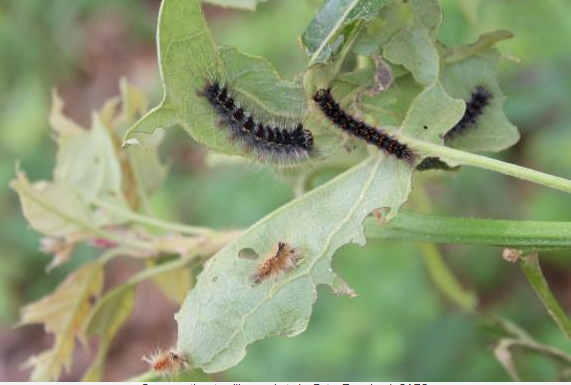
Gypsy moth caterpillar

Gypsy moth caterpillars – photo by Peter Trenchard, CAES.

The potential for gypsy moth outbreak exists every year in our community.

Dr. Kirby Stafford III, head of the Department of Entomology at the Connecticut Agricultural Experiment Station, has written a fact sheet on the gypsy moth available on the CAES website. The following information is from this fact sheet.

The gypsy moth, Lymantria dispar, was introduced into the US (Massachusetts) by Etienne Leopold Trouvelot in about 1860. The escaped larvae led to small outbreaks in the area in 1882, increasing rapidly. It was first detected in Connecticut in 1905. By 1952, it had spread to 169 towns. In 1981, 1.5 million acres were defoliated in Connecticut. During the outbreak of 1989, CAES scientists discovered that an entomopathogenic fungus, Entomophaga maimaiga, was killing the caterpillars. Since then the fungus has been the most important agent suppressing gypsy moth activity.

The fungus, however, cannot prevent all outbreaks and hotspots have been reported in some areas, in 2005-06 and again in 2015.

The life cycle of the gypsy moth is one generation a year. Caterpillars hatch from buff-colored egg masses in late April to early May. An egg mass may contain 100 to more than 1000 eggs and are laid in several layers. The caterpillars (larvae) hatch a few days later and ascend the host trees and begin to feed on new leaves. The young caterpillars, buff to black-colored, lay down silk safety lines as they crawl and, as they drop from branches on these threads, they may be picked up on the wind and spread.

There are four or five larval stages (instars) each lasting 4-10 days. Instars 1-3 remain in the trees. The fourth instar caterpillars, with distinctive double rows of blue and red spots, crawl up and down the tree trunks feeding mainly at night. They seek cool, shaded protective sites during the day, often on the ground. If the outbreak is dense, caterpillars may feed continuously and crawl at any time.

With the feeding completed late June to early July, caterpillars seek a protected place to pupate and transform into a moth in about 10-14 days. Male moths are brown and fly. Female moths are white and cannot fly despite having wings. They do not feed and live for only 6-10 days. After mating, the female will lay a single egg mass and die. The egg masses can be laid anywhere: trees, fence posts, brick/rock walls, outdoor furniture, cars, recreational vehicles, firewood. The egg masses are hard. The eggs will survive the winter and larvae hatch the following spring during late April through early May.

The impact of the gypsy moth can be extensive since the caterpillar will feed on a wide diversity of trees and shrubs. Oak trees are their preferred food. Other favored tree species include apple, birch, poplar and willow. If the infestation is heavy, they will also attack certain conifers and other less favored species. The feeding causes extensive defoliation.

Healthy trees can generally withstand one or two partial to one complete defoliation. Trees will regrow leaves before the end of the summer. Nonetheless, there can be die-back of branches. Older trees may become more vulnerable to stress after defoliation. Weakened trees can also be attacked by other organisms or lack energy reserves for winter dormancy and growth during the following spring. Three years of heavy defoliation may result in high oak mortality.

The gypsy moth caterpillars drop leaf fragments and frass (droppings) while feeding creating a mess for decks, patios, outdoor furniture, cars and driveways. Crawling caterpillars can be a nuisance and their hairs irritating. The egg masses can be transported by vehicles to areas where the moth is not yet established. Under state quarantine laws, the CAES inspects certain plant shipments destined to areas free of the gypsy moth, particularly for egg masses.

There are several ways to manage the gypsy moth: biological, physical and chemical.

Biologically, the major gypsy moth control agent has been the fungus E. maimaiga. This fungus can provide complete control of the gypsy moth but is dependent on early season moisture from rains in May and June to achieve effective infection rates and propagation of the fungus to other caterpillars. The dry spring of 2015 resulted in little or no apparent fungal inoculation or spread until it killed late-stage caterpillars in some areas of the state, after most defoliation.

Infected caterpillars hang vertically from the tree trunk, head down. Some die in an upside down “V” position, a characteristic of caterpillars killed by the less common gypsy moth nucleopolyhedrosis virus (NPV). This was not detected in caterpillars examined in 2015.

Physical controls include removing and destroying egg masses, which can be drowned in a soapy water and disposed of. Another method is to use burlap refuge/barrier bands wrapped around tree trunks so that migrating caterpillars will crawl into or under the folded burlap or be trapped by the sticky band.

There are a number of crop protection chemicals labeled for the control of gypsy moth on ornamental trees and shrubs. There are treatments for egg masses, larvae and adult moths. Detailed information about these chemical treatments is available in the CAES factsheet.

For complete information about the gypsy moth and its management, visit the CAES website and look for the fact sheet on gypsy moth.

Old Lyme Middle School Student Wins National Award in C-SPAN Video Contest

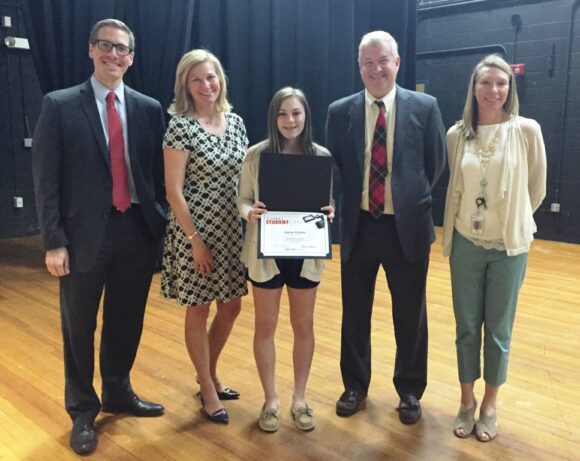
Standing with LOLMS eighth grader Daisy Colvin (center) after she was presented her award are C-SPAN RCommunity Relations Representatives Josgh (left( and Doug Bedig (second from right), LOLMS Principal Michelle Dean (right) and Comcast VP of Public Relations & Community Investment Kristen Roberts (Second from left).

Standing with LOLMS eighth grader Daisy Colvin (center) after she was presented her award are C-SPAN Community Relations Representatives Josh Koning (left) and Doug Hemmig (second from right), LOLMS Principal Michelle Dean (right) and Comcast VP, Public Relations & Community Investment, Kristen Roberts (second from left).

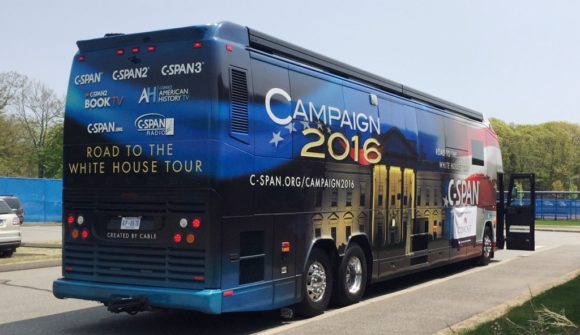
C‑SPAN’s award-winning, 45-foot customized bus rolled into Lyme-Old Lyme Middle School’s (LOLMS) parking lot on Friday, May 20, with two C-SPAN Community Relations Representatives on board. They had arrived to participate in a ceremony honoring eighth grader Daisy Colvin for her award-winning entry in C‑SPAN’s annual student video documentary competition, StudentCam.

The C-SPAN bus at Lyme-Old Lyme Middle School.

The C-SPAN bus at Lyme-Old Lyme Middle School.

The contest, now in its 11th year, requires entrants “to think critically about issues that affect our communities and nation.”  This year, students were asked to create a five to seven minute video documentary on the topic “Road to the White House: What’s the issue YOU most want candidates to discuss during the 2016 presidential campaign?” Colvin’s winning entry was a video titled ‘Gun Control Debate,’ which looked objectively at both sides of the issue.

The whole LOLMS eighth grade gathered in the school’s auditorium and watched attentively while the video was played. Colvin’s video featured Old Lyme First Selectwoman Bonnie Reemsnyder, who advocated for increased gun control, and East Lyme gun shop owner Ron Rando, who presented the opposing argument.

Interspersed with video clips from C-Span.org (which was a requirement for any video submitted to the contest) showing images of mass-shooting locations and lawmakers speaking on both sides of the argument, Colvin created a powerful, objective video.  At the end of the video, she presented her own opinion on the topic, which was that gun laws needed to be enforced and some revisions made to gun laws so that “Together we can make a change.”

C-SPAN Representative Doug Hemmig told the audience that Colvin had done “a wonderful job … and her passion for the subject came through clearly in the video.”

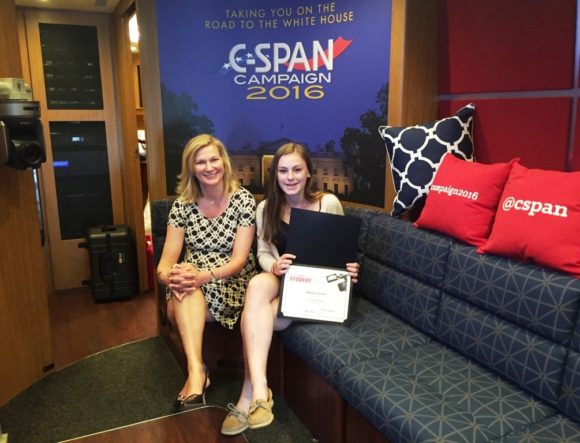
Daisy Colvin displays her certificate of Merit while sitting with Comcast VP Kristen Roberts inside the C-SPAN bus.

Daisy Colvin displays her Certificate of Merit while sitting with Comcast VP Kristen Roberts inside the C-SPAN bus.

C‑SPAN had received 2,887 video submissions from almost 6,000 students in 45 states and Washington.  This represented a record number of entries and Colvin received one of only 150 Honorable Mention awards, something that Hemmig described as “an incredible accomplishment.” Kristen Roberts, Vice President, Public Relations & Community Investment, presented Colvin with a StudentCam certificate of merit and check for $250, and commented that she was “so proud of Daisy.”  Roberts noted that in Old Lyme, C-SPAN, which is available locally through Comcast, is “a great partner” for Comcast.

In a press release, Mike Parker, Regional Senior Vice President of Comcast’s Western New England Region, which is headquartered in Connecticut, said, “Comcast is proud to congratulate Daisy on her StudentCam documentary. It’s a rare opportunity to honor students for thinking critically about issues important in our community and across the nation and we are pleased to recognize her locally for her creative achievement.”

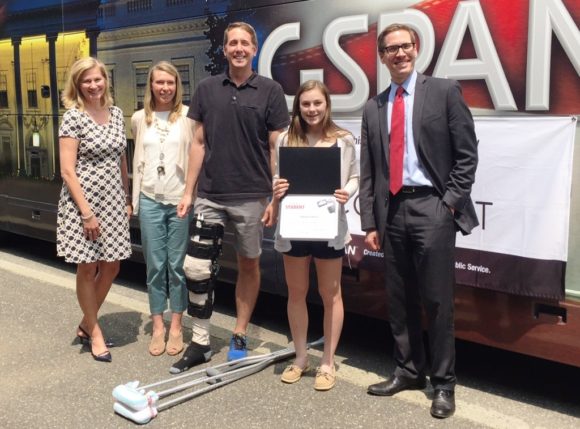
Standing outside the C-SPAN bus are (from left to right) Kristen Roberts, Michelle Dean, Daisy Colvin, Bill Eydman (recuperating after knee surgery) and Josh Koning.

Standing outside the C-SPAN bus are (from left to right) Comcast’s Kristen Roberts, LOLMS Principal Michelle Dean, award winner Daisy Colvin, LOLMS Talented & Gifted teacher Bill Eydman (recuperating after knee surgery) and C-SPAN’s Josh Koning.

Josh Koning, the second C-SPAN Representative, particularly commended the teachers who had assisted Colvin to make her video, saying, “We want to thank the teachers,” adding, “This wouldn’t happen without the teachers.”  Colvin explained that her project had been conceived in her Social Studies class and then she had made the video working with the LOLMS Talented and Gifted teacher, William Eydman. Responding to a question from the C-SPAN team as to what she had learned from making the film, she said, “I realized how many gun crimes there are … and learned the other side of the debate.”

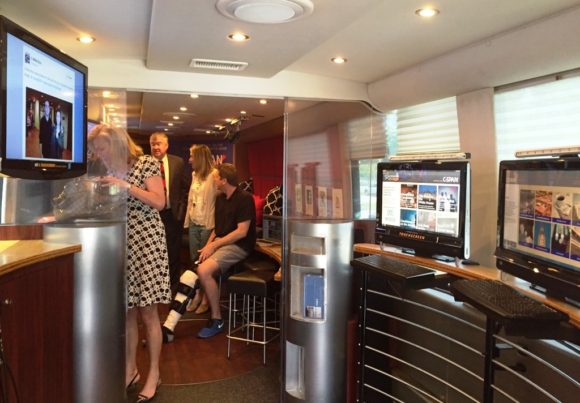
The C‑SPAN Bus, now in its 23rd year on the road, partners with local cable providers to visit schools and community events across the country to promote C‑SPAN’s educational and political resources and programming for students, teachers, and the public. Aboard the Bus, teachers and students experience on-board multimedia technology that showcases C‑SPAN’s programming and resources dedicated to showing the American political process.

As part of her award, Daisy Colvin was given the opportunity to tour the C-SPAN bus.

As part of her award, Daisy Colvin was given the opportunity to tour the technology-filled C-SPAN bus.

Through interactive exhibits, visitors learn about the public affairs network’s in-depth coverage of the U.S. Congress, White House, federal courts, and its signature political program, “Road to the White House,” which provides access to all of the Campaign 2016 presidential candidates and their events from the campaign trail, all without editing, commentary, or analysis.

Visit http://www.viddler.com/v/3613162?secret=95288074 to view Colvin’s ‘Gun Control Debate’ video.

Visit www.studentcam.org to watch all the winning videos for 2016.

Editor’s Note: C‑SPAN.org is a searchable, video-rich site that has every C‑SPAN program aired since 1987. The public can access this extensive online collection — over 218,000 hours of political and governmental footage — for free, and share user-generated video clips by email and social media.

Tune in to C‑SPAN’s public affairs programming on the C‑SPAN Networks, C‑SPAN Radio, and c‑span.org. In Old Lyme, C-SPAN can be seen on Comcast channel 15, C-SPAN2 on channel 86 and C-SPAN3 on channel 190. All funding for C‑SPAN operations, including Bus visits, is provided by local TV providers.

Created by the cable TV industry and now in nearly 100 million TV households, C‑SPAN programs three public affairs television networks in both SD and HD; C- SPAN Radio, heard in Washington, DC, at 90.1 FM and available as an App (Android, iPhone, Blackberry); and a video- rich website offering live coverage of government events and access to the vast archive of C‑SPAN programming.

Visit http://www.c-span.org for coverage and schedules; follow C-SPAN on Facebook/cspan and @cspan on Twitter.