Enjoy a Tour of Private Gardens in Essex, June 4

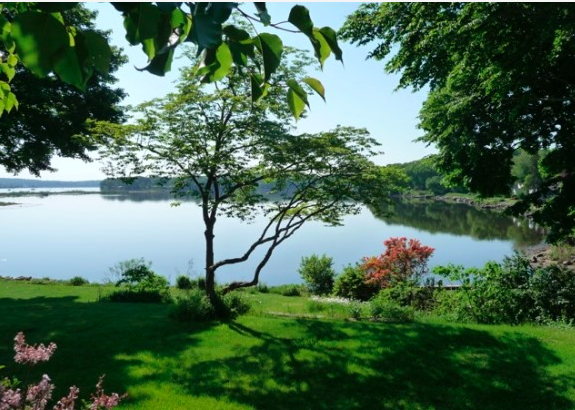
See this beautiful private garden in Essex on June 4.

See this beautiful private garden in Essex on June 4.

ESSEX – On Saturday, June 4, from 10 a.m. to 3 p.m., plan to stroll through eight of the loveliest and most unusual private gardens in Essex. Some are in the heart of Essex Village while others are hidden along lanes most visitors never see. While exploring, you will find both formal and informal settings, lovely sweeping lawns and panoramic views of the Connecticut River or its coves. One garden you will visit is considered to be a ‘laboratory’ for cultivation of native plants. Master Gardeners will be available to point out specific features, offer gardening tips, and answer questions.

The garden tour is sponsored by the Friends of the Essex Library. Tickets are $25 in advance and $30 at the Essex Library the day of the event. Cash, checks, Visa or Master Card will be accepted. Tickets can be reserved by visiting the library or by completing the form included in flyers available at the library and throughout Essex beginning May 2. Completed forms can be mailed to the library. Confirmations will be sent to the email addresses on the completed forms.

Your ticket will be a booklet containing a brief description of each garden along with a map of the tour and designated parking. Tickets must be picked up at the library beginning at 9:45 a.m. the day of the event.

Richard Conroy, library director, has said, “The Essex Library receives only about half of its operating revenue from the Town. The financial assistance we receive each year from the Friends is critical. It enables us to provide important resources such as Ancestry.com and museum passes, as well as practical improvements like the automatic front doors that were recently installed. I urge you to help your Library by helping our Friends make this event a success! Thank you for your support.”

The tour will take place rain or shine. For more information, call 860-767-1560. All proceeds will benefit Friends of the Essex Library.

Presentation of Sound View Improvements Draws Praise, Criticism at Lively Meeting

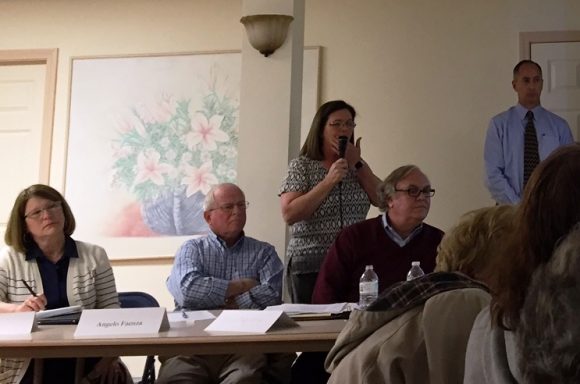
From left to right, Selctwoman Mary Jo Nosal, Sound View Improvement Committee member Angelo Faenza, First Selectwoman Bonnie Reemsnyder (standing), SVIC member Pappalardo and a memebr of engineering member BSC listen to a question from the audience at Monday night's meeting.

From left to right, Old Lyme Selectwoman Mary Jo Nosal, Sound View Improvement Committee (SVIC) member Angelo Faenza, Old Lyme First Selectwoman Bonnie Reemsnyder (standing), SVIC member Frank Pappalardo and a member of engineering firm BSC listen to a question from the audience at Monday night’s meeting.

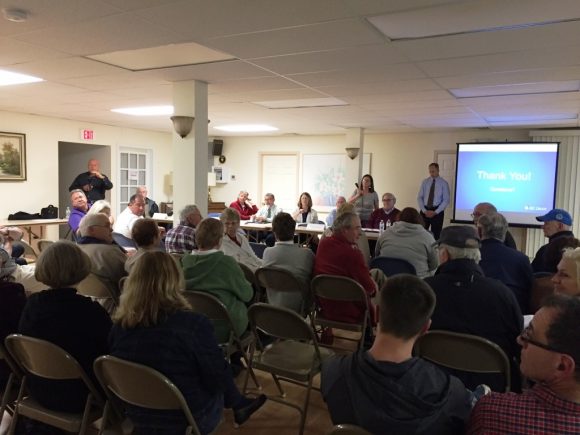
In a boisterous meeting Monday night held at the Shoreline Community Center on Hartford Ave. Old Lyme, more than 60 people gathered to hear the latest information on the Sound View Improvement Project.  With her fellow members of the Old Lyme Board of Selectmen, members of the Sound View Improvement Committee (SVIC) and representatives of the engineering firm of BSC of Glastonbury seated behind her, First Selectwoman Bonnie Reemsnyder made a presentation covering where the project stands currently.

Noting that construction is expected to begin after Labor Day this year and continue through early December 2016, then “shut down [and re-start in early 2017] and finish in early spring [2017],” Reemsnyder noted that the final design is “close to going out to bid.”  She anticipates a town meeting this summer on July 16 to approve the Town of Old Lyme’s 20 percent share of the cost of the improvements estimated at $148,000.  The remaining 80 percent of the cost is being funded by the Connecticut Department of Transportation (ConnDOT).

The improvements, which originally included a park (named Sound View Green) and upgraded restrooms that have both now been removed from the plan due to budget overruns, comprise the reinstatement of horizontal parking on Hartford Avenue, sidewalks expanded from 3 ft. to 6 ft., lighting, plantings, bike racks and the addition of curbs and bump-outs.  The proposed plans do not include the much discussed bike path on Rte. 156 that is planned to connect the Baldwin Bridge with Sound View because Rte. 156 is a state road and therefore, the state must carry out those upgrades.  Reemsnyder noted, “It is likely the town will finish their portion before the state.”

Question time was lively at Monday's Sound View informational meeting.

There was almost a full house at Monday’s Sound View informational meeting.

Reactions to the project ran the gamut from those who were delighted with the proposals to those who expressed anger and frustration about them. Mary Hyland – a seasonal resident of Portland Ave., which runs parallel to Hartford Avenue, whose family has been in Sound View for 70 years – said, “You’re doing a great job,” adding that she was, “Very, very pleased with what’s going on.” In contrast, Deb Corto, whose son, Lenny, operates, “Lenny’s on the Beach” at the southern end of Hartford Ave., complained she would likely lose $72,000 in business “over the season” due to the reduction in the number of parking spaces  resulting from the proposed plans.  She demanded forcefully, “I want the [eliminated] 22 spaces reinstated.”

Frank Pappalardo, a member of the SVIC, countered Corto’s comments pointing out that the owner of the ‘Lenny’s on the Beach’ property, Frank Noe, had written to the committee in support of the proposals.  Pappalardo quoted from Noe’s letter, saying, “The street is in dire need of new sidewalks, better lighting, … these streetscape improvements are well overdue after many years of neglect.”  Noe concluded in his letter that Pappalardo read, “I urge everyone to strongly support the efforts by the Sound View Improvement Committee.”

In contrast, a town resident opposed to the reduction of parking spots complained that on busy summer days at the beach, even with the current number of parking spots, “I can’t park at my own beach.”  He questioned why the committee had not presented any numbers regarding bike usage at Sound View and stated, “[At} Every meeting, if you don’t like what we say, you shut us down.”

Lenny Corto, who operates “Lenny’s on the beach,” asked Reemsnyder, “How can you maintain a new streetscape when you can’t maintain the current one?” continuing, “It’s clear what you’re doing … it’s totally against all commercial business.”

Reemsnyder responded, “I have to disagree with [Corto’s comment about] Public Works’s ability to maintain things,” adding, “This really was an effort to improve the area.”

Dino Dinino questioned why the sidewalk was being increased from 3 ft. to 6 ft. to which Reemsnyder responded that it was a requirement in order to receive the state funding.

Jim Lampos, another member of the SVIC, expressed his support for the proposals saying, “There is incredible potential here.  The Town hasn’t invested here for years. This [the proposal] is going to benefit everybody.” He commented, “Right now, parking is an issue 10 days a year,” adding, “The parking is half empty the rest of the time.”

When Reemsnyder called for a motion to close the meeting, some members of the audience objected with one shouting, “We’re not done,” but the motion was successfully seconded and approved.

After the meeting, Lenny Corto told LymeLine that he agreed, “The street needs work,” but commented, “They’ve cut out the bathrooms, the park, the lighting and they’re still over budget.  All we’re getting is sidewalks, bike paths and trees.”  Meanwhile, Hyland expressed a different opinion to LymeLine about the proposed plans, saying simply, ”It’s about time.”

Letter From Paris: Madrid and the Incredible Wealth of its Museums

Nicole Prévost Logan

Nicole Prévost Logan

The silent crowd stands with emotion as it would in a cathedral, keeping respectfully a few feet away from “Guernica” – the huge (11 by 27 ft. ) scene painted by Pablo Picasso in 1937 after the bombings by the Nationalist forces led by General Franco of the Basque village of Guernica.

A weekend spent stomping the art collections of Madrid is mind-boggling.  Spend six hours a day and you will only have a glimpse at the Thyssen museum, the Prado, the house studio of Sorolla and the Reina Sofia modern art museum.

Baron Hans Heinrich Thyssen-Bornemisza and his son Heinrich had an unusual flair when they selected outstanding works of art in the 1920s and 1930s to create one of the world’s richest private collections at the Thyssen.

Some of the early masterpieces there include, “The portrait of Giovanna degli Albizzi Tornabuoni” (1480), which is a beautiful example of the work of Florence Quattrocento, showing the idealized profile of a woman. “A young man in a landscape” was painted by Vittore Carpaccio, probably from the Venetian school.  Nature is codified with each animal having a symbolic meaning related to good and evil.

In his “Jesus among the doctors” (1506), Albrecht Dürer – the most important representative of the German Renaissance – depicts the 12-year-old Jesus surrounded by a group of old men.  Some of them have been touched by grace while others have sin written all over their ugly faces, hands like claws threatening the child.   In The “Portrait of a lady” (1530?) painted by Hans Baldung Grien – the remarkable disciple of Dürer – the influence of Cranach the Elder is noticeable in the rendering of the decorative elements of the dress, necklaces and large hat with feathers of a supremely elegant model.

Flanders – or modern Belgium and Netherlands – was part of Spain in medieval times and the Prado has many Flemish paintings, which reflect the highly sophisticated culture of trading towns like Ghent or Bruges.  Jan van Eyck, Rogier van der Weyden, Gerard David or Hans Memling are the best representatives the 15th century “Northern Renaissance.”

Contacts were frequent between artists who traveled from the “Low Countries” of Northern Europe to Italy.  Unlike the Italians who painted with tempura and an egg base applied over a thin layer of wet plaster called “gesso,” Flemish painters used oil directly on panels of wood without knots, such as mahogany or oak.
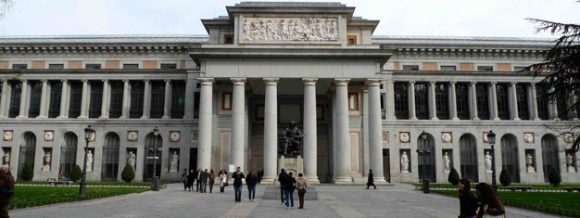
The Prado Museum in Madrid, Spain.

The Prado Museum in Madrid, Spain.

The “Garden of Delights” by Hieronymous Bosch is one of the highlights of the Prado — it is a display of amusing, bawdy or frightening details intended to give a didactic message to the population of his time.  The Flemish landscape painter Joachim Patinir (1480-525) offered panoramic views, with details at some times naturalistic, and at others, fantastic.  Instead of using linear perspective, which Florentine artists had mastered at that time, his way of showing distance was by drowning the landscape in bluish colors.

One room of the Prado is turned into a gallery of family portraits of the Spanish dynasty of the Habsburgs.  An equestrian painting by Titian of Charles V (1500-1558) at the battle of Mulhberg shows the most powerful sovereign in the world.  His kingdom went from the North Sea to the Mediterranean.  Velasquez painted many of his descendants: Philip II, Philip III, Philip IV and his son, the young prince Balthazar Carlos, riding a frisky horse.  His death, at age 17 from smallpox was a tragedy.  And there is poor Charles II, the end of the Habsburg dynasty, who was a total mental and physical disaster because of repeated consanguine marriages.

“Las Meninas”  (ladies in waiting), also by Velasquez, is one the most famous paintings ever.  It is a complex composition, which has puzzled art historians through the centuries.  At the center stands the five-year-old infanta Margareta Teresa, Philip IV’s daughter. Velasquez is looking at us and working on a huge painting, which he never painted.  The infanta’s parents are not far away and we see their reflection in a mirror.  There are two sources of light, which is quite unusual.  In 1957, inspired by the masters of the past, Picasso tackled the deconstruction of “Las Meninas,” particularly of the dog.

Velasquez (1599-1660) was the leading painter of the Spanish “Golden Age,”  during the Baroque age which lasted until 1690.  As a court painter, he had an immense influence living and working in the el-Escorial palace and was not only honored as an artist but also as the curator of the Kings’ art collections.

The love for animals is strong in Spanish painting.  Just two examples:  “Agnus Dei”, by Zurbaran (1640) showing a lamb with its  four legs garroted is probably the most heartbreaking sight in the Prado, with the animal accepting his fate.  The other one is a dog by Goya.  In an undefined brownish background of sand and sky, a dog is looking in panic at his master as he is being pulled down by quicksand.

It was not until 1840 that Spanish art began to be known in France.  The Pyrenees constituted an insurmountable barrier separating Spain from the rest of Europe.  In 1835, French King Louis Philippe sent Baron Isidore Taylor to Spain to acquire some Spanish paintings intended for the future Galerie Espagnole or Spanish Gallery at the Louvre.  After his visit to Spain in 1865, Manet said, “the scales fell off my eyes.”  The Spanish influence on Manet and Courbet is clear, especially their use of black.

Beside the works of the well-known artists like Miro, Dali or Juan Gris, the presence of Ignacio Zuloaga (1870-1945), Joaquin Sorolla (1863-1923), Santiago Rossignol (1861-1931), and Ramon Casas (1866-1933) at the Reina Sofia museum attests to the importance of Spanish contemporary art.
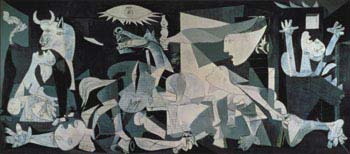
'Guernica' by Pablo Picasso is one of the most famous paintings in the world.

‘Guernica’ by Pablo Picasso is one of the most famous paintings in the world. It hangs today in the Reine Sofia Museum in Madrid.

In the attic of the old convent of Grands Augustins, near the Seine, Picasso completed  “Guernica” – probably the most important artistic statement of the 20th century against war.  The Spanish civil war from 1936 to 1939 left 500,000 dead.  Dora Maar, his companion, photographed each stage of the work , leaving a unique document on the creative process of the artist.

The composition is a frieze, powerful, fluid, easy to read and devoid of any narrative. The horse and the bull – the main actors of the bullfight about which he was so passionate – are treated like human characters.  The horse underwent many changes from deep suffering to the defiance he shows in raising his head.  The bull is aloof and protective of the population.  The dead warrior lying on the ground has the profile of Marie Therese Walter, his previous companion.  To balance the duo of bull and horse, Picasso created a screaming mother, head thrown back, with a tongue like a dagger, her dead child hanging limp from her arm.

Painted in May and June of 1937, “Guernica”  traveled the world, stayed several years at MOMA at the request of Picasso, then returned to Spain in 1981 and hangs today in the Reina Sofia museum of Madrid, never to be moved again.

Editor’s Note: This is the opinion of Nicole Prévost Logan.
Nicole LoganAbout the author: Nicole Prévost Logan divides her time between Essex and Paris, spending summers in the former and winters in the latter. She writes a regular column for us from her Paris home where her topics will include politics, economy, social unrest — mostly in France — but also in other European countries. She also covers a variety of art exhibits and the performing arts in Europe. Logan is the author of ‘Forever on the Road: A Franco-American Family’s Thirty Years in the Foreign Service,’ an autobiography of her life as the wife of an overseas diplomat, who lived in 10 foreign countries on three continents. Her experiences during her foreign service life included being in Lebanon when civil war erupted, excavating a medieval city in Moscow and spending a week under house arrest in Guinea.
Clinton, Trump Win in Both Lyme, Old Lyme

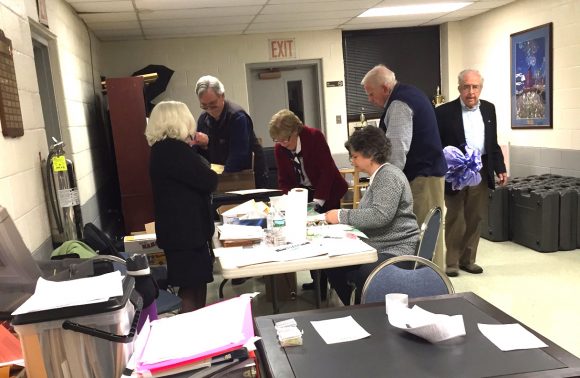
Poll workers tally totals at the Cross Lane FireHouse after voting closed in Tuesday's presidential primary election.

Poll workers tally totals at the Cross Lane FireHouse after voting closed in Tuesday’s presidential primary election.

Reflecting statewide results, Donald Trump and Hilary Clinton were the winners in both the Lyme and Old Lyme primaries. Republican Trump’s margin of victory over runner-up John Kasich in Lyme was only seven votes but in Old Lyme, Trump garnered 470 votes to Kasich’s 326. Third-placed Ted Cruz secured 89 votes in Old Lyme and 36 votes in Lyme.

Interestingly, on the Democratic side, using the totals for just Clinton and Bernie Sanders, in a close race again reflecting the state’s position, Clinton secured exactly the same percentage of the vote (52.3 percent) in both towns., defeating Sanders by 18 votes in Old Lyme and seven in Lyme.

The unofficial results in detail were as follows:

Lyme Democrats:

Rocky De La Fuente: 0
Hilary Clinton: 206
Bernie Sanders: 188
Uncommitted: 1

Old Lyme Democrats:

Rocky De La Fuente: 0
Hilary Clinton: 476
Bernie Sanders: 434
Uncommitted: 14

Lyme Republicans:

Ted Cruz: 36
Ben Carson: 4
Donald Trump: 137
John Kasich: 124
Uncommitted: 7

Old Lyme Republicans:

Ted Cruz: 89
Ben Carson: 5
Donald Trump: 470
John Kasich: 326
Uncommitted: 13


It’s Presidential Primary Day in Connecticut — Don’t Forget to Vote!

All registered Democrats and Republicans can vote in today’s Presidential Primary election. Unaffiliated registered voters must wait until the November election to cast their ballots.

Voting locations in Lyme and Old Lyme are open from 6 a.m. to 8 p.m. as follows:

Lyme residents:

Hamburg Fire House

Old Lyme residents:

Cross Lane Fire House

We will report the results of the election in both towns here on LymeLine.com shortly after they have been announced at the respective polling stations.